

B2B Email Drip Campaigns: The Practitioner's Playbook
Your SDR loaded 2,000 contacts into a sequence last Tuesday. Four hundred bounced. Gmail throttled the domain by Thursday. Now the entire outbound motion is frozen while RevOps scrambles to repair sender reputation.
That scenario plays out constantly - and it's almost never a copy problem. It's a data problem. One in six legitimate emails never reaches the inbox, which means your B2B email drip campaign is dead on arrival if the list underneath it is dirty.
If your bounce rate is above 5%, stop all outbound right now. No amount of subject-line optimization will save a poisoned domain.
The Short Version
Two common types of B2B drip campaigns exist - marketing nurture and cold outreach. They need completely different tooling. Fix your list before your copy. Bounce rates above 3-4% trigger inbox-provider throttling. And stop tracking open rates. Apple MPP makes them unreliable in 2026. Clicks and replies are what matter.
What Is a B2B Drip Campaign?
A B2B email drip campaign is a trigger-based automated sequence where contacts receive pre-written emails on a set cadence after a specific action - a form fill, a demo request, a cold list upload. Drips can also run on scheduled intervals ("send the next email 3 days later") rather than real-time triggers.
Marketing nurture drips warm inbound leads who already know you. Cold outreach drips introduce you to strangers. Mixing the two - sending HTML newsletters to cold prospects, or plain-text "just checking in" emails to webinar registrants - tanks performance fast.
Campaign Types With Templates
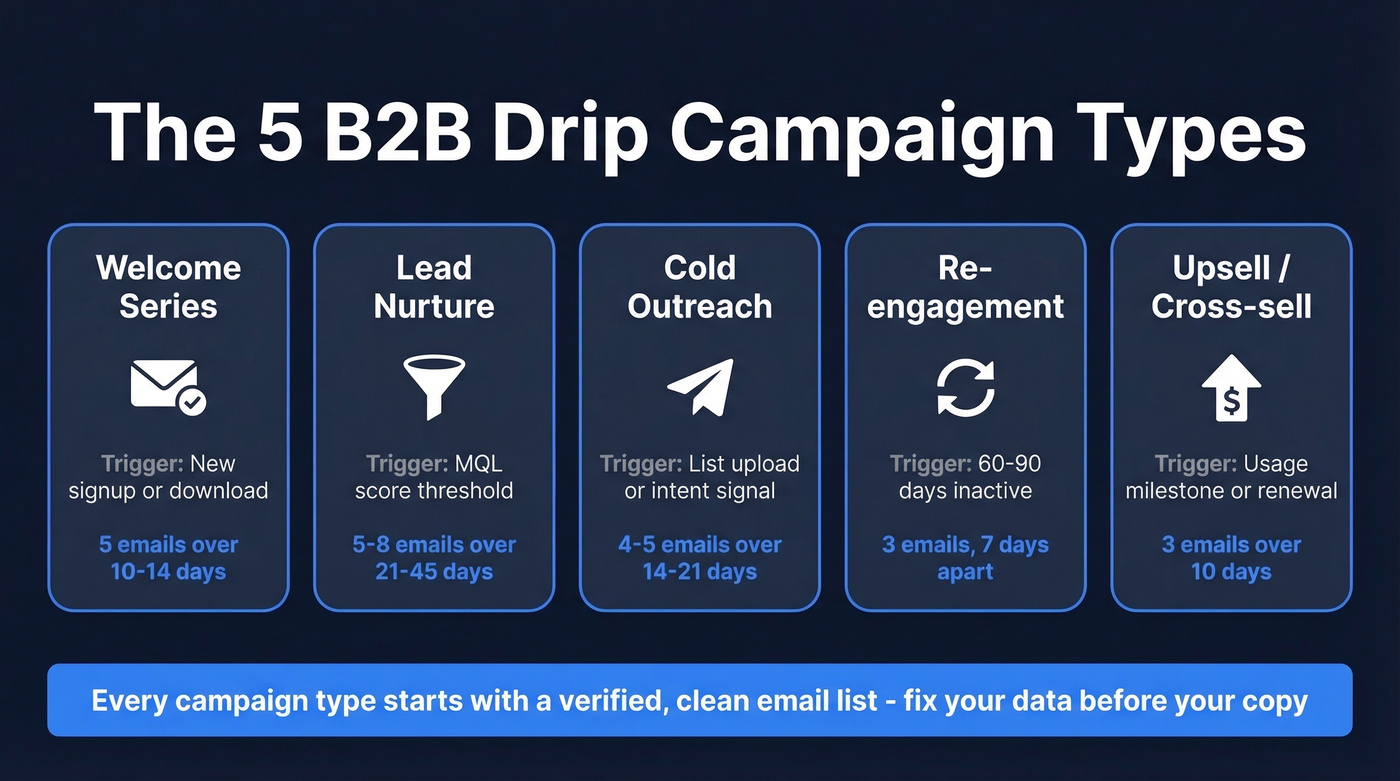
Welcome Series
Trigger: New signup, form fill, or content download. Cadence: 5 emails over 10-14 days.
| Purpose | Subject Line | |
|---|---|---|
| 1 | Set expectations, deliver one quick win | "Here's what's next" |
| 2 | Survey - "What are you trying to solve?" | "Quick question" |
| 3 | Best resource tied to their answer | "This might help" |
| 4 | Social proof - customer story or metric | "How [Company] did it" |
| 5 | Soft CTA - book a call or start a trial | "Ready when you are" |
Lead Nurture
Trigger: MQL status or scoring threshold. Cadence: 5-8 emails over 21-45 days.
The progression matters: case study, then educational resource, then comparison content, then demo CTA. Each email moves the prospect one step closer to a buying conversation without feeling like a pitch. Start with pain-point content, not product features. For B2B SaaS with deal cycles over 90 days, lead nurture drips generate more pipeline than cold outreach - invest here first. If you're looking for drip campaign examples to model, this nurture arc is the most reliable starting point.
Cold Outreach
Trigger: List upload or intent signal. Cadence: 4-5 emails over 14-21 days.
Cognism's 4-email structure works well: personalized trigger with value prop, then social proof with a specific result, then a low-commitment resource or trial offer, then a breakup email. Keep these plain text. Avoid HTML-heavy templates and keep links to a minimum. This is the drip sequence for B2B teams that need to open conversations with strangers who've never heard of them.
Re-engagement
Trigger: 60-90 days of inactivity. Cadence: 3 emails, 7 days apart.
Email 1 is "Still interested?" with a single relevant resource. Email 2 reminds them what they're missing. Email 3 offers a final incentive or a clean unsubscribe. If three emails don't re-engage them, stop. Continuing just hurts sender reputation.
Upsell / Cross-sell
Skip this if your product doesn't have clear expansion triggers. These drips only work when tied to something the customer actually did - hit a usage limit, completed onboarding, or entered a renewal window. Three emails over 10 days, triggered by the milestone. Generic "check out our new feature" emails get ignored.
Fix Your List First
Here's the thing: we've watched teams spend weeks A/B testing copy while 15-35% of their emails bounce and Gmail quietly throttles their domain. Stack Optimize, a Prospeo customer, built from zero to $1M ARR running client campaigns with 94%+ deliverability, under 3% bounce rates, and zero domain flags across all clients. The foundation was clean data, not clever copy. Every successful drip sequence starts with verification, not wordsmithing.
Verify every address before it enters a sequence. Prospeo's 5-step verification process - including catch-all handling, spam-trap removal, and honeypot filtering - catches invalid addresses that other tools miss. Upload a CSV, run bulk verification at 98% accuracy, and export only valid contacts. That upstream fix is what separates teams with healthy domains from teams begging Google for reinstatement.

Stack Optimize built a $1M agency with under 3% bounce rates and zero domain flags - because every contact was verified before entering a drip sequence. Prospeo's 5-step verification catches spam traps, honeypots, and catch-all domains that silently kill your sender reputation. At $0.01 per email, cleaning a 2,000-contact list costs less than a single bounced domain recovery.
Verify your entire drip list in minutes - 75 free emails, no card required.
Deliverability Checklist
SPF + DKIM + DMARC - all three, non-negotiable. Keep SPF under 10 DNS lookups. Use 2048-bit DKIM keys. Start DMARC at p=none, move to quarantine, then reject after auditing. Google's Postmaster Tools will show you exactly where you stand.
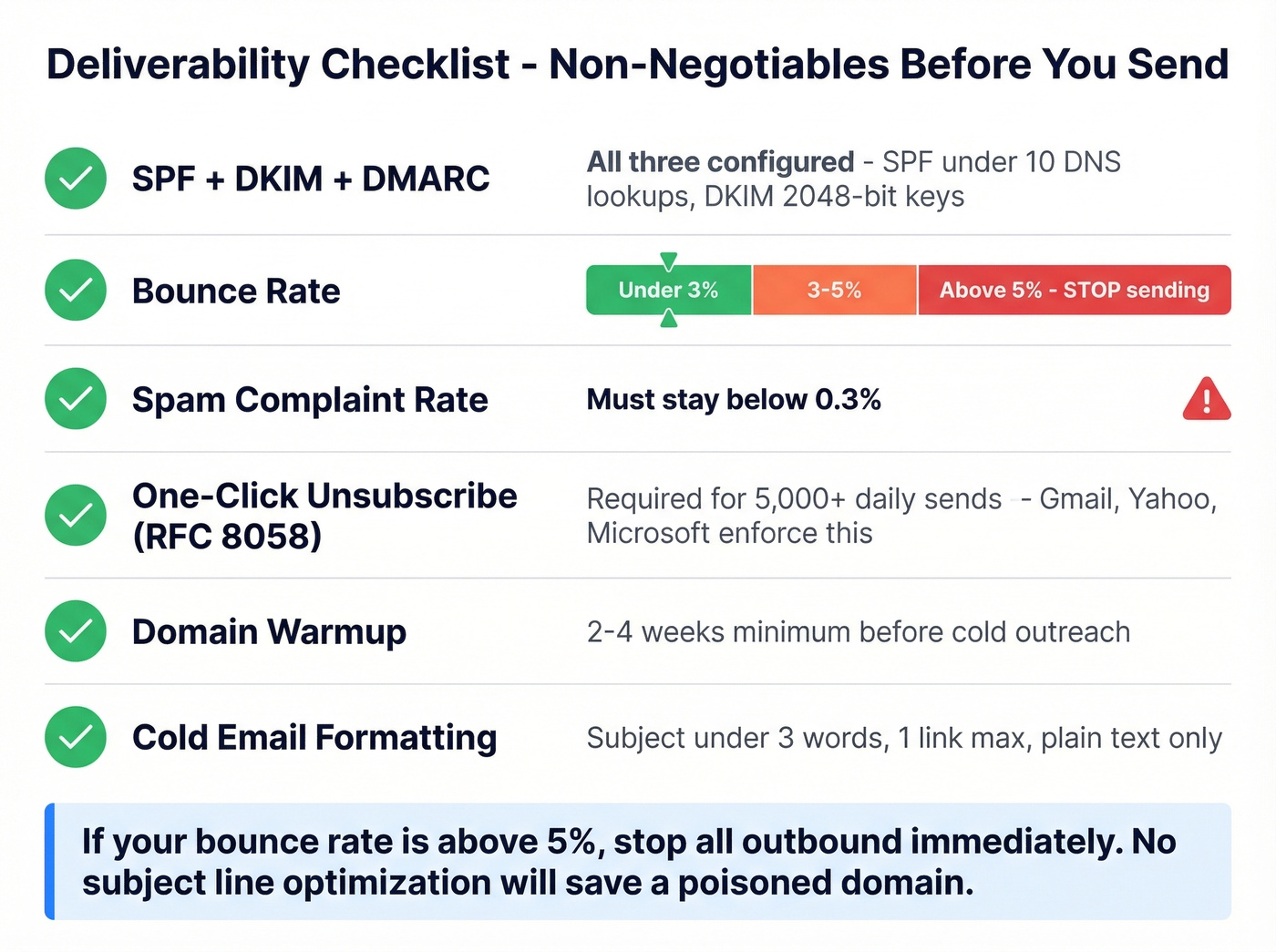
One-click unsubscribe as defined by RFC 8058 - Gmail and Yahoo enforce this for bulk senders sending 5,000+ messages/day. Microsoft followed suit in 2025.
Spam complaint rate below 0.3%. That's the hard ceiling. Exceed it and you're in trouble.
Warm up new domains 2-4 weeks minimum before cold outreach. Teams that skip warmup usually lose weeks of outbound momentum recovering sender reputation - the exact time they thought they were saving. (If you need a deeper playbook, start with sender reputation and email velocity.)
For cold outreach specifically: subject lines under 3 words, one link per email, plain text formatting. These rules come from Allegrow's analysis of 30M+ emails and they work.
Intent signals make cold drip campaigns convert. Prospeo tracks 15,000 buyer intent topics so you can trigger sequences when prospects are actively researching your category - not when they're ignoring everyone. Pair intent data with 98% verified emails and your drip campaign reaches real buyers at the exact right moment.
Stop dripping into the void. Reach prospects who are already in-market.
Benchmarks That Actually Matter
Let's be honest about what "good" looks like. MailerLite's 2025 dataset covers 3.6M campaigns from 181,000 accounts.
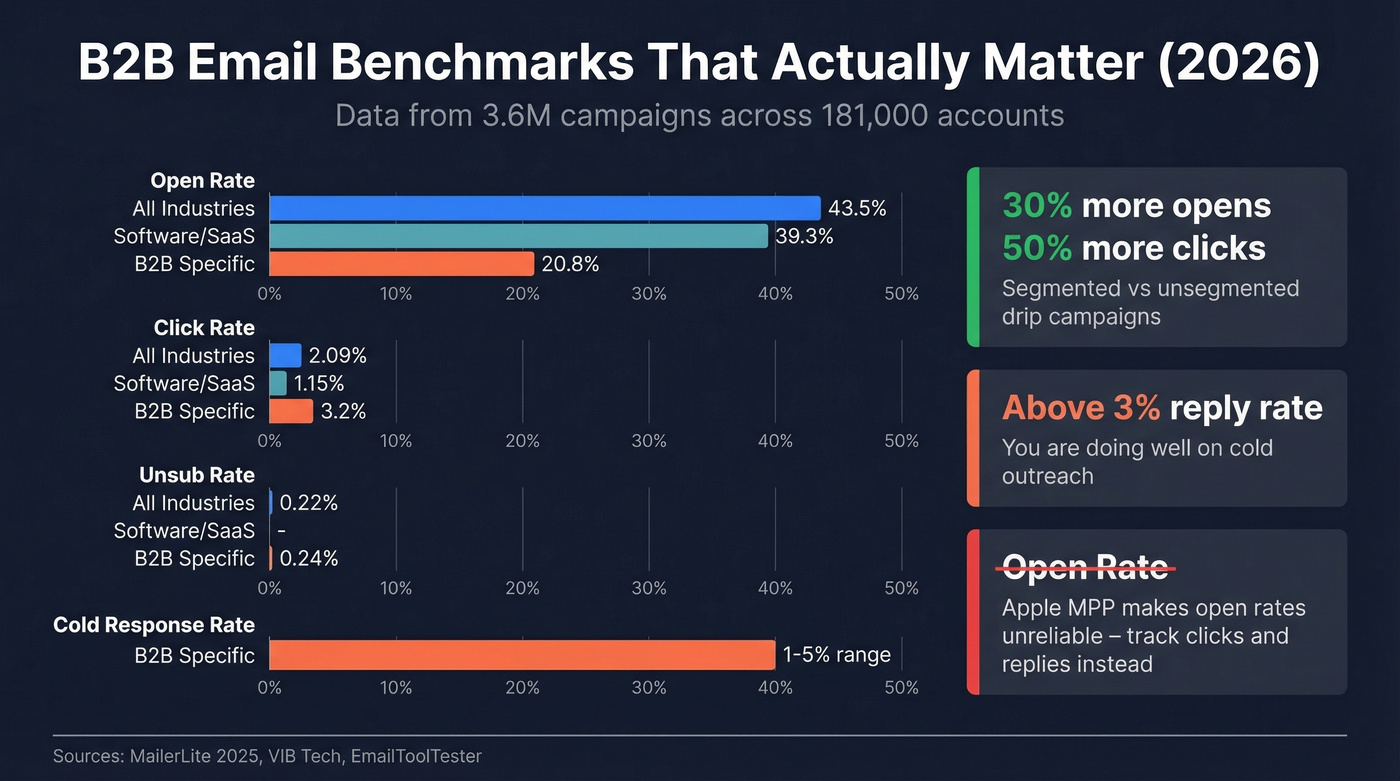
| Metric | All Industries | Software/SaaS | B2B Benchmarks |
|---|---|---|---|
| Open rate | 43.46% | 39.31% | 20.8% |
| Click rate | 2.09% | 1.15% | 3.2% |
| Unsub rate | 0.22% | - | 0.24% |
| Conversion | - | - | 2.5% |
The gap between "all industries" and B2B benchmark open rates tells you something important: B2B audiences are harder to reach, and Apple MPP inflates the top-line number anyway. Open rates are a vanity metric in 2026. For cold outreach, response rates land between 1-5%. Above 3% means you're doing well.
Segmented drip campaigns see 30% more opens and 50% more clicks than unsegmented blasts. Segmentation is the single highest-leverage thing you can do after fixing your list.
Segmentation That Drives Replies
Layer firmographic signals like company size and funding stage with behavioral triggers like pricing page visits and content downloads. Each layer narrows the audience and sharpens the message - and that's what separates a generic blast from a sequence that feels personally relevant. (If you want a practical framework, use intent based segmentation and a clear ideal customer profile.)
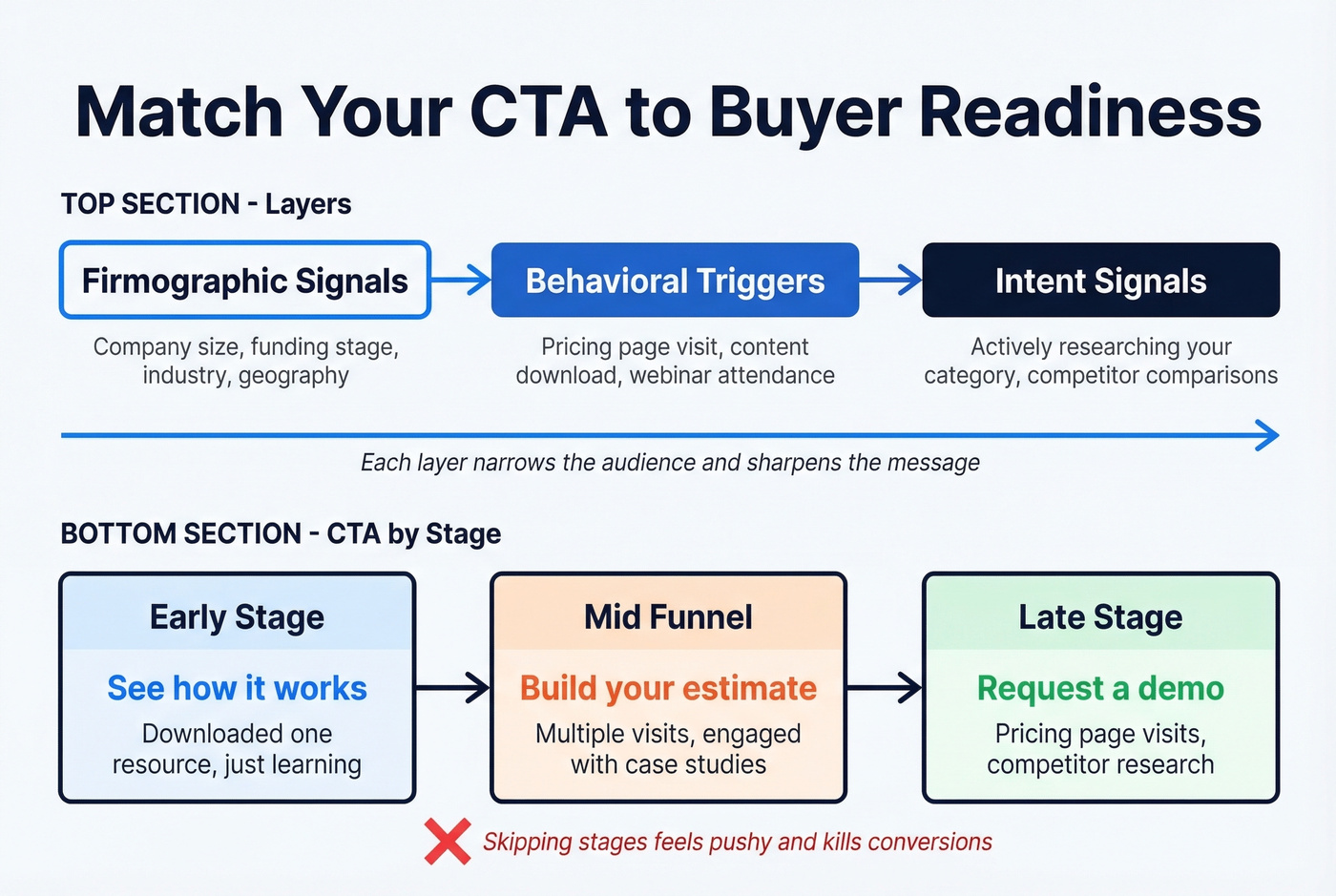
Match CTAs to readiness level. Early-stage prospects get "See how it works." Mid-funnel gets "Build your estimate." Late-stage gets "Request a demo." Sending a demo CTA to someone who downloaded one ebook skips three steps in the buying process and feels pushy.
Tools for B2B Drip Campaigns
Marketing automation tools handle nurture sequences for known contacts. Cold outreach tools handle prospecting sequences to strangers. You need one of each - and a verification layer underneath both.
Verification Layer
| Tool | Starting Price | Best For |
|---|---|---|
| Prospeo | Free tier (75 emails/mo); ~$0.01/email on paid plans | Bulk verification before any send - 98% accuracy with 5-step verification. Data refreshed every 7 days. |
Sending Tools
| Tool | Category | Starting Price | Best For |
|---|---|---|---|
| ActiveCampaign | Marketing automation | $15/mo | Best value for sub-50-person B2B teams |
| Brevo | Marketing automation | $9/mo | Budget-conscious teams with simple workflows |
| Mailchimp | Marketing automation | $13/mo | Teams already in the Mailchimp ecosystem |
| HubSpot | Marketing automation | Free CRM; Pro ~$800-$1,000/mo | Only worth it if you're already a HubSpot shop |
| Apollo | Cold outreach | Free (100 credits); $59/user/mo | Starter cold outreach with built-in database |
| Gmass | Cold outreach | $25/mo | Gmail-native sequences for solo operators |
In our experience, Apollo's native data accuracy is weaker than lists verified through a dedicated tool before sending - 98% email accuracy with Prospeo vs. 79% with Apollo. ActiveCampaign is the best value for small-to-mid B2B teams. HubSpot is only worth the price tag if your CRM, CMS, and marketing stack are already there.
Mistakes That Kill Drip Campaigns
Sending without verifying your list. Everything downstream fails if your bounce rate is high. Snyk's 50-person AE team saw bounce rates drop from 35-40% to under 5% after switching to verified data - and AE-sourced pipeline jumped 180%. (If you're diagnosing issues, start with email bounce rate and a full email deliverability guide.)
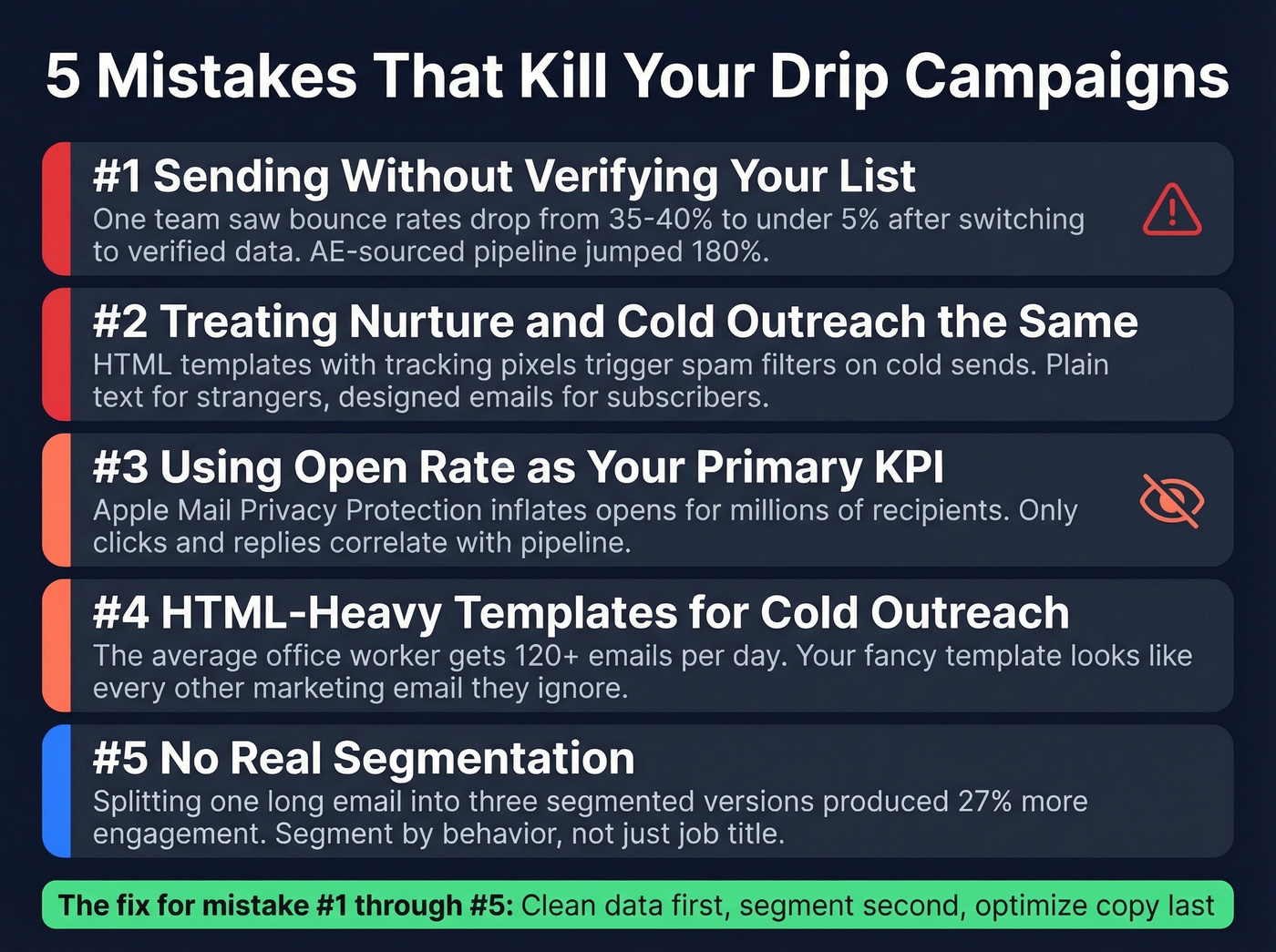
Treating nurture and cold outreach as the same thing. HTML templates with tracking pixels trigger spam filters on cold sends. Plain text for strangers, designed emails for subscribers. We can't stress this enough.
Using open rate as your primary KPI. Apple MPP inflated opens for millions of recipients. Clicks and replies are the only metrics that correlate with pipeline.
Sending HTML-heavy templates for cold outreach. The average office worker receives 120+ emails per day. Your fancy template looks like every other marketing email they ignore.
No segmentation beyond "downloaded any ebook, ever." One team found that splitting a single long email into three shorter, segmented versions produced a 27% lift in CTR. Segmentation compounds over every send.
FAQ
How many emails should a B2B drip campaign have?
Marketing nurture sequences typically run 5-8 emails over 3-6 weeks; cold outreach works best at 4-5 emails over 14-21 days. Start shorter and extend only if engagement data supports it. Going beyond 8 emails rarely improves conversion and risks fatiguing your list.
What's a good open rate for B2B drip campaigns?
Across 3.6M campaigns, the average open rate is 43.46%, but B2B benchmarks sit closer to 20.8%. Apple Mail Privacy Protection inflates opens across the board. Track click rate and replies instead - they actually correlate with pipeline.
How do I keep drip emails out of spam?
Authenticate your domain with SPF, DKIM, and DMARC, and keep spam complaints below 0.3%. Verify your list before sending - catch invalid addresses and spam traps before they damage your sender reputation. For cold outreach, use plain text, one link per email, and subject lines under three words.
What makes a B2B drip campaign different from a consumer drip?
B2B drip campaigns target buying committees, not individuals, which means longer cadences, more educational content, and CTAs tied to business outcomes rather than impulse purchases. Decision cycles run weeks or months, so patience and segmentation matter far more than urgency tactics or discount codes.