

B2B Geographic Segmentation: What Every Guide Gets Wrong (and What Actually Works)
You're crushing it in the US. Same ICP, same messaging, same sequence structure. Then you expand into DACH and everything falls apart - reply rates dip, meetings no-show, and procurement asks questions your team's never had to answer.
B2B geographic segmentation isn't about where customers are. It's about where your assumptions stop working.
The short version
Geographic segmentation isn't a targeting tactic - it's an analytical lens that reveals where your strategy breaks. Segment by regulatory zone, industry cluster, and data coverage quality, not just country or zip code. And your geo segments are only as good as your data. If it's a few months old, your territories are already drifting.
What geographic segmentation actually means in B2B
Most B2B segmentation guides treat geo as a sub-bullet under firmographics and move on. That's why teams keep "doing geo" and getting nothing but prettier dashboards.
Here's the thing: you're organizing performance, pipeline, and coverage by location to answer one question - does the same GTM motion work everywhere? It almost never does. Geography changes your compliance obligations, your data quality, your outreach timing, and your close rates. Treat it like a footnote and you'll keep shipping a US playbook into markets that punish it.
Most guides skip compliance variance, data coverage gaps by region, and the HQ-vs-buying-center problem entirely. This one doesn't.
Geographic variables that change execution
Country and city are table stakes. These variables actually shift how your team operates:
| Variable | What it changes in B2B |
|---|---|
| Region / country | Market maturity, pricing, competitors |
| Regulatory zone | Outreach rules, consent, data handling |
| Time zone | Send windows, SLA expectations, handoffs |
| Language | Reply rates, objection handling, localization |
| Urbanicity | Field coverage, event strategy, travel cost |
| Industry cluster | Vertical density, partner ecosystems |
| Seasonality / fiscal calendar | Budget timing, buying windows, planning cycles |
| HQ vs operating location | Who buys vs who uses vs who signs |
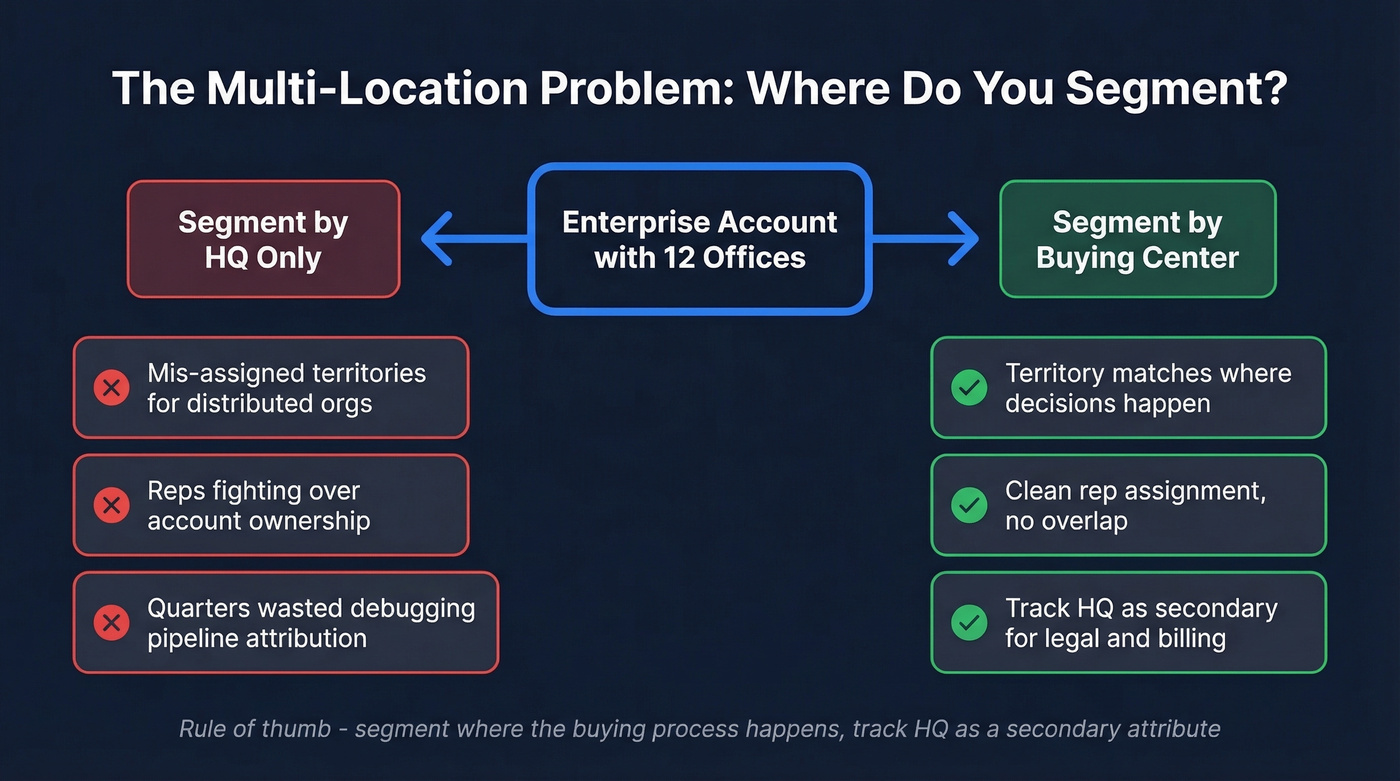
The multi-location problem is where teams get burned. Do you segment by HQ or buying center? The answer changes your territory assignments, outreach strategy, and compliance obligations.
In our experience, the cleanest rule is: segment by where the buying process happens, then track HQ as a secondary attribute for legal, billing, and parent/child rollups. If you only segment by HQ, you'll mis-assign territories for distributed orgs and wonder why reps keep "stealing" accounts. We've seen teams waste entire quarters debugging pipeline attribution issues that traced back to this single decision.
Layer technographic data on top of geo segments to find clusters where your tech stack fit is strongest - geography tells you where to look, technographics tell you who's ready to buy.
Compliance changes by region
Privacy law isn't a legal footnote - it's a segmentation constraint. Research from twenty-one-twelve shows that 88% of advertisers say privacy regulations materially impact personalization, and 61% say targeting is the hardest hit.
Here's the quick-reference version teams actually use in ops docs:
| Regime | Practical outbound impact |
|---|---|
| GDPR (EU) | Consent-heavy; SCCs for transfers |
| CCPA/CPRA (CA) | Opt-out required; precise geo is sensitive |
| UK GDPR + PECR | B2B work-email outreach permitted with opt-out under soft opt-in rules; stricter for personal email/mobile |
If you're running the same outbound playbook in the US and Germany, you're either breaking the law or leaving money on the table. Adjust data collection, messaging, and opt-out handling by regulatory zone - not by country name.

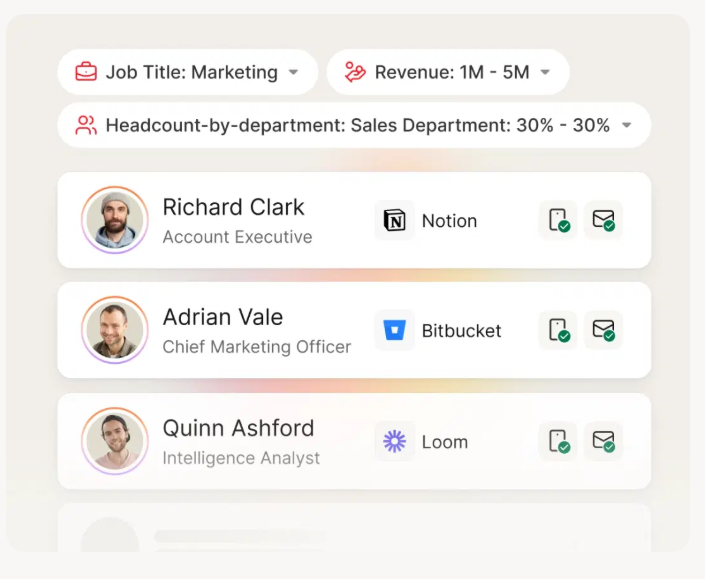
Compliance zones change your outreach rules - but stale data changes your results. Prospeo's 30+ filters let you segment by country, region, and regulatory zone, then verify every email in real time with 98% accuracy. No more shipping a US playbook into GDPR markets with unverified contacts.
Filter by geography, verify in real time, and export clean lists in minutes.
Data realities by region
Geo segmentation gets weird fast because your data coverage isn't uniform. One enrichment scenario we ran showed an 87% match in the US, 61% in France, and 34% in Japan for the same workflow. That gap isn't "vendor quality" - it's structural: data source density, regulatory environment, and local platform adoption all play a role.
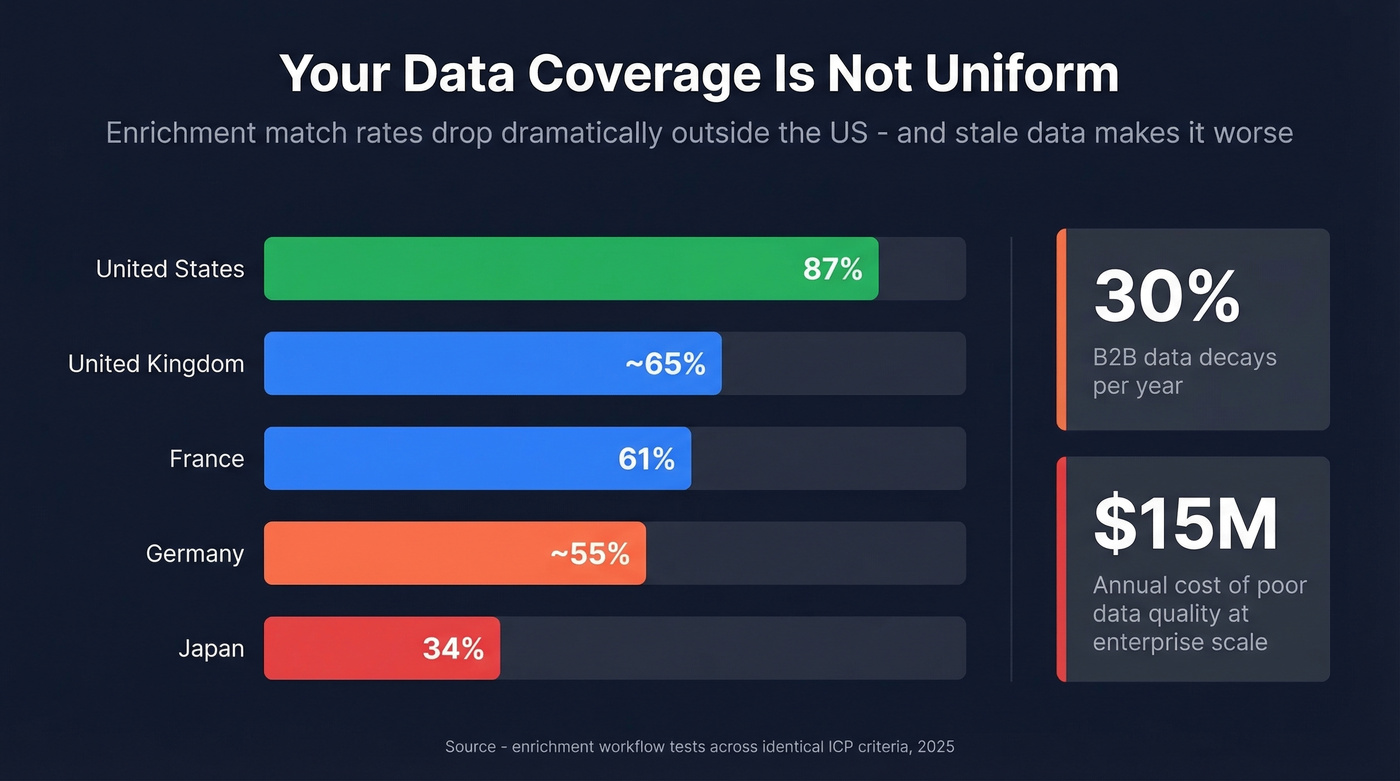
Teams expanding internationally often see US match rates around 70-90%, drops to roughly 50-60% in parts of Europe, and below 40% in some APAC markets. Even in the US, about 10.9% of professionals change jobs annually, so a "high match rate" from stale data is a false signal.
B2B data degrades about 30% per year, and poor data quality costs enterprise-scale companies roughly $15M annually. Even if your segments were perfect on day one, they rot underneath you.
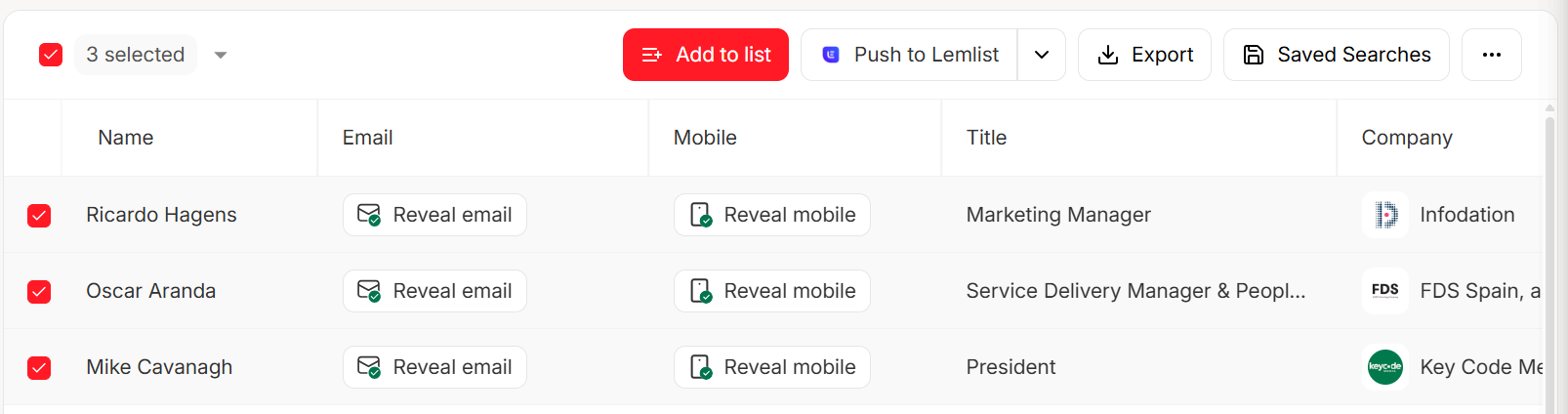
This is where Prospeo earns its place in the stack - not as a segmentation idea, but as the data layer underneath your segments. With 300M+ professional profiles on a 7-day refresh cycle and 98% email accuracy, your geo segments drift far less between territory reviews. Filter by geography, verify emails and mobiles in real time, and export clean lists before they ever hit your sequencer.
If you're evaluating vendors for this layer, start with a shortlist of data enrichment services and compare coverage by region, not just feature checklists.
From segments to territories
Geographic segmentation becomes real when it changes coverage. Here's how to turn it into territory design without making it a once-a-year spreadsheet ritual.
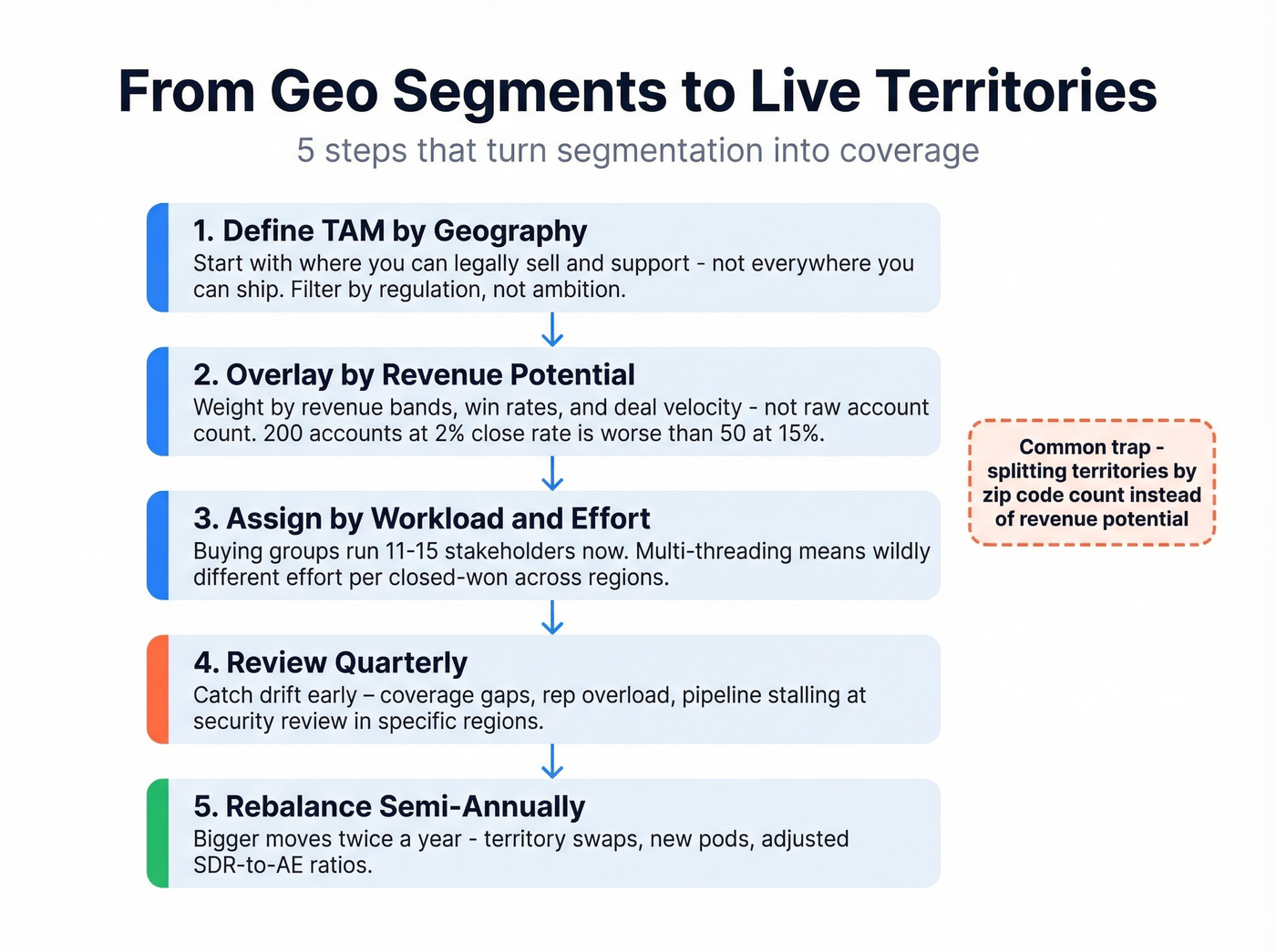
1. Define TAM by geography. Start with where you can legally sell and support - not "everywhere we can ship." If you sell compliance software, your TAM-by-geography starts with countries where the regulation you solve for exists. (If you need a refresher on TAM/SAM/SOM, see addressable market.)
2. Overlay opportunity data by revenue potential, not account count. Account count is a trap. Weight by revenue bands, win rates, and deal velocity. A territory with 200 accounts and a 2% win rate is worse than one with 50 accounts closing at 15%. This is also where sales pipeline benchmarks help you sanity-check what “good” looks like by segment.
3. Assign resources by workload and effort. Buying groups now run 11-15 stakeholders. That means multi-threading, more meetings, more follow-ups - and wildly different effort per closed-won across regions.
4. Set a quarterly review cadence. This is where you catch drift: coverage gaps, rep overload, and "why is EMEA pipeline stalling at security review?" If you want a tighter operating rhythm, borrow a few QBR questions to ask and make geo performance a standing section.
5. Rebalance semi-annually. Do the bigger moves twice a year: territory swaps, new pods, new SDR-to-AE ratios.
Territory planning that splits accounts by zip code count instead of revenue potential is how you end up with one rep sitting on $5M in pipeline and another cold-calling into a desert.
Operationalizing geo segments in outreach
Once your territories are set, the next challenge is making sure your sequences actually reflect them. Let's be honest - most teams build beautiful geo-based territory maps and then blast the same cadence to every region.
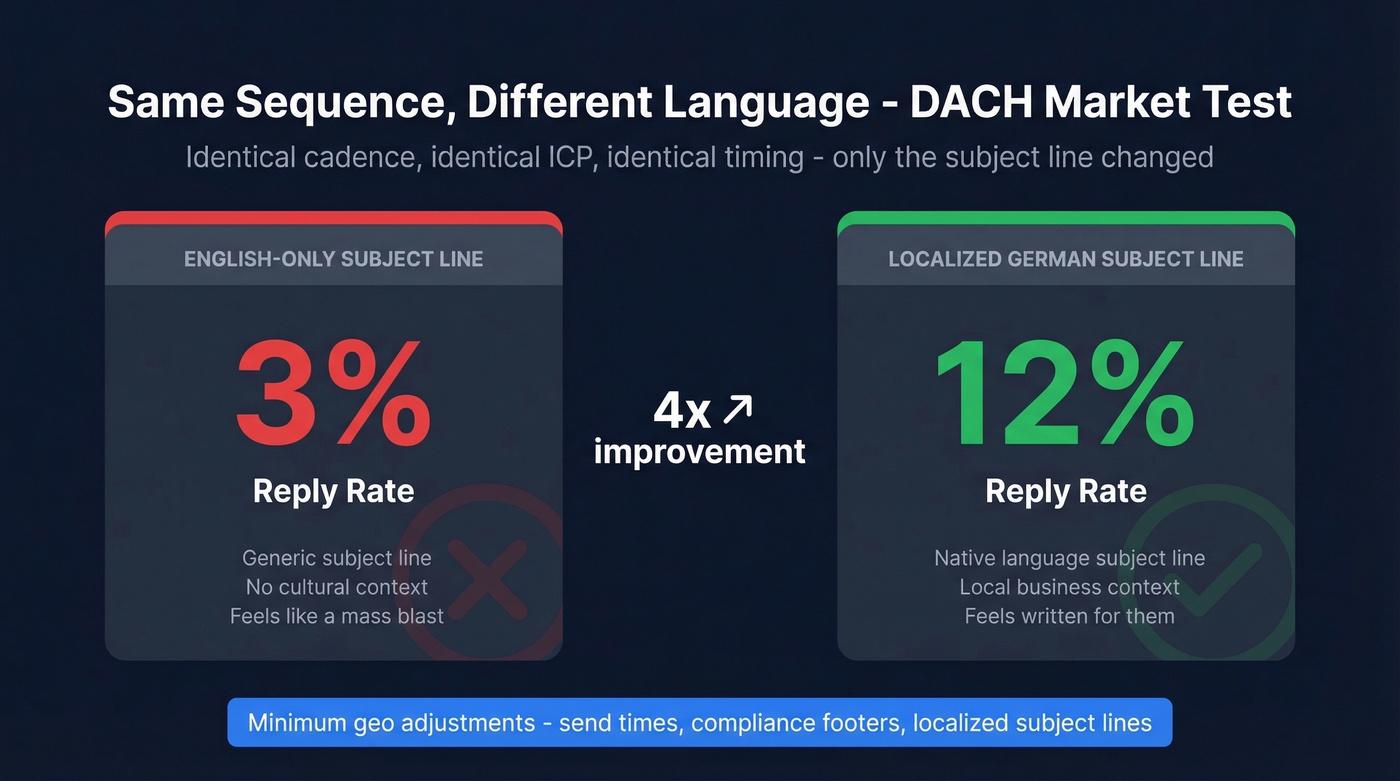
At minimum, adjust send times to local business hours, swap compliance footers by regulatory zone, and localize subject lines for non-English markets. These aren't nice-to-haves. We tested identical sequences with and without localized subject lines in DACH markets last year, and the localized version pulled a 12% reply rate versus 3% for the English-only version. The consensus on r/sales echoes this - reps who localize even basic elements consistently outperform those who don't.
If you need a starting point for localization, build a geo-specific swipe file from proven email subject line examples and then test by region.
Tools for B2B geographic segmentation
You need two layers: something to visualize and manage territories, and something to feed those territories with accurate account and contact data.
| Category | Tool | Best for | Pricing |
|---|---|---|---|
| Data/enrichment | Prospeo | Verified geo lists, 30+ filters | Free tier; ~$0.01/email |
| Territory mapping | Felt | Modern collaborative maps | Free; Team $200/mo |
| Territory mapping | BatchGeo | Fast cluster visuals | $99/mo |
| Territory mapping | Google Maps Platform | Custom applications | $100-$1,200+/mo |
Felt is the best option for teams that don't need enterprise GIS - it's modern, collaborative, and fast. BatchGeo works when you just need to see clusters and drive-time realities. Skip Google Maps Platform unless you're building custom applications; it's powerful, but you'll pay in engineering time.
Hot take: If your average deal size is under $25k, you probably don't need a dedicated territory mapping tool at all. A well-structured spreadsheet with geo-filtered exports will outperform a fancy map that nobody updates. The bottleneck is almost never visualization - it's data freshness.
Don't ignore industry clusters when you build geo segments. Houston for energy, Silicon Valley for SaaS, Detroit for automotive, NYC for finance, Boston for biotech, London for fintech - these aren't trivia, they're shortcuts to higher-density TAM and tighter messaging. (If you want more options for the mapping layer, compare sales mapping software before you commit.)
US match rates at 87%, France at 61%, Japan at 34% - sound familiar? Prospeo's 7-day data refresh cycle and 300M+ profiles close the coverage gap that kills international expansion. Your geo segments stop drifting between territory reviews when the data underneath them is actually current.
Stop building territories on data that's already 30% decayed.
FAQ
What's the difference between geographic and firmographic segmentation?
Geographic segmentation is technically a subset of firmographics, but it deserves its own framework because it independently changes compliance, data quality, and outreach timing. Two companies with identical headcount and industry behave differently when they sit in different regulatory zones, time zones, and buying cultures.
How often should I update geographic segments?
Review quarterly for misalignment signals like coverage gaps, territory overload, and regional conversion drops, then rebalance semi-annually. Your contact and account data should refresh weekly at minimum - a 7-day refresh cycle prevents the slow rot that makes territories unreliable within a single quarter.
What are examples of geographic segmentation in B2B?
The most common approach is segmenting by compliance zone - grouping GDPR countries separately from US states with their own privacy laws like CCPA. Another powerful example is clustering by industry density: targeting fintech buyers specifically in London, or energy-sector accounts concentrated in Houston and Calgary. A third is segmenting by data coverage quality, running different enrichment and verification workflows for high-match regions like the US versus low-match regions like Japan or Southeast Asia.