

B2B Go-to-Market Strategy Template That's Actually Usable
For every successful market entry, roughly four fail. Most don't die from bad products - they die from vague plans that never translate into action. One product marketer on r/ProductMarketing put it perfectly: they needed "actionable items with dates to get to launch," not another strategy deck full of aspirational bullet points.
Here's a B2B go-to-market strategy template built around that principle. Every section has fields to fill in, benchmarks to calibrate against, and owners to assign. No fluff.
What a Working GTM Template Actually Contains
A usable B2B GTM strategy template has seven components:
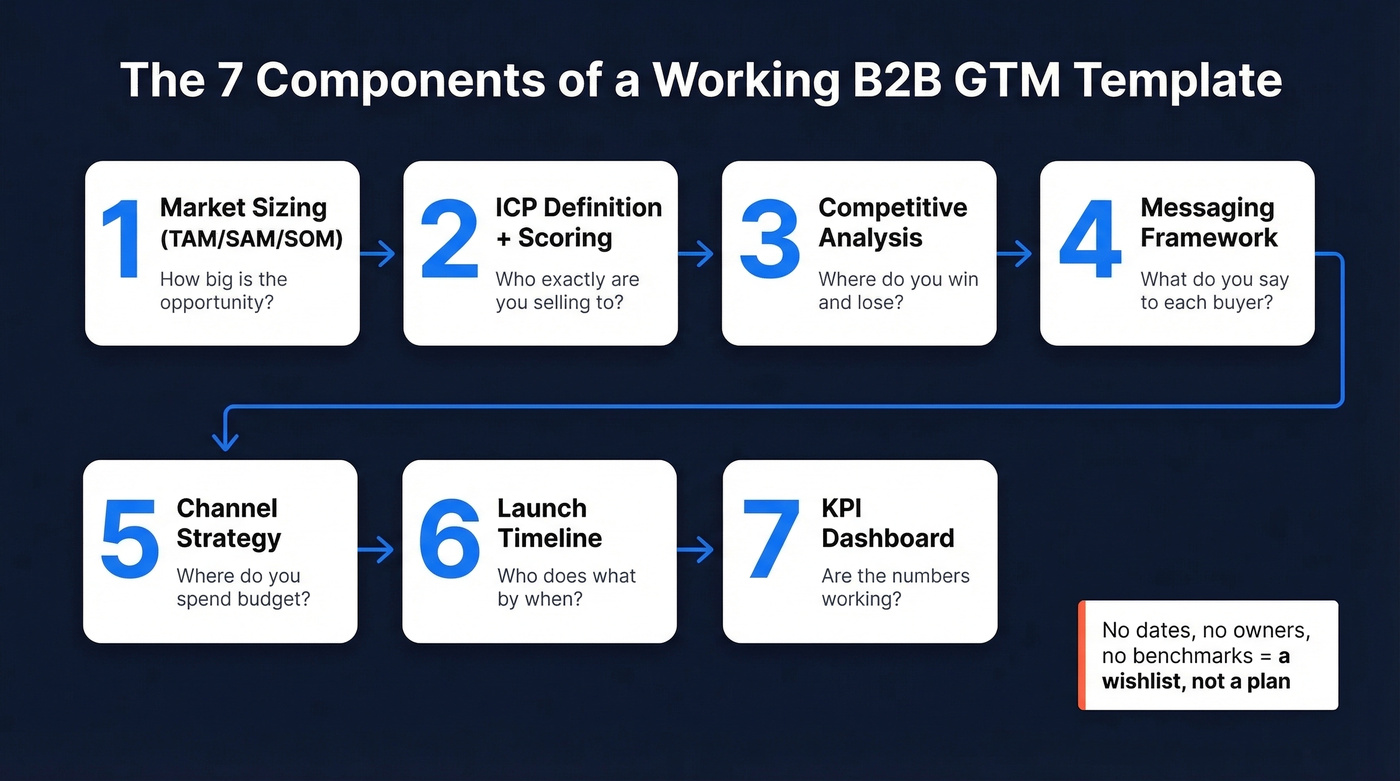
- Market sizing (TAM / SAM / SOM)
- ICP definition + scoring rubric
- Competitive analysis worksheet
- Messaging framework by buyer role
- Channel strategy with budget allocation
- Launch timeline with owners and dates
- KPI dashboard with benchmark targets
If yours doesn't have dates, owners, and benchmark targets, it's a wishlist. Let's walk through each section.
Pick Your GTM Motion First
Before you fill in a single field, decide how you're going to sell. This choice shapes your pricing page, your first hire, and your channel budget.
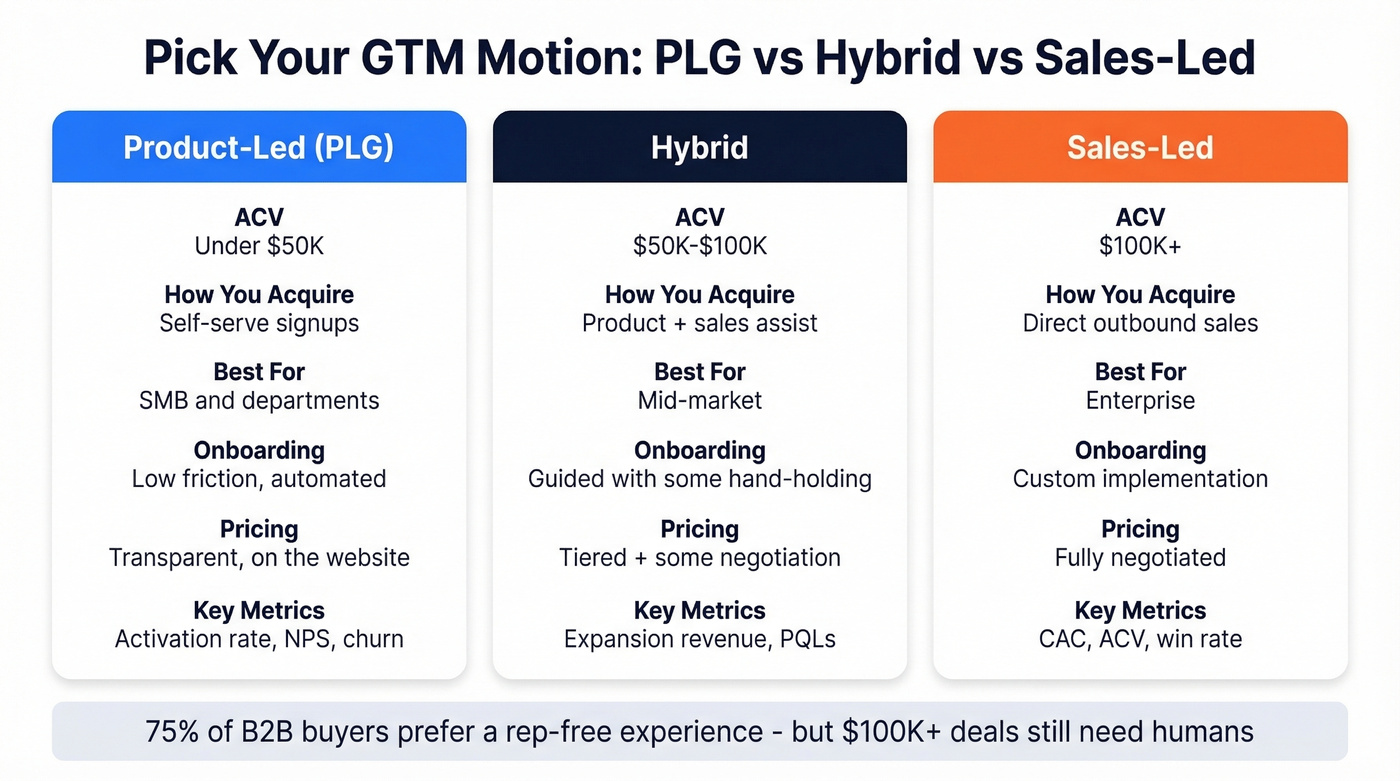
| Dimension | PLG | Hybrid | Sales-Led |
|---|---|---|---|
| ACV Range | < $50K | $50K-$100K | $100K+ |
| Acquisition | Self-serve | Product + sales-assist | Direct sales |
| ICP | SMB / departments | Mid-market | Enterprise |
| Onboarding | Low friction | Guided | Custom implementation |
| Pricing | Transparent | Tiered + negotiated | Fully negotiated |
| Key Metrics | Activation, NPS, churn | Expansion revenue, PQLs | CAC, ACV, win rate |
| Examples | Slack, Calendly | Zoom, Notion | Salesforce, Workday |
PLG dominates when ACV sits under $5K - and 75% of B2B buyers now say they prefer a rep-free sales experience. Best-in-class PLG activation rates hit 65%+ (top decile), while the average hovers around 33%. Selling six-figure contracts into procurement-heavy orgs? Self-serve won't cut it. You need a sales-led motion with custom onboarding and negotiated pricing.
Here's the thing: most teams default to sales-led because it feels safer. If your average deal size is under $10K, you're probably overspending on sales headcount and underinvesting in product-led activation. Run the numbers before you hire rep number three.
If you want a deeper breakdown of PLG vs Hybrid vs Sales-Led motions, it’s worth reading before you lock your org design.

Your ICP scoring rubric is useless without verified contact data behind it. Prospeo gives you 300M+ profiles with 30+ filters - intent data, technographics, job changes, headcount growth - so Tier A accounts get actioned, not filed away.
Turn your GTM template into pipeline at $0.01 per verified email.
Template Walkthrough: Section by Section
Market Sizing
Use three methods and triangulate:
| Method | Formula |
|---|---|
| Top-down | Industry size x relevant segment % |
| Bottom-up | Target companies x avg annual spend |
| Value theory | Annual value per customer x target companies |
Your SAM narrows TAM by geographic reach and market access - say you only sell to mid-market SaaS in North America. SOM is the realistic slice, typically 1-5% in mature markets. If your SOM projection is 15% in year one, pressure-test that hard. We've seen founders build entire hiring plans on SOM numbers that assumed zero competition and perfect execution, which is a recipe for a painful board meeting.
ICP Definition + Scoring
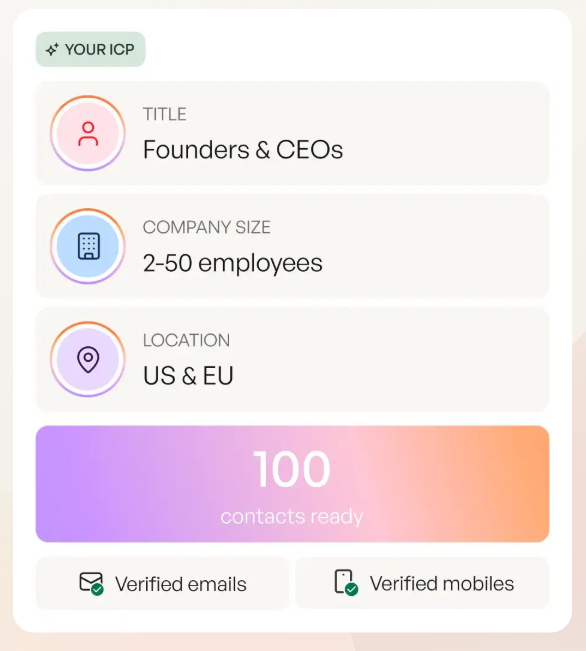
If your ICP is "companies with 50-500 employees in North America," you don't have an ICP. You have a demographic filter.
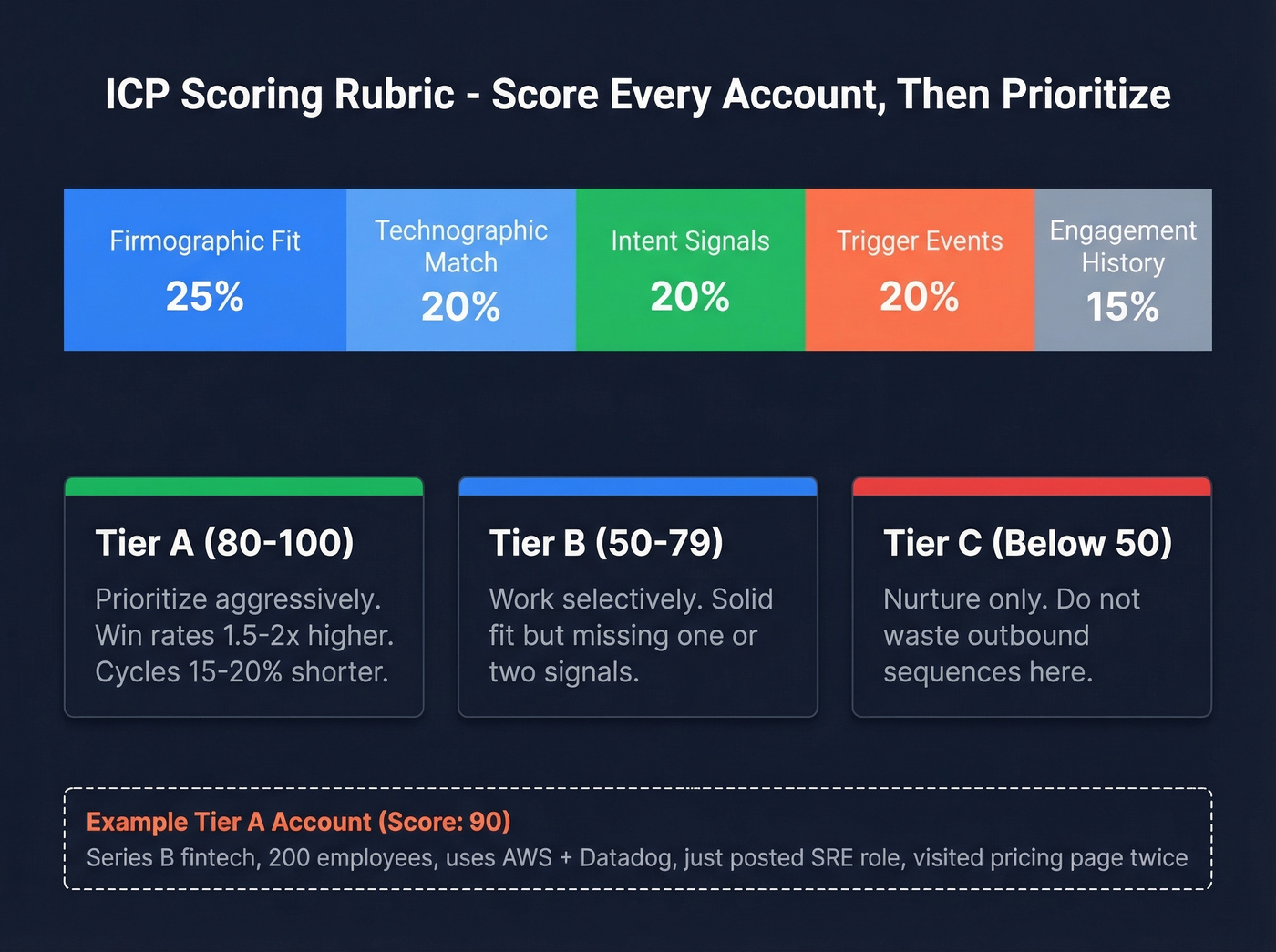
Start by analyzing 50-100 closed-won deals from the last 12 months. Look for 3-5 shared traits appearing in 70-80% of wins. Then score accounts on five dimensions:
| Dimension | Weight | Score (0-100) |
|---|---|---|
| Firmographic fit | 25% | ___ |
| Technographic match | 20% | ___ |
| Intent signals | 20% | ___ |
| Trigger events | 20% | ___ |
| Engagement history | 15% | ___ |
Tier A (80-100): Prioritize aggressively - expect win rates 1.5-2x higher and 15-20% shorter cycles. Tier B (50-79): work selectively. Tier C (below 50): nurture only.
What this looks like filled in: Imagine you sell an API monitoring tool to mid-market SaaS companies. A Tier A account scores 90: Series B fintech, 200 employees, uses AWS and Datadog (technographic match), recently posted a Site Reliability Engineer role (trigger event), and visited your pricing page twice (engagement). That's who gets your best sequence first.
Once you've defined Tier A accounts, you need verified contact data to reach them. Prospeo covers 300M+ professional profiles with 30+ search filters and Bombora-powered intent data across 15,000 topics, so you can act on your scoring rubric instead of filing it away.
Competitive Analysis
Score each competitor across these dimensions (1-10 scale):
| Dimension | Competitor A | Competitor B | Competitor C |
|---|---|---|---|
| Product depth | ___ | ___ | ___ |
| Pricing position | ___ | ___ | ___ |
| Market awareness | ___ | ___ | ___ |
| Sales motion | ___ | ___ | ___ |
| Customer retention | ___ | ___ | ___ |
Capture each competitor's pricing model and starting price. The output is a competitive threat level that informs your positioning - not a spreadsheet you file away and forget about.
Messaging Framework
B2B buying committees span 6-10 stakeholders across 5 business functions, with 89% of purchases involving multiple departments. One message doesn't cut it.
| Buyer Role | Primary Pain | Outcome Hook |
|---|---|---|
| Economic buyer | ROI justification | Revenue impact + payback |
| Technical evaluator | Integration risk | Time-to-value + stack fit |
| End user | Daily workflow friction | Hours saved per week |
Every message should answer "so what?" from the buyer's perspective. Lead with outcomes, not features. This messaging section is where a go-to-market marketing strategy template diverges from a pure sales playbook - marketing needs role-specific ad copy, landing pages, and nurture sequences mapped to each buyer persona above.
Channel Strategy
McKinsey's "rule of thirds" still holds: roughly a third of B2B buyers want in-person interaction, a third prefer remote, and a third want self-serve with no human contact. The average company runs 10.5 GTM efforts across core and experimental channels.
Look, you don't need 10 channels. You need 3 that work.
Here's the scale of what you're up against: closing a deal with $100K+ ACV takes roughly 5,500 impressions and 417 touchpoints. Even at lower ACVs, expect around 2,879 impressions and 266 touchpoints before a buyer converts. That's why channel selection matters more than channel quantity.
For cold email specifically, timeline-based hooks pull a 10.01% reply rate versus 4.39% for problem hooks - and the meeting rate gap is even wider (2.34% vs. 0.69%). We've tested both hook types across dozens of campaigns, and timeline hooks consistently outperform. But none of that matters if your contact data is stale. A 7-day data refresh cycle, like what Prospeo runs, means you're not sending sequences to people who changed jobs six weeks ago - the fastest way to tank domain reputation.
Launch Timeline
This section turns strategy into execution. Without dates and owners, everything above is academic.
| Phase | Timeline | Owner | Key Milestone |
|---|---|---|---|
| Pre-launch | Weeks 1-4 | ___ | ICP validated, messaging tested |
| Launch | Weeks 5-8 | ___ | First outbound sequences live |
| Post-launch | Weeks 9-12 | ___ | First pipeline review + iteration |
Assign names, not teams. "Marketing" doesn't own anything - a person does.
KPI Dashboard
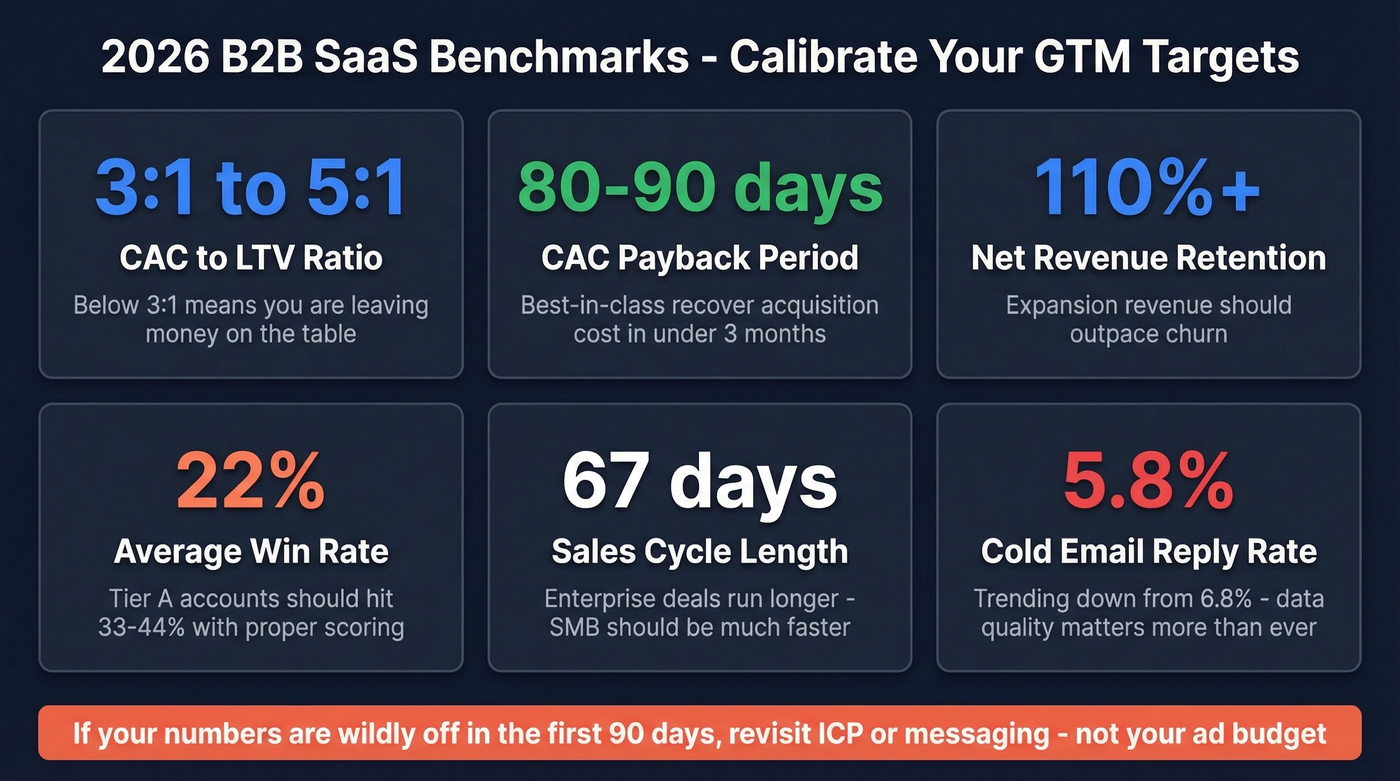
Set targets before you launch. Here are 2026 B2B SaaS benchmarks to calibrate against:
| Metric | Benchmark | Your Target |
|---|---|---|
| CAC:LTV ratio | 3:1-5:1 | ___ |
| CAC payback | 80-90 days | ___ |
| Net revenue retention | 110%+ | ___ |
| Win rate | 22% | ___ |
| Sales cycle length | 67 days | ___ |
| Cold email reply rate | ~5.8% (trending down from 6.8%) | ___ |
If your numbers are wildly off these benchmarks in the first 90 days, that's a signal to revisit ICP or messaging - not to double your ad spend.
5 GTM Mistakes That Kill Launches
1. Skipping customer conversations. Talk to 20 prospects before writing a single positioning doc. Launching without confirming pain and buying behavior is the most expensive mistake you'll make.
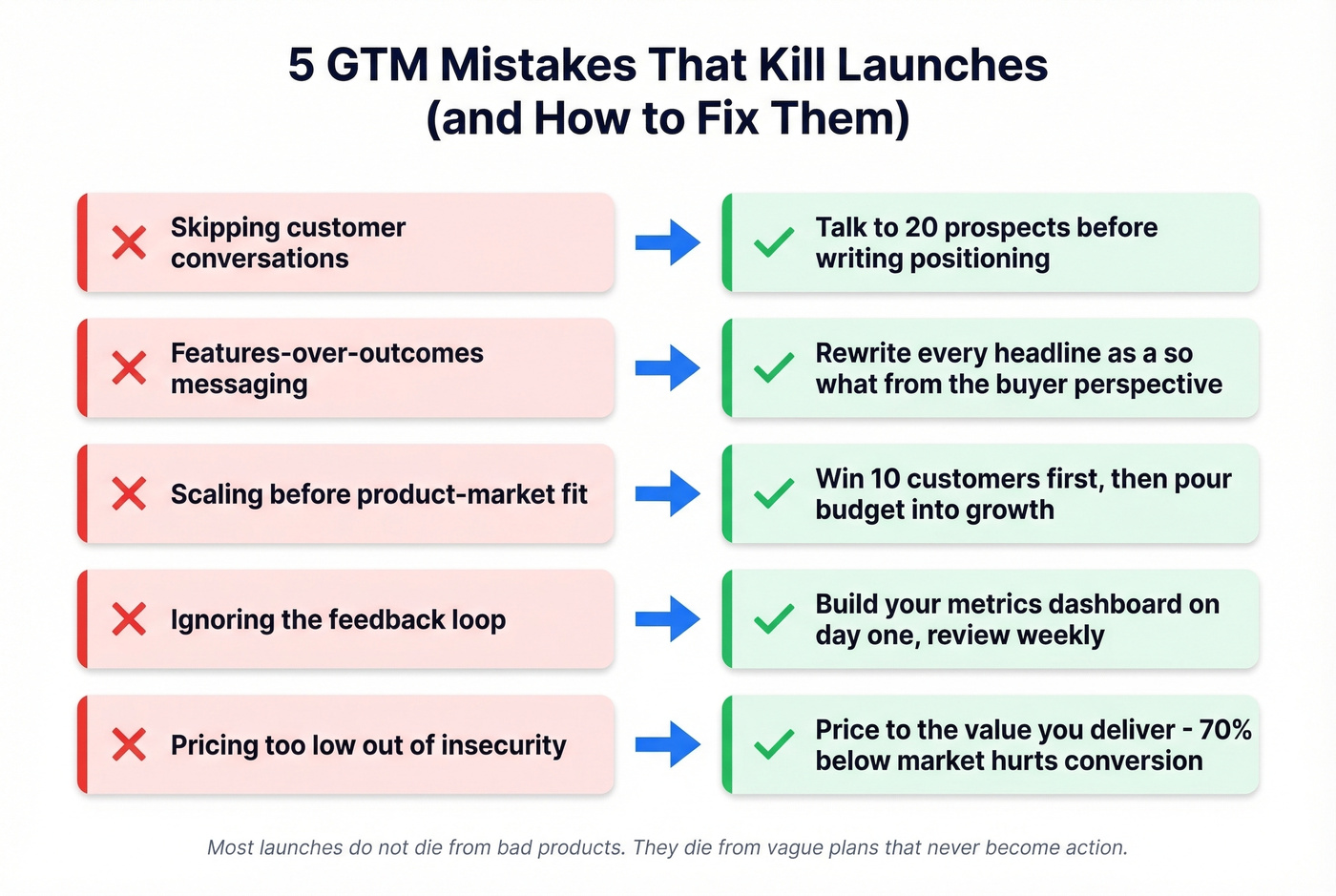
2. Features-over-outcomes messaging. Rewrite every headline as a "so what." Nobody cares about your architecture. They care about what it does for them on Tuesday morning.
3. Scaling before product-market fit. Find your beachhead. Win 10 customers. Then scale. In our experience, teams that pour budget into growth before nailing retention end up buying the same customers twice.
4. Ignoring the feedback loop. Build your metrics dashboard on day one. We've seen teams run the same broken sequence for three months because nobody looked at the numbers. That's not persistence - it's negligence.
5. Pricing too low. One founder-stage analysis found that pricing 70% below market actually hurt conversion because buyers perceived higher risk. Price to the value you deliver, not to your insecurity about being new.
Cold email drives GTM launches, but stale data kills domain reputation before your first sequence finishes. Prospeo refreshes every record on a 7-day cycle - 6x faster than the industry average - with 98% email accuracy and 125M+ verified mobile numbers.
Stop building launch timelines on data that expired last month.
Keep Your GTM Plan Alive
The best B2B go-to-market strategy template is the one you update weekly. If you launched three months ago and haven't touched your GTM doc, you've got a historical artifact, not a strategy. Review KPIs weekly. Revisit ICP scoring quarterly. Treat your channel mix as a hypothesis that needs constant testing - not a decision you made once and forgot about.
Skip the quarterly "strategy offsite" where everyone agrees the plan is fine. Instead, run a 30-minute weekly standup against your KPI dashboard. The teams we've seen execute best treat their GTM doc like a living product backlog, not a PDF in a shared drive.
FAQ
What's the difference between a GTM strategy and a marketing plan?
A GTM strategy aligns product, sales, marketing, and pricing around a specific market entry or product launch. A marketing plan covers channels, campaigns, and content - one execution layer inside the broader GTM. Think of the marketing plan as a subset, not a synonym.
How long does a B2B GTM plan take to build?
A focused team can build a working GTM plan in 1-2 weeks. Start with ICP scoring and competitive analysis - those two sections inform every decision downstream. Ship the plan, run it for 30 days, then iterate based on real pipeline data rather than assumptions.
How do I validate my ICP without closed-won data?
Run 10-20 discovery calls and look for pattern clusters in pain points, buying triggers, and deal velocity. You can also test ICP hypotheses by filtering large professional databases across firmographics, technographics, and intent topics before committing budget to outbound - validate targeting before you scale it.
What tools help execute a GTM launch plan?
You need three layers: a CRM (HubSpot or Salesforce), a sequencing tool (Instantly, Smartlead, or Outreach), and a data provider for verified contacts. Most sequencing tools integrate natively with major data platforms, so the stack should talk to itself without manual CSV exports.