

B2B Growth Marketing: Benchmarks, Channel Economics, and a 90-Day Plan
Your CEO just asked why CAC is up 40% and pipeline is flat. Your team is running content, outbound, paid ads, and a partner program - and none of them are getting enough resources to actually work. Customer acquisition costs have surged 222% over the past eight years, and the median SaaS company now spends $2.00 to acquire every $1 of new ARR. The "do more of everything" approach isn't a B2B growth marketing strategy. It's expensive chaos.
Here's how to replace the chaos with math. Real CAC benchmarks, channel unit economics with actual dollar ranges, and a 90-day plan with gating metrics so you know what's working before you scale it.
The Quick Version
If you're a B2B SaaS company with under 10K total addressable accounts and $10K+ lifetime value, start with outbound and one paid channel. If your TAM is 50K+ with mid-range LTV, cold email at scale is your first move.
Don't touch content or SEO until month six. Those are compounding channels - they pay off on a 6-12 month horizon, so they shouldn't be your first bet.
Your first two investments:
- Clean, verified contact data. Every channel downstream depends on this. A platform with 98% email accuracy and a weekly refresh cycle keeps your outbound hitting real inboxes instead of bouncing into the void.
- A CRM you'll actually use. HubSpot free or Salesforce. Everything else is a multiplier on these two foundations.
If your data is bad, your CAC math is fiction. Fix the inputs first.
What Growth Marketing Actually Means in B2B
Growth marketing isn't a rebrand of demand gen, and it's not growth hacking with a bigger budget. It's a systematic process that combines brand and performance to drive acquisition, activation, retention, and expansion across the full customer lifecycle.
The operational model matters more than the definition. Growth teams form hypotheses quarterly, prioritize experiments monthly, and run them in sprint cycles. Every experiment has a clear metric, a kill threshold, and a documented outcome - that discipline is what separates real growth programs from "we tried some stuff and hope it worked."
| Growth Marketing | Traditional Marketing | Growth Hacking | |
|---|---|---|---|
| Focus | Full funnel + retention | Awareness + leads | Viral acquisition |
| Metrics | CAC, CLV, pipeline velocity | MQLs, impressions, reach | Signups, activation |
| Timeline | 90-day sprint cycles | Annual campaigns | Days to weeks |
| Scope | Cross-functional (sales, product, marketing) | Marketing department | Product + engineering |
| Model | Hypothesize, test, scale | Plan, execute, report | Hack, measure, pivot |
Why It Matters in 2026
Three forces are converging to make a structured growth approach non-optional.
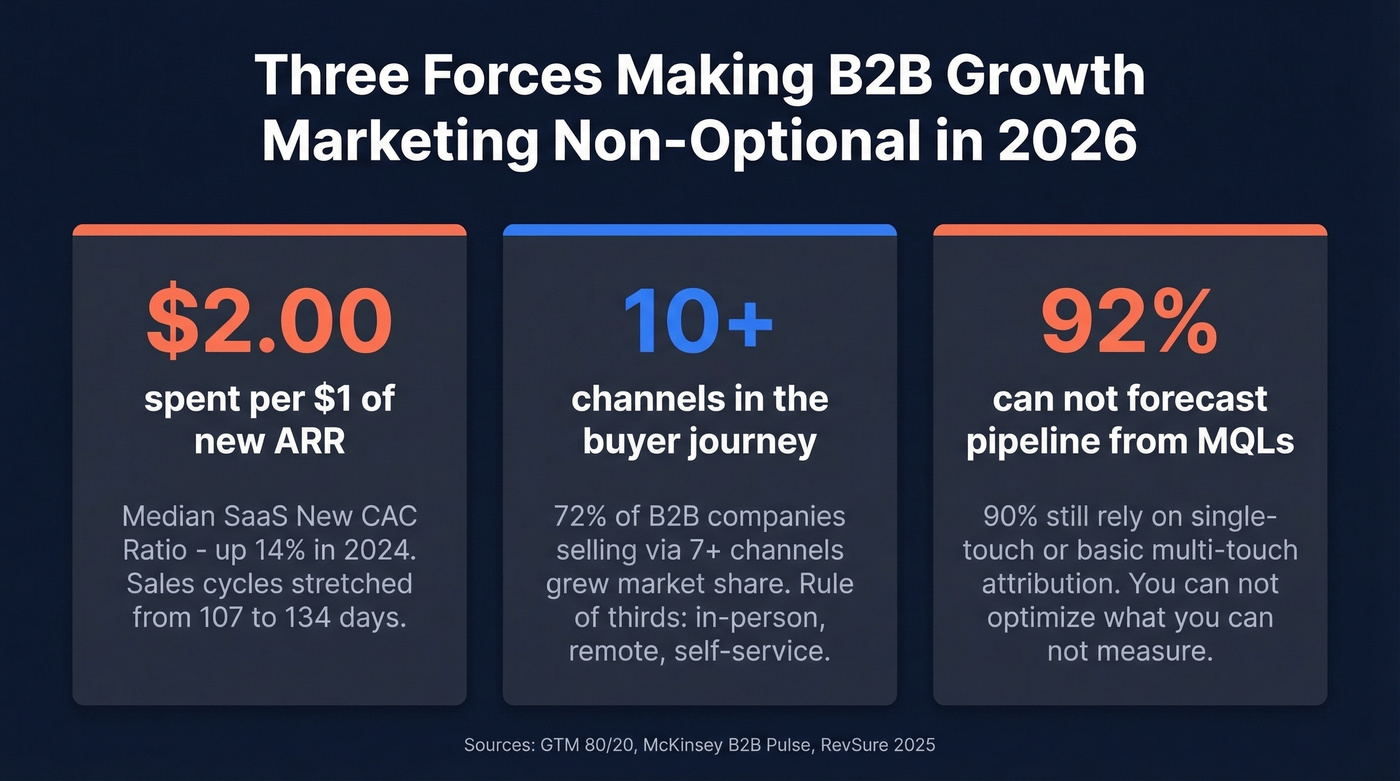
The CAC crisis is real. The median SaaS company's New CAC Ratio hit $2.00 per $1 ARR - up 14% in 2024. Top-quartile companies operate at roughly $1.00 per $1 ARR. Bottom quartile? $2.82. Meanwhile, average B2B SaaS sales cycles stretched from 107 days in early 2022 to 134 days. You're paying more and waiting longer for every deal.
Buyers expect omnichannel. McKinsey's B2B Pulse research, tracking trends since 2016 across 3,500 decision makers in 12 markets, confirmed we're in a "ten-channel world." 72% of B2B companies selling through seven or more channels grew market share. The rule of thirds holds: buyers want a balance of in-person, remote, and self-service interactions across the journey. Single-channel strategies are market-share losers.
Attribution is broken, and everyone knows it. A RevSure survey of 66 marketing leaders found that roughly 90% still rely on single-touch or basic multi-touch attribution, and 92% admit they can't forecast pipeline from MQLs with any precision. You can't optimize what you can't measure - and most teams can't measure.
CAC Benchmarks by Industry
Knowing your CAC is meaningless without context. Here's what First Page Sage found across B2B industries using client data from January 2022 through August 2025.
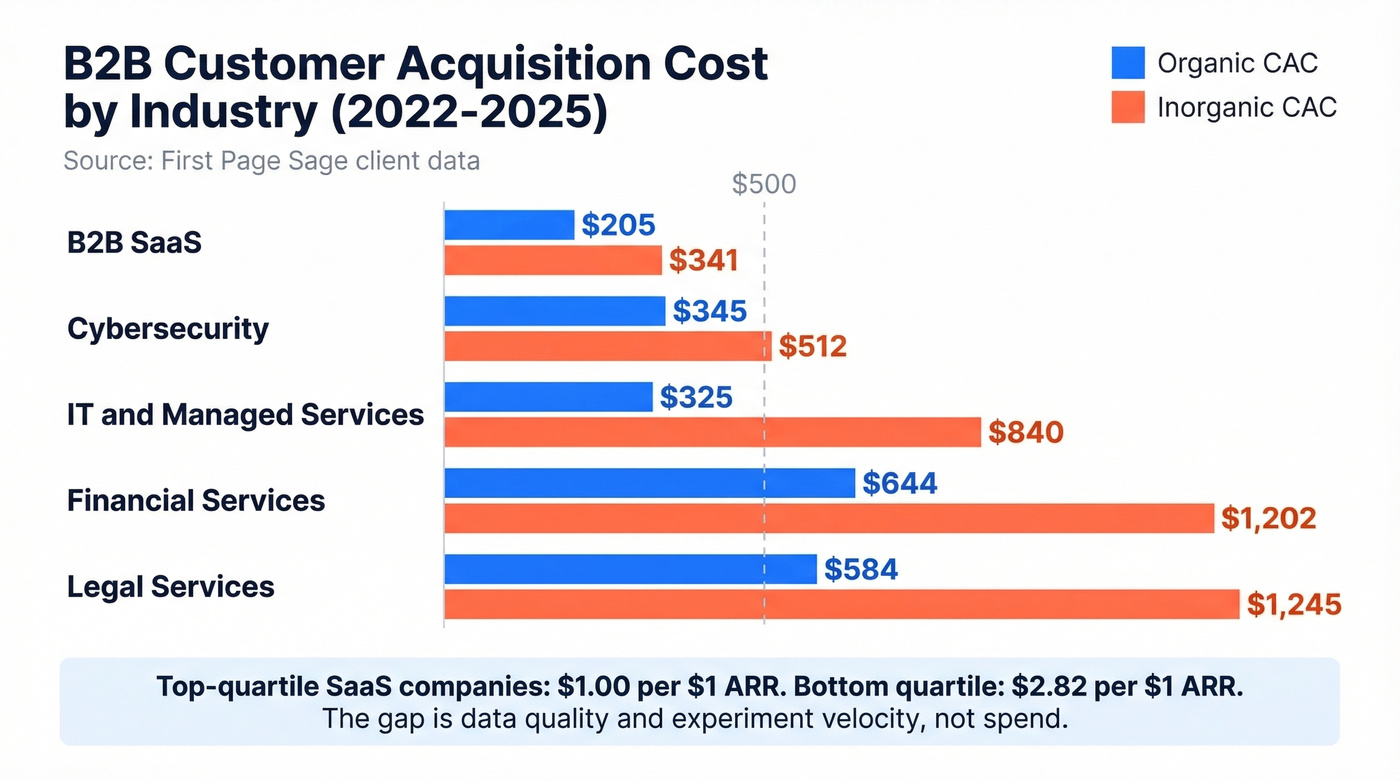
| Industry | Organic CAC | Inorganic CAC | Combined CAC |
|---|---|---|---|
| B2B SaaS | $205 | $341 | $239 |
| Cybersecurity | $345 | $512 | $387 |
| IT & Managed Services | $325 | $840 | $454 |
| Financial Services | $644 | $1,202 | $784 |
| Legal Services | $584 | $1,245 | $749 |
The combined averages are weighted roughly 75% organic and 25% inorganic, so they skew toward companies investing heavily in SEO. If your mix is paid-heavy, your actual blended CAC will be higher.
The efficiency spread is massive. Top-quartile SaaS companies acquire $1 of ARR for about $1.00 in spend. Fourth-quartile companies burn $2.82 for that same dollar. The difference isn't usually channel selection - it's data quality, targeting precision, and experiment velocity. You close that gap systematically, not by spending more.

The article says it plainly: if your bounce rate crosses 5%, your CAC benchmarks are meaningless. Prospeo's 98% email accuracy, 7-day data refresh, and 5-step verification keep bounce rates under 4% - so every channel dollar you spend reaches a real person.
Stop inflating CAC with bad data. Start with verified contacts at $0.01 each.
How to Choose Your Growth Channels
The consensus on r/b2bmarketing is clear: founders pick channels based on hype instead of matching them to their TAM, LTV, and audience behavior. Let's look at the math that should actually drive the decision.
Channel Unit Economics
| Channel | Cost Range | Performance | Best For |
|---|---|---|---|
| Cold email | $500/mo infra + $2-3K/mo execution | 1-2% reply, $200-500 CAC | Large TAM (50K+), mid LTV |
| LinkedIn outbound | ~$100/mo tooling | 20-30% connect, 5-15% reply | Small TAM, high LTV |
| Google Ads | $5-30/click B2B SaaS | 20-50 clicks/conversion | High LTV + search volume |
| LinkedIn Ads | $8-15 CPC, $150-400+ CPL | High CPL, precise targeting | $5K+ LTV only |
| Cold calling | 80-150 dials/day/rep | 3-5% connect (tech) | Enterprise, local services |
| SDR hire | ~$14,500/mo loaded | Breakeven month 4-5 | Outbound-first orgs |
The Decision Rules
Match your channel to your market reality, not to what worked for someone else's company.
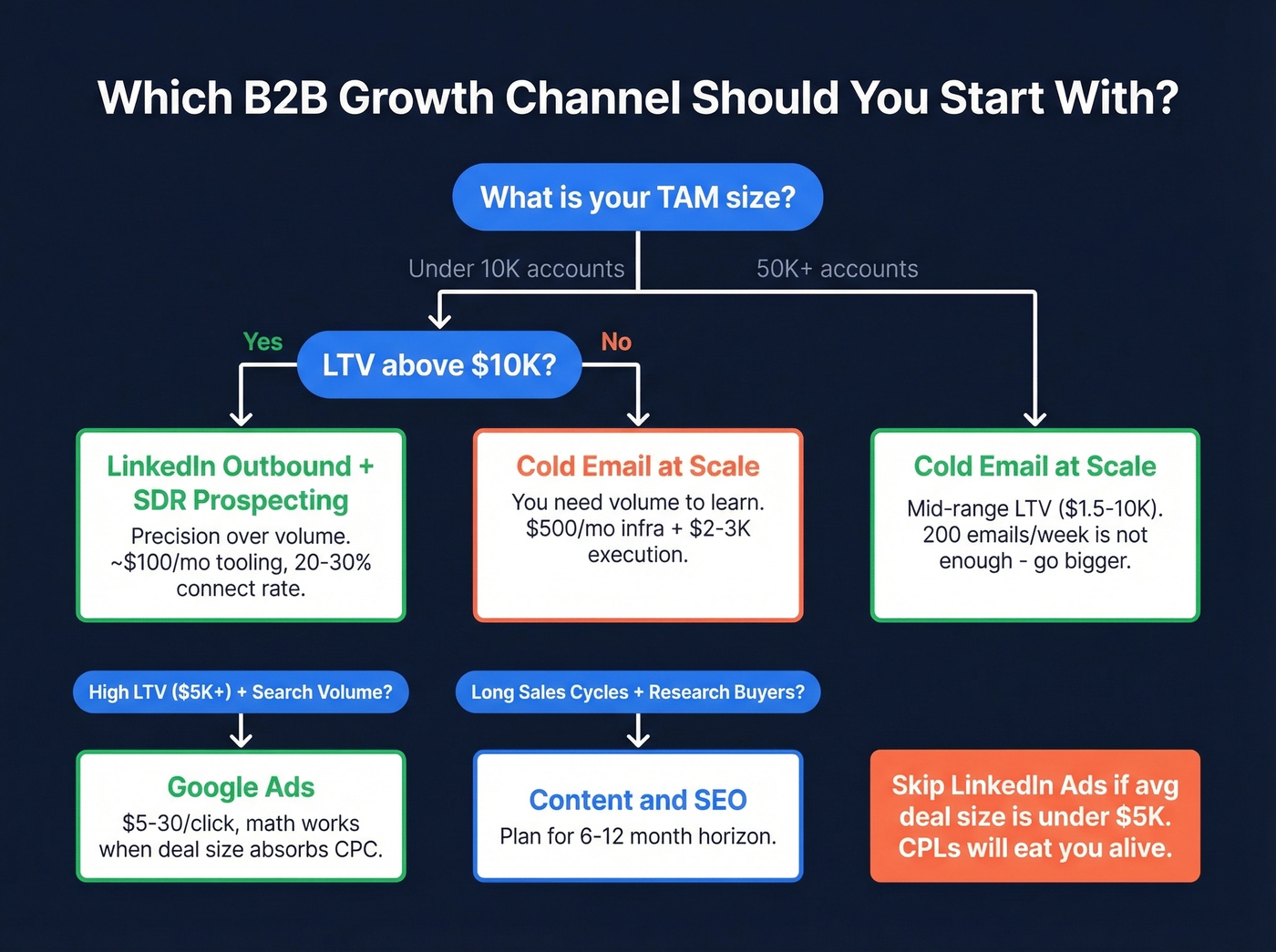
For teams with a small TAM (under 10K accounts) and high LTV ($10K+), LinkedIn outbound and SDR-driven prospecting make sense. You can't afford to spray - you need precision. When your TAM is 50K+ with mid-range LTV ($1.5-10K), cold email at scale is the play. You need volume to learn what messaging works, and 200 emails a week won't tell you anything statistically meaningful.
Any TAM with high LTV ($5K+) and real search volume justifies Google Ads - the math works when your deal size absorbs the CPC. For long sales cycles with research-heavy buyers, content and SEO are the right bet, but plan for a 6-12 month horizon before meaningful pipeline contribution.
Skip LinkedIn Ads entirely if your average deal size is under $5K. The CPLs will eat you alive.
Why Data Quality Decides Channel ROI
Every benchmark above assumes clean data. The moment your bounce rate crosses 5%, you're damaging domain reputation and inflating CAC. Cold email at $200-500 CAC becomes dramatically more expensive when a big chunk of your list is invalid.
This isn't theoretical. One outbound team cut bounce rates from 35% to under 4% after switching to Prospeo's verified data, tripling pipeline from $100K to $300K per week. The channel wasn't broken - the data feeding it was.

The 90-Day Plan
Theory is cheap. Here's the operating plan with gating metrics at each phase.
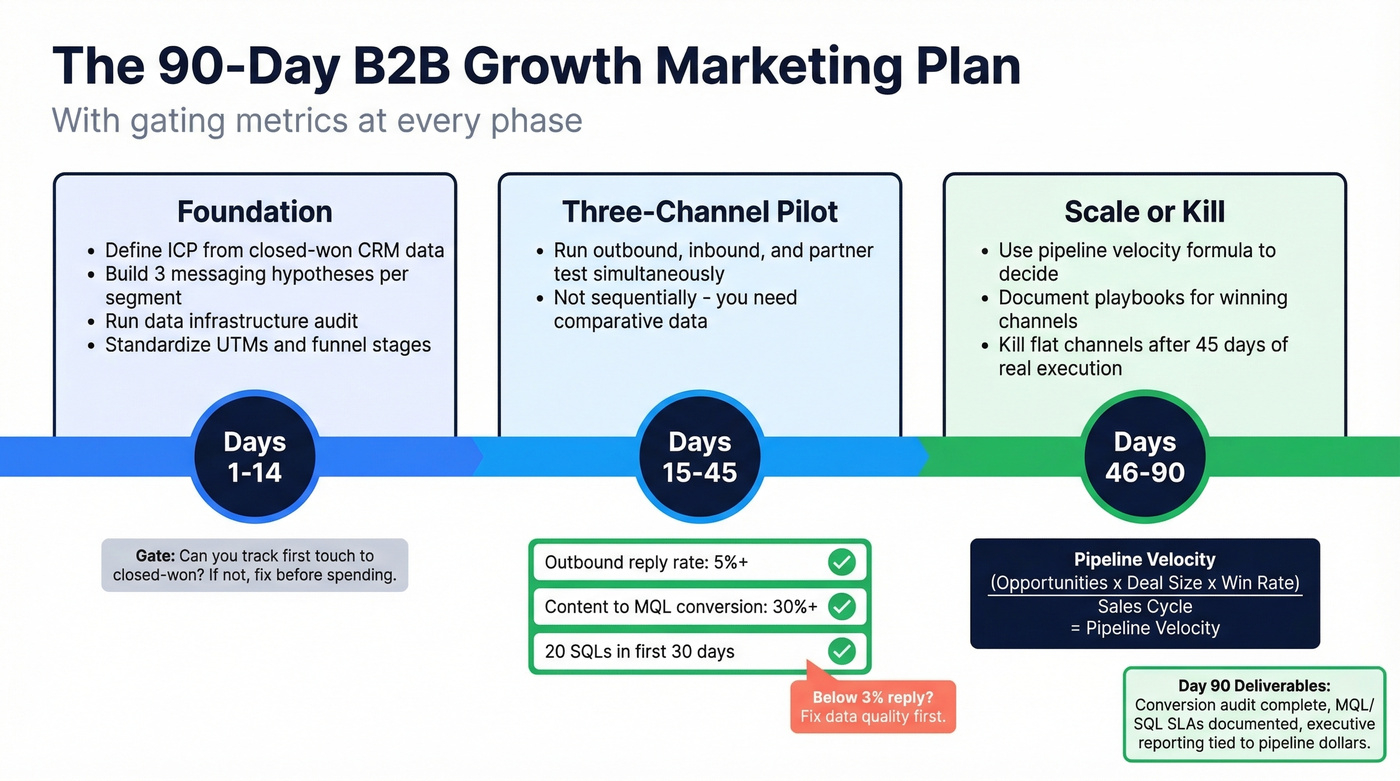
Days 1-14: Foundation
Define your ICP with evidence, not assumptions. Pull closed-won data from your CRM, identify the three to five firmographic and behavioral patterns that predict conversion, and build three messaging hypotheses per ICP segment. In our experience, teams that skip this evidence step waste their entire first 45 days chasing the wrong accounts.
Run a data infrastructure audit. Can you track a lead from first touch to closed-won? If the answer is "sort of," fix that before spending a dollar on channels. Get your CRM clean, your UTM structure standardized, and your funnel stages defined with clear exit criteria.
Days 15-45: Three-Channel Pilot
Run outbound, inbound, and a partner test simultaneously. Not sequentially - simultaneously. You need comparative data, and running channels in sequence wastes 90 days before you have it.
Gating metrics for this phase:
- Outbound reply rates of 5% or higher
- Webinar or content offer live-to-MQL conversion of 30% or higher
- 20 SQLs generated in the first 30 days
If outbound reply rates are below 3%, the problem is almost always data quality or messaging - not the channel itself. Fix the input before killing the channel.
Days 46-90: Scale or Kill
Here's where most teams fail. They keep running underperforming channels because "we haven't given it enough time." Use the pipeline velocity formula to make the call:
(Opportunities x Deal Size x Win Rate) / Sales Cycle = Pipeline Velocity
If a channel's pipeline velocity is negative or flat after 45 days of real execution, kill it and reallocate budget. Document playbooks for winning channels - messaging, targeting criteria, cadence, conversion assets. Build your experiments database with clear ship/iterate/stop decisions for every test.
By day 90, you should have a conversion assets audit complete, MQL/SQL handover flow documented with SLAs, and an executive reporting cadence that ties marketing activity to pipeline dollars - not vanity metrics. That's how you connect marketing to revenue growth in a way the board actually trusts.
Measuring Without Lying to Yourself
Most B2B marketing teams are measuring wrong, and they know it. That RevSure survey paints the full picture: 86% of marketing leaders can't connect multiple stakeholders to opportunities, 92% admit their MQL-based forecasting lacks precision, and nearly 90% report siloed systems and integration challenges.
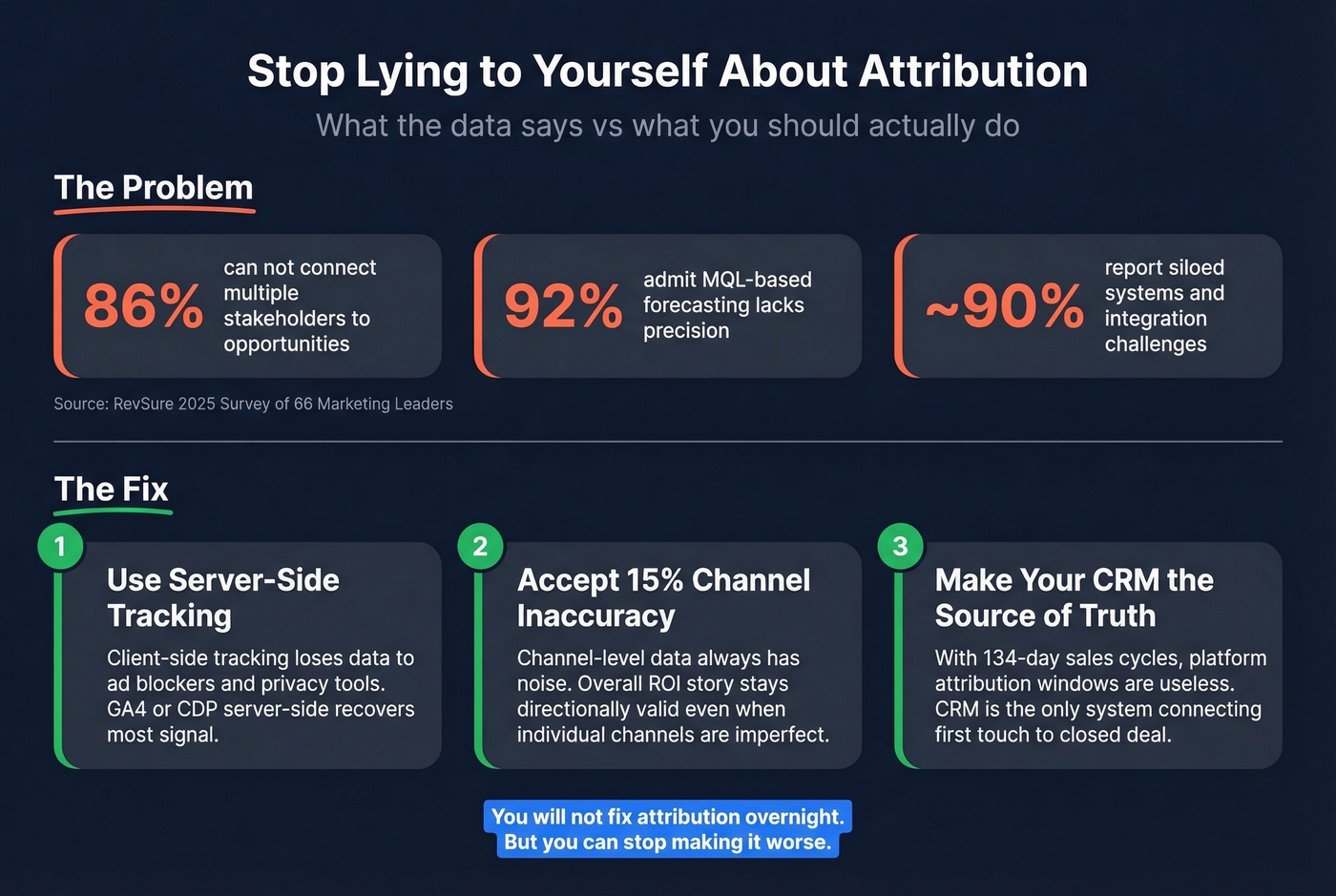
You're not going to fix attribution overnight. But you can stop making it worse.
Use server-side tracking. Client-side tracking loses data to ad blockers and privacy tools. Server-side implementations through GA4 or a CDP recover most of that signal.
Accept ~15% channel-level inaccuracy. Channel-level data will always have noise. The overall ROI story remains directionally valid even when individual channel attribution is imperfect.
Make your CRM the source of truth. With sales cycles running 134 days, platform-level attribution windows are useless. Your CRM is the only system that can connect a first touch in January to a closed deal in May.
The metrics that actually matter: CAC by channel, customer lifetime value, CAC ratio (spend per $1 ARR), pipeline velocity, and funnel conversion rates at each stage. Everything else is a vanity metric until these five are solid.
Case Studies With Real Numbers
SAP - EUR924M Pipeline From Brand + Content
SAP's "Inspire the Future" campaign is the best large-scale proof that brand investment drives pipeline. The results: EUR924.4M in pipeline generated and EUR266.15M in projected revenue. Social engagement ran 48% higher than any other SAP campaign, the podcast hit 22,000+ listeners (top 2% globally), and YouTube crossed 10,000 views within 30 days.
The campaign expanded globally across LATAM, India, China, and ANZ, attracting partner co-investment from companies like Capgemini. The lesson isn't "spend like SAP." It's that brand and content aren't soft metrics - they're pipeline infrastructure when executed with measurement discipline.
SaaS Content Campaign - 40% More Qualified Leads
A mid-market SaaS company ran a targeted content marketing campaign combining persona-driven content, lead scoring, webinars, and nurture sequences. Within six months: 40% increase in qualified leads and 20% improvement in lead-to-customer conversion. Webinar attendance hit 80% with half of attendees converting to high-quality leads, driving a 25% pipeline increase and 15% year-over-year revenue growth.
Those webinar numbers stand out. 80% attendance and 50% conversion to qualified leads is exceptional - and it came from tight persona targeting, not broad promotion. Content works when it's built for a specific buyer, not for "awareness."
The Tech Stack You Actually Need
Here's the thing: most teams use only about 42% of their martech stack. Don't buy tools you won't activate.
CRM: HubSpot (free tier to start; paid plans range from a few hundred to several thousand dollars per month depending on seats) or Salesforce. Non-negotiable - this is your measurement backbone. If you're evaluating options, start with a few examples of a CRM to map features to your workflow.
B2B Data Platform: We've tested a lot of data providers, and accuracy differences are real. Prospeo delivers 98% email accuracy with a 7-day refresh cycle, native integrations with Salesforce and HubSpot, and a free tier with 75 emails plus 100 Chrome extension credits per month. Self-serve, no contracts. If you're comparing vendors, use this shortlist of data enrichment services to sanity-check accuracy claims.
Marketing Automation: HubSpot Marketing Hub or Marketo (typically several thousand dollars per month). Keep it in the same ecosystem as your CRM to avoid integration headaches.
Intent Data: Bombora (~$25-50K/year), 6sense (~$30-100K+/year), or Demandbase (~$30-100K+/year) for enterprise ABM. If your average deal size is under $10K, you probably don't need a six-figure intent data platform. (If you do go this route, align it with intent based segmentation so it actually changes targeting.)
Analytics: GA4 with data-driven attribution, plus your CRM's native reporting. Don't buy a separate BI tool until you've maxed out what these two can do.
Look - the stack matters less than the data flowing through it. A $200/month tool stack with verified contacts outperforms a $50K/year stack built on stale data every single time.

Scaling cold email to 50K+ TAM accounts? That only works when every send hits a real inbox. Prospeo gives you 300M+ verified profiles with 30+ filters - buyer intent, technographics, headcount growth - so you target the right accounts and skip the expensive chaos.
Build your 90-day growth plan on data that actually connects to buyers.
FAQ
How long does it take to see results?
Outbound channels generate pipeline within 30-45 days with solid data and messaging. Content and SEO take 6-12 months. Plan for a 90-day pilot to identify winners, then scale. Most teams see measurable CAC improvement within one quarter.
What's the difference between growth marketing and demand gen?
Growth marketing covers the full customer lifecycle - acquisition, activation, retention, and expansion - using sprint-based experimentation. Demand gen focuses on filling the top of funnel. A complete growth strategy subsumes demand gen and adds post-acquisition revenue optimization.
What's a good CAC for B2B SaaS?
The combined average is around $239, with organic at $205 and inorganic at $341. More important is your CAC ratio: top-quartile companies spend about $1.00 to acquire $1 of new ARR. Above $2.00 means you have an efficiency problem that needs immediate attention.
Do I need a dedicated growth marketer?
Under $2M ARR, your existing team can run growth experiments with a structured 90-day framework. Between $2-10M ARR, a dedicated growth hire pays for itself within two quarters. Above $10M, you need a growth team, not a growth person.