

B2B Inbound Marketing: A Data-Backed Guide to What Actually Works
A fintech SaaS founder posted on r/b2bmarketing with a familiar confession: 95% of their revenue came from outbound. After a full year of B2B inbound marketing effort, they'd generated 80-100 qualified leads with a decent conversion rate - but ROI was "relatively low." The question wasn't whether inbound works for B2B companies. It was whether it works fast enough, and at what cost, to justify the investment.
That's the question this guide answers - with funnel math, channel benchmarks, and the operational details that separate programs generating pipeline from those burning budget.
What Separates Winners From Budget Burners
Three things matter. First, realistic funnel math and timeline expectations - most teams quit before compounding kicks in because nobody told them the real numbers. Second, channel prioritization based on ROI data, not gut feel. SEO and blog content consistently rank first; webinars consistently disappoint. Third, a data quality layer so sales can actually reach the leads you generate. The best content strategy in the world is worthless if your SDRs are emailing dead addresses.
The 2026 Inbound Reality
The definition hasn't changed: attract potential buyers through content, search, and education rather than interrupting them with cold outreach. Everything else has.
Buyers now complete 80% of their research independently before contacting a vendor. [60% of searches end](https://searchengineland.com/google-search-zero-click-study-2024-443869) without a click, thanks to AI Overviews answering queries directly in the SERP. When AI Overviews do appear, organic click-through rates drop by around 55%. Nearly 30% of marketers report decreased search traffic as buyers shift to AI tools for research. The organic traffic engine that powered inbound for a decade is running on less fuel.
Buying committees have ballooned to 10-13 stakeholders, the average B2B purchase journey spans 14+ touchpoints over 10.1 months, and 83% of marketers say customer paths are getting longer. HubSpot introduced "The Loop" at INBOUND - a framework built around Express, Tailor, Amplify, and Evolve stages that acknowledges buyers don't move linearly through funnels anymore.
Here's the thing: none of this is a reason to abandon inbound. It's a reason to stop running the 2019 version of it. AI-referred visitors convert at 23x higher rates and carry 4.4x higher value than average visitors. The teams winning in 2026 are building for zero-click visibility, multi-stakeholder nurture, and data quality at the handoff - not just blog traffic.
If your average deal size is under $10K and your sales cycle is under 30 days, you probably don't need a full inbound program. A solid landing page, some paid amplification, and a tight outbound motion will outperform a 12-month content investment. Inbound's compounding math rewards high-ACV, long-cycle businesses disproportionately.
Funnel Math Nobody Publishes
Before you invest in inbound, you need to understand what the numbers actually look like. Most guides skip this part because the truth isn't sexy.
FirstPageSage's 2026 benchmarks - based on client data from January 2022 through August 2025 - break down visitor-to-conversion rates by industry:
| Industry | Conversion Rate |
|---|---|
| B2B SaaS | 1.1% |
| IT & Managed Services | 1.5% |
| Financial Services | 1.9% |
| Manufacturing | 2.2% |
| Legal Services | 7.4% |
A separate Default benchmark study analyzing 100 B2B software websites found that once you cross 25,000 monthly visitors, your visitor-to-demo-request rate drops below 1%. Earlier-stage companies with less traffic actually convert better, almost certainly because their traffic is more targeted.
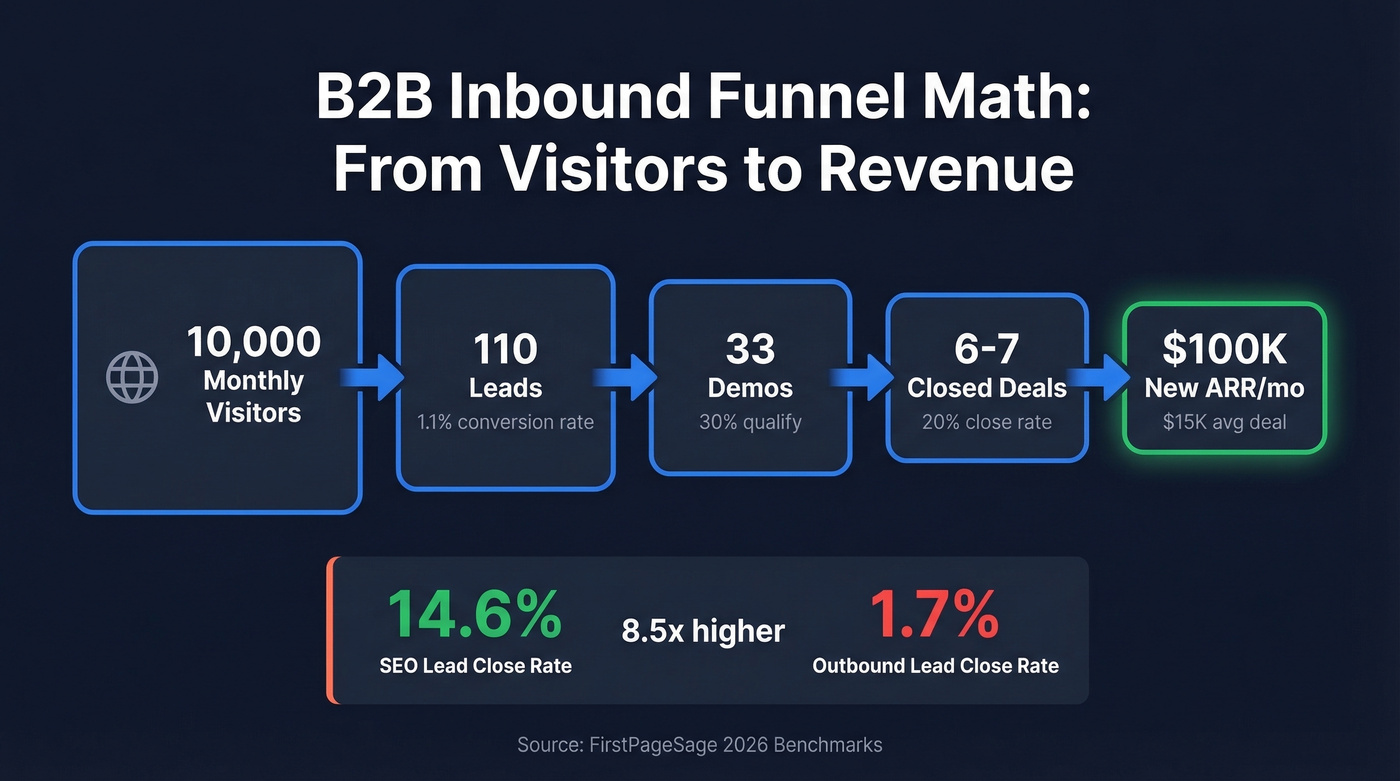
Let's run the math for a typical B2B SaaS company. Start with 10,000 monthly visitors at a 1.1% conversion rate - that's 110 leads per month. Assume 30% qualify for a demo and you're at 33 demos. With a 20% close rate and a $15,000 average deal, that's roughly 6-7 closed deals and $100K in new ARR per month. Not bad, but it took 10,000 visitors to get there, and building that traffic takes time.
The number that should really get your attention: SEO-sourced leads close at roughly 14.6% compared to 1.7% for outbound. Inbound leads are smaller in volume but dramatically higher in quality. Any lead generation strategy that accounts for this close-rate advantage will outperform outbound on a per-dollar basis - it just requires patience.
Why Most Programs Fail
The Content Marketing Institute's annual survey of 980 B2B marketers tells you exactly why most inbound programs stall. Only 29% rate their content strategy as very or extremely effective. The majority - 58% - land at "moderately effective," which is corporate speak for "we're doing stuff but can't prove it works."
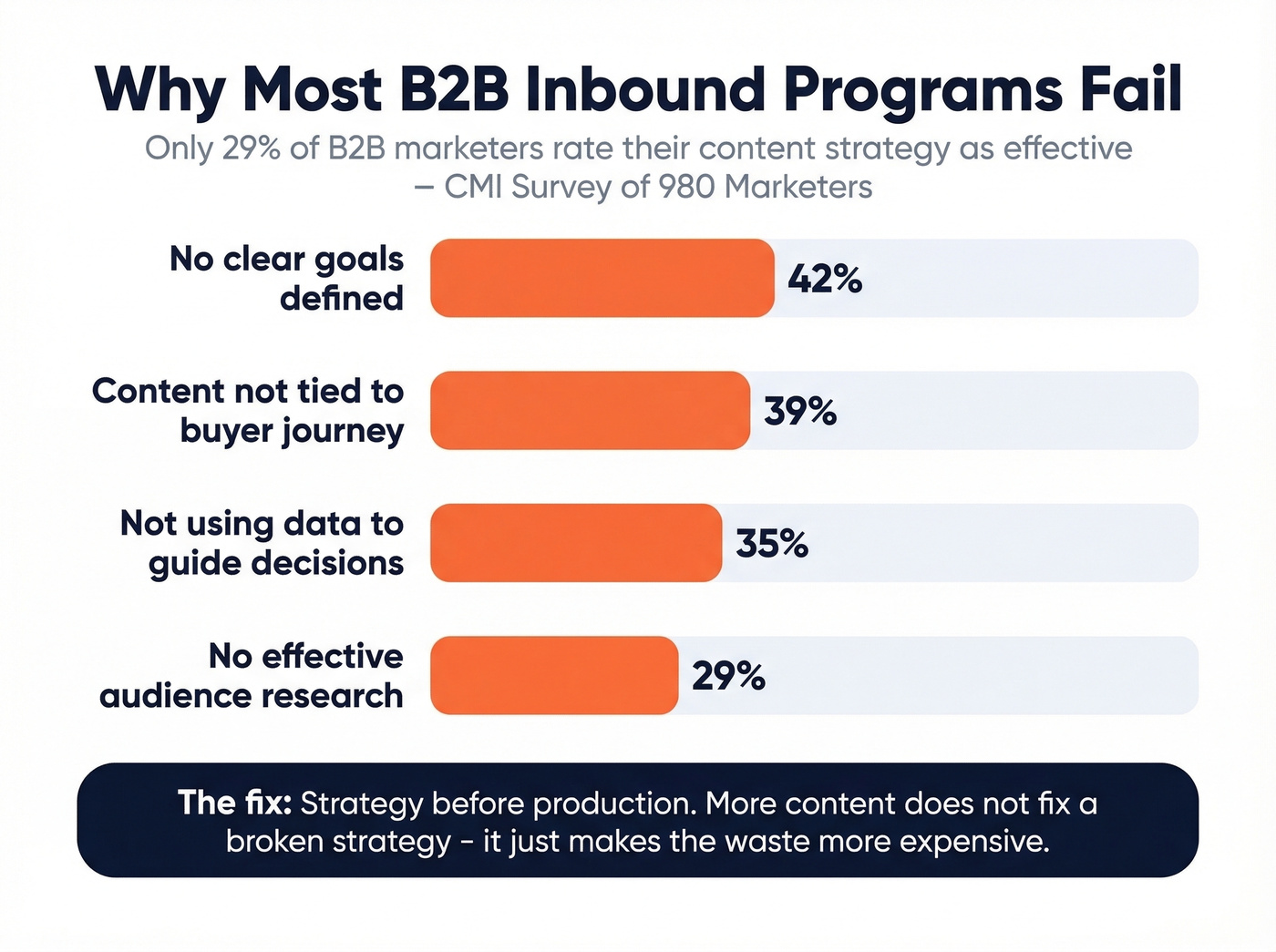
Among those underperforming teams, the root causes are remarkably consistent. 42% lack clear goals - they're publishing content without defining what success looks like, celebrating page views while pipeline stays flat. 39% haven't tied content to the buyer journey, writing what's easy to produce instead of what buyers need at each stage. 35% aren't data-driven, guessing which topics matter instead of using search data and conversion analytics. And 29% haven't done effective audience research, writing for a persona doc nobody updated since 2022.
Fix these problems before you spend another dollar on content production. We've seen teams triple their output while getting worse results because they never addressed the strategic foundation. More content doesn't fix a broken strategy. It just makes the waste more expensive.

You just read the math: inbound leads close at 14.6% vs 1.7% for outbound. But that advantage evaporates when SDRs can't reach those leads. Prospeo's 98% verified emails and 125M+ direct dials ensure every inbound lead your content generates actually gets contacted - not bounced.
Stop losing hard-won inbound leads to bad contact data.
Tactics That Actually Drive Pipeline
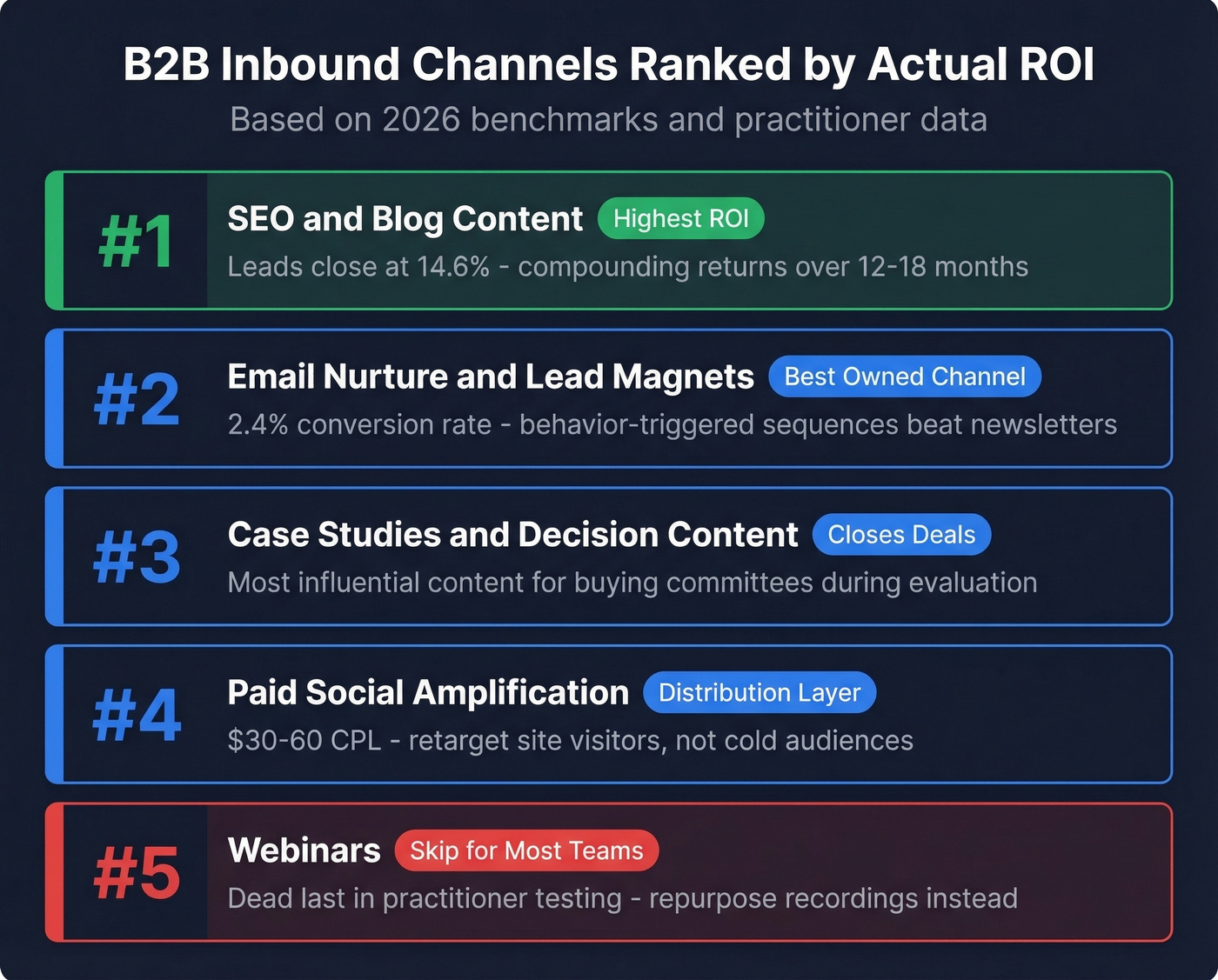
Not all inbound channels deliver equal returns. The top B2B channels by ROI: website/blog/SEO first, paid social second, and social media shopping tools third. Practitioner data from Reddit largely confirms this hierarchy, with one notable addition - network meetings and referrals outperformed everything for at least one B2B SaaS team.
SEO & Blog Content
This is your compounding engine. SEO-sourced leads close at roughly 8.5x the rate of outbound leads. The tradeoff is time - expect 3-6 months before you start ranking for target keywords, and 12-18 months before organic traffic becomes a meaningful pipeline source.
The tactical lesson from Sales Hacker's 268% traffic growth (90,000 to 242,000 monthly visitors in six months) is worth internalizing: don't target a topic unless you can produce content that's 3-5x better than what currently ranks first. That's not hyperbole - it's the minimum bar in a world where AI Overviews are summarizing mediocre content before anyone clicks through. With organic CTR dropping around 55% when AI Overviews appear, "good enough" content is now invisible content.
Your north star metric here isn't traffic. It's email list growth among your ICP. Traffic without capture is vanity. Build content upgrades, gated tools, and newsletter opt-ins into every high-intent page.
If you want a tighter operational view of what to track, start with funnel metrics and work backward from pipeline.
Email Nurture & Lead Magnets
Email remains the highest-ROI owned channel for B2B, with a 2.4% average conversion rate on campaigns. The key is segmentation - a generic monthly newsletter to your entire database won't move pipeline. Behavior-triggered sequences based on content consumption, page visits, and lead scoring changes will.
Lead magnets still work, but the bar has risen. Nobody's downloading a generic "State of X" PDF anymore. The magnets that convert in 2026 are interactive tools, benchmarking calculators, and templates that solve a specific workflow problem. If your lead magnet takes longer to read than to implement, it's too long.
Case Studies & Decision-Stage Content
Most inbound programs over-invest in top-of-funnel blog content and under-invest in the content that actually closes deals. Buying committees cite peer case studies as the most influential content type during evaluation - ahead of analyst reports and vendor demos.
A VP of Sales doesn't care about your thought leadership. They care whether a company like theirs got results. Build a case study library organized by industry, company size, and use case. Make them findable, not buried three clicks deep on your website.
Social Distribution & Paid Amplification
Creating content without a distribution plan is the most common inbound mistake we see. Organic social reach on most platforms is effectively zero for B2B company pages. The teams getting results spend $500-2,000/month pushing high-performing organic content to targeted audiences, where B2B CPLs typically run $30-60.
The play isn't running ads to cold audiences. It's retargeting people who've already visited your site, engaged with content, or match your ICP. Paid social as a distribution layer for organic content consistently outperforms paid social as a standalone lead gen channel.
Skip Webinars (Mostly)
Real talk: webinars are overrated for most B2B companies. The Reddit practitioner who tested every organic channel ranked webinars dead last - "performed very poorly." Attendance-to-pipeline conversion is typically abysmal, and the production overhead is significant. If you insist on running them, treat them as a mid-funnel nurture tool for existing leads, not a top-of-funnel acquisition channel. Repurpose the recording into blog posts, clips, and email sequences - the content is more valuable than the live event.
Building Your Inbound Stack
The average B2B org runs 12-20 marketing technology tools and spends $30,000-$80,000/year on the stack. 61% cite cost as their top concern, and 65.7% report data integration difficulties. A third admit they aren't using the full capabilities of what they've already bought.
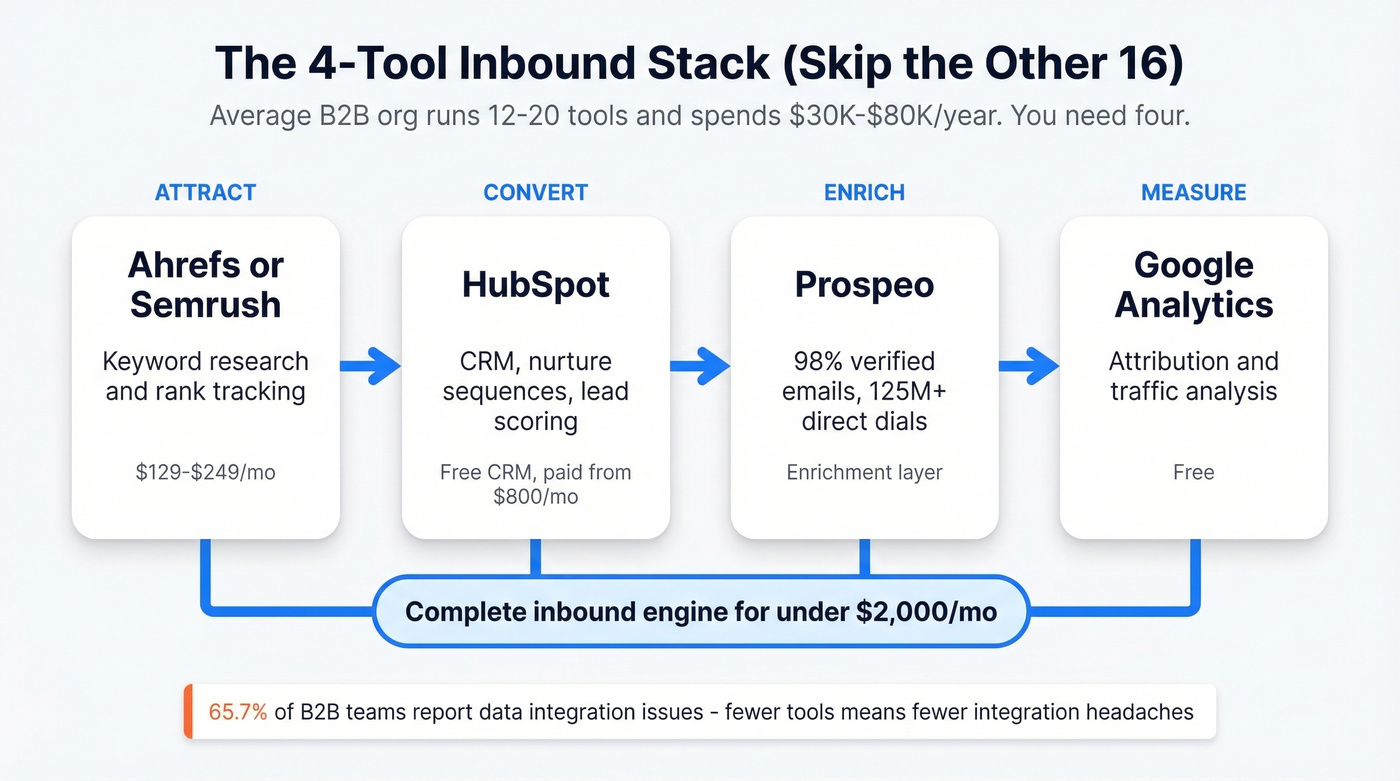
You don't need 20 tools. You need four.
| Tool | Category | Cost Range | Purpose |
|---|---|---|---|
| HubSpot | CRM + Automation | Free CRM; paid tiers ~$800-$3,600+/mo | Nurture, scoring, CRM |
| Google Analytics | Measurement | Free | Attribution, traffic |
| Ahrefs or Semrush | SEO | ~$129-$249+/mo | Keyword research, tracking |

This minimum viable stack covers the entire inbound workflow: attract (SEO tool), convert (HubSpot), enrich (Prospeo), and measure (GA). The "trifecta stack" of HubSpot + LinkedIn Ads + Google Analytics is used by 28.5% of mid-market companies. Add an enrichment layer and an SEO tool, and you've got a complete inbound engine for under $2,000/month - well below the industry average.
If you're evaluating vendors for the enrichment layer, compare options in data enrichment services.
The Lead Quality Gap
Every inbound guide covers how to generate leads. Almost none address what happens after a lead converts. This is the gap that kills ROI.
Here's the scenario we see constantly: marketing generates 200 inbound leads per month. They flow into the CRM. An SDR picks up the phone or sends an email. The email bounces. The phone number is wrong. The lead sits in a queue for 48 hours while someone manually researches the contact. By the time sales reaches out, the buyer has moved on.
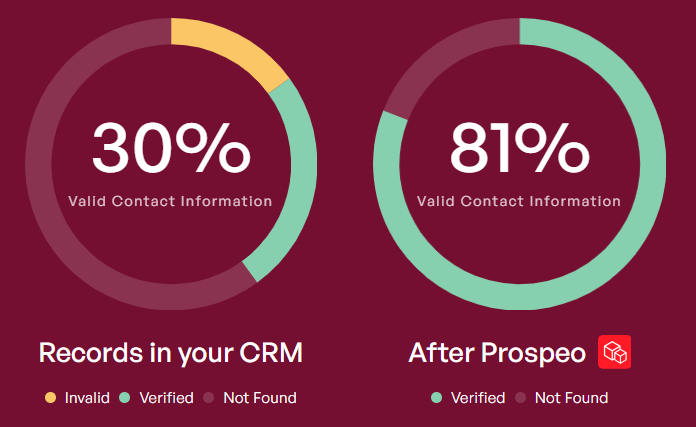
The Meritt team lived this exact problem. Their bounce rate was running at 35%, which meant more than a third of their outreach never reached anyone. After implementing CRM enrichment that returns 50+ data points per contact with a 92% API match rate, bounce rates dropped to under 4%. Pipeline tripled from $100K to $300K per week. Connect rates jumped 3x to 20-25%.
Every inbound lead that enters your CRM should get verified emails, direct dials, company data, and technographic signals automatically. A weekly data refresh cycle keeps records current instead of stale. This is the layer that turns leads into actual conversations, and it's the piece most strategies completely ignore. Aligning marketing and sales around shared data quality standards is what separates programs that generate pipeline from those that generate frustration.
If you're seeing bounces, start by fixing your email bounce rate before scaling volume.
42% of B2B teams lack clear goals. 35% aren't data-driven. Don't add a broken handoff to the list. Prospeo enriches every inbound lead with 50+ data points - verified emails, direct dials, technographics, and intent signals - so sales knows exactly who they're calling and why.
Turn every inbound conversion into a sales-ready contact in seconds.
Case Studies With Real Numbers
Theory is useful. Numbers are better.
An industrial oven manufacturer invested in inbound content targeting engineers and procurement teams through Gorilla76. Result: $9M in pipeline attributed to inbound efforts. This wasn't a SaaS company with a viral product - it was an industrial business selling complex, high-ticket equipment. A generator distributor working with the same agency generated $800,000 in Q2 revenue, driven by technical comparison guides and ROI calculators that purchasing committees actually used during evaluation.
A material science startup generated 92 qualified leads in 10 months from a standing start. For an early-stage company in a niche vertical, that's a pipeline that would've cost 5-10x more through outbound alone.
Sales Hacker's content play grew traffic 268% in six months - from 90,000 to 242,000 monthly visitors. Their north star metric wasn't page views; it was email list growth among directors and VPs of marketing. They used enrichment surveys with a 15% response rate and tools like Clearbit to qualify and segment their list.
The timeline reality across all of these: 3-6 months to start ranking, 6-12 months to see meaningful pipeline, 12-18 months to reach compounding returns. No shortcuts.
Your First Year - Month by Month
If leadership can't commit to 12-18 months, don't start. That's not pessimism - it's the math.
Months 1-3: Foundation. Build your ICP and buyer personas using real customer data. Audit existing content against the buyer journey. Set up your minimum viable stack. Establish baselines for traffic, conversion rates, lead volume, and pipeline attribution. Publish your first 8-12 pieces targeting high-intent, lower-competition keywords. This is where you define the tactics that match your market and ACV.
If you need a practical starting point, use an Ideal Customer Profile template and scoring rubric.
Months 3-6: First signals. Early content starts ranking. Initial organic leads trickle in - don't panic if the numbers are small. Launch email nurture sequences. Activate paid amplification on your best-performing content. This is where most teams quit because the numbers don't look impressive yet. Don't.
Months 6-12: Compounding begins. Traffic growth accelerates as older content gains authority and backlinks. Pipeline attribution becomes clearer. Double down on topics that convert, prune content that doesn't, expand into adjacent keywords. Sales Hacker's 268% traffic growth happened in this window. By month 12, you should have enough data to calculate true inbound CAC and compare it to outbound.
To pressure-test ROI, map inbound costs to cost to acquire customer and compare against outbound.
I'll be honest: the first six months feel like shouting into a void. The second six months feel like compound interest. Teams that survive the void win.
FAQ
How long does B2B inbound marketing take to show results?
Expect 3-6 months for first rankings and initial leads, then 12-18 months for meaningful, attributable pipeline. Content quality and publishing consistency are the two non-negotiable inputs - teams that publish fewer than 4 pieces per month rarely reach compounding.
What's the difference between inbound and outbound?
Inbound attracts buyers through content and SEO - they come to you. Outbound reaches them directly through cold email and calls. The best B2B programs blend both: outbound delivers faster meetings while inbound compounds over time at roughly 8.5x the close rate.
How much does a B2B inbound program cost?
A minimum viable stack - HubSpot free CRM, a free-tier enrichment tool, Google Analytics, and an SEO platform - starts under $500/month. Add content team salaries or agency fees for the full picture, which typically runs $5,000-$15,000/month total.
Which inbound channel has the highest ROI?
SEO and blog content rank first across every benchmark study. That said, conversion rate optimization on existing pages often delivers faster returns than producing more content. Fix your landing pages before you publish your next blog post.
How do you prevent inbound leads from going stale?
Enrich every lead with verified emails and direct dials the moment it enters your CRM. A weekly data refresh cycle eliminates the bounced-email problem that silently kills inbound ROI - the Meritt team cut bounce rates from 35% to under 4% this way.