

The 12 Best B2B Intent Data Providers - With Pricing Nobody Else Publishes
You're a VP of Marketing staring at a $60,000 renewal quote for intent data. Your SDRs say the signals are "interesting but not actionable." Your CFO wants proof it's working. And your provider just told you pricing is "custom" - again.
70% of B2B teams cite data quality as their top challenge with intent data, and the consensus on Reddit is blunter: practitioners who've tested the major vendors describe themselves as "mostly disappointed." The market's real, the technology works, but picking the wrong B2B intent data provider at the wrong price is a $50K+ mistake. We've spent months testing these tools and talking to teams who use them daily, so let's break down what actually delivers.
Our Top Picks
| Pick | Best For | Starting Price |
|---|---|---|
| Bombora | Deepest third-party topic intent (raw signal layer) | ~$25,000/year |
| 6sense | Enterprise predictive buying-stage intelligence | ~$50,000/year |
| Prospeo | Intent signals + verified contact data in one platform | Free tier; ~$0.01/email |
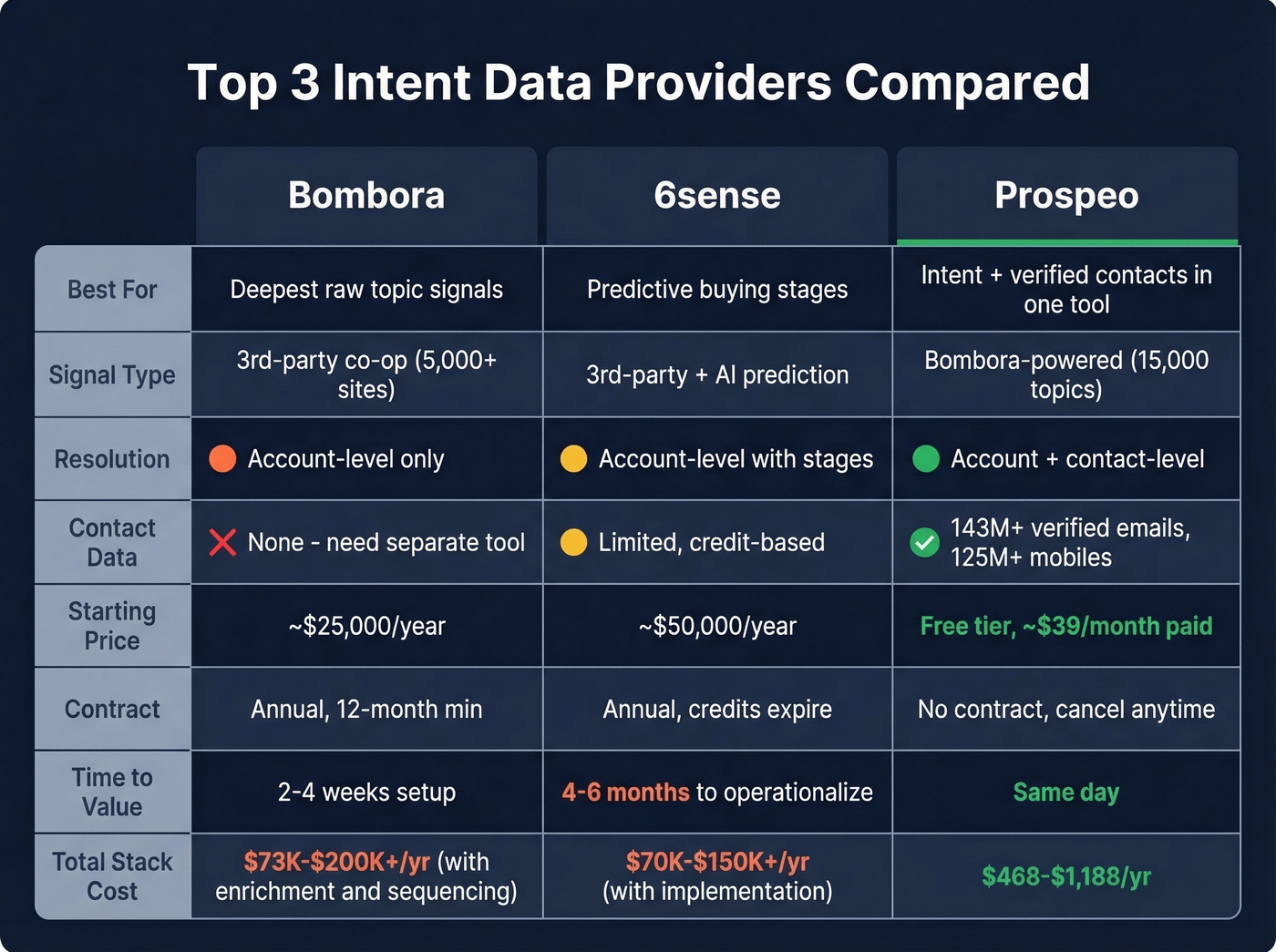
Bombora is the gold standard for raw third-party topic signals - but it's a signal layer, not an activation platform. 6sense is the enterprise play: predictive buying stages, AI-driven orchestration, and a price tag to match. Prospeo is the pick when you need to go from "this account is surging" to "here's the VP's verified email and direct dial" without stitching three tools together.
What B2B Intent Data Actually Is
Intent data captures digital signals suggesting a company or individual is actively researching a problem your product solves. The nuance is in the signal source and resolution level.
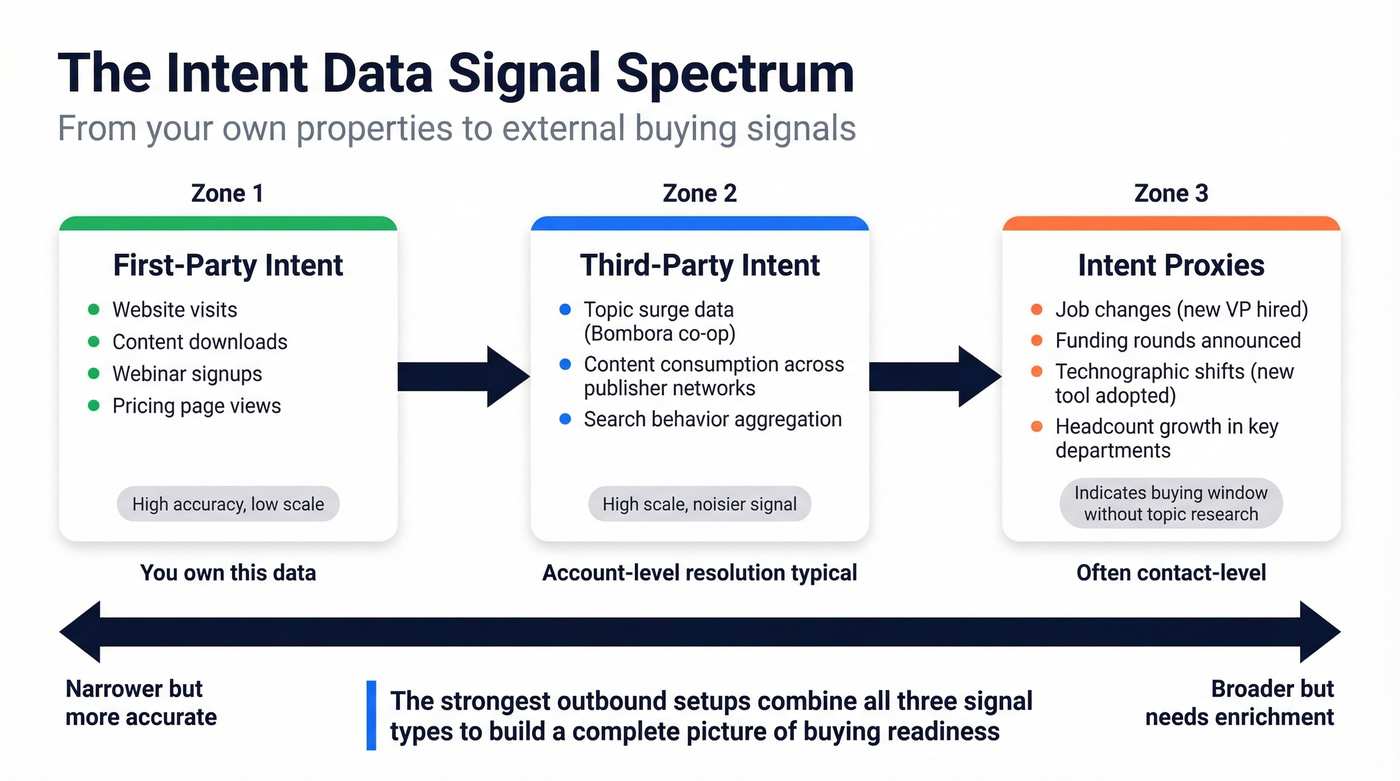
First-party intent comes from your own properties - website visits, content downloads, webinar registrations. High accuracy, but limited to people who already know you exist. Third-party intent is aggregated from external publisher networks. Bombora, for example, tracks digital journeys across a network of 5,000+ B2B websites. The scale is massive, but the signal is noisier.
Then there's the resolution question. Most third-party intent operates at the account level - "Acme Corp is researching cloud security." Useful for ABM prioritization, but it doesn't tell you which person at Acme to call. Contact-level intent ties signals to individuals, which is rarer and far more valuable for outbound teams. Job-change signals, technographics, and funding events function as intent proxies too - they indicate a buying window even if nobody's reading whitepapers. The strongest intent prospecting setups combine these proxy signals with traditional topic-surge data to give sales teams a fuller picture of buying readiness.
How to Choose - Forrester's 4 Business Models
Before you compare features, understand what kind of provider you're evaluating. Forrester's 4 Business Models classifies intent vendors into four business models, and mixing them up is how teams end up with overlapping tools and wasted budget.
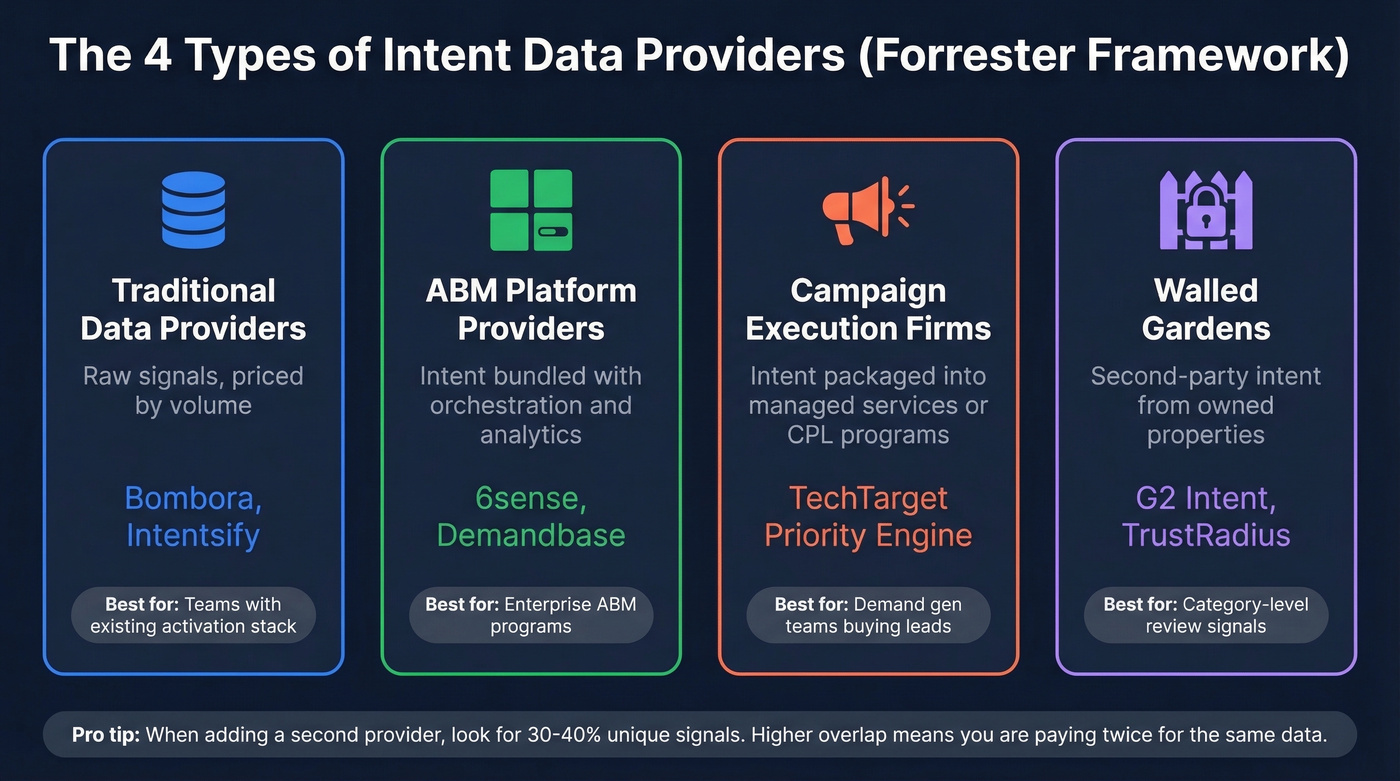
Traditional data providers sell standalone third-party signals priced by volume. Bombora is the archetype - raw intent data you pipe into your own stack. ABM platform providers bundle intent into a broader platform with analytics, orchestration, and advertising. 6sense and Demandbase live here. Campaign execution firms package intent into managed services or CPL-based programs. Informa TechTarget's Priority Engine straddles this line. Walled gardens offer second-party intent from their own properties - G2 Buyer Intent and TrustRadius know who's reading reviews of your category, a powerful but narrow signal.
Most mature teams use more than one source. Forrester recommends looking for ~30-40% unique signals when adding a second provider. If the overlap is higher, you're paying twice for the same data.

Most intent data providers stop at the account level - you know Acme Corp is surging, but not who to call. Prospeo layers Bombora-powered intent across 15,000 topics with 143M+ verified emails and 125M+ direct dials, so you go from signal to send in one platform. No $50K contracts. No stitching three tools together.
Stop paying enterprise prices just to know who's researching - start reaching them.
What Intent Data Actually Costs in 2026
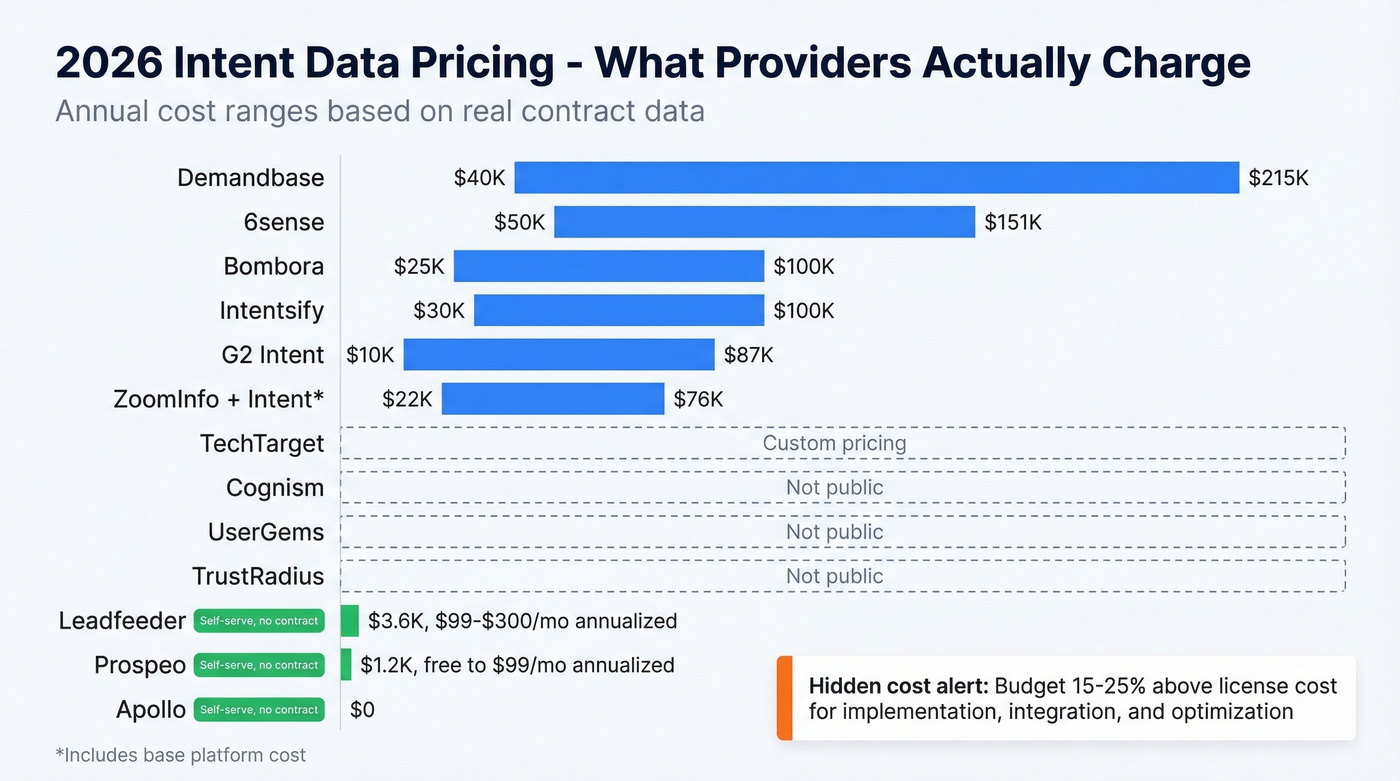
Every major provider hides pricing behind "contact sales." Here's what these companies actually charge - plus the number nobody talks about: budget 15-25% above your license cost for implementation, topic configuration, CRM integration, and ongoing optimization. A $60K 6sense contract is really a $70-75K commitment in year one.
If you're evaluating vendors alongside your broader RevOps tech stack, this is where costs usually balloon.
| Provider | Best For | Signal Type | Entry Price | Mid-Market Range |
|---|---|---|---|---|
| Bombora | Raw topic signals | 3rd-party co-op | ~$25K/yr | $50K-$100K/yr |
| 6sense | Predictive buying stages | 3rd-party + AI | ~$50K/yr | $58K-$150K/yr |
| Prospeo | Intent + verified contacts | Bombora-powered + verified contact data | Free | ~$39-$99/mo |
| Demandbase | ABM + intent | 3rd-party + 1st-party | ~$40K/yr | $80K-$215K/yr |
| ZoomInfo | Intent add-on | 3rd-party (Bombora) | ~$7.2K/yr | $15K-$36K/yr |
| TechTarget | Tech buyer intent | 1st-party (walled) | Custom | Custom |
| Intentsify | Multi-source aggregation | 3rd-party blend | ~$30K/yr | $50K-$100K/yr |
| Cognism | EMEA + intent | 3rd-party (Bombora) | Not public | Not public |
| G2 Intent | Review-site signals | 2nd-party (walled) | ~$10K/yr | $30K-$87K/yr |
| Apollo.io | Budget prospecting | Lighter 3rd-party | Free | $59-$149/user/mo |
| Leadfeeder | Website visitor ID | 1st-party | Free; ~$99/mo paid | $99-$300/mo |
| UserGems | Job-change signals | Proprietary | Not public | Not public |
| TrustRadius | Review-site signals | 2nd-party (walled) | Not public | Not public |
Most enterprise intent vendors sell annual contracts with 12-month minimums. Prospeo and Apollo offer self-serve pricing with no contracts. Leadfeeder also has a self-serve plan.
The 12 Best Intent Data Tools
Bombora
Bombora runs one of the largest intent data cooperatives in B2B. The platform tracks digital journeys across a network of 5,000+ B2B websites, analyzing billions of consumption events every month across 18,000+ intent topics. As the co-op model archetype, Bombora's signal depth is unmatched by any single competitor.

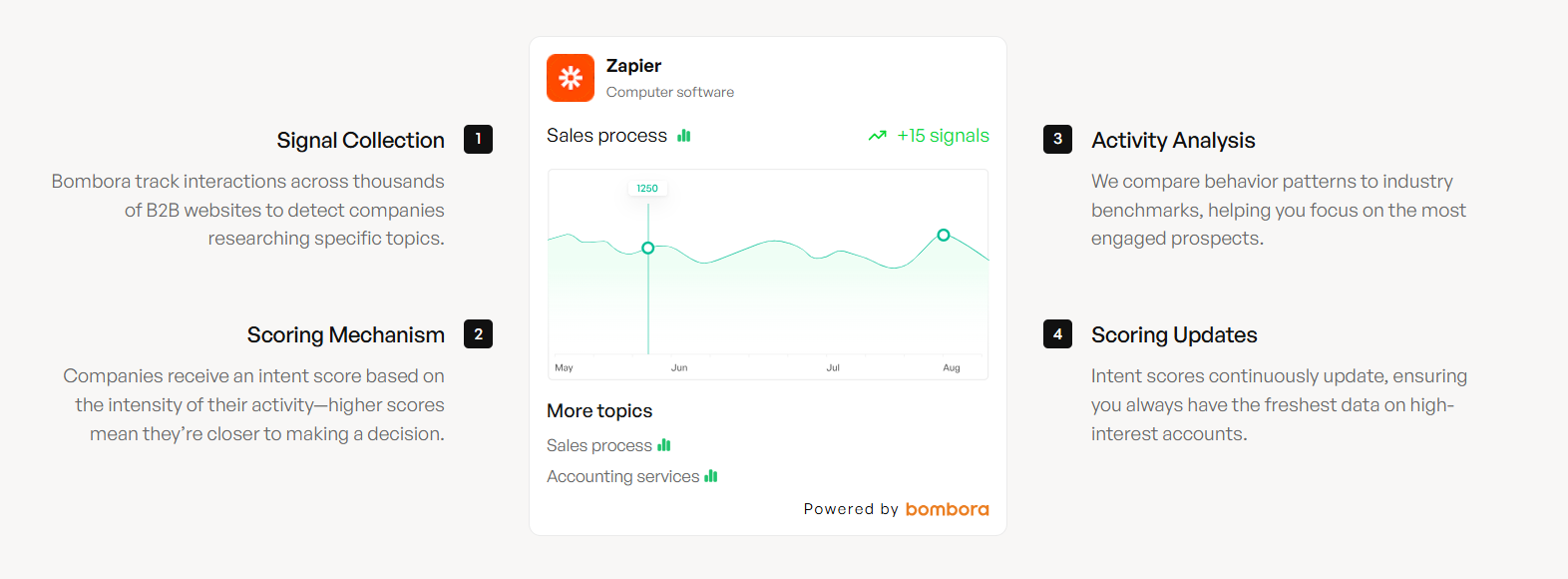
The Company Surge product tells you which accounts are researching specific topics at abnormal volumes compared to their baseline. The data is account-level, not contact-level, so you'll need a separate tool to find the right person at a surging account. Pricing is commonly structured by topic count - basic topics often land around $500-$2,000/year each, premium topics $5,000-$25,000. Most teams need 20-50 topics, which is how a "basic" plan quickly scales to six figures.
Use this if: You want the deepest third-party topic signal and you've already got data enrichment and sequencing tools in your stack.
Skip this if: You're a smaller team looking for an all-in-one solution. Bombora is a signal layer. By the time you add enrichment, a sequencer, and a dialer, your total stack cost runs $73,600-$200,000+/year.
6sense
6sense doesn't just tell you an account is researching - it predicts where they are in the buying journey. The platform uses AI to assign accounts to buying stages (awareness, consideration, decision, purchase), letting teams prioritize based on readiness, not just topic volume.

The pricing reality: Vendr's dataset of 314 purchases shows a median annual cost of $58,617, with a range from $10,621 to $151,709. Enterprise deployments with expanded TAM and premium data packages hit $300K+. The platform runs on credits, and here's the gotcha - credits don't roll over. If you don't use them, they expire. There's a free plan at 50 credits/month, but serious usage starts around $50K/year.
Use this if: You're an enterprise team that needs predictive buying-stage intelligence and can commit to a 6+ month implementation.
Skip this if: You need fast time-to-value. We've seen teams take 4-6 months to fully operationalize 6sense, and the credit expiration model punishes slow adoption.
Prospeo
Here's the thing most intent data buyers discover too late: knowing an account is surging means nothing if you can't reach the right person there. Prospeo closes that gap. The platform layers 15,000 Bombora-powered intent topics on top of a 300M+ professional profile database with 143M+ verified emails and 125M+ verified mobile numbers, all refreshed on a 7-day cycle.
If you're comparing vendors, it helps to benchmark against the broader B2B database landscape too.
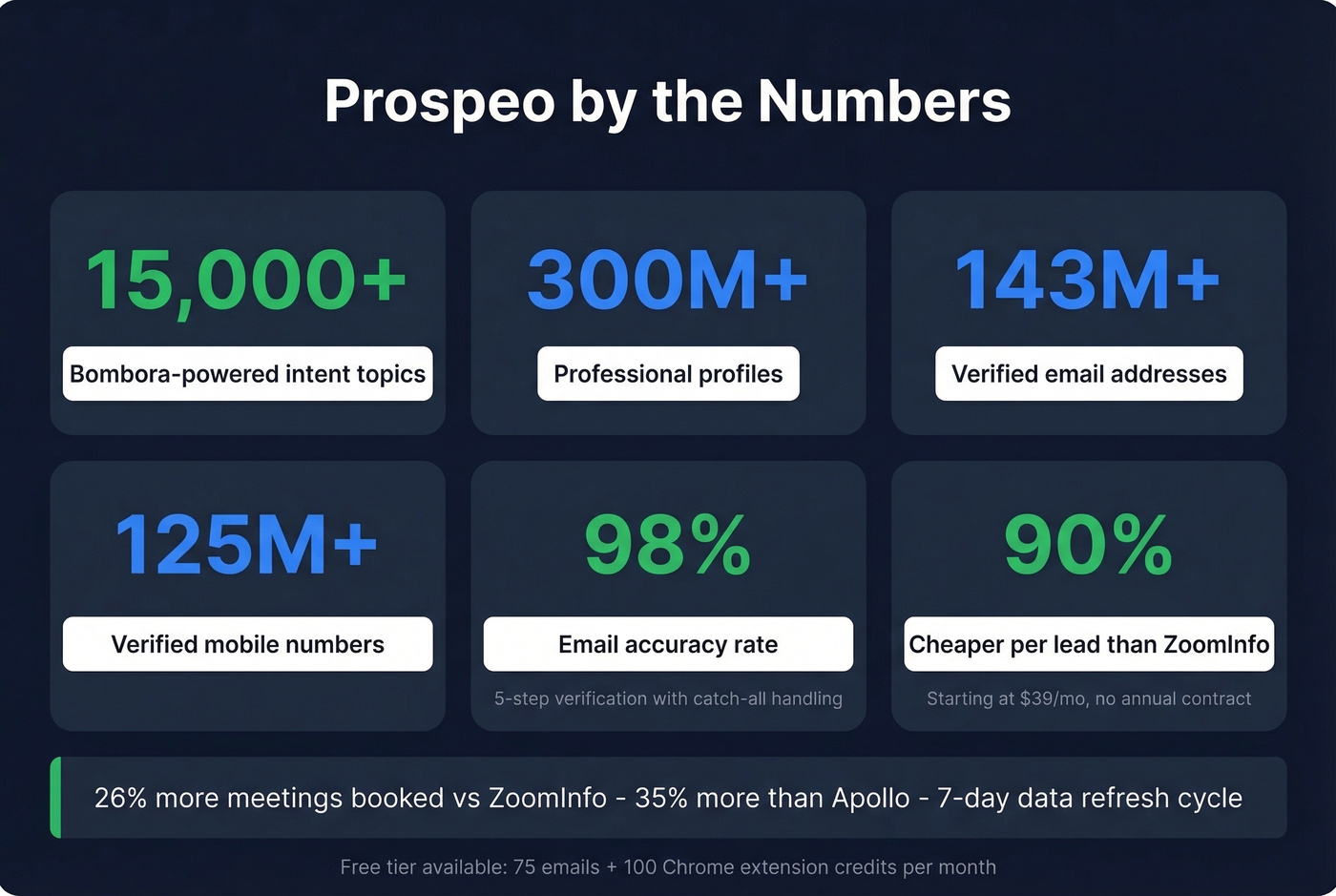
Where standalone intent providers stop at account-level signals, Prospeo lets you filter by intent topic surge and job title, department headcount growth, technographics, funding events, and 30+ other criteria to surface the exact decision-makers at in-market accounts. Email accuracy sits at 98% thanks to a proprietary 5-step verification process with catch-all handling and spam-trap removal. Mobile numbers carry a 30% pickup rate across all regions.
The pricing model is the real differentiator for teams that aren't ready to commit $50K+ annually. A free tier includes 75 emails and 100 Chrome extension credits per month. Paid plans start around $39/month with no annual contracts - roughly 90% cheaper per lead than ZoomInfo. Teams using Prospeo report booking 26% more meetings compared to ZoomInfo and 35% more than Apollo, largely because fresher data means fewer bounces and more live conversations.
Use this if: You want intent signals and verified contact data in one self-serve platform without enterprise pricing or long implementation cycles.
Skip this if: You need deep predictive buying-stage modeling or managed ABM orchestration - that's 6sense or Demandbase territory.
Demandbase
Demandbase is the other major ABM platform with bundled intent, combining third-party and first-party signals with account identification, advertising, and sales intelligence. The AWS Marketplace lists a 12-month contract at $215,000 for Demandbase One, though typical mid-market deals land in the $40K-$120K range with an average discount of 13%. One catch: Demandbase can't sync Salesforce custom objects, which increases implementation complexity. Median ROI timeline is 13 months per G2 data.
ZoomInfo Streaming Intent
ZoomInfo's intent data is Bombora-powered and sold as an add-on to the core platform. Mid-market intent pricing runs $7,200-$36,000/year, but you're paying for the core ZoomInfo platform on top of that - typically $15K-$40K+/year. So the real cost of "ZoomInfo with intent" is $22K-$76K/year.
If you're already a ZoomInfo customer, adding Streaming Intent is the path of least resistance. If you're not, buying ZoomInfo just for intent is like buying a house because you like the mailbox.
Informa TechTarget
TechTarget operates a walled garden of 220+ technology and vertical websites with 50M+ permissioned professionals, generating 1M+ directly observed intent signals per day. The Forrester Wave named them a Leader and "Customer Favorite." This is the strongest option for tech vendors selling to IT buyers. Pricing is custom. If you're selling outside tech, look elsewhere.
Intentsify
Intentsify earned the highest score in 12 of 21 categories in the Forrester Wave, making it a top-ranked Leader for current offering. Their differentiator is multi-source signal aggregation - blending multiple third-party intent feeds rather than relying on a single co-op. Pricing typically runs $30K-$100K+/year. If single-source intent noise is frustrating you, Intentsify's aggregation approach is worth evaluating.
Cognism
Cognism partners with Bombora to provide intent signals inside its platform, and it's a strong option for teams selling into EMEA that want prospecting plus intent in one workflow. GDPR compliance is baked in, not bolted on. Where Cognism often wins over ZoomInfo: European data quality and compliance. Where ZoomInfo still wins: US database depth. If your ICP is heavily European, Cognism deserves a serious look.
G2 Buyer Intent
Second-party intent from the G2 review platform - tells you which companies are researching your category, reading competitor reviews, or comparing alternatives. Pricing ranges from $10,000 to $87,000+/year as an add-on to your G2 vendor profile. Best for companies already investing in G2 presence.
Apollo.io
The budget entry point. Apollo bundles lighter intent filters into paid plans (Basic $59 / Professional $99 / Organization $149 per user/month). The Organization plan requires a minimum of 3 users and is annual-billing only. Signals aren't as deep as Bombora's, but for teams that need prospecting with intent prioritization and don't have $25K to spend, Apollo gets you moving fast.
Leadfeeder (Dealfront)
Website visitor identification - first-party intent showing which companies visit your site. Free plan available; paid plans start around $99/month. Core technology is IP-to-company resolution, which means remote work and VPNs create real accuracy gaps. Best for teams that want to know who's browsing their pricing page, but don't expect contact-level precision.
UserGems
Job-change signals as an intent proxy. When your champion moves to a new company, that's a buying signal - and often a strong one. UserGems tracks these transitions and surfaces pipeline opportunities. Pricing is custom. A complement to traditional intent data, not a replacement.
TrustRadius (acquired by HG Insights)
Another walled-garden, second-party intent source from a review platform. HG Insights acquired TrustRadius in 2025, signaling continued market consolidation. Pricing is custom.
The real cost of intent data isn't the license - it's the $73K+ stack you build around it. Prospeo combines Bombora intent signals with 98%-accurate contact data, 30+ prospecting filters, and native sequencer integrations starting at $0.01/email. One platform replaces the signal layer, the enrichment tool, and the data vendor.
Get intent signals and verified contacts in one platform - no annual contract required.
Mistakes That Kill Intent Data ROI
We've watched teams burn through $100K+ in intent data spend and have nothing to show for it. The technology isn't the problem - the implementation is.
Treating all intent sources the same. Bombora co-op signals, TechTarget first-party data, and G2 review-site behavior are fundamentally different in methodology, accuracy, and freshness. Weighting them equally in your scoring model produces garbage prioritization.
Ignoring signal freshness. Intent data decays fast. A topic surge from three weeks ago doesn't mean the account is still in-market. If your provider refreshes monthly or slower, old signals make everyone look like a buyer. Demand weekly or near-real-time refresh cycles.
Treating intent as qualification instead of prioritization. Intent tells you who to call first, not who's ready to buy. Teams that route surging accounts straight to AEs without engagement qualification waste rep time on casual researchers.
Using intent in a vacuum. Intent signals paired with engagement data, technographics, and firmographics are predictive. Intent signals alone are noisy. Layer your sources.
Ignoring the last mile. This is the mistake that quietly kills more deals than any other: 200 high-intent accounts mean nothing without verified contacts at those accounts. Pairing intent with contact-level data closes the gap between "interesting signal" and "booked meeting."
If you want to go deeper on this, see our guide to contact-level intent data.
Does Intent Data Actually Work?
The short answer: yes, but only with the right activation workflow.
Okta reported 24x higher opportunity conversion, a 2.7x reduction in cost per conversion, and 63% faster time from opportunity to closed deal after implementing intent-driven targeting. Salesforce saw +20% conversion rates and a 30% reduction in sales cycle length. These are enterprise teams with mature operations and months of optimization behind them.
The Intentsify 2024 survey paints a more nuanced picture: 67% of teams use intent data primarily for digital advertising, not direct sales outreach. That gap between "we bought intent data" and "intent data drives pipeline" is where most teams get stuck.
Look - if your average deal size is under $15K, you probably don't need a $50K+ intent platform. Start with a lighter tool, prove the workflow, and upgrade when the math justifies it. The teams that see 2-5x conversion improvements combine surging accounts with verified contact data, personalize outreach to the specific topic being researched, and follow up within days, not weeks. The teams that dump intent scores into a Salesforce field and hope reps notice them? They see nothing.
If you're building the workflow from scratch, start with a clear ideal customer profile and a repeatable sales outreach strategy.
FAQ
What's the difference between first-party and third-party intent data?
First-party comes from your own properties (website visits, content downloads) and is high-accuracy but limited to known visitors. Third-party is aggregated from external publisher networks, giving market-wide visibility with more noise. Most teams layer both for the fullest picture.
Should I use more than one intent data provider?
Forrester recommends it - look for 30-40% unique signals when adding a second source. Higher overlap means you're paying twice for the same intelligence. Mixing a co-op provider like Bombora with a walled-garden source like G2 typically yields the highest percentage of unique signals.
How long before intent data shows ROI?
Expect 3-6 months for measurable pipeline impact with a solid rollout. Teams that pair intent signals with verified contacts and act within days consistently shorten that payback period to under 90 days.
Can I get buyer intent signals without spending $50K/year?
Yes. Apollo.io offers lighter intent filters from $59/user/month. Leadfeeder has a free plan with paid tiers starting at $99/month for website visitor ID. Prospeo bundles 15,000 Bombora-powered intent topics with verified contact data starting free - the strongest option for teams that want intent and activation in one platform without enterprise pricing.
Why is IP-to-company mapping less reliable now?
Remote work and VPNs mean office IPs no longer map cleanly to companies. Before committing to any IP-based provider, ask how they handle non-office traffic and what their match confidence thresholds look like. Providers relying solely on IP resolution see 20-40% accuracy drops in hybrid-work environments.