

B2B Lead Conversion Rates: 2026 Benchmarks & What Actually Moves Them
29% of sales pros say conversion rate is their top metric - but most can't tell you which rate they're measuring. A single number without funnel-stage context is just noise, and that's exactly why so many teams misdiagnose their B2B lead conversion rates.
The average visitor-to-lead rate is 1.4%. Lead-to-customer runs 2-5%. The biggest levers aren't fancy tools - they're cleaning your contact data, responding within five minutes, and simplifying your forms. Below you'll find full-funnel benchmarks by company size, industry, and channel, plus three fixes that actually shift the numbers.
Why "Average Conversion Rate" Is Meaningless
A 2.9% "conversion rate" means something completely different at the top of funnel than at MQL-to-SQL. It shifts by industry, deal size, channel, and whether you're measuring a form fill or a closed deal.
Here's the thing: your conversion rate is actually five or six rates stacked on top of each other. The average B2B purchase involves 6-10 stakeholders and can take 3-18 months. If you don't know which stage is broken, you'll optimize the wrong thing.
Full-Funnel Benchmarks by Stage
The data below compiles Digital Bloom's pipeline analysis of 40+ studies, segmented by company size.
Stage-by-Stage Waterfall
| Funnel Stage | SMB ($10M-$100M) | Enterprise ($1B+) |
|---|---|---|
| Visitor → Lead | 1.4% | 0.7% |
| Lead → MQL | 41% | 39% |
| MQL → SQL | 39% | 31% |
| SQL → Opportunity | 42% | 36% |
| Opp → Close | 39% | 31% |
| Overall Lead → Customer | ~2.7% | ~1.3% |
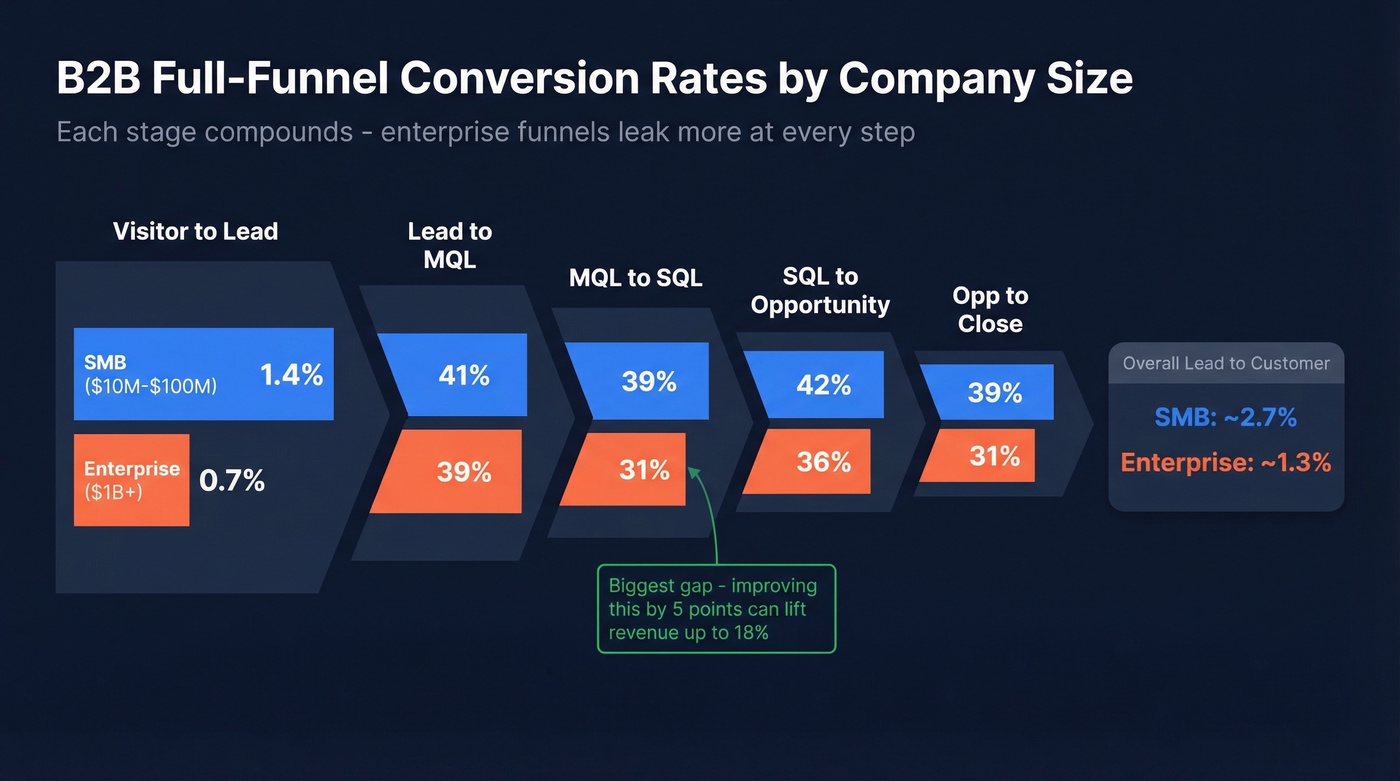
Enterprise funnels leak more at every stage - more stakeholders, longer cycles, higher scrutiny. The biggest gap is MQL-to-SQL. Improving that single stage by just 5 points can lift revenue by up to 18%.
Let's do the quick math. If 10,000 visitors hit your site at a 1.4% visitor-to-lead rate, you get 140 leads. At 2.7% lead-to-customer, that's roughly 4 closed deals. Now you see why each stage matters - and why obsessing over top-of-funnel traffic while ignoring mid-funnel leaks is a recipe for wasted budget.
Channel Performance
| Channel | Visitor → Lead | MQL → SQL | Opp → Close |
|---|---|---|---|
| SEO | 2.1% | 51% | 38% |
| Webinars | 2.2% | 30% | 33% |
| 1.8% | 46% | 32% | |
| PPC | 0.7% | 26% | 35% |
| Events | 1.0% | 24% | 40% |
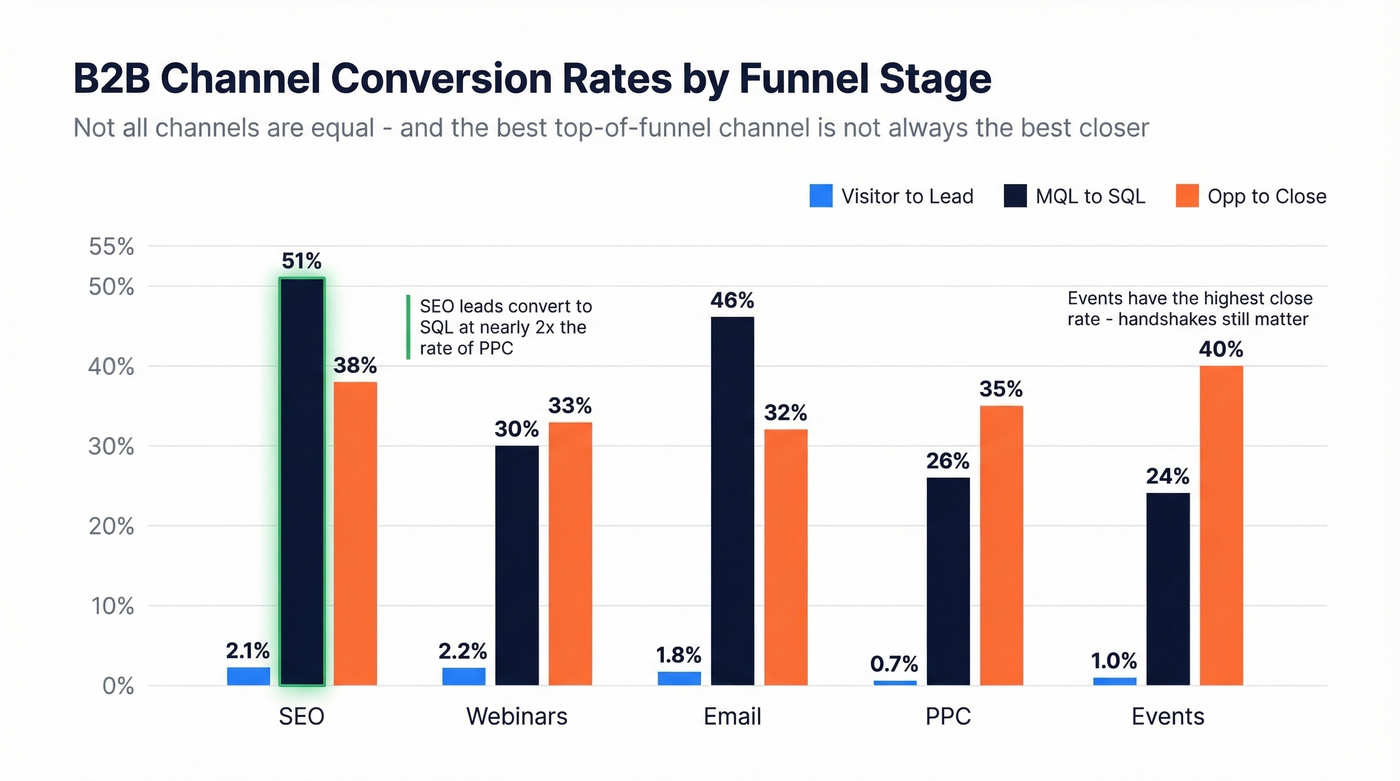
SEO leads convert to SQL at nearly double the rate of PPC leads. Events have the lowest MQL-to-SQL rate but the highest close rate - those handshakes still matter.
Across industries, Ruler Analytics pegs the average qualified-lead conversion rate at 2.9% based on 100M+ data points. Practitioners report lead capture pages converting at 5-15%, SaaS free trials at 3-8%, and direct purchase pages at 1-5%. SaaS lead conversion rates tend to skew higher when a product-led growth motion shortens the evaluation cycle.
If you want a simpler baseline to compare against, start with the average B2B lead conversion rate and then break it down by stage.
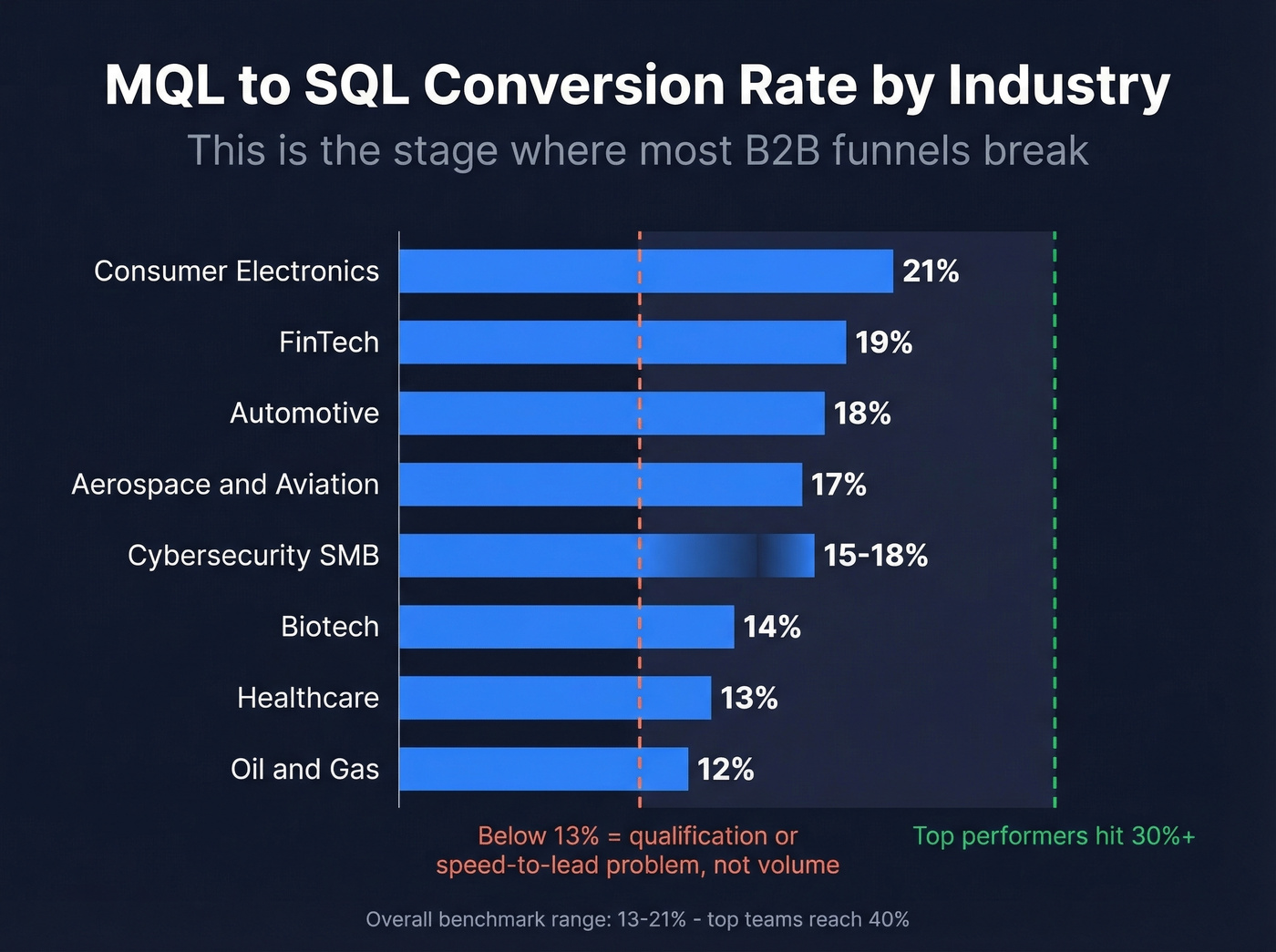
MQL-to-SQL by Industry
This is the stage where most funnels break. Here's how it varies by sector, per Data-Mania's 2026 benchmarks.
| Industry | MQL → SQL |
|---|---|
| Consumer Electronics | 21% |
| FinTech | 19% |
| Automotive | 18% |
| Aerospace & Aviation | 17% |
| Cybersecurity (SMB) | 15-18% |
| Biotech | 14% |
| Healthcare | 13% |
| Oil & Gas | 12% |
The overall MQL-to-SQL range sits at 13-21%. Top performers hit 30%+, with some teams reaching 40%. If you're below 13%, the problem is qualification criteria or speed-to-lead - not lead volume. Tracking your MQL-to-customer rate end-to-end reveals whether the bottleneck is qualification, sales execution, or both.
If you need a tighter definition of stages and handoffs, use a B2B sales funnel template so marketing and sales measure the same thing.

If your MQL-to-SQL rate is below 13%, bad contact data is the likely culprit. Prospeo delivers 98% email accuracy with a 7-day refresh cycle - so reps reach real buyers, not dead inboxes. Meritt cut their bounce rate from 35% to under 4% and tripled pipeline to $300K/week.
Stop losing deals to bounced emails and disconnected numbers.
Outbound BDR Benchmarks
The Instantly 2026 benchmark report covering billions of emails puts the average cold email reply rate at 3.43%. Top 25% hit 5.5%+, top 10% clear 10.7%+. One stat that should change how you sequence: 58% of all replies come from the first email.
| Metric | Benchmark |
|---|---|
| Avg reply rate | 3.43% |
| Top 25% reply rate | 5.5%+ |
| Top 10% reply rate | 10.7%+ |
| Trial → paid (opt-in) | 15-25% |
| Trial → paid (opt-out) | 40-60% |
| Sales cycle (<$20K ACV) | ~75 days |
| Sales cycle (>$60K) | ~180 days |
The r/coldemail consensus is blunt: deliverability and list quality matter more than personalization. Fix your data before adding more follow-up steps. If you're rebuilding your outbound motion, start with a proven B2B cold email sequence and then iterate.
Why Your Numbers Trail Benchmarks
If your conversion rates trail these benchmarks, the cause is almost always one of four operational failures.
You're too slow
The average B2B lead response time is 42 hours. Responding within one hour makes you 7x more likely to qualify the lead, and following up within the first hour can push warm lead conversion as high as 53%. After five minutes, conversion likelihood drops 8x.
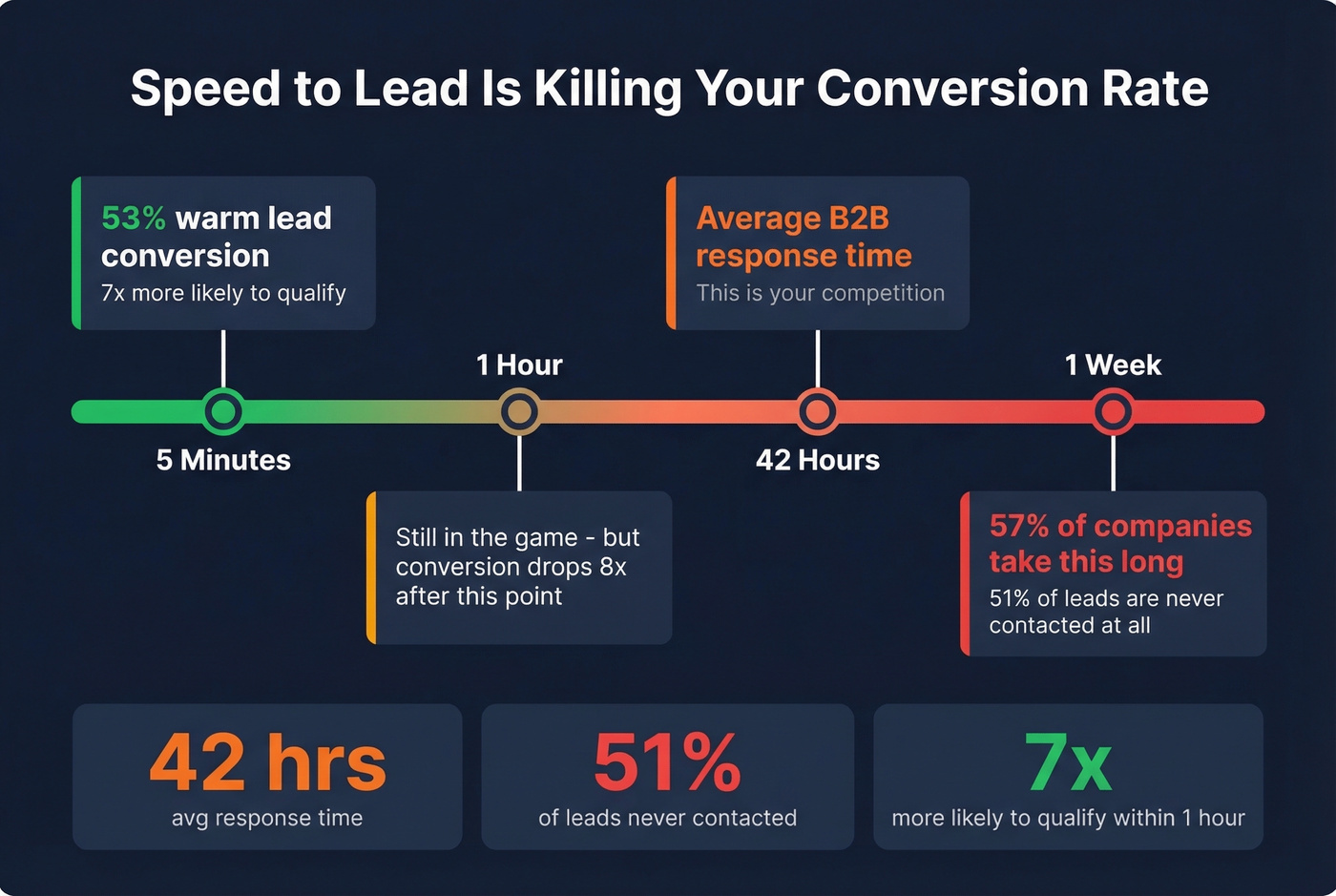
It gets worse. 57% of companies take a full week to respond, and 51% of leads are never contacted at all. Forty-two hours isn't just slow - it's handing deals to your competitors.
If you want to operationalize this, map your lead status so nothing sits unworked.
Your forms are killing conversions
Between 25-40% of B2B forms get abandoned before completion. Every unnecessary field is a leak. We've tested this ourselves - cutting a 7-field form to 3 fields doubled completion rates on one campaign. The data backs this up across the board.
Your contact data is garbage
This is the one nobody measures until it's too late. If 35% of your emails bounce, your effective conversion rate is cut by a third before a rep even picks up the phone. The downstream effects compound: 30% of leads are never contacted, and reps make 1.3 call attempts on average before giving up.
We've seen this pattern over and over - teams invest in top-of-funnel demand gen, then route leads through a database full of dead emails and disconnected numbers. Prospeo's 98% email accuracy and 7-day data refresh cycle exist to solve exactly this. Meritt went from a 35% bounce rate to under 4% and tripled pipeline from $100K to $300K per week.
If you want to quantify the damage, track your email bounce rate alongside stage conversion.
Reps have no context
Routing failures, missing buyer signals, no enrichment data - reps are calling blind. The root cause of declining lead-to-opportunity rates is usually operational, not a lead quality problem. Teams that track conversion rates by source and rep can pinpoint exactly where deals stall.
To fix the “calling blind” problem, add lead enrichment and basic scoring rules before routing.
Look, if your deal size is under $20K, you probably don't need more leads. You need to actually reach the ones you have. Most teams we talk to are sitting on a goldmine of uncontacted or bounced leads that would convert if someone just verified the data and picked up the phone.
Three Fixes That Actually Move the Numbers
Clean your data first
Every campaign you run on unverified data burns budget and domain reputation. Verify emails before any send. In our experience, the ROI on data verification is immediate - if a third of your list bounces, you don't have a conversion problem, you have a data problem. Prospeo handles this at roughly $0.01 per email, with 75 emails/month free.
If you're comparing vendors, start with these data enrichment services and then validate accuracy on your own list.
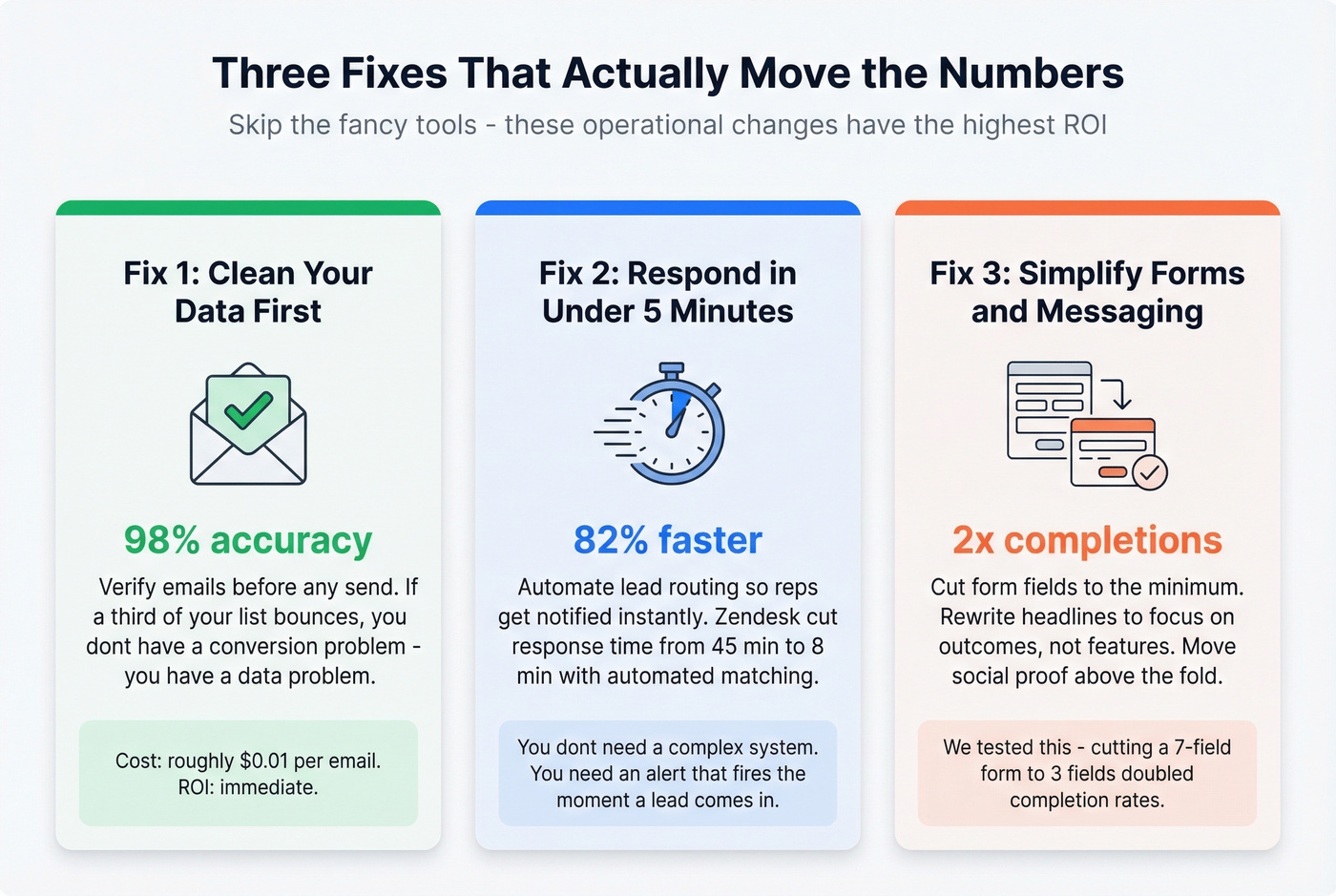
Respond in under five minutes
Automate lead routing so reps get notified instantly. Zendesk cut response time from 45 minutes to 8 minutes with automated matching - an 82% reduction. You don't need a complex system. You need an alert that fires the moment a lead comes in.
If your team is still doing this manually, a dedicated SDR tool can enforce speed-to-lead and follow-up SLAs.
Simplify forms and messaging
The practitioner insight from r/SaaS is dead simple: pages fail because people don't get it fast enough. Rewrite your headline to focus on the outcome, not the feature. Move social proof above the fold. Cut form fields to the minimum.
For outbound, skip links and attachments in your first cold email. Propose specific meeting times instead of sending calendar links - practitioners report higher booking rates this way. And follow up with closed-lost deals every few months; it's one of the most underused levers in outbound. Referred leads tend to outperform cold outreach by 3-5x on close rate, so building a structured referral ask into your post-sale process pays outsized dividends.
If you need copy you can deploy fast, use these sales follow-up templates and adapt them by stage.
Skip SMS if you're in a heavily regulated industry, but for everyone else it's underused in B2B and delivers significantly higher read rates than email for time-sensitive follow-ups.
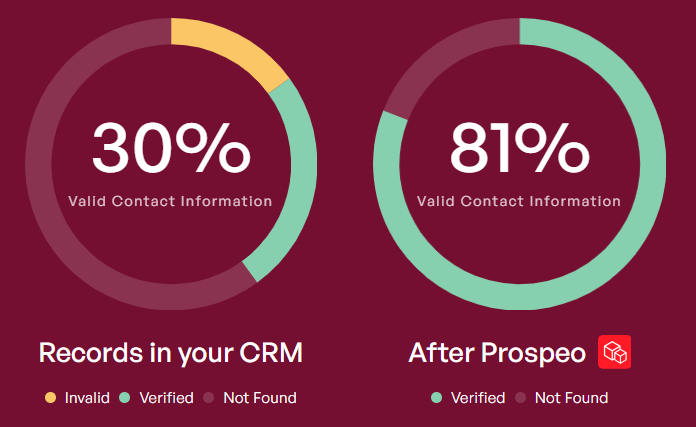
The article math is brutal: 10,000 visitors yield just 4 closed deals. Every percentage point matters - and every bounced email erases a point you already paid for. Prospeo's 143M+ verified emails and 125M+ verified mobiles at $0.01/email mean your reps actually connect with the leads you generate.
Plug the mid-funnel leak with data that's verified weekly.
FAQ
How do you calculate B2B lead conversion rate?
Divide conversions by total leads (or visitors) at that funnel stage, then multiply by 100. Track each stage separately - visitor-to-lead, MQL-to-SQL, opportunity-to-close - because a single blended number hides where your funnel actually breaks.
What's a good lead-to-customer rate?
For most B2B companies, 2-5% lead-to-customer is the benchmark range. SMBs average ~2.7%, enterprise ~1.3%. Top-performing SaaS teams with product-led growth motions can push above 5%, especially when free trials accelerate qualification.
What's the biggest reason B2B leads don't convert?
Speed-to-lead and data quality. The average response time is 42 hours, and if a big chunk of your list bounces, you're losing deals before reps ever make contact. Meritt cut bounce rates from 35% to under 4% after switching to verified data - and tripled weekly pipeline as a result.
How do BDR teams benchmark outbound conversion?
Cold outbound typically converts 1-3% of contacted prospects to meetings, while inbound speed-to-lead responses within five minutes can push that above 10%. Measure reply-to-meeting and meeting-to-opportunity separately so you know whether the issue is messaging or qualification.