

B2B Lead Generation Statistics for 2026
Marketing leaders estimate 25% of their budget goes to campaigns that look productive in dashboards but don't drive revenue. Meanwhile, 37.7% of marketers face pressure to deliver MQLs regardless of quality, which only compounds the problem.
Lead gen feels harder because it is harder. Here are the numbers that explain why - and what to do about them.
Key Benchmarks at a Glance
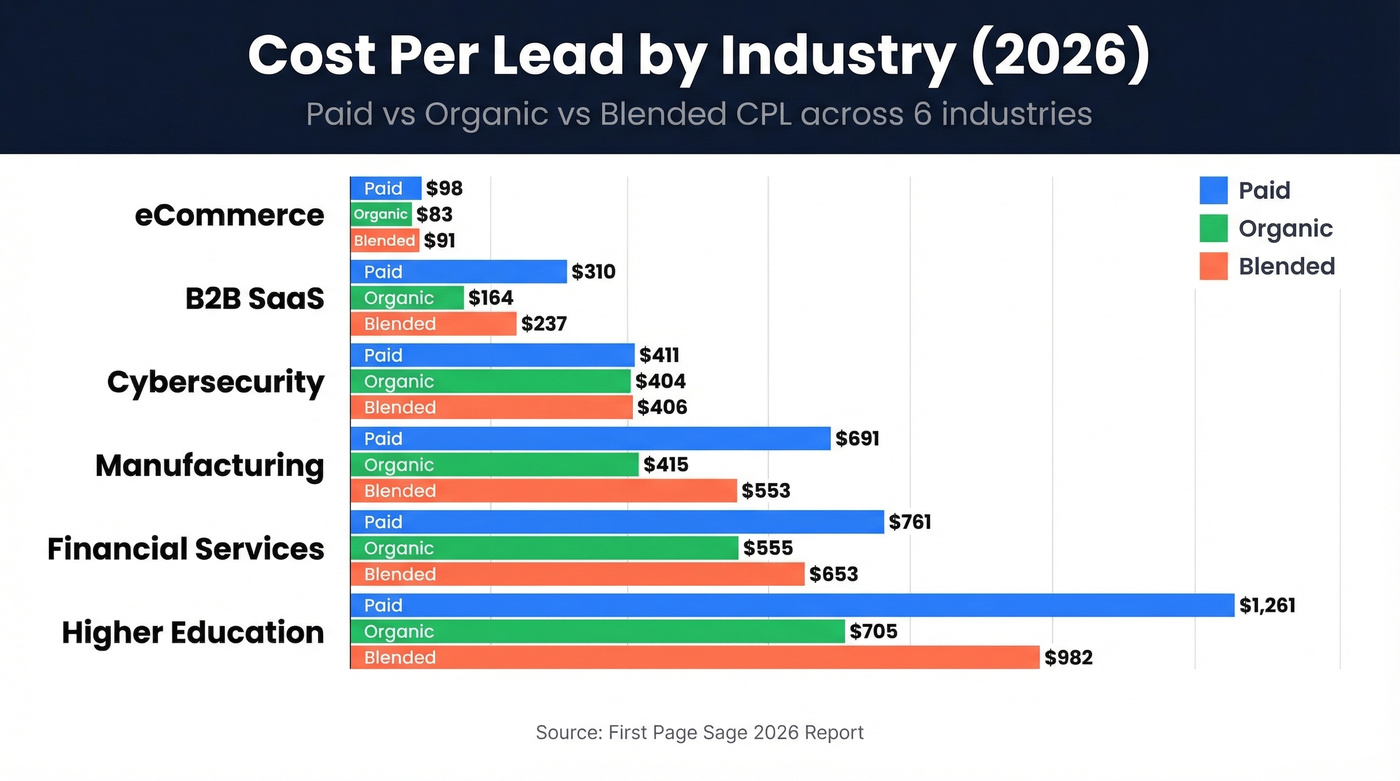
- Blended CPL ranges from $91 (eCommerce) to $982 (Higher Education)
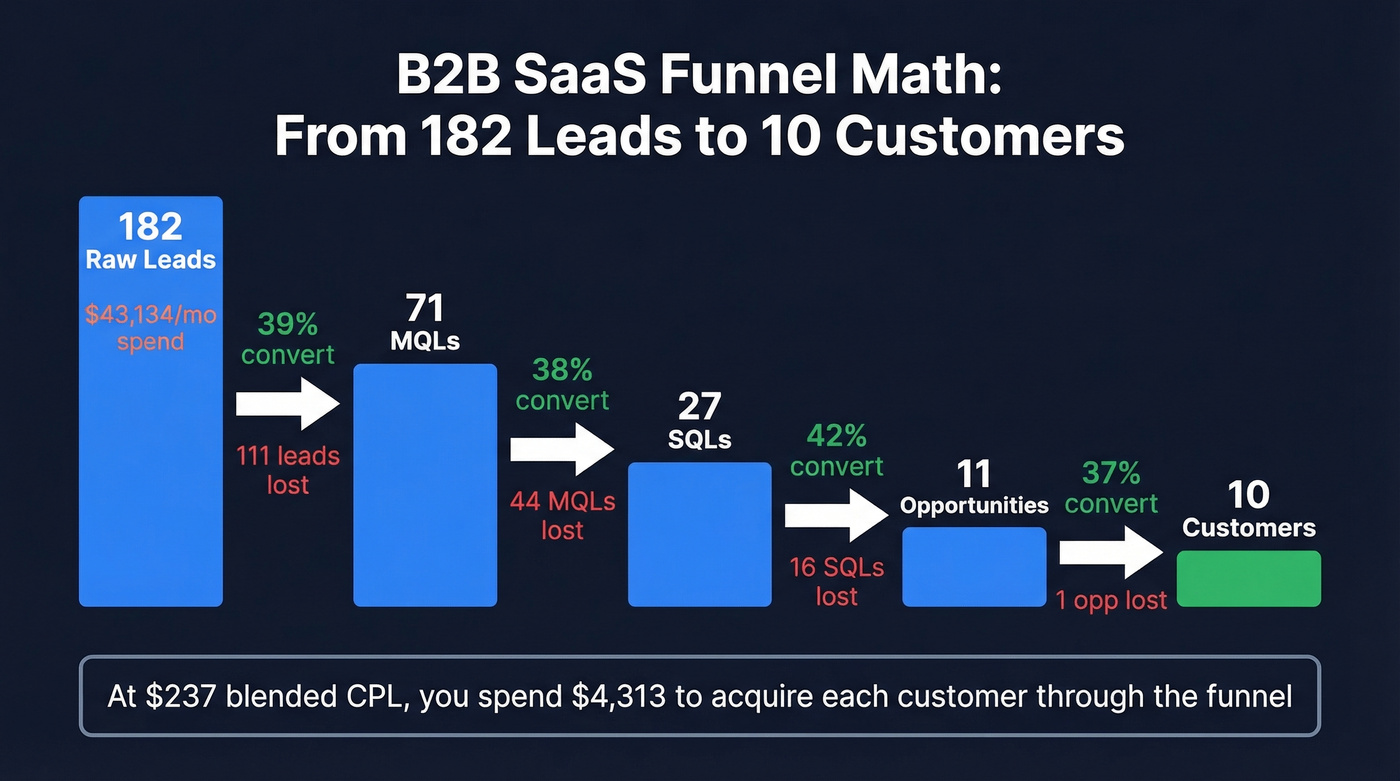
- In B2B SaaS, 39% of leads become MQLs - meaning 61% never make it past the first gate
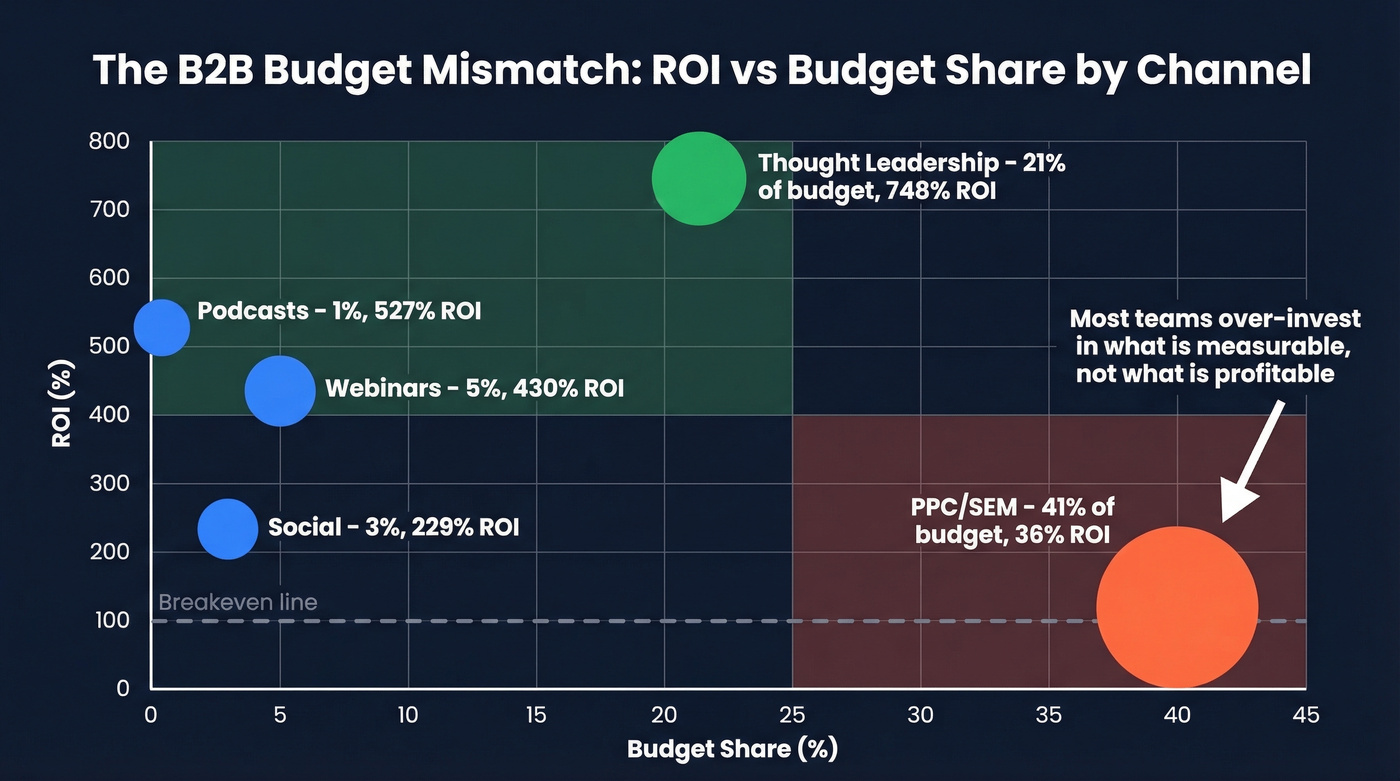
- Thought leadership delivers 748% ROI; PPC/SEM delivers 36% ROI but eats 41% of budget
- A practitioner who sent 147K cold emails got a 1.2% positive reply rate
- 72% of B2B leaders say AI-generated content has hurt brand distinctiveness
Cost Per Lead by Industry
CPL varies wildly by vertical. The table below draws from First Page Sage's 2026 report, covering 30 industries with data collected between January 2022 and June 2025.
| Industry | Paid CPL | Organic CPL | Blended |
|---|---|---|---|
| eCommerce | $98 | $83 | $91 |
| B2B SaaS | $310 | $164 | $237 |
| Cybersecurity | $411 | $404 | $406 |
| Manufacturing | $691 | $415 | $553 |
| Financial Svcs | $761 | $555 | $653 |
| Higher Ed | $1,261 | $705 | $982 |
Across most industries in this dataset, organic CPL runs lower than paid CPL - which is why SEO and content can look "slow" but still win on unit economics over a 12-month window.
If you're benchmarking against "average B2B CPL," stop. Your industry number is the only one that matters.
Funnel Conversion Benchmarks
Raw lead volume means nothing without conversion context. Here's how leads actually move through the funnel, per First Page Sage's conversion benchmarks covering 2017-2025 data that's roughly 65% B2B.
| Industry | Lead to MQL | MQL to SQL | SQL to Opp | SQL to Closed |
|---|---|---|---|---|
| B2B SaaS | 39% | 38% | 42% | 37% |
| Cybersecurity | 24% | 40% | 43% | 46% |
| Financial Svcs | 29% | 38% | 49% | 53% |
| Manufacturing | 26% | 41% | 46% | 51% |
Let's run the math on SaaS. If you need 10 new customers per month, you need roughly 27 SQLs (10 / 0.37), about 71 MQLs (27 / 0.38), and approximately 182 raw leads (71 / 0.39). At $237 blended CPL, that's $43,134/month just to fill the top of the funnel. Now you know why CFOs ask hard questions about lead gen spend.
If you want a cleaner way to model this, map each stage to funnel metrics and track drop-offs weekly.

At $237 blended CPL in SaaS, every lead that bounces is money burned. Prospeo's 98% email accuracy and 7-day data refresh mean more of those $237 leads actually convert - not rot in your CRM with stale contact info.
Stop paying $237 per lead just to hit an invalid inbox.
ROI and Budget by Channel
Here's where the disconnect gets painful. This data comes from First Page Sage's ROI analysis of 117 B2B companies from 2016-2021, averaging 226 employees. These numbers predate the AI content boom, so treat them as a baseline rather than gospel.
| Strategy | Monthly Cost | ROI | Budget Share | Breakeven |
|---|---|---|---|---|
| Thought Leadership | $10K | 748% | 21% | 9 months |
| Podcasts | $9.5K | 527% | 1% | 12 months |
| Webinars | $7.5K | 430% | 5% | 7 months |
| Social/LinkedIn | $2.5K | 229% | 3% | 10 months |
| PPC/SEM | $3-30K | 36% | 41% | 6 months |
PPC/SEM gets 41% of the average budget share and returns 36% ROI. Thought leadership gets 21% and returns 748%. The reason is simple: PPC breaks even fast and is easy to measure. Content takes longer but compounds. Most teams over-index on what's measurable, not what's profitable.
Practitioner data from Reddit backs this up at the channel level. One B2B advertiser reported Google Ads CPLs above $250 with a 4.8% lead-to-opportunity rate, while LinkedIn Ads ran $300+ CPL with just 2.6% lead-to-opportunity. Paid channels can work, but the math is brutal if your funnel isn't tight.
Here's the thing: if your average deal size is under $15K, you probably can't afford paid acquisition as a primary channel. The CPL-to-close math just doesn't work. Go all-in on content and outbound instead.
To pressure-test your plan, align spend to lead generation metrics instead of vanity KPIs.
Outbound and Email Performance
Cold email numbers look grim, and bad data is the silent killer behind most of it.
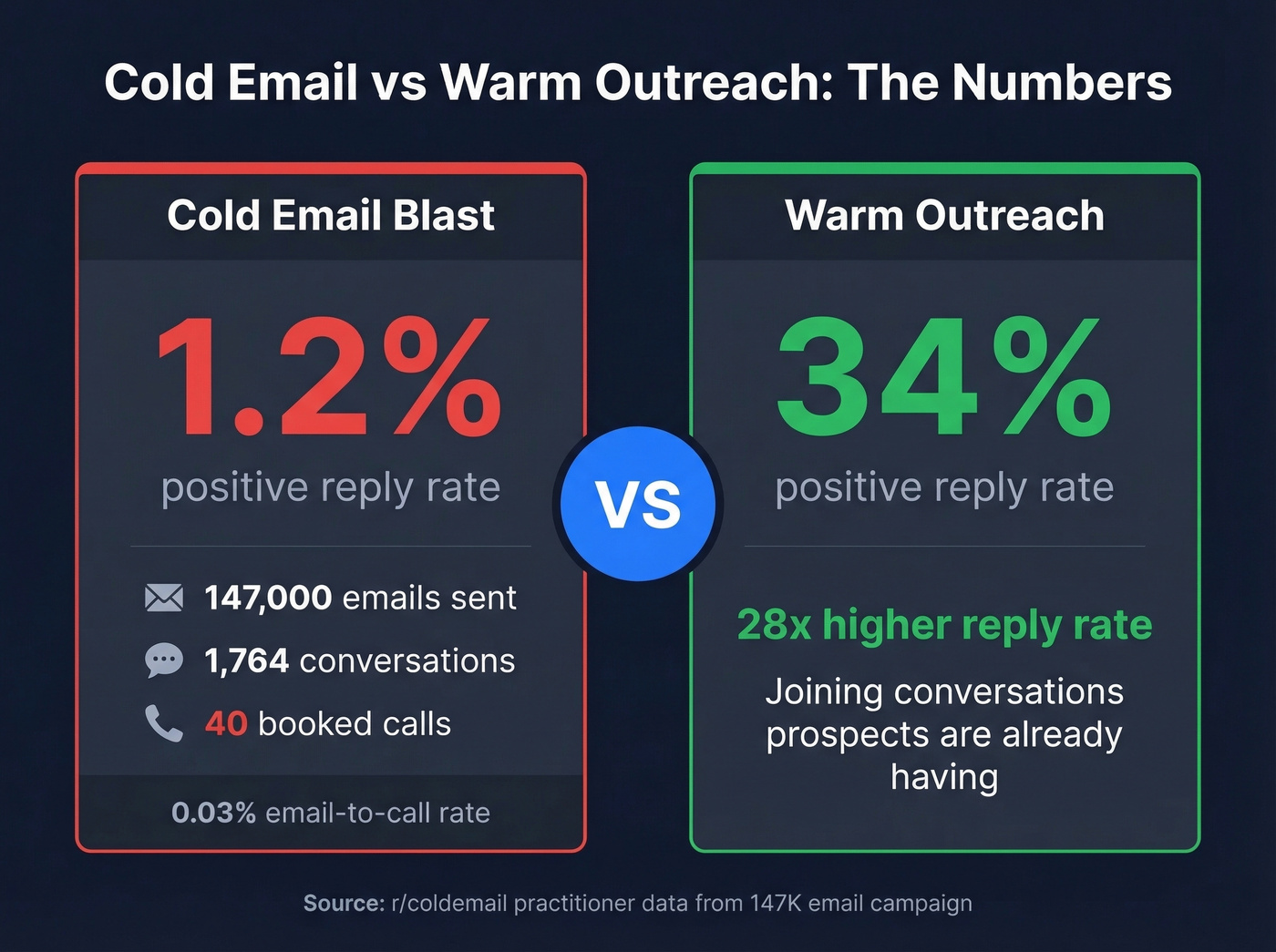
One practitioner on r/coldemail shared results from 147,000 cold emails - a 1.2% positive reply rate, producing 1,764 conversations and just 40 booked calls. When they shifted to "warm" outreach (joining conversations prospects were already having), reply rates jumped to 34%. That's not a marginal improvement. That's a completely different game.
A DemandScience survey of 750 B2B leaders found that in 85% of cases where sales acted on positive intent signals, conversion rates remained "stubbornly low." Intent data isn't a magic bullet if the underlying contact data is garbage. Even warm leads degrade fast when contact records are stale, which is why data freshness matters as much as lead source.
If you're building an outbound motion, start with sales prospecting techniques and a repeatable lead generation workflow before you scale volume.

Bounced emails don't just waste sends - they damage your sender reputation, which tanks deliverability for every subsequent campaign. We've seen teams triple pipeline just by fixing bounce rates. Prospeo maintains 98% email accuracy across 143M+ verified addresses on a 7-day refresh cycle, compared to the six-week industry average. Real-world proof: Meritt cut their bounce rate from 35% to under 4% after switching, and pipeline tripled from $100K to $300K per week.
To diagnose the root cause, benchmark your email bounce rate and follow a proper email deliverability checklist.
Intent signals are worthless when 85% of acted-on leads still don't convert. The missing link is data freshness. Prospeo refreshes 300M+ profiles every 7 days - not the 6-week industry average - so you reach buyers while they're still in-market.
Turn intent data into pipeline with contacts that are actually current.
AI, Content, and MarTech Trends
The 2026 DemandScience survey confirms the AI-content hangover. 72% of B2B leaders say AI-generated content has hurt brand distinctiveness, and 76% admit they're creating content not tied to any data-driven strategy. That's a lot of content nobody asked for.
The MarTech stack isn't helping either. 79% say costs are rising with no clear ROI improvement, 66% use 11+ marketing tools, and 85% spend more than half their time fixing problems - cleaning data, reconciling systems, troubleshooting integrations. Meanwhile, HubSpot's 2026 State of Marketing reports roughly 30% of marketers have seen decreased search traffic as buyers shift to AI tools, with about 24% now exploring SEO for generative AI.
A CMI/MarketingProfs survey of 1,015 B2B marketers found only 12% rate themselves "highly effective." The #1 needle-mover? Content relevance and quality at 65% - not volume, not AI, not tools.
If you're rethinking your 2026 plan, compare these shifts against broader lead generation trends.
What High Performers Do Differently
The CMI data reveals what separates effective B2B marketing teams from everyone else:
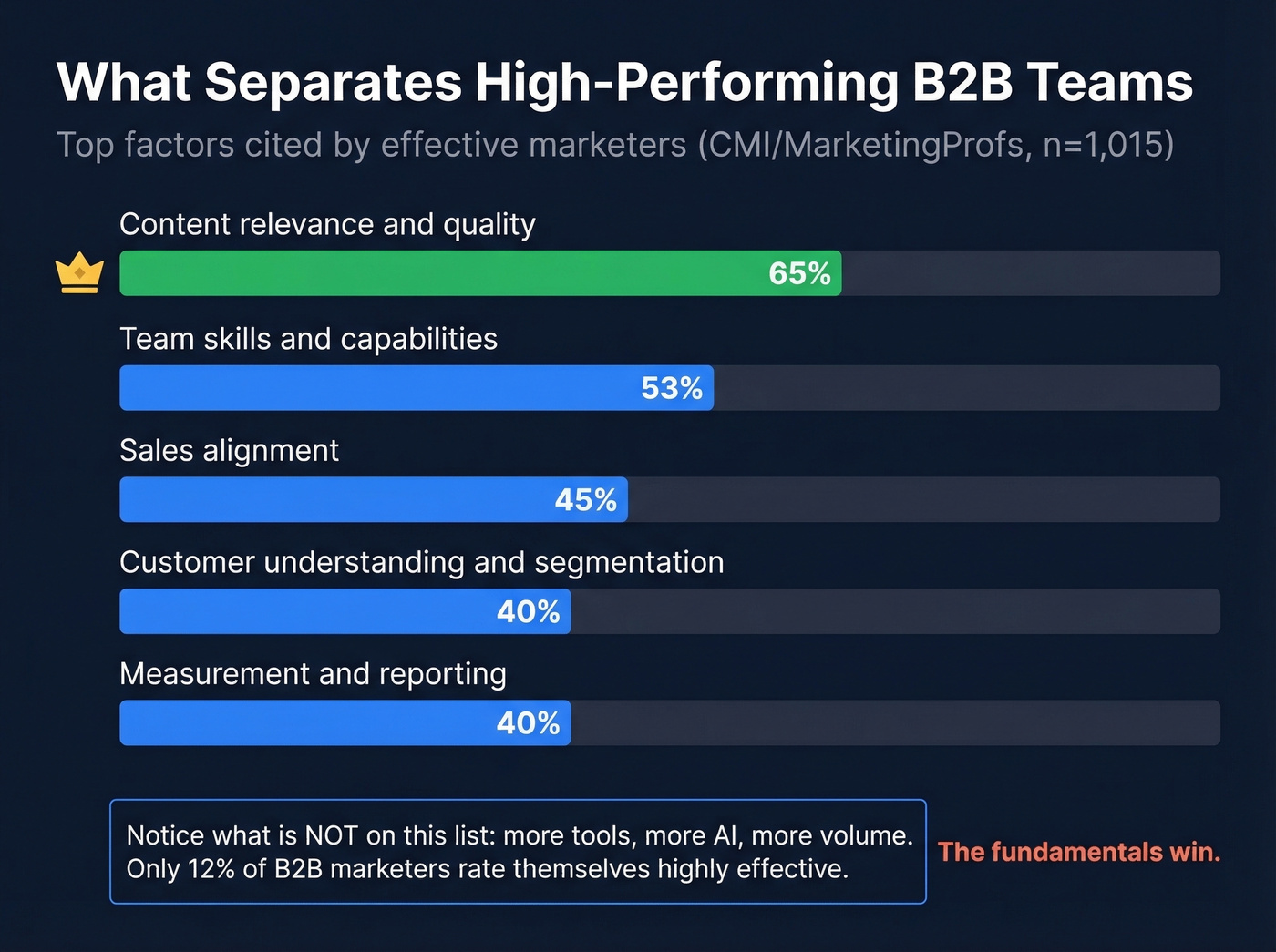
- Content relevance and quality - 65%
- Team skills and capabilities - 53%
- Sales alignment - 45%
- Customer understanding and segmentation - 40%
- Measurement and reporting - 40%
The teams winning aren't rotating through new tools every quarter. They're nailing the fundamentals: relevant content, clean data, and tight sales alignment. Then they measure what actually converts, not what looks good in a slide deck.
These b2b lead generation statistics all point to the same conclusion. Quality beats volume at every stage of the funnel - from the content you publish, to the data you prospect with, to the leads you hand off to sales.
FAQ
What's a good cost per lead in B2B?
Blended CPL ranges from $91 in eCommerce to $982 in Higher Education, with B2B SaaS averaging $237. Organic CPL runs 30-45% lower than paid across most industries, making SEO and content the most cost-efficient lead sources long-term. Benchmark against your own vertical, not a cross-industry average.
What's a typical B2B conversion rate from lead to customer?
B2B SaaS converts about 39% of leads to MQLs and 37% of SQLs to closed deals. Financial services closes at 53% from the SQL stage. Work backward from your revenue target - in SaaS, 10 customers requires roughly 182 raw leads at $43K/month in blended spend.
Which lead generation channel has the highest ROI?
Thought leadership leads at 748% ROI, followed by podcasts at 527% and webinars at 430%. PPC/SEM captures 41% of budget but returns only 36% ROI. The highest-ROI channels take 9-12 months to break even versus 6 for paid, which is why most teams under-invest in them.
How can I improve cold email reply rates?
Start with data quality. Verified emails reduce bounces that destroy sender reputation, and a 7-day refresh cycle keeps records current versus the six-week industry standard. Then focus on relevance: practitioners report "warm" outreach lifts reply rates from roughly 1% to 34%.