

B2B Lead Nurturing Email Examples You Can Actually Steal
Half your webinar leads went dark. The other half opened your follow-up, clicked nothing, and vanished into a CRM nobody checks. You can't close a deal that takes two or more quarters 62.2% of the time with a single "thanks for attending" email.
Here's the thing: buyers don't move through your funnel in a straight line. Gartner's research confirms the journey is non-linear - prospects loop backward, revisit old content, go silent for weeks, then suddenly reappear on your pricing page at 11pm on a Thursday. Your nurture sequence needs to meet them wherever they are, not where you wish they were.
Below are seven B2B lead nurturing email examples you can copy verbatim, a cadence framework, and subject lines with measured read rates from real campaigns.
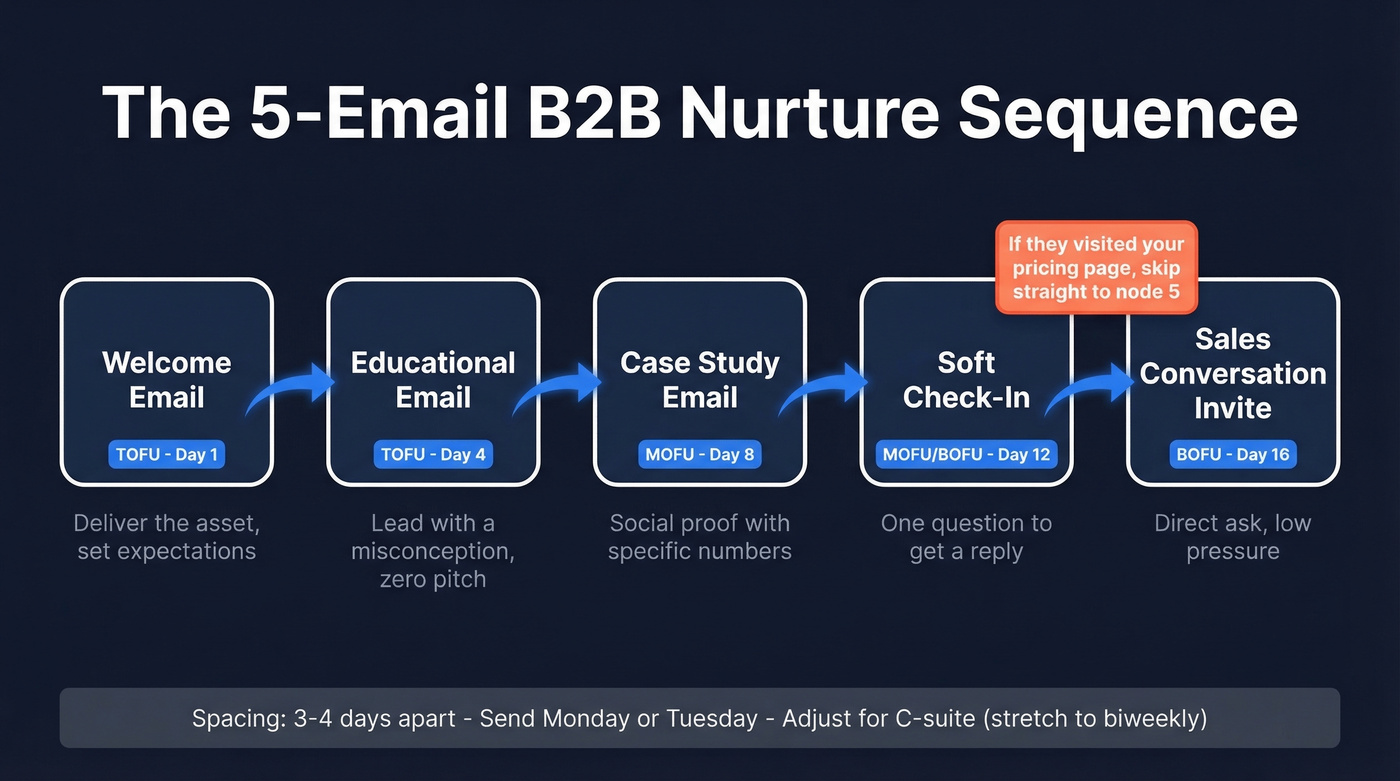
Start here: Welcome → Educational → Case Study → Soft Check-In → Sales Conversation Invite. Space them 3-4 days apart. Adjust from there.
7 Copy-Paste Nurture Email Templates
One rule before the templates: if an email could go to anyone on your list, it's not a nurture email - it's a newsletter. Segmented campaigns produce 30% more opens and 50% more clickthroughs. Tag every email below by funnel stage and send it to the right slice.
Welcome Email (TOFU)
Subject: Glad you're here, [First Name].
Hey [First Name],
Thanks for downloading [asset name]. Here's your copy: [link].
Over the next couple of weeks, I'll send you a few insights on [topic] - no fluff, just things we've seen work for teams like yours. If any of it's useful, great. If not, one click and you're out.
Talk soon, [Your name]
This email has one job: deliver the asset and set expectations. No product pitch, no company history, one CTA. The human tone ("If not, one click and you're out") earns the right to send email #2.
Educational Email (TOFU)
Subject: A quick insight on [topic]
[First Name],
Most [role] teams we talk to assume [common misconception]. Turns out, [counterintuitive insight backed by a stat or example].
Here's a 2-minute breakdown: [link to blog post or resource].
Worth a look if you're rethinking [related challenge].
Problem-centric, zero product mention. The goal is to be useful enough that they open the next one. Lead with the misconception - it creates a knowledge gap the reader needs to close.
A/B test worth running: Try a subject line that names the misconception directly ("No, [common belief] isn't true") against the generic version above.
Industry Insight Email (TOFU/MOFU)
Subject: 3 [industry] trends we're watching in 2026
[First Name],
Three things we're paying attention to this quarter:
- [Trend + one-sentence explanation]
- [Trend + one-sentence explanation]
- [Trend + one-sentence explanation]
We put together a deeper breakdown here: [link]. Curious which of these is hitting your team hardest.
This positions you as an informed peer, not a vendor. The numbered format makes it scannable - executives can absorb value in 10 seconds without committing to a full read.
Case Study Email (MOFU)
Subject: How one [industry] team [specific result]
[First Name],
[Company name] was dealing with [specific problem your prospect likely shares]. In [timeframe], they [specific measurable result - e.g., "cut bounce rates from 35% to under 4%" or "tripled pipeline from $100K to $300K/week"].
Here's the full story: [link to case study].
If [pain point] sounds familiar, this one's worth 3 minutes.
Social proof with concrete numbers. Don't summarize the entire case study - tease the result and let curiosity do the work. The specificity of the number matters more than the number itself. "Tripled pipeline" is good; "tripled pipeline from $100K to $300K/week" is better.
Common mistake: Sending a case study from the wrong industry. A fintech VP doesn't care that a DTC brand improved their email metrics. Match the case study to the prospect's vertical, or at minimum, their company size and pain point.
Problem-Awareness Email (MOFU)
Subject: The hidden cost of [pain point]
[First Name],
Here's something most [role] teams don't calculate: [specific hidden cost - e.g., "every bounced email doesn't just waste a send. It damages your sender reputation across every campaign you run"].
We broke down the math here: [link].
No pitch - just a framework for thinking about [problem] differently.
This email agitates a specific problem without offering your product as the fix. The restraint builds trust. Practitioners on r/Emailmarketing call this "air cover" - even if the prospect doesn't click, your name stays visible during internal buying committee discussions. That matters more than any single open rate.
Soft Check-In Email (MOFU/BOFU)
Subject: Quick question
[First Name],
I noticed you [opened the last email / downloaded X / visited the pricing page]. Curious - is [specific challenge] something your team is actively working on right now, or more of a 2026 priority?
Either way, happy to share what we're seeing work for similar teams.
Short, personal, designed to get a reply. "Quick question" works as a subject line because it mimics the cadence of an internal Slack message - it triggers curiosity without signaling a sales pitch. One question, not three.
Pro tip: If they visited your pricing page, skip this email entirely and go straight to the Sales Conversation Invite. Pricing page visits are a high-intent signal - don't cool them down with a check-in.
Sales Conversation Invite (BOFU)
Subject: [First Name]'s invitation
[First Name],
You've been digging into [topic area based on their engagement]. I'd love to share how teams in [their industry] are approaching [specific challenge] - and whether what we're building could help.
Would [specific day/time] work for a 15-minute call? No deck, no demo unless you want one.
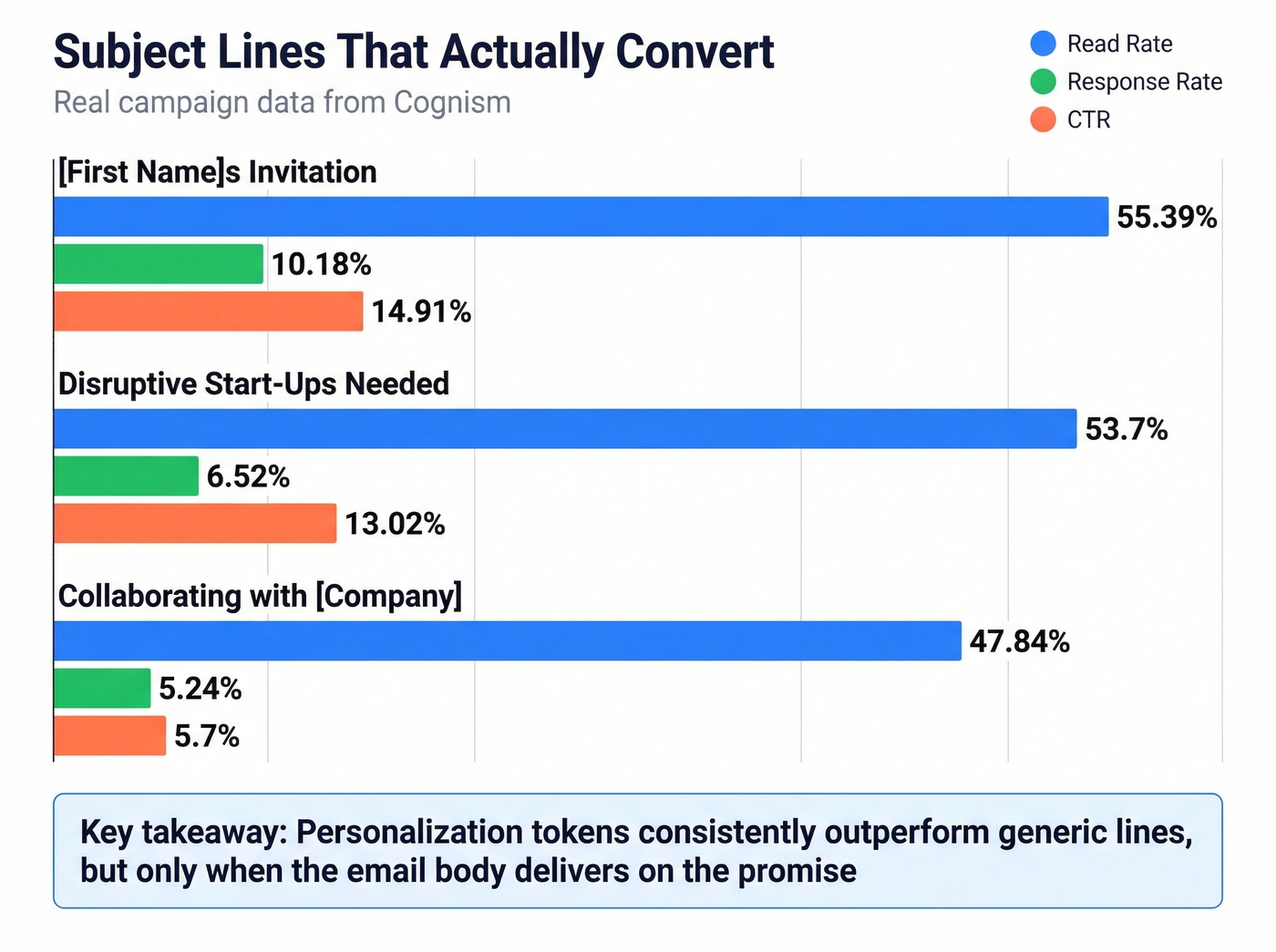
Direct but low-pressure. Mentioning their engagement history makes it feel earned, not random. The "[First Name]'s Invitation" subject line isn't just clever - Cognism's data shows it pulls a 55.39% read rate.
Subject Lines That Actually Convert
Cognism tested subject lines across real campaigns and published the results:
| Subject Line | Read Rate | Response | CTR |
|---|---|---|---|
| [First Name]'s Invitation | 55.39% | 10.18% | 14.91% |
| Disruptive Start-Ups Needed | 53.7% | 6.52% | 13.02% |
| Collaborating with [Company] | 47.84% | 5.24% | 5.7% |
Keep subject lines under 50 characters for mobile. Personalization tokens consistently outperform generic lines, but only when the rest of the email delivers on the promise. A personalized subject line with a generic body is worse than no personalization at all - it feels like a bait-and-switch.

Every bounced nurture email damages your sender reputation and kills the sequence for everyone else on your list. Prospeo's 98% email accuracy and 7-day data refresh mean your carefully crafted nurture emails actually land in inboxes - not bounce logs.
Stop writing perfect emails to dead addresses.
Building the Right Nurture Cadence
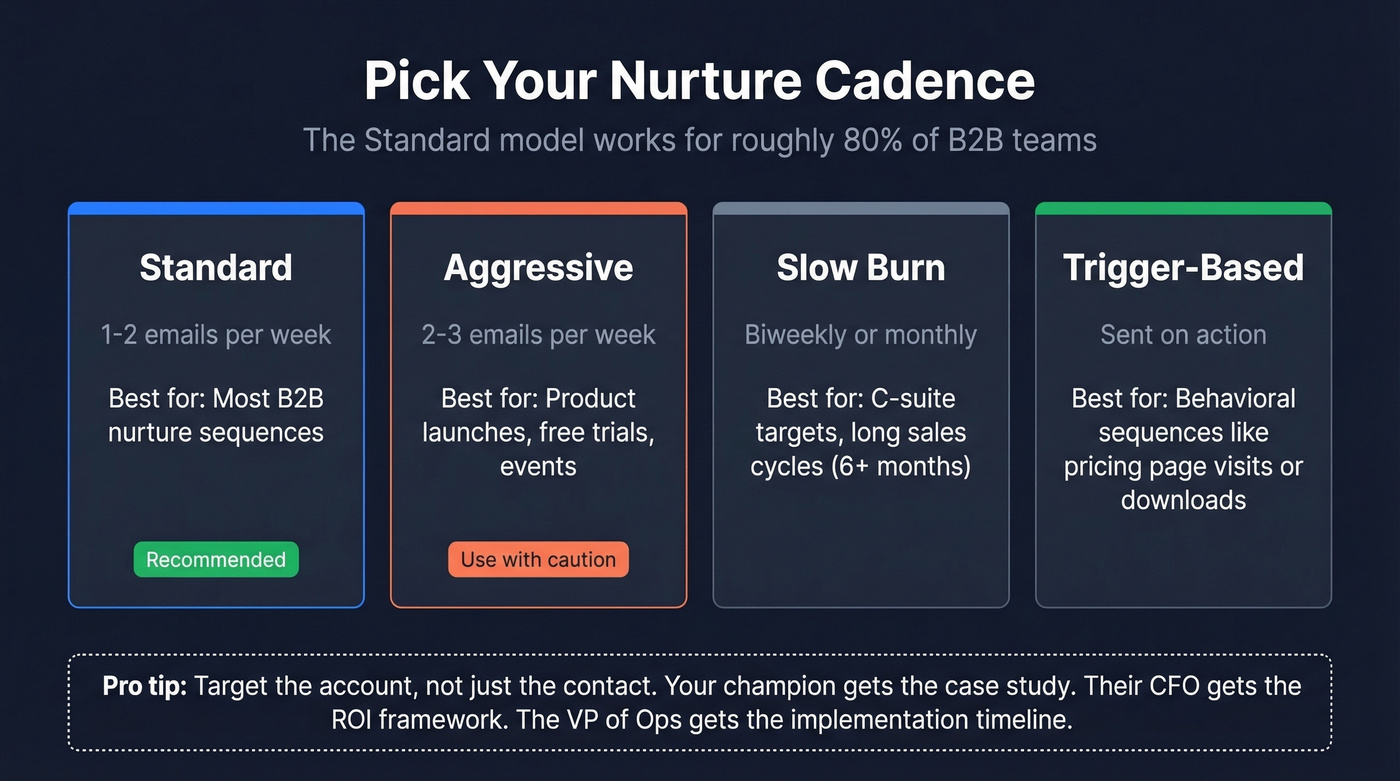
There's no universal cadence. But after testing across multiple industries, we've found the Standard model works for roughly 80% of B2B teams:
| Model | Frequency | Best For |
|---|---|---|
| Standard | 1-2/week | Most B2B nurture |
| Aggressive | 2-3/week | Launches, trials, events |
| Slow Burn | Biweekly/monthly | C-suite, long cycles |
| Trigger-Based | On action | Behavioral sequences |
For the Standard model: Day 1 Welcome → Day 4 Educational → Day 8 Case Study → Day 12 Soft Check-In → Day 16 Sales Conversation Invite. Send Monday or Tuesday. For C-suite prospects, stretch to every two weeks - executives don't want to hear from vendors weekly.
One thing most nurture guides miss: target the account, not just the contact. Practitioners on Reddit's r/Emailmarketing stress that nurture works best when multiple stakeholders in the same buying committee receive coordinated - not identical - messaging. Your champion gets the case study; their CFO gets the ROI framework. The VP of Ops gets the implementation timeline. Same deal, three different conversations happening in parallel.
Email is the backbone, but the best nurture programs layer in retargeting ads and social touches alongside the sequence. Short video snippets (30-60 seconds) embedded in nurture emails can reactivate dormant accounts and reopen conversations.
Add re-engagement triggers at 30-90 days for leads that go dark. An office worker receives 120+ emails per day. Respect that reality.
Mistakes That Kill Your Sequence
Most nurture sequences fail for fixable reasons. Let's be honest - we've made a few of these ourselves. Run through this checklist before you launch:
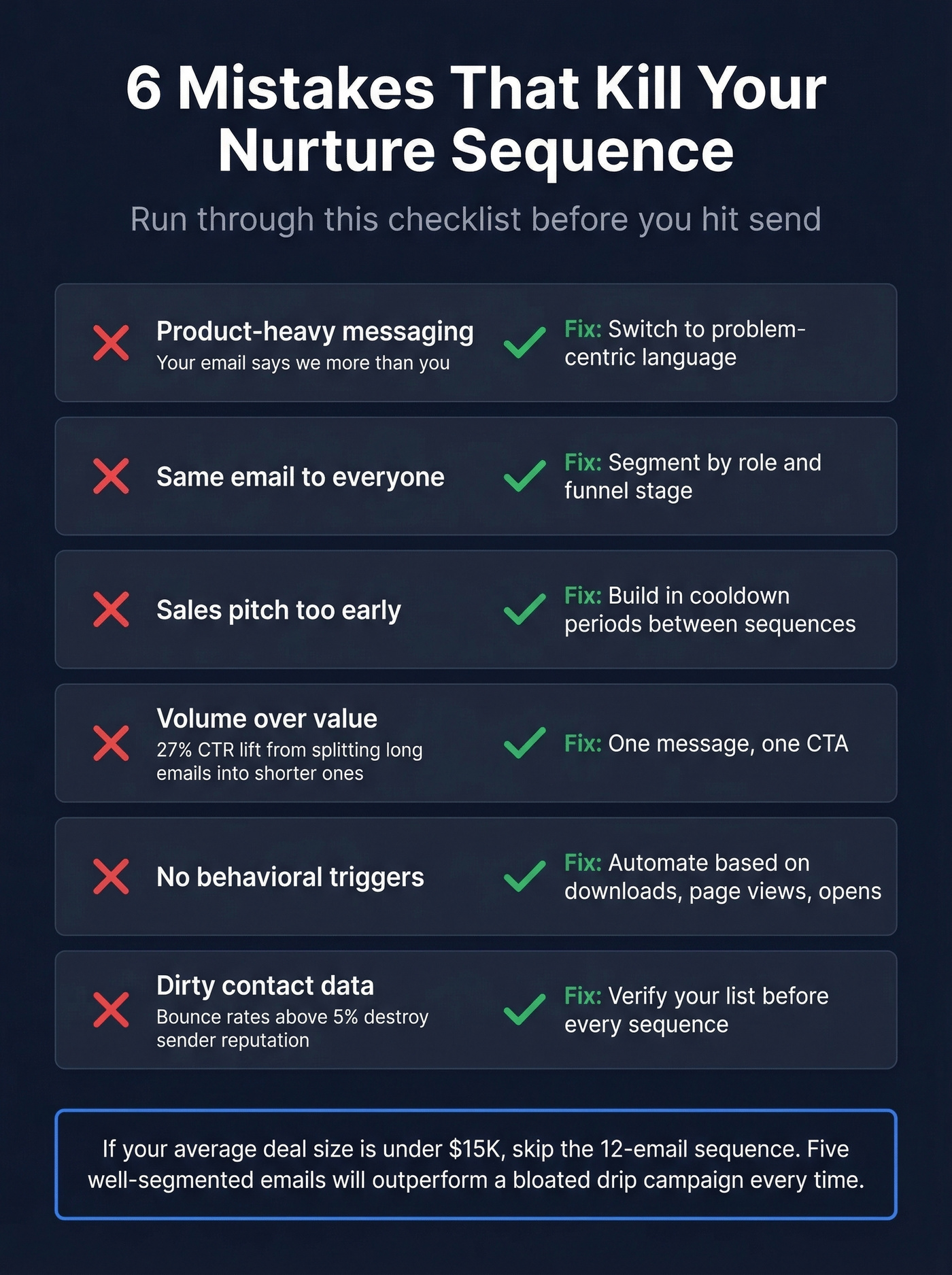
- Product-heavy messaging - Shift to problem-centric language. If your email says "we" more than "you," rewrite it. (If you need help tightening copy, see email copywriting.)
- Same email to everyone - Segment by role and funnel stage. A VP of Sales and a Marketing Director shouldn't get identical content. Use an ideal customer profile to define slices that actually convert.
- Sales messaging too early - Unsubscribe spikes almost always mean you pushed a pitch before earning trust. Build in cooldown periods between sequences. (More on importance of follow-up in sales when cycles get long.)
- Volume over value - More emails don't equal more pipeline. One message, one CTA. Splitting a long newsletter into three shorter emails produced a 27% CTR lift in one documented test.
- No behavioral triggers - Automate based on actions. Downloaded a guide? Send a tips sequence. Viewed pricing? Route to a deep dive. (Tie this to identifying buying signals so sales knows when to jump in.)
- Dirty contact data - Bounce rates above 5% destroy your sender reputation across all email, not just nurture. Run your list through a verification tool before sending another message. Prospeo's 5-step verification catches invalid addresses, spam traps, and catch-all domains at 98% accuracy, with a 7-day refresh cycle so your data doesn't go stale between sequences. If you're troubleshooting, start with email bounce rate benchmarks and fixes.

Skip the 12-email nurture sequence if your average deal size is under $15K. Five emails, well-segmented, will outperform a bloated drip campaign every time. Complexity isn't sophistication.
Benchmarks to Measure Against
Here are the latest B2B email benchmarks to gut-check your performance:
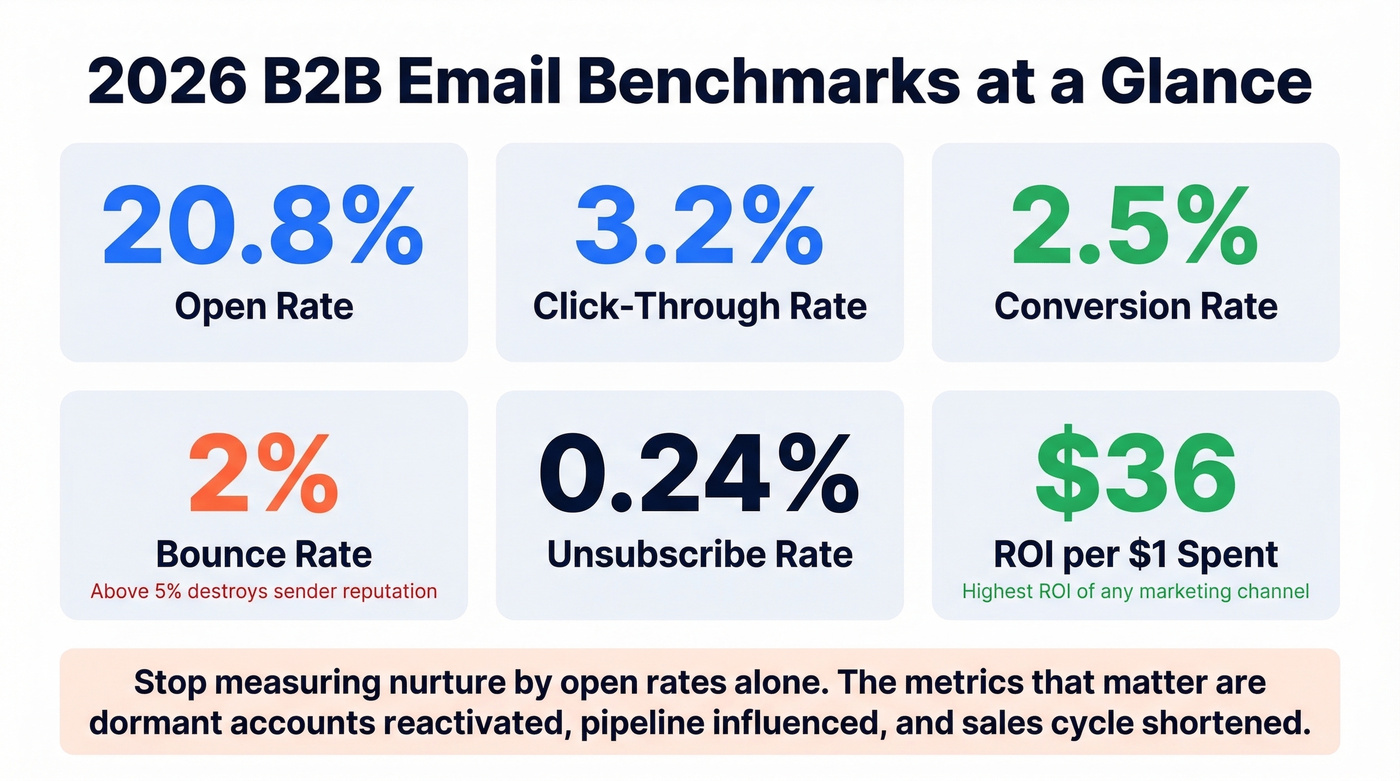
| Metric | B2B Benchmark |
|---|---|
| Open Rate | 20.8% |
| CTR | 3.2% |
| Bounce Rate | 2% |
| Unsubscribe | 0.24% |
| Conversion | 2.5% |
| ROI | $36 per $1 spent |
Stop measuring nurture by open rates alone. The metrics that actually matter are dormant accounts reactivated, pipeline influenced, and sales cycle shortened. If your lead nurturing emails aren't moving those numbers, you've built a drip campaign and called it strategy. To pressure-test your funnel, track funnel metrics alongside pipeline outcomes.
Segmented nurture campaigns need clean, enriched contact data to work. Prospeo returns 50+ data points per contact - job title, industry, company size, tech stack - so you can tag leads by funnel stage and send the right email to the right slice, every time.
Enrich your CRM and segment nurture lists in minutes.
FAQ
How many emails should a B2B nurture sequence have?
Start with 5-6 emails spread over 2-4 weeks: Welcome → Educational → Case Study → Soft Check-In → Sales Conversation Invite covers the full funnel without overwhelming inboxes. Add re-engagement triggers at 30-90 days for leads that go dark, and stretch intervals to biweekly for enterprise buyers.
What's the difference between a drip campaign and a nurture sequence?
A drip campaign sends pre-scheduled emails on a fixed timeline regardless of behavior. A nurture sequence adapts based on engagement - clicks, downloads, page visits - routing leads into different tracks. Most teams think they're nurturing when they're actually just dripping.
How do I keep nurture emails out of spam folders?
Verify your entire list before launching any sequence - bounce rates above 5% damage sender reputation across all campaigns. Use a verification tool with catch-all handling and spam-trap removal alongside proper SPF/DKIM/DMARC authentication to maximize deliverability.