

How to Build a B2B Marketing Mix That Actually Drives Pipeline
You just got promoted to Head of Marketing. The CEO wants a plan by Friday. You've got a CRM full of stale contacts, a budget that hasn't been approved yet, and every guide you pull up lists the 7Ps like it's a college exam and calls it a day.
That's not a plan - it's a glossary. Building a B2B marketing mix that generates revenue requires resource allocation decisions tied to pipeline, not definitions you could copy from a textbook. On r/b2bmarketing, the same thread repeats every month: one marketer responsible for everything, leadership defaulting to "just post on social" instead of building a coherent strategy. Let's build something you can actually execute.
The Short Version
- Start with 3 channels - email, content/SEO, and one paid channel. Not 10. Three you can measure and optimize.
- Allocate ~7.7% of revenue to marketing. Budgets have been flat at that number since 2024. A common planning heuristic is to put about half into digital.
- Measure pipeline contribution, not vanity metrics. Fix your data before optimizing your channels - a 30%+ email bounce rate will tank deliverability and make outbound performance look "mysteriously" bad.
What Is the B2B Marketing Mix?
The term "marketing mix" goes back to Neil Borden in the 1950s, who described it as the set of tools a marketer uses to influence demand. Jerome McCarthy compressed it into the 4Ps - Product, Price, Place, Promotion - in 1960. Booms and Bitner expanded it to 7Ps in 1981, adding People, Process, and Physical Evidence for service businesses and complex B2B sales.
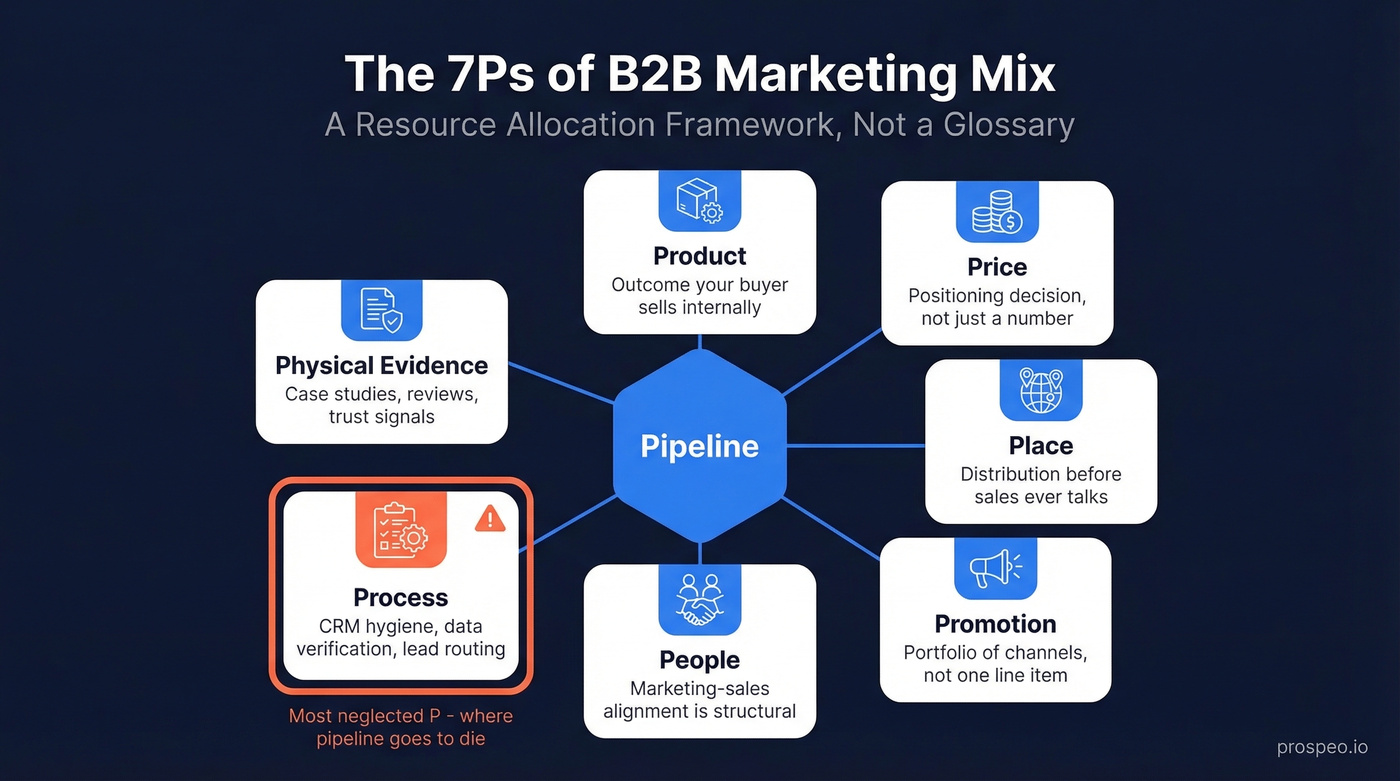
The marketing mix isn't a framework you memorize. It's a resource allocation tool. Every dollar, hour, and headcount decision maps to one of these Ps, and the question isn't "can I define each P?" but "am I allocating resources across them in a way that generates pipeline?" Most B2B teams over-invest in Promotion and under-invest in Process and Place. That imbalance is where pipeline goes to die.
You'll also see simplified models like Visionary Marketing's 3Ps (Price, Performance, Proximity) and expanded ones like Lead Agency's 8th P: Partners. The 7Ps remain the most useful because they force you to address operational gaps - like Process - that simpler models skip entirely.
The 7Ps (Not the Textbook Version)
Product
In B2B, your product isn't the software - it's the outcome your buyer can sell internally. Frame everything around the business case: time saved, revenue generated, risk reduced. If your product marketing can't articulate the ROI story in two sentences, your sales team is winging it on every call.
Price
Do this: Publish transparent, self-serve pricing if you're targeting SMB velocity deals. Not this: Hide pricing behind "talk to sales" when your competitors publish theirs. B2B pricing is a positioning decision. Hiding it when buyers can comparison-shop creates friction that costs you pipeline.
Place
Where do buyers encounter you before they ever talk to sales? One benchmark puts it at 71% of B2B researchers beginning with generic Google searches. Your "place" strategy is really a distribution strategy: SEO, partner marketplaces, review sites, industry communities. If you're not showing up on page one for your category, you're invisible during the research phase - and that's where most deals start.
Promotion
Here's the thing: for most teams, the honest answer to "how much of your promotion budget generates pipeline?" is "we don't know." Promotion covers everything from paid ads to email sequences to event sponsorships. The mistake is treating it as a single line item instead of a portfolio. A healthy B2B promotion mix balances brand awareness (top-of-funnel content, video, thought leadership) with demand capture (paid search, retargeting, outbound).
People
Your marketing team's skills and your sales team's ability to follow up are both "People" decisions. A brilliant ABM campaign that routes leads to an SDR team with no context is a waste. Marketing-sales alignment isn't a nice-to-have - it's a structural requirement of any functioning B2B marketing mix. (If you need a starting point for the handoff, use these sales follow-up templates.)
Process
This is the P everyone skips, and it's the one that breaks everything else.
Process means the plumbing behind your marketing: CRM hygiene, lead routing, data verification, scoring models, and handoff protocols. Your marketing mix is only as good as your data. If a third of your emails bounce, your Promotion and Place strategies are dead on arrival. We've seen teams fix nothing but their email verification workflow - switching to Prospeo's 98% accuracy verification on a 7-day refresh cycle - and watch outbound reply rates double overnight. Not because the messaging changed. Because the emails actually landed. (If deliverability is a recurring issue, start with an email deliverability guide.)
Process isn't glamorous, but it's the foundation.
Physical Evidence
In B2B, physical evidence is trust collateral: case studies with real numbers, third-party reviews on G2 or Capterra, SOC 2 badges, published benchmarks. Buyers need proof before they bring your name to a committee of 6-10 stakeholders. If your website doesn't have at least three case studies with measurable outcomes, you're asking buyers to take a leap of faith they won't take.
B2B vs B2C: Why the Mix Differs
Your marketing mix operates under fundamentally different rules than a consumer playbook:
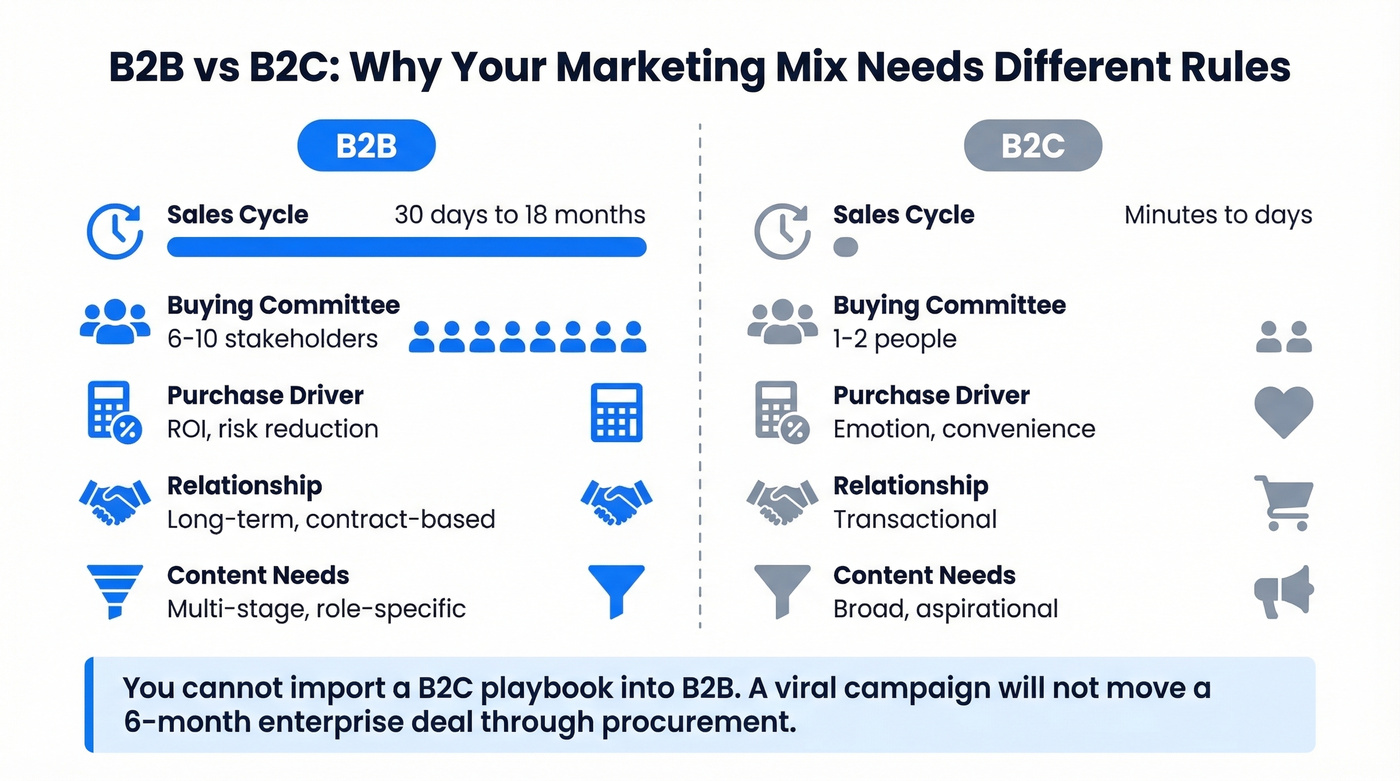
| Dimension | B2B | B2C |
|---|---|---|
| Sales cycle | 30-90 days (SMB), 3-6 months (mid-market), 6-18 months (enterprise) | Minutes to days |
| Buying committee | Typically 6-10 stakeholders | 1-2 people |
| Purchase driver | ROI, risk reduction | Emotion, convenience |
| Relationship model | Long-term, contract-based | Transactional |
| Content needs | Multi-stage, role-specific | Broad, aspirational |
You can't import a B2C playbook. A viral social campaign generates awareness, sure, but it won't move a 6-month enterprise deal through procurement. Your mix needs to account for multiple decision-makers at different stages, each needing different content and different proof points.
Budget Benchmarks That Help
Marketing budgets have plateaued at 7.7% of company revenue - down from 9.1% in 2023 and flat since 2024. And 59% of CMOs say they don't have enough budget to execute their strategy. The problem isn't budget. It's allocation.
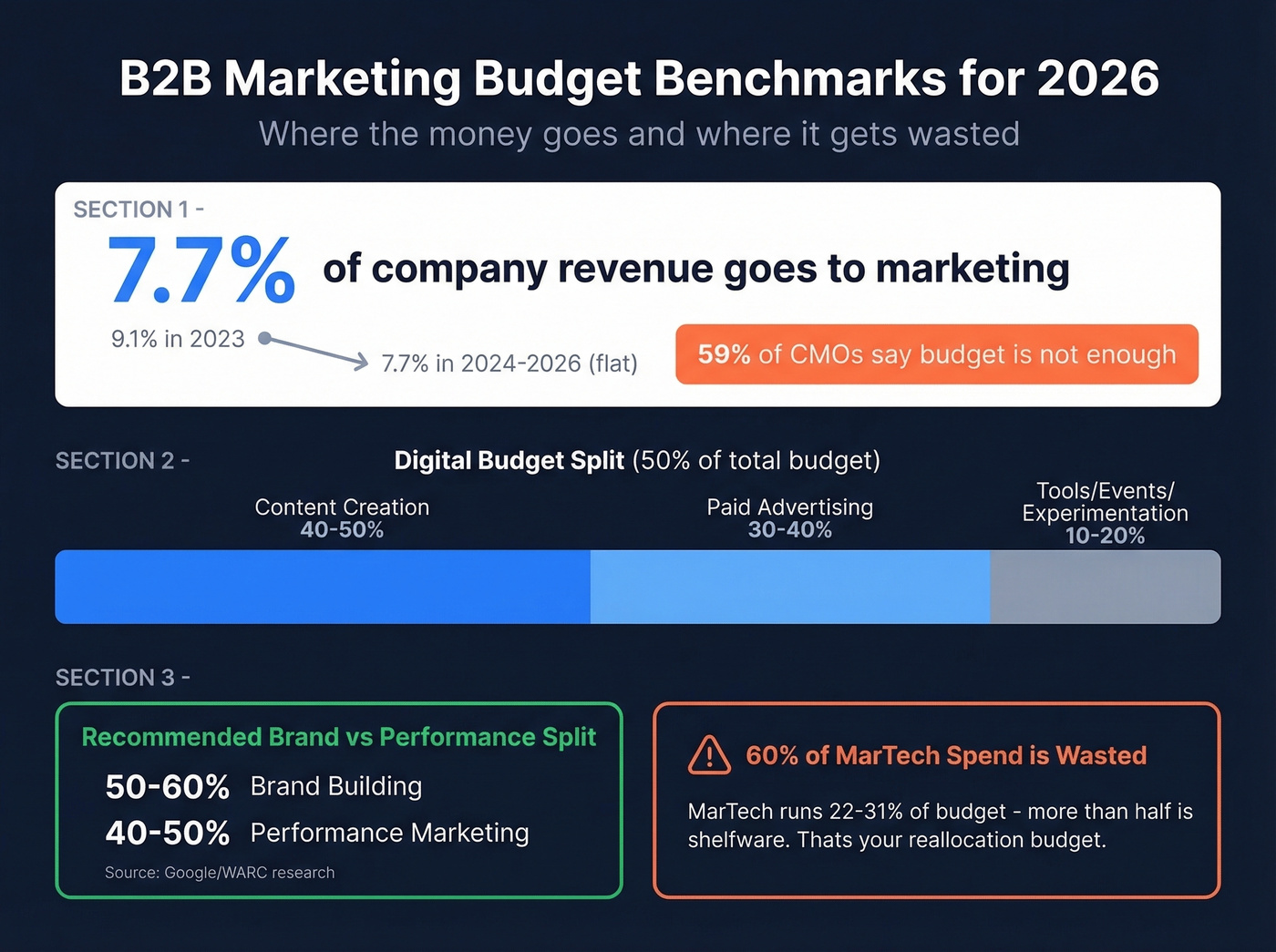
A practical planning split puts around 50% of your total marketing budget into digital. Within that digital spend, content creation should eat 40-50% and paid advertising 30-40%. The rest covers tools, events, and experimentation.
The brand vs. performance split is where most teams get it wrong. Google and WARC research recommends 50-60% brand building and 40-50% performance marketing. Performance marketing already consumes 30.6% of budgets, and with 70% of marketers planning to increase that share in 2026, the brand-building deficit will widen. Performance marketing without brand equity is a treadmill - you run faster and go nowhere.
One more uncomfortable number: 60% of MarTech spend is wasted due to underutilization. MarTech budgets run 22-31% of total marketing spend. If more than half of that is shelfware, you've found your reallocation budget without asking the CFO for a dime.

You just read it: Process is the P that breaks everything else. If a third of your emails bounce, your entire marketing mix underperforms. Prospeo's 5-step verification delivers 98% email accuracy on a 7-day refresh cycle - so your outbound actually lands.
Fix the plumbing before you optimize the channels.
Which Channels Belong in Your Mix
A Belkins study of 90 B2B companies provides some of the clearest channel data available. This is the most actionable table in this article - no one else publishes channel-level budget allocation like this:
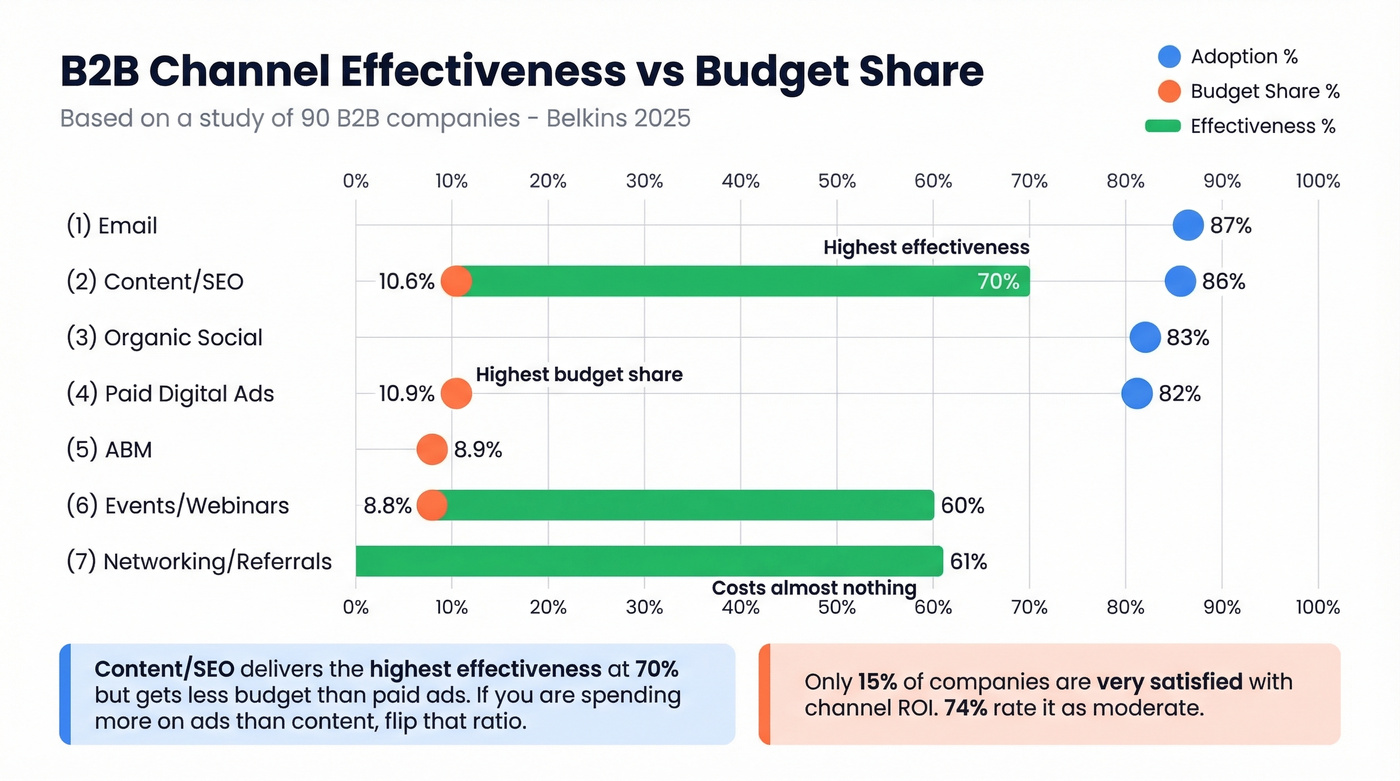
Channel Adoption & Budget Share
| Channel | Adoption | Budget Share |
|---|---|---|
| 87% | - | |
| Content/SEO | 86% | 10.6% |
| Organic social | 83% | - |
| Paid digital ads | 82% | 10.9% |
| ABM | - | 8.9% |
| Events/webinars | - | 8.8% |
Channel Effectiveness
| Channel | Effectiveness Rating |
|---|---|
| Content/SEO | 70% |
| Networking/referrals | 61% |
| Events/webinars | 60% |
Only 15% of companies are "very satisfied" with their channel ROI. 74% rate it as moderate. Most teams are spreading too thin and measuring too loosely.
Let's be honest: most B2B companies don't need more channels - they need fewer channels with better data. Paid digital ads get the biggest budget share at 10.9%, but content marketing delivers the highest effectiveness at 70%. If you're spending more on ads than on content, flip that ratio and give it two quarters. And don't sleep on referrals - at 61% effectiveness, networking is the second-most effective channel and costs almost nothing.
Email is the #1 adopted B2B channel for a reason, but only if your list is clean. A 35% bounce rate doesn't just waste sends - it torches your sender reputation and drags down every future campaign. Prospeo's database covers 300M+ professional profiles with 30+ filters including buyer intent, technographics, and job changes, so you're targeting the right accounts instead of spraying into the void. (If you're rebuilding your outbound motion, borrow these sales prospecting techniques.)
ABM makes sense when you're working deals above $50K with sales cycles longer than 3 months. Below that threshold, the operational overhead usually exceeds the return. Start with email, content/SEO, and one paid channel. Add ABM and events once those three produce measurable pipeline.
The Mix in Action
SAP: Multi-Channel Brand Campaign
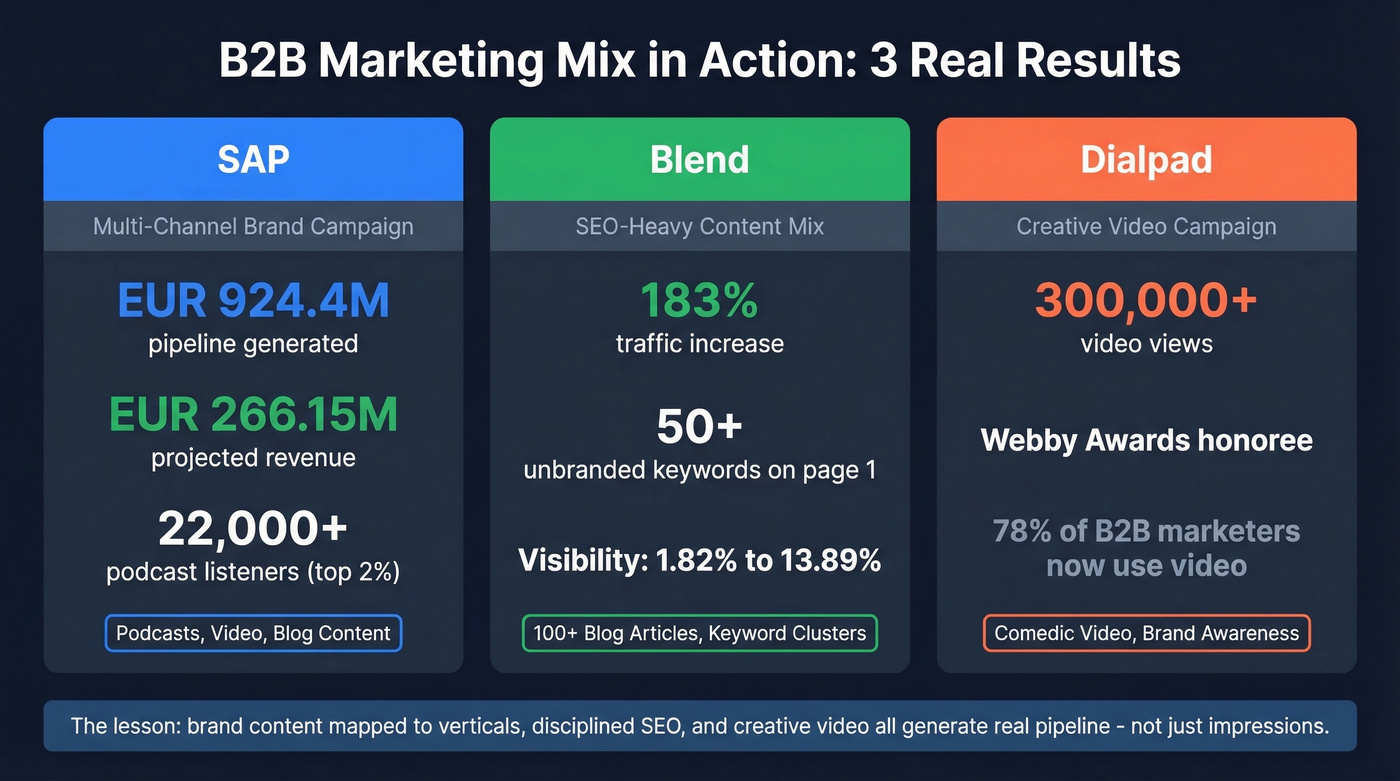
SAP's "Inspire the Future" campaign spanned podcasts, stop-motion videos, and blog content mapped to pain points across six industries. Their "Searching for Salai" podcast hit 22,000+ listeners (top 2% benchmark is 18,000) and won Content Marketing Institute awards. The broader campaign's commercial impact: EUR 924.4M in pipeline generated and EUR 266.15M in projected revenue. They also brought in partner co-investment from Capgemini, extending reach without extending budget. The lesson: brand content at scale, mapped to industry verticals, generates real pipeline - not just impressions.
Blend: SEO-Heavy Content Mix
Blend, a fintech company, went all-in on content and SEO. They built keyword clusters, optimized core pages, and produced 100+ blog articles. The result: 183% increase in site traffic and 50+ unbranded keywords on page one. Site visibility jumped from 1.82% to 13.89%. No massive ad budget required - just disciplined content production aligned to search intent.
Dialpad: Creative Video
Dialpad ran a comedic video campaign that generated 300,000+ views and earned a Webby Awards honoree nod. Video is already mainstream in B2B - 78% of marketers use it, and over half plan to increase investment. Dialpad proved that B2B video doesn't have to be boring to drive results. (If you're evaluating tools in that ecosystem, see Dialpad alternatives.)
How to Measure Your Mix
Modern B2B measurement rests on three pillars: marketing mix modeling (MMM), incrementality testing, and multi-touch attribution. Each solves a different problem, and you need at least two of the three.
53.5% of US marketers now use MMM, and 30.1% say it's the best method for identifying what actually drives business value - ahead of web analytics (20.2%) and incrementality testing (19.9%). But only 26% run MMM in-house. Most outsource it, which means insights arrive quarterly, not weekly.
In our experience, most teams that can't measure channel contribution have a CRM problem, not a measurement tool problem. Multi-touch attribution across long sales cycles, siloed tools that don't talk to each other, buying committees where influence is distributed across 6-10 people - these are real challenges. But 94% of marketers diversified their channel mix last year, and most can't measure which channels actually work. Diversification without measurement is just expensive experimentation.
Start simple. Track pipeline contribution by channel, not just MQLs. If your CRM can't tell you which channels sourced and influenced closed-won deals, fix that before optimizing anything else. (If you're auditing your stack, these examples of a CRM can help you sanity-check what “good” looks like.)
Five Mistakes That Kill Pipeline
Chasing reach metrics when your TAM is 10,000 people. Impressions don't matter in niche B2B. Track MQLs and CAC - those connect marketing activity to revenue. (If you need a clean definition and model, use this Cost to Acquire Customer guide.)
Dumping bought lists into your CRM without hygiene. Stale data and duplicate records poison everything downstream. Clean before you import. Every time. (If you’re comparing vendors, start with data enrichment services.)
Over-relying on look-alike audiences in niche markets. Small seed datasets produce garbage look-alikes. Manual list-building with verified data often outperforms algorithmic targeting in B2B.
Neglecting mid-funnel nurture. "Get a demo" is a bottom-funnel CTA that intimidates early-stage buyers. Offer guides, benchmarks, and assessments for people who aren't ready to talk to sales yet.
Buying MarTech you don't use. If 60% of MarTech spend is wasted, the fastest budget optimization isn't adding a new tool - it's auditing the ones you already have and cutting what nobody logs into.
What's Changing in 2026
Three shifts worth watching this year:
Trust is the new currency. 94% of senior B2B marketers agree trust is key to success. 42% cite brand awareness among decision-makers as their top priority. If your brand doesn't show up in the consideration set before a buyer talks to sales, you're already behind.
Video and creator partnerships are compounding. Brands combining video with industry voice partnerships are 2.2x more likely to be trusted. 55% of B2B marketers now partner with creators and subject-matter experts - up sharply from two years ago.
The performance trap. 70% of marketers plan to prioritize performance over brand. That's a mistake. The right 2026 mix decision isn't "brand or performance" - it's finding the ratio that builds long-term awareness while capturing existing demand. Skip brand-building now and you'll pay double for demand gen later.
The real question for your 2026 mix: how much brand vs. performance, how much human vs. automated, how much owned vs. rented audience? Get those three ratios right and the channel-level decisions become much simpler.
Allocating budget across 7Ps means nothing if your CRM is full of stale contacts. Prospeo enriches your database with 50+ data points per contact at a 92% match rate - for roughly $0.01 per email. No contracts, no sales calls.
Stop funding a marketing mix built on bad data.
FAQ
What are the 7Ps of B2B marketing?
Product, Price, Place, Promotion, People, Process, and Physical Evidence - developed by Booms and Bitner in 1981 to extend McCarthy's original 4Ps. In B2B, the added Ps matter more than in consumer marketing because operational processes like data hygiene and trust signals like case studies directly influence whether deals close.
How much should a B2B company spend on marketing?
The current benchmark is 7.7% of company revenue, with roughly half allocated to digital channels. Content/SEO and paid search are the highest-priority line items. Adjust based on your sales cycle length and deal size - companies closing enterprise contracts above $75K typically shift more budget toward ABM and events.
What's the most effective B2B marketing channel?
Content marketing delivers the highest effectiveness rating at 70%, followed by networking and referrals at 61%, based on a study of 90 B2B companies. Email has the highest adoption at 87% but depends entirely on list quality - a clean, verified list is the difference between a channel that prints pipeline and one that burns your sender reputation.
What is marketing mix modeling?
MMM is a statistical method measuring how each channel contributes to revenue and pipeline. 53.5% of US marketers now use it, and 30.1% say it's the best method for identifying what drives business value - ahead of web analytics and incrementality testing. It works best as a quarterly strategic tool, supplemented by real-time attribution for tactical decisions.