

B2B SaaS Demand Generation: A Playbook With Actual Numbers
You're spending $15K a month on Google Ads and LinkedIn, but your pipeline report shows the same 12 opportunities it showed 90 days ago. The problem isn't your budget. It's that your demand generation strategy is fighting over 5% of the market while ignoring the other 95%.
Here's a playbook with real numbers to fix that.
The 95/5 Problem
92% of B2B buyers start with at least one vendor already in mind. The pre-contact favorite wins 80% of deals. And the average B2B buying cycle runs 10.1 months, which means if you're not on the shortlist before a buyer enters a formal evaluation, you've already lost.
Most SaaS teams pour budget into bottom-funnel capture - paid search, retargeting, G2 profiles - and wonder why pipeline stays flat. Capture is necessary, but it only works on the roughly 5% who are actively shopping right now. Your demand gen has to create preference months before someone's ready to buy.
Demand Creation vs. Demand Capture
The 95/5 rule frames it simply: only about 5% of your TAM is in-market at any given time. Demand creation builds preference with the other 95%. Demand capture converts the ready buyers.
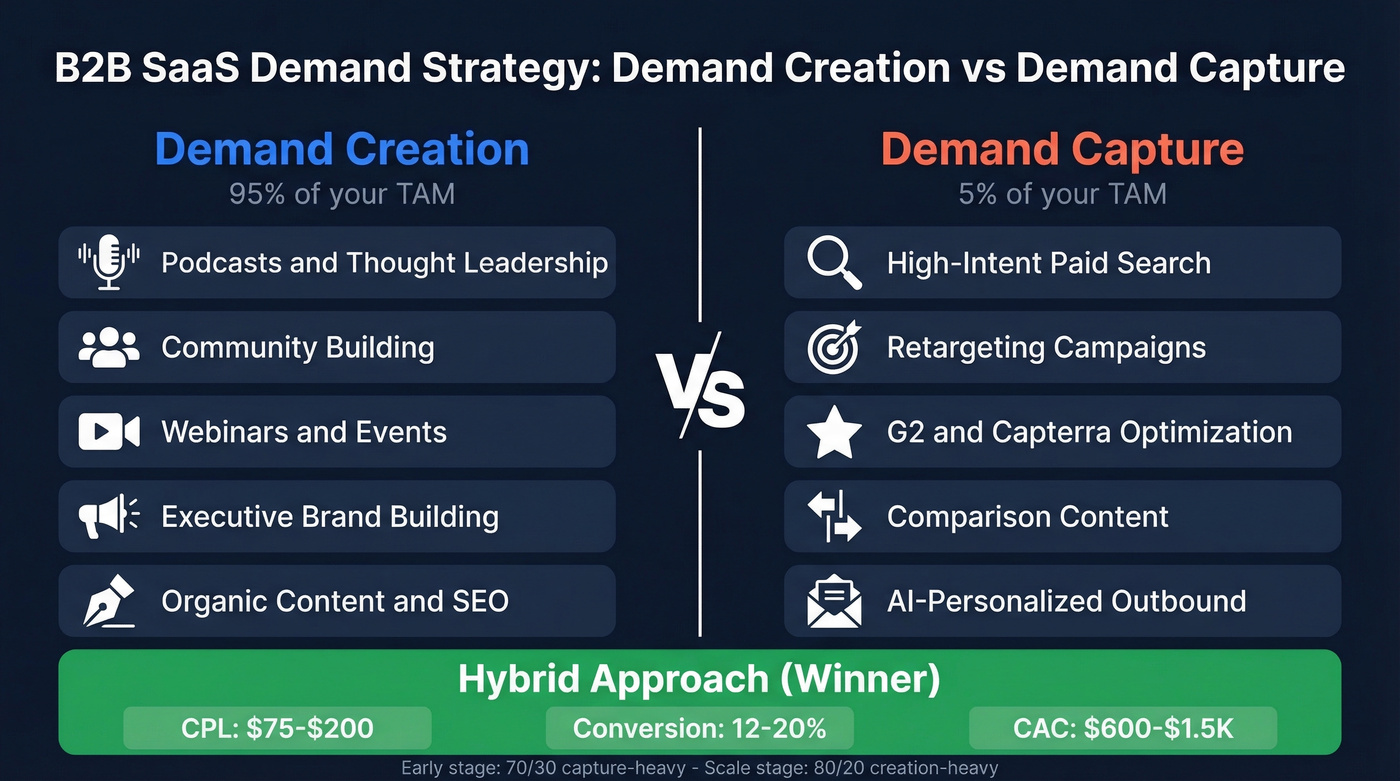
| Metric | Lead Gen Only | Demand Gen Only | Hybrid (Winner) |
|---|---|---|---|
| CPL | $50-$150 | $200-$400 | $75-$200 |
| Conversion Rate | 2-5% | 8-15% | 12-20% |
| CAC | $1K-$3K | $800-$2K | $600-$1.5K |
| Time to Revenue | 30-60 days | 90-180 days | 60-120 days |
Demand gen costs more per lead but produces cheaper customers. The hybrid approach delivers the best economics because you're building brand preference (creation) while still catching the buyers who are ready now (capture).
Recommended mix: lean 70/30 toward lead gen when you're early and need cash flow, then shift toward 80/20 creation-heavy as you scale into enterprise. For creation, focus on thought leadership, webinars, podcasts, executive brand-building, and community. For capture, invest in paid search on high-intent keywords, retargeting, G2/Capterra optimization, and comparison content.
Pick Your GTM Motion
Your average contract value dictates your motion. Don't overthink this.
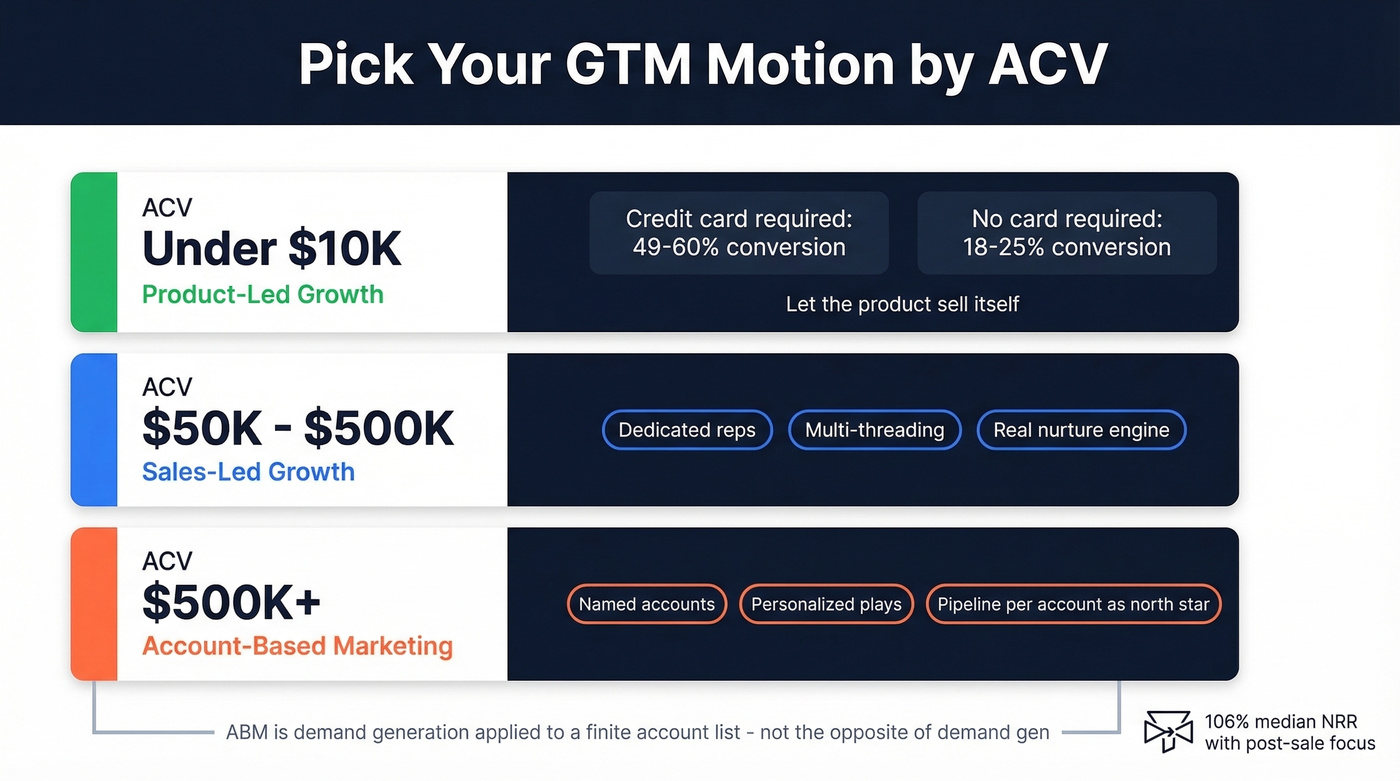
ACV under $10K - product-led growth. Free trials with credit-card-required convert at 49-60%; no-card trials convert at 18-25%. Let the product sell itself.
ACV $50K-$500K - sales-led growth. You need reps, multi-threading, and a real nurture engine that doesn't just drip blog posts at people for six months.
ACV $500K+ - ABM. Named accounts, personalized plays, pipeline contribution per account as your north star.
ABM and demand gen aren't opposites - ABM is demand generation applied to a finite account list. The bowtie funnel, which treats post-sale activation, retention, and expansion with equal priority, helps drive outcomes like 106% median NRR instead of leaking revenue after close.
Budget: How Much and Where
The median SaaS company spends about 8% of ARR on marketing. But that median hides massive variance:
| Stage | % of ARR | Example ($5M ARR) |
|---|---|---|
| Mature | 5-7% | $250-$350K |
| Mid-stage | 8-12% | $400-$600K |
| Startup | 15-20%+ | $750K-$1M+ |
Within that budget: 60-80% on demand gen and direct response, 10-20% on brand, 10-20% on nurture and retention. Companies that actually fund that retention bucket hit the 106% NRR median; those that don't watch expansion revenue evaporate. Digital channels eat 70-72% of total spend across the board.
The 70/20/10 rule keeps you from over-experimenting: 70% on proven channels, 20% on promising ones you're scaling, 10% on pure experiments. We've seen teams blow 40% of budget on "tests" and wonder why nothing compounds. Discipline matters more than creativity here.

Your demand gen budget is wasted if 15-35% of emails bounce. Prospeo's 5-step verification delivers 98% email accuracy across 300M+ profiles - refreshed every 7 days, not every 6 weeks. At $0.01 per verified email, your CAC drops while deliverability stays above 96%.
Stop funding bounces. Start funding pipeline.
Channels That Actually Drive Pipeline
SEO-sourced leads convert from MQL to SQL at 51% - nearly double the 26% rate from PPC. That delta alone justifies heavy investment in organic content for SaaS companies where the buying cycle gives you time to rank.
AI-personalized outbound is the other standout. Baseline cold email reply rates sit at 1-5%. AI-personalized campaigns hit 15-25% reply rates, and AI-optimized campaigns improve performance 23% quarter-over-quarter. If you're still sending templated sequences, you're leaving pipeline on the table.
Here's the thing: the best-performing teams aren't picking one channel. They're running SEO for compounding inbound, AI-driven outbound for targeted pipeline, and paid capture for the 5% who are ready now. The compounding effect of all three working together is what separates teams that grow from teams that plateau.
Your Demand Gen Tech Stack
You don't need a $50K/year platform. Only 29% of enterprise apps are actually integrated, which means most teams run fragmented workflows that leak data at every handoff. Here's a stack that connects, for roughly $500-$800/mo:
| Category | Tool | Monthly Cost |
|---|---|---|
| CRM | HubSpot | Free-$800/mo |
| Data + Enrichment | Prospeo | Free-~$0.01/verified email |
| Cold Email | Instantly | $30-$77 |
| SEO | Ahrefs | $99-$199 |
| Scheduling | Cal.com | Free-$12 |
| Analytics | Mixpanel | Free-$20 |
| Automation | Make | $9-$16 |

Every tool downstream depends on the data feeding it. Prospeo anchors this stack with 300M+ professional profiles, 98% email accuracy, and a 7-day data refresh cycle - the industry average is six weeks. Your nurture sequences, ad audience matching, and outbound all start with contacts that are actually current. The free tier gives you 75 verified emails per month to test, and paid plans run about $0.01 per email with no contracts.
Skip this stack if you're already locked into a Salesforce + ZoomInfo contract with two years left. But for teams under $10M ARR who aren't tied down, this setup covers everything you need without the enterprise tax.
Funnel Benchmarks
Stop guessing. Here's what the funnel actually looks like for a median B2B SaaS company:
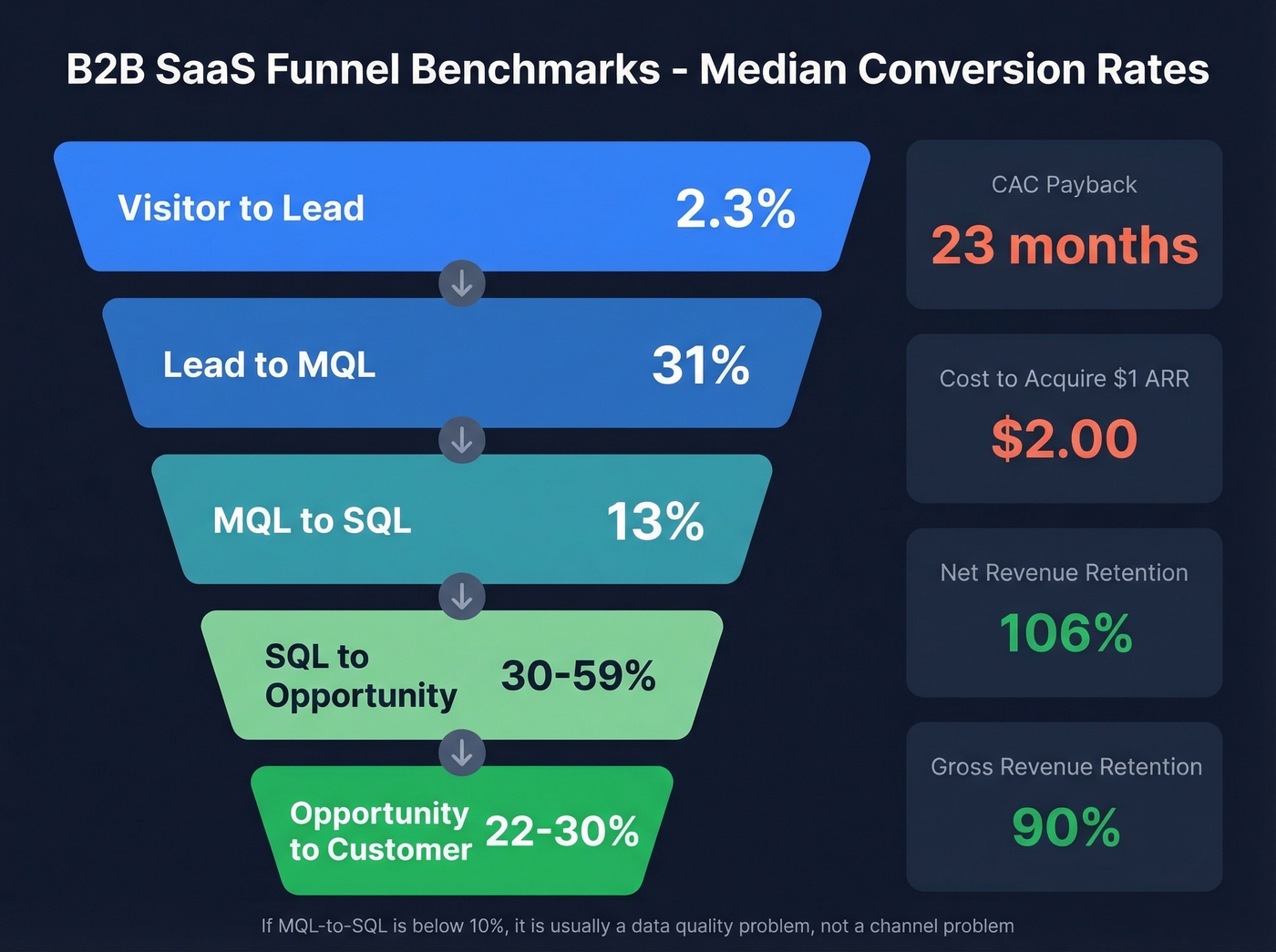
| Stage | Conversion Rate |
|---|---|
| Visitor to Lead | 2.3% |
| Lead to MQL | 31% |
| MQL to SQL | 13% |
| SQL to Opportunity | 30-59% |
| Opportunity to Customer | 22-30% |
Pin these to your wall: CAC payback averages 23 months. The median company spends $2.00 to acquire $1.00 of new ARR. Median NRR is 106%, and median GRR is 90%.
These MQL benchmarks are useful for pipeline math, but if your team optimizes for MQL volume over pipeline revenue, you'll inflate activity without moving the number that matters. In our experience, teams with MQL-to-SQL rates below 10% almost always have a data quality problem, not a channel problem. We've watched teams triple their SQL rate just by cleaning their contact database - no new channels, no new budget, just better data going into the same sequences.
Mistakes That Kill SaaS Demand Gen
The cost of acquiring a B2B lead has increased 23% over the past two years, and 32% of marketing spend gets wasted on ineffective tactics. Here's where the money dies:
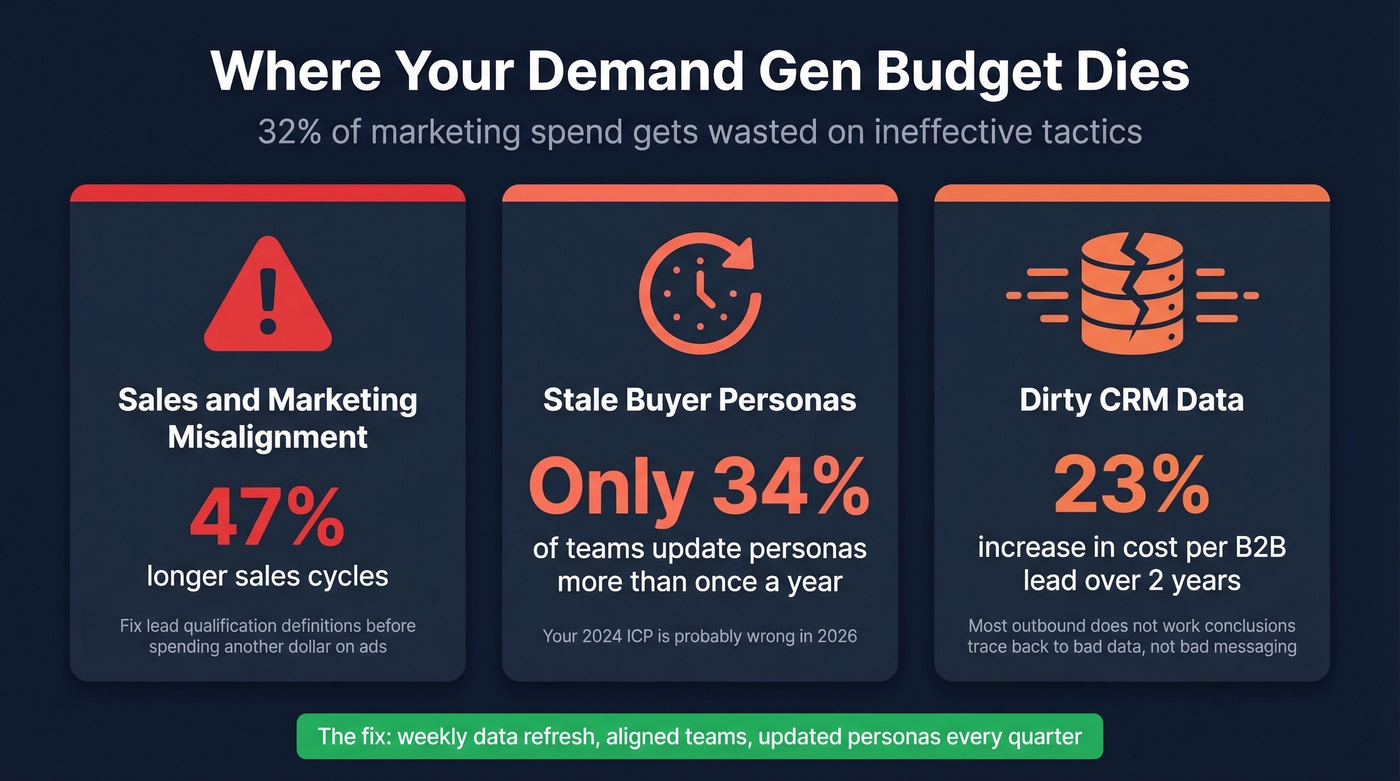
Sales and marketing misalignment causes 47% longer sales cycles. If your SDRs and marketing team can't agree on what a qualified lead looks like, fix that before you spend another dollar on ads. Real talk: one of the fastest ways to waste budget is hiring an agency, getting sold by senior strategists, and then getting junior execution. Vet the people doing the work, not just the pitch deck.
Stale buyer personas compound the problem. Only 34% of marketing teams update personas more than once a year. Your ICP from 2024 is probably wrong in 2026 - markets shift, buying committees change, and the pain points that drove urgency two years ago aren't the same ones driving it today.
Dirty data is the silent killer. Bad CRM data compounds every mistake on this list. If your outbound bounces off stale records, you'll conclude the channel doesn't work when the channel was never the problem. This is exactly why a weekly data refresh cycle matters: contacts change jobs, companies restructure, and six-week-old records decay fast. The consensus on r/sales is pretty clear - most "outbound doesn't work for us" conclusions trace back to bad data, not bad messaging.
Putting It Together
Everything above collapses into one principle: create preference before buyers enter the market, then capture them efficiently when they do. The 95/5 split, the budget allocation, the channel mix, the tech stack - they all serve that single objective.
Start with clean data, pick channels that match your ACV, benchmark ruthlessly against the funnel numbers above, and resist the urge to over-invest in capture at the expense of creation. The teams winning in 2026 aren't the ones spending the most. They're the ones spending in the right ratio.
AI-personalized outbound hits 15-25% reply rates - but only when you're reaching real inboxes. Prospeo gives you 300M+ profiles with 30+ filters including buyer intent, technographics, and headcount growth so your sequences land with the right buyers, not dead addresses.
Build your demand gen lists on data that's actually current.
FAQ
How much should a B2B SaaS startup spend on demand gen?
Startups should budget 15-20% of ARR on marketing, with 60-80% of that allocated to demand generation and direct response. For a $5M ARR company, that's $750K-$1M+ annually. Shift the creation-to-capture ratio from 30/70 early on toward 80/20 as pipeline matures.
What's the difference between demand creation and demand capture?
Demand creation builds brand preference with the 95% of your TAM that isn't actively buying - through content, podcasts, and community. Demand capture converts the 5% who are in-market via paid search, retargeting, and comparison pages. The best results come from a hybrid approach that funds both.
What funnel conversion rates should I benchmark against?
Median B2B SaaS benchmarks: 2.3% visitor-to-lead, 31% lead-to-MQL, 13% MQL-to-SQL, 30-59% SQL-to-opportunity, and 22-30% opportunity-to-close. If your MQL-to-SQL rate falls below 10%, investigate data quality before blaming channel performance.
What's a good affordable tool for outbound data quality?
Prospeo offers 98% email accuracy at roughly $0.01 per verified email with a 7-day data refresh cycle, compared to the six-week industry average. The free tier includes 75 emails and 100 Chrome extension credits monthly, making it accessible for teams testing outbound without committing to enterprise contracts.