

The B2B SaaS Growth Strategy Playbook: Benchmarks, Frameworks, and What to Focus First
The most common complaint on r/b2bmarketing about SaaS growth advice? "It feels like 'do more of everything.'" That's because most playbooks skip the only question that matters: what do you focus on first, given your stage and resources? A strong B2B SaaS growth strategy starts with ruthless prioritization - not a laundry list of tactics.
Median growth rates have dropped to 25% across 1,000+ private B2B SaaS companies, and nearly 1,000 U.S. startups shut down in the past year - up 25.6% year-over-year. The margin for unfocused execution is gone.
2026 SaaS Growth Benchmarks
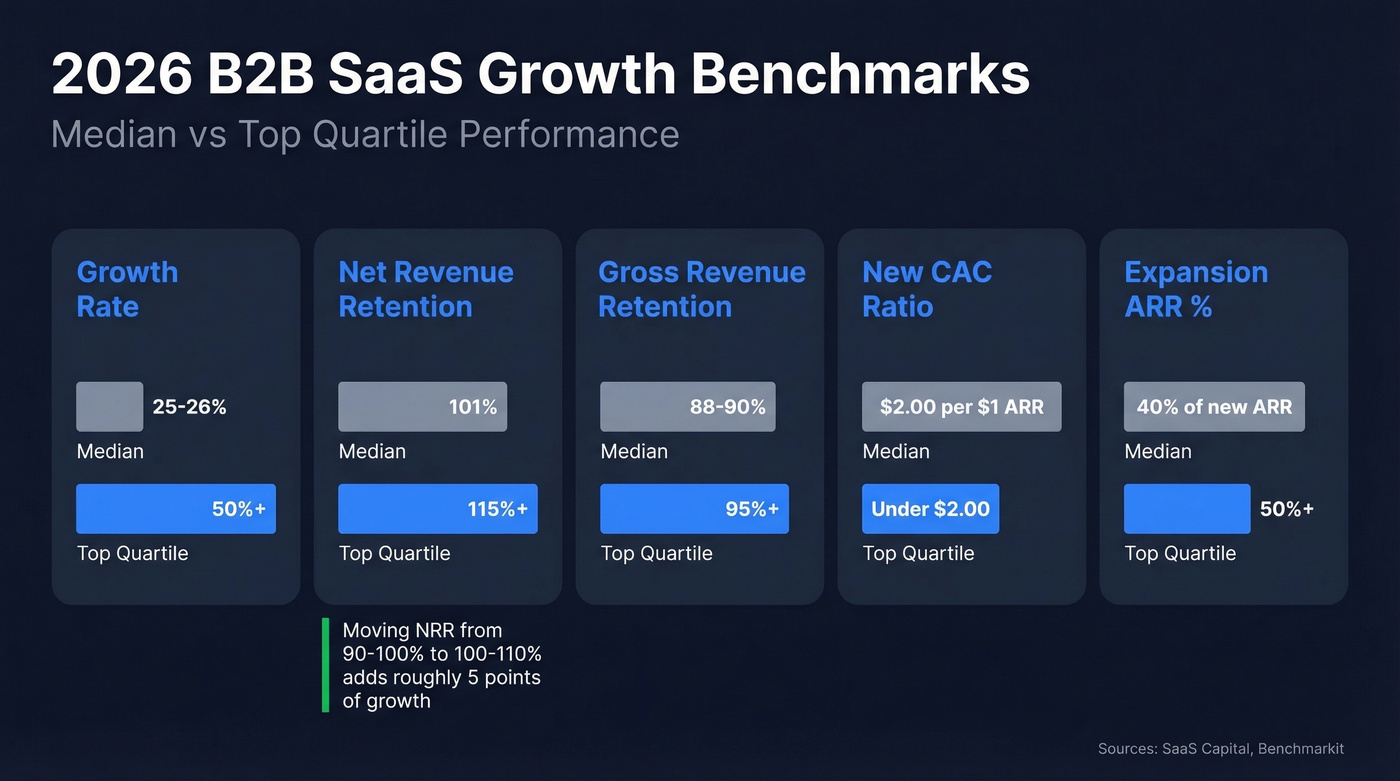
Before picking a strategy, you need to know what "good" looks like. These numbers come from SaaS Capital's annual survey and Benchmarkit's performance data:
| Metric | Median | Top Quartile |
|---|---|---|
| Growth Rate | 25-26% | 50%+ |
| NRR | 101% | 115%+ |
| GRR | 88-90% | 95%+ |
| New CAC Ratio | $2.00 per $1 ARR | <$2.00 |
| Expansion ARR % | 40% of new ARR | 50%+ |
The number that should jump out is NRR. Moving net revenue retention from the 90-100% band to 100-110% correlates with roughly +5 percentage points of growth. Companies with the highest NRR show median growth 83% higher than the population median. That's not a rounding error - it's the difference between a flat business and one that compounds.
GRR has been sliding too, from 90% down to 88% over the past three years. Expansion is papering over retention cracks for many companies, and that works until it doesn't.
Growth Priorities by Stage
The T2D3 framework maps four stages, each with distinct priorities:
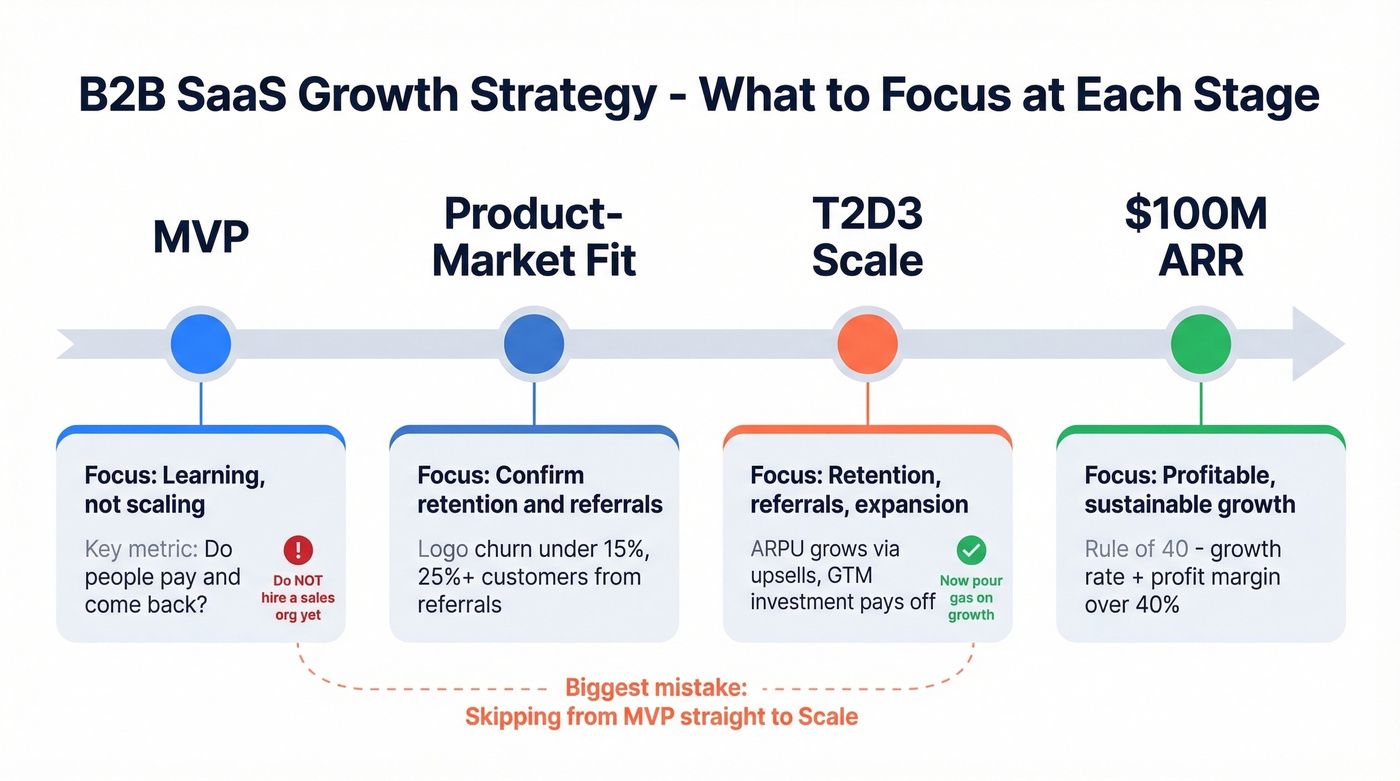
MVP - Problem/solution confirmed, first paying customers. Focus entirely on learning, not scaling. Your only metric is whether people pay and come back.
Product-Market Fit - Customers pay, stay, and refer. You aren't ready to pour gas on growth until annual logo churn is below 15% and at least 25% of customers come from referrals.
T2D3 (Scale) - Retention, referrals, and expansion are your engines. ARPU grows via upsells. This is where go-to-market motion investment pays off.
$100M ARR - Profitable, sustainable growth. The Rule of 40 - growth rate plus profit margin should exceed 40% - becomes the governing metric.
The biggest mistake we see is founders trying to skip from MVP straight to T2D3. We've watched teams burn through 18 months of runway hiring a sales org before product-market fit was confirmed. It produces misleading pipeline signals and kills companies that had viable products.

Multichannel outbound converts 4-6x better than email alone - but only if your data connects you to real buyers. Prospeo's 300M+ profiles with 98% email accuracy and 125M+ verified mobiles are refreshed every 7 days, not the 6-week industry average. Meritt tripled pipeline from $100K to $300K/week after switching.
Stop burning runway on bounced emails. Start with data that actually connects.
Choosing a GTM Motion
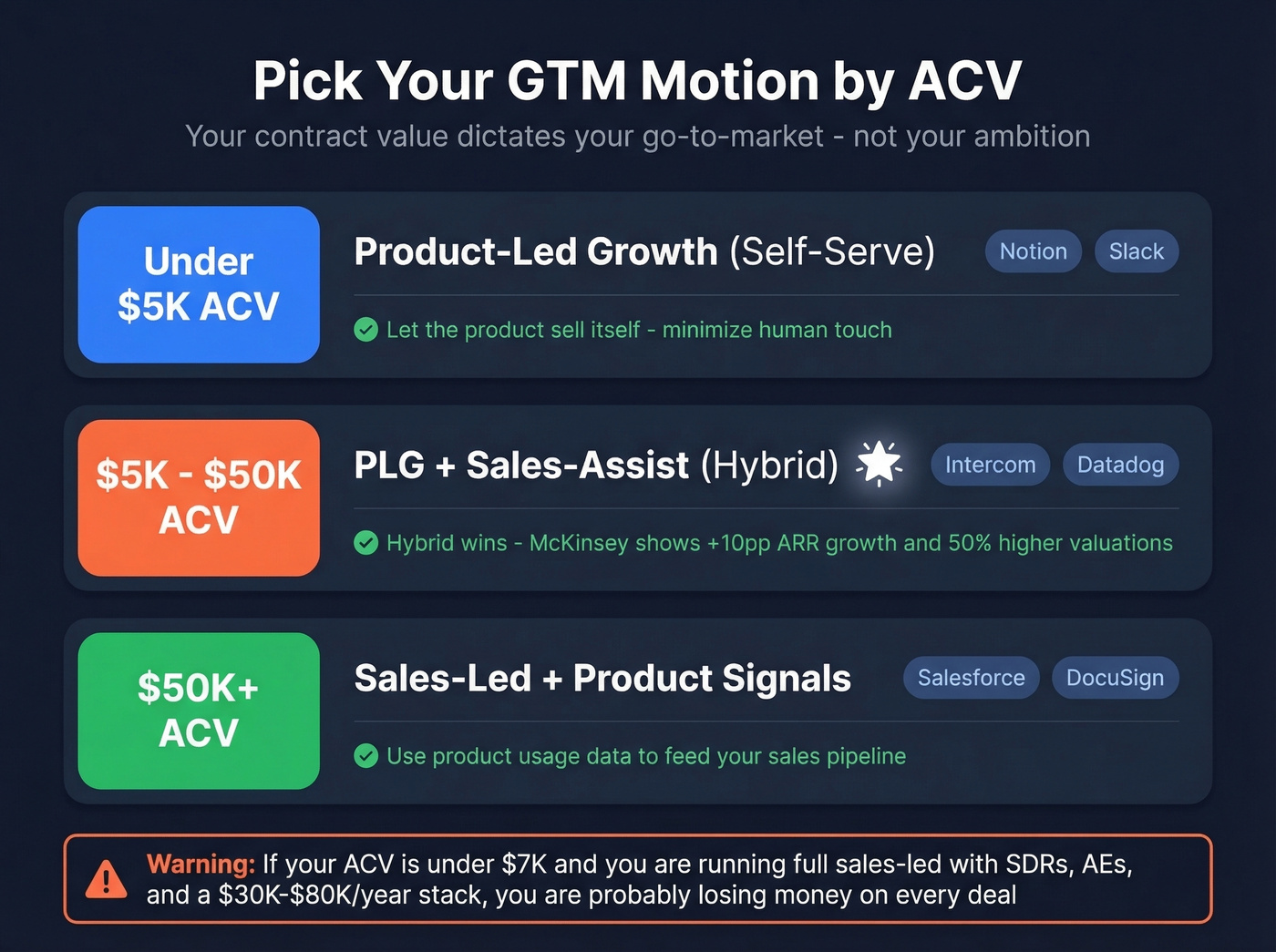
Your average contract value dictates your go-to-market motion more than any other variable:
| ACV | Motion | Example |
|---|---|---|
| <$5K | PLG (self-serve) | Notion, Slack |
| $5K-$50K | PLG + sales-assist | Intercom, Datadog |
| $50K+ | Sales-led + product signals | Salesforce, DocuSign |
Here's the thing: pure PLG is overhyped. McKinsey analyzed 107 publicly listed B2B SaaS providers and found that while product-led companies grow faster on average, only a select subset drives most of the outperformance. The real winners run hybrid - PLG with a sales-assist layer - showing +10 percentage points more ARR growth and roughly 50% higher valuation ratios than sales-led peers.
The bridge between PLG and sales is the product-qualified account (PQA). Forget MQLs. Watch for signals like 5+ weekly active users in the same domain, 3 power features used by 2 distinct roles, or usage thresholds indicating team-level adoption. Those are your sales triggers (and a good place to formalize identifying buying signals).
If your ACV sits below $7K and you're running a full sales-led motion with SDRs, AEs, and a sales engagement + CRM stack costing $30K-$80K/year, you're probably losing money on every deal. Match your GTM cost to your contract value or you'll grow yourself into bankruptcy (start with a clean cost to acquire customer model).
The Three Growth Engines
Acquisition: Signals Over Spray-and-Pray
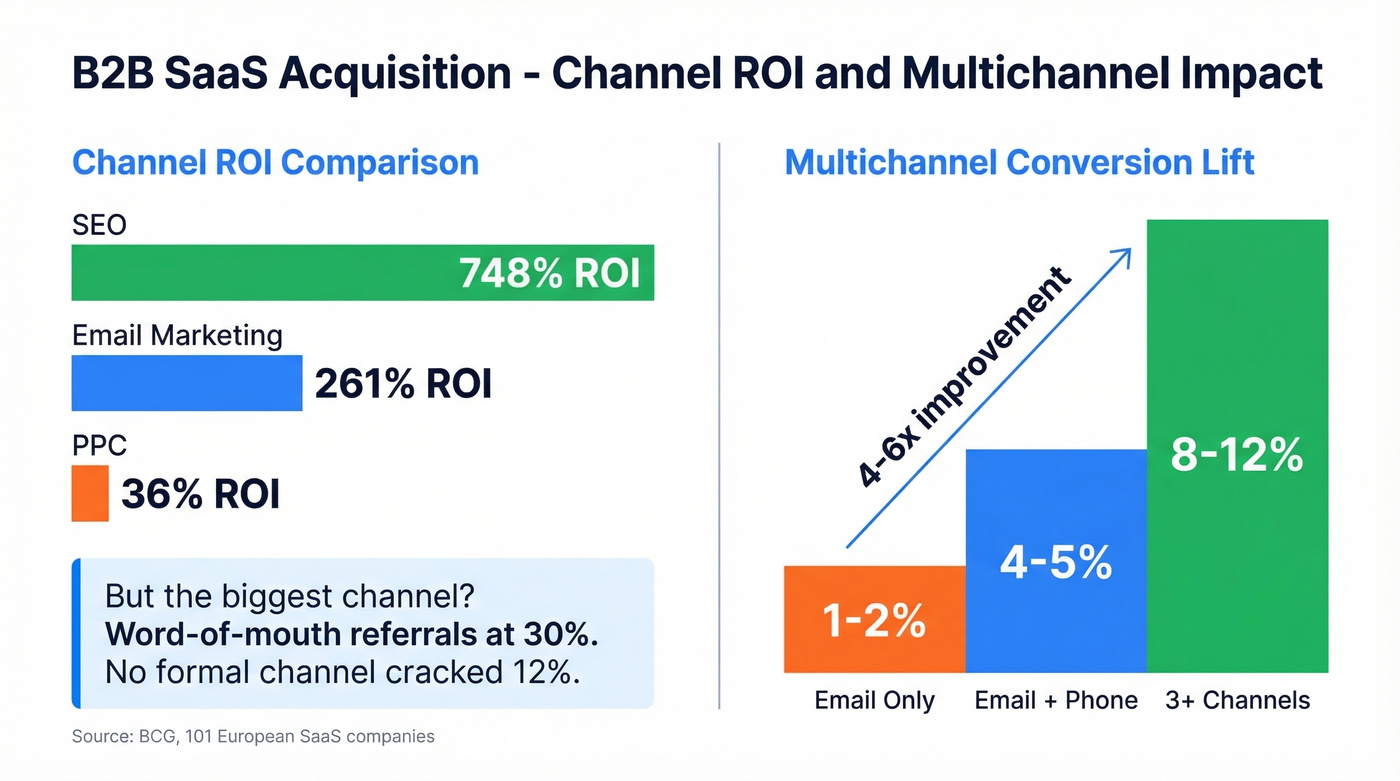
SEO delivers roughly 748% ROI, email marketing 261%, and PPC just 36%. But the single biggest acquisition channel in BCG's survey of 101 European SaaS companies? Word-of-mouth referrals at 30%. No "formal" channel cracked 12%. BCG's survey of 101 European SaaS companies also found that personalized marketing correlates with 40% faster growth - and AI-powered personalization at scale is making this accessible to smaller teams for the first time.
GEO (generative engine optimization) is emerging as a parallel channel to traditional SEO. Teams ignoring AI-driven search visibility are already falling behind.
For outbound, the data is clear: email-only converts at 1-2%. Add phone and you're at 4-5%. Add a third channel and conversion jumps to 8-12%. Multichannel isn't optional - it's the baseline.
One practitioner on r/startups shared how they kept pipeline alive as a solo GTM operator: they turned ~3,000 messy CRM accounts into 30,000+ mapped companies using Clay, Apollo, and signal-based routing, then covered 2-5K active leads weekly through automated multichannel sequences. The key wasn't more tools. It was better targeting built on verified data (see Clay list building for a practical workflow).
That's where data quality becomes a competitive advantage. Prospeo delivers 98% email accuracy on a 7-day refresh cycle at ~$0.01/email, and one customer, Meritt, saw bounce rates drop from 35% to under 4% and pipeline triple from $100K to $300K per week after switching their data source. When your outbound depends on contact quality, a weekly refresh that outpaces the 6-week industry average makes a real difference (especially if you're tracking email bounce rate and deliverability).

Retention: NRR as the Real Engine
High-NRR companies grow 2.5x faster than low-NRR companies. Here are simple "good vs. great" targets:
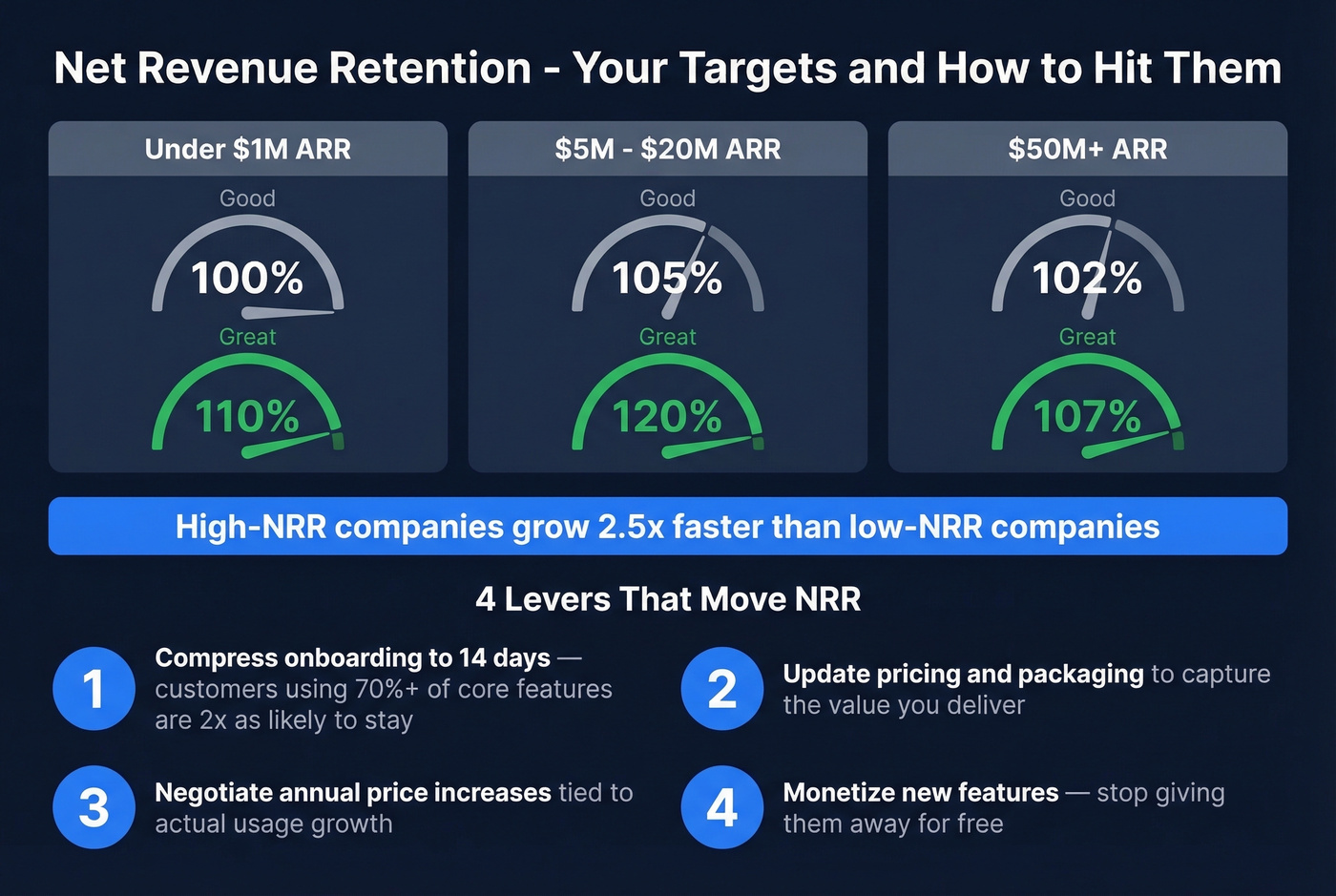
| ARR Band | Good NRR | Great NRR |
|---|---|---|
| <$1M | 100% | 110% |
| $5M-$20M | 105% | 120% |
| $50M+ | 102% | 107% |
In our experience, companies that nail onboarding in the first 14 days - not 30 - see the biggest retention lift. Customers using 70%+ of core features are 2x as likely to stay. If your onboarding doesn't drive feature adoption fast, you're leaking revenue before expansion can kick in (run a proper churn analysis to find where it starts).
Four levers move NRR: reduce churn through better onboarding, update pricing and packaging to capture value, negotiate annual price increases tied to usage, and monetize new features instead of giving them away. Getting these right is the fastest way to accelerate growth without increasing acquisition spend.
Expansion: The Primary Revenue Lever
Expansion ARR now represents 40% of total new ARR at the median. For companies above $50M ARR, it's over 50%.
Usage-based pricing delivers 18-23% higher NRR and 34% faster land-and-expand velocity. Per 2026 benchmarks, 43% of SaaS companies now use usage-based pricing (+8pp year-over-year), and 61% run hybrid models. If your pricing doesn't create natural upsell paths - collaboration limits, scale limits, governance features behind paid tiers - you're leaving expansion revenue on the table (tie it back to upsell vs cross-sell in SaaS).
What Not to Do
Quibi burned $1.75 billion in six months. Fast generated $600K in revenue on $124.5M invested. These aren't edge cases - they're the extreme end of a pattern that kills SaaS companies at every stage.
The subtler version is more common and just as deadly: build for 6-12 months, then launch to no audience and no distribution. A study of 28 SaaS startups found this "build first, market later" approach was the dominant failure mode. BCG's data reinforces it - 39% of surveyed companies cite lead acquisition and sales as their main risk, yet most skip distribution planning until post-launch.
Let's be honest. If you don't have a distribution hypothesis before you have a product, you don't have a B2B SaaS growth strategy. You have a hope strategy.
Expansion drives 40%+ of new ARR at the median - but you can't upsell accounts you never reached. Prospeo layers buyer intent data across 15,000 topics with job change, headcount growth, and technographic filters so you target accounts already in-market. All at ~$0.01/email with no contracts.
Find in-market buyers before your competitors do. Free tier included.
FAQ
What's a good SaaS growth rate in 2026?
Median annual growth for private B2B SaaS companies is 25-26%; top quartile exceeds 50%. Every 10-percentage-point improvement in NRR adds roughly 5 points of topline growth, making retention the highest-leverage accelerator for most companies.
Should I choose PLG or sales-led?
Below $5K ACV, lead with product-led growth. Between $5K and $50K, layer in sales-assist. Above $50K, run sales-led with product usage signals feeding your pipeline. McKinsey's data shows hybrid models outperform pure approaches by +10pp ARR growth.
How do I build outbound pipeline with a small team?
Use signal-based targeting - intent data, job changes, funding events - paired with multichannel sequences and verified contact data. One solo operator covered 2-5K active leads weekly using automated routing with tools like Prospeo, Clay, and Apollo. Prospeo's 98% email accuracy and 125M+ verified mobiles keep deliverability high without burning your domain.
What's the fastest way to improve NRR?
Compress onboarding to 14 days, drive adoption of 70%+ of core features, and shift to usage-based or hybrid pricing. Companies making these changes see 18-23% higher NRR and 34% faster expansion velocity compared to flat-rate peers.