

B2B Sales Stats That Actually Matter in 2026
That "67% of the buyer's journey happens digitally" stat you keep seeing in pitch decks? It's from 2013. Corporate Visions flagged this years ago, and yet it still shows up in board presentations like it's fresh insight. Most B2B sales stats roundups recycle the same stale numbers without checking when the underlying research was conducted or how many people were actually surveyed.
We've tracked down every core number below from a primary source published within the last 18 months. Where sample sizes exist, we've included them. Where methodology matters, we've noted it.
Five Stats Shaping 2026 Strategy
If you're short on time:
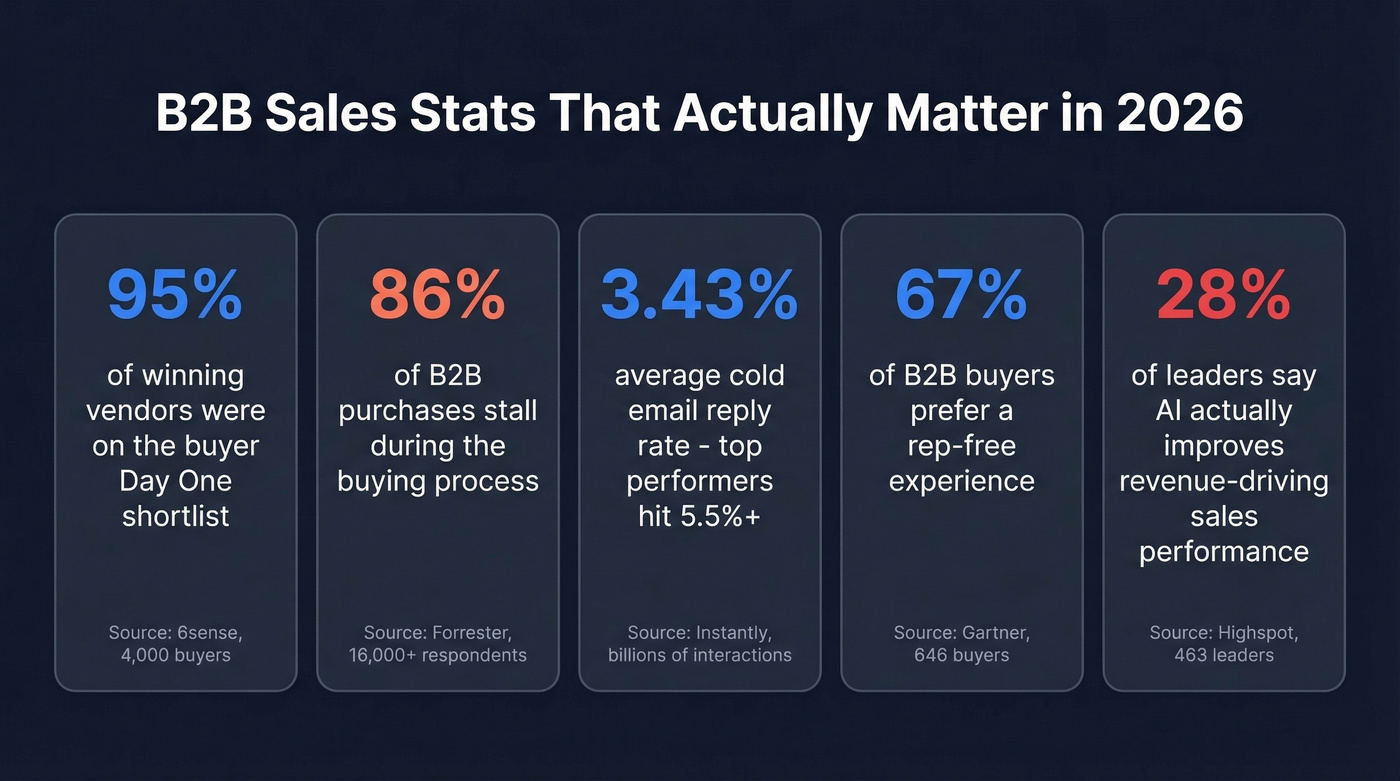
- 95% of winning vendors were on the buyer's "Day One" shortlist - if you're not in the consideration set before outreach starts, you're almost certainly losing. 6sense surveyed nearly 4,000 buyers.
- 86% of B2B purchases stall at some point during the buying process. Forrester, 16,000+ respondents.
- 3.43% is the average cold email reply rate - top performers hit 5.5%, and elite campaigns exceed 10%. Instantly analyzed billions of interactions.
- 67% of B2B buyers prefer a rep-free experience. Gartner surveyed 646 buyers in Aug-Sep 2025.
- Only 28% of leaders say AI actually improves revenue-driving sales performance - despite near-universal adoption. Highspot surveyed 463 leaders in June 2025.
The B2B Buying Cycle in 2026
The average B2B buying cycle now runs 10.1 months, down from 11.3 months in 2024. That compression is real - nearly half of buyers in 6sense's study said economic pressure shortened their timelines, and 62% said it drove them to engage sellers earlier than they otherwise would have.
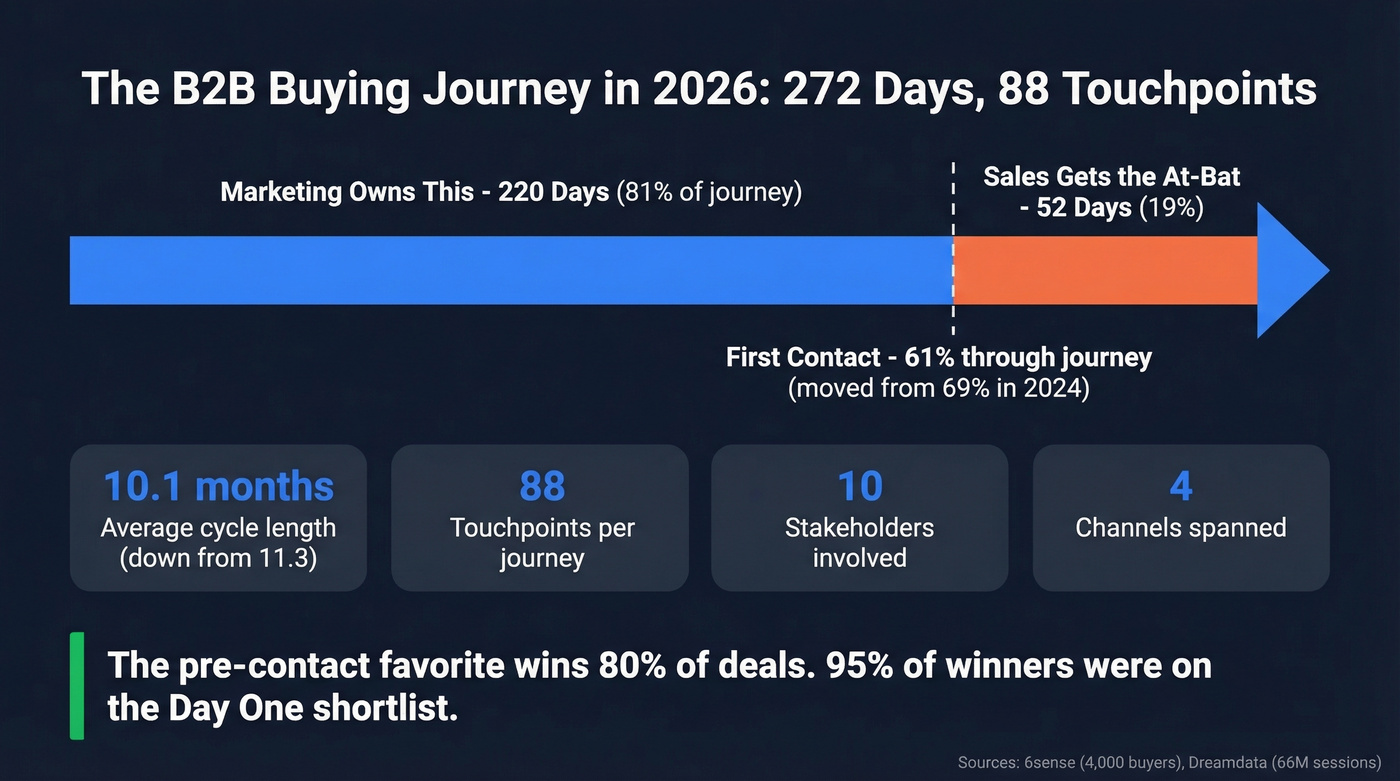
But "shorter" doesn't mean "simpler." A Dreamdata analysis shared on Reddit (66M sessions across 3.5M B2B customer journeys) puts the full journey at 272 days, spanning 88 touchpoints across 4 channels and involving 10 stakeholders. Marketing owns roughly 81% of that timeline - about 220 days - before sales even gets a meaningful at-bat.
Here's the thing: the most important finding isn't the cycle length. It's the shortlist dynamics. The winning vendor appears on the buyer's "Day One" shortlist 95% of the time. The pre-contact favorite - the vendor the buyer already prefers before talking to any sales rep - wins roughly 80% of deals. By the time a buyer reaches out, the decision is largely made.
The point of first contact moved from 69% of the journey to 61%. Buyers are reaching out about 6-7 weeks earlier than they did in 2024. That's a window. But it only matters if you're already on the shortlist.
Why Deals Stall
Even when buyers do engage, the process breaks down constantly. 86% of B2B purchases stall, per Forrester's survey of 16,000+ global business buyers. And the outcome for "successful" purchases isn't much better - 81% of buyers report dissatisfaction with the provider they ultimately chose.
Among Gen Z and Millennial buyers, that dissatisfaction rate climbs to 91%. These aren't fringe buyers anymore. They're increasingly the ones running evaluation processes.
The structural problem is buying group complexity. The average B2B purchase involves 13 people, and 89% of purchases span two or more departments. When you multiply 13 decision-makers by internal politics, competing priorities, and misaligned timelines, it's surprising that only 86% of deals stall. Every unnecessary step, every misrouted approval, every "let me loop in my colleague" email is a deal killer.
Self-Serve Buying and the AI Reality Check
Two-thirds of B2B buyers now prefer a rep-free experience - 67%, per Gartner's survey of 646 buyers conducted in Aug-Sep 2025. And 45% reported using AI during a recent purchase, not just researching with AI, but actively using it to evaluate vendors and make decisions. Nearly 90% of buyers said AI features were part of the solutions they acquired.
On the seller side, the enthusiasm is even louder. 94% of sales leaders with AI agents call them essential for meeting business demands. 88% of reps with agents say the technology increases their odds of hitting targets. High performers are 1.7x more likely than underperformers to use prospecting agents, per Salesforce. And the results can be dramatic: one SDR agent created 3,200 opportunities in four months from low-score leads that human reps had deprioritized - the kind of "sawdust" pipeline most teams ignore entirely.
But here's where the narrative cracks.
Only 28% of leaders say AI actually improves revenue-driving sales performance. That's a massive gap between "we're using AI" and "AI is making us money."
The bottleneck isn't the technology. It's the data underneath it. 74% of sales teams with AI prioritize data hygiene, and 51% cite data security concerns as a barrier to AI initiatives. AI amplifies whatever you feed it - stale data just means you automate bad outreach faster.
Gartner adds a counterpoint worth sitting with: by 2030, they expect 75% of B2B buyers will prefer sales experiences that prioritize human interaction over AI. The self-serve wave may already be approaching its peak.

AI amplifies whatever you feed it - and 74% of sales teams with AI prioritize data hygiene for exactly that reason. Prospeo's 5-step verification delivers 98% email accuracy on a 7-day refresh cycle, so your AI agents and sequences run on data that actually connects. 15,000+ companies trust it to power their outbound.
Stop automating bad outreach. Start with data that's verified this week.
Funnel Conversion Benchmarks
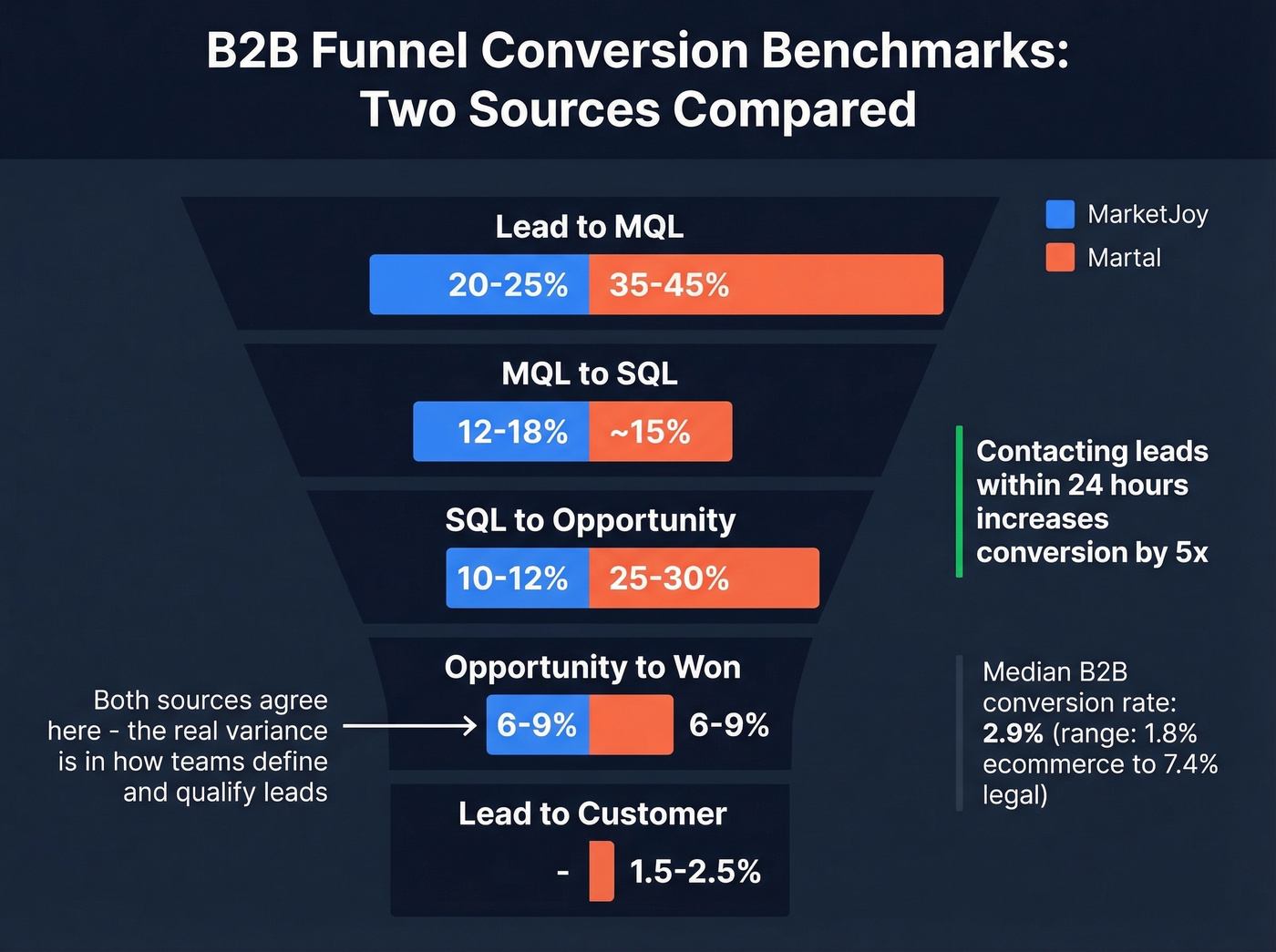
Two sources - MarketJoy (aggregated client data, 2024-2025) and Martal (analysis of 100M data points) - provide stage-by-stage benchmarks worth comparing:
| Stage | MarketJoy Range | Martal Range |
|---|---|---|
| Lead to MQL | 20-25% | 35-45% |
| MQL to SQL | 12-18% | ~15% |
| SQL to Opportunity | 10-12% | 25-30% |
| Opportunity to Won | 6-9% | 6-9% |
| Lead to Customer | - | 1.5-2.5% |
MarketJoy's ranges skew conservative - if your team runs tight qualification, use those as your baseline. Martal's higher Lead-to-MQL numbers likely reflect looser MQL definitions. Both converge on the close rate, which tells you the real variance is in how teams define and qualify leads, not how they close them.
The biggest drop-off is consistently MQL to SQL. That's where marketing-qualified leads hit the reality of sales qualification - and most don't survive. The median B2B conversion rate across industries sits at 2.9%, but the spread is enormous: legal services convert at 7.4% while B2B e-commerce runs closer to 1.8%. Referrals convert at roughly 3.6%, while cold calling lands closer to 1%.
One number that deserves its own line: contacting leads within 24 hours increases conversion by 5x. Speed-to-lead isn't a nice-to-have. It's the single highest-leverage operational fix most teams can make. If you want a deeper baseline, compare against the median B2B conversion rate by channel and industry.
Outbound Email Benchmarks
Cold email is noisier than ever, and the data confirms it. 69% of cold email senders report performance declined year-over-year, driven by tighter spam filtering and AI-content fatigue. But "noisier" doesn't mean "dead." It means the gap between average and elite performers is widening fast.
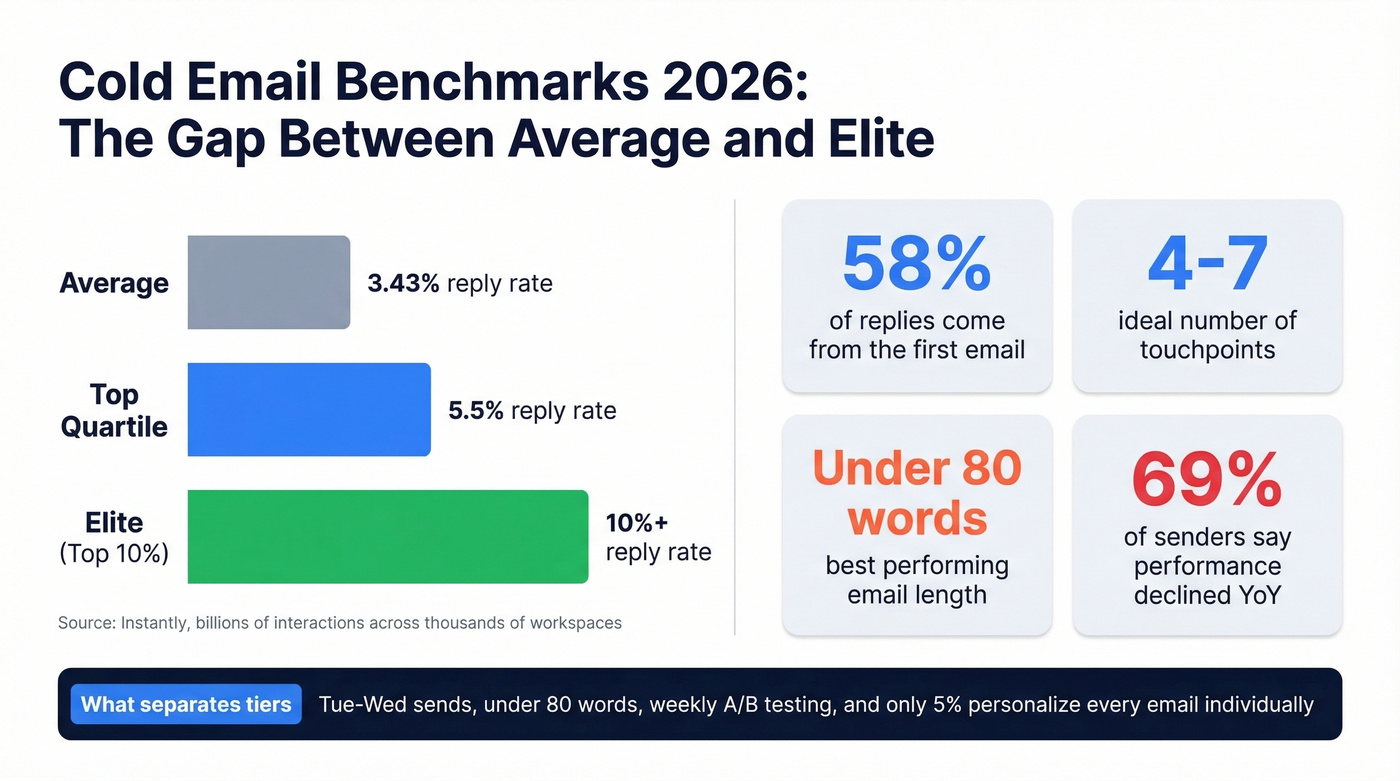
Instantly's 2026 Cold Email Benchmark Report, drawn from billions of interactions across thousands of workspaces, breaks it down:
| Tier | Reply Rate |
|---|---|
| Average | 3.43% |
| Top quartile | 5.5% |
| Elite (top 10%) | 10%+ |
58% of replies come from the first email. That means your opener carries more weight than your entire follow-up sequence. Follow-ups still matter - the sweet spot is 4-7 touchpoints, with diminishing returns after that.
The tactical details that separate tiers: best-performing campaigns keep emails under 80 words, A/B test messaging weekly, and send on Tuesday-Wednesday. Only 5% of senders personalize every email individually - most rely on segment-based templates. If you need a starting point, use these cold email subject lines and then iterate with a follow-up sequence.

Bounce rates tell the deliverability story. 48% of senders report 2-5% bounce rates, and 15% report 6% or higher. That 6%+ group is burning domain reputation with every send. To stay under ~2% bounce, verify every email before it enters your sequence. Prospeo runs a 98% accuracy rate on a 7-day refresh cycle, but any real-time verification tool works - the point is to never send to an unverified list. For the mechanics, see our email deliverability guide and how to improve sender reputation.
One Operator's Results
A practitioner on r/Entrepreneur shared a detailed breakdown of how they doubled their reply rate from 3% to 6%:
- Deliverability: expanded from 3 domains to 7, capped sends at 26/day per domain
- List quality: stopped buying lists, verified manually - bounce rate dropped from 11% to under 2%
- Copy: cut email length from 141 words to under 56 words
- Timing: Tue-Thu, 8-11am recipient timezone, reported +16% open rate improvement
- Cost: ~$420/month total stack
- Output: 16 qualified leads/month from email alone
One person's results. But the pattern - deliverability discipline, shorter emails, verified lists - aligns with the Instantly data at scale. These outbound statistics reinforce a simple truth: volume without quality is just noise.
Sales Team Performance
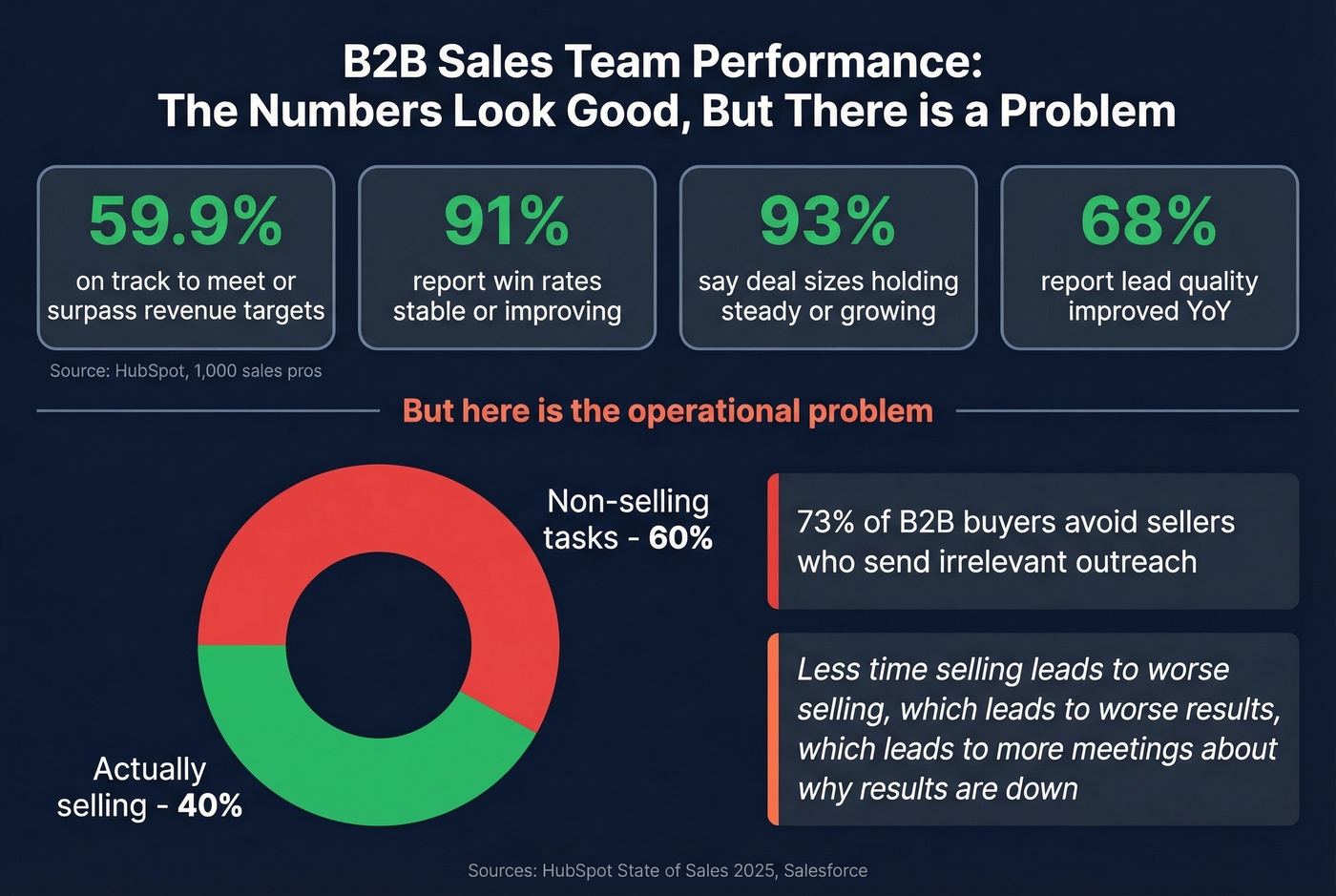
Despite the noise about AI disruption and buyer dissatisfaction, sales teams are broadly holding steady. HubSpot's 2025 State of Sales survey of 1,000 global sales pros found that 59.9% are on track to meet or surpass revenue targets. 91% report win rates that are stable or improving. Average deal sizes are holding steady or growing for 93% of respondents, and 68% report lead quality improved year-over-year.
Those are healthier numbers than the doom-and-gloom narrative suggests.
But they mask an operational problem: reps still spend 60% of their time on non-selling tasks, per Salesforce. That's admin, CRM updates, internal meetings, and data cleanup eating into the hours that actually generate revenue. Look - 73% of B2B buyers actively avoid sellers who send irrelevant outreach. When reps spend most of their day not selling, the outreach they do send tends to be less targeted and less personalized. Less time selling leads to worse selling, which leads to worse results, which leads to more internal meetings about why results are down. We've seen this cycle firsthand with teams that come to us after burning through their domain reputation on bad data. If you're trying to fix the time allocation problem, start with sales prospecting techniques and a tighter sales process optimization.
What's Coming (2026-2030)
Let's be honest: the teams still treating outbound as a volume game in 2027 will be the ones wondering why their pipeline dried up. Three trends explain why.
First, Gartner predicts that by 2030, 75% of B2B buyers will prefer human interaction over AI in sales experiences. That's a dramatic reversal from today's 67% rep-free preference. If it holds, the companies investing in hybrid models - AI for research and qualification, humans for complex conversations - will have the structural advantage.
Second, nearly 95% of buyers anticipate using genAI to support purchase decisions in the next 12 months, per Forrester. AI isn't going away. But the Highspot data suggests the winners won't be the teams with the most AI tools - they'll be the ones with the cleanest data feeding those tools. AI adoption among revenue organizations has already jumped from 34% in 2023 to 89% today. The adoption curve is flattening. Execution quality is the only remaining differentiator.
Third, economic pressure continues to compress buying cycles. With 62% of buyers engaging sellers earlier due to economic conditions, the window for influence is shifting. The teams that win will be the ones already on the Day One shortlist - which means brand, content, and early-stage awareness aren't optional anymore. They're the pipeline. If you want a practical framework for that, build around B2B brand positioning and what is B2B content marketing.
Contacting leads within 24 hours increases conversion by 5x - but only if you have the right contact data when intent signals fire. Prospeo combines 300M+ profiles, buyer intent across 15,000 topics, and verified emails at $0.01 each so your team moves fast on real opportunities.
Speed-to-lead means nothing if your emails bounce. Fix that first.
B2B Sales Stats: FAQ
What's the average B2B sales cycle length in 2026?
The average B2B buying cycle runs 10.1 months, down from 11.3 in 2024, per 6sense's study of nearly 4,000 buyers. A Dreamdata analysis puts the full journey at 272 days across 88 touchpoints and 10 stakeholders. Economic pressure shortened cycles for nearly half of buyers surveyed.
What's a good cold email reply rate?
The average cold email reply rate is 3.43%, per Instantly's 2026 benchmark report analyzing billions of sends. Top quartile performers hit 5.5%, and elite campaigns exceed 10%. Keep emails under 80 words, use 4-7 touchpoints, and send Tuesday-Wednesday for peak engagement.
How many people are involved in a B2B buying decision?
Thirteen on average, per Forrester's survey of 16,000+ buyers. 89% of purchases span two or more departments. You're selling to a committee, not an individual - which is why 86% of deals stall at some point.
Is AI actually improving B2B sales performance?
Only 28% of leaders say AI improves revenue-driving sales performance, despite 94% calling AI agents essential and 88% of reps crediting agents with better quota attainment. The gap comes down to data quality - 74% of high-performing teams prioritize data hygiene before layering on AI tools.
How can I reduce email bounce rates below 2%?
Verify every contact with a real-time validation tool before sending. One practitioner dropped bounce rates from 11% to under 2% by switching from purchased lists to verified contacts - and doubled their reply rate in the process. Any provider with 98%+ accuracy and frequent data refreshes will keep you safe.