

BASHO Emails: How to Write Them and Whether They Still Work in 2026
You just spent 20 minutes crafting the perfect cold email sequence to a VP of Engineering - referencing their conference talk, tying it to a pain point you spotted in their job postings - and it bounced. The address was two jobs old. That's the paradox of basho emails: the highest-effort outreach in sales is also the most punishing when the foundation is wrong.
Here's how to get the framework, the templates, and the data layer right.
What Is a BASHO Email?
The term comes from Jeff Hoffman's Basho Strategies sales training program. Hoffman built the methodology around a simple idea: a cold email should be so specific to the recipient that it could not have been sent to anyone else. Not "Hi {first_name}, I noticed your company is growing" - that's a merge tag, not personalization.
A BASHO email targets one decision-maker at one company, references a real trigger like a funding round, a public statement, or a strategic initiative, and connects that trigger to a specific way you can help. 88% of people say they're more likely to respond to an email that's been specifically written for them, which sounds obvious until you look at your own inbox and count how many cold emails actually clear that bar.
The defining test is brutal: if you could swap the recipient's name and company for someone else's and the email still makes sense, it's not a BASHO email. It's a template with a veneer.
Is BASHO Dead? The 2026 Verdict
The label is almost irrelevant now. What matters is whether the underlying principles still work.
The "Series B trigger" style got commoditized years ago. Five vendors send the same "Congrats on the funding round!" email in the same week, and the trigger stops being a trigger - it becomes noise. That's not a failure of the framework. It's a failure of lazy execution.
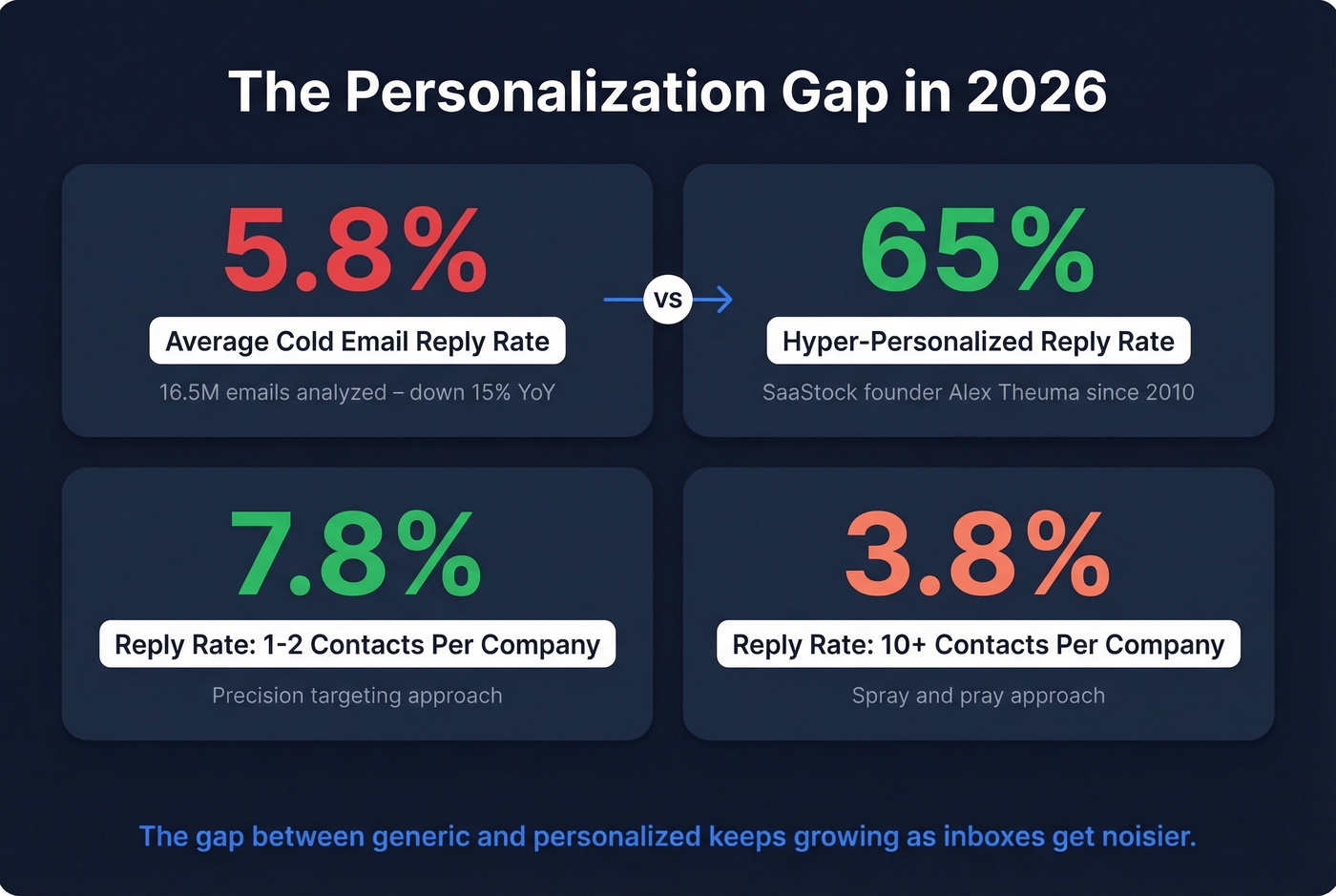
The numbers tell a clear story. Belkins analyzed 16.5 million cold emails across 93 business domains and found the average reply rate dropped to 5.8% - down 15% year-over-year. Meanwhile, SaaStock founder Alexander Theuma has maintained roughly 65% response rates on his hyper-personalized outreach since 2010. That's not a typo. The gap between generic outbound and genuinely personalized emails has never been wider, and it keeps growing as inboxes get noisier and spam filters get smarter.
Here's a stat that reinforces the BASHO philosophy: targeting just 1-2 contacts per company yields a 7.8% reply rate, while blasting 10+ contacts at the same company drops to 3.8%. Precision beats volume every time.
Lazy BASHO is dead. The principles - real triggers, specific insight, soft ask - are more relevant than ever.
Hoffman's Original Framework
Hoffman's methodology centers on WYWYN - "Why You? Why You Now?" Every element of the email must answer both questions. If you can't articulate why this specific person should care about your message this specific week, you don't have a real BASHO email.
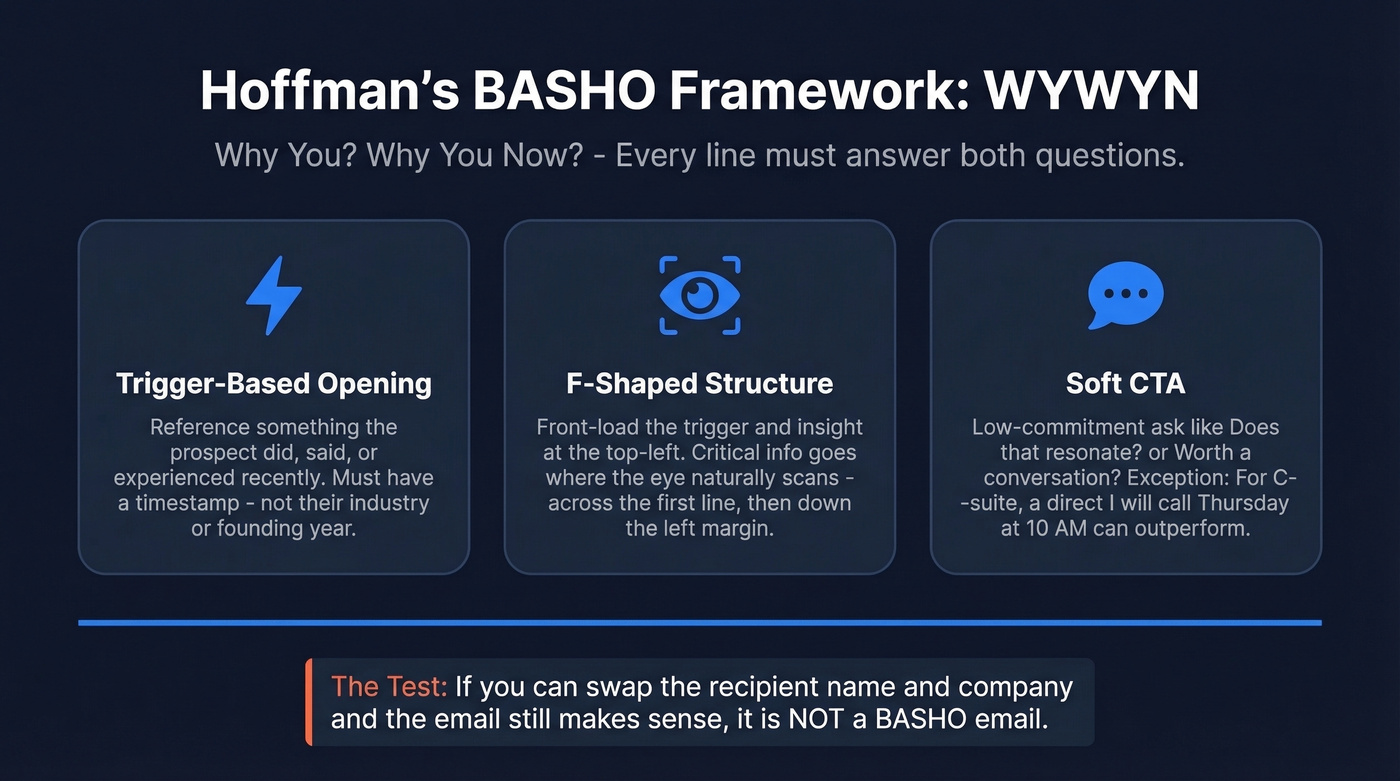
The framework breaks down into three components:
- Trigger-based opening. The first line references something the prospect did, said, or experienced recently. Not their company's founding year. Not their industry. Something with a timestamp.
- F-shaped email structure. Format emails so the critical information sits where the eye naturally scans - top-left, across the first line, then down the left margin. Front-load the trigger and the insight. Bury nothing.
- Soft CTA. No "Are you free Tuesday at 2:15?" The ask is low-commitment: "Does that resonate?" or "Worth a conversation?" One exception for C-suite outreach: "I'll call your office Thursday at 10 AM" can outperform the soft ask because it's direct and removes friction.
How to Write One Step by Step
Step 1: Spend three minutes researching. Not three seconds scanning a profile. Three actual minutes. Look for a trigger - a recent hire, a public statement, a product launch, a conference talk, a job posting that reveals a strategic priority. One practitioner on r/Entrepreneur doubled their reply rate by spending three minutes per email writing a first line that referenced a specific announcement or post.
Step 2: Open with the trigger. Delete "I hope this finds you well." Delete "My name is." Delete your company history. Start with the thing you found. "Saw you're hiring three ML engineers while sunsetting your legacy data pipeline - that's a big bet."
Step 3: Connect the trigger to an insight. This is where most people stop short. The trigger alone isn't enough - you need to show you understand what it means for them. "That usually means the existing stack can't handle the inference workload, and the team's spending more time on infra than models."
Step 4: Keep it short. Data from 16.5M emails shows 6-8 sentences performs best for cold email generally, but many high-performing BASHO emails stay under ~90 words and feel even shorter because every line earns its place. That same Reddit case study cut emails from 141 words to under 56 and doubled reply rates. When in doubt, cut.
Step 5: End with a soft CTA. "Does that match what you're seeing?" beats "Can I get 15 minutes on your calendar Thursday?" every time.
One more tip we've seen work well: send on Thursday evenings between 8-11 PM. The data shows Thursday pulls a 6.87% reply rate versus Monday's 5.29%, and evenings are a reply-rate peak. (If you want the full breakdown, see our guide on the best time to send cold emails.)
Pro tip from a practitioner we respect: write stream-of-consciousness first, find the "aha" moment, then delete everything before it. That's your opening line.

You just spent three minutes crafting the perfect trigger-based opening. Don't let it bounce. Prospeo's 98% verified emails and 7-day data refresh mean your BASHO emails actually reach the decision-maker - not a dead inbox from two jobs ago.
Stop wasting hyper-personalized emails on stale data.
BASHO vs. Generic Cold Email
| Element | Generic Cold Email | BASHO Email |
|---|---|---|
| Opening | Company history / pleasantries | Specific trigger from prospect's world |
| Body | Broad claims ("save up to 30%") | Insight tied to prospect's challenge |
| Length | 141+ words | Under ~90 words (often much shorter) |
| CTA | Hard meeting ask with time | Soft ("Does that resonate?") |
| Personalization | First name + company merge | Unique to one recipient |
| Expected reply rate | 2-3% | 10-20%+ |
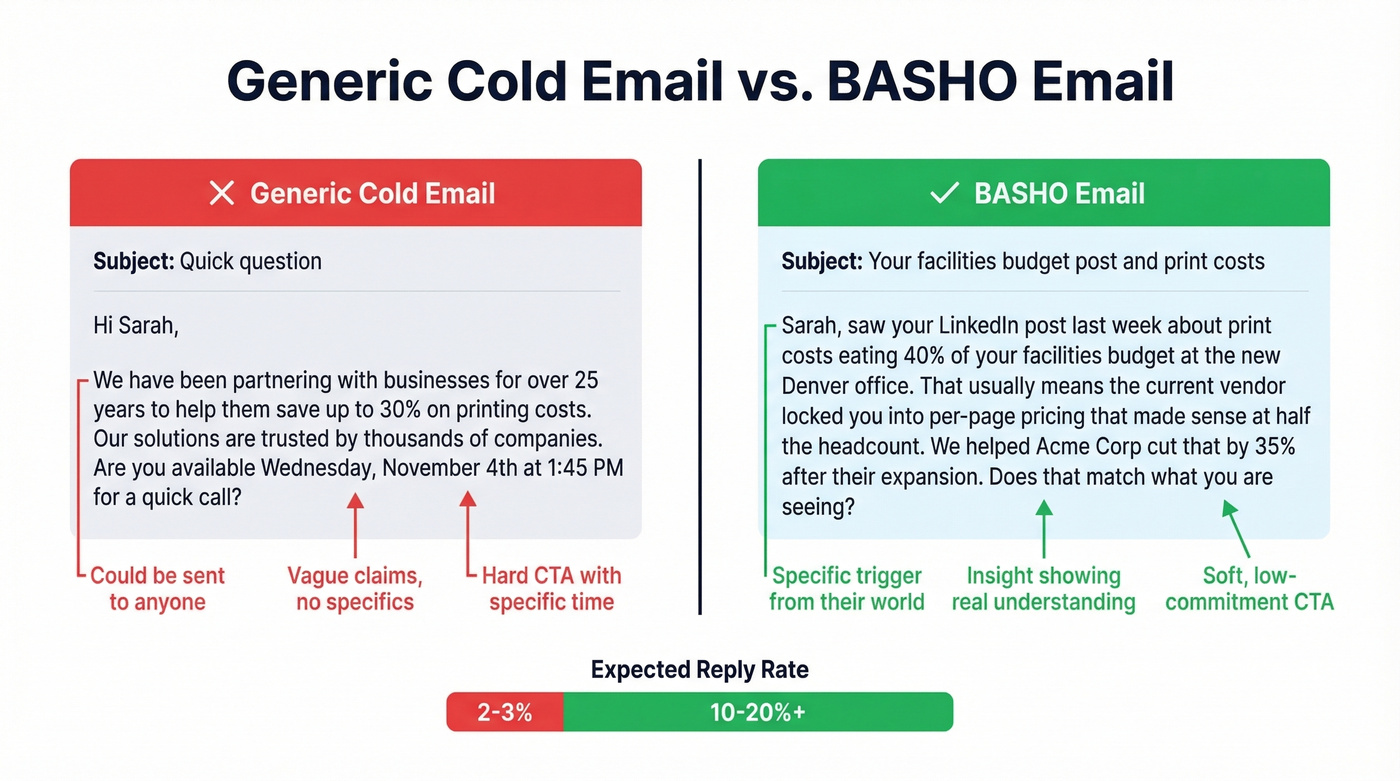
The difference isn't subtle. A generic cold email from an r/sales thread reads like this: "We've been partnering with businesses for over 25 years... save up to 30%... Are you available Wednesday, November 4th at 1:45 PM?" That email could go to any office manager at any company. A BASHO rewrite would reference the prospect's specific pain - maybe they just posted about print costs eating their facilities budget - and tie it to a concrete outcome.
Three Templates You Can Steal
Each template below follows Hoffman's WYWYN structure but adapts the tone and CTA for different buyer personas. Use them as starting points, not copy-paste scripts - the whole point is that a real BASHO email can't be generic.
Template 1: SaaS to VP Sales (Funding Trigger)
Subject: [Company]'s Series B and the ramp problem
[First name], saw [Company] closed a $[X]M Series B last month - congrats. That usually means doubling the sales team in two quarters, which means ramp time becomes the bottleneck, not headcount.
We helped [similar company] cut ramp from 90 to 55 days after their B round. Worth a quick look?
Template 2: Agency to CMO (Pattern-Interrupt)
Subject: Scaling [initiative name] before attribution breaks
What keeps you up more right now - scaling your [specific initiative, e.g., podcast / content hub] too fast and losing attribution, or not scaling fast enough and losing momentum?
We helped [similar brand] solve both after their launch and drove [specific metric]. Happy to share the playbook if it's useful.
This example breaks the trigger-then-insight pattern on purpose. Leading with a question that names the prospect's actual dilemma earns a reply because it proves you understand the tension, not just the headline.
Template 3: Startup to CTO (Hiring Signal + Bold CTA)
Subject: [Company]'s [specific tech] migration
[First name], noticed [Company] posted three [specific role] openings this month while your team's contributing to [specific signal - e.g., an open-source migration project]. That's usually a sign the current stack hit a wall.
We helped [similar company]'s eng team [specific result]. I'll call your office Friday at 9 AM to see if it's worth a conversation.
This variant swaps the soft CTA for a direct one. For C-suite and senior technical leaders, "I'll call you" can outperform "Does that resonate?" because it signals confidence and saves them the decision of whether to reply.
Subject line patterns that work: Name a specific initiative or event. "[Mutual connection] suggested I reach out" and "Helping [similar company] achieve [result]" also pull strong opens. Avoid generic "Quick question" subjects - in one real-world case study, "Quick question" got 39% opens, but it reads like a template to experienced buyers. (For more options, borrow from these cold email subject line examples.)
Scaling Personalized Outreach with AI
Classic BASHO guidance discourages automation. But in 2026, you can get 80% of BASHO quality at 10% of the time cost. If you're building this into your outbound motion, our AI cold email outreach playbook is a good companion to this guide.
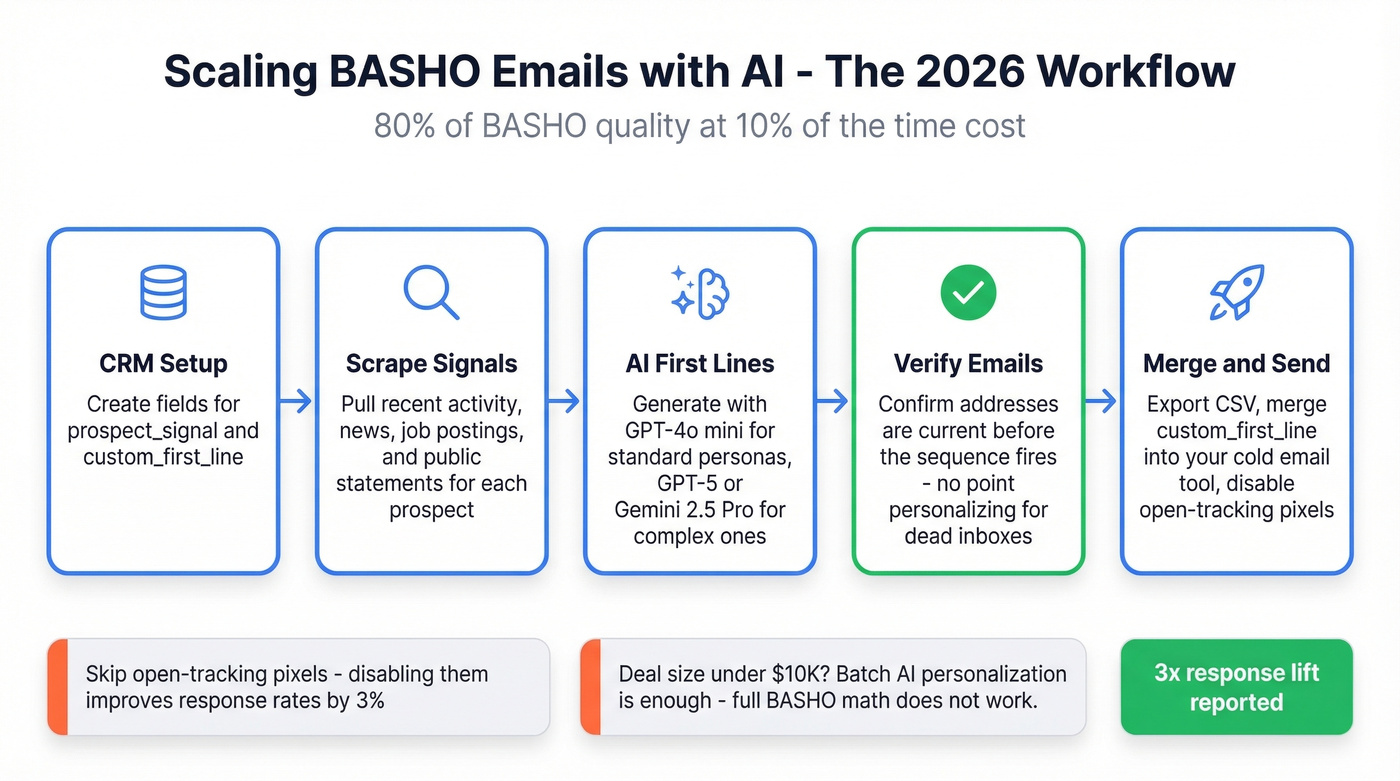
Here's the workflow that's producing results right now:
- Create CRM fields for
prospect_signalandcustom_first_line. (If your CRM setup is messy, start with solid contact management software.) - Scrape recent activity or news for each prospect.
- Generate the first line with GPT-4o mini, and upgrade to GPT-5 or Gemini 2.5 Pro for trickier personas.
- Export the CSV to your cold email tool and merge
{{custom_first_line}}into the opening.
One r/SaaS practitioner reported a ~3x response lift using this exact pipeline.
The critical piece most teams skip: verifying the email address before the AI-personalized sequence fires. We use Prospeo for this - find the prospect's verified email, confirm it's current, then feed it into the sequence. No point running an AI pipeline against dead addresses. (If you want a broader view of the category, compare email verification approaches before you commit.)
Two more things we've learned watching teams run this workflow. First, turn off open-tracking pixels - data from 16.5M emails shows disabling them improves response rates by 3%, likely because tracking pixels trip spam filters. Second, some guides recommend embedding personalized video. That can work for certain personas, but it adds production time to an already high-effort format. Start with text-only. (If you do use tracking, make sure you understand email tracking pixels and the deliverability tradeoffs.)
Hot take: If your average deal size is under $10K, you probably don't need this level of personalization at all. The math doesn't work - 20 minutes per email at 15% reply rates means roughly 2 hours per reply. For six-figure enterprise deals, that's a bargain. For SMB sales, batch personalization with AI-generated first lines gets you 80% of the result at a fraction of the cost. Skip the full BASHO treatment and spend that time on volume instead.
Verify Before You Personalize
Picture this: you've just spent 20 minutes on a hyper-personalized email to a CFO. You hit send. It bounces. She changed companies six weeks ago.
That scenario is more common than you'd think. 17% of cold emails never reach the inbox, and that stat should terrify anyone writing basho emails - the highest time-per-email investment in outbound. The Reddit case study we referenced earlier? They cut bounce rates from 11% to under 2% by verifying every address before sending. That single change - not the copy, not the timing - was the biggest driver of their reply rate improvement. (If you're troubleshooting, start with email bounce rate benchmarks and fixes.)
In our experience, verification is where most teams cut corners, and it costs them dearly. Prospeo's 5-step verification handles catch-all domains, spam traps, and honeypots, delivering 98% email accuracy on a 7-day refresh cycle. That refresh matters because people change jobs constantly; an address valid six weeks ago might bounce today. The free tier gives you 75 emails per month, and paid verification runs about $0.01 per email. For outreach where you're sending 10-20 highly researched emails per day, that's pennies to protect hours of work.
The math is simple: verify first, personalize second, send third.
BASHO emails work because they target one person with one insight. Prospeo gives you the triggers to write them - job changes, headcount growth, funding rounds, and technographics across 300M+ profiles with 30+ filters. Research in three minutes, not thirty.
Build your prospect list with the signals that fuel real BASHO emails.
Common Mistakes to Avoid
Using triggers everyone else uses. "Congrats on the Series B" stopped working when five vendors started sending it the same week. Dig deeper - a specific hire, a conference comment, a job posting signal.
Over-personalizing into creepy territory. Referencing someone's vacation photos or their kid's school isn't research. It's surveillance. Stick to professional triggers.
Asking for too much. A 30-minute demo request in a first-touch email to a C-suite exec is a non-starter. Soft CTAs only - unless you're using the bold "I'll call you" variant for senior executives.
Writing too long. If your email is three paragraphs, you've written a memo, not an email. (If you need tighter copy, use a simple email copywriting checklist.)
Skipping the breakup email. The original BASHO methodology includes a final "OK, I'll assume the timing isn't right" touch. That breakup email consistently pulls responses from prospects who ignored the first four. Don't leave it out.
FAQ
Is BASHO an acronym?
No. It's named after Jeff Hoffman's Basho Strategies training program. You'll occasionally see people try to reverse-engineer an acronym, but there isn't one - it's a brand name that became shorthand for hyper-personalized cold email.
What reply rate should I expect?
Well-executed basho emails pull 10-20% reply rates, compared to the 5.8% cold email average. Alexander Theuma reports roughly 65% since 2010, though that's an outlier. Expect 3-4x your current reply rate when moving from generic templates to genuine BASHO outreach.
How long should a BASHO email be?
Under 90 words is the sweet spot. General cold email data shows 6-8 sentences as optimal, but many high-performing BASHO emails are even shorter. One practitioner doubled their reply rate by cutting from 141 to under 56 words. When you think it's short enough, cut one more sentence.
Can I automate them?
Partially. Use AI to generate personalized first lines at scale by feeding prospect signals into GPT models, then merge them into your sequences. Pair that with Prospeo's email finder to verify addresses before sending - the research step still needs a human eye, but the pipeline gets you 80% of the way there.
Do the templates work for service businesses?
Yes. Swap the trigger for something relevant to your buyer - a new office lease, a compliance deadline, a vendor contract renewal - and follow the same WYWYN structure: trigger, insight, soft CTA. The three examples above cover SaaS, agency, and startup scenarios, but the framework adapts to any industry.