

The BDM Role: What It Actually Means, What It Pays, and Why Most Guides Get It Wrong
A friend of ours manages a team of SDRs at a NetSuite partner. His title? Business Development Manager. Another contact with the same title at a mid-market SaaS company carries a personal quota and closes six-figure deals. Same three letters, completely different jobs. That's the BDM role problem in a nutshell - and most guides describe a position that doesn't exist at half the companies hiring for it.
The Short Version
What does a BDM actually do? It depends on the company. A BDM is either a people manager who leads SDR/BDR teams and owns pipeline strategy, or a full-cycle closer who opens new markets and lands new logos. Sometimes both.
What does it pay? $56K-$206K total comp, depending on experience, industry, and geography. Median sits around $154K based on 32,600 Glassdoor salaries.
Is it above or below Sales Manager? Lateral or above, depending on org structure. BDMs open new markets; Sales Managers optimize existing pipeline and manage closing teams.
What Does a BDM Do?
The business development manager title is one of the most inconsistently used in B2B sales. There's no universal job description, and that's not a bug - it reflects how differently companies think about growth.
Variant 1: The SDR/BDR Team Lead. This BDM manages a team of outbound reps, coaches them on messaging and process, owns pipeline targets, and reports into a VP of Sales or CRO. They don't carry a personal closing quota. Their success is measured by the pipeline their team generates.
Variant 2: The Full-Cycle Closer. This BDM personally identifies new markets, builds relationships with target accounts, and closes deals. They're essentially a senior AE with a strategic mandate - think market expansion, partnership development, and new-logo acquisition.
A Reddit thread on r/sales illustrates the confusion perfectly. The OP describes a BDM at NetSuite who doesn't close anything - he coaches SDRs via Zoom and makes $100K+. That's a legitimate version of the position. It's just not the one most job descriptions advertise. Title confusion is a recurring theme on r/sales, and for good reason: the same three letters mean wildly different things depending on who's hiring.
Here's the thing most career guides won't tell you: the player-to-coach transition is the hardest part. A top-performing BDR who crushes individual quota doesn't automatically make a great business development manager. Managing a team requires coaching instincts, pipeline architecture thinking, and the patience to develop others instead of just doing the work yourself. The skill sets barely overlap.
BDM vs Other Sales Roles
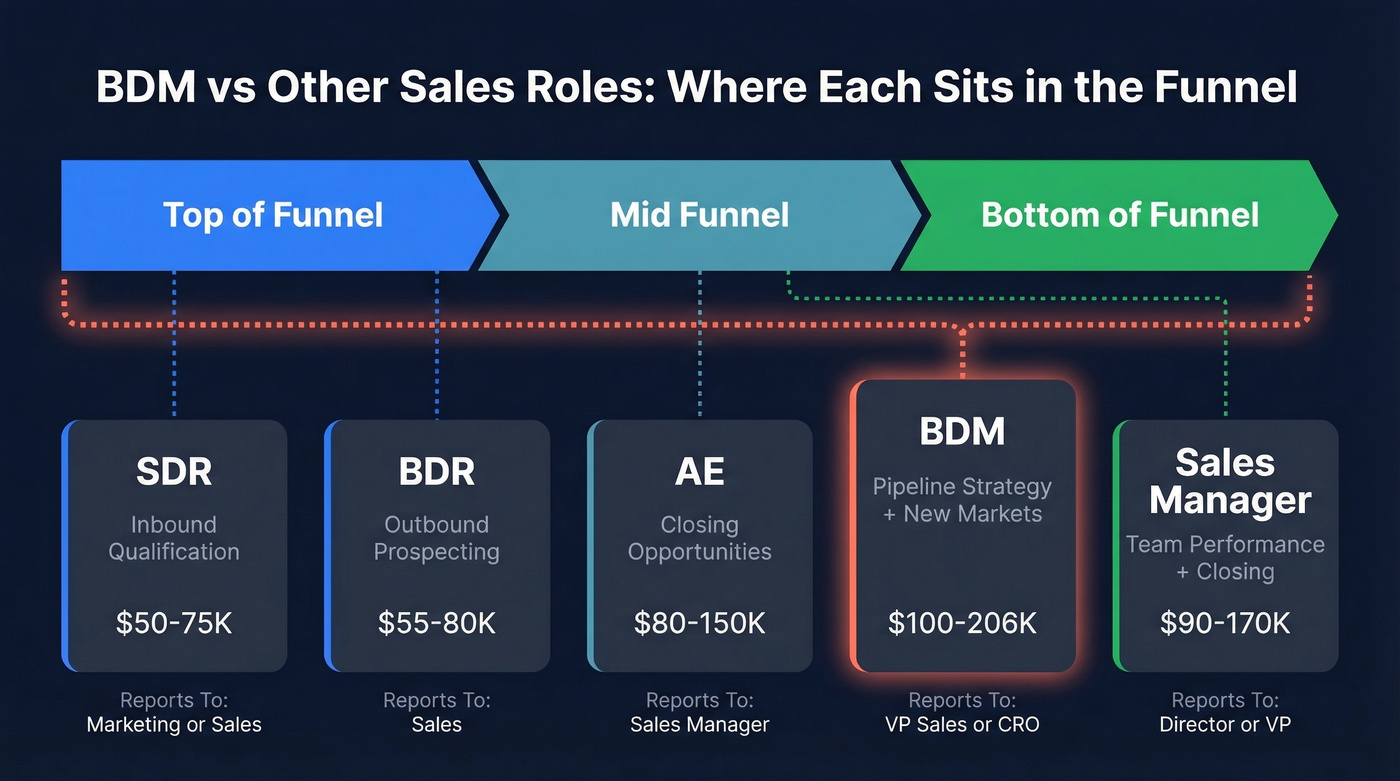
These roles sit at different points in the funnel, and the business development manager often oversees or interfaces with several of them.
| Role | Focus | Funnel Stage | Reports To | Typical Comp |
|---|---|---|---|---|
| SDR | Inbound qualification | Top | Marketing/Sales | $50-75K |
| BDR | Outbound prospecting | Top | Sales | $55-80K |
| AE | Closing opportunities | Mid-Bottom | Sales Manager | $80-150K |
| BDM | Pipeline strategy + new markets | Full funnel | VP Sales/CRO | $100-206K |
| Sales Mgr | Team performance + closing | Mid-Bottom | Director/VP | $90-170K |
SDRs qualify inbound leads. BDRs run outbound. 58% of SDRs manage 75+ accounts per quarter, which gives you a sense of the volume game at that level. AEs work qualified opportunities and push deals to close.
The BDM sits above or alongside these roles. Per Martal's breakdown, BDMs create new opportunities and open markets while Sales Managers focus on closing and managing existing sales teams. Many orgs blur these lines, but that's the cleanest way to think about it.
Core Responsibilities
BDM work falls into five buckets:
Strategy
Identifying new markets, verticals, and partnership channels. This means defining ICP for outbound motions and building go-to-market plans for untapped segments - not just recycling last quarter's target list with a fresh coat of paint.
Pipeline Oversight
Setting pipeline targets for SDR/BDR teams. Monitoring conversion rates across funnel stages and ensuring pipeline quality, not just volume. We've seen too many BDMs celebrate a 3x pipeline increase that's stuffed with unqualified meetings. That's not growth - it's noise.
Relationship Management
Building executive-level relationships with target accounts and managing strategic partnerships that drive referral revenue. This is where the "business development" part of the title earns its keep.
Cross-Functional Coordination
Aligning with marketing on messaging and content. Working with product on competitive positioning. Feeding field intelligence back to leadership. If your BDM operates in a silo, they're leaving money on the table.
Reporting
Owning pipeline dashboards, forecasting new-business revenue, and presenting pipeline health to the CRO.
BDM Salary & Compensation in 2026
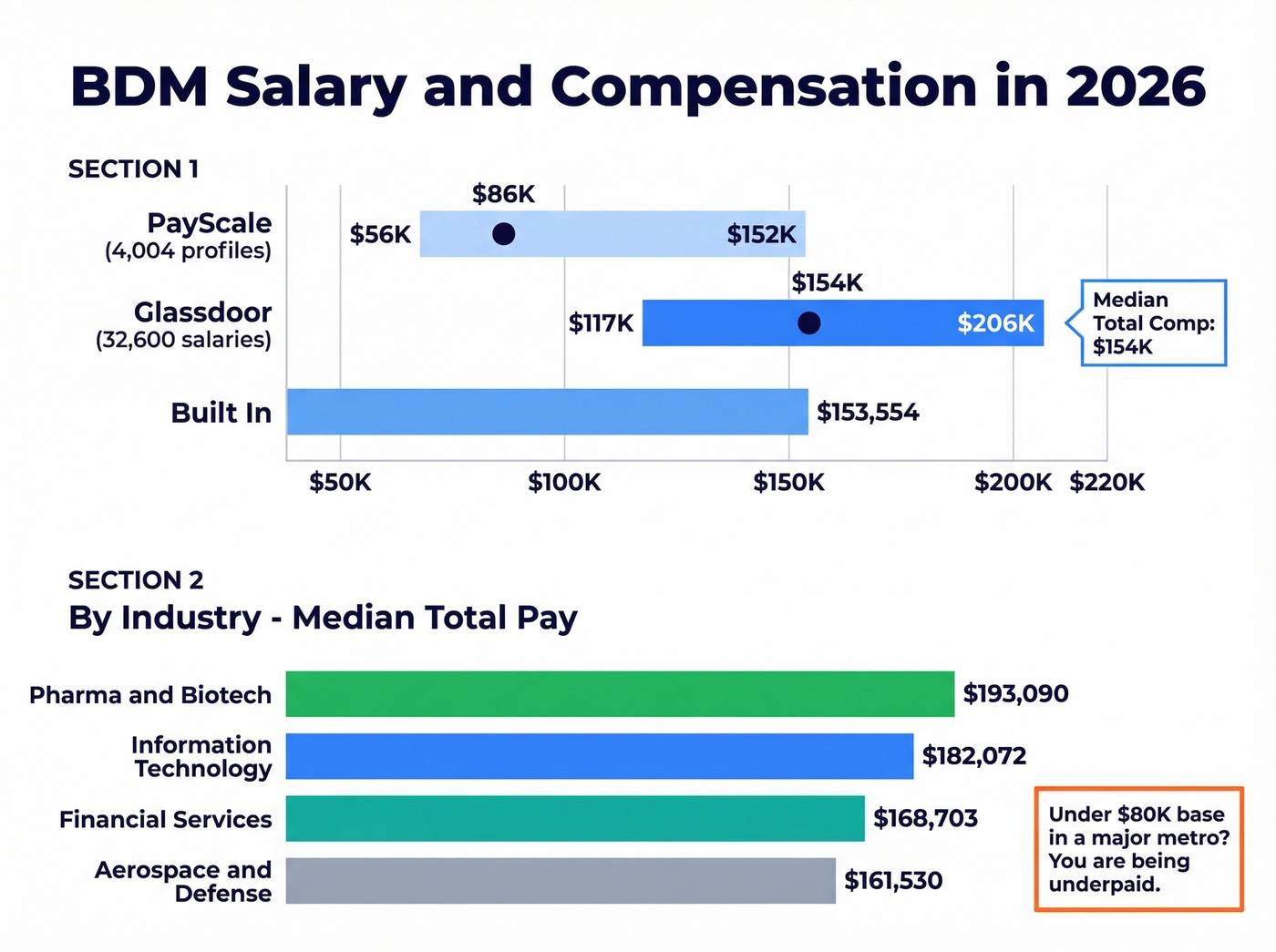
PayScale, Glassdoor, and Built In all land in the same neighborhood for total compensation, with Glassdoor putting the median at $154K and Built In showing an average total comp of $153,554.
| Source | Base Pay | Total Comp | Sample Size |
|---|---|---|---|
| PayScale | $86,254 avg | $56K-$152K range | 4,004 profiles |
| Glassdoor | $70K-$119K range | $117K-$206K range | 32,600 salaries |
| Built In | $102,769 avg | $153,554 avg | Respondent-based |
Variable pay is where the real spread happens. PayScale reports commission ranges of $2K-$45K and bonuses of $2K-$32K. Glassdoor's additional pay range runs $47K-$87K. If you're offered a business development manager position with no variable comp, that's a red flag - the role is designed around performance incentives.
By industry (Glassdoor median total pay):
| Industry | Median Total Pay |
|---|---|
| Pharma & Biotech | $193,090 |
| Information Technology | $182,072 |
| Financial Services | $168,703 |
| Aerospace & Defense | $161,530 |
By metro (Built In averages):
| Location | Avg Total Comp |
|---|---|
| San Francisco | $163,954 |
| Remote | $131,072 |
| New York City | $125,085 |
There's a meaningful gender gap in reported comp. Built In respondents show women averaging $95,202 vs $110,785 for men - a 14% gap on the same title. If you're offered under $80K base in a major metro, you're being underpaid. Full stop.
Entry-level BDMs under one year average around $61,344 total comp per PayScale. At 7+ years, Built In puts the average at $123,862.

Whether you're a BDM coaching an SDR team or personally opening new markets, pipeline quality starts with data quality. Prospeo gives you 300M+ profiles with 98% email accuracy, 125M+ verified mobiles, and 30+ filters - including buyer intent, technographics, and headcount growth - so you can build targeted lists that actually convert.
Stop stuffing your pipeline with noise. Start filling it with verified buyers.
Skills That Actually Matter
Hard skills: CRM fluency in Salesforce or HubSpot, pipeline analytics and forecasting, data enrichment tools, intent data interpretation, multi-channel campaign design, and basic SQL or BI tool literacy.
Soft skills: Coaching and mentorship, executive-level negotiation, cross-functional communication, strategic thinking, and the ability to translate market signals into pipeline action.
Look - if your BDM can't read a CRM dashboard, they're not a business development manager. They're a relationship manager from 2012. The position has shifted decisively toward data fluency, and understanding pipeline velocity, conversion rates by segment, and intent signals is the baseline now, not a differentiator.

KPIs That Define Success
Activity metrics alone are dead as primary KPIs. A Forbes Council piece from March 2026 makes the case that modern BD measurement needs to tie directly to pipeline quality and revenue growth.
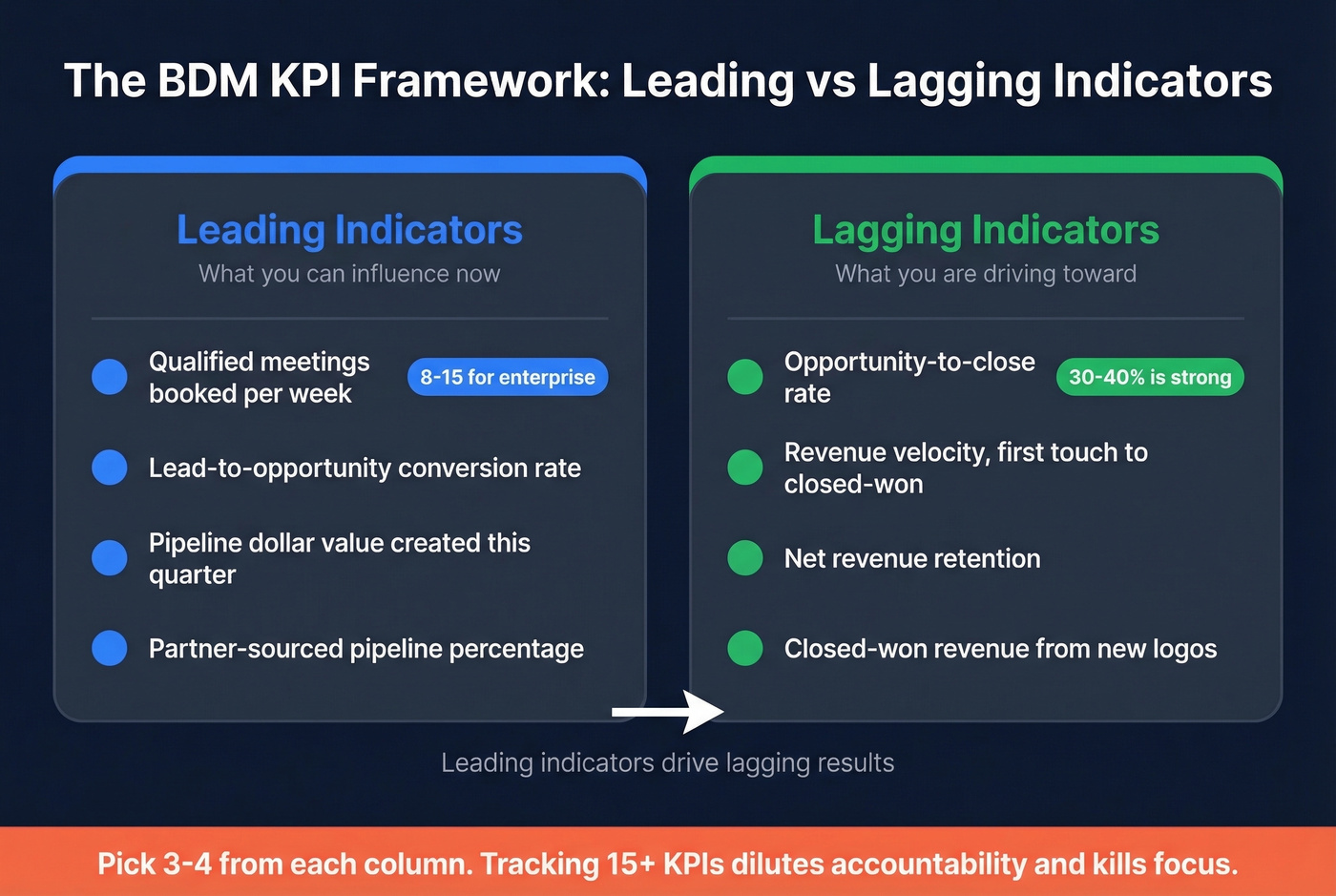
The smartest framework splits KPIs into leading and lagging indicators:
Leading indicators you can influence now: qualified meetings booked per week (benchmark: 8-15 for enterprise BDMs), lead-to-opportunity conversion rate, pipeline dollar value created this quarter, and partner-sourced pipeline.
Lagging indicators you're driving toward: opportunity-to-close rate (30-40% is strong for enterprise), revenue velocity from first touch to closed-won, net revenue retention, and closed-won revenue from new logos.
The most common mistake? Tracking 15+ KPIs and losing focus. Pick 3-4 leading and 3-4 lagging indicators. Anything more dilutes accountability. A BDM who books 20 meetings a week with unqualified prospects is worse than one who books 8 meetings with decision-makers who actually have budget.
The Modern BDM Tech Stack
Four categories matter most for a well-equipped business development team in 2026:
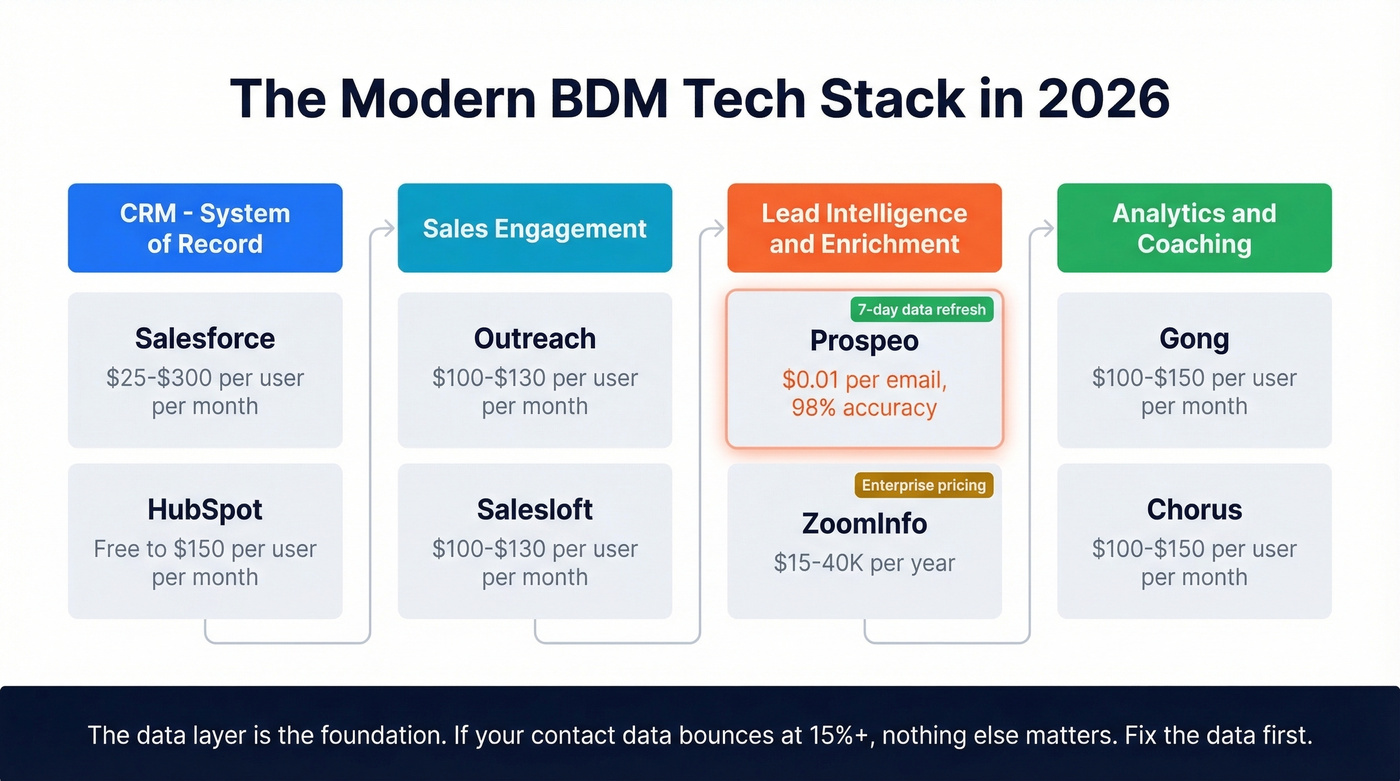
CRM: Salesforce at $25-$300/user/mo or HubSpot from free to $150/user/mo. This is your system of record - everything else plugs into it.
Sales Engagement: Outreach or Salesloft, both running $100-$130/user/mo. Multi-channel sequences, A/B testing, and analytics for the SDR/BDR team you're managing. If you're building your stack from scratch, start with a shortlist of SDR tools.
Lead Intelligence & Enrichment: This is where pipeline quality lives or dies. For a BDM overseeing pipeline generation, data freshness matters directly - stale data means burned domains, bounced sequences, and wasted SDR time. Prospeo runs a 7-day data refresh cycle with 98% email accuracy, compared to the 6-week industry average most providers sit on. Paid plans run about $0.01 per email on a credit-based model, and the free tier gives you 75 verified emails monthly to test. ZoomInfo offers deeper workflow features but at $15-40K/year, which doesn't make sense for most mid-market teams.

Analytics & Coaching: Gong or Chorus, typically $100-$150 per user per month, for call intelligence. These tools let BDMs coach reps on actual conversations, not just activity metrics.
Skip the $30K/year enterprise data platform if your average deal size is under $25K. Most mid-market BD teams get better ROI from accurate, affordable contact data paired with strong engagement tools than from an enterprise suite they'll use 20% of.
The data layer is the foundation everything else sits on. If your contact data bounces at 15%+, your engagement platform doesn't matter. Your sequences don't matter. Fix the data first. (If you’re diagnosing bounce issues, start with email bounce rate benchmarks and root causes.)
Great BDMs don't recycle last quarter's target list. They identify new verticals, track market signals, and reach decision-makers before competitors do. Prospeo's intent data covers 15,000 topics, refreshes every 7 days, and pairs with job change and funding filters - giving you the strategic edge the role demands.
Find in-market accounts before your competitors even know they exist.
How the BDM Role Is Evolving
The business development manager of 2026 looks nothing like the conference-networking, golf-outing stereotype. Three trends are reshaping the position:
Digital-first pipeline building. Over 80% of B2B sales interactions now happen in digital channels. BDMs who can't run a multi-channel outbound motion - email, social, video, events - are falling behind fast. (If you need a refresher on what’s working now, see these sales prospecting techniques.)
AI-augmented workflows. 81% of sales teams are using or experimenting with AI for lead scoring, outreach personalization, and pipeline forecasting. BDMs don't need to be data scientists, but they need to understand how AI tools prioritize accounts and surface signals. In our experience, the BDMs who thrive aren't the ones building AI models - they're the ones who know which AI outputs to trust and which to override.
Hybrid sales models. 9 in 10 companies plan to maintain hybrid sales structures. The BDM role bridges in-person relationship building with digital pipeline generation - and that hybrid skill set is increasingly rare.
The CRM market alone hit $25.7B in 2024 and is still growing. The modern BDM is a data-driven pipeline architect who happens to be great with people - not the other way around.
Career Path: How to Become a BDM
The typical progression:
SDR/BDR (0-2 years) - Learn outbound fundamentals, handle rejection, build pipeline discipline. Entry comp: ~$50-75K.
Account Executive (2-4 years) - Carry a quota, close deals, learn negotiation and deal management. Comp: $80-150K.
Business Development Manager (4-7 years) - Own pipeline strategy, manage teams or open new markets. Comp: $100-180K.
Senior BDM / Head of BD (7-10 years) - Cross-functional leadership, executive relationships, market strategy. Comp: $150K+.
VP of Business Development (10+ years) - P&L ownership, board-level reporting, M&A and partnership strategy.
BDMs who skip the closing experience - jumping straight from BDR to business development manager - tend to struggle with pipeline strategy because they've never felt the pressure of carrying a personal number. The cross-functional skills that matter most - communication, sales execution, marketing alignment, data analysis, and project management - are built through that AE stage. Don't skip it.
First 90 days tip: Spend your first month listening to every recorded call your team has run in the last quarter. You'll learn more about pipeline quality, messaging gaps, and coaching opportunities from 50 call recordings than from any onboarding deck ever written. If you want a structure for ramping, borrow a 30-60-90 day plan.
FAQ
Is a BDM higher than a Sales Manager?
Typically lateral or slightly above in most org charts. BDMs open new markets and create pipeline from scratch; Sales Managers optimize existing pipeline and manage closing teams. In enterprise orgs, both usually report to the VP of Sales.
What's the difference between a BDM and a BDR?
BDRs are individual contributors who handle outbound prospecting - cold calls, emails, and social touches. BDMs oversee pipeline strategy, often managing BDR/SDR teams or personally working strategic accounts at the executive level.
How much do BDMs make in 2026?
Total comp ranges from $56K to $206K, with a median around $154K based on 32,600 Glassdoor salaries. Base pay typically falls between $70K and $119K, with variable pay adding $47K-$87K depending on performance.
What tools should a new BDM learn first?
Start with your CRM - Salesforce or HubSpot - and a data enrichment platform for verified contact data. These two cover pipeline visibility and lead quality, the two things that determine whether your team hits target or misses.
What degree do you need to become a BDM?
No specific degree is required. Experience consistently outweighs credentials - a BDR who's closed deals as an AE will beat an MBA with no pipeline experience every time. Certifications in Salesforce or HubSpot carry more weight than a business degree for this role.