

BDR Job Description Guide for 2026
Most BDR job descriptions are terrible. Vague responsibilities, no comp data, and "unlimited earning potential" doing a lot of heavy lifting. You're either writing one that needs to attract the right candidates, or you're reading one and trying to figure out if the company is legit. Either way, here's everything both sides actually need.
Hiring managers: Jump to the copy-paste template, then customize with salary data and KPI benchmarks.
Candidates: Skip to salary benchmarks and red flags to evaluate any offer in under two minutes.
What Is a BDR?
A Business Development Representative generates qualified pipeline by identifying potential customers through outbound prospecting, qualifying inbound inquiries, and setting appointments for account executives. It's the entry point into B2B sales - steep ramp, high activity, and the fastest path to a six-figure AE role if you're good at it.
80% of BDR orgs report into Sales, not Marketing. That distinction matters because reps are measured on pipeline and revenue contribution, not just lead volume. The role is 85% outbound - cold calls, cold emails, and social touches to accounts that haven't raised their hand yet. The Bureau of Labor Statistics projects roughly 149,900 openings per year in the broader sales rep category, so demand isn't slowing down.
BDR vs SDR
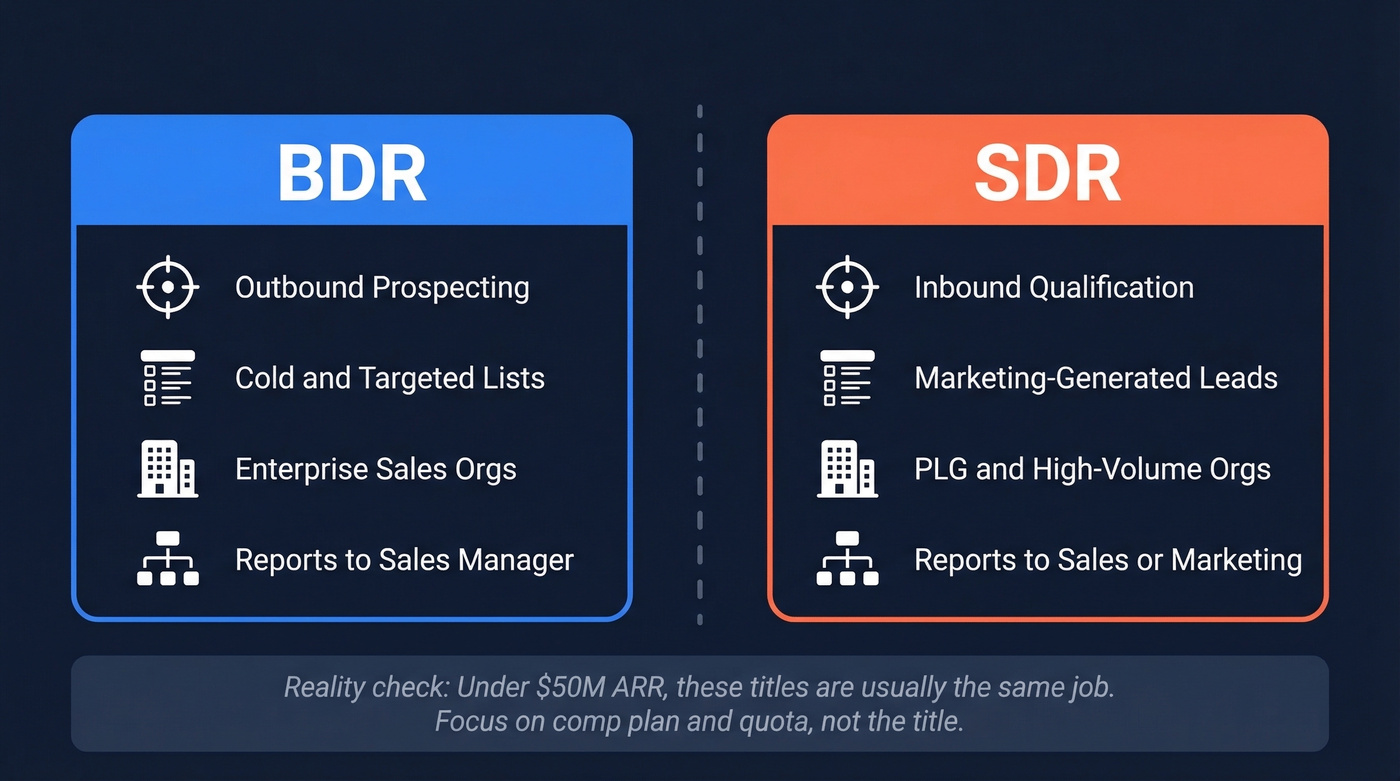
Here's the honest answer: it depends who you ask. A T2D3 analysis of top results found that six sources define SDR as inbound and BDR as outbound, while two sources flip it entirely. The most common convention follows Salesforce's original taxonomy:
| Dimension | BDR | SDR |
|---|---|---|
| Primary focus | Outbound prospecting | Inbound qualification |
| Lead source | Cold/targeted lists | Marketing-generated |
| Common in | Enterprise sales | PLG / high-volume |
| Typical report line | Sales Manager | Sales or Marketing |
Let's be honest: for most B2B companies under $50M ARR, these titles are functionally identical. The person does outbound, qualifies inbound, and books meetings. Whether the business card says "BDR" or "SDR" matters less than the comp plan and quota structure behind it. If you're writing a JD, pick one title and be consistent. If you're evaluating an offer, ignore the title and look at the responsibilities.
BDR Job Description Template
Copy this, replace the bracketed placeholders, and you'll have a posting that's better than 90% of what's on job boards right now.
[Company Name] - Business Development Representative
Location: [City, State / Remote / Hybrid] Reports to: [Sales Manager / Director of Sales Development] Compensation: [Base] + [Variable] = [OTE] ([Split]% base / [Split]% variable)
About the Role
You'll be the first point of contact for [Company Name]'s future customers. Your job is to identify, engage, and qualify prospects through outbound prospecting and inbound follow-up, then hand off qualified opportunities to our AE team. This role is directly tied to pipeline, with a clear path to Account Executive within [12-18] months.
What You'll Do
- Research and identify target accounts using [CRM/tools] and [data platform]
- Execute [X] outbound touches per day across email, phone, and social channels
- Qualify inbound leads against our ICP within [X hours] of submission
- Book [X] qualified meetings per month for the AE team
- Maintain accurate activity and pipeline data in [CRM]
- Collaborate with Marketing on campaign follow-up and feedback loops
- Multi-thread into target accounts, engaging [X+] stakeholders per deal
- Iterate on messaging based on response data and A/B test results
- Hit or exceed monthly quota of [X SQLs / X pipeline value]
Requirements
- 0-[X] years of B2B sales or customer-facing experience
- Strong written and verbal communication skills
- Comfort with high-volume outbound activity - 40-50 calls/day, 10-40 emails/day
- Familiarity with CRM systems, preferably Salesforce or HubSpot
- Coachability - you take feedback and apply it fast
- Resilience - you hear "no" a lot and keep going
Preferred Qualifications
- Experience with sales engagement platforms like SalesLoft or Outreach
- Familiarity with data enrichment and prospecting tools
- Track record of quota attainment in a previous BDR/SDR role
- Bachelor's degree (preferred, not required)
Tech Stack You'll Use
[CRM], [Sales Engagement Platform], [Data/Enrichment Tool], [Call Recording], [Scheduling Tool]
Benefits
[Health/dental/vision], [401k match], [PTO policy], [Remote/hybrid flexibility], [Professional development budget]
[Company Name] is an equal opportunity employer.
Hiring for a senior BDR? Add strategic outbound campaign ownership, mentorship of junior reps, and cross-functional collaboration with Product and Marketing to the responsibilities. Bump the experience requirement to 3-5 years and adjust OTE to the $90K-$100K+ range.
Interview tip: Ask candidates to walk you through how they'd research a target account from scratch. The answer tells you more than any resume line - you'll immediately see whether they understand ICP, multi-threading, and tool fluency.
BDR Salary and Compensation
Let's talk money. The national median BDR base is $55,000 with a median OTE of $83,000. Those numbers shift dramatically based on experience, location, and commission structure.
OTE by Experience Level
| Experience | Base Range | OTE Range | Typical Split |
|---|---|---|---|
| Entry (0-1 yr) | $42K-$52K | $70K-$75K | 70/30 |
| Mid (1-3 yrs) | $50K-$60K | $80K-$90K | 65/35 |
| Senior (3-5+ yrs) | $55K-$70K | $90K-$100K+ | 60/40 |
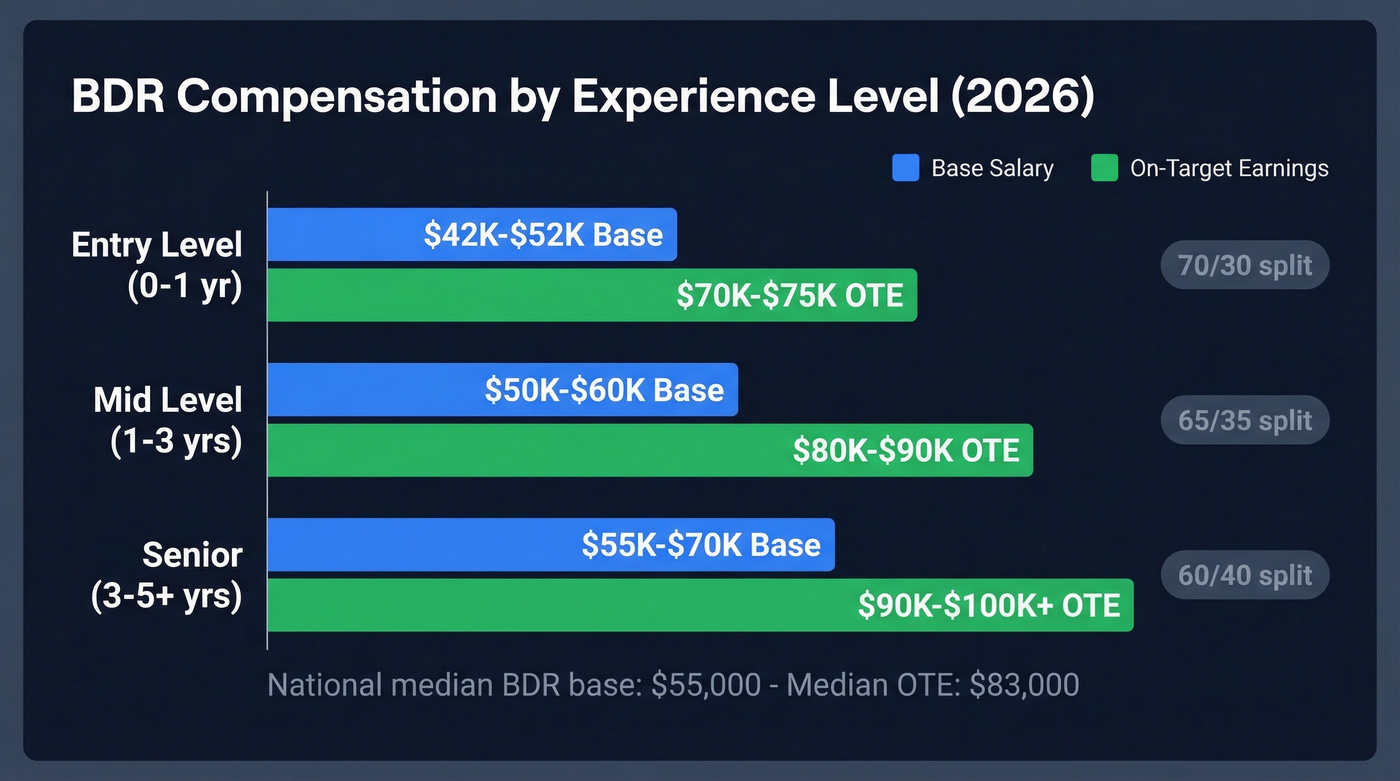
PayScale data from 919 salary profiles shows the base distribution running from $42K at the 10th percentile to $77K at the 90th. Variable comp adds $3K-$30K on top, depending on plan structure and attainment.
Commission Plan Types
Three models dominate. Activity-based plans pay $150-$200 per qualified meeting booked - straightforward, common for entry-level reps. Opportunity-based plans pay ~$200 per sales-accepted opportunity, which adds a quality filter. Revenue-based plans pay 1-4% of closed contract value, aligning comp directly with downstream revenue.
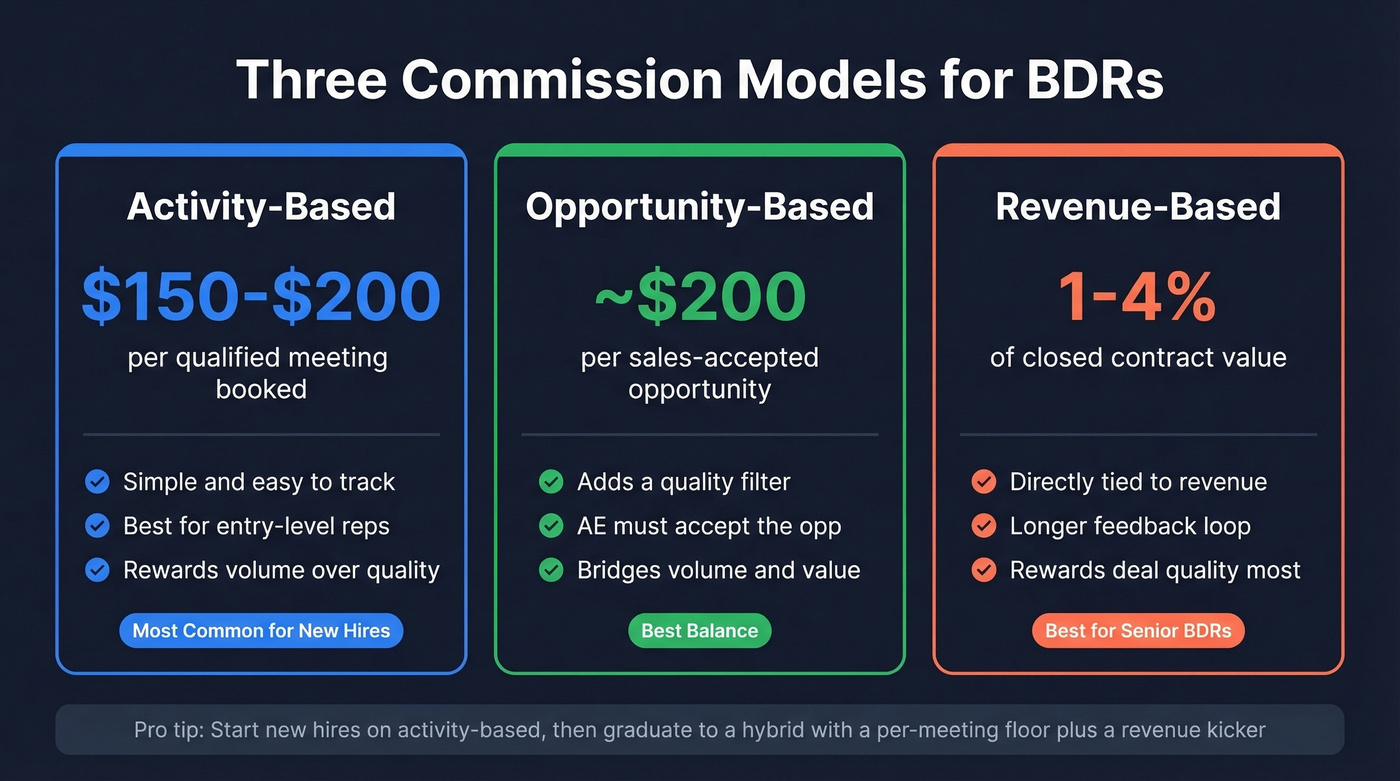
Most companies start new hires on activity-based plans and graduate them to opportunity or revenue-based structures as they prove out. We've seen teams get the best results with a hybrid: a per-meeting floor plus a revenue kicker that rewards quality over volume.
Salary by City
Location still matters, even with remote work pulling numbers toward the middle. Here's what compensation looks like across major metros:
| City | Annual Salary |
|---|---|
| San Jose, CA | $108,524 |
| San Francisco, CA | $108,091 |
| Washington, DC | $96,070 |
| New York, NY | $78,410 |
| Seattle, WA | $73,598 |
| Austin, TX | $57,115 |
| Raleigh, NC | $57,039 |
| Chicago, IL | $55,664 |
| Charlotte, NC | $54,326 |
The national average sits at $59,559. These figures skew closer to base than true OTE. Full OTE in Seattle runs closer to $160,149, and SF Bay Area median OTE is ~$126,536. Remote roles average $66,616. Glassdoor breaks NYC down to a $63,564 base plus $35,783 in additional comp, totaling roughly $99K.

That tech stack line in your BDR job description matters. Teams using Prospeo book 26% more meetings than ZoomInfo users and 35% more than Apollo - because 98% email accuracy and 125M+ verified mobiles mean reps spend time selling, not chasing bad data.
Give your BDRs the data platform that actually hits quota.
KPIs and Performance Metrics
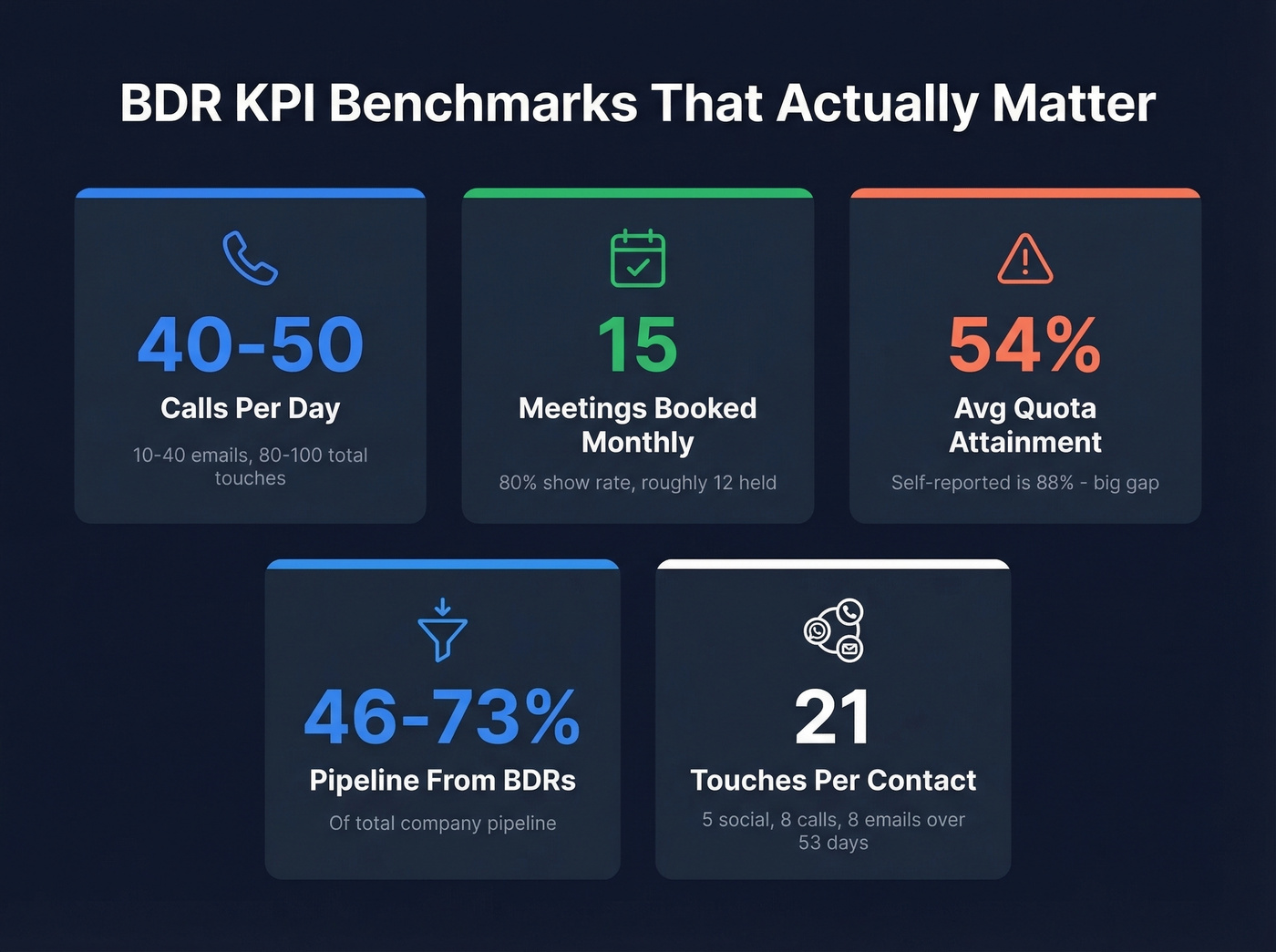
A good BDR job description specifies what success looks like. Vague language like "drive pipeline growth" tells candidates nothing. Here are the five KPIs that actually matter: Activity Volume, Meetings Booked, Lead-to-Opportunity Conversion Rate, Pipeline Value Generated, and SQLs.
By the numbers:
- Daily activity: 40-50 calls, 10-40 emails, 80-100 total touches
- Monthly meetings: 15 booked, ~80% show rate, ~12 held
- Pipeline contribution: TOPO research puts BDR-sourced pipeline at 46-73% of total
- Quota attainment reality: The industry average is just 54%
That last number matters for both sides. Hiring managers: if your average rep hits 54% of quota, your quota is the problem, not your people. Self-reported attainment averages 88% per 6sense's survey, but broader compilations put it closer to 54% - the gap tells you how much selection bias exists in vendor benchmarks. Candidates: if a company tells you "everyone hits quota here," ask for the data. We've seen plenty of orgs set aspirational targets and then wonder why turnover is 40%.
A BDR's Day-to-Day
A typical day breaks into three blocks. Morning is research and prep - building lists, reviewing intent signals, and prioritizing accounts. Midday is execution - calls, emails, and social touches in concentrated bursts. Afternoon is follow-up, CRM hygiene, and coaching sessions.
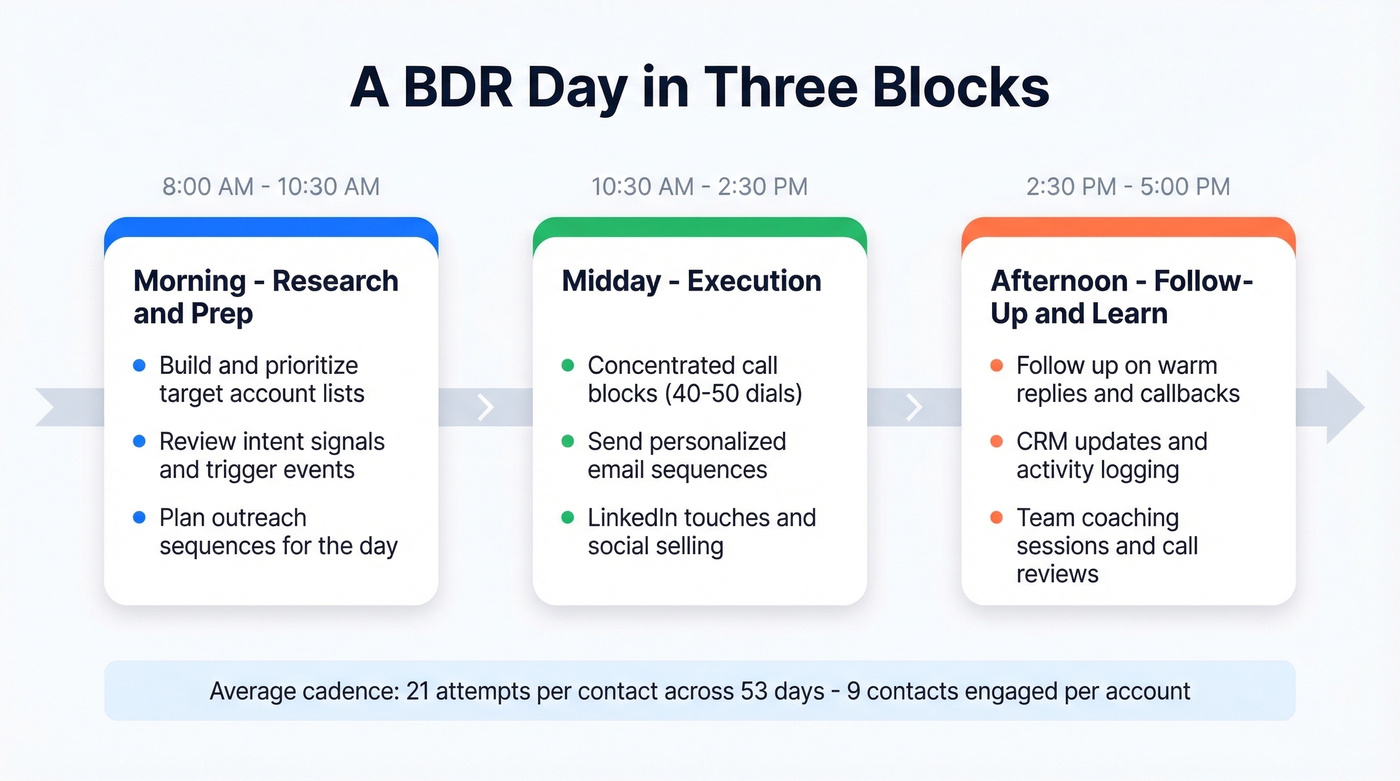
The 6sense benchmark report puts the average cadence at 21 attempts per contact, up from 17 the prior year, spread across roughly 5 social touches, 8 calls, and 8 emails over a 53-day window. Multi-threading is now standard - 90% of reps engage multiple stakeholders, averaging 9 contacts per account.
AI adoption is accelerating fast. 60% of BDRs already use AI tools, primarily for call transcription and email drafting. AI handles the repetitive work, but it can't fix the underlying data. If your contact list is stale or unverified, those 40-50 daily emails bounce, your domain reputation tanks, and your sequences become useless. That's where data freshness matters more than any AI feature - a list built Monday needs to still work Friday.
Tools and Tech Stack
Every BDR job description should list the tools candidates will use. It signals maturity and helps candidates self-select. In our experience, the companies that list their tech stack in the JD are the ones that actually have a playbook.
| Category | Example Tools | Purpose |
|---|---|---|
| CRM | Salesforce, HubSpot | Pipeline & activity tracking |
| Sales Engagement | SalesLoft, Outreach | Sequences & A/B testing |
| Lead Intelligence | Prospeo, ZoomInfo, Apollo | Verified contacts & enrichment |
| Prospecting/Lists | Apollo, Seamless.AI | ICP-based list building |
| Call & Demo | Gong, Chorus | Recording & coaching |
| Analytics | CRM dashboards, Tableau | Pipeline reporting |
| Enablement | Highspot, Seismic | Content, training, onboarding |
The enrichment category is where most teams waste money or get burned. If your average deal size is under $15K, you don't need ZoomInfo-level pricing for your data. A self-serve enrichment tool like Prospeo - at roughly $0.01 per email versus $1+ per lead at legacy platforms - paired with a solid sales engagement platform will outperform an expensive all-in-one suite that your team only uses at 30% capacity.
If you want a broader shortlist, start with these SDR tools and data enrichment services.
Skip the all-in-one suite if your team is under 10 reps. You'll pay for features nobody touches and get locked into an annual contract that's painful to exit.
Red Flags to Watch For
Whether you're a candidate evaluating an offer or a hiring manager reviewing your own JD, watch for these.
"Unlimited earning potential" with no published OTE. If they won't tell you the number, the number isn't good. (If you want to sanity-check the math, use this OTE definition and formula.)
Unrealistic quotas. One Reddit thread on r/sales called out a company trying to replace three BDRs, each booking 30 meetings/month targeting Fortune 500s. That's 90 meetings a month from one headcount. Pure delusion.
No tech stack listed. If the JD doesn't mention tools, the team probably doesn't have them - and you'll be prospecting with a spreadsheet and a prayer.
High turnover signals. "Fast-paced, high-growth environment" repeated three times usually means they burn through reps. Ask why the last person left. If the answer is evasive, that tells you everything.
Vague "self-starter" language without training details. Every company wants a self-starter. Good companies also provide a playbook, a ramp plan, and weekly coaching. If the JD mentions none of those, expect to figure it out alone.
BDR Career Path
Nobody plans to be a BDR forever - and that's the point. The typical promotion timeline runs 12-18 months, though post-pandemic that's stretched to 15-16 months on average. The threshold most orgs use: hit 90%+ quota for two consecutive quarters, and you've built your promotion case.
Where reps go next, per Monday.com's career path research:
Account Executive - $120K-$180K OTE. The most common path. You've learned to prospect; now you learn to close. (To level up faster, borrow a 30-60-90 day plan.)
Customer Success Manager - $80K-$110K total comp. Great for reps who love relationship-building more than hunting.
Revenue Operations - $90K-$130K total comp. For the analytically minded rep who'd rather optimize the machine than run it. (If you're curious what that role actually does, see RevOps Manager.)
The BDR-to-AE path is still the highest-ROI career move in B2B sales. Twelve to eighteen months of outbound grind, and you're in a closing role making $150K+. No other entry-level position offers that trajectory, and the consensus on r/sales backs this up - the role is brutal, but the exit options are worth it.
A BDR doing 40-50 calls a day needs direct dials that connect. Prospeo delivers 125M+ verified mobile numbers with a 30% pickup rate - nearly 3x the industry average. At $0.01 per email, your cost per rep drops while pipeline climbs.
Stop hiring great BDRs and handing them garbage data.
FAQ
Do you need a degree to be a BDR?
Most postings list a bachelor's degree as "preferred," not required. Demonstrable sales skills, coachability, and hustle matter far more than a diploma. Many top-performing reps come from non-traditional backgrounds - hospitality, retail, military. If you can communicate clearly and handle rejection, you're qualified.
What's a realistic first-year OTE?
Entry-level reps with 0-1 years of experience typically earn $70K-$75K OTE with a 70/30 base-to-variable split. The national median base is $55K. Expect higher in San Francisco or New York and lower in mid-market cities like Charlotte or Raleigh.
Is the BDR role being replaced by AI?
No - but it's evolving. 60% of reps already use AI for call transcription and email drafting. AI handles repetitive tasks; humans still own relationship-building, creative outreach, and live conversations. The role is shifting from pure volume to quality engagement and multi-threading.
What tools should a new BDR learn first?
At minimum: a CRM like Salesforce or HubSpot, a sales engagement platform like SalesLoft or Outreach, and a data enrichment tool for verified emails and direct dials. Familiarity with Gong for call recording and Calendly for scheduling rounds out the stack.
What should a BDR job description include?
Every strong posting covers six things: specific daily responsibilities with activity targets, compensation with a clear base/variable split and OTE, quota expectations and KPIs, the tech stack the rep will use, career path and promotion timeline, and a realistic description of team structure and reporting line. If any of those are missing, the JD isn't finished.