

BDR Solutions: Tools, Benchmarks, and Strategies That Actually Work
You sent 500 emails last week. 140 bounced. Your sequencing tool flagged the domain. Now your BDR team is spending Tuesday morning cleaning a spreadsheet instead of booking meetings.
That's not a people problem - it's a stack problem.
When people search "BDR solutions," they usually find one of two things: the federal IT contractor BDR Solutions, LLC, or what we're covering here - the combination of people, process, and platform that turns a business development rep into a pipeline generator. One popular SDR tools roundup cites 2-3x faster revenue growth from adopting advanced sales technology. The trick is knowing which tools actually matter, and which ones just look good in a demo.
Quick note: BDR Solutions, LLC is a small-business federal contractor specializing in Health IT and agile development for agencies like the VA, DHS, DIA, and DoD. If that's what you're looking for, head to bdrsolutionsllc.com.
What a BDR Stack Actually Needs
Here's the contrarian take: you don't need 15 tools. You need 3-4 that work together without creating data gaps or CRM chaos. BDRs with proper enablement and tooling hit 95% of quota versus 80% for unsupported reps, and the difference isn't more software - it's the right software wired together cleanly.
The quick-pick stack for 2026:
- Prospeo - data foundation. 98% email accuracy, 7-day refresh, starts free.
- Outreach or Salesloft - sequencing. Multichannel cadences so reps don't live in spreadsheets.
- HubSpot - CRM. The free tier handles basic pipeline tracking.
- Orum or Aircall - calling. Only if phone is a primary channel for your ICP.
That's it. Let's break down each layer.
The 4 Pillars of a BDR Stack
Prospecting & Data Enrichment
This layer makes or breaks everything else. Contact databases decay by 28% within six months - people change jobs, companies get acquired, emails go stale. If your data provider refreshes on a 6-week cycle, which is the industry average, you're always working with partially rotten lists.
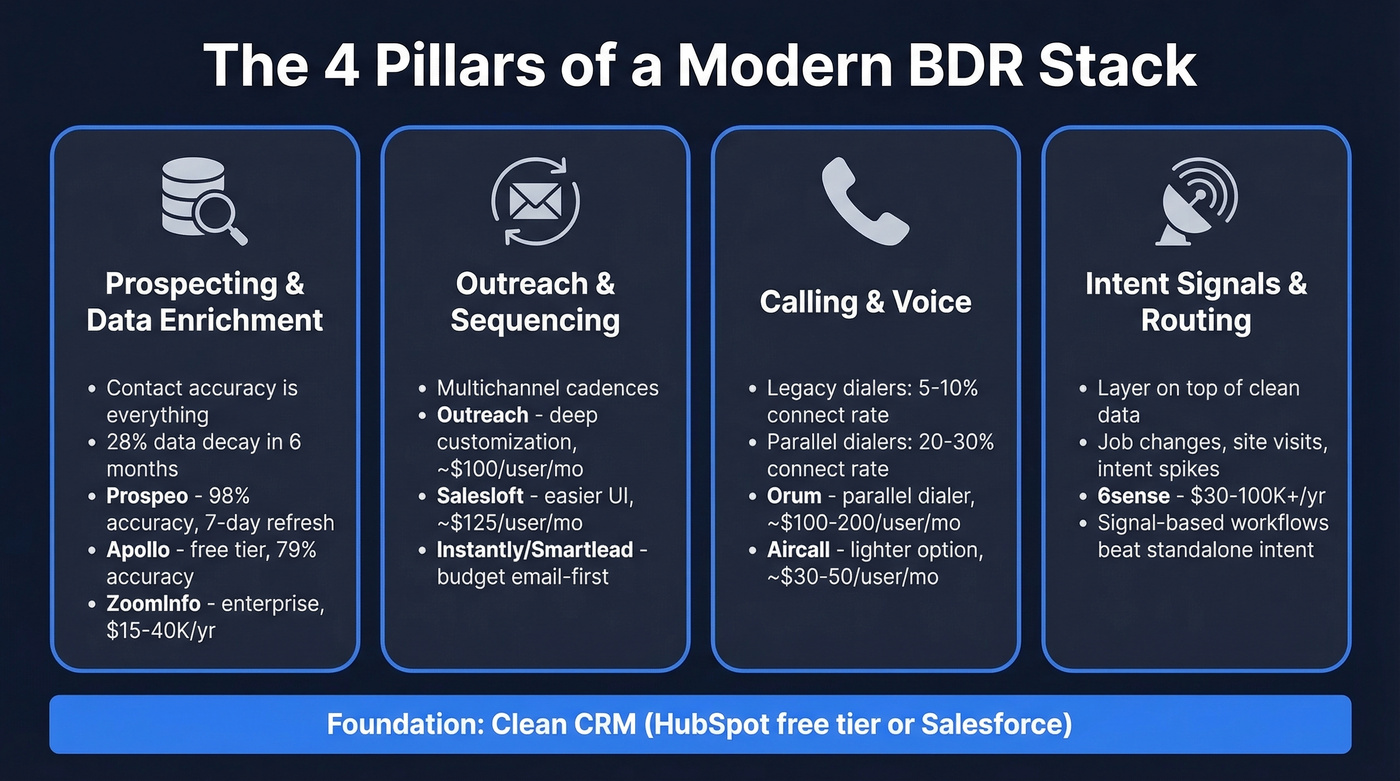
Prospeo runs a 7-day refresh cycle across 300M+ professional profiles, covering 143M+ verified emails at 98% accuracy and 125M+ verified mobile numbers. At roughly $0.01 per lead, it's 90% cheaper than ZoomInfo while delivering higher accuracy - 98% versus ZoomInfo's 87% on email verification. The search interface includes 30+ filters with intent topics, technographics, job changes, and funding data, and native integrations push contacts straight into Salesforce, HubSpot, Smartlead, Instantly, and Lemlist.

After deploying Prospeo, Snyk's team of 50 AEs saw bounce rates drop from 35-40% to under 5%, with AE-sourced pipeline jumping 180%.
Apollo is the go-to if you're bootstrapped and need a free tier to get started. Paid plans start at $49/mo. Skip it if you need strong mobile coverage - Apollo's 79% email accuracy and weaker phone performance leave gaps that compound across large campaigns.
ZoomInfo is the enterprise play: massive US database, bundled intent data, and $15-40K/year in cost. The consensus on r/sales is that ZoomInfo is "crazy expensive" but defensible if your org already has the budget locked in.
Clay ($149/mo) is a workflow-first enrichment tool - great for RevOps teams building custom waterfall enrichment sequences (see our deeper guide on data enrichment services), but overkill if you just need clean contacts fast. Other providers like Cognism, Lusha, and LeadIQ serve niche use cases but don't match the coverage-to-cost ratio of the tools above.
Outreach & Sequencing
Two tools dominate mid-market and enterprise, and the Reddit sentiment is consistent: Outreach is more customizable, Salesloft is easier to learn.
Outreach runs ~$100/user/month with deep workflow customization, A/B testing, and analytics. Salesloft comes in at ~$125/user/month with a cleaner UI and faster onboarding. For teams under 10 reps, pick based on which demo feels less painful - seriously, that's the tiebreaker at this level.
On the budget end, Instantly ($30/mo) and Smartlead ($39/mo) handle cold email sequencing without enterprise overhead. They're email-first tools, not full sales engagement platforms - and that's fine if email is your primary channel. LinkedIn Sales Navigator (~$100/mo) remains a staple for social selling but doesn't replace a dedicated data provider.
If you want to tighten messaging and improve reply rates, keep a set of sales follow-up templates handy and iterate weekly.
Calling & Voice
If your BDRs are dialing, the tool matters more than most teams realize. Legacy telemarketing setups connect at 5-10%. Parallel dialers push that to 20-30%.
Orum is the parallel dialer most teams graduate to - typically ~$100-200/user/month. Expensive, but it pays for itself if phone is a core channel. Aircall (~$30-50/user/month) is the lighter option for teams that need a cloud dialer without parallel calling infrastructure.
If you're building a repeatable phone motion, it helps to standardize your cold calling system before adding more tooling.
Intent Signals & Routing
Look, intent data sounds incredible in demos and disappoints in practice for most teams. One practitioner on Reddit put it bluntly - "never had success" with intent signals. Tools like 6sense ($30-100K+/year), Leadfeeder (~$100-200/mo), and Chili Piper (~$30-50/user/month for routing) all have their place, but intent data works best when layered on top of clean contact data, not as a standalone strategy.
The modern approach is signal-based workflows - triggers fired by job changes, site visits, and intent spikes that route prospects to reps in real time. That requires a data provider with built-in intent tracking, not a separate $30K purchase bolted onto your stack.
If you're formalizing how you act on those triggers, use a simple lead scoring model so reps know what to prioritize.
Pricing at a Glance
| Tool | Category | Starting Price |
|---|---|---|
| Prospeo | Data/Enrichment | Free; paid ~$39/mo |
| Apollo | Data/Enrichment | Free; paid $49/mo |
| ZoomInfo | Data/Enrichment | ~$15-40K/year |
| Outreach | Sequencing | ~$100/user/mo |
| Salesloft | Sequencing | ~$125/user/mo |
| Instantly | Sequencing | $30/mo |
| Smartlead | Sequencing | $39/mo |
| Orum | Dialer | ~$100-200/user/mo |
| Aircall | Dialer | ~$30-50/user/mo |
| Clay | Enrichment/Workflow | $149/mo |
CRM note: HubSpot's free CRM handles basic pipeline tracking. Salesforce ($25-300/user/month) is the enterprise standard but adds cost and admin overhead that smaller teams don't need. If you're comparing options, here are examples of a CRM with real pricing.
AI BDR Tools - Real vs. Hype
60% of BDRs now use AI tools, but most of that adoption is call transcription and email writing - not autonomous agents replacing reps.
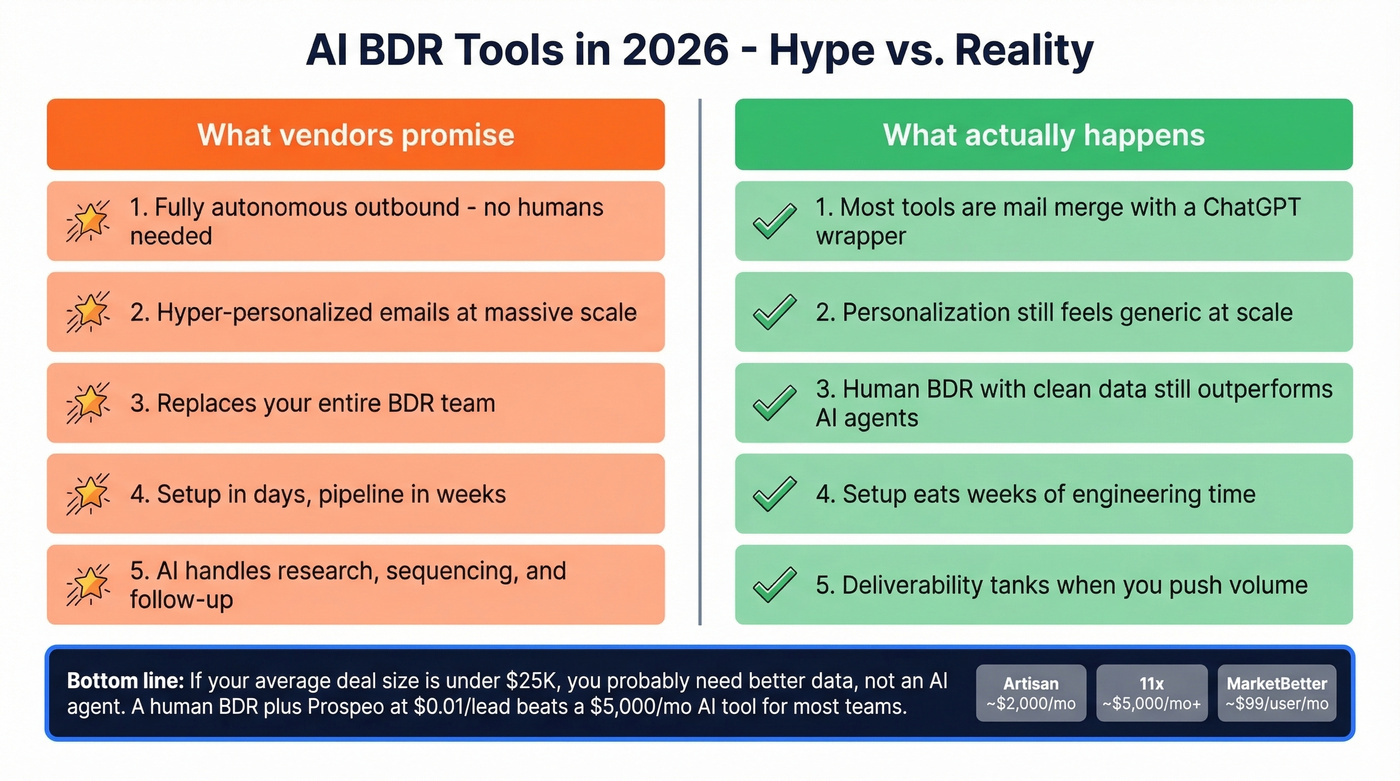
Let's be honest about what most "AI BDR" tools actually are: mail merge with a ChatGPT wrapper. They automate cold email sequencing, add some variable personalization, and call it artificial intelligence. The better ones - Artisan (~$2,000/mo), 11x (~$5,000/mo+), and MarketBetter (~$99/user/month) - attempt autonomous outbound, handling research, sequencing, and follow-up without human intervention.
The common complaints are predictable: deliverability tanks at scale, personalization feels generic, and setup complexity eats weeks of engineering time. We've seen teams spend more time configuring an AI agent than they would've spent just hiring a rep.
Here's the thing: for most teams in 2026, a human BDR armed with clean data and a solid sequencing tool still outperforms autonomous AI alternatives. If your average deal size is under $25K, you almost certainly don't need an AI BDR - you need a better data provider and a rep who knows how to write a subject line. (If you want a swipe file, start with these email subject line examples.) The technology is improving fast, but the ROI math doesn't work yet unless you're running very high-volume, low-touch outbound at scale.

140 bounced emails out of 500 isn't a BDR problem - it's a data problem. Prospeo's 98% email accuracy and 7-day refresh cycle killed bounce rates for Snyk's 50-person AE team (35% → under 5%) and boosted their pipeline 180%.
Stop cleaning spreadsheets. Start booking meetings at $0.01 per lead.
How to Evaluate BDR Solutions
Outreach published a useful 8-step evaluation framework worth condensing into what actually matters. Run a 30-day proof of concept with any tool before signing an annual contract. During that POC, measure against these thresholds:
- 90%+ account field population in your CRM after enrichment
- Under 3% CRM duplicates created by the integration
- Bidirectional sync every 15 minutes or faster
In our experience, a well-implemented stack delivers 20-30% more qualified pipeline within six months. For the weighted scorecard:
| Criterion | Weight |
|---|---|
| Automation depth | 25% |
| Integration quality | 20% |
| Scalability | 15% |
| Data accuracy | 15% |
| ROI impact | 15% |
| Security (SOC 2, RBAC) | 10% |
The security piece matters more than most teams realize. SOC 2 compliance, encryption, and documented AI policies aren't optional if you're handling prospect data at scale. If deliverability is part of your risk profile, keep an eye on email reputation tools and your email deliverability guide basics.
Build vs. Outsource
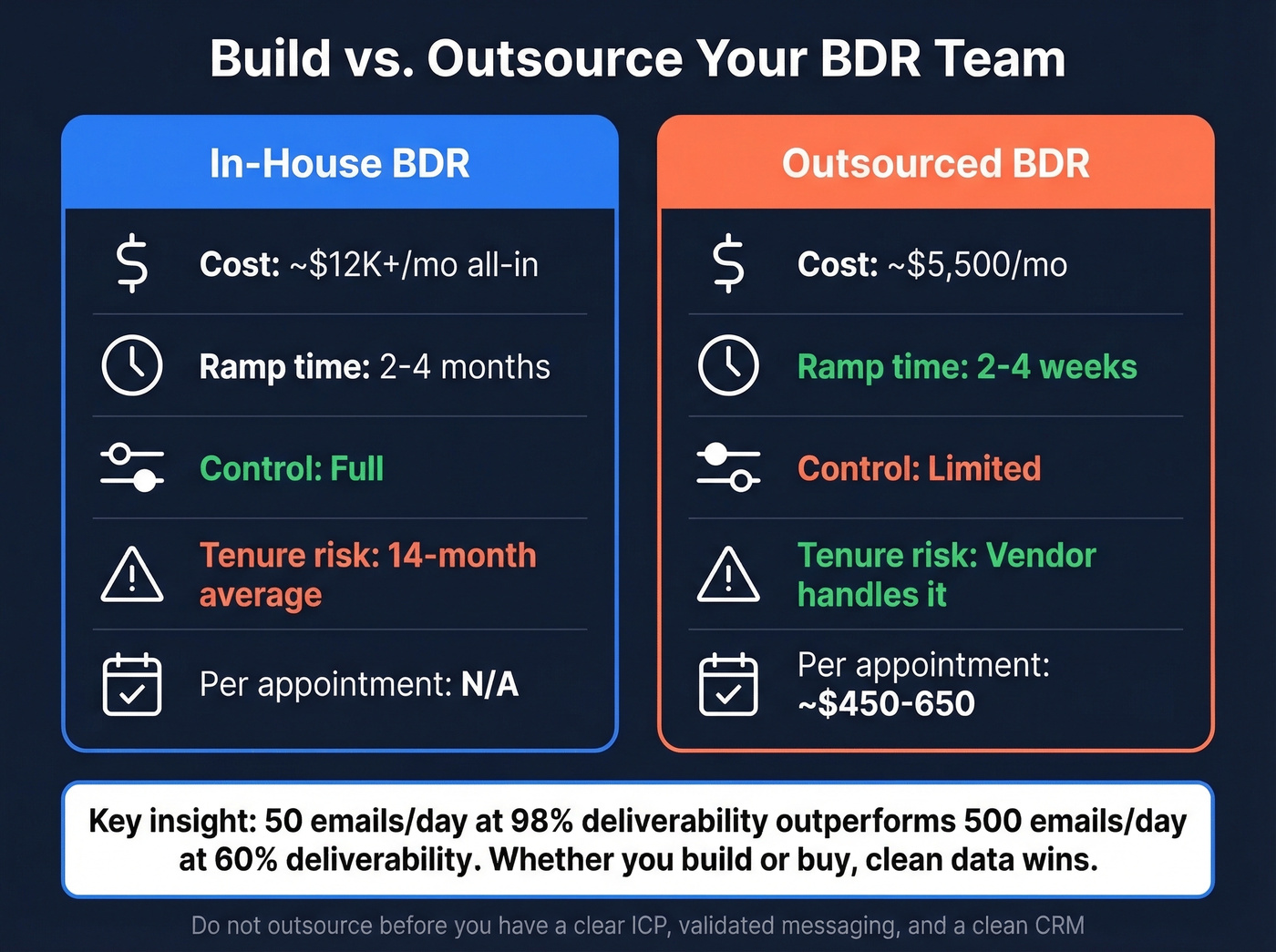
An in-house BDR costs $12K+ per month all-in - salary, commission, tools, management overhead. With average SDR tenure at 14 months, you're constantly re-hiring and re-training. Outsourced BDR services offer a faster path to pipeline when you lack the internal infrastructure to recruit, enable, and retain reps.
| Factor | In-House | Outsourced |
|---|---|---|
| Cost per rep | ~$12K+/mo all-in | ~$5,500/mo |
| Per-appointment | N/A | ~$450-650 |
| Ramp time | 2-4 months | 2-4 weeks |
| Control | Full | Limited |
| Tenure risk | 14-month avg | Vendor's problem |
Outsourcing makes sense when you need pipeline fast and don't have the infrastructure to support reps internally. But don't outsource before you have a clear ICP, validated messaging, and a clean CRM - otherwise you're paying someone else to fail faster.
One stat worth remembering: 50 emails per day at 98% deliverability outperforms 500 emails per day at 60% deliverability. Whether you build or buy, quality data beats volume every time. Teams using 3-channel outreach - email, phone, and social - see 22% more held meetings versus email alone. (If you need a refresher on the fundamentals, revisit these sales prospecting techniques.)
2026 BDR Benchmarks Worth Knowing
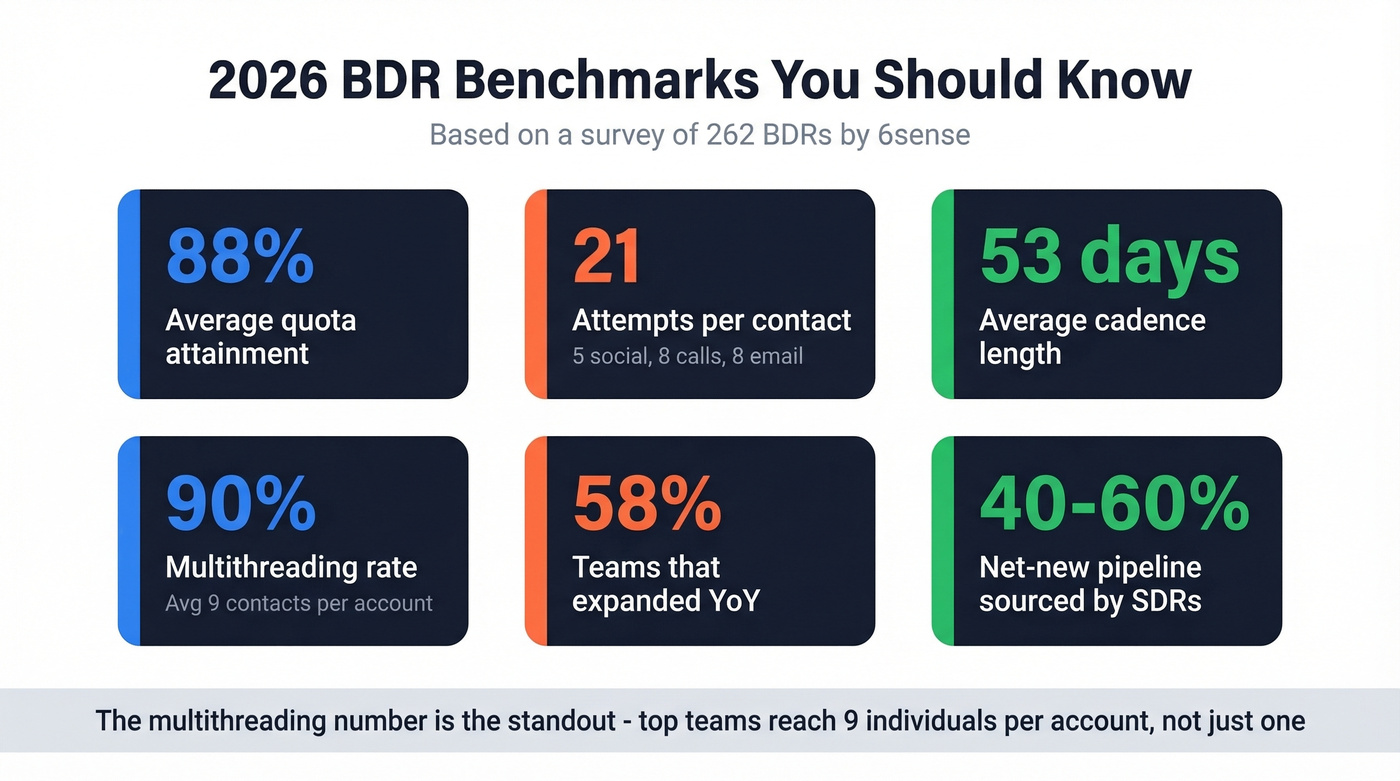
These numbers come from 6sense's BDR Benchmark survey of 262 BDRs. Pin them to your wall.
| Metric | Benchmark |
|---|---|
| Average quota attainment | ~88% |
| Attempts per contact | ~21 (5 social, 8 calls, 8 email) |
| Cadence length | 53 days |
| Multithreading rate | 90% (avg 9 contacts/account) |
| Team growth (YoY) | 58% expanded |
| Pipeline sourced by SDRs | 40-60% of net-new |
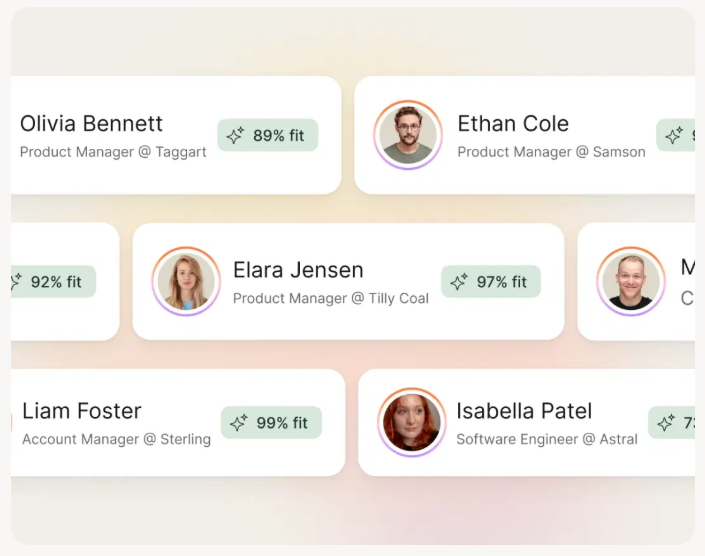
The multithreading number is the one that jumps out. Top-performing teams aren't emailing one person per account - they're reaching 9 individuals on average. That requires a data provider that can surface multiple verified contacts per company, not just the CEO.
You don't need 15 tools. You need one data layer that doesn't rot. Prospeo covers 300M+ profiles, 125M+ verified mobiles, 30+ filters with intent and technographics - and pushes clean contacts straight into HubSpot, Salesforce, Instantly, and Lemlist.
The entire data pillar of your BDR stack, starting free.
FAQ
What does BDR stand for in sales?
Business Development Representative - the role responsible for outbound prospecting, qualifying leads, and booking meetings for account executives. Not to be confused with BDR Solutions, LLC, a federal IT contractor.
How much does a BDR tech stack cost?
A budget stack runs under $100/month using free tiers from tools like Prospeo and HubSpot plus a sequencer like Instantly ($30/mo). Enterprise stacks with ZoomInfo, Outreach, and Salesforce can exceed $15,000-$40,000+/year per rep. Most mid-market teams land at $500-1,500/month.
Are AI BDR tools worth it in 2026?
For most teams, not yet. Autonomous agents like Artisan ($2,000/mo) and 11x ($5,000/mo+) often underdeliver on personalization and deliverability. A human BDR with verified contact data and a good sequencing tool still outperforms at deal sizes below $30K.
What's the most important tool to invest in first?
Your data provider. Every tool downstream - sequencing, calling, AI personalization - is only as good as the contact data feeding it. Start with verified emails and direct dials before adding anything else.
Should I use in-house reps or outsourced BDR services?
Outsourced services ramp in 2-4 weeks at roughly $5,500/month - about half the all-in cost of an in-house rep. They're ideal for teams that need pipeline quickly. In-house reps give you full control over messaging and process but require more time and budget to hire, train, and retain.