

The Ben Franklin Close: Origin, Psychology, Scripts, and When It Backfires
Your prospect just said "I need to think about it" for the third time. You've demo'd the product, handled objections, sent the proposal - and now you're watching a deal slowly die of indecision. The average proposal-stage win rate across industries sits at 47%, meaning more than half of deals that reach the finish line still don't close. The Ben Franklin close is built for exactly this moment. But most people teach it wrong.
What Is the Ben Franklin Close?
You'll also hear it called the Balance Sheet Close or the List Close. The technique traces back to a 1772 letter Benjamin Franklin wrote to scientist Joseph Priestley. Priestley was agonizing over a career decision, and Franklin's advice was elegant: "divide half a Sheet of Paper by a Line into two Columns, writing over the one Pro, and over the other Con."
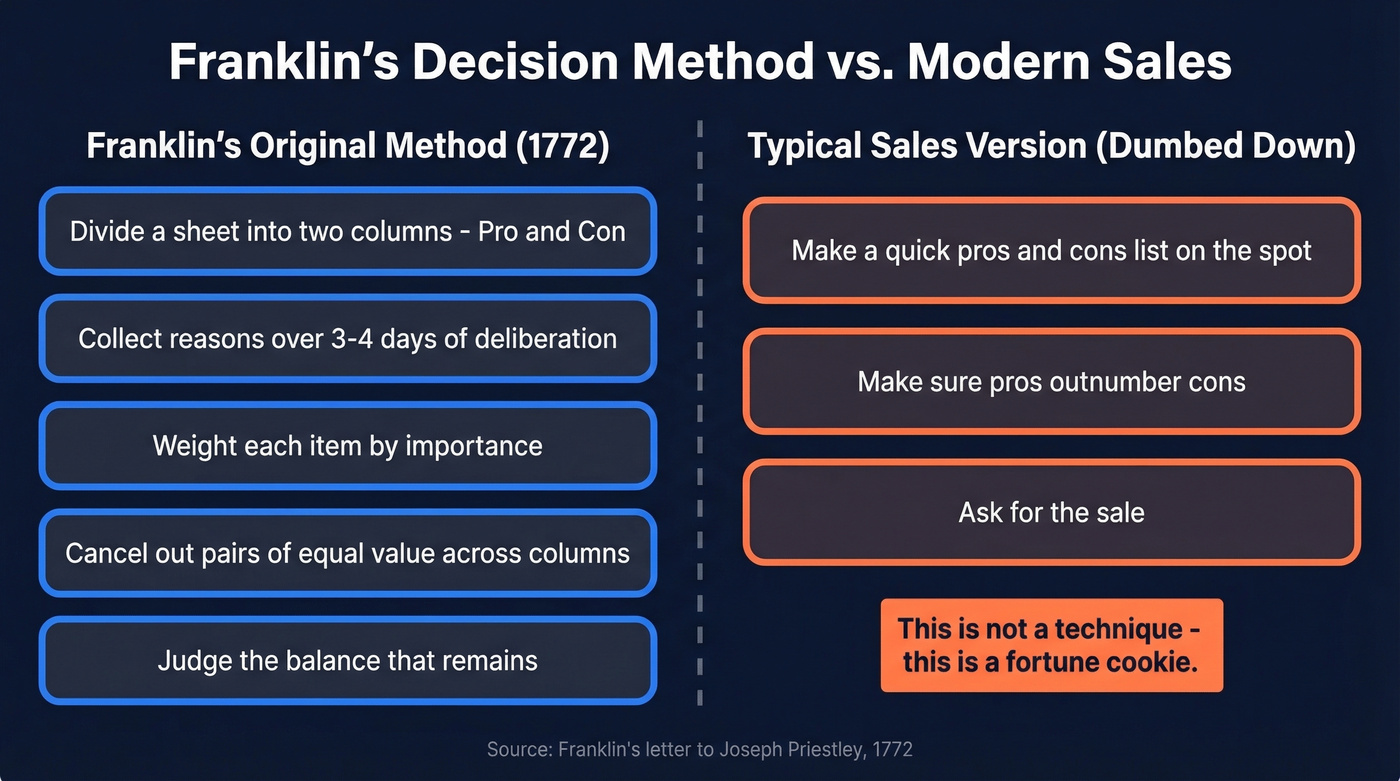
Here's what every sales guide leaves out. Franklin didn't suggest a quick five-minute exercise. He recommended collecting reasons over "three or four Days Consideration," then weighting each item and cancelling out pairs of equal value: "if one pro equals two cons, I strike out the three." He called this process "Moral or Prudential Algebra" and acknowledged its limits - "the Weight of Reasons cannot be taken with the Precision of Algebraic Quantities" - while arguing it still dramatically improved judgment by forcing "the whole" to lie before the decision-maker.
The sales version most trainers teach is a dumbed-down caricature of a genuinely brilliant decision framework. Franklin's original involved weighting, cancellation, and multi-day deliberation. The typical sales adaptation? "Make a list, make sure pros win, ask for the sale." That's not a technique - that's a fortune cookie.
Psychology Behind the Pros and Cons Close
This approach works because it activates several well-documented cognitive biases. A 2022 Frontiers in Psychology review confirmed that cognitive biases systematically affect professional decision-making across management, finance, medicine, and law. Here's how the relevant ones play into a structured pros/cons exercise.
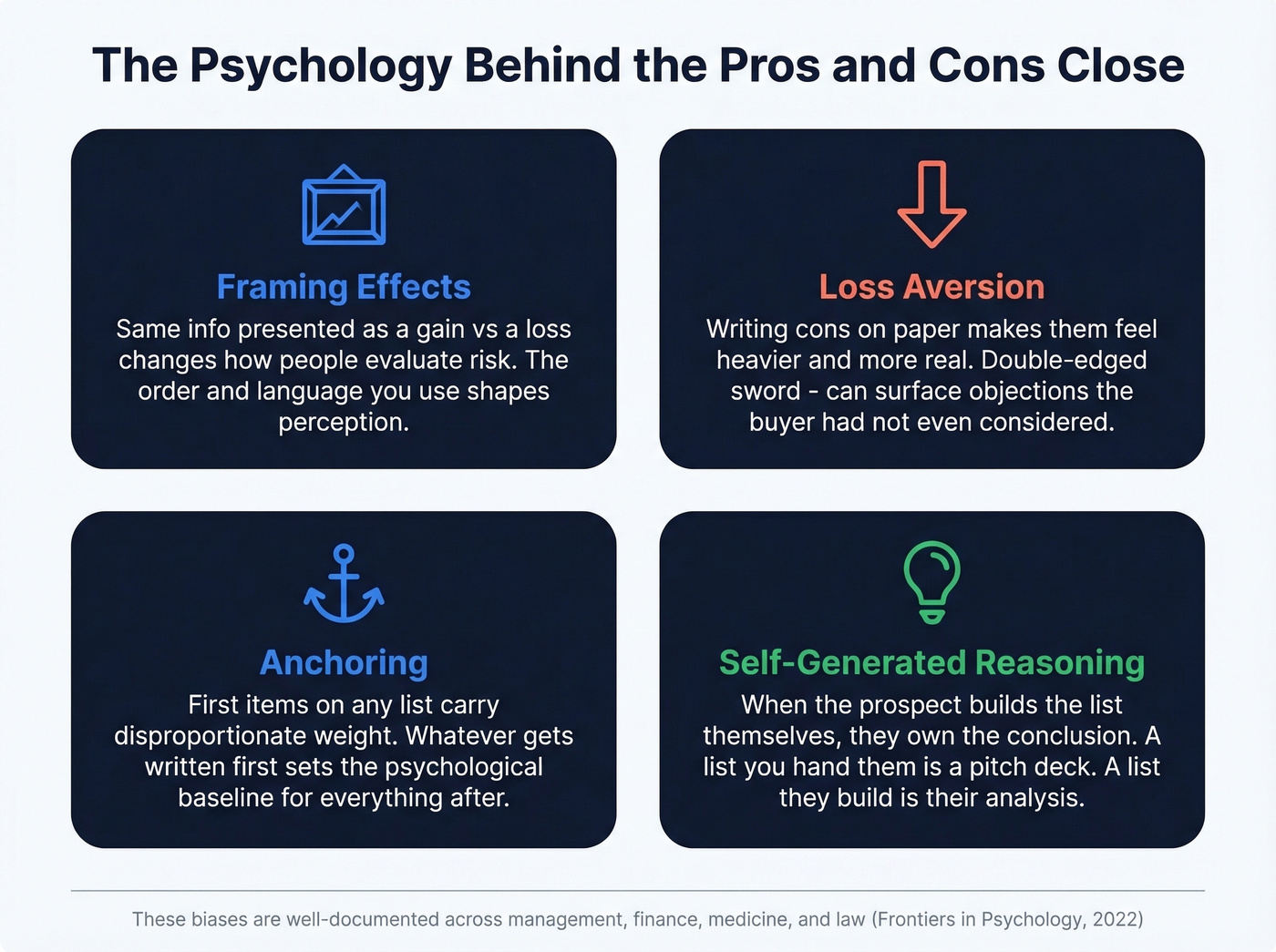
Framing effects. Behavioral decision research shows that presenting the same information as a gain versus a loss changes risk preferences. When a prospect writes down "saves 12 hours per week" versus "costs $5,000/year," the framing of each line item shapes how heavily it registers. The rep who understands this can guide which items get articulated first.
Loss aversion. Writing cons on paper makes them feel heavier and more real than they are in the prospect's head. This is a double-edged sword - it can work for you if the pros list is strong, or against you if the cons crystallize objections that were previously vague. We've seen reps accidentally talk themselves out of deals by surfacing cons the buyer hadn't even considered yet.
Anchoring. The first items on any list carry disproportionate weight. Whatever gets written first - pro or con - sets the psychological anchor for everything that follows. Execution order matters enormously.
Self-generated reasoning. When the prospect generates the list themselves, they own the reasoning. A list you hand them is a pitch deck. A list they build is their own analysis. That distinction is the difference between persuasion and facilitation.
How to Execute It Step by Step
Here's a five-step framework with exact talk tracks. We've refined this through dozens of deal reviews, and the scripts matter more than most reps think.
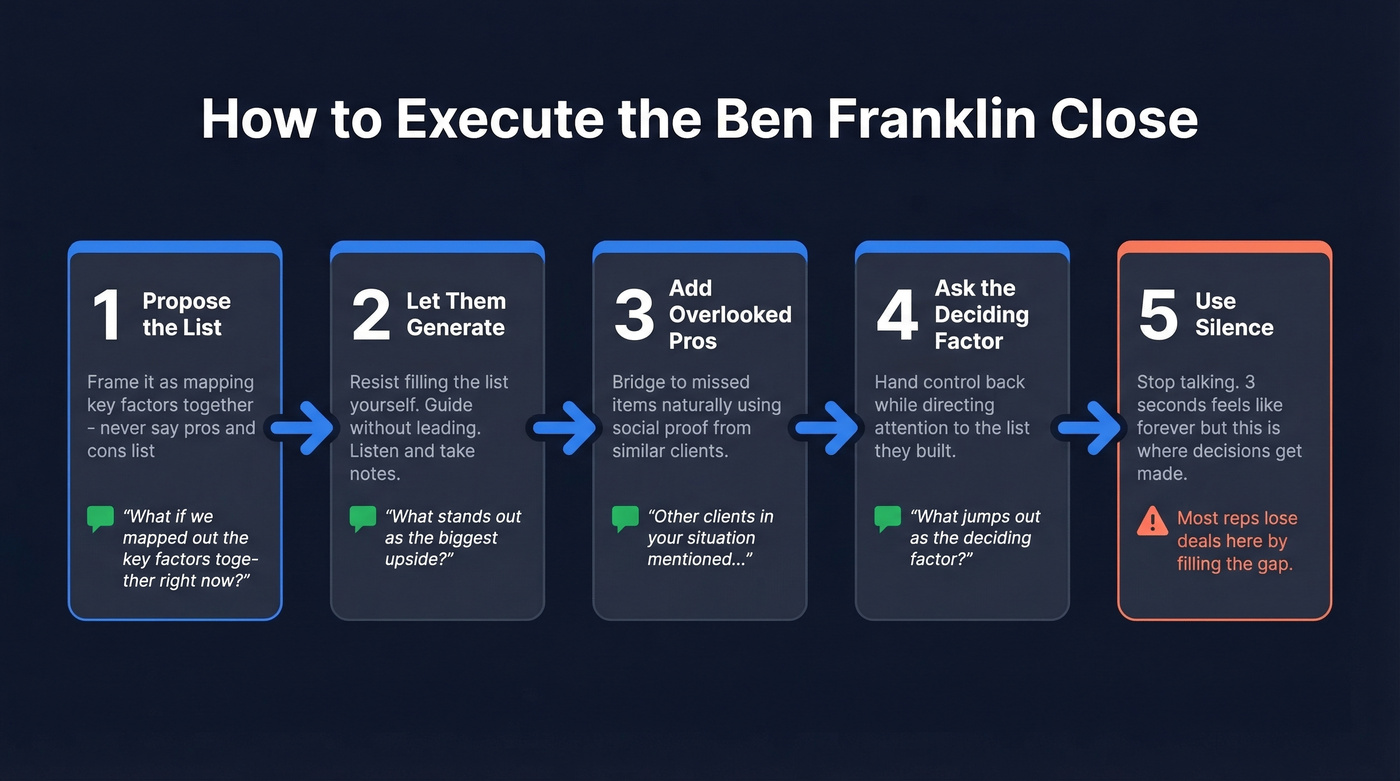
Step 1: Propose the list. Don't announce "let's do a pros and cons list" - that sounds like a sales tactic. Instead: "You mentioned wanting to think this through. What if we mapped out the key factors together right now, so you've got a clear picture to take back to your team?"
Step 2: Let the prospect generate items. Resist the urge to fill the list yourself. Guide without leading: "What stands out as the biggest upside if this works the way we discussed?" Then wait. Let them write. Your job is to listen and take notes.
Step 3: Add overlooked pros naturally. After they've listed what comes to mind, bridge to items they missed: "One thing other clients in your situation have mentioned is [specific benefit]. Does that resonate, or is that less relevant for your team?" This feels collaborative, not pushy - especially when you’re using consultative selling instead of pressure.
Step 4: Ask the closing question. Don't say "so the pros outweigh the cons, right?" That's transparent and insulting. Try: "Looking at this, what jumps out to you as the deciding factor?" This hands control back to the prospect while directing their attention to the list they just built. (If you want more options, see sales closing questions.)
Step 5: Use silence. After you ask, stop talking. Most reps fill the gap with more talking, which lets the prospect off the hook. We've watched reps lose deals in the three seconds after a perfect closing question because they couldn't tolerate the quiet. Three seconds of silence feels like an eternity when you're the one who just asked, but it's where decisions actually get made.
Example Worksheet
Here's what a filled-out sheet looks like for a $5K/year SaaS platform evaluation:
| Pros | Cons |
|---|---|
| Saves ~12 hrs/week | $5K/yr cost |
| Replaces 2 tools | 3-week onboarding |
| Native CRM sync | Team needs training |
| Reduces errors 40% | Switching risk |
| Scales with growth |
In Franklin's original method, you'd weight these - the 12 hrs/week savings might cancel out both the cost and the onboarding time. That weighting conversation is where the real magic happens.
Try something like: "Your team saves 12 hours a week - at your blended rate, that's roughly $X per year. That single line item covers the cost and the onboarding time combined. Does that math track for you?" When you frame it that way, a five-line pros list can neutralize every con on the page - classic value proposition work.

The Ben Franklin close only works when you're talking to the right person. Prospeo's 300M+ profiles with 30+ filters - including buyer intent and job change signals - let you find the actual decision-maker before you ever pitch. 98% email accuracy means your follow-up lands, not bounces.
Stop closing the wrong people. Start reaching the right ones.
When It Works vs. Backfires
| Use It When | Skip It When |
|---|---|
| Analytical buyer who needs logic | Multi-stakeholder committee |
| Price objection (quantify value) | Emotional/identity purchase |
| "I need to think about it" | Buyer already decided no |
| One decision-maker, clear authority | Complex enterprise procurement |
| Prospect is 60-80% convinced | You're using it as a Hail Mary |
A Purdue Sales Excellence Survey of 2,200 agribusiness sales professionals found that reps who ranked closing as their most important activity had the lowest performance and were less likely to exceed goals. The interpretation is straightforward: fixation on closing causes reps to rush discovery and trust-building, making the close harder.
Here's the thing most sales trainers won't tell you: only about 5% of prospects are actively ready to buy at any given time. The balance sheet close is for the subset of the remaining 95% who are genuinely evaluating - not the ones who've already checked out and are too polite to say it. If you're pulling out a pros/cons list as a Hail Mary to save a dying deal, you've already lost. Save yourself the awkwardness. (If this is a pattern, you may be dealing with stalled deals.)
The Modern Twist: Pre-Call Prep
Jeffrey Gitomer made a contrarian argument worth taking seriously: don't use this technique on the prospect. Use it on yourself, before the call.
His framework turns the pros/cons list into a pre-call strategy sheet. On the plus side: prospect's needs, questions to ask, benefits to cover, ideas to discuss, decision-makers involved, reasons they'll buy. On the minus side: reasons they won't buy plus your responses, obstacles to overcome, competitive threats.
This is honestly the more valuable modern adaptation. Instead of performing a closing technique in real time, you walk into the call having already mapped the decision landscape. You know the objections before they surface. You've rehearsed responses. You've identified gaps in your understanding. In our experience, reps who do this kind of structured pre-call work close at noticeably higher rates than those who wing it - regardless of which "technique" they use in the room. (A solid discovery call makes the close feel inevitable.)
Step zero of any close is making sure you're reaching the actual decision-maker. Prospeo finds verified emails and direct dials across 300M+ professional profiles, so you're not practicing your closing technique on someone who can't sign the deal.
How It Compares to Other Closes
| Technique | Best For | Avoid When | Risk Level |
|---|---|---|---|
| Ben Franklin | Analytical buyers | Committee decisions | Medium |
| Assumptive | Strong buying signals | Too early in process | High |
| Summary | Complex, multi-touch deals | Simple transactions | Low |
| Question | Prospects who need control | Impatient buyers | Low |
| Takeaway | Noncommittal prospects | Price-sensitive buyers | High |
| Trial / Puppy Dog | SaaS and product-led sales | High-touch enterprise | Low |
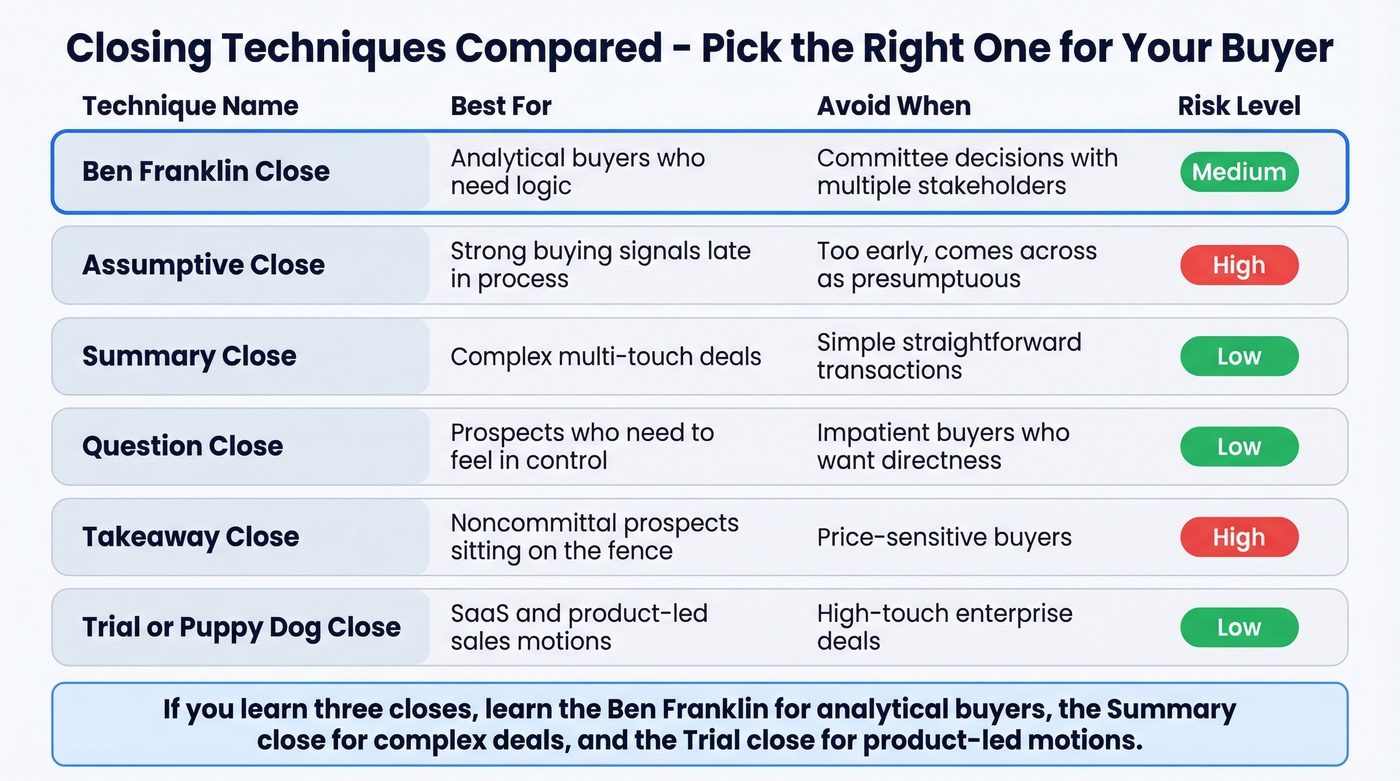
If you learn three closes, learn the Ben Franklin for analytical buyers, the summary close for complex deals, and the trial close for product-led motions. The assumptive close is powerful but dangerous - use it too early and you come across as presumptuous. The takeaway close triggers loss aversion but requires genuine confidence that you're willing to walk away. (For a broader menu, see sales closing techniques.)
The trial close (let them use the product and sell themselves) is quietly the strongest closer in SaaS right now, but it only works if your product delivers value fast enough to create its own urgency. For teams running outbound, the close that matters most isn't a technique at all - it's reaching the right person with the right message at the right time, which is more of a data problem than a sales skills problem. That’s why teams obsess over lead targeting and pipeline quality as much as talk tracks.
Does This Technique Still Work in 2026?
Steve Weinberg argues it should be retired, calling it a technique that "oversimplifies complex, strategic decisions" that should be guided by data, alignment, and trust. He's not entirely wrong about the manipulative version.
But the "retire all closing techniques" crowd is throwing the baby out with the bathwater. Talk to working reps and you'll hear a consistent split: many dismiss scripted closes as relics, but the same people use structured decision frameworks with analytical buyers every week without calling it a "close." The consensus on r/sales tends to echo this - nobody brags about using named techniques, but the underlying principles show up constantly in deal strategy posts.
Let's be honest about what this really is. The Ben Franklin close isn't a trick. It's a decision-facilitation framework for a specific situation: an analytical buyer who's genuinely torn and needs structured clarity. Used that way - as an outcome of good discovery, not a substitute for it - it absolutely still works. The close is an outcome, not a moment.
Half of proposal-stage deals die from indecision - and stale contact data kills the other half. Prospeo refreshes every 7 days, so when you follow up after that pros-and-cons conversation, you're hitting a verified inbox, not a dead end. At $0.01 per email, the cost never makes your cons list.
Your closing technique is only as good as the data behind it.
FAQ
Who invented the Ben Franklin close?
Benjamin Franklin described the method in a 1772 letter to scientist Joseph Priestley, calling it "Moral or Prudential Algebra." His original involved weighting items and cancelling equal pairs over several days - far more rigorous than the simplified pros/cons list sales trainers teach today.
What's the difference between this and the summary close?
The Ben Franklin close uses a written pros/cons list for analytical buyers who need decision logic on paper. The summary close verbally recaps agreed-upon benefits and works better for complex, multi-touchpoint deals where the buyer needs a reminder of cumulative value rather than a structured comparison.
Can I use this in group selling situations?
Generally, skip it for committee decisions. The technique works best with a single decision-maker who has clear authority. In group settings, different stakeholders weight pros and cons differently, and the exercise can surface internal disagreements you aren't equipped to mediate. For multi-stakeholder deals, a summary close or mutual action plan tends to be more effective.