

7 Consultative Selling Skills That Actually Win Deals
A rep on r/sales shared a story that's burned into our memory. His VP made the team sit through six hours of consultative selling training. Next discovery call, he opened with the textbook question - "What's keeping you up at night?" - and the prospect immediately fired back: "Are you reading from a script?" Then hung up.
That's the core paradox of consultative selling skills. The moment you systematize them into a script, they stop being consultative. But without some structure, most reps default to a feature dump. The trick is building a framework you can internalize and then forget - like a jazz musician who learns scales so they can improvise.
The Short Version
Consultative selling isn't a methodology. It's a mindset. Master three things and you'll outperform most reps: listen more than you talk (top closers maintain a 43/57 talk-to-listen ratio), pick one framework that matches your deal size and actually use it, and show up to every discovery call having done real research on the buyer.
What Consultative Selling Actually Is
Consultative selling means diagnosing before you prescribe. You're not pitching a product - you're helping a buyer understand their own problem more clearly, then co-creating a solution that fits. Think of it as the operating system, not the app. Frameworks like SPIN and Challenger are apps that run on top of the consultative mindset.
The confusion usually comes from lumping it together with solution selling and transactional selling. They're different animals.
| Consultative | Solution | Transactional | |
|---|---|---|---|
| Starting point | Buyer's undefined problem | Buyer's known problem | Buyer's known need |
| Rep's role | Advisor / diagnostician | Problem-solver | Order-taker |
| Discovery depth | Deep, multi-call | Moderate | Minimal |
| Cycle length | Longer | Medium | Short |
| Win driver | Trust + insight | Fit + speed | Price + convenience |
Solution selling focuses on resolving a buyer's known issue with the seller's product. The consultative approach goes deeper: it prioritizes trust and root-cause clarity, even when that doesn't lead to an immediate sale.
Why These Skills Matter More in 2026
The data on modern B2B buying behavior is stark. Buyers don't need you for information anymore. They need you for insight.
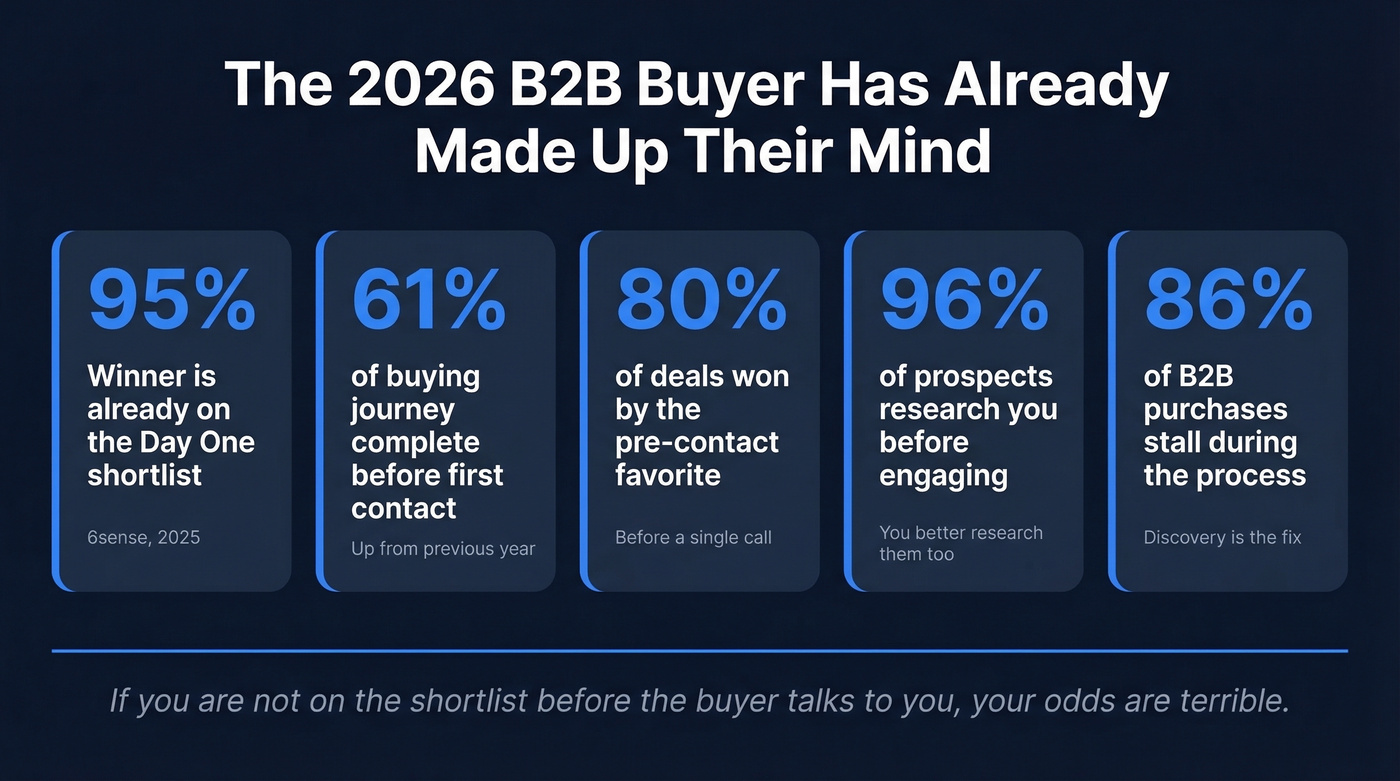
A 6sense study of nearly 4,000 B2B buyers found that 95% of the time, the winning vendor is already on the buyer's Day One shortlist. First contact now happens at 61% of the buying journey - about six to seven weeks earlier than the previous year. The pre-contact favorite wins roughly 80% of the time. And the average buying cycle has compressed from 11.3 months to 10.1 months, meaning you have less time to make an impression once you're in the room.
If you're not on the shortlist before the buyer ever talks to you, your odds are terrible. And if you are on the shortlist, the discovery call is where you either confirm their instinct or lose to a competitor who showed up better prepared.
The self-education numbers reinforce this: 96% of prospects research companies and products before engaging a sales rep, 71% prefer independent research over talking to one, and buyers define their requirements 83% of the time before speaking with sales. Even more sobering - 86% of B2B purchases stall during the buying process, and 81% of buyers end up dissatisfied with the provider they choose.
73% of B2B buyers actively avoid sellers who send irrelevant outreach. The bar is genuinely on the floor. You don't need to be a world-class consultant. You just need to be better than the rep who shows up unprepared and pitches features for 30 minutes.
Let's be honest: most reps don't have a closing problem. They have a discovery problem. Fix discovery and closing takes care of itself.
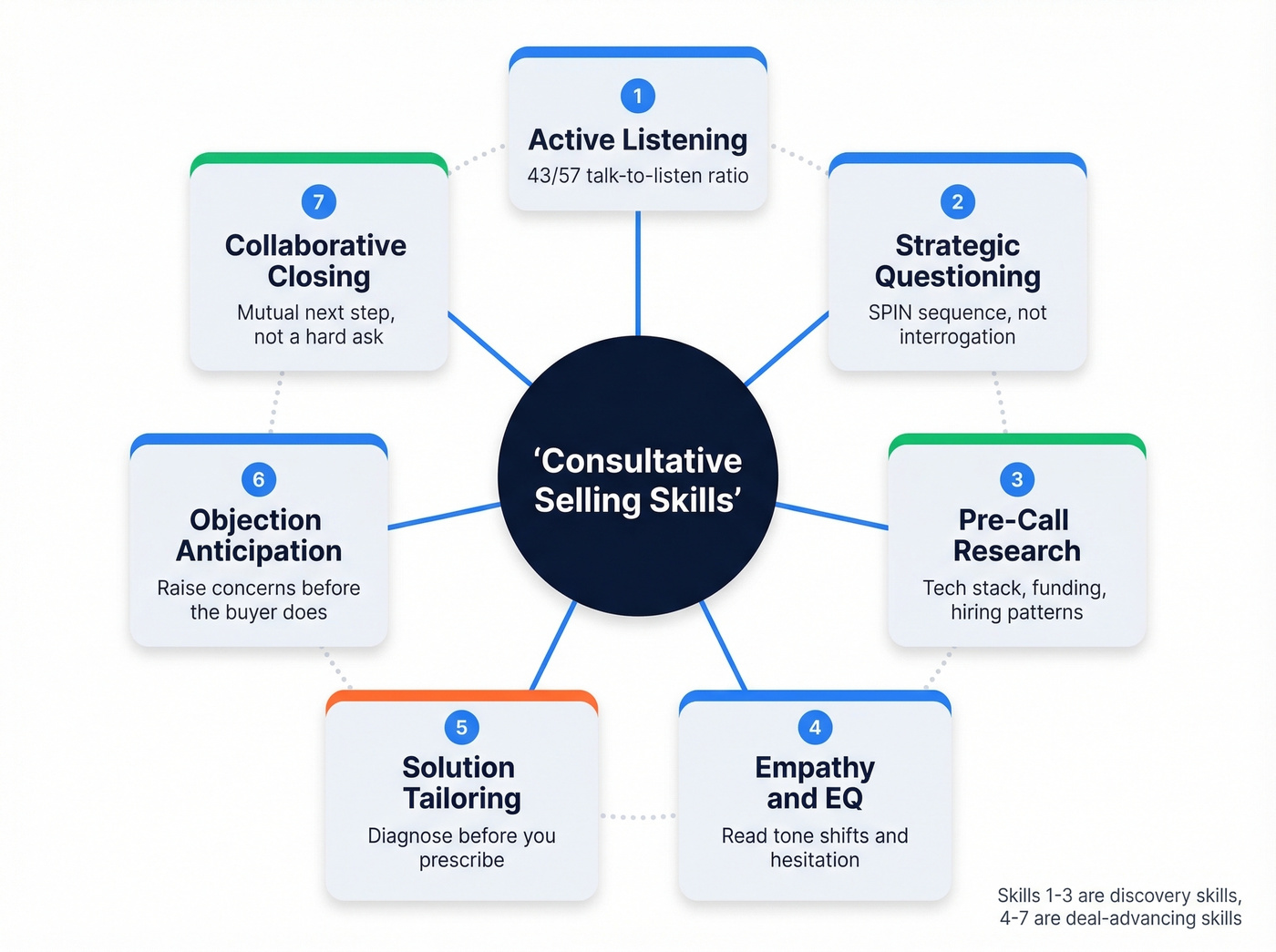
The 7 Core Skills
1. Active Listening
Top-performing closers speak 43% of the time on calls. Average performers? 65%. That's not a small gap - it's the difference between a conversation and a monologue. And only 5% of B2B buyers say salespeople exceed their expectations.
Active listening means shutting up long enough to hear what the buyer actually needs, not just waiting for your turn to talk. One concrete technique: use qualifiers - phrases that reference what the buyer just said. "You mentioned your team spends three hours a week cleaning data..." proves you're tracking the conversation and gives the buyer confidence that you're building toward something relevant.
2. Strategic Questioning
Good questions are open-ended, sequenced, and woven throughout the conversation - not clustered into an interrogation block at the start. The SPIN sequence (Situation, Problem, Implication, Need-Payoff) is the gold standard here because it builds momentum. Each question type sets up the next. Clustering five situation questions in a row feels like a survey. Alternating between question types feels like a real conversation.
A common refrain on r/sales is that SPIN works great in theory but falls apart when reps try to follow it step-by-step like a checklist. That's the point - internalize the logic, then let the conversation flow naturally.
If you want a deeper bank of prompts, start with a structured list of discovery questions you can adapt by deal size.
3. Pre-Call Research
If 96% of prospects research you before the call, showing up without researching them is an insult. We've all done it - Googling the About page two minutes before the meeting and winging it. That's not preparation.
Real pre-call research means understanding the company's tech stack, recent funding, hiring patterns, and the specific person's role and tenure. Use a B2B data platform like Prospeo to pull verified contact details and company technographics before every discovery call. Showing up informed is the first skill that actually moves the needle - and it separates advisors from order-takers.
If you're tightening your workflow, it helps to standardize firmographic and technographic data so reps research the same fields every time.
4. Empathy and Emotional Intelligence
Reading verbal and nonverbal cues - tone shifts, hesitation, enthusiasm - tells you more than any discovery question. When a prospect says "that's interesting" in a flat voice, they're not interested. When they lean forward and ask "how would that work for us?" - that's buying intent.
Empathy isn't a soft skill in consultative sales. It's the skill that tells you when to push, when to pull back, and when to shut up entirely.
If you want to get more systematic about this, build a simple rubric for identifying buying signals across calls.
5. Solution Tailoring
Never pitch before you've diagnosed. The temptation to jump into a demo after hearing one pain point is enormous, and it kills deals. Solution tailoring means mapping your recommendation to the specific problems the buyer articulated - using their language, referencing their examples, and connecting features to outcomes they care about. Generic decks don't close consultative deals.
Sometimes the most consultative move is telling a buyer your product isn't the right fit and pointing them elsewhere. That costs you one deal but builds the kind of trust that generates referrals for years.
If your team demos early, a lightweight product demo checklist can keep discovery from getting skipped.
6. Objection Anticipation
The best consultative sellers raise concerns before the buyer does. "You're probably wondering about implementation timeline - let me address that." This is proactive, not reactive. It builds trust because it signals you've been through this before and you're not afraid of the hard questions. Reactive objection handling feels defensive. Proactive anticipation feels confident.
If objections are a recurring bottleneck, it’s worth tracking patterns and working to reduce sales objection rate with better qualification and expectation-setting.
7. Collaborative Closing
Consultative deals don't close with pressure tactics. They close when both sides agree on a natural next step. "Based on what we've discussed, it sounds like a pilot with your EMEA team makes sense. Should we scope that out?" That's collaborative closing - tying it up as a mutual decision, not a hard ask.
Here's the timing piece most people miss: opportunities closed within 50 days have a 47% win rate. After 50 days, it drops to 20% or lower. Consultative doesn't mean leisurely. It means efficient and thorough. If your discovery is sharp, the deal should move faster, not slower.
If you want a clean end-to-end flow, map discovery into your broader steps to close a sale so next steps are consistent.

Pre-call research is the #1 consultative selling skill that separates advisors from order-takers. Prospeo gives you technographics, buyer intent across 15,000 topics, and 30+ filters to understand your prospect's world before you ever pick up the phone.
Show up to every discovery call like you already know the answer.
Pick a Framework and Stop Debating
Here's the thing: the framework matters less than actually using one. Companies with a defined sales process are 33% more likely to be high performers, and teams with a formal process see 18% more revenue growth. Structured qualification frameworks like MEDDIC and SPICED drive a 37% increase in win rates when teams implement them consistently.
If you’re formalizing this across the org, treat it as sales process optimization, not a one-off enablement project.
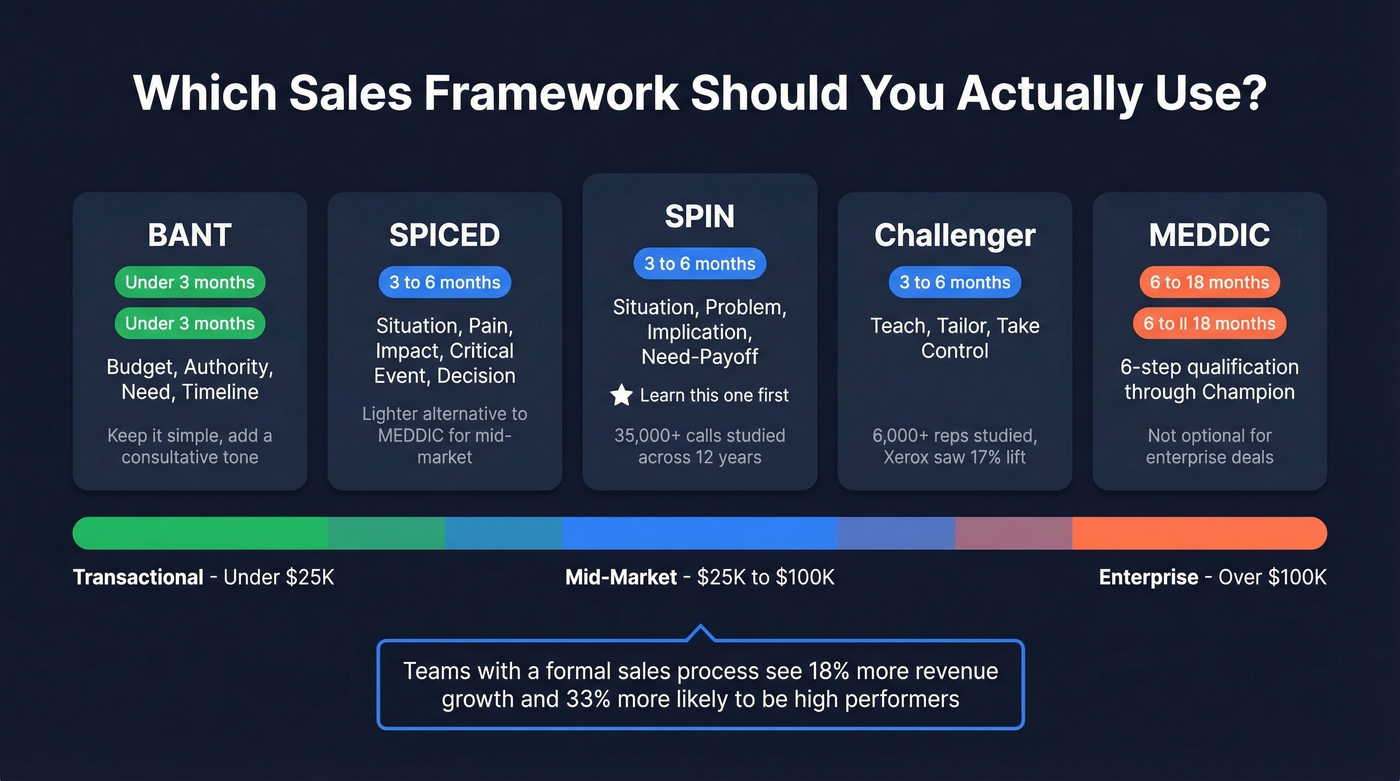
| Framework | Best For | Deal Size | Cycle | Core Mechanic |
|---|---|---|---|---|
| SPIN | Complex discovery | $25K-$100K | 3-6 mo | Situation, Problem, Implication, Need-Payoff |
| Challenger | Competitive markets | $25K-$100K | 3-6 mo | Teach, Tailor, Take Control |
| MEDDIC | Enterprise qualification | >$100K | 6-18 mo | 6-step qualification through Champion |
| SPICED | Mid-market qualification | $25K-$100K | 3-6 mo | Situation, Pain, Impact, Critical Event, Decision |
| BANT | Transactional | <$25K | <3 mo | Budget, Authority, Need, Timeline |
SPIN is backed by research analyzing 35,000+ sales calls across 20+ countries over 12 years. Challenger comes from CEB's study of 6,000+ reps - and Xerox reported a 17% sales increase and $65M in contract value after implementing it. Both are battle-tested.
If you learn one framework, learn SPIN. It teaches you how to ask questions that build urgency without being pushy. Layer Challenger once you've mastered discovery - it's powerful in competitive markets where the buyer thinks they already know what they need, and you need to reframe their thinking.
For enterprise deals above $100K, MEDDIC isn't optional. It's the qualification layer that keeps you from spending six months on a deal with no champion and no budget. SPICED is a lighter alternative for mid-market teams who find MEDDIC overkill. For transactional deals under $25K, don't overthink it. BANT with a consultative tone gets the job done.
Discovery Call Template
A good discovery call runs 15-30 minutes and follows a loose structure: set the agenda, ask sequenced questions, agree on next steps.
If you want a printable version, you can also use a discovery call script PDF as a starting point (then make it sound like you).
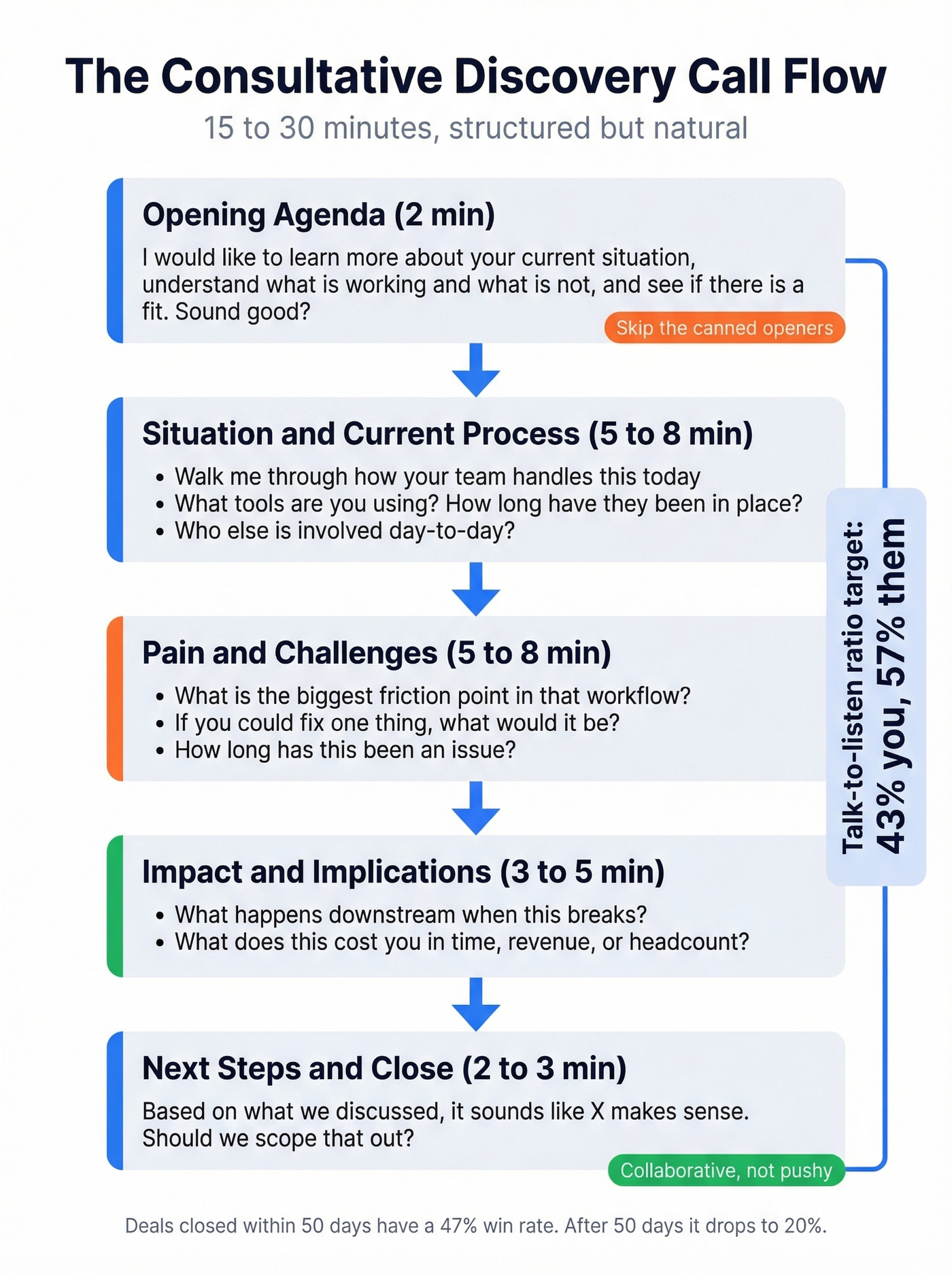
Opening agenda: "I'd like to learn more about your current situation, understand what's working and what isn't, and see if there's a fit. Sound good?"
That's it. No "What's keeping you up at night?" No canned openers. Just a clear, honest framing of what the next 20 minutes will look like.
Situation / Current Process
- Walk me through how your team handles [process] today.
- What tools are you using for [function]? How long have they been in place?
- Who else is involved in this process day-to-day?
Pain / Challenges
- What's the biggest friction point in that workflow?
- If you could fix one thing about your current setup, what would it be?
- How long has this been an issue? What's changed recently?
Impact / Implications
- What happens downstream when [pain point] isn't addressed?
- How does this affect your team's ability to hit [goal/metric]?
- Have you quantified the cost of this problem - in time, revenue, or headcount?
Decision Process
- Who else would need to weigh in on a decision like this?
- What does your evaluation process typically look like?
- Is there a timeline or event driving urgency here?
Objections / Concerns
- What would make you hesitate to move forward?
- Have you tried solving this before? What happened?
The key is weaving these questions throughout the conversation rather than firing them in sequence. Follow the buyer's thread. If they mention a pain point in response to a situation question, go deeper on the pain before circling back to process. Consultative discovery is a conversation, not a questionnaire.
Mistakes That Kill Consultative Deals
Robotic scripts. Remember our opening anecdote? "Are you reading from a script?" is the death sentence. Internalize frameworks; don't recite them.
Talking too much. If you're above that 43% talk ratio, you're pitching, not consulting. Record your calls and check.
Leading with features. "We have AI-powered analytics" means nothing until you've established why the buyer needs analytics in the first place.
Failing to qualify. Spending three calls with a director who can't sign a PO is a discovery failure, not a closing failure. Make sure you're talking to the economic buyer - or at least someone with a direct line to them. (If this is a recurring issue, train reps on the MEDDIC sales qualification layer.)
Confusing consultative with slow. Outreach's data confirms the 50-day cliff. A consultative approach should accelerate deals by surfacing the right information faster, not drag them out with endless discovery loops.
How to Build These Skills
Brooks Group assessed hundreds of sales professionals before and after consultative selling training. At the 9-12 month reassessment, skills improved over 20% across the board. Before training, reps were strongest in presenting and demos - weakest in discovery and closing. That tracks with everything we see in the field.
Corporate training programs run $10K-$30K per cohort. Individual courses range from $50-$500. But the cheapest training is recording your own calls and listening to them with a timer. Track your talk ratio. Count your questions. Note where you pitched before diagnosing.
For deeper study, start with Neil Rackham's SPIN Selling and The Challenger Sale by Dixon and Adamson. Both are grounded in large-scale research, not opinion.
Record every call and review your talk-to-listen ratio weekly. Most conversation intelligence tools calculate this automatically. If you don't have one, a stopwatch and a notebook work fine.
Practice one framework per quarter. Don't try to learn SPIN, Challenger, and MEDDIC simultaneously. Master one, then layer the next. Trying to run three frameworks at once is a recipe for doing all of them poorly.
Role-play with peers weekly. Even 15 minutes of practice with a colleague who pushes back realistically beats hours of reading. The discomfort of role-play is exactly why it works - it forces you to internalize responses instead of memorizing them.
Track win-rate changes monthly. If your discovery skills are improving, your win rate should follow. If it doesn't, you're practicing the wrong things.
Better Data, Better Discovery
Before you can ask the right questions, you need to reach the right person. That's where most consultative selling advice falls apart - it assumes you're already in the meeting. Reps spend roughly 60% of their time on non-selling tasks, and a huge chunk of that is chasing bad contact info, bounced emails, and dead phone numbers.
Skip this section if your data hygiene is already solid. But if your bounce rates are above 5% or your dials are hitting voicemail at disconnected numbers, this is the bottleneck.
We've found that pairing strong discovery skills with verified data from Prospeo - 98% email accuracy, 125M+ verified mobile numbers with a 30% pickup rate - eliminates the noise before the conversation even starts. The 7-day data refresh cycle means you're working with current titles and companies, not data that's six weeks stale. Every enrichment returns 50+ data points per contact, giving you the technographic and intent context you need to walk into a discovery call already informed.
If you’re cleaning lists to protect deliverability, start with email bounce rate benchmarks and fixes, then evaluate dedicated data enrichment services to keep records current.
The best consultative selling skills in the world don't matter if your emails bounce and your dials go to voicemail at disconnected numbers. Data quality is the prerequisite.
96% of prospects research you before the call. Showing up uninformed kills consultative deals. Prospeo's 300M+ profiles with 98% email accuracy and 7-day data refresh mean you're never working with stale intel when it matters most.
Stop winging discovery calls - prep with data that's actually fresh.
FAQ
What's the difference between consultative selling and solution selling?
Solution selling resolves a buyer's known issue with the seller's product. Consultative selling helps the buyer discover and define the problem first, then co-creates the solution. The consultative approach works upstream - it builds deeper trust because you're diagnosing root causes, not just prescribing features to a stated need.
How long does it take to develop consultative selling skills?
Brooks Group data shows measurable improvement within 9-12 months of structured training, with skills jumping 20%+ across the board. The fastest path is deliberate practice: record calls weekly, track your talk-to-listen ratio, and tighten questioning habits one framework at a time.
Which framework is best for consultative sales?
SPIN for mid-market discovery ($25K-$100K deals), Challenger for competitive markets where you need to reframe buyer thinking, and MEDDIC for enterprise qualification above $100K. Pick the one that matches your typical deal size and master it before layering another.
Can consultative selling work for transactional deals?
Yes - scale it down to a five-minute discovery conversation instead of a 30-minute deep dive. For deals under $25K, BANT qualification with genuine curiosity and active listening outperforms a feature dump every time, even in a compressed interaction.
What tools help with consultative selling preparation?
A B2B data platform for verified contact details, technographics, and buyer intent signals - so you walk into calls informed. A CRM for tracking deal context across conversations. And conversation intelligence software for reviewing recordings, measuring talk ratios, and spotting where discovery breaks down.