

Lead Targeting: Build a System, Not a Checklist
79% of marketing leads never convert into sales. Not because the leads are bad people - because they're the wrong people, reached at the wrong time, with the wrong message. That's a lead targeting problem, not a volume problem.
What Is Lead Targeting?
Lead targeting is the upstream discipline of deciding who deserves your team's time and resources before you spend a dollar on outreach. It's not lead generation - that's the downstream act of capturing contact information. Targeting is the strategic layer that makes generation actually work.
Here's the thing: 95% of your market isn't actively buying at any given moment. This discipline is how you find the 5% who are evaluating solutions and ignore the rest, instead of blasting 10,000 contacts and hoping 50 respond. If you're wondering how to get targeted leads consistently, the answer starts here - with a system, not a spray-and-pray campaign.
What You Need First
Most guides list 10 strategies. You need three things working before any of them matter.
- A scoring model, not a slide deck ICP. We give you a 100-point template below. It takes an afternoon to build and immediately changes how your team prioritizes accounts. (If you want a deeper rubric, use an ICP scoring framework.)
- Verified contact data that doesn't decay. A 7-day refresh cycle at 98% email accuracy is the baseline. Stale data kills targeting before outreach starts. (More on data enrichment if you're building this layer.)
- One outbound channel executed relentlessly before you add a second. Email, cold call, or social. Pick one. Master it. Then expand.

You just built a 100-point scoring model and layered intent signals. Don't feed it into a database with a 6-week refresh cycle. Prospeo gives you 300M+ profiles with 98% email accuracy, 30+ filters for technographics, buyer intent, and headcount growth - refreshed every 7 days so your targeting never runs on stale data.
Meritt tripled their pipeline to $300K/week. Your scoring model deserves data that keeps up.
Why Targeting Matters More Than Ever
B2B buying has shifted underneath most teams. Over 70% of B2B marketers report declining paid channel performance due to audience saturation. CPCs keep climbing while conversion rates stall. B2B practitioners on Reddit echo the same frustrations - tiny budgets, massive CPCs, and unrealistic expectations from leadership. These are all symptoms of a targeting problem dressed up as a demand problem.
Meanwhile, 53% of marketers say at least 10% of their leads get disqualified by sales due to poor quality. Buyers aren't waiting for your SDR to call - 94% of buying groups have ranked their preferred vendors before the first sales conversation. By the time someone fills out your form, the decision is half-made.

The dark funnel compounds this. Peer recommendations in Slack communities, Reddit threads, and untracked conversations shape decisions long before a form fill. If your targeting is off, you aren't just wasting budget - you're invisible to the people actually buying.
Let's be honest: most teams don't have a lead gen problem. They have a targeting problem wearing a lead gen disguise. Fix targeting first, and half your "pipeline issues" disappear.
The 6-Step Lead Targeting System
Step 1 - Score Your ICP, Don't Describe It
Stop treating your ICP like a paragraph in a strategy deck. Turn it into a scoring model. Analyze 50-100 closed-won deals from the last 12 months and you'll find 70-80% share 3-5 common traits.
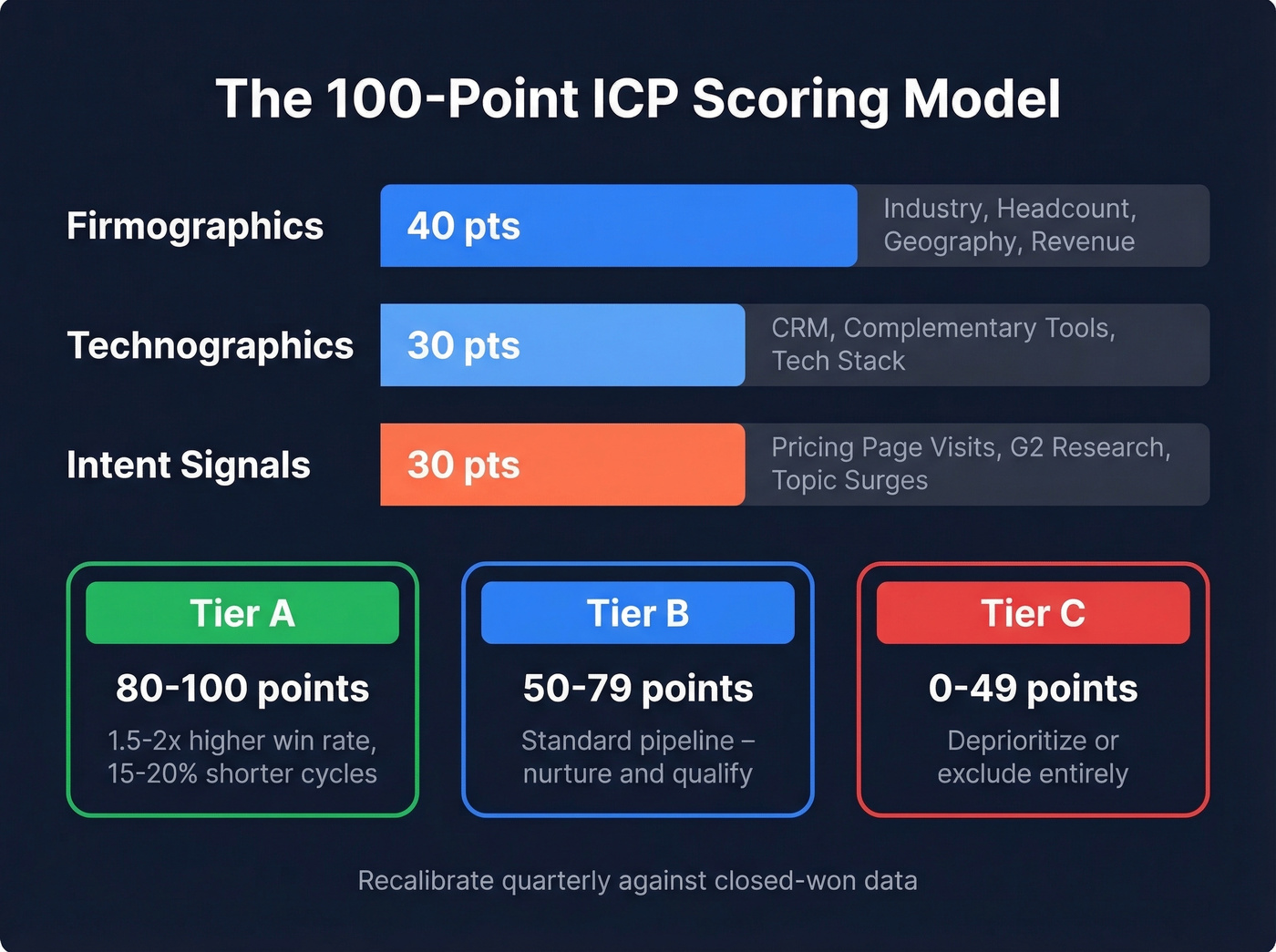
| Category | Weight | Sample Criteria | Score Range |
|---|---|---|---|
| Firmographics | 40 pts | Industry, headcount, geo, revenue | 0-40 |
| Technographics | 30 pts | CRM, complementary tools, stack | 0-30 |
| Intent Signals | 30 pts | Pricing page visits, G2 research, topic surges | 0-30 |
Set tier thresholds: A (80-100), B (50-79), C (0-49). Tier A accounts should show win rates 1.5-2x higher than Tier B, with 15-20% shorter sales cycles. If they don't, recalibrate. Marketo research shows that sales/marketing alignment on ICP yields 38% higher win rates and 208% growth in marketing-generated revenue. That alignment starts with a shared scoring model, not a shared slide deck.
Step 2 - Layer Intent Signals
A good ICP model tells you who to target. Intent data tells you when. Three types matter:
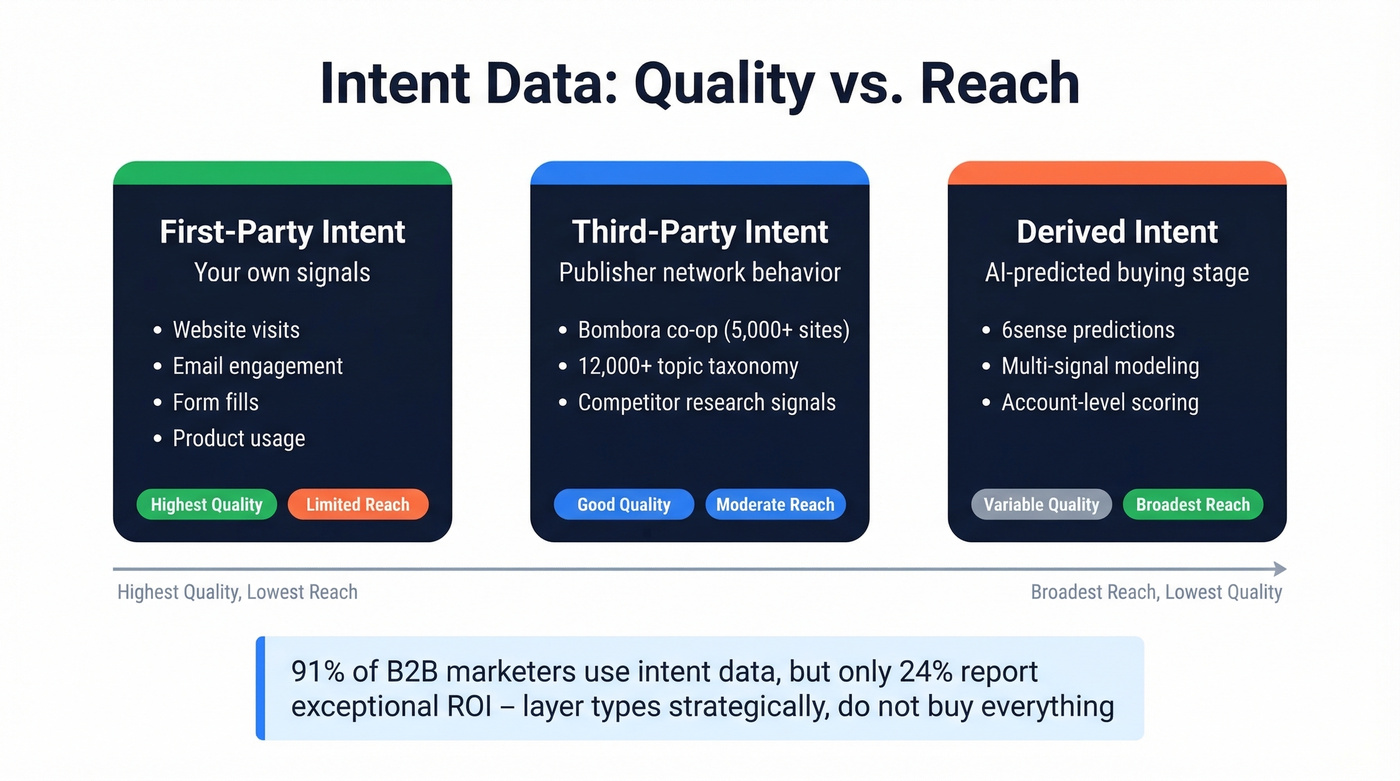
- First-party intent - your own website visits, email engagement, form fills. Highest quality, limited reach.
- Third-party intent - publisher network behavior. Bombora runs the largest co-op with 5,000+ B2B sites and a 12,000+ topic taxonomy.
- Derived intent - multi-signal AI predictions of buying stage. 6sense is the heavyweight here.
91% of B2B marketers use intent data, but only 24% report exceptional ROI. Enterprise intent platforms are overkill for most teams. Quick comparison:
| Vendor | Type | Pricing | Best For |
|---|---|---|---|
| Bombora | Third-party | $12K-$40K/yr | Standalone topic signals |
| 6sense | Derived | $35K-$300K+/yr | Enterprise ABM orchestration |
| Databar | Aggregated | From $39/mo | Budget consumption model |
One angle competitors miss: monitoring competitor keyword trends through tools like Semrush can serve as a derived intent signal, revealing which pain points prospects are actively researching. (If you want a process for this, borrow a competitive intelligence strategy.)
Step 3 - Verify and Enrich Your Data
Data quality makes everything else work. The industry average refresh cycle is 6 weeks. In that time, people change jobs, companies get acquired, and your "verified" list decays into a bounce-rate liability. (If you're troubleshooting this, start with email bounce rate benchmarks and causes.)
We've seen this pattern over and over: a team builds a beautiful ICP model, layers intent signals, then feeds it all into a database with 20%+ bounce rates. The sequences fail, the domain reputation tanks, and everyone blames "outbound doesn't work." No - the data didn't work.

Prospeo addresses this with a 7-day refresh cycle and 98% email accuracy across 300M+ profiles. The 5-step verification process handles catch-all domains, removes spam traps, and filters honeypots. Meritt tripled their pipeline from $100K to $300K/week after switching, with bounce rates dropping from 35% to under 4%. (If deliverability is a recurring issue, use an email deliverability guide to fix the root causes.)
One compliance note that matters: don't buy lists from brokers. Beyond the terrible data quality, GDPR fines can reach EUR 20M or 4% of global annual turnover. The compliance risk alone makes purchased lists a non-starter for any team selling into the EU. (Related: Is it illegal to buy email lists.)
Step 4 - Segment and Prioritize
Once you've scored accounts and enriched contacts, prioritize with a fit+intent matrix:
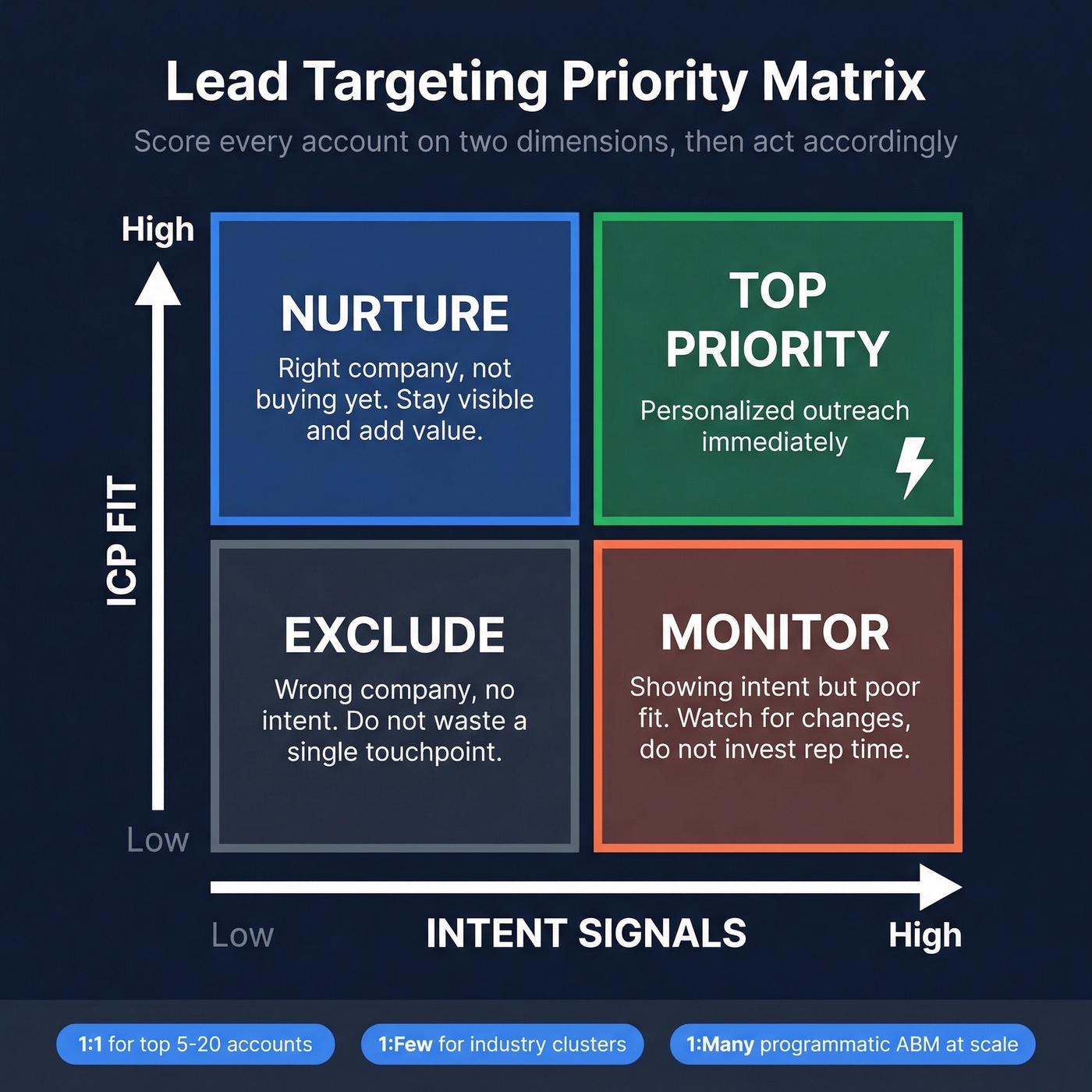
- High fit + high intent = top priority. Personalized outreach immediately.
- High fit + low intent = nurture. Right company, not buying yet.
- Low fit = exclude. Don't waste rep time regardless of intent signals.
For ABM execution, tier your approach: 1:1 for your top 5-20 strategic accounts, 1:few for clusters sharing industry or challenge, and 1:many programmatic ABM at scale. Narrow your target account list to 1,000-5,000 accounts. Anything broader and you're back to spray-and-pray with extra steps. (If you need a tighter operational playbook, follow account-based selling best practices.)
Here's what this looks like in practice. One SaaS team we spoke with scored 200 accounts using the rubric above, layered Bombora intent to find 40 actively researching their category, ran personalized email sequences to verified contacts at those 40 accounts, and booked 12 meetings in 30 days. That's a 30% account-to-meeting rate - roughly 6x what untargeted outbound produces. Every layer of the system reinforced the next.
Step 5 - Execute Targeted Outreach
Pick one channel:
- Email - still generates $42 for every $1 spent. Best for scale and measurability. (If you're building sequences, use a B2B cold email sequence structure.)
- Cold call - highest conversion per touch, lowest scale. Best for deals above $50K ACV. (If you want a repeatable process, build a cold calling system.)
- Social - best for warming accounts before direct outreach. Slow burn, compounds over time.
63% of B2B buyers are more likely to engage with vendors who provide helpful content early. Your outreach needs to account for this - provide value before asking for a meeting, and show up in the spaces where your buyers actually hang out.
Execute one channel relentlessly for 90 days before adding a second. Splitting focus across all three simultaneously is how teams get mediocre results everywhere. We've watched agencies try to launch email, cold calling, and social selling in the same sprint. The result is always the same: three half-baked channels instead of one that actually converts.
Step 6 - Measure and Recalibrate
Calibrate against real benchmarks: Unbounce reports a median landing page conversion rate of 6.6% across industries (SaaS sits at 3.8%), while Ruler Analytics puts the average qualified lead conversion at 2.9%. Targeted outbound converts 2-5x better than untargeted campaigns - that gap compounds every quarter.
Validate your ICP model quarterly. If Tier A accounts aren't converting at 1.5-2x the rate of Tier B, your scoring weights are off. Recalibrate based on last quarter's closed-won data. The best targeted lead generation strategies evolve with your market - what worked in Q1 may need adjustment by Q3 as buyer behavior shifts.
Tools Worth Using
Data and Enrichment
Stack Optimize built from $0 to $1M ARR using Prospeo, keeping bounce rates under 3% with zero domain flags across all clients. The 30+ search filters translate your ICP scoring model directly into search criteria, which makes finding targeted leads as straightforward as setting your tier thresholds and hitting search. Pricing runs ~$0.01/email with a free tier at 75 emails/month. (If you're comparing vendors, see data enrichment services.)
For scrappy teams just getting started, Apollo is worth a look. The free tier is generous enough to test outbound before committing budget, and paid plans start at $49/user/month. The tradeoff: email accuracy sits around 79%, which works for early-stage prospecting but creates deliverability problems at scale where bounce rates compound fast.
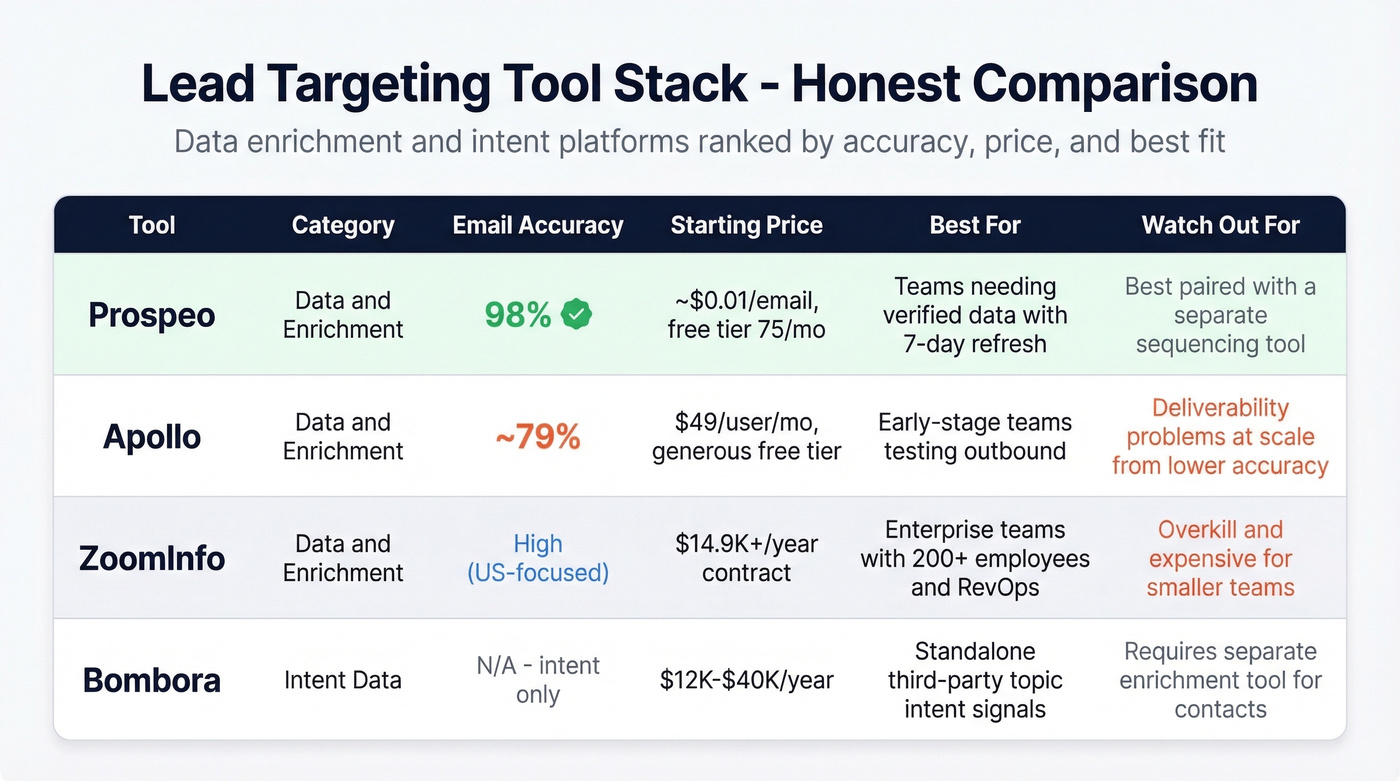
ZoomInfo is the enterprise incumbent, and it earns that label - for better and worse. Deep US coverage and a full-featured platform, but you're locked into $14.9K+/year contracts and need a dedicated RevOps team to extract full value. Skip this if your team is under 200 employees. You'll be paying for capabilities you'll never touch.
Intent Data Platforms
Bombora runs the largest publisher co-op at $12K-$40K/year - the gold standard for third-party intent signals. 6sense combines derived intent with ABM orchestration starting at ~$35K/year, but the 3-6 month implementation timeline makes it impractical for teams under 100 employees.
Outbound Execution
Instantly handles cold email at scale from $30/month. It's the go-to for agencies running multi-client campaigns where deliverability management is the core challenge. Clay automates enrichment and sequencing workflows from $149/month - best for RevOps teams building custom stacks who want granular control over every data transformation step. Both integrate natively with Prospeo's enrichment API.
FAQ
What's the difference between lead targeting and lead generation?
Lead targeting defines who to pursue and how to prioritize them using ICP scoring, intent signals, and verified data. Lead generation captures contact information from those prioritized accounts through outbound, content, or ads. Targeting makes generation efficient - generation without targeting is expensive noise.
How many accounts should I target at once?
For ABM-style outbound, 1,000-5,000 accounts is the sweet spot. Start with Tier A accounts first - expanding too early dilutes conversion rates and wastes rep time on low-fit prospects. Resist the urge to inflate your list with low-scoring accounts just to hit a volume number.
How do I build targeted lists without a big budget?
Use an ICP scoring model (free - the 100-point template above works), a verified contact database with a free tier (75 emails/month), and one outbound tool like Instantly ($30/month). Total cost under $80/month to start. Score your closed-won data and work outward from those patterns.
How do I target prospects in a new market segment?
Start with adjacent firmographics. If your best customers are 50-200 employee SaaS companies, test 200-500 employee SaaS or 50-200 employee fintech - one variable at a time. Run small outbound tests of 50-100 contacts and let conversion data tell you whether the expansion is worth scaling.
Step 3 is where most targeting systems break. Teams nail the ICP scoring, layer intent data, then watch sequences fail because 20% of emails bounce. Prospeo's 5-step verification eliminates catch-alls, spam traps, and honeypots - at $0.01 per email with no annual contract.
Stop blaming outbound. Fix the data layer and watch your 30% account-to-meeting rate become real.