

The 10 Best AI Tools for Sales Prospecting in 2026
A RevOps lead we know ran a 3-tool bake-off last quarter. The "best" database created 4,000 duplicate contacts in Salesforce in five days. The cheapest one had better phone connect rates. Picking the best AI tools for sales prospecting isn't about who has the biggest database - it's about which tools actually produce meetings without torching your domain reputation.
Sellers spend roughly 25% of their time actually selling. The rest disappears into research, list building, and CRM hygiene. AI prospecting tools exist to claw that time back, and the good ones are doing it. A ZoomInfo survey of 1,000+ GTM professionals found AI users report a 47% productivity boost and save 12 hours per week. But Gartner found 49% of salespeople feel overwhelmed by the number of tools available. More isn't better. The right two or three tools, wired together properly, beat a bloated stack every time.
Best for enrichment & orchestration: Clay - 150+ data providers, workflow automation
Best free starting point: Apollo.io - generous free tier, built-in sequences, all-in-one platform
Why AI Prospecting Matters in 2026
The shift from spray-and-pray to signal-based selling is the defining trend in outbound right now. Teams running signal-personalized outreach - using intent data, job changes, and technographic triggers - see 15-25% reply rates compared to the 3-5% cold email baseline. That's a completely different sport.
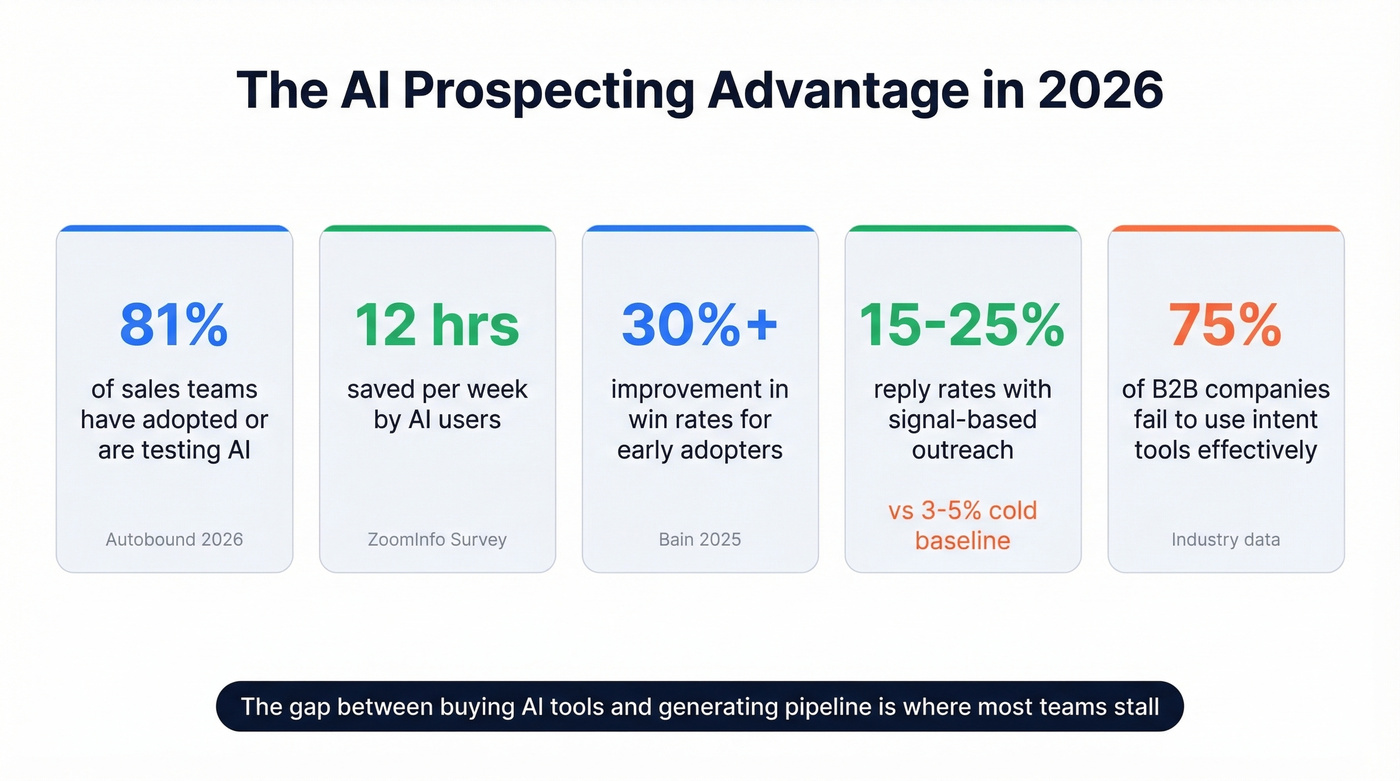
81% of sales teams have implemented or are experimenting with AI, and teams using it are 1.3x more likely to see revenue growth. Bain reports early AI adopters are seeing 30%+ improvement in win rates. Signal-driven teams also report 47% better conversion rates and 43% larger deal sizes. The AI SDR market alone is projected to hit $15B by 2030 at a 29.5% CAGR.
But adoption doesn't mean value. Only 25% of B2B companies actually use intent and signal tools effectively. The gap between "we bought an AI tool" and "AI is generating pipeline" is where most teams stall. The tools below close that gap.
How We Evaluated
We scored each tool across five criteria that predict whether a team will get ROI - not just whether the demo looks impressive.
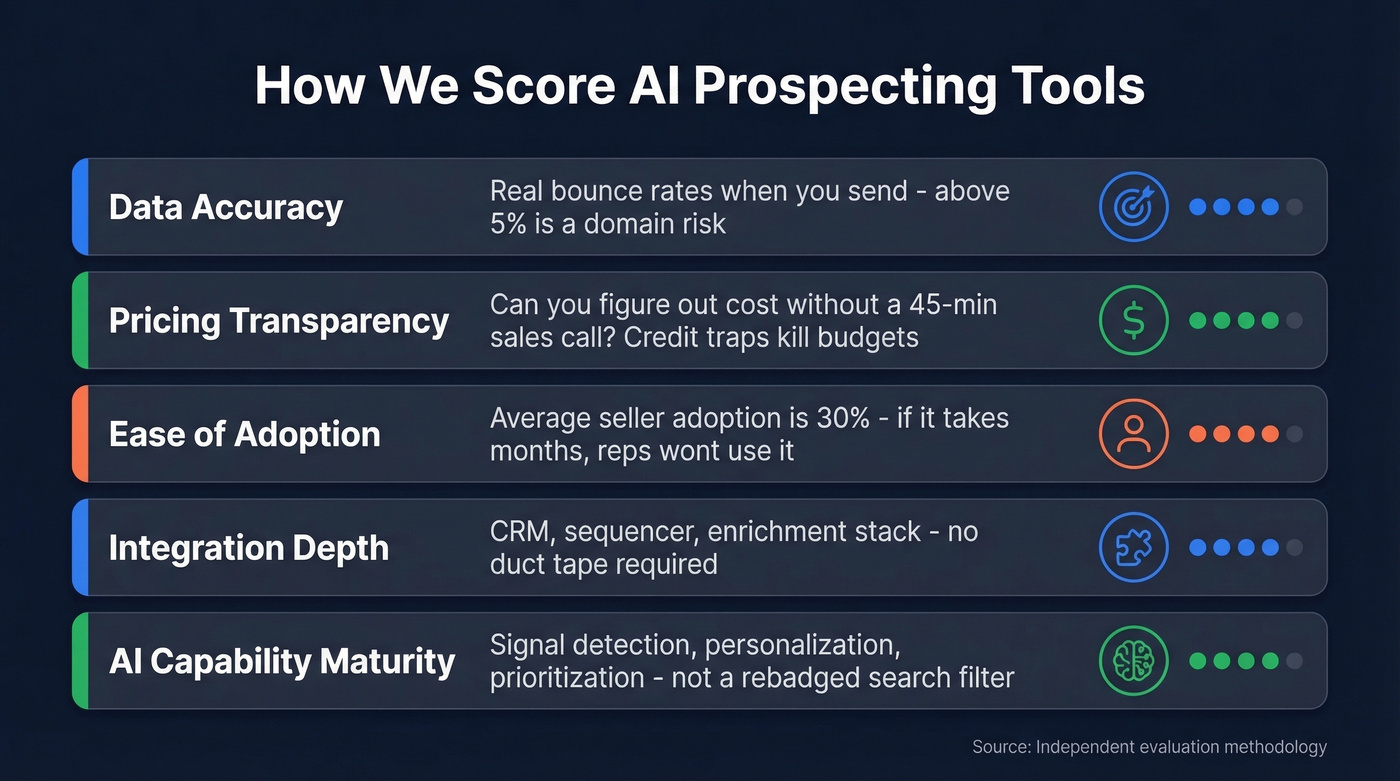
- Data accuracy - What's the real bounce rate when you send? Anything above 5% is a domain risk. (If you need a deeper breakdown, start with email verification.)
- Pricing transparency - Can you figure out what you'll pay without a 45-minute sales call? Credit traps and hidden overages kill budgets.
- Ease of adoption - The average seller adoption rate for sales tech is 30%. If a tool takes months to implement, most reps won't use it.
- Integration depth - Does it plug into your CRM, sequencer, and enrichment stack without duct tape? (More on CRM automation if you're rebuilding workflows.)
- AI capability maturity - Is the AI doing real work like signal detection, personalization, and prioritization, or is it a rebadged search filter?
The 10 Best AI Sales Prospecting Tools
| Tool | Best For | Starting Price | Email Accuracy | G2 Rating | Key Differentiator |
|---|---|---|---|---|---|
| Clay | Enrichment | $185/mo | Varies by source | 4.5/5 | 150+ data sources |
| Apollo.io | Free all-in-one | Free | 65-70% | 4.7/5 | Largest free tier |
| Instantly | Outbound sending | $30/mo | N/A (sender) | 4.8/5 | Built-in warmup |
| Cognism | EU/EMEA data | ~$1,000/mo | Phone-verified | 4.5/5 | GDPR-first mobiles |
| Lemlist | Multichannel | $39/mo | N/A (outreach) | 4.4/5 | Email + social + calls |
| Reply.io | AI SDR budget | $49/mo | N/A (outreach) | 4.6/5 | AI SDR "Jason" |
| Seamless.AI | Real-time search | ~$79/user/mo | ~85% | 4.2/5 | Real-time engine |
| Gong | Call intelligence | ~$1,200/user/yr | N/A | 4.7/5 | Deal intelligence |
| Outreach | Enterprise SEP | ~$100/user/mo | N/A | 4.3/5 | Workflow at scale |
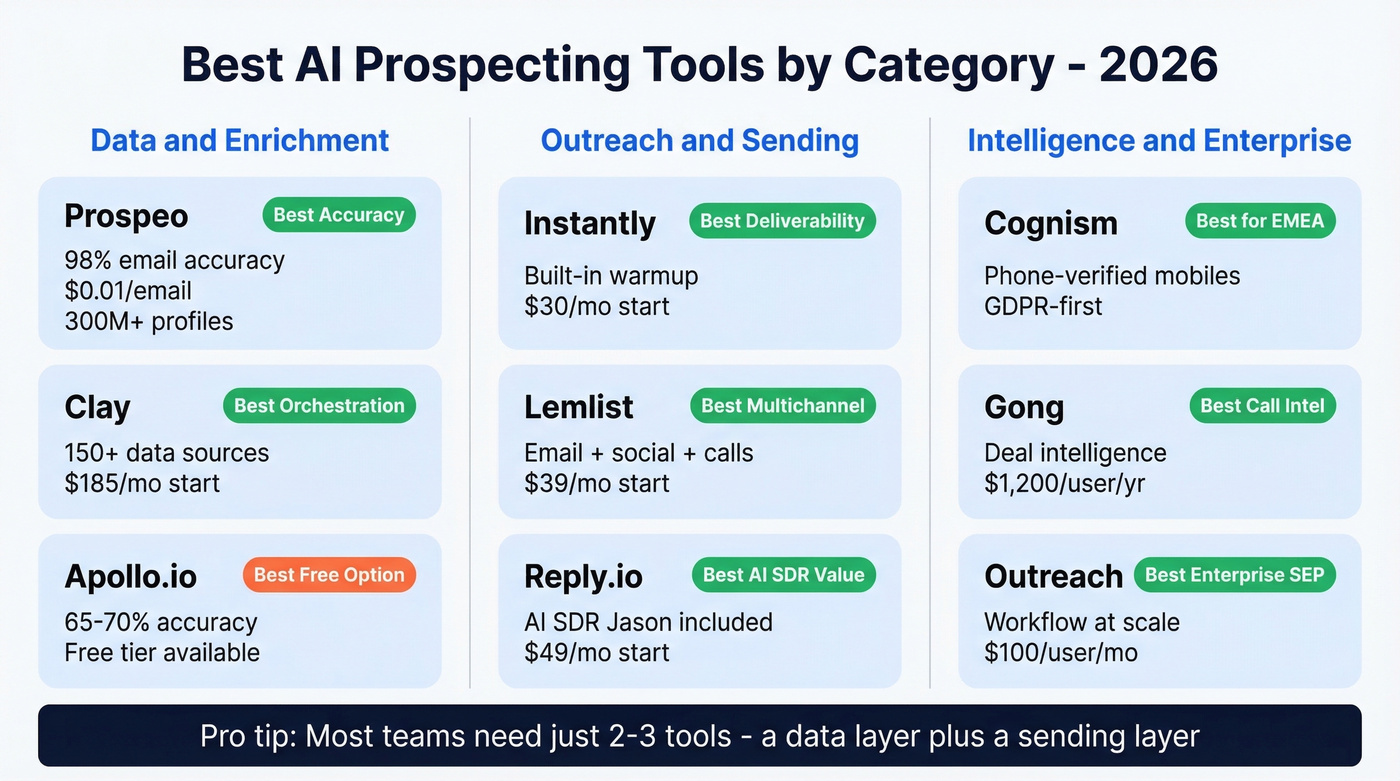
Here's the thing: if your average deal size sits below $10K, you probably don't need ZoomInfo-level data or an enterprise SEP. A verified data layer plus a good sending tool will outperform a $40K/year platform that half your reps never log into.
Prospeo
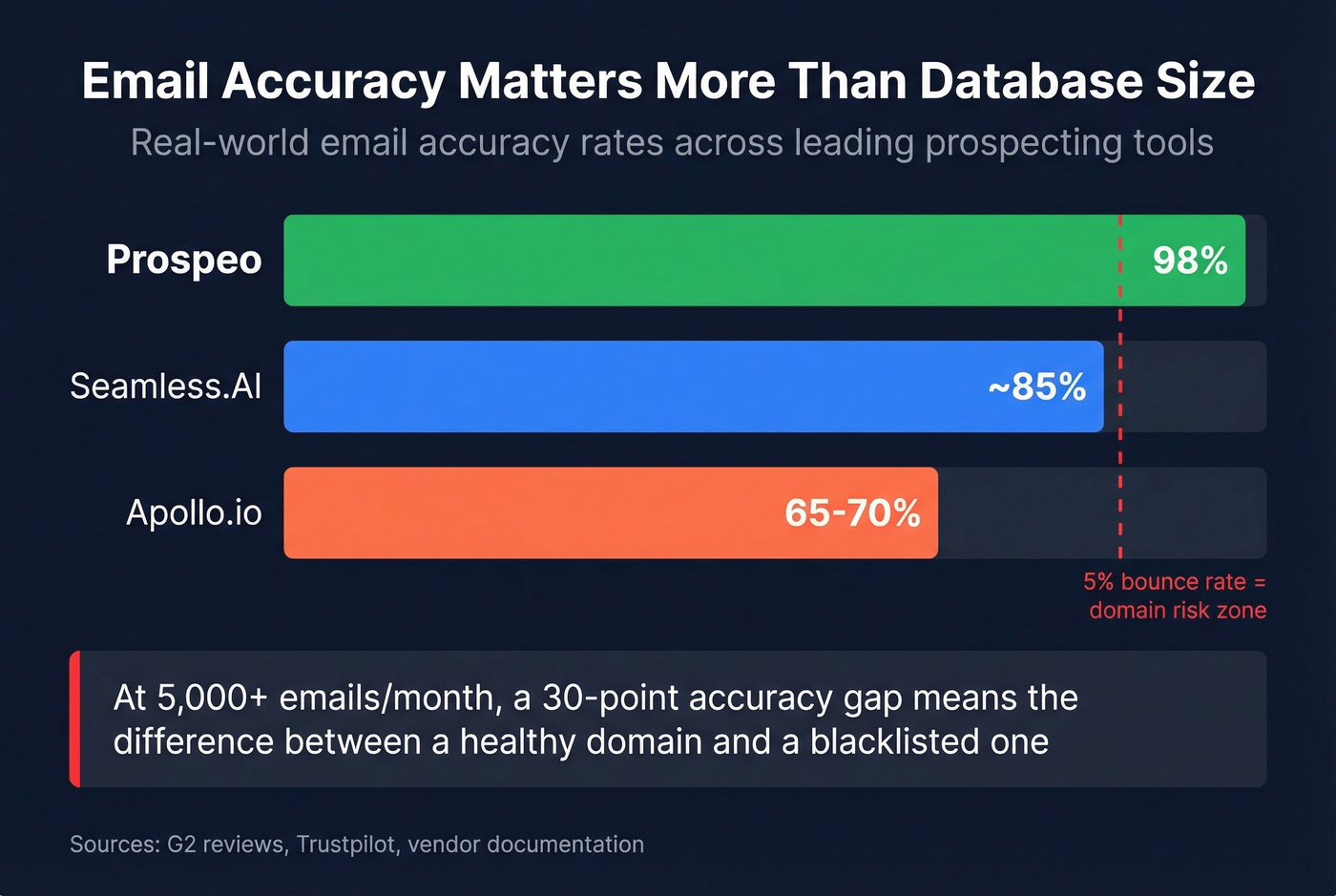
Prospeo's database covers 300M+ professional profiles - 143M+ verified emails and 125M+ verified mobile numbers - with 98% email accuracy that holds up in production, not just on a spec sheet. For context, Apollo's real-world accuracy runs 65-70%, and Seamless.AI sits around 85%. At scale, a 30-point accuracy difference means the difference between a healthy domain and a blacklisted one.

The mobile data is equally strong, with a 30% pickup rate on those 125M+ numbers. Every record refreshes on a 7-day cycle, compared to the 6-week industry average. Prospeo also layers in intent data across 15,000 topics powered by Bombora, so you're not just finding contacts - you're finding contacts actively researching solutions like yours.
Use this if you need a data foundation that won't burn your sending domains. At ~$0.01 per email with a free tier of 75 emails/month plus 100 Chrome extension credits/month, it's the obvious starting point before you layer on orchestration or outreach tools. Snyk's team of 50 AEs dropped their bounce rate from 35-40% to under 5% and saw AE-sourced pipeline jump 180% after switching. Stack Optimize built from $0 to $1M ARR with deliverability above 94% and zero domain flags across all clients.
Pair with a sequencer like Instantly or Lemlist for sending - Prospeo is the data layer, not the outreach layer. (If you're building a bigger list engine, compare options in our guide to B2B databases.)
Clay
Clay is the most powerful enrichment and orchestration tool on the market. It's also the hardest to adopt. If you've got a GTM engineer on staff (or you are one), Clay's ability to waterfall across 150+ data providers and build automated workflows is unmatched. If you're a team of AEs who just want to search and send, you'll hate it.
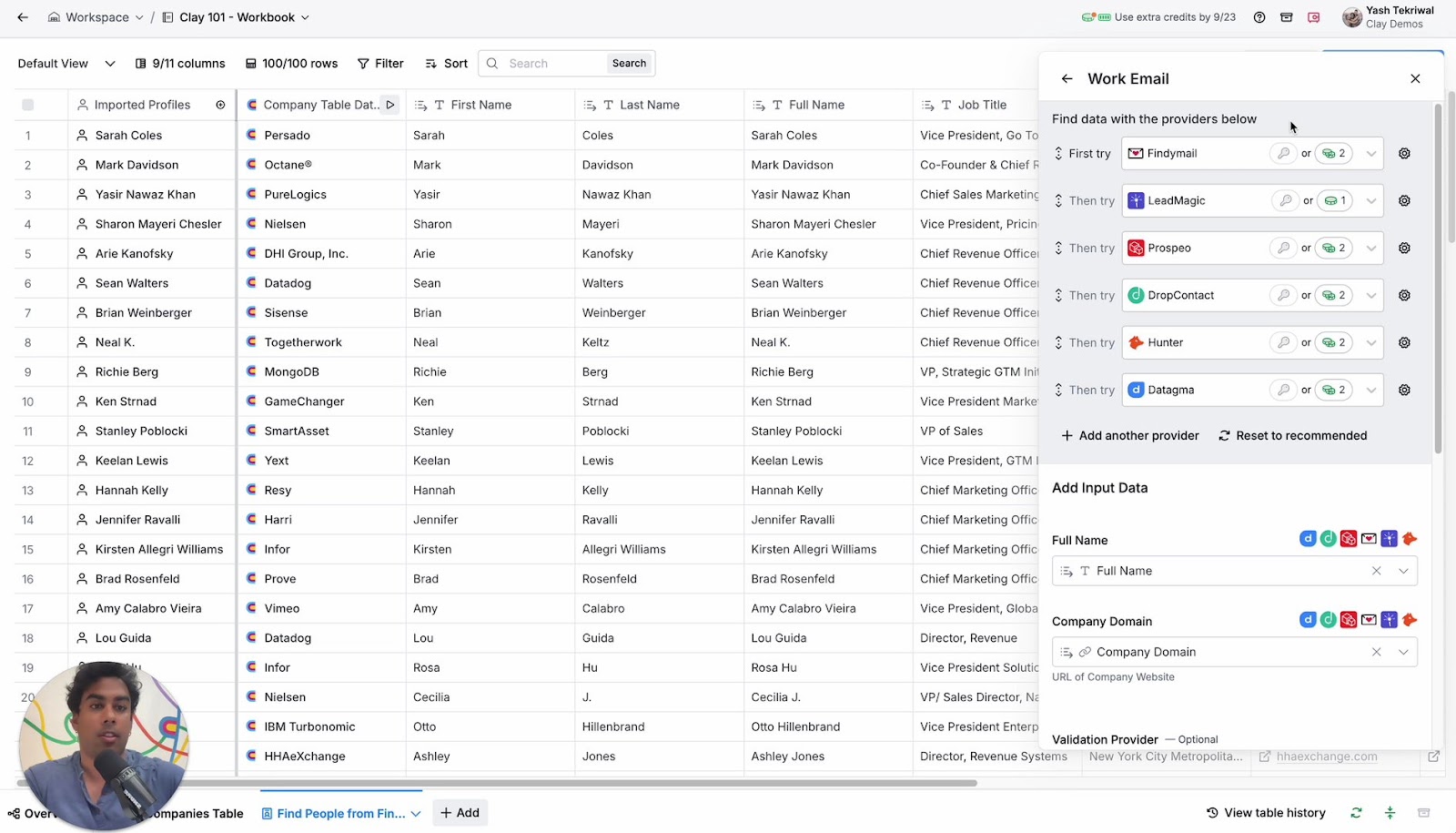
Clay overhauled its pricing on March 11, 2026. The new tiers are Launch at $185/mo and Growth at $495/mo, down from the old Pro plan at $800/mo. The catch: Clay now runs on a dual-currency model - Data Credits for enrichment and Actions for platform operations like AI calls, CRM pushes, and API requests. The no-result-no-charge policy is fair, though. If an enrichment returns nothing, you don't pay. Early reactions to the new model highlight 50-90% lower data costs, with the tradeoff that the dual-currency system adds a learning curve.
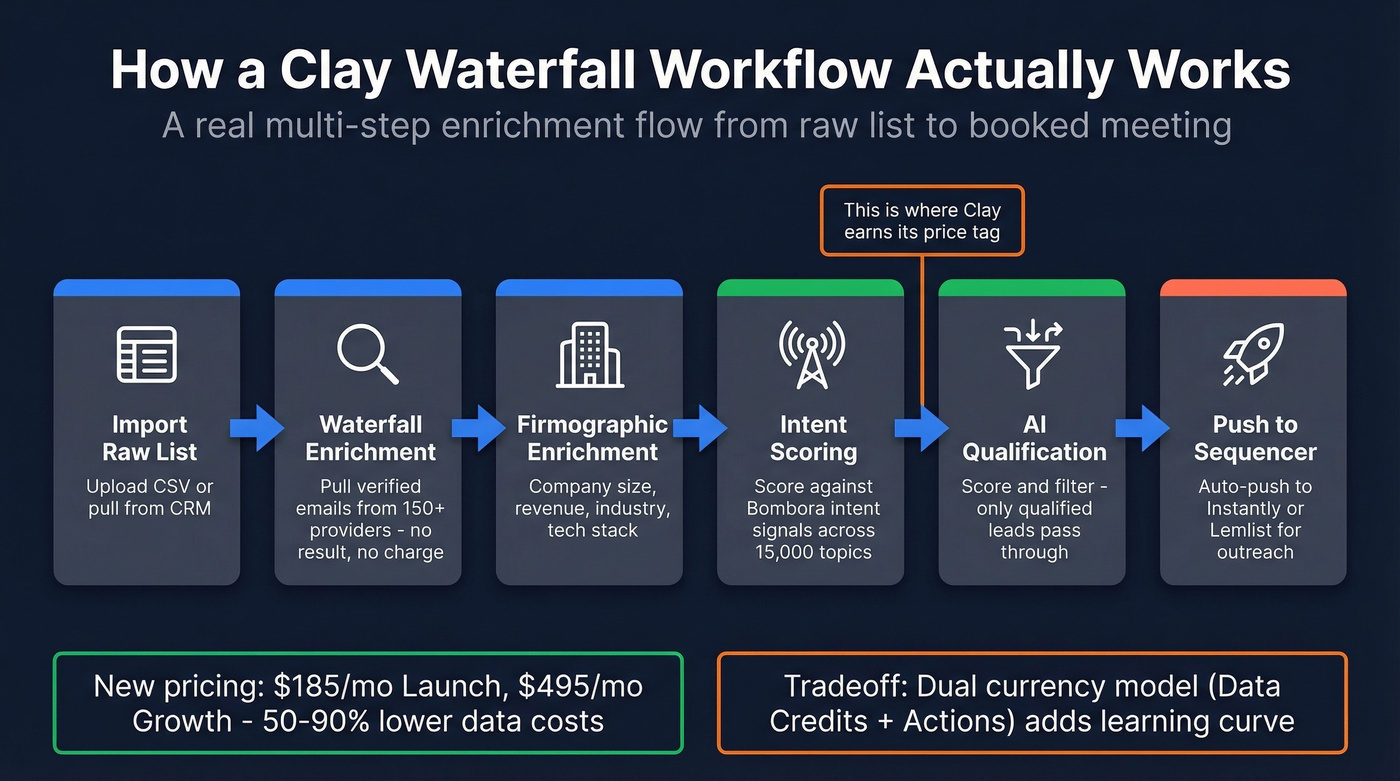
Let's walk through a concrete workflow that shows Clay's power: build a waterfall that pulls verified emails from your data provider, enriches with firmographic data, scores accounts against Bombora intent signals, then pushes qualified leads directly into Instantly for sequencing. That kind of multi-step automation is where Clay earns its price tag. (If you're comparing vendors, start with our roundup of data enrichment tools.)
Use this if you're building complex, multi-step enrichment workflows and want to pull from dozens of providers in a single waterfall. Skip this if you want plug-and-play simplicity - Clay's learning curve is real, and the 30% average adoption stat applies here more than anywhere.
Apollo.io
Apollo is the obvious starting point for budget-conscious teams who want everything in one platform. The free tier is generous - you get 10 export credits, 5 mobile credits, and 2 active sequences per billing cycle. That's enough to test whether outbound works for your business before spending a dollar.
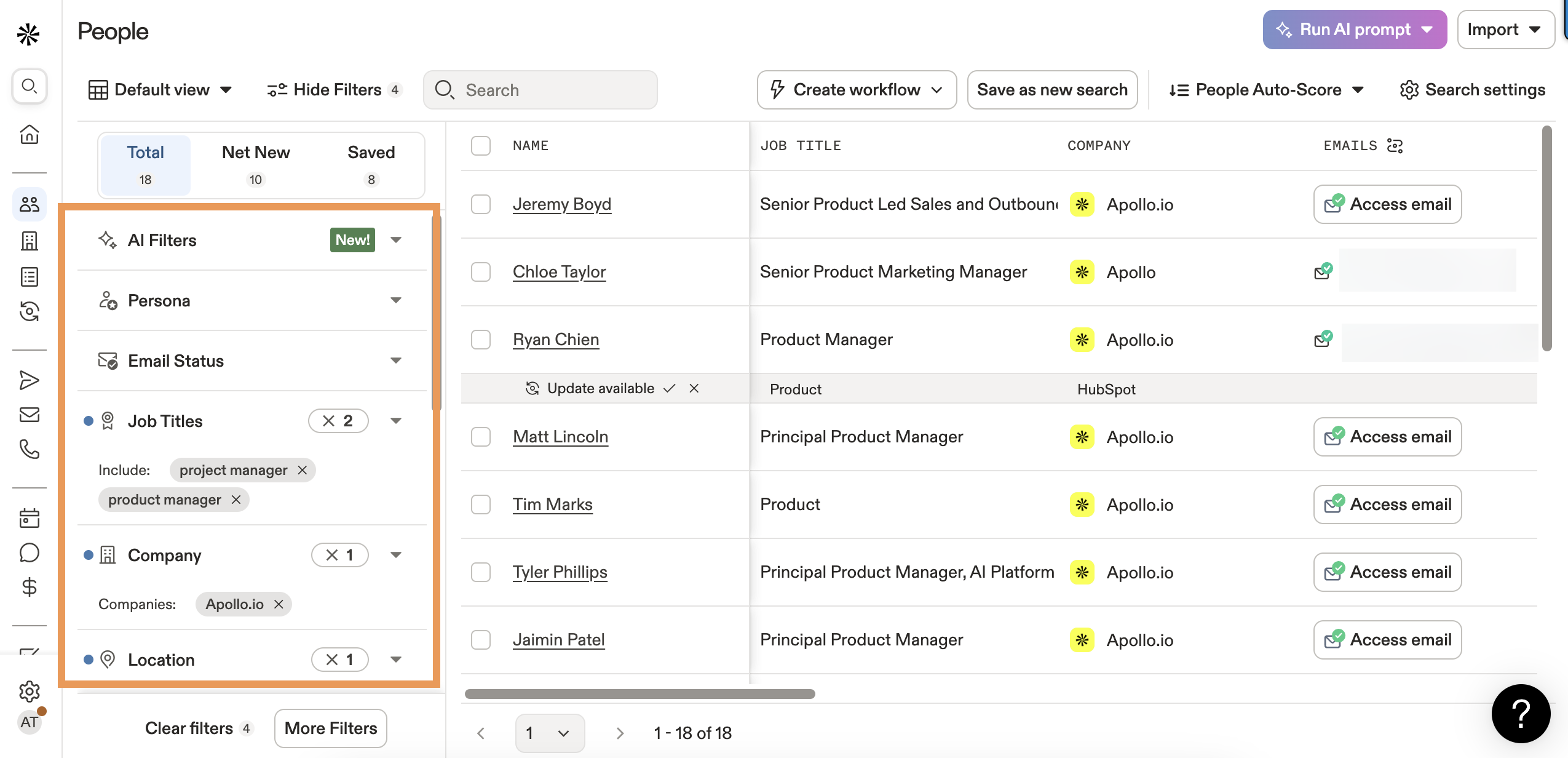
Paid tiers scale from Basic at $49/user/mo through Professional at $79/user/mo to Organization at $119/user/mo on annual billing. But watch the credit mechanics closely. Phone numbers cost 8x more than emails, overage credits run $0.20 each with a 250-credit minimum purchase, and credits expire every billing cycle. A team that burns through mobile credits mid-month is suddenly looking at a much bigger bill than expected.
And Apollo's real-world email accuracy runs 65-70%, with bounce rates between 15-25% reported across G2 and Trustpilot reviews. That's fine for small-volume testing. At 5,000+ emails per month, those bounce rates will damage your sender reputation. Best free tier in the category, but verify your lists before sending at any real volume.
Instantly
Instantly solves the problem Apollo doesn't touch - actually getting emails into inboxes. The built-in warmup and inbox rotation are the real product here, not the contact database. Growth starts at $30/mo, Hypergrowth at $77.60/mo. The Leads add-on tiers ($37.90-$169.30/mo) add lead-finding capabilities, but the sending infrastructure is what you're paying for.
Skip this if you need a database-first tool. Instantly is a sending engine, not a data provider. Pair it with a verified data source and you've got one of the strongest outbound stacks available. (If you're scaling sequences, see our picks for outbound email automation.)
Cognism
Where ZoomInfo wins on US depth and workflow breadth, Cognism wins on EMEA compliance and mobile verification - and it's not close. Their phone-verified mobile data across Europe is the best in the category, and the GDPR-first approach means you're not playing compliance roulette with EU prospects.
Use this if you're selling into Europe. Skip this if you're an SMB team selling domestically in the US. Custom pricing typically runs $1,000-3,000/mo, which is enterprise money for what's essentially a contact database. (If compliance is a gating factor, start with a GDPR compliant database checklist.)
Lemlist
Lemlist handles email, social touches, and calls in a single sequence - and the multichannel design is genuinely well-built, not just email with a social step bolted on. Email Starter runs $39/mo, Pro $69/mo, Multichannel Expert $99/mo, and Outreach Scale $159/mo.
Skip this if you already have a sequencer you love and just need data. Lemlist is an outreach tool, not a database. (For a broader system, use this multichannel sales outreach playbook.)
Reply.io
Reply.io's standout feature is Jason, their AI SDR that's included in paid tiers - not a $5,000/mo add-on. Sales Volume starts at $49/mo, Multichannel at $89/mo, and Agency at $166/mo. For teams that want to test the AI SDR concept without betting the budget, Reply.io is the most accessible entry point. Jason handles multichannel sequences, reply classification, and meeting booking autonomously.
Skip this if you need deep CRM integration or enterprise-grade reporting. Reply.io is built for velocity, not complexity.
Seamless.AI
Seamless.AI runs a real-time search engine model - it finds contact data on demand rather than serving from a static database. Email accuracy sits around 85%, which is decent. Phone accuracy is closer to 60%. Not great.
The bigger issue is pricing opacity. There's no public pricing page - you have to talk to sales. Pro is commonly quoted at ~$79/user/mo with 1,000 credits, Enterprise at ~$149/user/mo with a 5-user minimum. Extra credits run $49 per 500. The consensus on Reddit threads about Seamless is that credits burn faster than expected and there's no way to pause your subscription.
Use this if you need real-time US contact data and don't mind the sales call. Skip this if pricing transparency matters to you - the lack of published pricing tells you something about how they think about the buyer relationship.
Gong
Gong is conversation intelligence, not a prospecting database. At ~$1,200-1,600/user/year plus platform fees, it's an investment. But for teams that need call recording, deal intelligence, and coaching insights, it's the category leader with a 4.7/5 on G2.
Outreach
Outreach is the enterprise sales engagement platform. At ~$100-150/user/month with custom pricing, it's built for large teams running complex, multi-step workflows. The 30% average adoption stat hits hard here - Outreach is powerful but notoriously complex to roll out.

You just read that a 30-point accuracy gap separates a healthy domain from a blacklisted one. Prospeo delivers 98% verified email accuracy across 300M+ profiles, refreshed every 7 days - not 6 weeks. Snyk's 50 AEs dropped bounce rates from 35-40% to under 5% and grew pipeline 180%.
Stop evaluating tools that burn your domain. Start with data that actually connects.
Best Tool Combinations
You don't need 10 tools. You need two or three that work together. We've tested dozens of stack configurations, and the strongest AI prospecting setups shine when each layer handles a single job well.
| Stack | Tools | Best For | Est. Monthly Cost |
|---|---|---|---|
| Lean multichannel | Prospeo + Lemlist | Teams of 2-10 reps moving fast | $100-$250 |
| Budget all-in-one | Apollo + Gong | Low-volume teams prioritizing simplicity | $150-$250 |

Stack 1 is the one we recommend for teams serious about outbound. Verified data flows into Clay's enrichment waterfall, gets scored against intent signals, and lands in Instantly's deliverability-optimized sending infrastructure. Every layer does one thing well.
Stack 2 cuts the orchestration layer entirely. Verified contacts feed directly into Lemlist's multichannel sequences - email, social, and calls in one workflow. No engineering required.
Stack 3 trades data accuracy for simplicity and cost savings. Apollo handles prospecting and sequences, Gong provides conversation intelligence. Works if your volume is low enough that Apollo's bounce rates don't hurt you.
The best AI prospecting stack starts with a data layer you can trust. Prospeo gives you 143M+ verified emails, 125M+ mobile numbers with 30% pickup rates, and Bombora intent data across 15,000 topics - all at ~$0.01 per email. Pair it with Clay, Instantly, or Lemlist and you have an enterprise-grade stack without the enterprise invoice.
Build your AI prospecting stack on 98% accurate data for free.
AI SDRs - Worth It?
| Metric | Human SDR | AI SDR |
|---|---|---|
| Annual cost | $110K-$168K | $31K-$147K |
| Hours/day | 8 | 24 |
| Emails/day | 50-100 | 500-2,500+ |
| Meeting conversion | 25% | 15-20% |
| Show rate | 75-85% | 60-70% |
The cost savings are real. The conversion gap narrows when AI SDRs are paired with strong data - bad contact info amplifies the quality difference. AI SDRs like Artisan's Ava, Reply.io's Jason, and Salesforce's Agentforce can handle volume no human matches, but they still struggle with nuanced objection handling and strategic accounts.
The smart play is hybrid. Let AI SDRs handle top-of-funnel volume - initial outreach, follow-ups, meeting booking for lower-complexity deals. Keep human SDRs for strategic accounts and deals where a personal touch moves the needle.
How to Roll This Out
Run a data hygiene check first. Sample 100 accounts from your CRM. If fewer than 70 have a valid primary contact, current title, and working email, fix your data before buying any new tools. Automating on dirty data just scales your problems faster. (If you're seeing deliverability issues, start with how to check domain reputation.)
Pick two or three tools max. The 49% of sellers who feel overwhelmed by tools aren't wrong - they're over-tooled. One data layer, one outreach layer, and optionally one orchestration layer. That's it.
Pilot with willing adopters. Find 3-5 reps who are excited about the tool and let them prove the workflow. In our experience, account research time drops dramatically with the right AI tooling - Analytic Partners found an 85% reduction, from 3 hours to 15 minutes per account. Those kinds of results become your internal case study.
Gate expansion at 70% adoption. Before scaling org-wide, make sure 70% of your pilot reps are using the tool at least 3x per week. If you can't hit that threshold with enthusiastic early adopters, the tool won't survive a full rollout.
Mistakes That Kill Prospecting ROI
Automating on dirty data. 30-40% of CRM data goes stale every year. If you're feeding AI tools contacts with outdated titles, dead emails, and wrong phone numbers, you're burning through credits and domain reputation simultaneously. Clean the data first - or use a provider with a weekly refresh cycle so the data stays clean.
Letting AI write entire emails. AI-generated personalization works for opening hooks - a relevant trigger, a specific pain point, a timely reference. It doesn't work for writing the full email. The moment a prospect senses the entire message was machine-generated, trust evaporates. Use AI for the first line and the research. Write the ask yourself. (If you want a framework, see AI email personalization.)
Tone-deaf automation at scale. Look, if your AI SDR sends a cheerful prospecting email to a company that just announced layoffs, you've done more damage than if you'd never reached out. Build signal-based suppression rules. Monitor the news. The speed of AI makes this kind of mistake more likely, not less.
FAQ
What's the most important feature in an AI prospecting tool?
Data accuracy. AI personalization and automation are worthless if 20% of your emails bounce and your domain lands on a blacklist. Look for providers with verified email accuracy above 95% and a data refresh cycle measured in days, not weeks.
How much do AI prospecting tools cost?
Most mid-market teams spend $200-$800/month across two or three tools. Pricing ranges from free (Apollo, Prospeo) to $40,000+/year for enterprise platforms like ZoomInfo. A verified data layer plus an outreach tool builds a strong stack for under $300/month.
Can AI fully replace human SDRs?
Not yet. AI SDRs convert meetings at 15-20% versus 25% for humans, and show rates run 10-15 points lower. The best approach is hybrid: AI handles volume and initial outreach, humans handle strategic accounts and complex objections.
How do I avoid burning my domain with AI outreach?
Start with verified data - 98% accuracy eliminates most bounces before they happen. Warm up sending domains for at least two weeks before scaling volume. Keep daily sends under 50 per inbox and monitor bounce rates weekly. If they creep above 3%, pause and investigate.
What's a good free alternative to expensive sales data platforms?
Prospeo's free tier (75 emails/month + 100 Chrome extension credits/month) delivers 98% email accuracy at no cost - stronger verification than many paid tools. Apollo's free plan offers broader features but lower accuracy at 65-70%. For teams testing outbound before committing budget, either works as a starting point, though we'd recommend verifying Apollo lists through a separate tool before sending at volume.