

Best Cold Email Software in 2026 (8 Tools Tested)
Gmail started rejecting non-compliant emails at the SMTP level in late 2025. Outlook retired Basic Auth. DMARC enforcement tightened across the board. Teams pulling 4% reply rates watched those numbers crater below 1% overnight - and most didn't see it coming.
We tested eight tools to find the best cold email software that actually works now, which ones deserve your money, and the two-tool stack that'll outperform teams spending 5x more.
Our Top Picks
| Pick | Tool | Best For | Starting Price |
|---|---|---|---|
| 🥇 Data layer | Prospeo | Email accuracy & verification | Free (75 emails/mo) |
| 🥈 Sequencer (volume) | Instantly | Scale + warmup | $37/mo |
| 🥉 Sequencer (agencies) | Smartlead | Multi-client scaling | ~$32.50/mo |
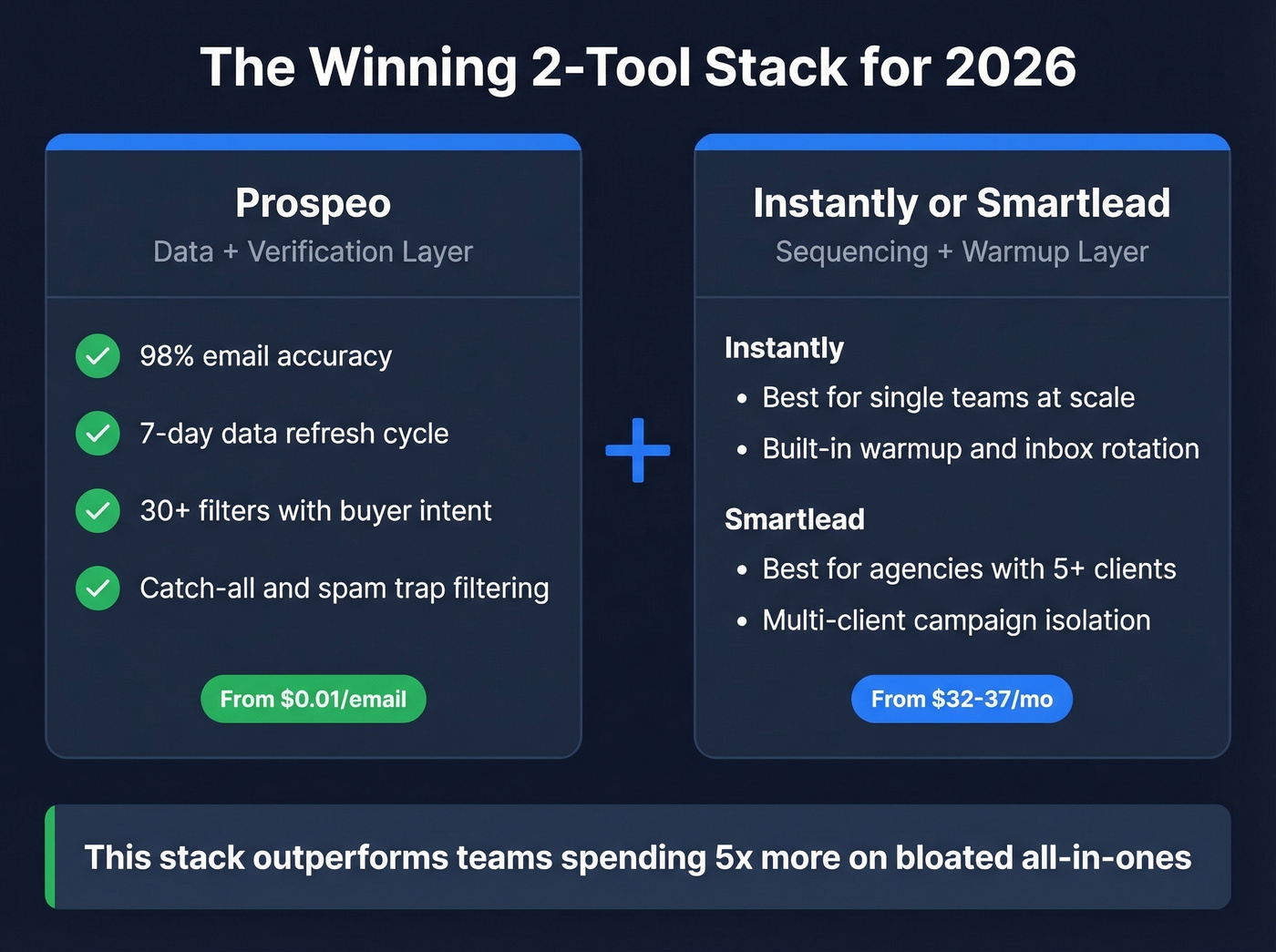
Build a two-tool stack - Prospeo for data, Instantly or Smartlead for sequencing - and you'll outperform teams spending 5x more on bloated all-in-ones.
The Cold Email Stack
One tool isn't enough anymore. Cold email at scale runs on five layers, and confusing them is how stacks break. The consensus on r/coldemail is clear: treat these as distinct problems.
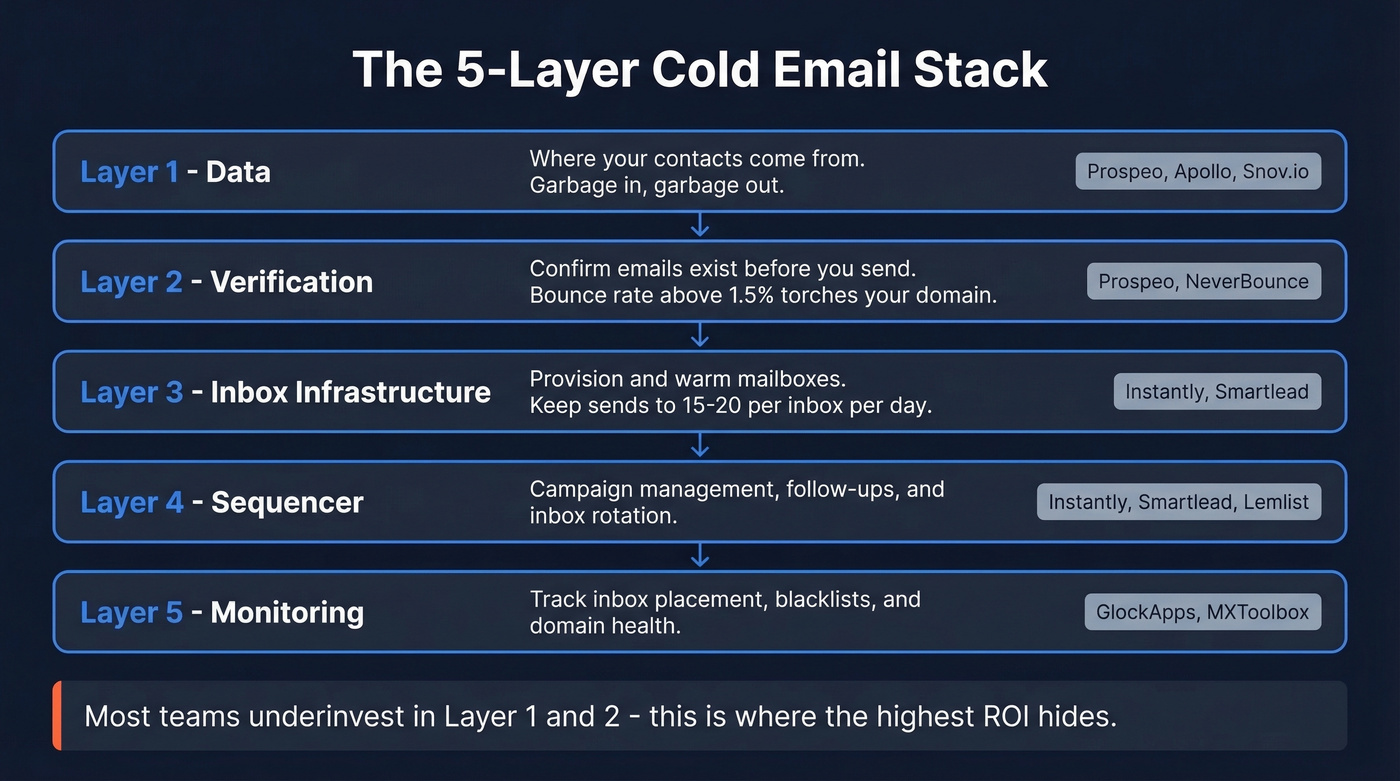
Layer 1 - Data. Where your contacts come from. Garbage in, garbage out.
Layer 2 - Verification. Confirming emails exist before you send. A bounce rate above 1.5% torches your domain.
Layer 3 - Inbox infrastructure. Provisioning and warming mailboxes. Keep sends to 15-20 per inbox per day.
Layer 4 - Sequencer. Campaign management, follow-ups, and inbox rotation.
Layer 5 - Monitoring. Tracking inbox placement, blacklists, and domain health.
In our testing, the data layer is where most teams underinvest - and where the highest ROI hides. That insight shaped every recommendation below.
2026 Benchmarks
Two major datasets set realistic expectations.
| Metric | Instantly (2026) | Belkins (16.5M emails) |
|---|---|---|
| Avg reply rate | 3.43% | 5.8% |
| Top quartile | 5.5%+ | - |
| Top 10% (elite) | 10.7%+ | - |
| Best sequence length | 4-7 touches | 1-2 contacts/co = 7.8% reply |
| Replies from step 1 | 58% | - |
Average is 3.4-5.8%. Top performers hit 10%+. The biggest variable isn't your sequencer - it's targeting, data quality, and copy. First emails under 80 words consistently outperform longer ones, Tuesday-Wednesday is the send-timing sweet spot, and targeting just 1-2 contacts per company yields 7.8% reply rates versus 3.8% when you blast 10+.

The benchmarks are clear: data quality is the #1 variable separating 3.4% reply rates from 10%+. Prospeo's 98% email accuracy and 7-day refresh cycle mean every contact you push to Instantly or Smartlead is verified, current, and safe for your domain.
Stop burning domains on stale data. Fix your data layer first.
Cold Email Outreach Tools Reviewed
Prospeo - Best for Data & Verification
Every sequencer on this list sends emails. None of them guarantee those emails are valid. That's Prospeo's job.
The numbers: 98% email accuracy across 143M+ verified emails, with a 5-step verification process that handles catch-all domains, strips spam traps, and filters honeypots. Where most providers refresh on a 6-week cycle, Prospeo refreshes every 7 days. It's a meaningful gap when you're sending thousands of emails per week and stale data means bounces.

The search interface gives you 30+ filters including buyer intent via Bombora across 15,000 topics, technographics, job changes, and funding signals. Find your ICP, export verified contacts, and push them directly to Instantly, Smartlead, or Lemlist through native integrations. Stack Optimize used Prospeo to build from $0 to $1M ARR - maintaining 94%+ deliverability, under 3% bounce, and zero domain flags across all clients. Pricing runs ~$0.01 per email on paid plans, with a free tier of 75 verified emails per month. For teams whose domain reputation has been wrecked by bad data from other providers, the verification layer alone pays for itself.
Instantly - Best for Volume & Warmup
Instantly is the sequencer most cold email operators reach for first. Unlimited email accounts, built-in warmup, and inbox rotation that works at scale.
The $37/mo headline is real but misleading. That Outreach Growth plan gives you 1,000 contacts and 5,000 emails - enough to test, not enough to run a real operation. Most teams land on Hypergrowth at $97/mo for 25K contacts and 100K emails. Add the Leads product ($47/mo) and CRM ($47/mo), and you're at $191/mo for the full Instantly suite.
The three-product split means juggling separate billing and navigation - not a dealbreaker, but noticeable friction when you're managing multiple campaigns. Reddit consistently praises Instantly for scale and warmup infrastructure. It's the best pure sequencer if you already have clean, verified data.
Smartlead - Best for Agencies
If you're managing campaigns for multiple clients, Smartlead is purpose-built for your workflow. Multi-client inbox rotation, per-client campaign isolation, and infrastructure designed for operators running 10+ accounts simultaneously.
Use this if: You're an agency managing 5+ client campaigns and need clean separation between accounts.
Skip this if: You're a single-company sales team. Instantly's simpler UX will serve you better.
The agency panel is powerful but the learning curve is steeper than Instantly's - budget a day for onboarding. Pricing starts at ~$32.50/mo on the Basic plan billed annually, Pro at ~$78/mo, with the agency add-on at $29/client/month. SmartReach (~$29/mo) is a viable alternative if you need time-zone-based sending and in-platform domain purchasing, but Smartlead's multi-client architecture wins for agencies managing 5+ accounts.
Saleshandy - Best Budget All-in-One
Saleshandy is the tool you pick when you want one login, one bill, and unlimited email senders without per-seat math ruining your budget. Outreach Starter runs $25/mo on annual billing, Pro $69/mo, Scale $139/mo. The unlimited senders angle is the real differentiator - most competitors charge per mailbox, which punishes teams that scale properly with multiple sending accounts. Good for teams under 50K emails/month. Past that, you'll outgrow the deliverability infrastructure.
Lemlist - Best for Personalization
Lemlist's image and video personalization is genuinely unique - dynamic images with prospect names, company logos, and custom variables embedded in the email. No other sequencer does this as well.
Here's the thing: the cost math is where it gets painful. Email Pro starts at $79/mo, but add extra senders ($9/mo each), deliverability protection ($20/mo/user), and domains ($4-8/mo each). A 5-person team often lands around $450-600/mo once you layer in the add-ons. Unless image personalization measurably lifts your reply rates, Instantly at $97/mo does the core job for a fraction of the price.
Apollo - Best for Prospecting + Outreach
Apollo's database is excellent - 275M+ contacts with solid filtering. The free plan with 100 credits/mo is generous enough to test. Paid plans start at $59/user/mo, and the Organization plan is $149/user/mo with a minimum of 3 seats.
Let's be honest about what Apollo actually is: a prospecting database that happens to have a sequencer bolted on. It removed its warmup feature in 2024, replacing it with "Inbox Ramp Up" - volume pacing without the engagement-building that protects sender reputation. Don't confuse it for a dedicated cold email tool. Use Apollo for finding contacts, then run them through verification and a real sequencer for sending.
Woodpecker - Best for Simplicity
Woodpecker's "contacted prospects" pricing model is refreshingly fair - you pay based on unique prospects contacted, not emails sent or seats used. Unlimited team members, 4 free warmups, catch-all verification included. The LinkedIn add-on runs $29/mo per account. Best for small teams who want straightforward pricing without surprises.
Reply.io - Best for Multichannel
Powerful multichannel capabilities spanning email, calls, social, and SMS - but expensive at scale. Email Volume runs $49/user/mo, Multichannel $89/user/mo, AI SDR $139/user/mo. A 10-person team on Multichannel hits $890/mo. The AI SDR tier rarely justifies the premium over a well-built sequence in Instantly.
We also evaluated GMass, Snov.io, Klenty, and Mailshake - none made the cut. GMass is Gmail-only, and Mailshake doesn't offer a free trial.
Real Cost for a 5-Person Team
The gap between "starting price" and what you'll actually pay is where most teams get burned. Across every tool we tested, add-ons - not base pricing - are the real budget killer.
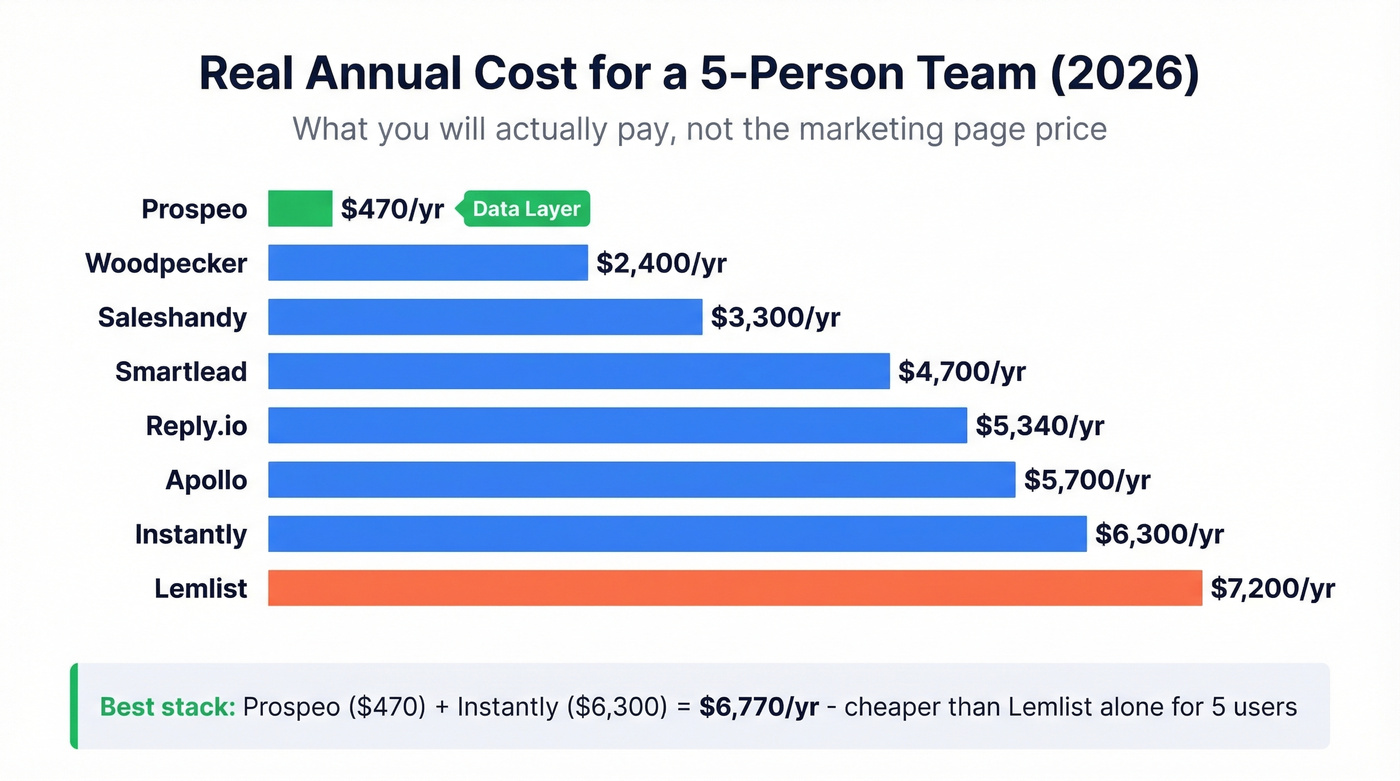
| Tool | Entry Price | Realistic 5-Person Annual | Included | Extra Cost |
|---|---|---|---|---|
| Prospeo (data) | Free | ~$470/yr | 75 free/mo; ~$0.01/email paid | Mobiles: 10 credits each |
| Instantly | $37/mo | ~$6,300/yr | Outreach + Leads + CRM | Enterprise features |
| Smartlead | ~$32.50/mo | ~$4,700/yr | Pro + SmartProspect | Agency add-ons |
| Saleshandy | $25/mo | ~$3,300/yr | Pro, unlimited senders | Scale features |
| Lemlist | $79/mo | ~$7,200/yr | Email Pro x 5 users | Senders, deliverability |
| Apollo | $59/user/mo | ~$5,700/yr | Paid plan x 5 seats | Intent, enrichment |
| Woodpecker | Varies | ~$2,400/yr | Contacted-prospect model | Agency panel |
| Reply.io | $49/user/mo | ~$5,340/yr | Multichannel x 5 seats | AI SDR upgrade |
The cheapest line item in your stack should be data verification. At ~$0.01/email, it costs less per month than a single bounced-email domain recovery.
Stack Optimize built a $1M agency on Prospeo data - 94%+ deliverability, under 3% bounce, zero domain flags. At $0.01 per verified email with native integrations to Instantly, Smartlead, and Lemlist, it's the data layer that makes your sequencer actually perform.
75 free verified emails per month. No credit card, no sales call.
Sequence Tips That Actually Move Numbers
We've seen teams obsess over tool selection and ignore the fundamentals that drive reply rates. Don't be that team.
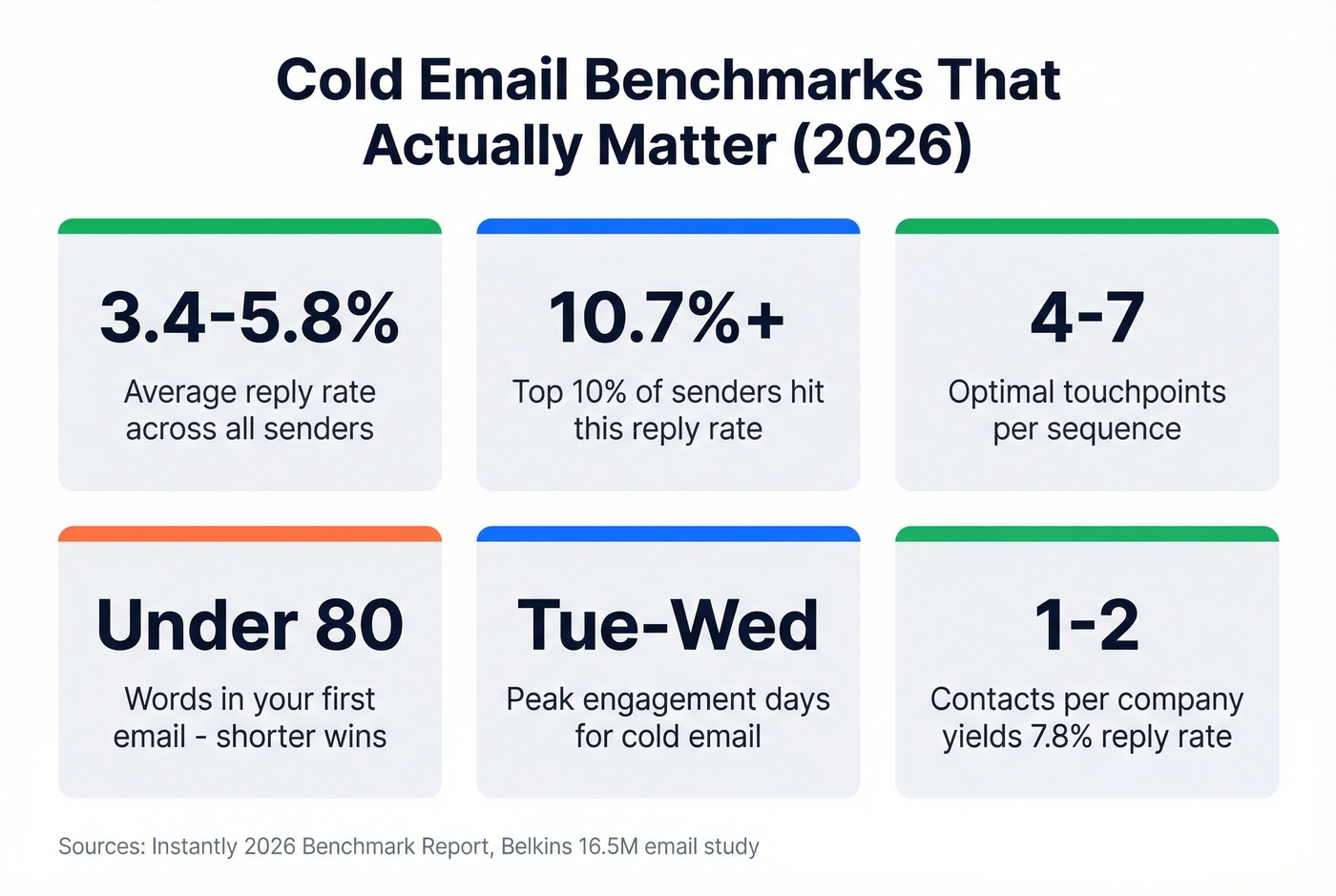
4-7 touchpoints. The first follow-up lifts replies up to 49%, but by the 4th, spam complaints triple. Find the sweet spot for your audience and stop there.
Under 80 words for your first email. Instantly's benchmark data is definitive on this - shorter emails win, period.
Tuesday-Wednesday for peak engagement. Mondays are inbox-clearing days and Fridays are checkout days. The middle of the week is where attention lives. (If you want the deeper breakdown, see our guide on the best time to send cold emails.)
One hyperlink max. Plain text, minimal signature. Banners, logos, and HTML formatting are spam filter triggers that'll tank your placement before a human ever reads your message. (If you're troubleshooting, start with an email deliverability guide and a quick spam checker.)
15-20 emails per inbox per day. Scale by adding warmed inboxes, not cranking volume on a single account. (More detail: email velocity limits and safe ramping.)
Run warmup continuously - not just during initial setup. Gmail weights engagement quality signals like time-to-read and reply depth, so stopping warmup after launch is like canceling your gym membership after one good week. (If you're comparing options, see unlimited email warmup tools.)
FAQ
How much does cold email software cost?
A 5-person team spends $2,400-$7,200/yr depending on the tool. Add ~$470/yr for data verification. The real cost driver is add-ons - extra senders, deliverability protection, and CRM access - not base pricing.
Do I need separate tools for data and sequencing?
Yes. Your sequencer sends emails - it doesn't guarantee they're valid. A dedicated verification layer prevents the bounces that burn your sending domain. Teams that skip verification consistently see bounce rates above 5%, which triggers blacklisting.
How many emails per day can I send per inbox?
15-20 per inbox per day is the safe ceiling in 2026. Scale by adding warmed inboxes with proper SPF/DKIM/DMARC, not by blasting higher volume from one account. Most operators running 50K+ emails monthly use 20-30 rotating inboxes.
What's the best free cold email tool to start with?
No single free tool covers the full stack. Prospeo's free tier handles data and verification with 75 emails/month, while Instantly's trial lets you test sequencing. Pair both to validate your ICP and messaging before committing to paid plans.