

The Best Email Outbound Tools in 2026 - And How to Stack Them
You've spent three hours comparing Instantly vs Smartlead and you're missing the point. Finding the right email outbound tools isn't about picking the flashiest sequencer - the sequencer is the last 20% of the problem. Data quality is the other 80%, and it's where most campaigns quietly die before they start.
Our Top Picks at a Glance
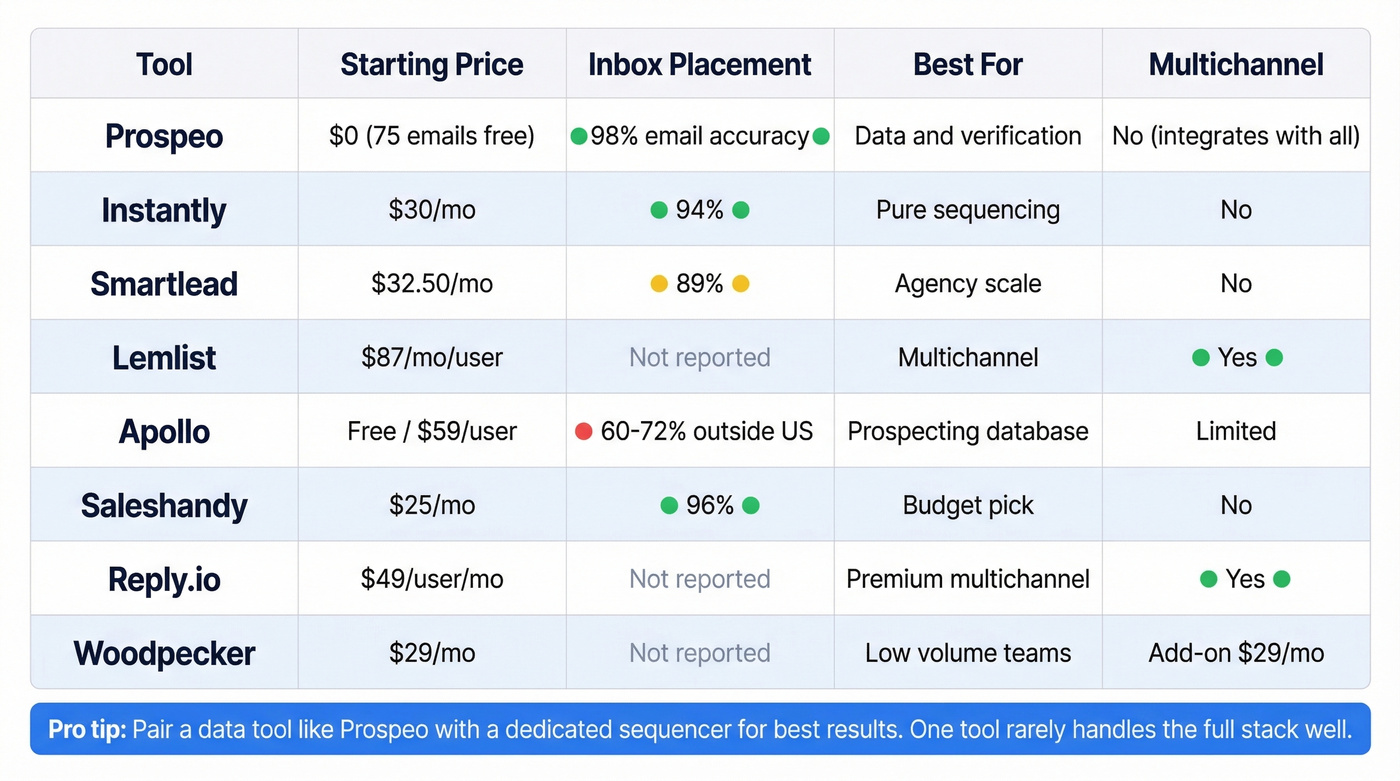
| Tool | Best For | Starting Price | Key Strength |
|---|---|---|---|
| Prospeo | Email accuracy & data | Free (75 emails/mo) | 98% email accuracy |
| Instantly | Pure sequencing | $30/mo (annual) | 94% inbox placement |
| Smartlead | Agency scale | $32.50/mo (annual) | Unlimited client accounts |
| Lemlist | Multichannel | $87/mo/user (annual) | LinkedIn + email in one |
| Apollo | Data + sequencing | Free; paid from $59/user/mo | 210M+ contacts |
| Saleshandy | Budget sequencing | $25/mo (annual) | 96% inbox placement |
| Reply.io | Premium multichannel | $49/user/mo (annual) | Email + LinkedIn + calls |
| Woodpecker | Low-volume teams | From $29/mo (usage-based) | Predictable costs |
The Stack Framework
Cold email runs on four layers. Conflating them is why campaigns underperform.
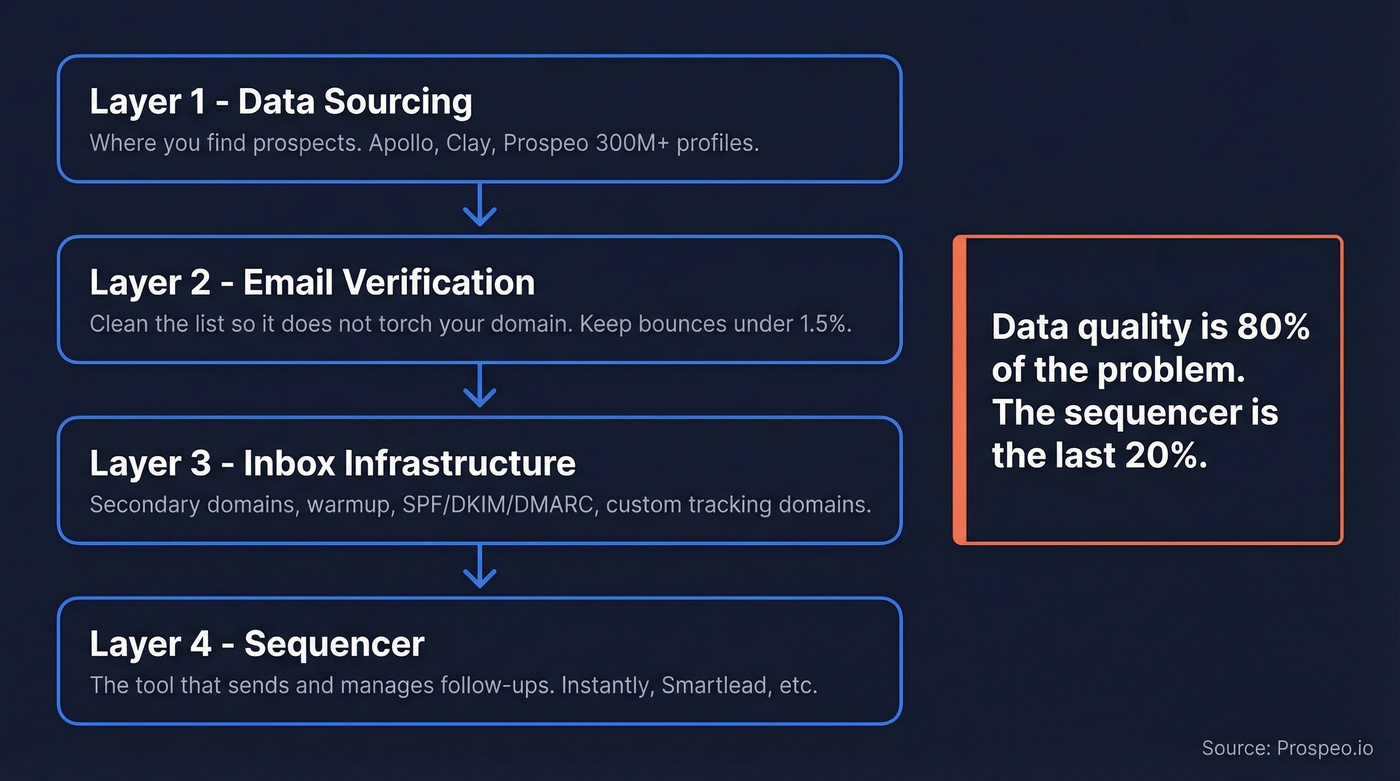
Layer 1 - Data sourcing. Where you find prospects (Apollo, Clay for waterfall enrichment, Prospeo's 300M+ profile database).
Layer 2 - Email verification. Where you clean the list so it doesn't torch your domain (more on email verification tools if you need options).
Layer 3 - Inbox infrastructure. Secondary domains, warmup, SPF/DKIM/DMARC, custom tracking domains via CNAME.
Layer 4 - Sequencer. The tool that actually sends and manages follow-ups (i.e., sequence management at scale).
Here's the math: 10,000 contacts with a 2% bounce rate means 200 hard bounces. That's enough to damage your sender reputation in a single campaign. Anything above 1.5% is a red flag. The consensus on r/coldemail backs this up - success comes from building a layered stack, not expecting one tool to do everything.
One more thing: AI SDR products like Reply.io's Agent, Lindy, and Agent Frank are emerging, but they start around $300-$500/mo and aren't mature enough to replace a well-built stack. Nail the fundamentals first.

You just read the math: anything above a 1.5% bounce rate is a red flag. Prospeo's 98% email accuracy and 7-day data refresh keep bounce rates under 3% - even at scale. Stack Optimize built a $1M agency on it. At $0.01 per lead with no contracts, it's the cheapest insurance your outbound stack can buy.
Fix the 80% that actually kills campaigns - start with better data.
Detailed Tool Breakdown
Prospeo - Best for Email Accuracy
We've tested a lot of data providers over the years, and the accuracy gap is real. Prospeo covers 300M+ professional profiles with 98% email accuracy and a 7-day data refresh cycle. The industry average refresh is six weeks - meaning most databases serve you contacts who've already changed jobs by the time you hit send. (If you're comparing vendors, see our breakdown of B2B company data providers.)
The database includes 143M+ verified emails and 125M+ verified mobile numbers. Search filters run 30+ deep, covering buyer intent powered by Bombora across 15,000 topics, technographics, job changes, headcount growth, and funding signals. The verification infrastructure is proprietary - Prospeo doesn't rely on third-party email providers, which is why the accuracy numbers hold up at scale. One customer, Stack Optimize, built from $0 to $1M ARR while maintaining 94%+ deliverability and sub-3% bounce rates across all their clients' campaigns.
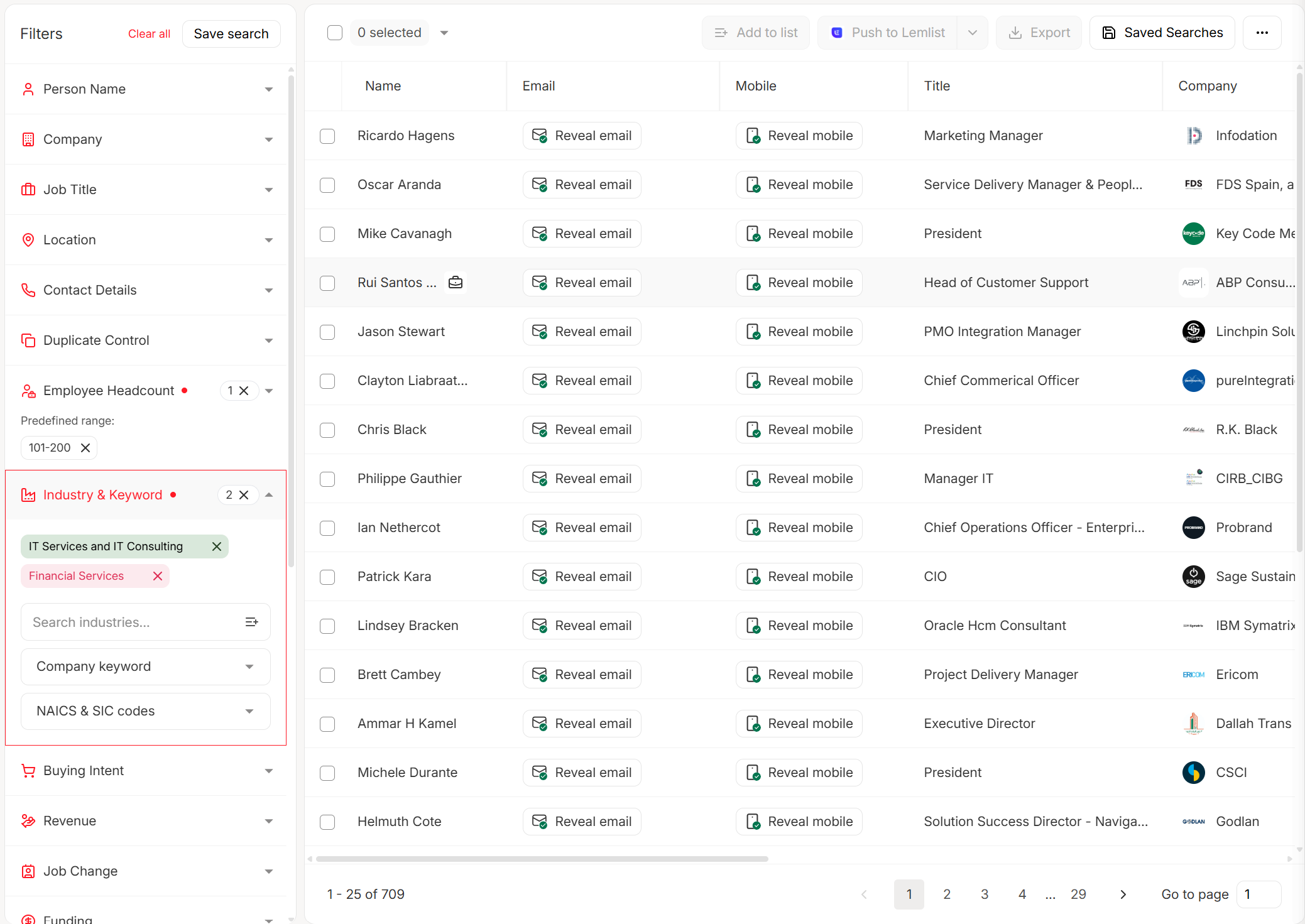
Native integrations push verified contacts directly into Instantly, Smartlead, Lemlist, Salesforce, HubSpot, Clay, Zapier, and Make. Pricing starts free at 75 emails/month, with paid plans running roughly $0.01 per lead and no contracts. GDPR and CCPA compliant out of the box.
Use it if you want your sequencer campaigns to actually land in inboxes. Skip it if you already have a verified, fresh contact list - though let's be honest, you probably don't.
Instantly - Best Sequencer for Most Teams
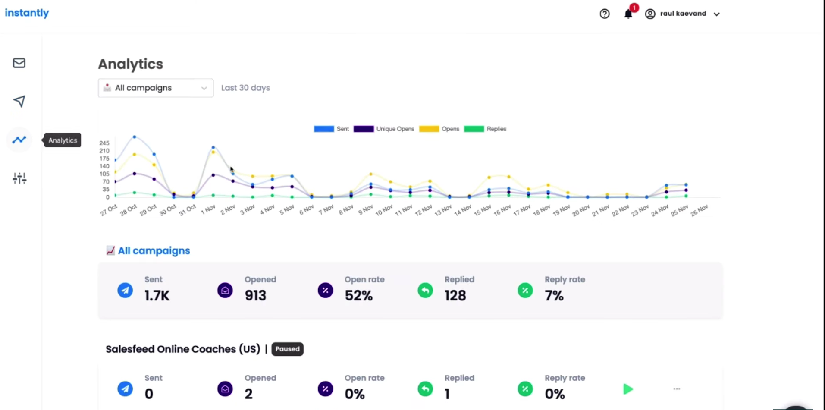
Instantly earned its reputation on deliverability. Based on data from 8M+ emails across 200+ campaigns, it hits 94% inbox placement with sender rotation across unlimited email accounts. That's the headline.
The fine print is pricing. The Outreach plan starts at $30/mo on annual billing - but that's just sending. Need their leads database? Another $47/mo. Want the CRM? Another $47/mo. A full Instantly stack runs $122+/mo before you've paid for a single contact from an external source. Most replies (58%) come from the first email, but follow-ups still drive 42% of total responses, so build at least a 3-step sequence (or use a proven B2B cold email sequence structure).
Use it if you want the best deliverability in a pure sequencer. Skip it if you need multichannel in one tool.
Smartlead - The Agency Workhorse
The G2 reviews tell the story: 4.6/5 across 306 reviews, with users praising ease of use and deliverability. The complaints? Slow customer support, consistently. If you can live with that tradeoff, the agency pricing model - $29/client/month as an add-on to the Pro plan ($78/mo) - makes it economical to manage 15+ client campaigns from one dashboard.
Deliverability trails Instantly: 89% inbox placement vs 94%, and a 2.1% bounce rate vs 1.2%. For most agency use cases, that gap matters less than the operational efficiency of centralized client management.
Use it if you're an agency managing multiple client campaigns. Skip it if you need responsive support when something breaks at 2 AM.
Lemlist - The Math Doesn't Work for Email-Only
Here's the thing about Lemlist: the Email Pro tier runs $63/mo per user on annual billing with 3 email senders included. Need more senders? $9/mo each. A 3-person team running 5 senders each clears $300/mo easily. Compare that to the same team on Saleshandy at $75/mo, or Instantly (sending only) at $90/mo.
The Multichannel Expert tier ($87/mo/user annual) adds LinkedIn automation - the main reason to pay the premium. Lemlist makes sense only if LinkedIn automation in the same platform is a hard requirement. For email-only campaigns, you're overpaying.
Apollo - Source Here, Send Elsewhere
Apollo's free tier gives you 100 credits/month, and the 210M+ contact database is massive. Paid plans start at $59/user/month. The problem is accuracy: email accuracy drops to 60-72% outside the US, and the built-in sequencer is mediocre for deliverability at scale. For teams sending 1,000+ emails per month, pair Apollo's data with a dedicated sequencer like Instantly or Smartlead.
Use it if you need a massive prospecting database on a budget. Skip it if you're targeting contacts outside the US - the data quality falls off a cliff.
Saleshandy - Budget Pick
Starts at $25/mo on annual billing with unlimited email accounts and built-in warmup. Our testing showed 96% inbox placement on a 5,000-email campaign, and there's a 7-day free trial. For solo operators who want simplicity without Instantly or Lemlist prices, this is the obvious pick.
Use it if you're a solo operator or small team watching every dollar. Skip it if you need multichannel or advanced analytics.
Reply.io - Premium Multichannel
From $49/user/month (annual) for email. LinkedIn automation adds $69/mo per account. Best for teams that need email, LinkedIn, and calls in one platform and have the budget to match. The AI SDR features are interesting but still early - don't buy Reply.io for the AI alone.
Woodpecker - Pay for What You Use
Woodpecker charges by contacted prospects per month, not per seat - rewarding smaller send volumes. Includes 4 free warm-ups and unlimited team members. LinkedIn add-on runs $29/mo per account.
If you're running low volume, Woodpecker is often cheaper than flat-rate alternatives. But once you scale past a few hundred contacts per month, the per-contact pricing starts working against you.
Benchmarks That Decide Success
Deliverability thresholds you can't negotiate on:
- Spam complaints under 0.3%
- Bounces under 2% (see email bounce rate benchmarks and fixes)
- SPF, DKIM, and DMARC on every sending domain
- RFC 8058 one-click unsubscribe headers for bulk senders
- Custom tracking domain via CNAME - shared tracking links tank your reputation (here’s a deeper guide to tracking domain setup)
Infrastructure rules:
- 2-3 inboxes per domain, max
- 15-20 sends per day per inbox (use safe email velocity limits)
- 14-21 day warmup minimum, and keep warmup running after launch
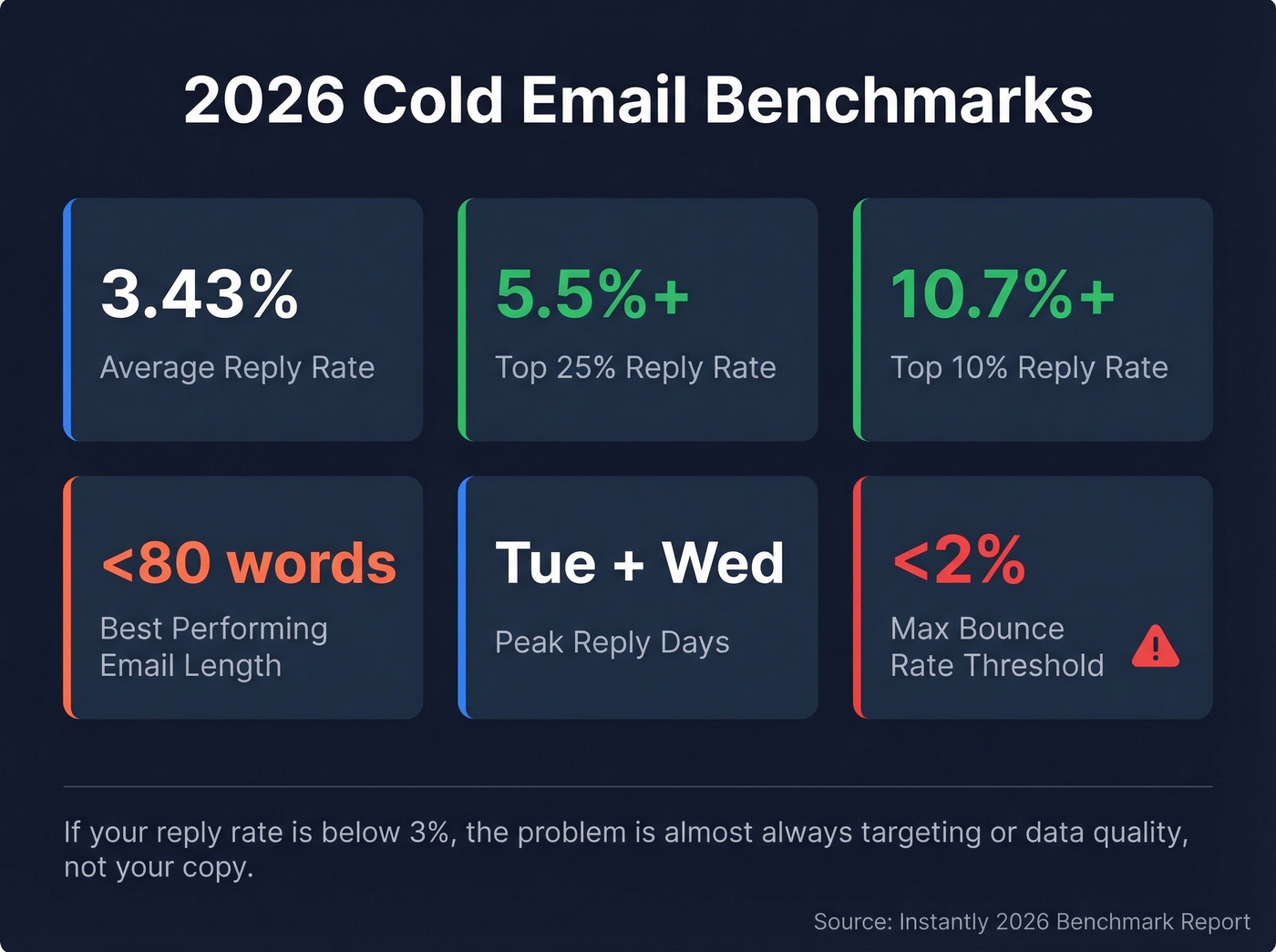
2026 performance benchmarks: Average reply rate sits at 3.43%. Top quartile hits 5.5%+, and the top 10% exceeds 10.7%. Emails under 80 words perform best. Tuesday and Wednesday are peak reply days. If you're below 3%, the problem is almost always targeting or data quality - not your copy.

Every sequencer on this list - Instantly, Smartlead, Lemlist - has a native Prospeo integration. Push 300M+ verified contacts directly into your sending tool with one click. No CSV exports, no manual cleanup, no stale data from six weeks ago.
Connect Prospeo to your sequencer and send with confidence today.
Mistakes That Kill Campaigns
Sending from your main domain. Use secondary domains - variations of your primary - so a bad campaign doesn't tank your core email deliverability. This is the most common mistake we see from teams launching their first outbound motion, and it's the most painful to recover from. (If you need a full checklist, start with an email deliverability guide.)
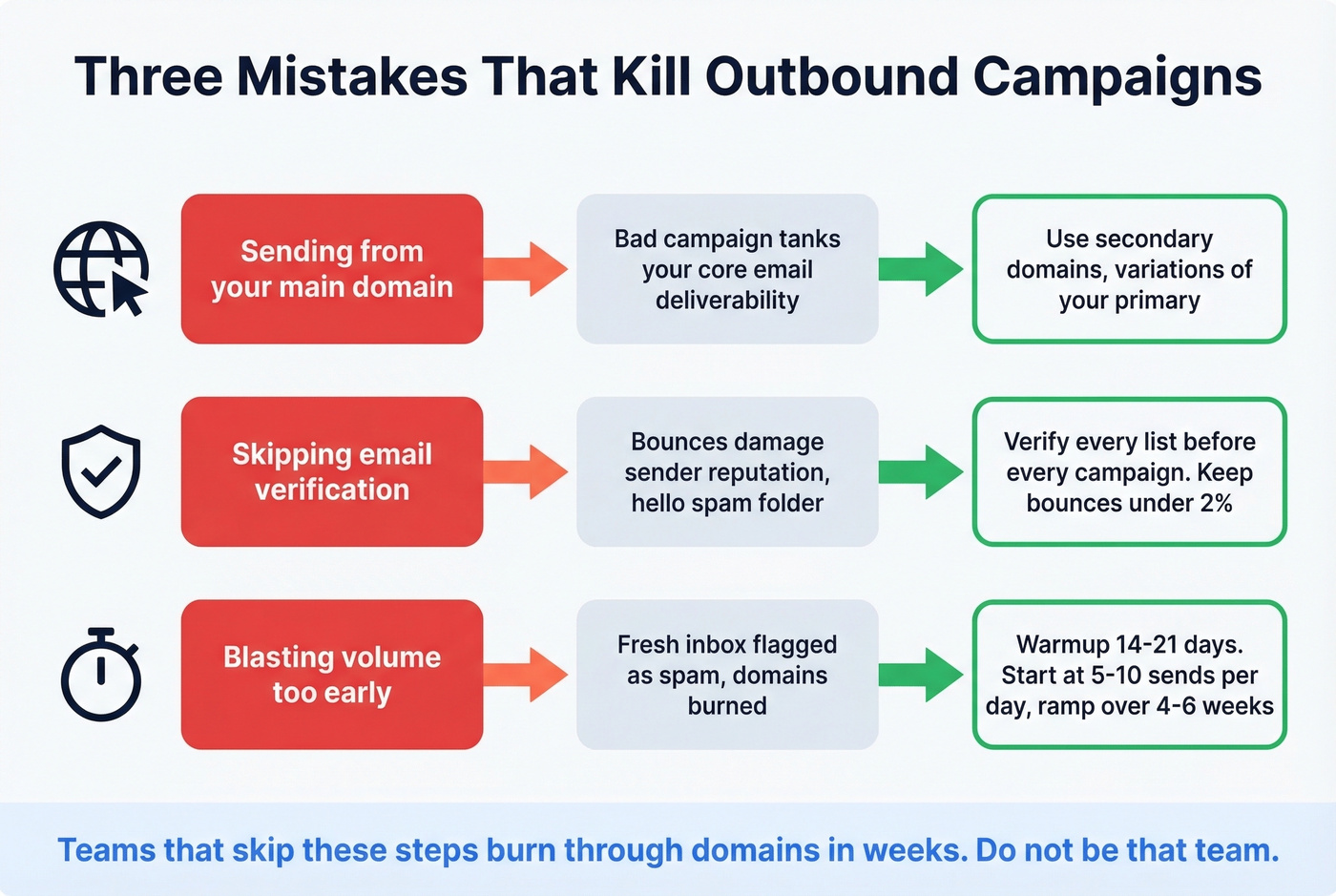
Skipping verification. Bad data leads to bounces, bounces lead to reputation damage, and reputation damage means the spam folder. Every campaign, every time - verify before you send.
Blasting volume too early. New inboxes need 14-21 days of warmup. Sending 50 emails on day one from a fresh inbox is a fast path to the spam folder. Start at 5-10 per day and ramp over 4-6 weeks. We've watched teams burn through three sets of domains because they couldn't wait two weeks. Don't be that team.
FAQ
How many outbound tools do I need?
Most teams need two to three: a data and verification tool, a sequencer like Instantly or Smartlead, and optionally an enrichment layer like Clay for waterfall data workflows. One tool rarely handles the full stack well.
What's a good cold email reply rate in 2026?
The average is 3.43%. Anything above 5% means your targeting and copy are working. The top 10% of campaigns exceed 10.7% - usually driven by tight ICP segmentation and verified contact data.
How do I keep emails out of spam?
Set up SPF, DKIM, and DMARC on every sending domain. Keep bounces under 2% and spam complaints under 0.3%. Warm up new inboxes for 14-21 days. Cap volume at 15-20 emails per inbox per day. Verify your contact list before every send.
What's the cheapest email outbound stack worth using?
Saleshandy at $25/mo offers unlimited email accounts, built-in warmup, and 96% inbox placement. Pair it with Prospeo's free tier for a sub-$30/mo stack that actually performs.