

The Best Email Scrapers in 2026 (Ranked by Accuracy, Not Hype)
A RevOps lead we work with ran a 10,000-contact outreach campaign last quarter using a "top-rated" email scraper. The bounce rate hit 31% by day three, and their sending domain got flagged within a week. Great reviews. Garbage data.
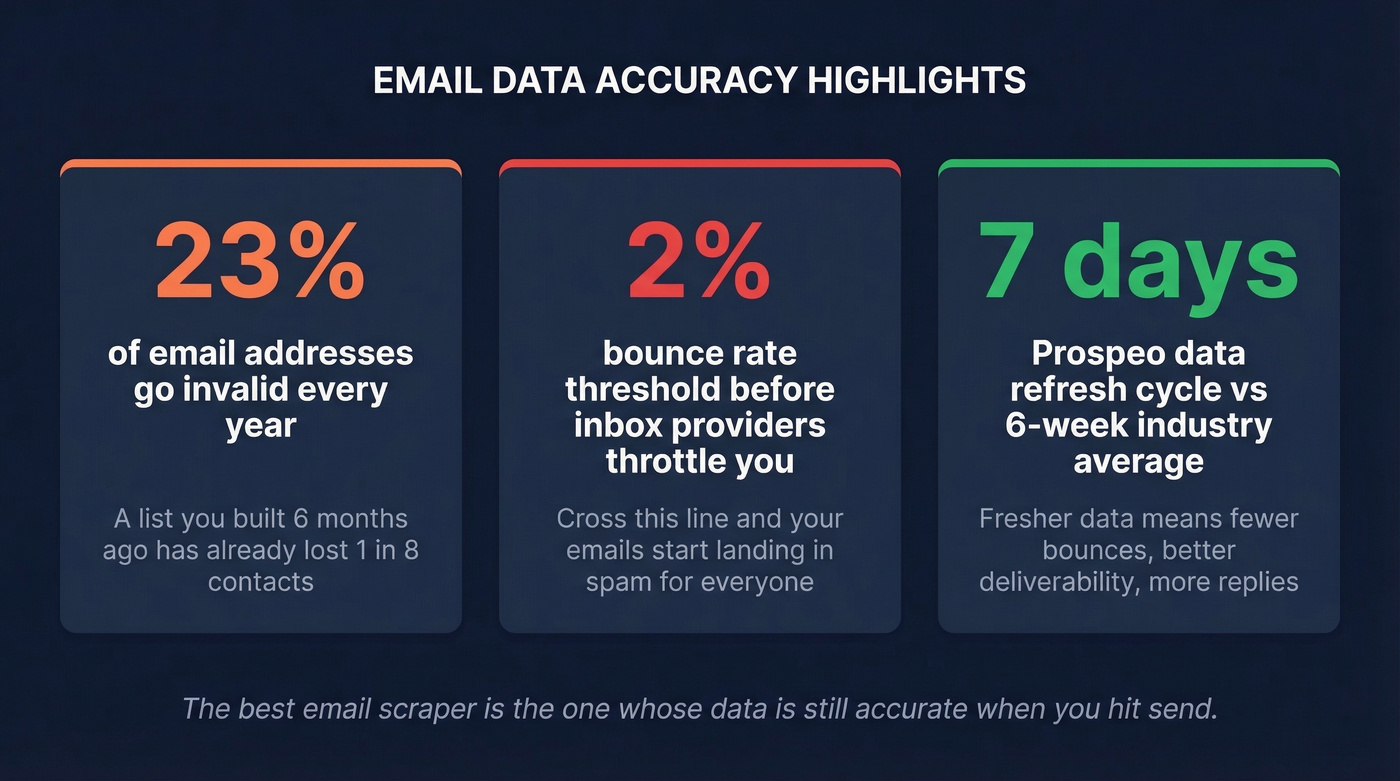
That's the core problem with finding the best email scraper: most tools optimize for volume, not accuracy. Roughly 23% of email addresses go invalid every year, which means any list you built six months ago is already rotting. Once your bounce rate crosses 2%, inbox providers start throttling you. The difference between a good email scraping tool and a bad one isn't how many emails it finds - it's how many actually land.
Quick terminology note: "email scraper," "email finder," and "email extractor" get used interchangeably. Most tools on this list are finders that use databases and pattern-matching rather than true scrapers that crawl the open web. We're covering both because that's what people actually mean.
We evaluated each tool on four criteria: email accuracy in real-world B2B sends, pricing transparency, verification depth, and data freshness. No vendor paid for placement.
Our Picks at a Glance
| Use Case | Pick | Why |
|---|---|---|
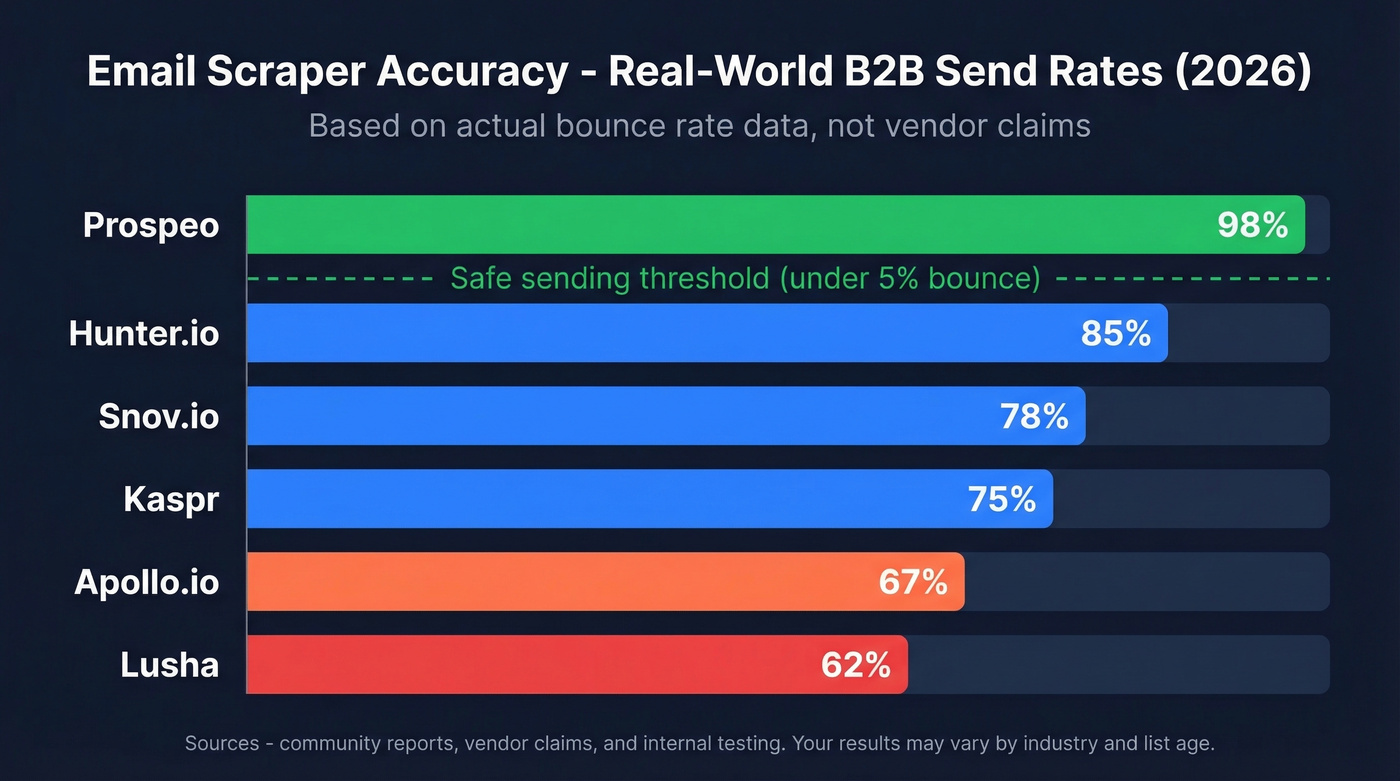
| Best for email accuracy | [Prospeo](#prospeo - best-for-verified-email-accuracy) | 98% verified accuracy, 7-day data refresh, free tier with 75 verified emails/month |
| Best free starting point | [Apollo.io](#apolloio - best-free-tier) | Generous free plan with database access and sequences |
| Best for domain search | [Hunter.io](#hunterio - best-for-domain-search) | Transparent source attribution, strong domain-level lookups |
9 Best Email Scraping Tools in 2026
Prospeo - Best for Verified Email Accuracy
Use this if you've been burned by bad data and need emails that actually land. Prospeo sits on 300M+ professional profiles and 143M+ verified emails, but the real differentiator is what happens before you see a result: a 5-step verification process covering syntax checks, DNS/MX validation, SMTP handshake, catch-all handling, and spam-trap removal. That's not a post-hoc verification bolt-on - it's baked into every lookup.

The 7-day data refresh cycle matters more than most people realize. Industry average sits around six weeks, which means most tools serve you contacts that have already changed jobs, switched companies, or abandoned that inbox entirely. Prospeo also layers in 30+ search filters including buyer intent signals, technographics, and job change alerts, so you're finding the right people at the right time rather than blasting a stale list and hoping. The Chrome extension (40,000+ users) lets you grab verified contacts from any website or CRM in one click.
If you're building a full outbound motion, pair your data layer with proven sales prospecting techniques so accuracy turns into meetings.
Real-world proof: Meritt went from a 35% bounce rate to under 4% after switching, and tripled their pipeline from $100K to $300K per week. That's not a marginal improvement - that's a different business.
Pricing: Free tier gives you 75 verified emails/month. Paid plans run about $0.01 per email with no annual contracts. Self-serve, cancel anytime.
Skip this if you need a built-in dialer or full sequencing platform - pair with Instantly or Lemlist for that.
Hunter.io - Best for Domain Search
Hunter's domain search remains the cleanest in the space. Type in a domain, get a list of associated addresses with source URLs showing exactly where each email was found. That transparency is rare and genuinely useful for compliance documentation.

Hunter's pricing starts free with 50 credits/month. Starter runs $34/mo billed yearly or $49/mo monthly for 2,000 credits. Growth is $104/mo yearly or $149/mo monthly for 10,000 credits, and Scale is $209/mo yearly or $299/mo monthly for 25,000 credits. Email verification uses 0.5 credit per address.
Here's the thing: Reddit threads consistently flag that Hunter's finding rate has declined over the past year or two. Domain search still works well, but individual email lookups aren't as reliable as they used to be. For high-volume prospecting, you'll likely need to supplement with another tool.
If you're comparing options, see our breakdown of Hunter alternatives.
Skip this if you need phone numbers or intent data - Hunter is email-only and doesn't pretend otherwise.
Apollo.io - Best Free Tier
No other tool gives you this much at $0. Apollo's free plan includes database access, basic sequences, and enough credits to test whether outbound works for your business before you spend a dime.
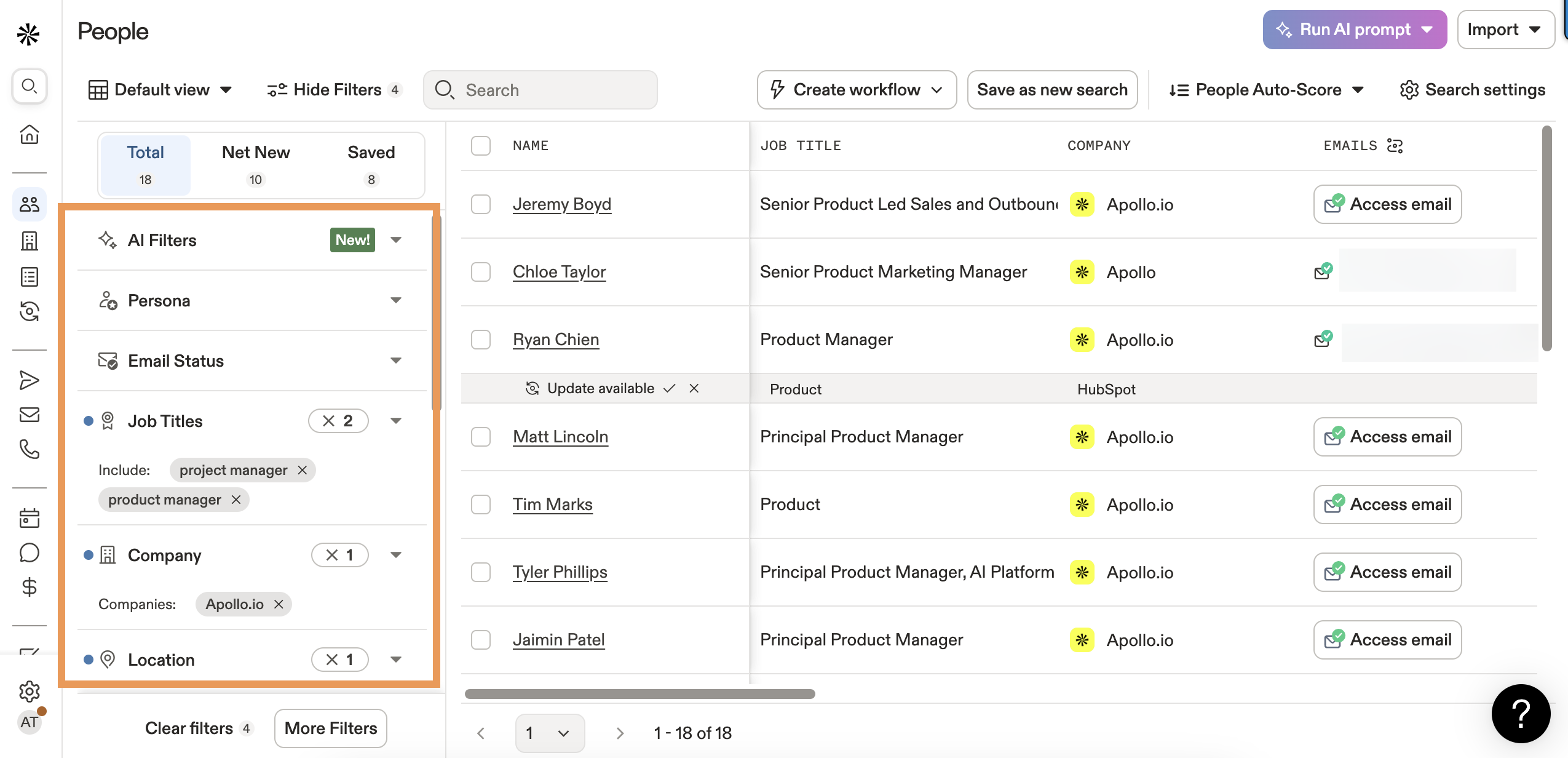
Paid plans start at $49/mo (Basic), $79/mo (Professional), and $119/mo (Organization, minimum 3 seats). Credits don't roll over - they expire monthly, which stings if your outreach cadence is uneven.
The accuracy question is real, though. Reddit users on r/SalesOperations report email accuracy around 65-70%, which tracks with what we've seen in bake-offs. Apollo finds a lot of emails. A meaningful percentage of them bounce. If you're running Apollo, budget for a separate verification step before you hit send.
Skip this if you're sending high-volume cold email where deliverability is make-or-break. A 30-35% miss rate will torch your domain reputation fast.
Snov.io - Best All-in-One with Outreach
Snov.io bundles email finding, verification, and outreach sequences into one platform. Starter runs $29.25/mo annually with 1,000 credits and 5,000 recipients. Pro is $74.25/mo with 5,000 credits and 25,000 recipients.
The catch: social-network automation costs an extra $69/mo per account slot, which adds up fast for multi-channel teams. Each verification and prospect search costs 1 credit, so your 1,000 Starter credits go quicker than you'd expect. Community sentiment on Reddit is mixed - users appreciate the convenience but note the email-finding accuracy doesn't match dedicated tools. Good for teams that want one login for everything, less so when deliverability is the top priority.
Kaspr - Best for European Markets
Kaspr's free plan includes unlimited B2B email credits, though you need to invite 3 colleagues to unlock them. Paid plans start at $49/mo. The Chrome extension is the core product - built for grabbing contact data from professional profiles in real time.
Where Kaspr genuinely shines is European data coverage. If your ICP is EMEA-heavy, Kaspr's database outperforms US-centric tools on email and phone match rates for that region. It's lightweight and focused - perfect for SDRs running EMEA campaigns, but too limited for teams that need intent data or multi-region coverage.
Skrapp.io - Budget Option
Skrapp includes a free plan and paid plans starting around $39/mo for 1,000 credits. It's one of the cheaper options that still delivers usable results. The interface is simple, the Chrome extension works, and for small teams doing low-volume prospecting, it gets the job done without fuss. Don't expect intent data or advanced filters.
If you're evaluating cost vs. output, compare Skrapp pricing before you commit.
Clay - For RevOps Power Users
Clay's March 2026 pricing overhaul introduced Launch at $185/mo (2,500 Data Credits + 15,000 Actions) and Growth at $495/mo (6,000 Data Credits + 40,000 Actions). Powerful orchestration for complex enrichment workflows - waterfall enrichment across multiple data providers, AI-powered research agents, custom scoring models. But if you just need to find emails and send them, Clay is overengineered and overpriced for that job. It's a workflow tool that happens to include email finding, not the other way around.
If you're using Clay primarily for enrichment, you'll also want to review the broader landscape of data enrichment services.
Clearout.io - Verification-First Finder
Better known as a verification tool, but it does both. Starter runs $18/mo for 3,000 credits, with each found address costing 4 credits. Treat it as a verification-first platform that also includes email finding - not the reverse. If you're already running a separate finder and just need a cheap verification layer, Clearout is a solid pick.
Outscraper - For Bulk Domain Scraping
The only true email web scraper on this list - it crawls public directories and websites to extract emails at scale. Free for 500 domains, then $3/1K domains dropping to $1/1K at volume. Built for bulk extraction from local directories and other publicly accessible web sources, not classic B2B prospecting. If you need to pull every email from a list of 50,000 business websites, this is your tool.
If you're doing this for pipeline, it's worth reading our guide to web scraping lead generation first.

This article exists because most email scrapers serve you stale data that bounces. Prospeo's 5-step verification and 7-day refresh cycle are why teams like Meritt cut bounce rates from 35% to under 4%. 98% accuracy, $0.01/email, no contracts.
Stop verifying scraped lists. Start with emails that are already verified.
Honorable mentions: Lusha has a strong Chrome extension with accuracy estimated around 60-65%, starting from $29/mo. RocketReach is solid for executive contacts with variable pricing. Voila Norbert offers simple per-lead pricing starting around $49/mo.
Every week you use a tool with a 6-week refresh cycle, your list decays further. Prospeo refreshes 300M+ profiles every 7 days - so the emails you pull today are still valid when you hit send tomorrow.
Your email scraper's data is already stale. Prospeo's was verified this week.
Pricing Comparison
| Tool | Free Tier | Starting Price | Data Refresh | Best For |
|---|---|---|---|---|
| Prospeo | 75 emails/mo | ~$0.01/email | 7 days | Verified accuracy |
| Hunter.io | 50 credits/mo | $34/mo (yearly) | ~6 weeks | Domain search |
| Apollo.io | Yes (limited) | $49/mo | ~6 weeks | Free prospecting |
| Snov.io | Trial only | $29.25/mo | Not public | All-in-one outreach |
| Kaspr | Yes (with invites) | $49/mo | Not public | European markets |
| Skrapp.io | Yes | ~$39/mo | Not public | Budget teams |
| Clay | No | $185/mo | Varies by source | RevOps workflows |
| Clearout.io | Yes | $18/mo | Not public | Verification + find |
| Outscraper | 500 domains | $3/1K domains | Real-time crawl | Bulk directory scrape |
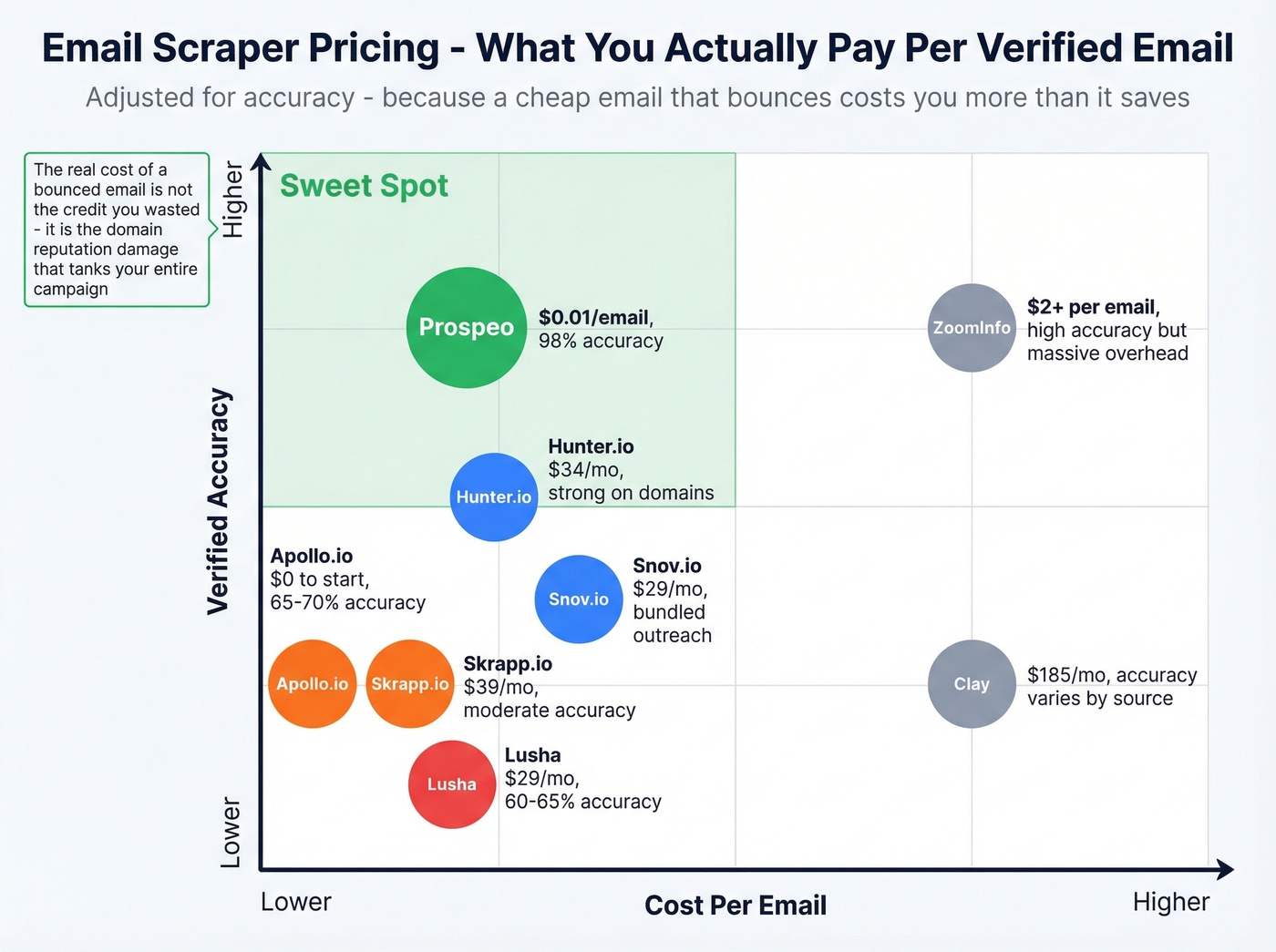
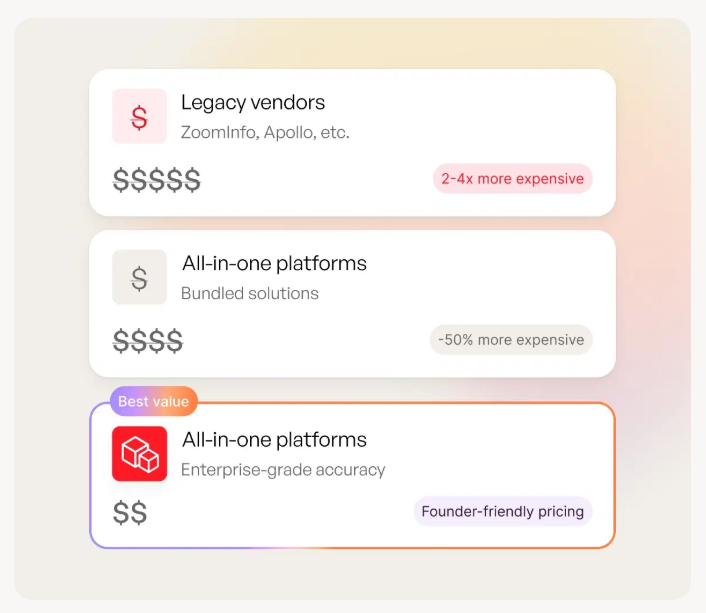
For context, ZoomInfo - the enterprise default - starts around $25,000/year for small teams. That's real money for a tool where most teams only use the contact search.
Let's be honest: if your average deal size is under $15K, you almost certainly don't need ZoomInfo-level data. A dedicated email scraping tool with strong verification will outperform a bloated enterprise platform that your team uses at 15% capacity.
If you're building a broader outbound stack, start with these outbound lead generation tools.
How to Verify Scraped Emails
Finding emails is half the battle. Verifying them before you send is what keeps your domain alive.

Syntax check. Strip out obviously malformed addresses - missing @ symbols, double dots, spaces. Low-hanging fruit, but you'd be surprised how many tools skip this.
If you're troubleshooting deliverability, use this email bounce rate guide to decode what's happening.
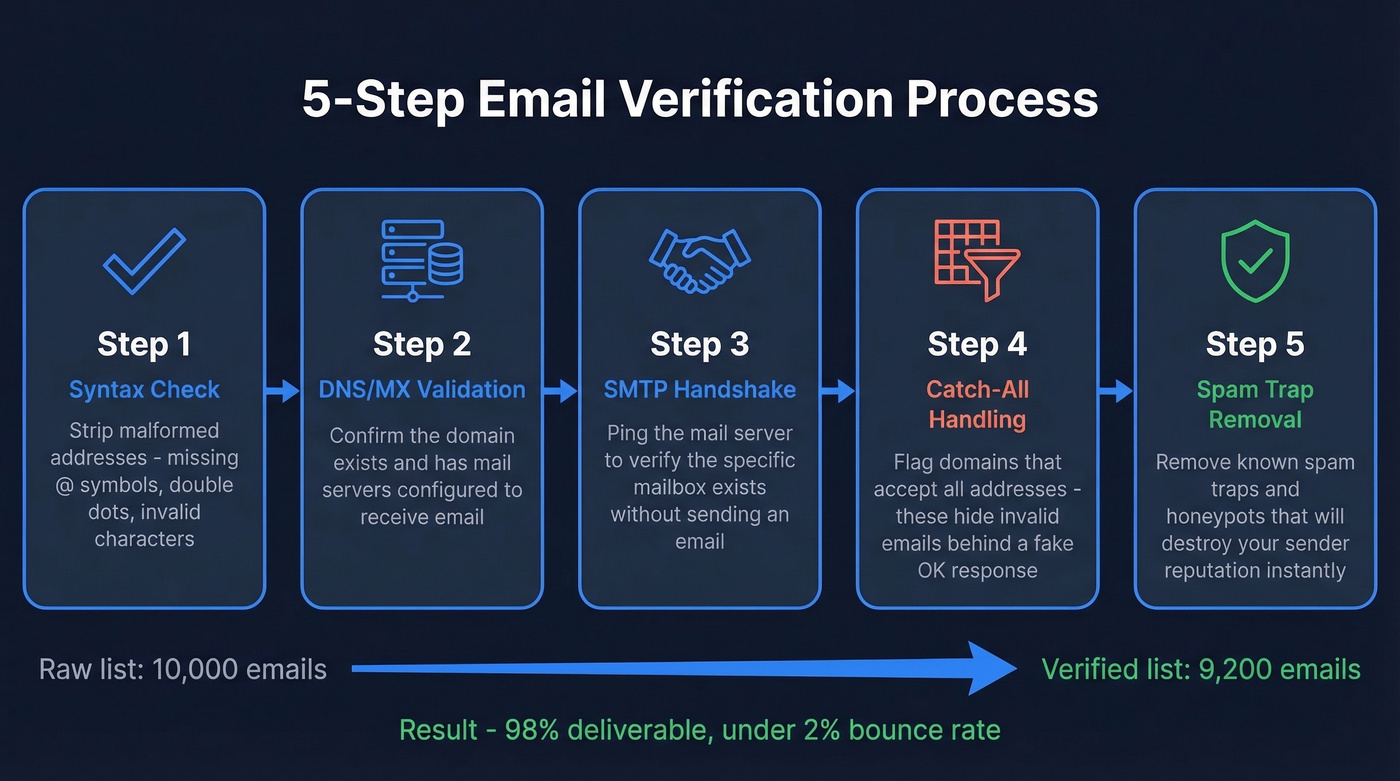
DNS/MX record validation. Confirm the domain actually has mail servers configured. No MX record means the email can't receive messages. Period.
SMTP handshake. Ping the mail server to check if the specific mailbox exists without actually sending an email. This is where most invalid addresses get caught, and it's the step that separates serious verification from checkbox verification.
Catch-all detection. Over 9% of "verified" emails sit on catch-all domains that accept everything - including addresses that don't exist. Good verification tools flag these so you can decide whether to risk sending.
Spam-trap and honeypot removal. These are addresses specifically designed to catch scrapers. Hit one and your sender reputation tanks immediately.
If your tool doesn't verify inline, run your list through a standalone verifier before sending. Standalone verification through Hunter runs about $24.50 per 1,000 emails - roughly 2-3x the cost of dedicated verifiers like ZeroBounce (~$10/1K) or NeverBounce (~$8/1K).
Re-verify quarterly at minimum. Gmail and Yahoo now require senders to maintain spam complaint rates below 0.3%, and a bounce rate above 2% signals poor list quality that can trigger filtering or outright blocking. No amount of email warmup fixes a list full of dead addresses.
For more on keeping inbox placement stable, see our email deliverability guide.
Is Email Scraping Legal?
The short answer: it depends on where you're sending and how you collected the data.
In the US, CAN-SPAM doesn't require prior consent for commercial emails. You can email someone who didn't opt in, as long as you include honest headers, a physical address, and a working unsubscribe link. You must honor opt-outs within 10 business days.
Under GDPR (EU/UK), it's more nuanced. A work email like firstname.lastname@company.com counts as personal data. You can't just scrape and blast. The most common legal basis for B2B outreach is "legitimate interest," which requires a documented balancing test - you need to show your interest in contacting them outweighs their privacy rights, and you must offer a clear opt-out.
Regardless of jurisdiction, three practical rules apply. First, record provenance for every address: the URL where you found it, the date, and the method used. This is your audit trail if anyone asks. Second, respect terms of service - scraping can trigger ToS violations even when the data itself is public, and the legal risk isn't always about data protection. Third, offer a real opt-out and honor it immediately. That's not just legal compliance; it's basic professionalism.
Look, none of this is legal advice. But teams that document their process and respect opt-outs rarely run into trouble.
FAQ
What's the most accurate email scraper in 2026?
Prospeo leads with 98% verified email accuracy and a 7-day data refresh cycle. Most tools claim 95%+ but deliver 65-85% in real-world B2B use. The key differentiator is whether verification happens before or after you receive results - inline verification produces dramatically fewer bounces.
Can I scrape emails for free?
Yes. Apollo.io offers the most generous free tier with database access and built-in sequences. Hunter.io gives 50 free credits per month, and Prospeo provides 75 verified emails monthly. Free tiers work for testing and low-volume prospecting, but you'll hit limits fast once you're running real campaigns.
Is email scraping legal?
In the US, CAN-SPAM allows unsolicited commercial emails if you include honest headers and a working unsubscribe link. Under GDPR, work emails are personal data - you need a documented legitimate interest basis and a clear opt-out mechanism. Always record where and when you collected each address.
How do I avoid bounces from scraped lists?
Verify every email before sending and keep your total bounce rate below 2%. Re-verify lists quarterly since roughly 23% of addresses go invalid each year. Tools with built-in verification eliminate the separate verification step, saving time and reducing the risk of sending to dead addresses.
What's the difference between an email scraper and an email finder?
An email scraper crawls websites and public directories to collect addresses automatically - a brute-force approach. An email finder uses databases and pattern-matching to predict and verify professional emails for specific people. Most tools marketed as "scrapers" are actually finders. The distinction matters for compliance since scrapers collect without consent while finders typically work from existing databases.