

Best Time to Make Sales Calls in 2026: What 3 Million Cold Calls Reveal
One SDR on r/sales tracked 37,000 cold calls over two years and landed on two windows: 8 AM and 3:30-5 PM. That matches the big studies - but only partially. Every dataset measures something different. One tracks connect rates, another measures talk time, a third counts demos booked. The best time to make sales calls depends on what you're optimizing for and who you're calling.
We dug into five studies covering over 3 million cold calls to reconcile the conflicting advice and build a schedule that actually works.
Quick Version
If you don't read another word:
- One call block per day? 9-11 AM in the prospect's local time zone.
- Two call blocks? Add 3:30-5 PM.
- Best days: Wednesday > Tuesday > Thursday.
- Calling executives? Friday 2-4 PM. Seriously.
- Connect rate below 10%? Your problem isn't timing - it's data. Verify your numbers before you optimize anything else.
Peak Hours for Sales Calls
Morning and afternoon both work. They just work differently.
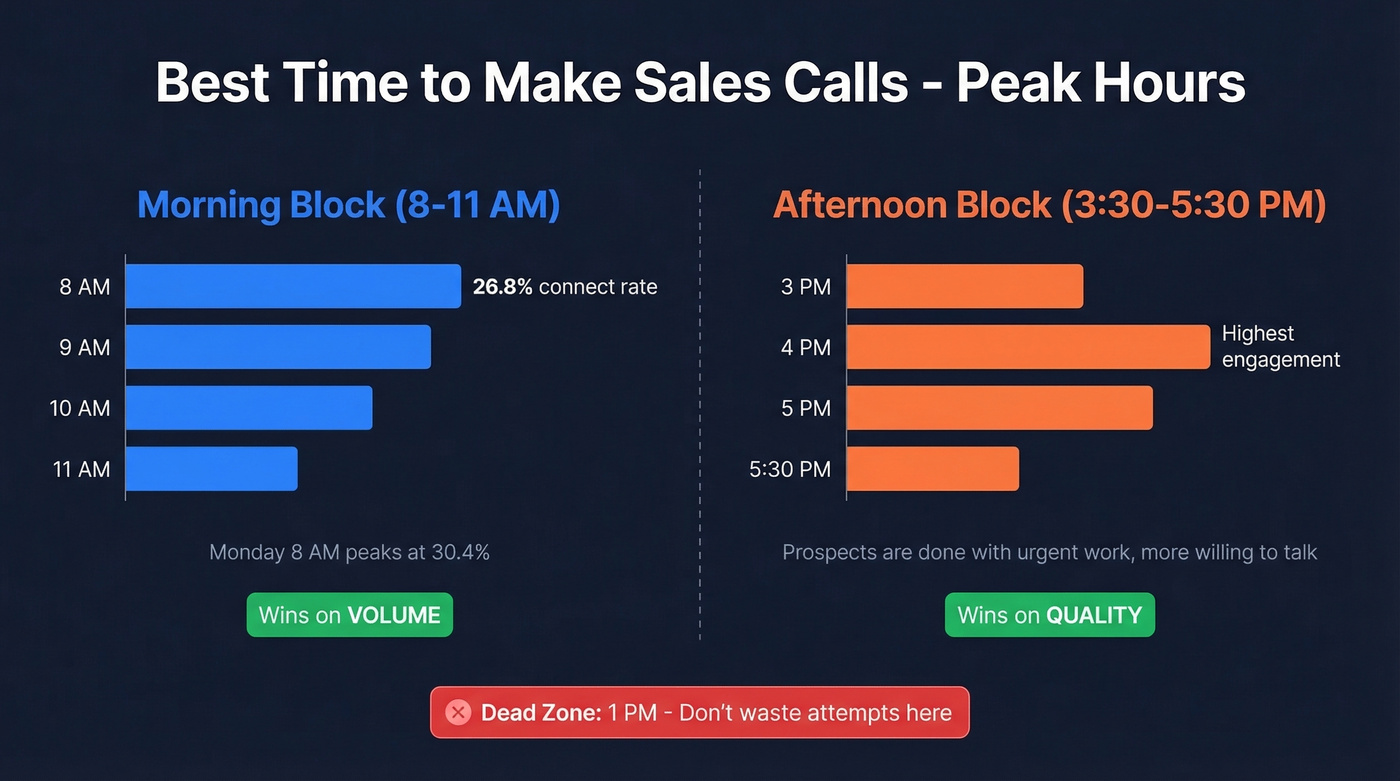
MightyCall analyzed 187,684 weekday calls and found the 8-11 AM window consistently outperformed every other slot. The 8 AM hour alone hit a 26.8% success rate for connected calls lasting 30+ seconds, and Monday at 8 AM peaked at 30.4%. Morning calling wins on raw connect rate - people are at their desks, haven't been beaten down by the day yet, and they're more willing to pick up an unknown number.
Revenue.io's internal 90-day analysis tells a different story. Their peak engagement window was 4-5 PM, with the entire 3-6 PM block outperforming midday. In our experience, the afternoon block consistently produces longer, more relaxed conversations - prospects who answer late in the day are done with their urgent work and more willing to talk.
The reconciliation is straightforward: morning wins on volume, afternoon wins on quality. If you can only run one call block, go morning. If you can run two, add the late afternoon.
One universal dead zone: 1 PM. Don't waste attempts on it.
| Study | Sample Size | Metric | Best Window | Peak Slot |
|---|---|---|---|---|
| MightyCall | 187,684 calls | Connect + 30s+ | 8-11 AM | Mon 8 AM (30.4%) |
| Revenue.io | 90-day internal | Engagement rate | 3-6 PM | 4-5 PM |
| Cognism | State of Cold Calling 2026 | Avg talk time | 10-11 AM | 10-11 AM |
| Revenue.io | Millions of calls | Connection rate | 8-11 AM | 15% higher vs other times |
If you're building a repeatable outbound motion, it helps to treat calling as one part of a broader cold calling system rather than a standalone activity.
Best Day of the Week
ZoomInfo's analysis of 1.4 million outbound calls gives us the clearest day-by-day picture. Tuesday and Wednesday together drive 44% of all demos booked. Monday actually has the highest call-to-demo efficiency at 1.19% - but lower overall volume because reps are slower to start dialing.
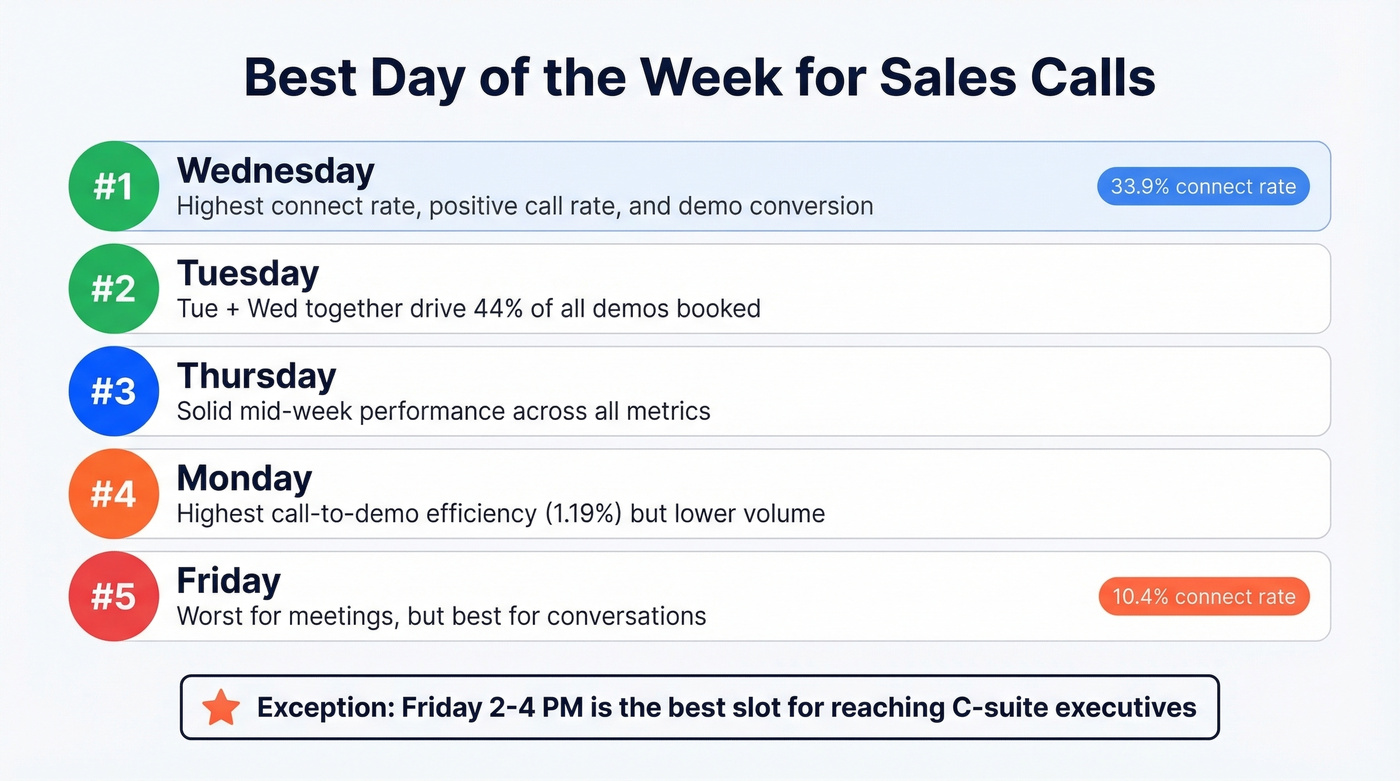
Friday is the consensus worst day for general prospecting. Cognism's data shows Friday is the worst day for booking meetings but the best day for having actual conversations. People are looser on Fridays. They'll chat. They just won't commit to a Tuesday demo.
For EMEA specifically, Wednesday pulls ahead on connect rate, positive call rate, and cold call-to-demo conversion. If you're running a European book, weight your Wednesday dial blocks heavier.
The ranking for general prospecting: Tuesday > Wednesday > Thursday > Monday > Friday.
Calling Executives: A Different Playbook
Everything above applies to mid-level contacts. For C-suite and VP-level prospects, throw the conventional wisdom out.
Friday 2-4 PM is the sleeper slot. Koncert's research shows 50% of executives are more open to calls on Fridays. Gatekeepers are less of a factor late in the week, and exec calendars tend to be lighter by Friday afternoon. Early morning, 7:30-8:30 AM is the other window - executives arrive before their support staff, so you bypass the gatekeeper entirely.
Skip Friday for everyone else, though. CallHippo's study of 15,000+ calls found a Friday connection rate of just 10.4% compared to Wednesday's 33.9%. The executive exception doesn't extend to managers and individual contributors.
Here's the thing: Friday is the most underrated day on the sales calendar. Most reps coast into the weekend while their competitors' executives sit unguarded. If your ICP is director-level and above, Friday afternoon should be your highest-priority block, not your day off.

You just learned that Friday 2-4 PM is the sleeper slot for reaching executives. But the best timing in the world won't help if you're dialing dead numbers. Prospeo's 125M+ verified mobile numbers deliver a 30% pickup rate - refreshed every 7 days, not every 6 weeks.
Stop optimizing call windows on a list full of disconnected numbers.
Timing by Industry
There's no single dataset breaking down connect rates by vertical with hard numbers, but the patterns are consistent enough across practitioner experience to be actionable.
Office-based buyers in SaaS, finance, and professional services answer best between 9 AM and noon. Field workers in construction, logistics, and healthcare are reachable before 8 AM or after 4 PM - they're simply not near a phone during working hours. Retail and hospitality managers respond best mid-morning Tuesday through Thursday; avoid Mondays when they're buried in inventory and scheduling.
Remote and hybrid workers are the wildcard. We've tested extensively and found wider answer windows but far more variance day to day. Internal A/B testing is mandatory here - there's no universal pattern for someone who might be at a home desk or walking their dog at 2 PM.
For time-zone sequencing: start your morning block targeting East Coast prospects and shift West through the day. Your 11 AM ET dial hits West Coast prospects at 8 AM - right in their peak window.
If you need more ways to fill those dial blocks, start with these sales prospecting techniques and a shortlist of free lead generation tools.
Inbound Leads: Speed Beats Timing
For inbound leads, the optimal call window is right now. Not in an hour. Not tomorrow morning. Now.
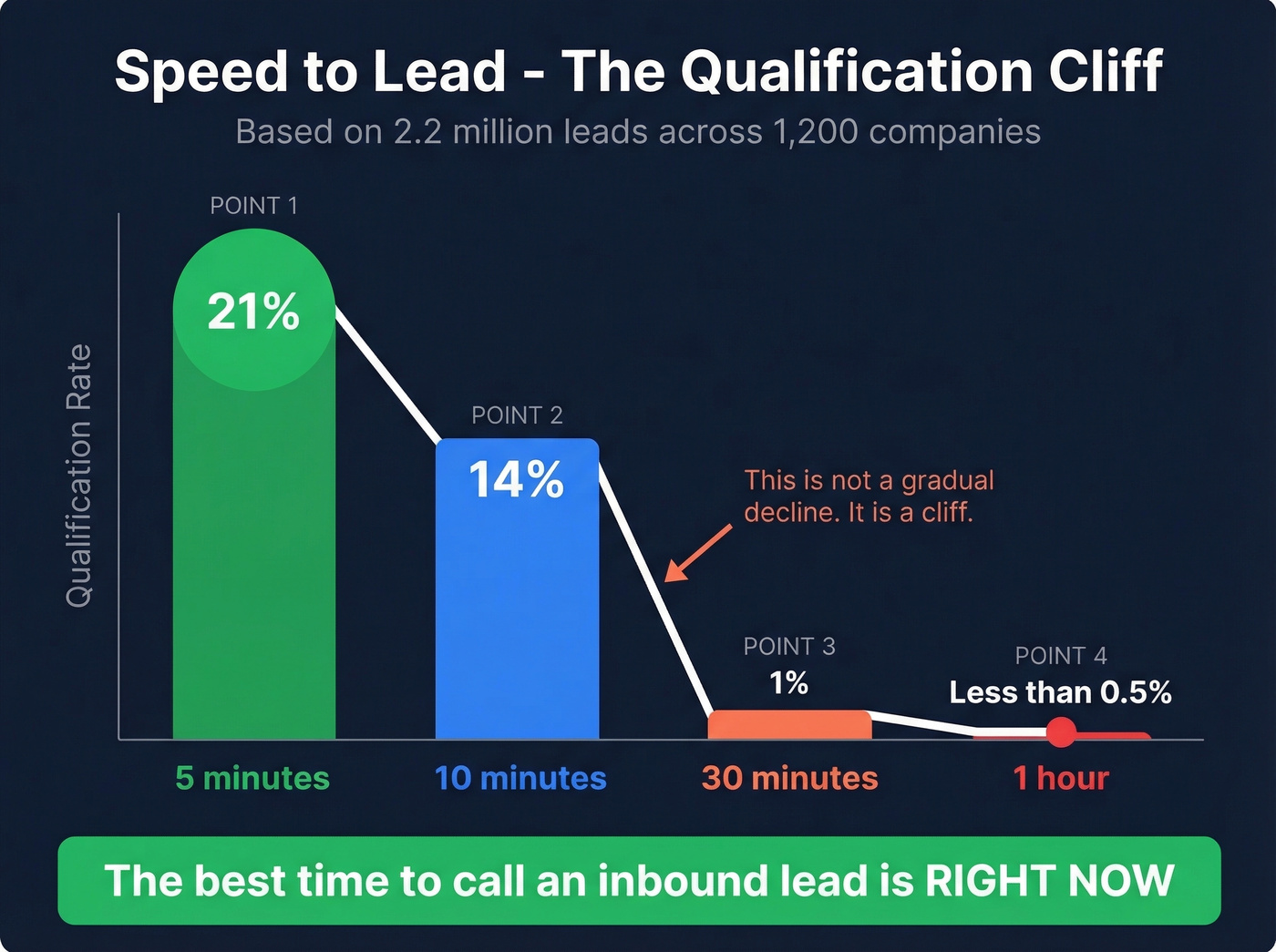
The landmark HBR study of 2.2 million leads across 1,200 companies produced a qualification curve that should be taped to every SDR's monitor - the pattern has been replicated consistently, and speed-to-lead remains the single strongest predictor of inbound conversion.
- Within 5 minutes: 21% qualification rate
- After 10 minutes: 14%
- After 30 minutes: 1%
- After 1 hour: less than 0.5%
That's not a gradual decline. It's a cliff. If your team is debating whether to call inbound leads at 9 AM or 4 PM, they're asking the wrong question entirely.
To tighten your inbound process, pair fast calling with a consistent lead scoring model so reps know who gets called first.
Data Quality Matters More Than Timing
Let's be honest about something most cold calling guides skip over entirely. Large-scale call studies show about a 15% lift in connection rates when you dial during peak windows versus off-peak hours. That's real, but it's modest. The difference between verified and unverified phone data is much bigger - 30% pickup on verified mobiles versus single digits on unverified lists. If your connect rate is below 10%, your problem isn't timing. It's that you're dialing dead numbers.
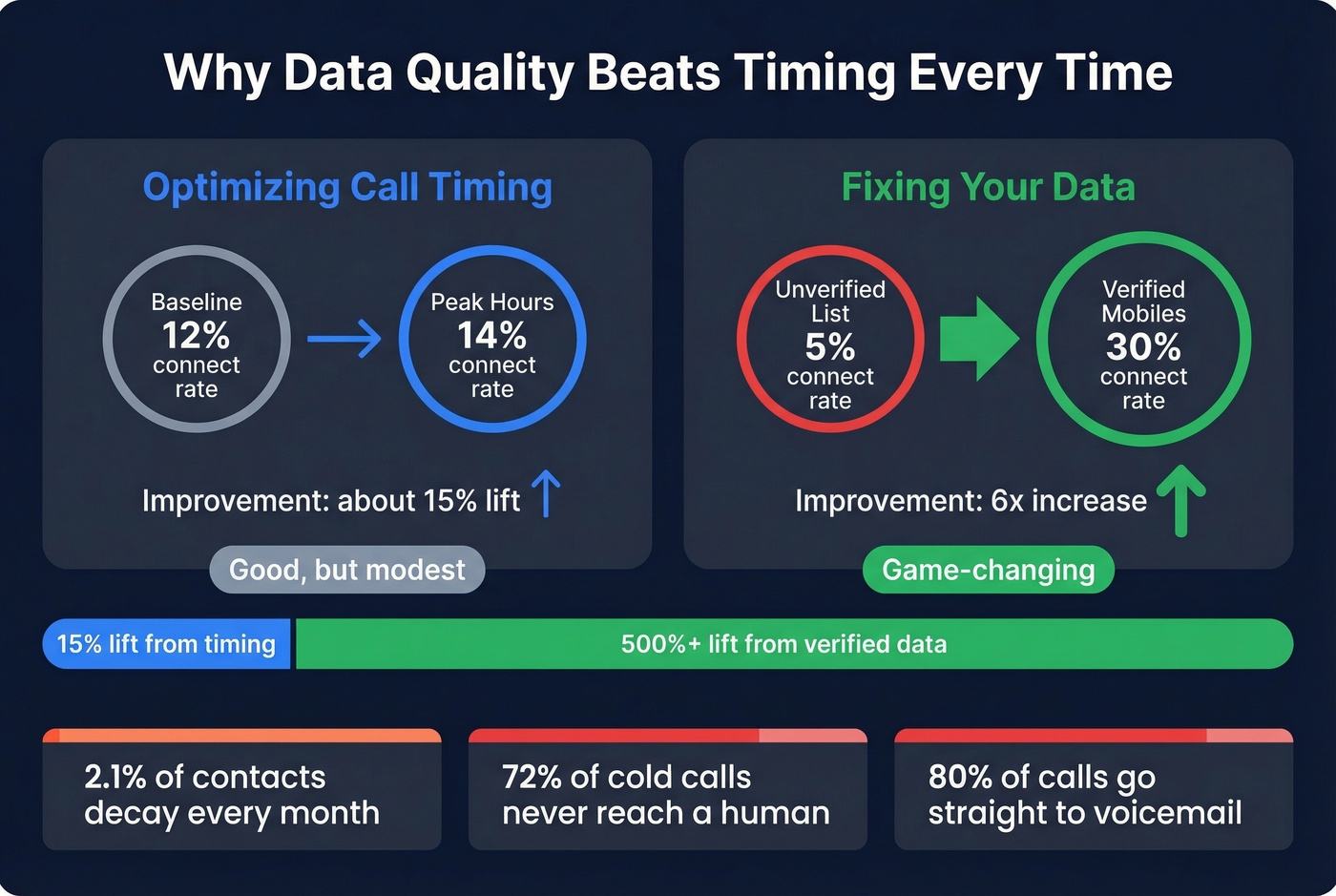
B2B contact data decays at about 2.1% per month - that's 22.5% of your list going stale every year. InsideView found that 72% of cold calls don't reach a human. RAIN Group puts the voicemail rate at 80%. We've seen teams double their connect rates just by running numbers through a verification step before dialing. No schedule optimization comes close to that impact.
Before you optimize when you call, make sure you're calling numbers that actually ring. Prospeo's Mobile Finder includes 125M+ verified mobile numbers with a 30% pickup rate, refreshed on a 7-day cycle versus the 6-week industry average - which means the numbers you pull on Monday are still good by Friday.
If you're rebuilding your list quality end-to-end, compare data enrichment services and consider a dedicated sales prospecting database instead of stitched-together sources.
72% of cold calls never reach a human. Most of that isn't bad timing - it's bad data decaying at 2.1% per month. Prospeo refreshes every 7 days and verifies every number through a 5-step process. Teams using Prospeo data see 30% pickup rates vs. single digits on unverified lists.
Your connect rate problem isn't the clock. It's your contact data.
Your Weekly Call Schedule
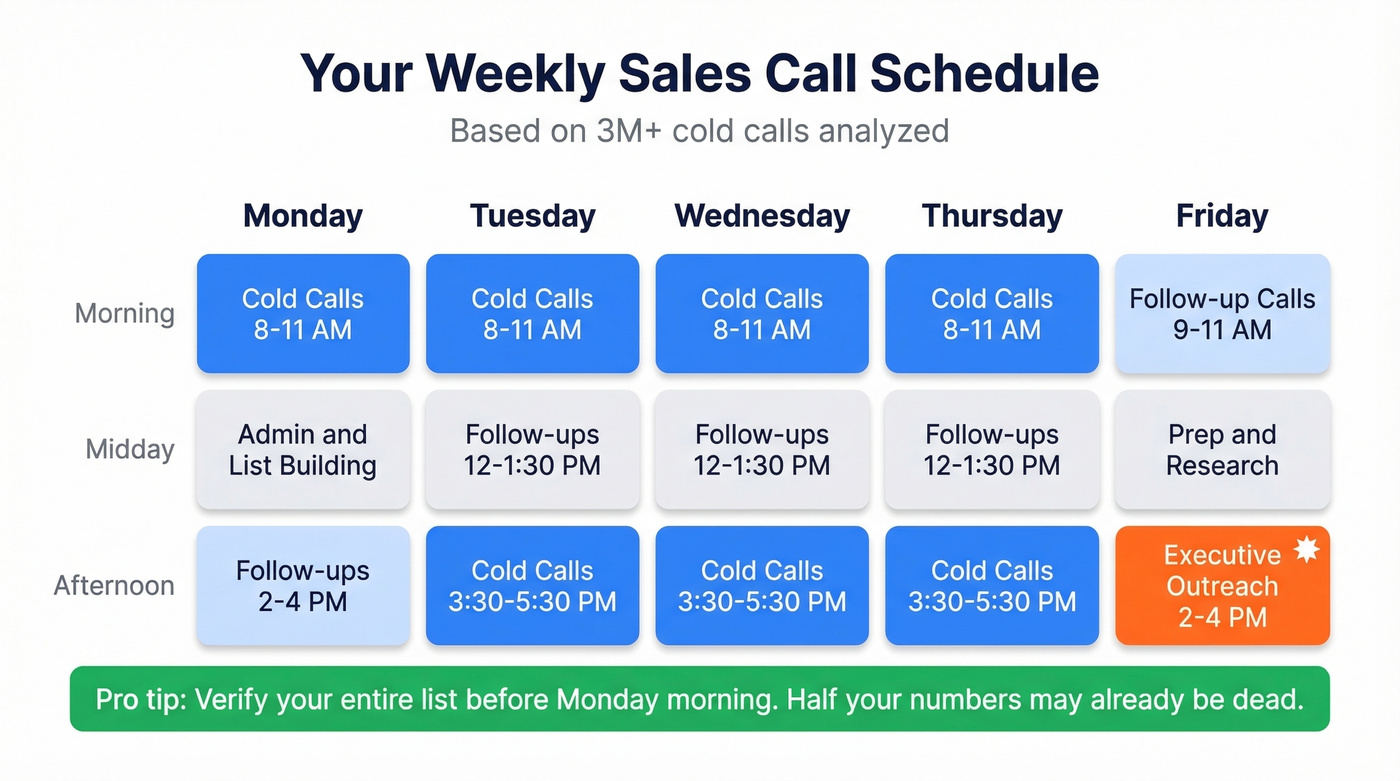
Here's the template we recommend based on the combined data. Adjust for your industry and time zones, but this is a strong starting point for structuring the best time to make sales calls into a repeatable rhythm.
| Day | Morning Block | Midday | Afternoon Block |
|---|---|---|---|
| Monday | Cold calls 8-11 AM | Admin / list building | Follow-ups 2-4 PM |
| Tue-Thu | Cold calls 8-11 AM | Follow-ups 12-1:30 PM | Cold calls 3:30-5:30 PM |
| Friday | Follow-up calls 9-11 AM | Prep / research | Executive outreach 2-4 PM |
Run your list through a verification tool before Monday's first dial block. There's no point perfecting your schedule if half your numbers bounce to voicemail on the first ring.
When you do get a conversation, having a tight set of discovery questions and a clean discovery call script makes the timing advantage actually convert.
Cold Calling Benchmarks
Before you judge your own performance, here's what "normal" looks like in 2026:
| Metric | Number | Source |
|---|---|---|
| Calls per appointment | 209 | Bridge Group |
| Hours of calling per appointment | 7.5 | Baylor University |
| Successful call duration | 5:50 | Gong |
| Failed call duration | 3:14 | Gong |
| Calls that don't reach a human | 72% | InsideView |
| Calls going to voicemail | 80% | RAIN Group |
| Reps who quit after one attempt | 44% | RAIN Group |
That last line is the one that matters most. 44% of reps give up after a single attempt, but talk to any SDR who's been dialing for six months and they'll tell you: it takes up to eight touches to get through. Persistence beats timing every time.
If your team struggles to keep follow-ups consistent, use these sales follow-up templates to standardize touches across calls, email, and LinkedIn.
FAQ
What time should you never cold call?
Avoid 1 PM - the universal lunch dead zone across every dataset we reviewed. Friday after 4 PM is dead for general prospecting, though executives are the exception. Before 8 AM and after 6 PM risk compliance issues in most jurisdictions.
What's the best day for sales calls?
Wednesday ranks first across multiple studies, followed closely by Tuesday and Thursday. ZoomInfo's data shows Tuesday and Wednesday together account for 44% of all demos booked. Friday is weakest for general prospecting but surprisingly effective for reaching C-suite contacts.
How many cold calls should I make per day?
Bridge Group benchmarks put it at 33 daily dials yielding roughly 6.6 conversations. Focus on two concentrated call blocks (8-11 AM and 3:30-5 PM) rather than spreading dials across the full day.
Why is my connect rate low even during peak hours?
Stale data is the most common culprit. B2B contacts decay 2.1% per month. Verify numbers with Prospeo's Mobile Finder before dialing - verified mobiles hit a 30% pickup rate versus single digits on unverified lists.