

Best Bulk Email Services in 2026 (Tested & Compared)
The world sends 376.4 billion emails every day. Roughly 1 in 5 never reaches the inbox - the average deliverability across tested ESPs sits at just 83.1%.
That gap between the best and worst bulk email services has widened fast. Gmail, Outlook, and Microsoft 365 all tightened enforcement. SendGrid killed its free plan. Inbox placement rates dropped across every major sending platform. Picking the wrong service doesn't just cost you money - it tanks your sender reputation in ways that take months to recover from.
Our Picks (TL;DR)
| Use Case | Pick | Starting Price |
|---|---|---|
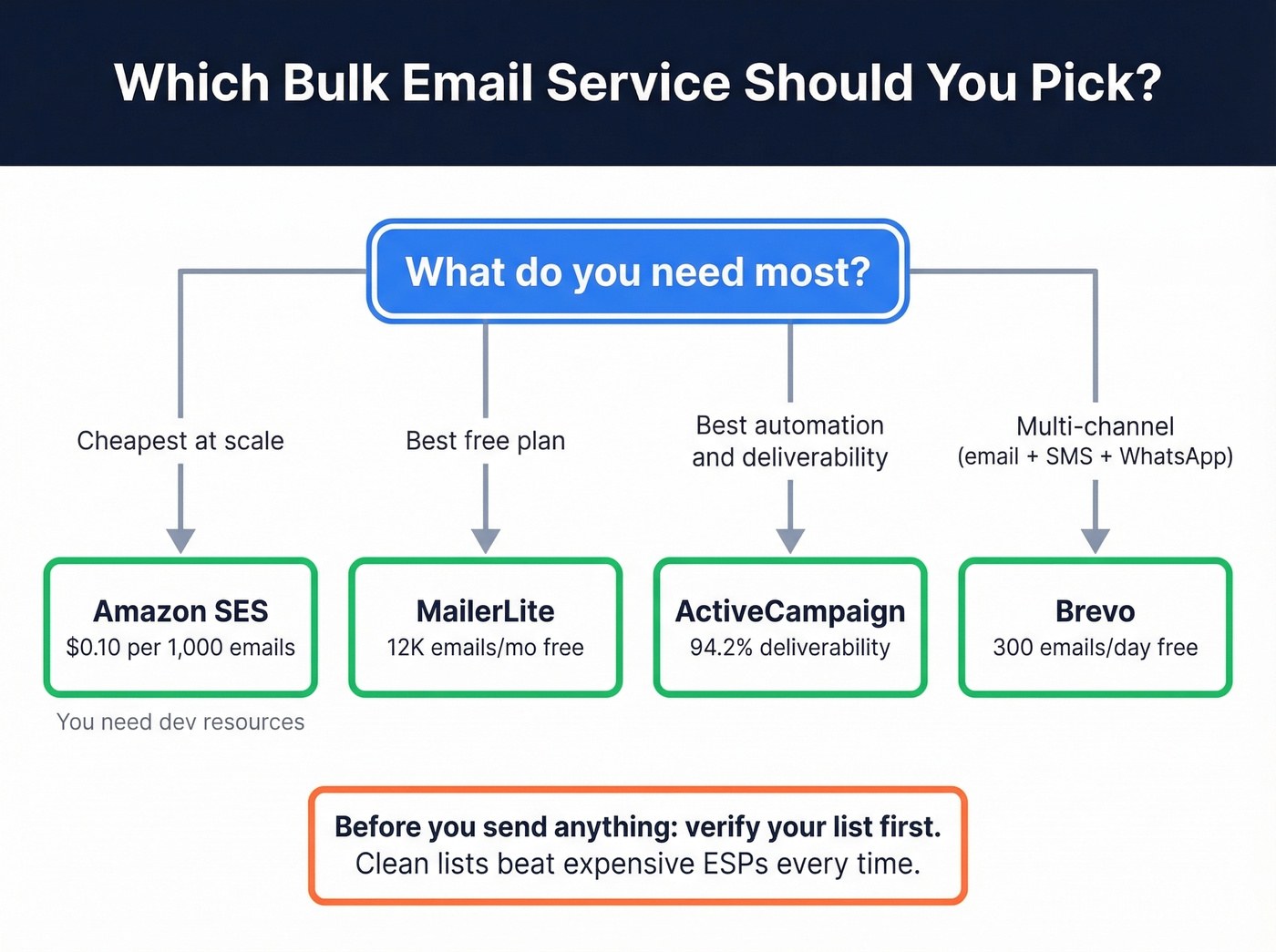
| Best overall (SMB marketing) | Brevo | Free (300/day) |
| Best free plan | MailerLite | Free (12K emails/mo) |
| Cheapest at scale (developers) | Amazon SES | $0.10/1,000 emails |
| Best automation | ActiveCampaign | $15/mo |
| Best deliverability | ActiveCampaign | $15/mo |
Here's the thing: your ESP choice matters less than your list quality. We've run deliverability audits on dozens of sender accounts, and the single biggest predictor of inbox placement is list hygiene - not which platform you're on. A clean list on a cheap ESP will outperform a dirty list on the most expensive one, every time.
What Changed in 2026
Bulk email changed more in the past 18 months than in the previous five years.
SendGrid killed its free plan. As of May 28, 2025, both the Free Email API and Free Marketing Campaigns plans are gone. After a 60-day transition, free accounts had sending paused and contacts deleted if they stored more than 100.
Gmail and Yahoo escalated bulk sender enforcement. What started as guidelines in February 2024 escalated to temporary and permanent rejections by November 2025 for non-compliant senders. One-click unsubscribe and DMARC authentication aren't optional anymore.
Microsoft joined the party. Starting May 2025, bulk senders to Outlook, Hotmail, and Live.com domains must publish DMARC with at least p=none and pass DMARC alignment via SPF or DKIM.
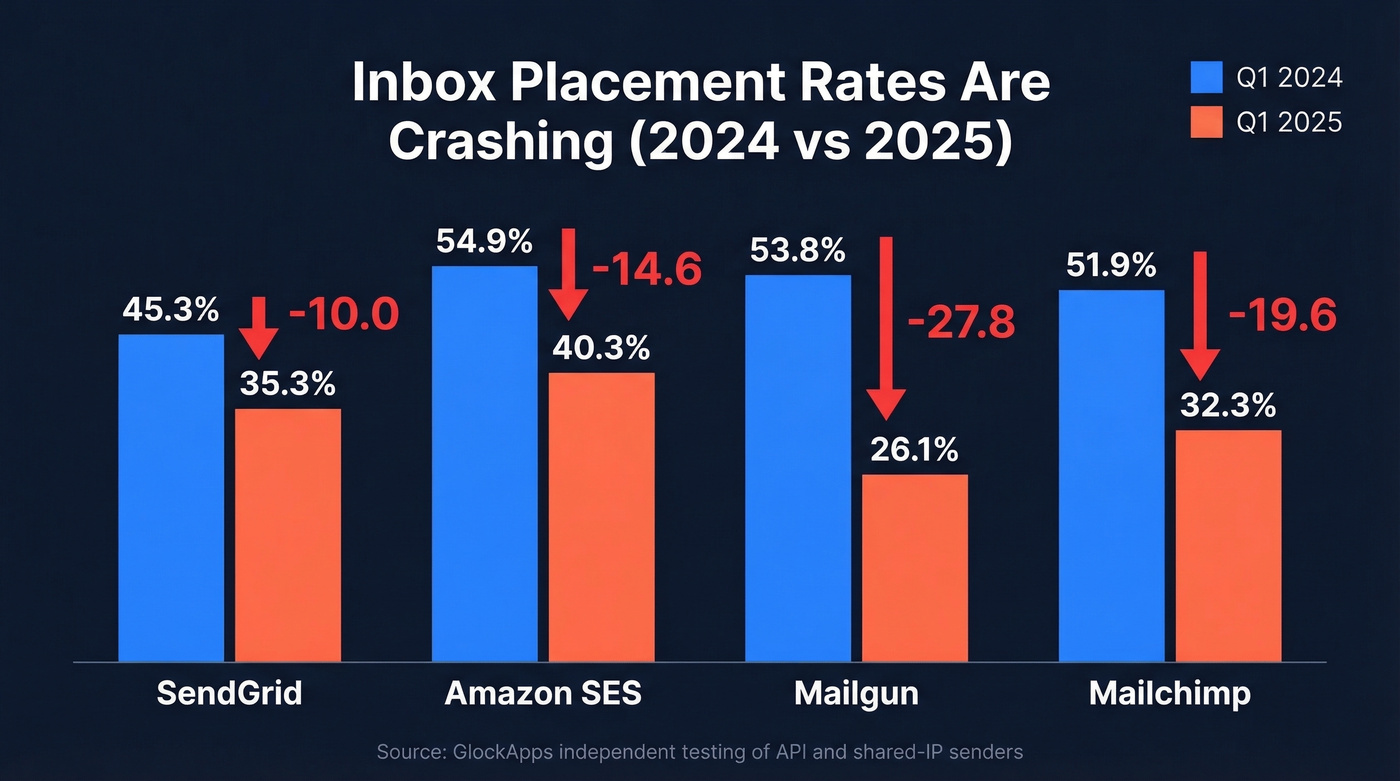
Inbox rates dropped across the board. Independent testing shows Mailgun's average inbox rate cratered from 53.8% to 26.1% between Q1 2024 and Q1 2025. Mailchimp fell from 51.9% to 32.3%. Even Amazon SES dropped from 54.9% to 40.3%.
DMARC adoption hit 54% in 2024 (up from 43% in 2023), but that still means nearly half of senders enter 2026 without basic authentication.
Deliverability: The Numbers
Let's be honest - deliverability data is where most recommendations fall apart. Everyone claims "great deliverability" without showing receipts.
EmailTooltester runs bi-annual deliverability tests across major ESPs. Their latest round puts the overall average at 83.1% - nearly 17% of emails don't reach the inbox. The top performers:
| ESP | Deliverability Score |
|---|---|
| ActiveCampaign | 94.2% |
| Constant Contact | 91.7% |
| GetResponse | 90.9% |
| MailerLite | 89.8% |
| Mailchimp | 89.5% |
Those numbers look decent. But GlockApps tells a darker story when you look at raw inbox placement rates for API-heavy senders:
| ESP | Q1 2024 Inbox Rate | Q1 2025 Inbox Rate | Change |
|---|---|---|---|
| SendGrid | 45.30% | 35.31% | -9.99 |
| Amazon SES | 54.90% | 40.30% | -14.60 |
| Mailgun | 53.80% | 26.05% | -27.75 |
| Mailchimp | 51.93% | 32.30% | -19.63 |

The inbox providers themselves got stricter too. Gmail inbox placement dropped from 58.7% to 53.7%. Outlook collapsed from 49.3% to 26.8%. Office 365 fell from 77.4% to 50.7%.
Nobody talks about this enough: a Mailgun survey of 1,100+ senders found 70% don't use Google Postmaster Tools to monitor sender reputation. That's driving without a speedometer and wondering why you keep getting tickets. The same survey found 48% of senders struggle to stay out of spam - and the fastest path to the spam folder is bounces from unverified addresses.
2026 Compliance Requirements
If you're sending more than 5,000 emails per day to Gmail or Yahoo recipients, these aren't suggestions - they're requirements that trigger rejections if you fail them.
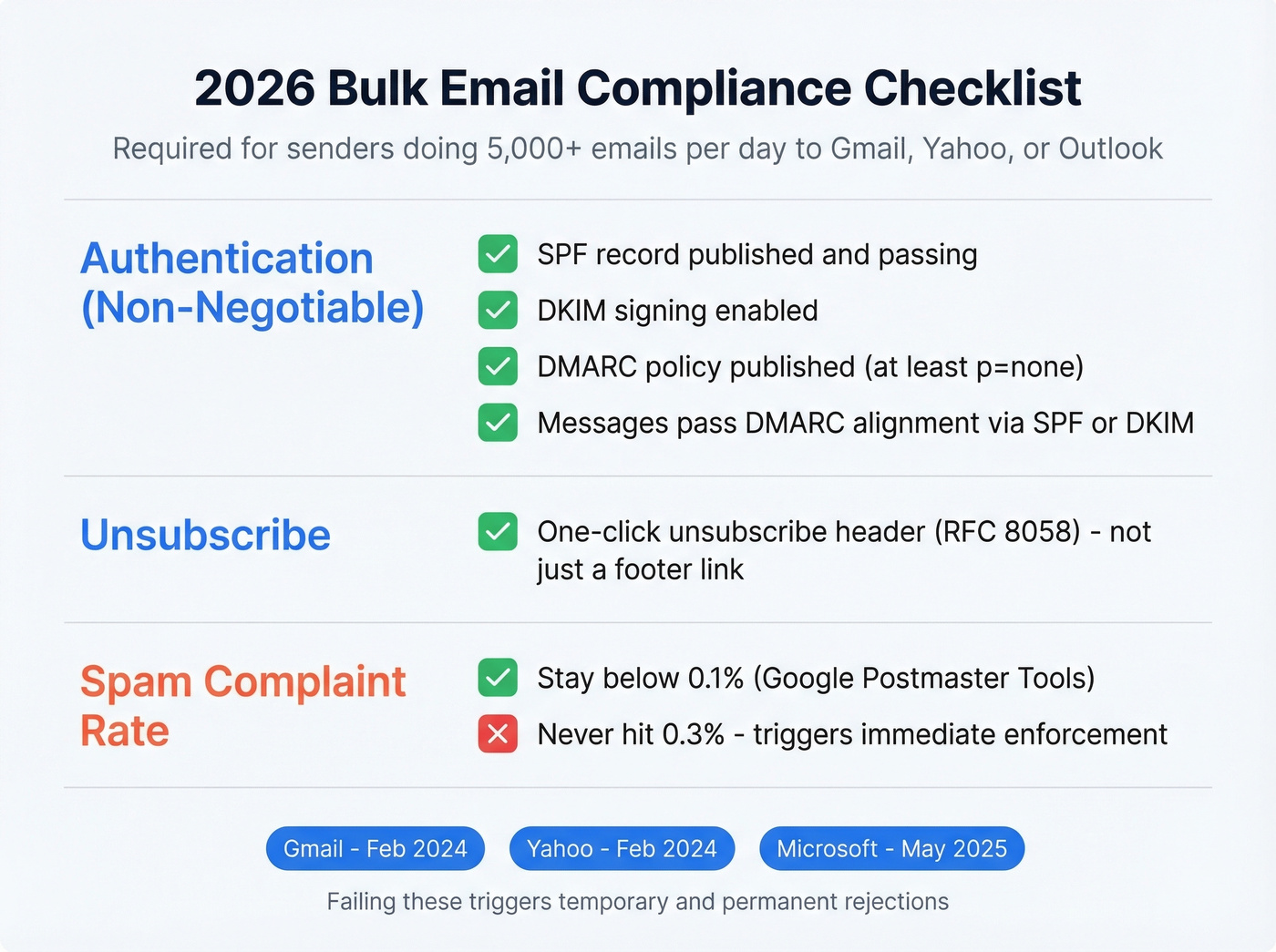
Authentication (non-negotiable):
- SPF record published and passing
- DKIM signing enabled
- DMARC policy published with at least p=none
- Messages must pass DMARC alignment (SPF or DKIM)
Unsubscribe: One-click unsubscribe header (RFC 8058) - not just a link buried in your footer.
Spam complaint rate: Keep below 0.1% as measured via Google Postmaster Tools. Never hit 0.3% - that threshold triggers immediate enforcement.
Gmail and Yahoo started enforcement in February 2024, extended the one-click unsubscribe deadline to June 2024, and escalated to temporary and permanent rejections by November 2025. Microsoft followed in May 2025 with DMARC requirements for bulk senders to Outlook domains. If you send both transactional and marketing email, use separate sending streams - different IPs or subdomains - to prevent marketing reputation issues from affecting transactional delivery.
The good news: most modern ESPs handle SPF and DKIM automatically. The bad news: DMARC is still on you. If you haven't published a DMARC record, stop and do it now.

Every deliverability stat above proves the same thing: list quality beats platform choice. Prospeo's 5-step verification catches spam traps, honeypots, and catch-all domains before they tank your sender reputation - at 98% accuracy and $0.01 per email.
Stop blaming your ESP. Clean your list and watch inbox rates climb.
The 13 Best Mass Email Platforms
Here's a consolidated view before we dig into each tool:
| Tool | Best For | Free Plan | Deliverability | Starting Price |
|---|---|---|---|---|
| Brevo | SMB multi-channel | 300/day | Strong | $9/mo |
| MailerLite | Beginners | 12K emails/mo | 89.8% | $10/mo |
| Amazon SES | Developer scale | $200 credits | 40.3% inbox* | $0.10/1K |
| Mailchimp | Ecosystem/integrations | 500 emails/mo | 89.5% | $13/mo |
| Mailgun | API-first developers | 100/day | 26.1% inbox* | $15/mo |
| ActiveCampaign | Automation | 14-day trial | 94.2% | $15/mo |
| SendGrid | Twilio ecosystem | None | 35.3% inbox* | ~$20/mo |
| Moosend | Budget automation | 30-day trial | Good | $9/mo |
| Mailtrap | Dev testing + sending | 4K emails | Good | $15/mo |
| Postmark | Transactional only | 100 emails | Excellent | $15/mo |
| Constant Contact | Events | None | 91.7% | ~$12/mo |
| GetResponse | Webinar funnels | 2,500 emails/mo | 90.9% | $19/mo |
*Inbox placement rates from independent testing of API/shared-IP senders. Newsletter-ESP deliverability scores use a different methodology. Both are valid - they measure different things.
Prospeo - Protect Deliverability Before You Send
Most bulk email service comparisons ignore the lever that moves deliverability the most: list quality.
Prospeo verifies emails in real time with 98% accuracy using a 5-step verification process that handles catch-all domains, removes spam traps, and filters honeypots. It's built on 300M+ professional profiles, including 143M+ verified emails and 125M+ verified mobile numbers, refreshed every 7 days (the industry average is 6 weeks). Used by 15,000+ companies and 40,000+ Chrome extension users, it's self-serve with no contracts.
If you're sending campaigns at any meaningful volume, verifying addresses before they ever hit your ESP is the simplest way to cut bounces, protect sender reputation, and keep inbox placement stable. For a deeper breakdown of the mechanics, see our Email Deliverability Guide and How to Improve Sender Reputation.
Brevo - Best Overall for SMBs
Use it if you want a multi-channel platform (email, SMS, WhatsApp) that charges by emails sent, not contacts stored. Brevo's free plan gives you 300 emails per day and supports up to 100,000 contacts - that's around 9,000 emails a month without paying a cent. Paid plans start at $9/month, and the drag-and-drop editor is clean.
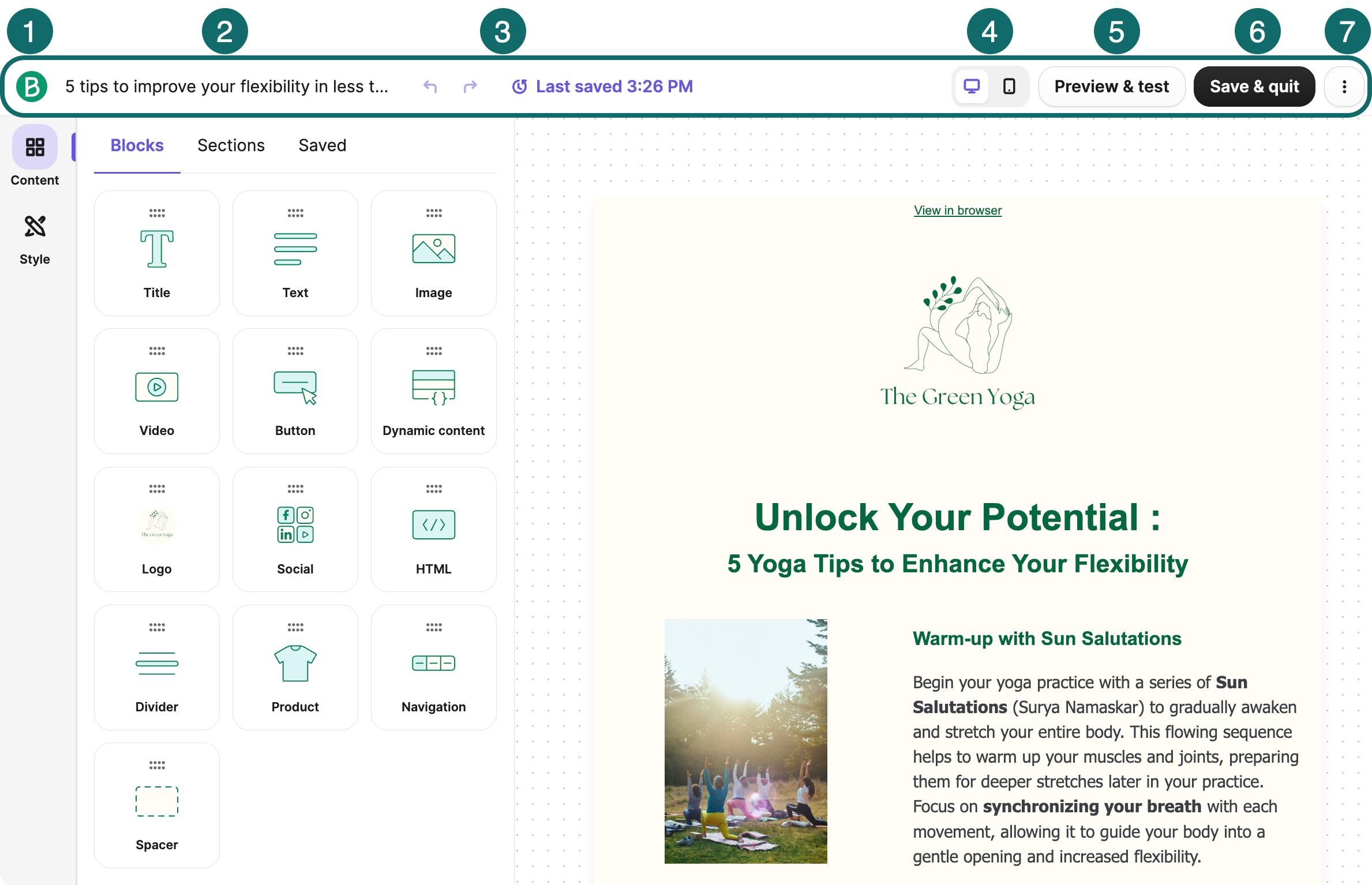
Skip it if you need deep CRM functionality or advanced reporting. Brevo's CRM is functional but thin compared to HubSpot or ActiveCampaign. And if you're sending transactional email at high volume, Amazon SES will be 10x cheaper.
MailerLite vs. Mailchimp's Free Tier
This is the comparison most people searching for a mass email service actually need.
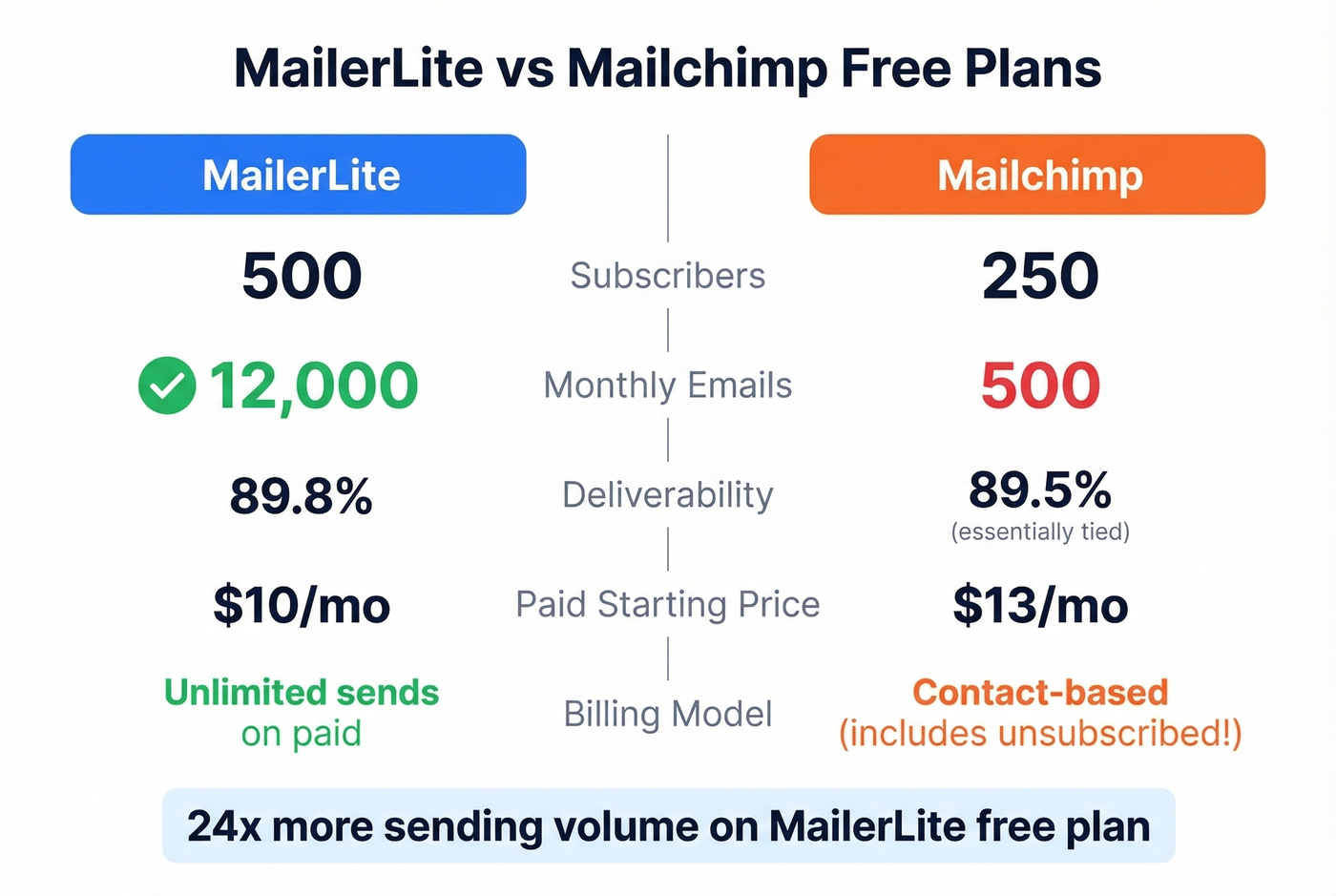
MailerLite's free plan covers 500 subscribers and 12,000 emails per month. Mailchimp's free plan covers 250 contacts and 500 emails per month. That's a 24x difference in sending volume. Paid plans tell a similar story: MailerLite starts at $10/mo with unlimited sends on paid tiers, while Mailchimp starts at $13/mo with send limits expressed as multiples of your contact count.
Independent deliverability testing puts MailerLite at 89.8% and Mailchimp at 89.5% - essentially identical. The drag-and-drop editor is intuitive on both, though MailerLite throws in a website builder.
MailerLite keeps things simple, and that's both its strength and its ceiling. Teams outgrowing it typically move to ActiveCampaign or Brevo. But for anyone starting out, MailerLite is the better free plan by a wide margin. The recurring complaint on r/emailmarketing about Mailchimp is that contact-based billing catches teams off guard - you can be charged for all contacts in your audience, including unsubscribed ones, unless you manage them properly.
If you're optimizing campaigns beyond the platform choice, start with email subject lines and a clean list (see Email Bounce Rate benchmarks).
Amazon SES - The Math Speaks for Itself
At $0.10 per 1,000 emails, here's what you'd pay compared to marketing platforms at 100,000 emails per month:
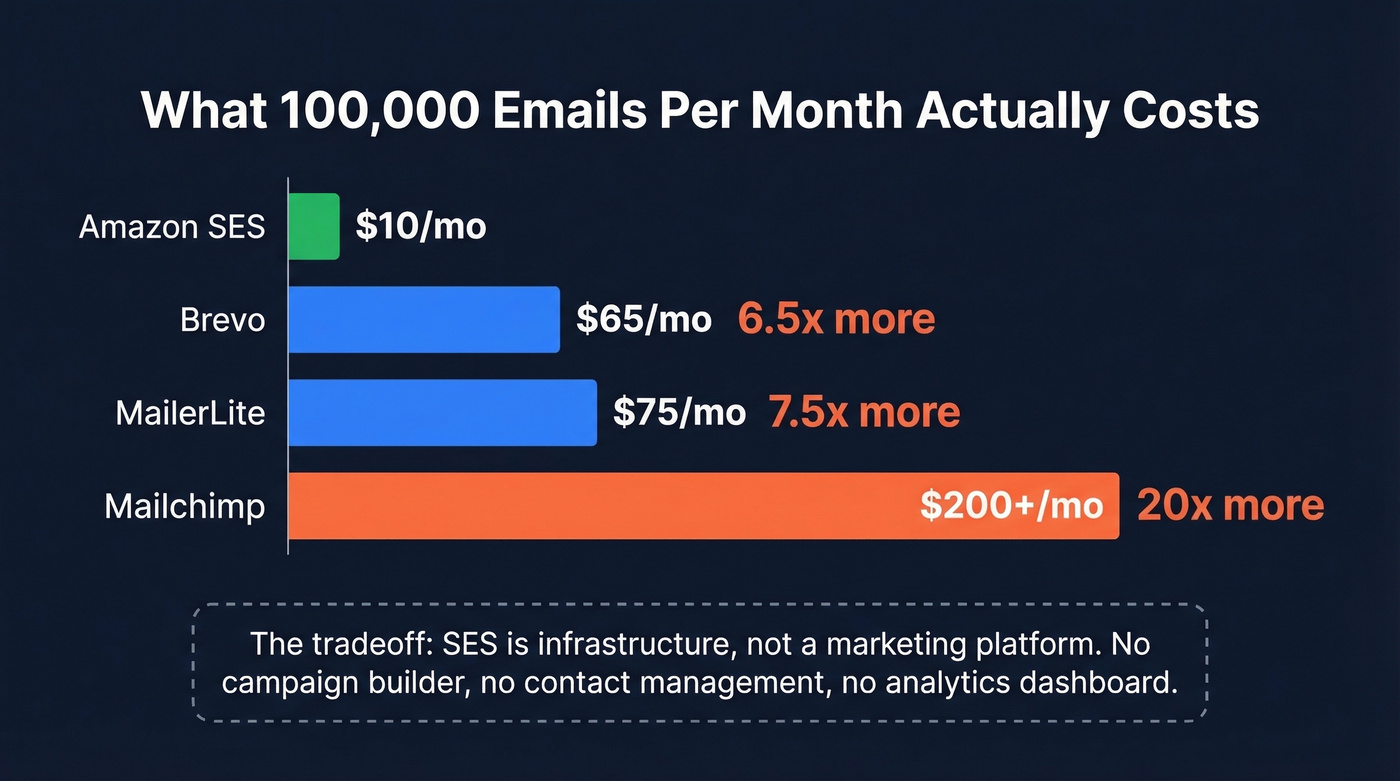
- Amazon SES: ~$10
- Brevo: ~$65
- MailerLite: ~$75
- Mailchimp: ~$200+
That's 6-20x cheaper. The standard SES free tier covers 3,000 messages per month for the first 12 months, and new AWS customers get $200 in credits usable within 12 months - enough for roughly 2 million emails. Dedicated IPs run $24.95/mo per IP. The Virtual Deliverability Manager starts at $0.07/1,000 emails.
The tradeoff is real: SES is infrastructure, not a marketing platform. There's no campaign builder, no contact management, no analytics dashboard beyond basic delivery metrics. You'll need to build or buy everything on top. In our experience, shared IP pools are taking hits from other senders - the inbox placement data showing rates dropping from 54.9% to 40.3% is exactly what that looks like in the wild.
Mailchimp - Biggest Name, Shrinking Value
Use it if you need the ecosystem. Mailchimp's integrations are unmatched - virtually every tool connects to it. The editor is polished, templates are abundant, and brand recognition means your team probably already knows how to use it. Essentials starts at $13/mo.
Skip it if you're cost-conscious at scale. Send limits are expressed as multiples of your contact count (10x on Essentials, 12x on Standard, 15x on Premium), which gets expensive fast. Pay-as-you-go credits expire after 12 months. Deliverability sits at 89.5% in newsletter testing, but inbox placement dropped from 51.9% to 32.3% year over year in API testing. At 50,000 contacts on Standard, you're typically looking at $300-$500/mo - Brevo often gives you more for less.
Watch out: That contact-based billing model means a 10,000-contact list with 3,000 unsubscribes can still bill you for 10,000 if you don't manage audience status correctly. If you're troubleshooting performance, our guide on Mailchimp deliverability issues breaks down the common failure points.
Mailgun - Best API-First Platform
Developer-friendly API, email validation available by plan, granular analytics. Free tier gives you 100 emails/day. Basic at $15/mo for 10,000 emails, Foundation $35/mo for 50,000, Scale $90/mo for 100,000. Overage rates are transparent ($1.80/1,000 on Basic, dropping to $0.40/1,000 at Scale).
The problem: that inbox rate drop - 53.8% to 26.1% - is the worst decline of any ESP tested. A massive red flag for shared IP users. If you're on Mailgun, dedicated IPs and careful domain management aren't optional anymore. If you're weighing list hygiene vs sending infrastructure, see Mailgun vs Prospeo.
ActiveCampaign - Best Automation
The highest independently tested deliverability at 94.2%. The automation builder is genuinely best-in-class - visual workflows with multi-step branching logic, conditional splits based on engagement data, lead scoring that feeds directly into CRM deal stages, and site tracking that triggers sequences based on page visits. No other tool under $100/mo offers this depth. Starts at $15/mo for 1,000 contacts and 10,000 emails.
No free plan (14-day trial only). Pricing scales aggressively with contact count - a 25,000-contact list pushes you well past $100/mo. If you don't need the automation, you're overpaying for deliverability you could get with better list hygiene on a cheaper platform.
SendGrid - Free Plan Is Dead
Warning: SendGrid's free plans were retired on May 28, 2025. After a 60-day transition, free accounts had sending paused and contacts deleted if they stored more than 100. If you're still seeing "SendGrid free tier" in other comparison articles, that information is outdated.
Still a solid API platform for developers who are paying - reliable infrastructure, good documentation, strong ecosystem. But inbox rates dropped from 45.3% to 35.3%, and paid plans typically start around $20-$30/mo.
Moosend - Budget Automation
Clean interface, solid automation for the price, unlimited sends on all paid plans. Pro starts at $9/mo for 500 contacts. The automation builder punches above its weight - conditional workflows and event-based automation at a price point that competes with MailerLite. No free plan (30-day trial only), and the template library is smaller than Mailchimp or Brevo.
Mailtrap
Free tier (4,000 emails, 100 contacts), paid from $15/mo. Mailtrap's real strength is combining email testing and sending in one platform - if you're a developer who needs a staging environment and production sending under one roof, it's worth a look.
Postmark
Free (100 emails), paid from $15/mo, dedicated IP $50/mo. Postmark is built for transactional email - receipts, password resets, shipping notifications. It's not a marketing platform and doesn't try to be. Skip it for campaigns.
Constant Contact
No free plan. Pricing starts around $12/mo and scales with contacts. Deliverability hits 91.7% in independent testing, which is strong. Best for event-driven businesses - RSVP management, ticketing features, and event promotion workflows are where Constant Contact differentiates.
GetResponse
Free plan covers 500 subscribers and 2,500 emails/mo. Paid from $19/mo. Deliverability at 90.9%. GetResponse bundles landing pages and webinar hosting into its platform - if you run webinar-driven funnels, it's one of the few tools that handles the full workflow natively.
Cost Per 1,000 Emails
Pricing models vary wildly. Some charge by emails sent, others by contacts stored, and the difference compounds fast at scale:
| Service | 10K emails/mo | 50K emails/mo | 100K emails/mo |
|---|---|---|---|
| Amazon SES | ~$1 | ~$5 | ~$10 |
| Mailgun (Basic) | $15 | $35 (Foundation) | $90 (Scale) |
| Brevo (Starter) | $9 | ~$35 | ~$65 |
| Moosend | $9 | ~$45 | ~$100 |
| MailerLite | $10 | ~$35 | ~$75 |
| Mailchimp (Standard) | $13+ | ~$300-$500 (50K contacts) | ~$500+ |
| Mailtrap | $15 | ~$55 | ~$100 |
Estimates based on published pricing pages as of Q1 2026. Actual costs vary by plan tier, add-ons, and contact count.
The biggest gotcha is contact-based vs. email-based pricing. Brevo charges by emails sent, so a large contact list that you email selectively stays cheap. MailerLite's paid plans include unlimited sends, but pricing still scales by subscriber tier. Mailchimp bills based on total contacts in your audience, which inflates costs if you don't manage unsubscribed contacts. At 50,000 contacts, Mailchimp can run 3-5x more expensive than Brevo for the same sending volume.
Why List Quality Matters More Than Your ESP
Look at the deliverability data again. Every ESP declined - SendGrid, SES, Mailgun, Mailchimp. All of them. When every platform drops simultaneously, the sending tool isn't the primary variable. The inbox providers are getting stricter, and the quality of what you're sending (and who you're sending to) matters more than which pipe you're sending it through.
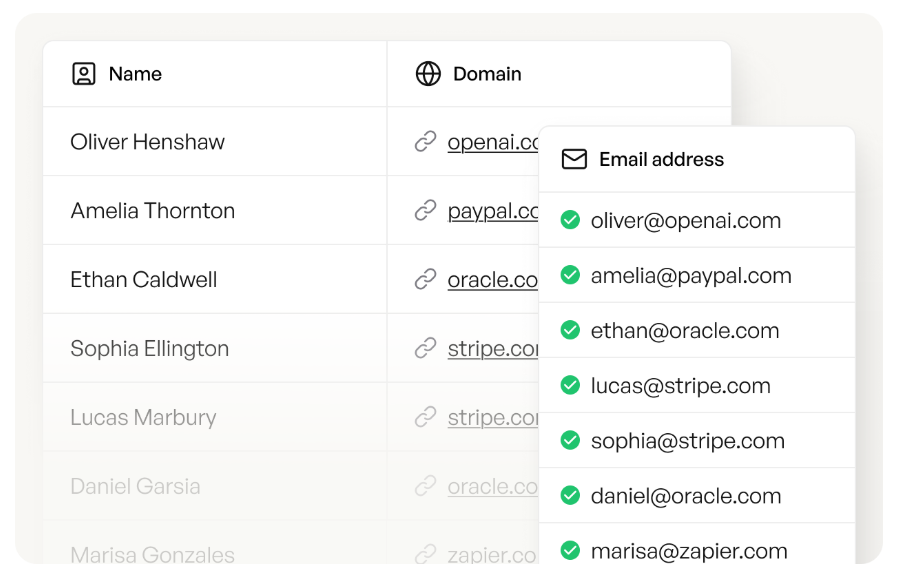
Every hard bounce signals to Gmail and Outlook that you aren't maintaining your list, and that signal compounds. A 5% bounce rate on one campaign can suppress inbox placement for weeks. Verifying your list before every campaign is the highest-ROI investment in your email stack - at $0.01 per verified address, it's negligible compared to the reputation damage from even a handful of bounces. Stack Optimize built from zero to $1M ARR with client deliverability consistently above 94%, bounce rates under 3%, and zero domain flags across all clients. List verification was the foundation of that result.
If you're building a repeatable process, pair verification with email reputation tools and a spam trap removal plan.
How to Choose the Right Service
The right bulk email service depends on what you're actually doing with it. Four buyer profiles, four different answers.
SMB marketer sending newsletters and promotions: Brevo or MailerLite. Brevo wins if you want multi-channel (SMS, WhatsApp). MailerLite wins if you want the simplest possible interface and the best free tier.
Developer or technical team building email into a product: Amazon SES or Mailgun. SES is cheaper at scale. Mailgun has better out-of-the-box tooling. Both require technical setup. For teams sending more than 100,000 emails per month, invest in dedicated IPs - shared pools are getting hammered across every provider.
Cold outreach team: Don't use Mailchimp or Brevo for cold email - they'll shut you down. Cold outreach is a different category entirely. Tools like Instantly, Smartreach.io, and Lemlist are purpose-built for it, with domain rotation, warmup, and inbox management. The consensus on r/coldemail is that Smartreach.io and Instantly lead for deliverability infrastructure, while Lemlist wins on personalization. Whichever tool you pick, verify every address before loading it into your sending sequences - cold outreach on unverified lists is the fastest way to burn a domain. For more on safe sending, see Cold Email Marketing and Email Velocity.
Enterprise team needing advanced automation: ActiveCampaign or HubSpot. ActiveCampaign's 94.2% deliverability and visual automation builder are hard to beat under $100/mo. HubSpot makes sense if you're already in their CRM ecosystem, but expect to pay significantly more - Marketing Hub Professional starts at $800/mo.
Newsletter creators and content publishers should also look at Kit (formerly ConvertKit) and Beehiiv - they're purpose-built for that use case and not covered here.
Real talk: if your list is under 500 contacts, a verified contact list and Gmail with a custom domain works fine. Don't overcomplicate it. Set up SPF/DKIM/DMARC and send.
Bounce rates above 2% destroy sender reputation faster than any ESP can fix it. Prospeo's proprietary verification infrastructure refreshes every 7 days - not 6 weeks - so you're never sending to stale addresses that trigger Gmail and Outlook rejections.
Meritt cut their bounce rate from 35% to under 4%. Your list is next.
FAQ
What is a bulk email service?
Software that sends large volumes of email - marketing campaigns, newsletters, transactional messages - while managing deliverability, authentication, and compliance. Unlike Gmail or Outlook (which cap daily sends), these platforms provide SPF/DKIM/DMARC infrastructure needed to land in inboxes at scale.
How many emails can you send for free?
MailerLite offers the most generous free plan at 12,000 emails per month (500 subscribers). Brevo gives 300 per day, roughly 9,000 monthly. GetResponse covers 2,500 emails for 500 subscribers. Mailchimp's free tier is limited to 500 emails with 250 contacts. SendGrid's free plan no longer exists.
Do you need a dedicated IP for mass email?
Only if you consistently send more than 100,000 emails per month or need strict reputation isolation. Shared IPs work fine for most SMBs - the ESP manages reputation across senders. Dedicated IPs require a 2-4 week warm-up period of gradually increasing volume. Current rates run $25-50/mo.
How do you improve bulk email deliverability?
Authenticate everything first - SPF, DKIM, and DMARC are table stakes in 2026. Verify your list before sending to catch bad addresses and spam traps. Keep spam complaints under 0.1% and monitor reputation via Google Postmaster Tools - 70% of senders don't, and it shows.
What's the cheapest way to send bulk email?
Amazon SES at $0.10 per 1,000 emails - roughly $10 for 100,000 sends. That's 6-20x cheaper than marketing platforms like Mailchimp or Brevo at the same volume. The tradeoff: SES is raw infrastructure with no campaign builder, templates, or contact management built in.