Bump Email Guide: Templates, Timing & Data-Backed Tactics for 2026
You sent a solid email to a VP of Marketing three days ago. Personalized opener, clear value prop, specific ask. Now you're staring at an empty inbox wondering if it landed in spam, got buried, or just didn't matter enough to reply to.
That anxiety - "Am I being annoying if I follow up?" - kills more deals than bad messaging ever will. The data says send that bump email. 42% of all cold email replies come from follow-ups, meaning nearly half your potential replies are sitting in unsent drafts right now.
Quick Version
A bump email is a short reply to your own unanswered email - two sentences max, same thread. Here's the cheat sheet:
- Wait 2-3 business days, not 1. Next-day follow-ups reduce replies by 11%; waiting three days increases them by 31%.
- Send Tuesday-Thursday, 9-11 AM in the recipient's local time.
- Keep it under 80 words.
- Two well-timed bumps can lift reply rates from 2.5% to 11.4%, based on a 26,000-prospect sequence study.
- Templates and the full timing framework are below.
What Does "Bump Email" Mean?
A bump email is a brief reply you send in the same thread as your original message, designed to push that message back to the top of someone's inbox. It's not a rewrite. It's not a new pitch. It's a nudge - usually one to two sentences - that gives the recipient a low-friction reason to respond.
The distinction between a bump and a follow-up matters more than most people realize. A follow-up can be a brand-new email with fresh information, a different angle, or even a new subject line. An email bump stays in the original thread and keeps things short. Think of it as tapping someone on the shoulder versus starting a new conversation entirely.
Why bother? Because the average cold email reply rate is 3.43%. That means roughly 96 out of 100 first emails go unanswered. Most of those aren't rejections - they're victims of decision fatigue. Your prospect opened your email, thought "interesting, I'll reply later," and then 14 new messages pushed it below the fold. A bump resurfaces your message without making the recipient feel like they're getting a second sales pitch.
Why Bumps Actually Work
The numbers here are hard to argue with. A bumper reply sequence tested across 26,000 prospects watched the overall reply rate jump from 2.5% to 11.4% after just two short bumps. The first bumper alone added 5.2 percentage points. That's not marginal - that's a fundamentally different pipeline.
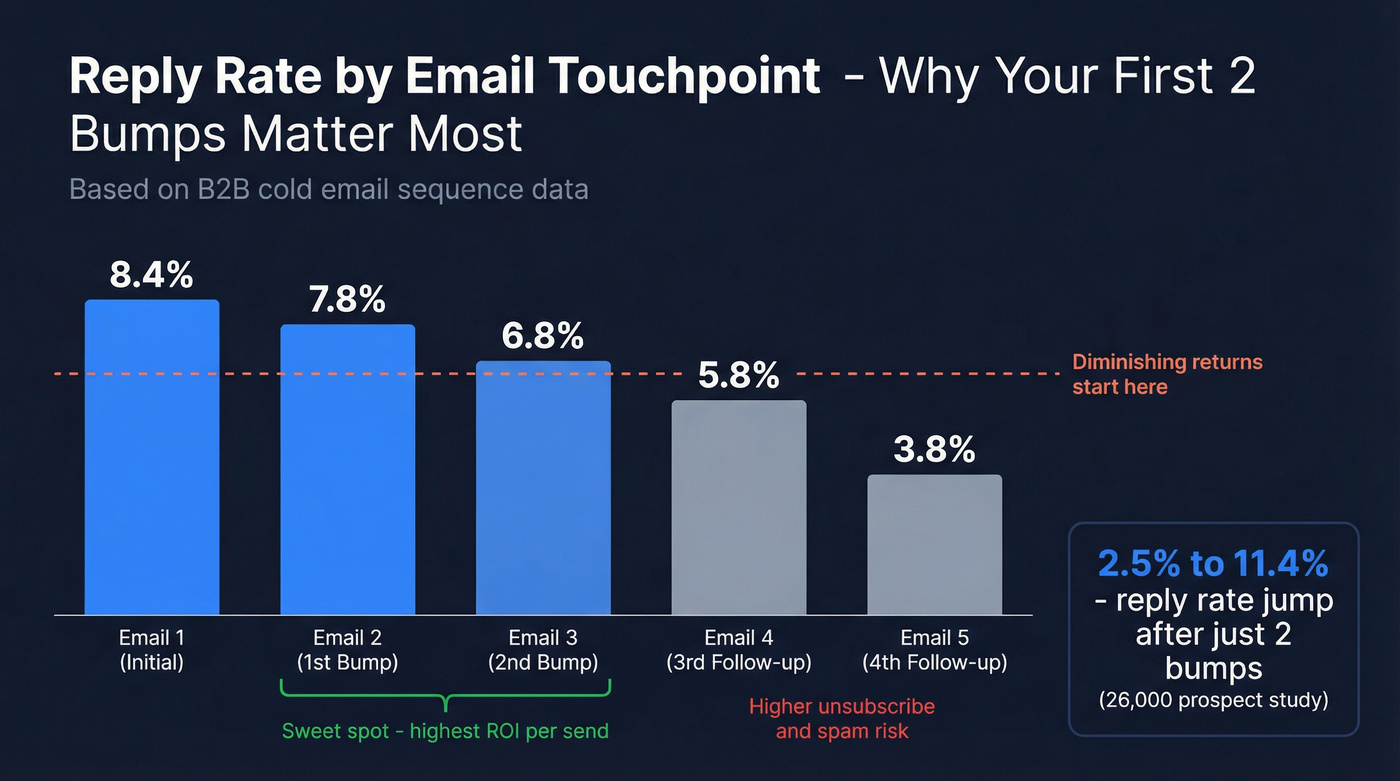
The per-touch decline curve tells you where to focus your energy. Data compiled by Stripo shows response rates running 8.4% on the initial email, 7.8% on the second, 6.8% on the third, 5.8% on the fourth, and 3.8% by the fifth. The first two follow-ups carry the most weight. After that, you're fighting diminishing returns hard.
Here's the stat that should kill your "Am I being annoying?" anxiety for good: 73-77% of B2B buyers prefer vendors to contact them via email. They're not annoyed by your nudge. They're expecting it. The sweet spot for sequence length is 4-7 touchpoints, but most of the value concentrates in those first two bumps. A two-sentence reply beats a rewritten pitch every time.
Bump Email Templates That Get Replies
If your bump is longer than your original email, it's not a bump - it's a second cold email. Every template below is designed to be pasted, personalized in under 30 seconds, and sent.
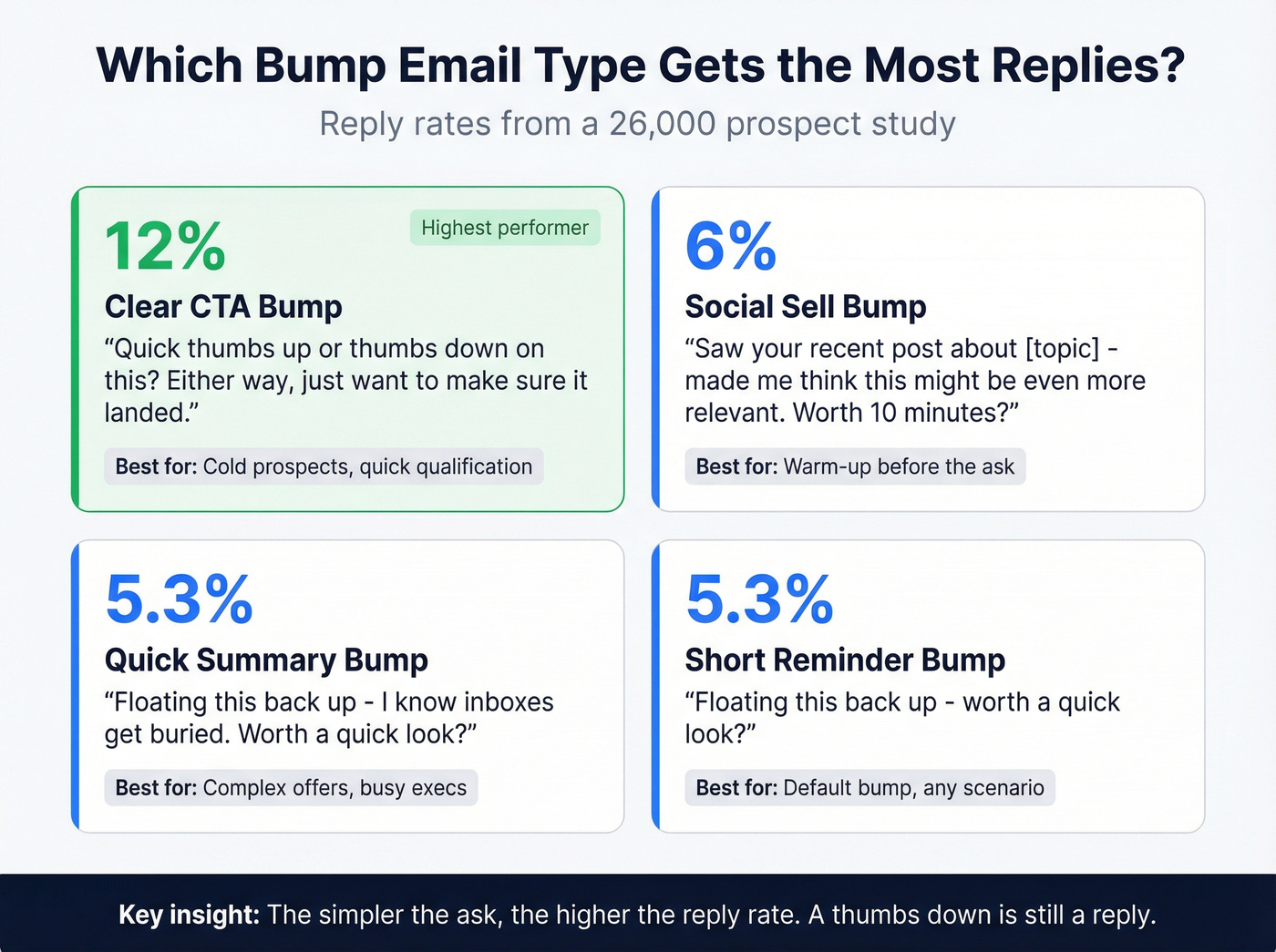
Here are the bumper reply scripts and reply rates from the 26,000-prospect Outreach study:
| Bump Type | Reply Rate | Best For |
|---|---|---|
| Clear CTA | 12% | Cold prospects, quick qualification |
| Social sell | 6% | Warm-up before the ask |
| Quick summary | 5.3% | Complex offers, busy execs |
| Short reminder | 5.3% | Default bump, any scenario |
Cold Sales Bumps
The CTA Bump (12% reply rate)
Hi {{first_name}}, quick thumbs up or thumbs down on this? Either way, just want to make sure it landed.
This works because it asks for almost nothing. A thumbs down is still a reply, and replies open conversations.
The Short Reminder (5.3% reply rate)
Floating this back up - I know inboxes get buried. Worth a quick look?
Clean, no pressure, no guilt trip. It acknowledges reality without being passive-aggressive. This is the quintessential bump up email - minimal effort for the sender, minimal friction for the recipient.
The Social Sell (6% reply rate)
Saw your recent post about {{topic}} - made me think this might be even more relevant. Worth 10 minutes?
This one requires a tiny bit of homework, but the personalization pays off. Personalized emails see 29% higher open rates - and personalization works even better in follow-ups because it proves you're paying attention, not just running a sequence. If you want more options, steal a few patterns from these outreach email templates.
The Break-Up Bump
Last one from me, {{first_name}} - if the timing's off, no worries at all. Door's open whenever it makes sense.
We've tested dozens of variations, and the break-up bump has a counterintuitive power: telling someone you're about to stop emailing them often triggers a reply. People hate losing options more than they hate ignoring emails.
Warm Lead / Proposal Follow-Up
Post-Demo Bump
Hi {{first_name}}, wanted to circle back on our conversation {{day}}. Any questions I can clear up before you loop in {{stakeholder}}?
Name the next step. Don't just "check in" - give them something specific to respond to. If you're building a full cadence, use this prospect follow up playbook.
Post-Proposal Bump
Following up on the proposal I sent {{date}}. Happy to walk through the numbers or adjust scope - whatever's most useful on your end.
This works because it offers flexibility without desperation. You're making it easy for them to re-engage on their terms.
Non-Sales Bump Examples
Not every bump is about closing a deal. Job seekers, freelancers, and anyone waiting on internal approvals need templates too.
Job Application Bump
Hi {{name}}, I applied for the {{role}} position on {{date}} and wanted to make sure my application came through. Still very interested - happy to provide anything else that's helpful.
Invoice / Payment Bump
Hi {{name}}, just floating Invoice #{{number}} back up - it was due {{date}}. Let me know if you need anything from my end to process it.
Keep invoice bumps factual and friendly. No passive aggression, no "as per my last email." State the invoice number, the due date, and offer to help. That's it.
Internal Approval Bump
Hey {{name}}, checking in on the {{request}} I sent over {{day}}. Need to move forward by {{deadline}} - let me know if there's anything blocking approval.
Internal bumps can be more direct because you're colleagues, not strangers. Name the deadline. People prioritize what has a due date.
Networking Bump
Hi {{name}}, circling back on my note from {{day}}. Would still love to grab 15 minutes - happy to work around your schedule.
Networking bumps are the most under-used type. Most people send one outreach email to a potential mentor or connection and then never follow up out of politeness. That politeness costs them the relationship. In our experience running outbound campaigns, the people who follow up once are the ones who build real networks - the ones who don't are just collecting unanswered threads.

A perfectly timed bump email is worthless if it bounces. Prospeo's 98% email accuracy means your follow-ups actually reach the inbox - not a dead address. 143M+ verified emails, refreshed every 7 days.
Stop bumping emails that were never deliverable in the first place.
When to Send a Bump Email
Timing isn't a nice-to-have. It's the difference between a 31% boost and an 11% penalty.
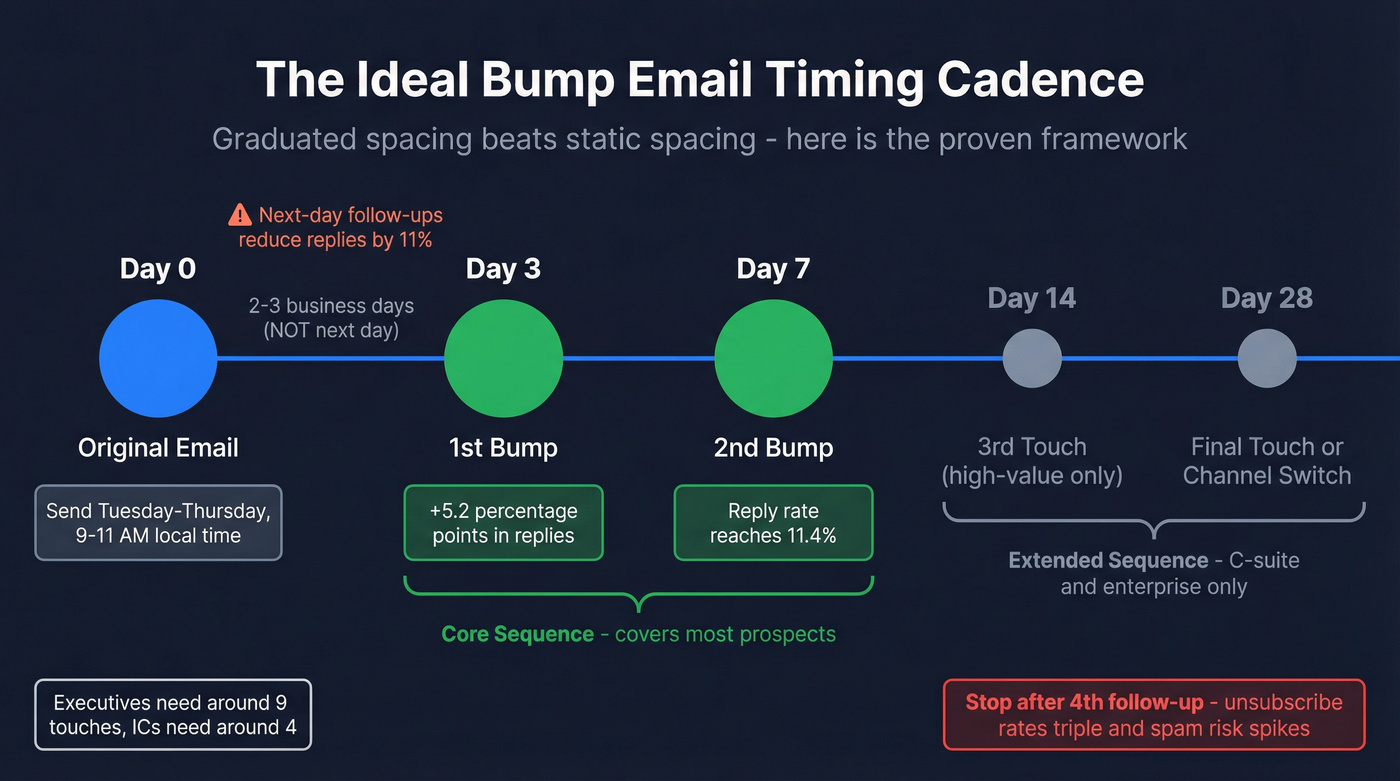
Graduated spacing cadence: Day 0 (original send) -> Day 3 (first bump) -> Day 7 (second bump). Those two bumps are your core sequence. For high-value prospects, add touches around Day 14 and Day 28. Static spacing - same gap every time - looks automated and hurts deliverability. Graduated spacing feels human. If you want a deeper timing framework, see when should i send a follow up email.
Executives typically require around 9 touches before engaging, compared to 4 for individual contributors. If you're targeting C-suite, extend your cadence and be patient. For everyone else, 2-3 bumps is usually enough.
Best days and times: Tuesday through Thursday, 9-11 AM in the recipient's local time zone. Wednesday pulls the highest reply rates. Monday mornings are a graveyard - your message lands in a flooded inbox alongside every newsletter, automated report, and weekend catch-up thread.
When to stop: By the 4th follow-up, unsubscribe rates triple and spam risk spikes. You don't need 7 follow-ups. You need 2-3 good bumps and better data. If three bumps don't work, switch channels - a brief voice note or a connection request on a professional network often breaks through where email can't. If you’re going multi-channel, these benefits of cold calling can help you pick the right mix.
Subject Lines for Bumps
47% of email opens are driven by the subject line, so this decision matters. You've got two options. For more examples, pull from these subject lines for follow-up emails.
Reply in the same thread (recommended default). Your subject line becomes "Re: [original subject]" automatically. This keeps context intact, shows the recipient the full conversation, and avoids triggering spam filters with a brand-new message. For bumps, this is almost always the right call. That means your original subject line does the heavy lifting:
- "Re: Quick question about {{company}}'s Q3 pipeline"
- "Re: {{first_name}} - idea for {{pain point}}"
- "Re: {{Company}} + {{outcome}} in 30 days"
New subject line (use sparingly). Only switch subjects when you're genuinely changing the angle - different value prop, new trigger event, fresh social proof. Keep it to 6-7 words and make it specific:
- "Quick question, {{first_name}}"
- "{{Company}} + {{outcome}} - worth 10 min?"
- "Saw your {{trigger event}}"
- "Following up (with a better reason)"
Personalized subject lines see 29% higher open rates. Even just dropping in a first name or company name moves the needle.
Mistakes That Kill Your Reply Rate
"Just checking in." This is the worst-performing bump in existence. It gives the recipient zero reason to reply. Every bump needs a micro-reason - a question, a new data point, a deadline.
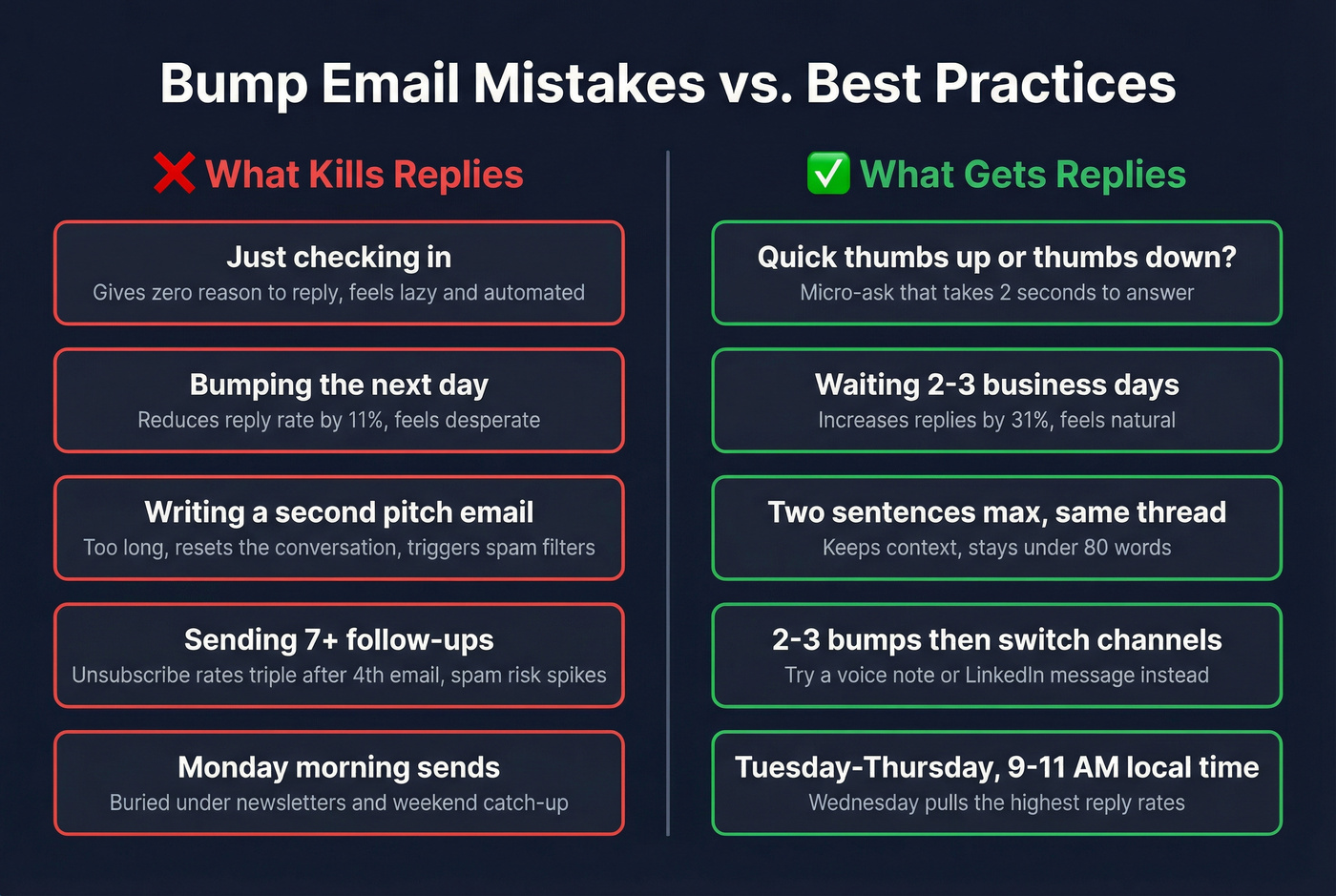
Bumping too soon. Next-day follow-ups reduce replies by 11%. Give people at least two business days. They're busy, not ignoring you.
Writing bumps that are too long. Emails under 80 words perform best in cold outreach, and bumps should be even shorter. Two sentences is the sweet spot. Our team has found that the bumps pulling the best replies clock in under 30 words - anything longer and you're giving the recipient too much to process, which gives them a reason to defer again. If you’re optimizing sequences end-to-end, use these cold email tactics to lift replies without adding length.
Sending on Monday mornings. Skip it. Your message lands in a flooded inbox alongside every newsletter and automated report from the weekend. Tuesday through Thursday is your window.
Not verifying contact data. A bump to a bounced address doesn't just fail - it damages your sender reputation. Once your domain reputation drops, every email you send suffers. Verify before you send, every time. If you’re comparing tools, start with this list of email ID validators.
Ignoring the 4th-follow-up cliff. Unsubscribe rates triple after the third follow-up. If someone hasn't replied after three touches, the problem isn't persistence - it's targeting. Move on or switch channels.
The Real Reason Bumps Fail
Let's be honest: the best template in the world can't save you if the email address is wrong. Teams build tight sequences, nail the copy, optimize the timing - and still burn results because the underlying contact data is stale. Those bounces don't just waste effort. They actively erode your sender domain's reputation, which tanks deliverability for every future email you send.
Here's the thing - most "low reply rate" problems aren't messaging problems. They're data problems. If your bounce rate is above 5%, no amount of template optimization will save you. Fix the data first, then worry about the copy. The consensus on r/coldemail is pretty clear on this: people obsess over subject lines when their list quality is the real bottleneck. If you’re seeing list decay, this guide on B2B contact data decay breaks down what to track.
Before you hit send on any bump sequence, verify your list. Prospeo runs every address through a 5-step verification process with 98% email accuracy and refreshes its data every 7 days - compared to the 6-week industry average. The free tier gives you 75 email verifications per month, enough to test the workflow before committing.

You just learned that two well-timed bumps can 4x your reply rate. Now imagine running that sequence against contacts verified through a 5-step process at $0.01 per email. That's Prospeo - 300M+ profiles, 98% accuracy, zero bounces killing your domain.
Send bump emails with confidence - start with data that actually connects.
FAQ
What's the difference between a bump email and a follow-up?
A bump email is a one-to-two sentence reply in the same thread - no new information, just a nudge to resurface the conversation. A follow-up can be a completely new email with a different angle, fresh value, or a new subject line. Bumps resurface; follow-ups re-engage.
How many bumps should I send before stopping?
Two to three is the sweet spot. By the 4th follow-up, unsubscribe rates triple and spam complaints spike. If three bumps don't get a response, switch channels - try a voice note or a connection request on a professional network.
Is it unprofessional to bump an email?
No. 42% of all email replies come from follow-ups, not the initial send. Keep your bump short, respectful, and give the recipient a low-effort reason to respond. A two-sentence nudge is standard practice across sales, recruiting, and business development.
Should I change the subject line when bumping?
Reply in the same thread to preserve context and avoid spam filters. Only use a new subject line when you're genuinely changing the angle - different value prop, new trigger event, or fresh social proof.
How do I make sure my bump actually arrives?
Verify the email address before sending. Bounced messages damage your sender reputation and hurt deliverability for every future email. A tool like Prospeo catches invalid addresses, spam traps, and catch-all domains before they can do damage - the free plan covers 75 verifications per month so you can test before scaling.