

How to Build a Business Development Funnel That Actually Generates Pipeline
Your VP of Sales just asked how many meetings your BD team needs to book this quarter to hit the pipeline target. You open a spreadsheet, stare at it, and realize you don't have a business development funnel - you have a list of activities with no conversion math connecting them.
Outbound pipeline delivers results in 30-60 days versus 6-12 months for inbound SEO. That speed only works if there's a real funnel behind it.
What Is a Business Development Funnel?
A business development funnel is the structured process your BDR team uses to identify target accounts, initiate outreach, and generate qualified opportunities that get handed to sales. It sits between marketing and sales - the pipeline engine that converts a list of companies into booked meetings and qualified opps.
The confusion happens because people use "funnel" to mean three different things:
| BD Funnel | Sales Funnel | Marketing Funnel | |
|---|---|---|---|
| Owner | BDR/SDR team | AEs / closers | Marketing team |
| Input | Target account list | Qualified opportunities | Website visitors |
| Output | Sales-accepted opps | Closed-won revenue | MQLs / SQLs |
| Key metric | Meetings booked | Win rate | Lead-to-MQL rate |
The BD funnel feeds the sales funnel. Marketing feeds both. But the BD funnel is uniquely outbound, proactive, and owned by your development reps. It can also include partner and channel tracks - a blind spot most guides skip entirely.
Here's the thing: SDRs should source 40-60% of net-new pipeline. If your BD function isn't pulling that weight, you don't have a funnel problem. You have a strategy problem.
The 6 Stages of a BD Funnel
Modern BD funnels aren't rigid pipelines. They adapt based on signals like intent surges, leadership changes, and new tech adoption. Gartner research shows buyers complete roughly 70% of their research before engaging sales, performing an average of 12 searches before reaching out to a specific brand. Meanwhile, organic social reach has collapsed from 60% to 2-5%. Your funnel has to be multi-channel or it's invisible.
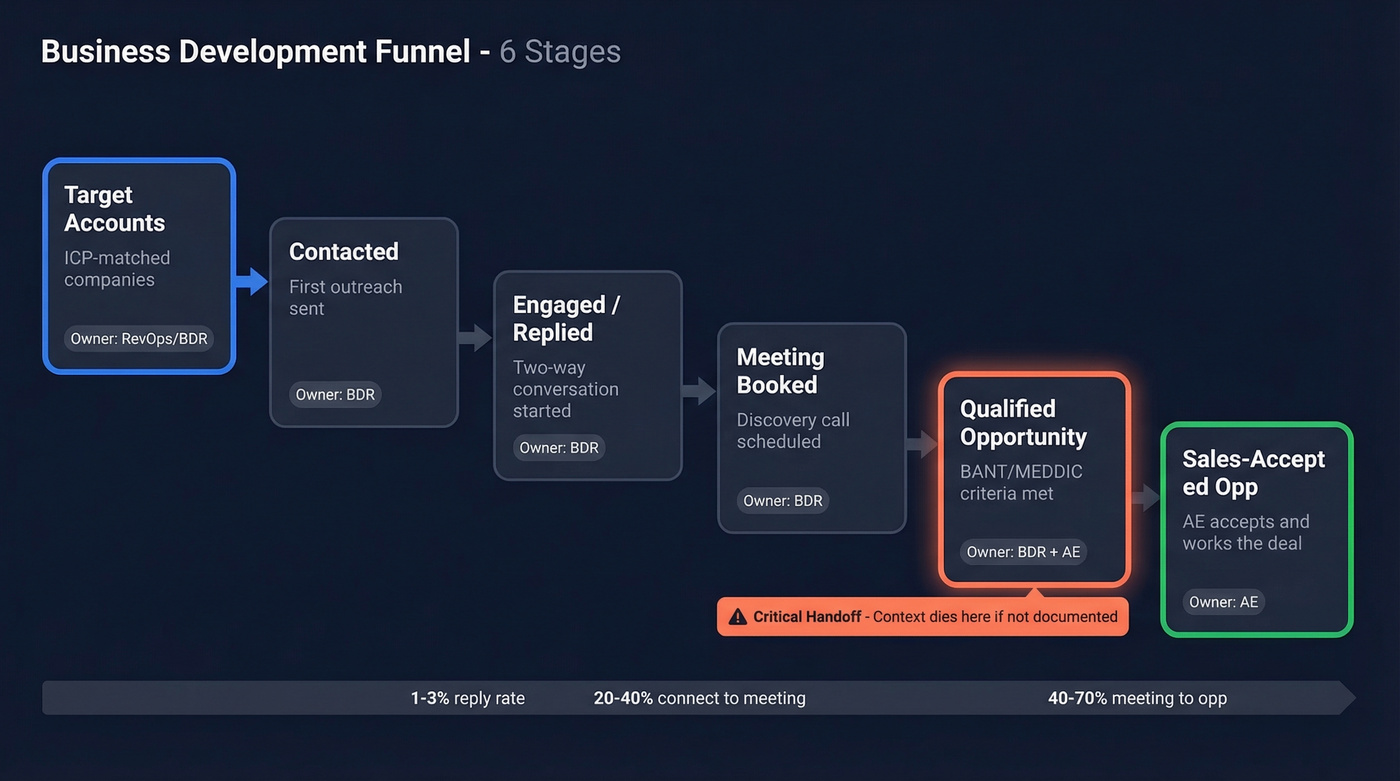
A quick distinction worth making: BDRs are outbound hunters targeting 8-12 meetings per month, while SDRs typically qualify inbound leads at 15-20 meetings per month. The stages below apply to the outbound BDR motion.
- Target Accounts - ICP-matched companies identified via firmographic, technographic, and intent filters. Owner: RevOps/BDR. Exit criteria: contact data verified, account assigned.
- Contacted - First outreach sent via email, call, or social touch. Owner: BDR. Exit: at least one multi-channel touchpoint completed.
- Engaged / Replied - Prospect responds or interacts meaningfully. Owner: BDR. Exit: two-way conversation initiated.
- Meeting Booked - Discovery or qualification call scheduled. Owner: BDR. Exit: calendar hold confirmed, context notes logged.
- Qualified Opportunity - Meeting held, BANT/MEDDIC criteria met. Owner: BDR + AE. Exit: opportunity created in CRM with deal value.
- Sales-Accepted Opportunity (SAO) - AE accepts the opp and commits to working it. Owner: AE. Exit: formal handoff complete, BDR credited.
The critical handoff is stage 4 to 5. This is where context gets lost and deals die. Document pain points, timeline, budget signals, and competitive context before the AE takes over - or watch that meeting you worked three weeks to book evaporate in a single confused discovery call.
Funnel Benchmarks for BDR Teams
Without benchmarks, you're guessing. Here's what good looks like across SaaS companies, based on data from Salesforce's State of Sales report and aggregated SaaS benchmarks.
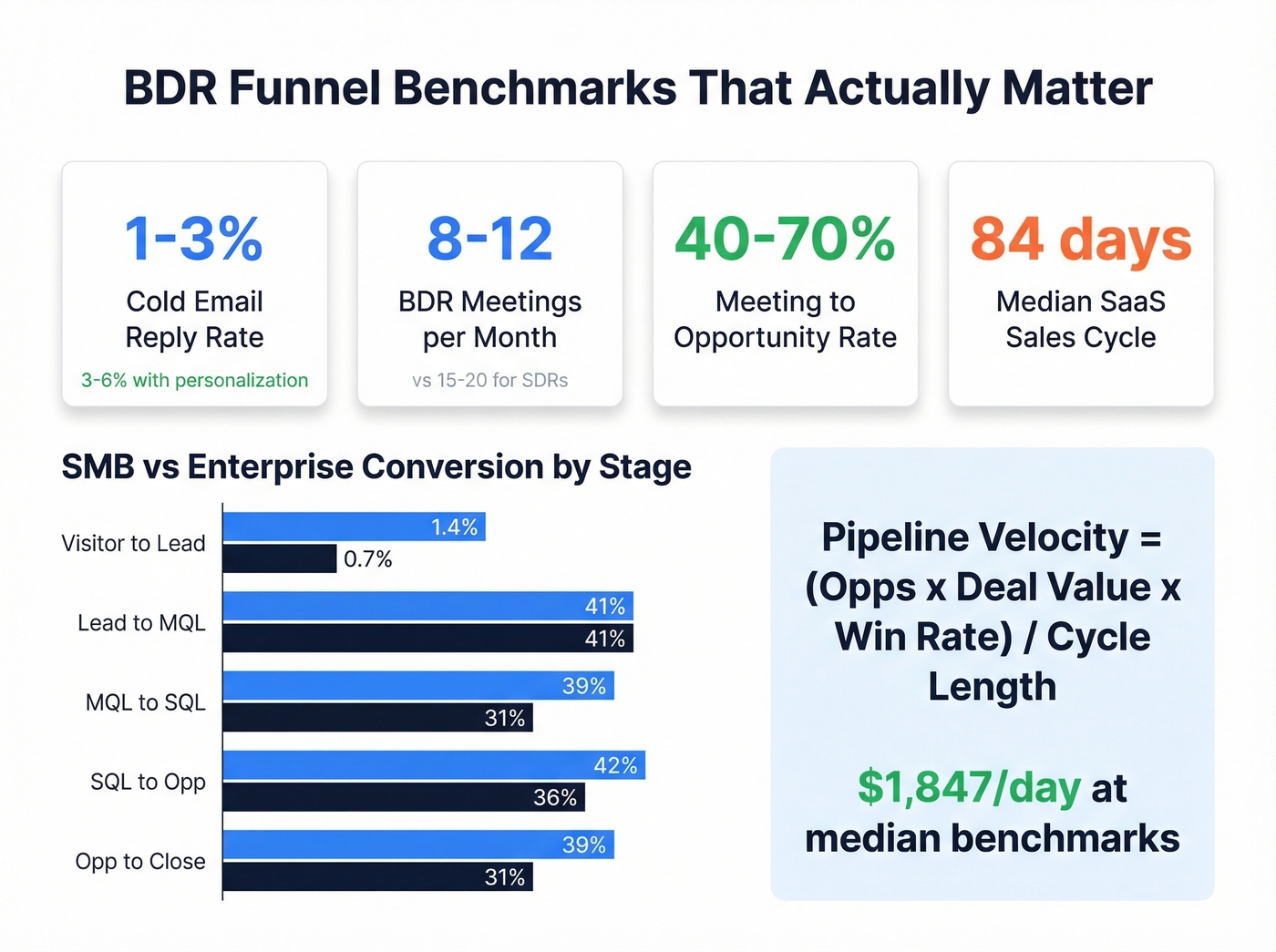
Outbound Activity Ratios
| Metric | Benchmark |
|---|---|
| Cold email reply rate | 1-3% (3-6% with personalization) |
| Connect to Meeting | 20-40% |
| Meeting to Opportunity | 40-70% |
| SDR meetings/month | 15-20 |
| BDR meetings/month | 8-12 |
Stage-by-Stage Conversion: SMB vs Enterprise
| Stage | SMB / Mid-Market | Enterprise |
|---|---|---|
| Visitor to Lead | 1.4% | 0.7% |
| Lead to MQL | 41% | 41% |
| MQL to SQL | 39% | 31% |
| SQL to Opportunity | 42% | 36% |
| Opp to Close | 39% | 31% |
These are median figures. The overall lead-to-customer range is 2-5% in B2B SaaS. Channel matters too: SEO-sourced leads convert at 2.1% visitor-to-lead versus just 0.7% for PPC.
Pipeline velocity ties it all together: (Opportunities x Avg Deal Value x Win Rate) / Sales Cycle Length. For SaaS, that works out to roughly $1,847/day at median benchmarks, with a typical 84-day sales cycle. We've found that teams who actually calculate this number make better hiring and tooling decisions than teams who just track meetings booked.

Your funnel math breaks down the moment bad data enters at the top. Prospeo's 300M+ profiles with 98% email accuracy and 7-day refresh cycle mean every contact you load into your cadence is real, current, and reachable. Layer 30+ filters - intent data, technographics, headcount growth, funding - to nail your ICP from Step 1.
Stop feeding your BD funnel stale data that kills conversion at every stage.
How to Build a BD Funnel from Scratch
Step 1: Define Your ICP
Start with firmographic criteria - industry, headcount, revenue, geography. Then layer in technographic signals and intent data. A vague ICP is the root cause of most funnel problems because you can't fix conversion rates downstream if you're targeting the wrong accounts upstream.
"We sell to mid-market SaaS" isn't an ICP. That's a market.
A real ICP looks like this: B2B SaaS companies with 50-500 employees, $5M-$50M ARR, using Salesforce and a sequencing tool, headquartered in North America, with a VP of Sales or CRO in the org chart, and showing hiring signals on the SDR/BDR team. That level of specificity changes everything about your outreach quality and reply rates. (If you need a starting point, use an ideal customer profile template.)
Step 2: Build a Verified Contact List
Your funnel is only as good as the data feeding it. Prospeo's B2B database covers 300M+ professional profiles with 30+ search filters including intent data, technographics, job change signals, headcount growth, funding, and revenue - all on a 7-day refresh cycle. The free tier gives you 75 emails plus 100 Chrome extension credits per month to test before committing.

Step 3: Design a Multi-Touch Cadence
A single email doesn't build pipeline. Map a sequence: Day 1 email, Day 2 social touch, Day 4 call, Day 6 follow-up, Day 9 breakup. Most sales happen on the 5th-7th touchpoint - a pattern the r/b2bmarketing community confirms repeatedly. If your cadence stops at two touches, you're leaving meetings on the table. If you want a proven structure, start with a B2B cold email sequence.
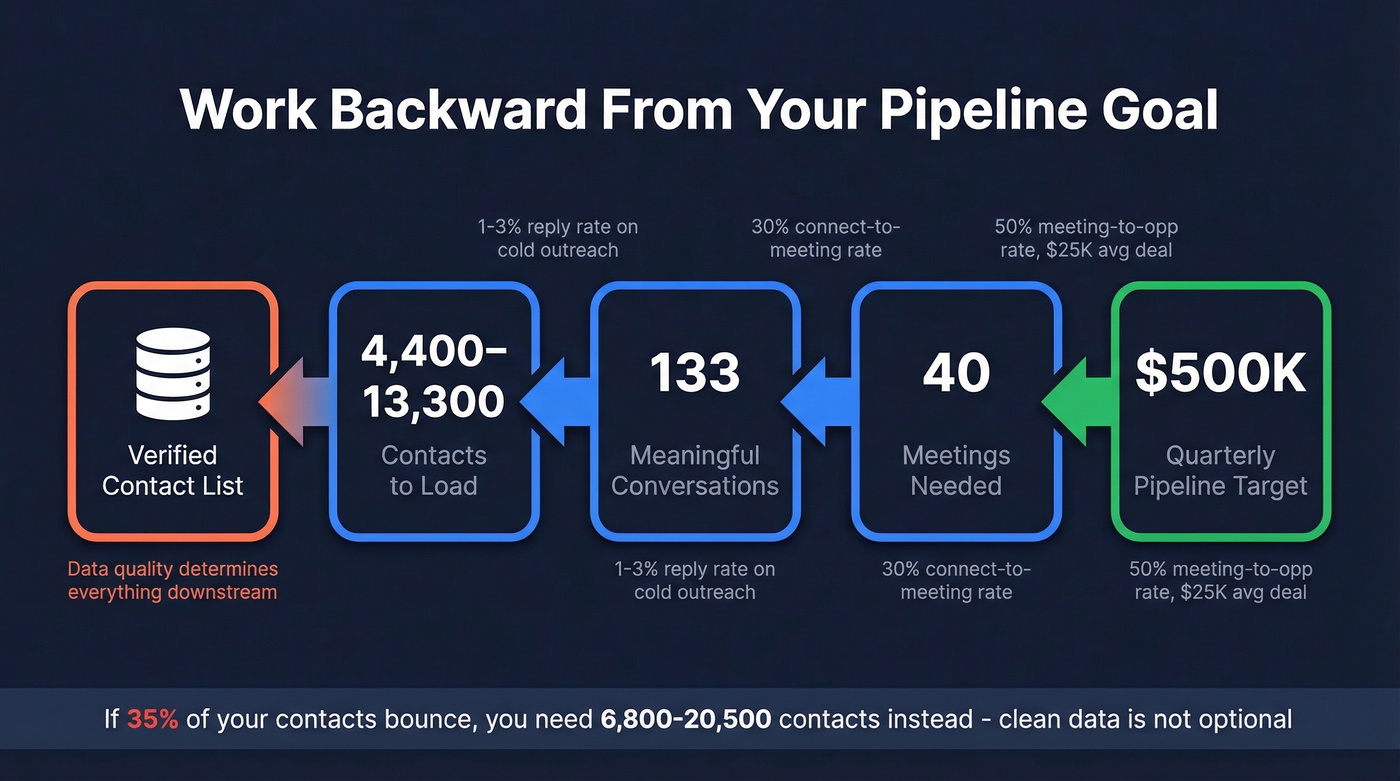
Step 4: Set Conversion Targets
Work backward from your pipeline goal. Need $500K in qualified pipeline this quarter? At a 50% meeting-to-opp rate and $25K average deal size, that's 40 meetings. At a 30% connect-to-meeting rate, you need about 133 meaningful conversations. Now you know exactly how many contacts to load at the top. (To go deeper, track funnel metrics consistently.)
Step 5: Instrument Tracking
Every stage needs to be trackable in your CRM. Create pipeline stages that mirror your funnel, set up required fields for exit criteria, and connect your sequencer so activity data flows automatically. If reps have to manually log stages, they won't - and you'll be flying blind within two weeks. A fully-loaded in-house SDR costs $12K+ per month, so you need the tracking to prove ROI. If you're seeing leaks, audit your sales pipeline challenges before you add more tools.
Step 6: Run Weekly Funnel Reviews
Look at conversion rates between each stage every week. Where's the biggest drop-off? If contacted-to-engaged is tanking, your messaging needs work. If meeting-to-opportunity is low, tighten your qualification criteria. Iterate fast. We run these every Monday morning, and the single biggest unlock has been catching messaging problems within a week instead of letting them bleed pipeline for a full quarter.
You just calculated that you need 133 conversations to hit $500K in pipeline. Now imagine 35% of those contacts bouncing because your data provider refreshes every 6 weeks. Prospeo refreshes every 7 days, delivers 98% accurate emails at $0.01 each, and teams using it book 26% more meetings than ZoomInfo users.
Fix the top of your funnel and every stage converts better.
BD Funnel Tool Stack by Stage
| Stage | Tool | Approx. Pricing |
|---|---|---|
| Prospecting | Prospeo | ~$0.01/email, free tier available |
| Prospecting | Apollo | ~$49-99/mo per user |
| Prospecting | ZoomInfo | ~$15-40K/yr |
| Outreach | Instantly | ~$30-97/mo |
| Outreach | Smartlead | ~$39-94/mo |
| Outreach | Lemlist | ~$39-99/mo |
| Calling | CloudTalk | ~$34/mo |
| Calling | Aircall | ~$40/mo per user |
| CRM | HubSpot | Free CRM; paid from ~$20/mo |
| CRM | Pipedrive | ~$24/mo per user |
| CRM | Salesforce | ~$25/user/mo entry tier |
| Scheduling | Calendly | Free - $12/mo |
| Analytics | GA4 / Power BI | GA4 free; Power BI has free tier |
ZoomInfo makes sense for large orgs that need the full GTM suite, but for most BD teams running outbound, that's overkill. If your average deal size is under $30K, you almost certainly don't need a $15K+ data contract. Skip it and put that budget toward hiring another BDR. If you're evaluating options, compare your stack against the best SDR tools and outbound lead generation tools.
5 Mistakes That Kill Pipeline
Too many stages. Keep it to 5-6 max. We've seen teams with 9-stage funnels where nobody could explain the difference between stages 4 and 5. If your reps can't tell you the exit criteria for a stage without checking a wiki, merge it with the one next to it.
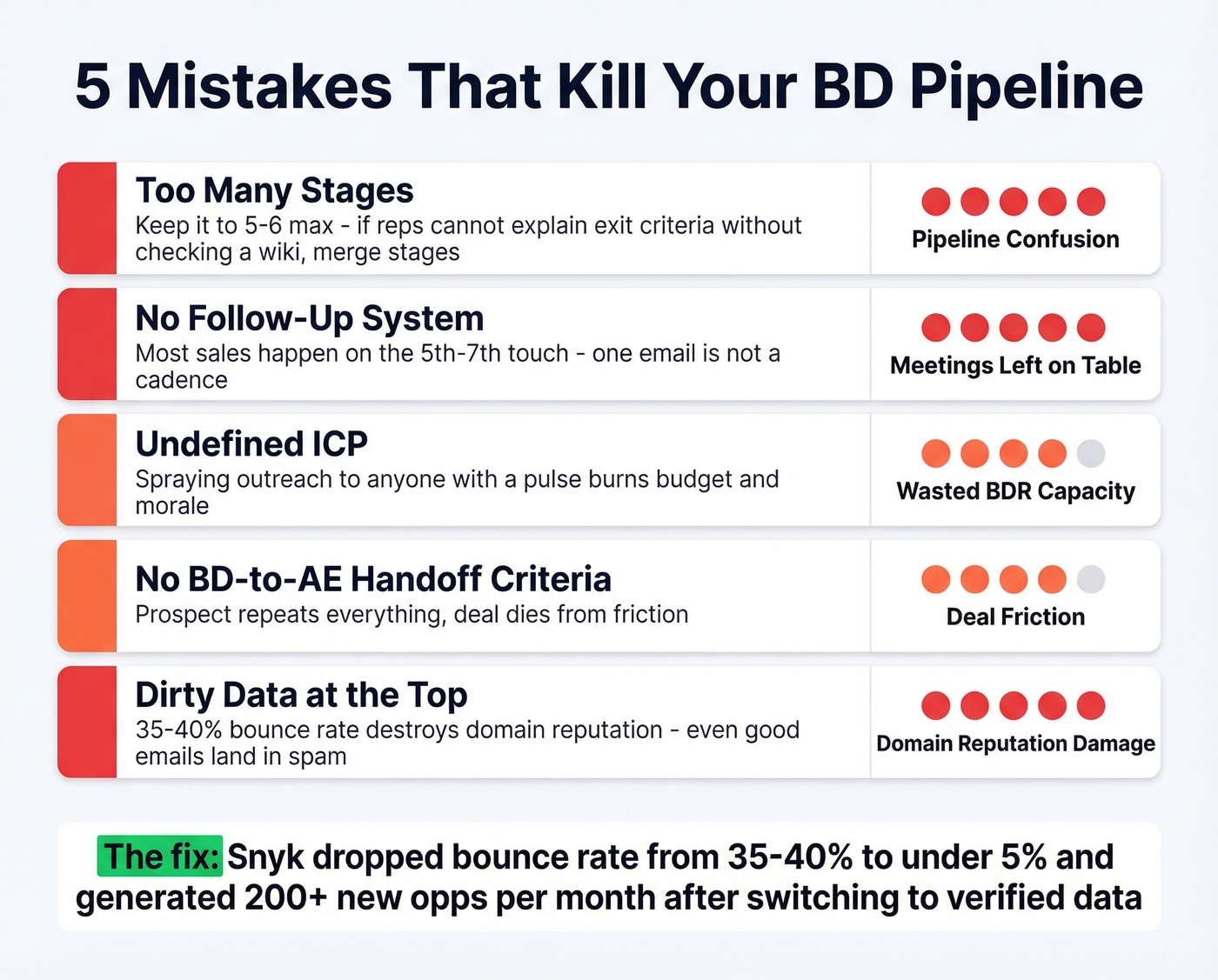
No follow-up system. Your BDR sent one email and moved on. Build follow-up into the cadence - don't leave it to memory. This is the single most frustrating pattern in outbound because it's so easy to fix and so expensive to ignore. If you need copy you can deploy today, use these sales follow-up templates.
Undefined ICP. A real ICP includes headcount range, tech stack, growth signals, and specific titles. Spraying outreach to anyone with a pulse burns budget and morale.
No BD-to-AE handoff criteria. The BDR books a meeting, the AE shows up cold, the prospect repeats everything, and the deal dies from friction. Define what must transfer at handoff: pain points, timeline, budget range, competitive context, and the specific trigger that got the prospect to agree to a call. If you want a clean process, standardize it with a handoff email template.
Dirty data at the top. Your BDR sent 500 cold emails last week. 180 bounced. Your domain reputation just took a hit, and now even the good emails land in spam. Snyk's BD team dropped their bounce rate from 35-40% to under 5% after switching to verified data, generating 200+ new opportunities per month. Clean data isn't a nice-to-have - it's the foundation of every working business development funnel.
FAQ
What's the difference between a BD funnel and a sales funnel?
A BD funnel generates qualified pipeline through outbound prospecting; a sales funnel closes those opportunities into revenue. The BD funnel's output - sales-accepted opportunities - becomes the sales funnel's input. Different stages, different owners, different metrics.
How many stages should a BD funnel have?
Five to six is the sweet spot for most outbound teams. More creates reporting overhead and hides where deals actually stall. If you can't explain two adjacent stages in one sentence each, merge them.
What's a good BD funnel conversion rate?
Expect 1-3% cold email reply rates, 20-40% connect-to-meeting, and 40-70% meeting-to-opportunity. Overall lead-to-customer runs 2-5% in B2B SaaS. Below those floors, audit your ICP targeting and data quality first - those two factors explain the majority of underperformance we see.