

How to Track Business Development Without Losing Your Mind
Business development tracking is broken at most companies, and everyone knows it. Picture a BD consultant managing six omni-channel clients who just wants automated weekly reports showing who they've contacted and what onboarding stage each prospect is in. Instead, they spend three hours pulling data from email, Slack, and a spreadsheet that hasn't been updated since last Tuesday. The numbers don't match, two deals are duplicated, and one "active" prospect changed jobs six months ago.
Over 70% of small businesses still rely on spreadsheets or notebooks to track sales activity. Spreadsheets work in the right context, but most teams outgrow them long before they realize it - and the gap between "tracking something" and "tracking the right things well" is where pipeline value goes to die.
The Quick Version
To track BD effectively, you need three things:
- Five KPIs you actually review weekly
- A pipeline with defined stages and exit criteria
- Clean, verified contact data
Everything else - the CRM, the dashboards, the automation - is built on top of those three. Most teams skip straight to buying a tool, configure 47 fields, build a dashboard nobody checks, and wonder why reps stop updating it by week three. Start with the foundation.
What BD Tracking Actually Means
BD tracking isn't sales tracking. This distinction determines what you measure, and what you measure determines what your team optimizes for.
Sales tracking is transactional: calls made, demos booked, proposals sent, deals closed. The cycle is short, the metrics almost entirely quantitative. BD tracking is strategic. It covers longer-cycle activities like partnerships, market expansion, relationship building, and cross-functional influence.
A BD rep might spend three months cultivating a channel partner that eventually sources 40% of next year's pipeline - and none of that shows up in a standard sales dashboard. As BDA Global's framework puts it, BD KPIs require a market-level, external orientation with longer time horizons. Your system needs to capture strategic progress, not just transactional velocity. Professional services firms track bid/proposal pipelines, SaaS companies track expansion revenue, financial services firms track relationship depth. One-size-fits-all doesn't work here.
Here's the thing: if your average deal size is under $10k and your cycle closes in under 30 days, you probably don't need a dedicated BD tracking system. A good sales CRM will cover you. BD tracking earns its keep when relationships are complex, cycles are long, and the path from first touch to revenue isn't a straight line.
BD Tracking KPIs for 2026
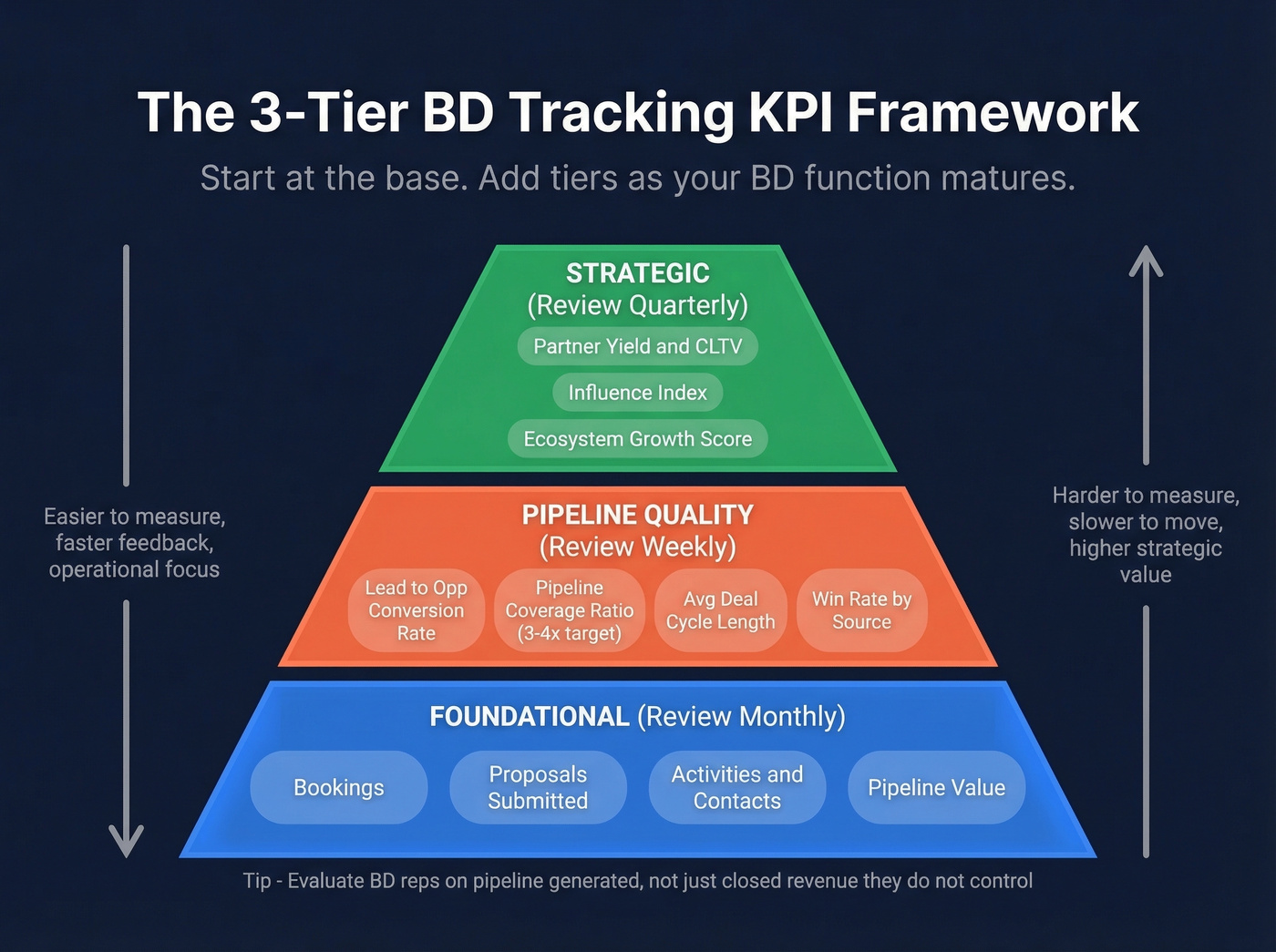
Stop tracking more. Start tracking better. We've seen teams drown in 20+ KPIs and still miss the signals that matter. Here's a three-tier framework that scales with your BD maturity, starting with your quota and working backward to required activities.
The Foundational Four
These come from Aecumen's BD measurement framework: bookings, proposals submitted (count and value), activities/contacts, and pipeline value. One critical nuance: evaluating BD reps on bookings alone is unfair when proposal writing, pricing, and interviews are handled by other people. Track the opportunities and pipeline value a BD rep generates, not just the closed revenue they don't control. Review monthly - frequent enough to course-correct without creating reporting fatigue.
Pipeline Quality Metrics
This is where 2026 BD tracking diverges from legacy approaches. A Forbes Council panel framed it well: activity metrics alone aren't enough anymore. The shift is toward pipeline conversion efficiency, revenue velocity, and sales accepted leads.
Track these: lead-to-opportunity conversion rate, pipeline coverage ratio (3-4x your target is the common rule of thumb), average deal cycle length, and win rate by source. These tell you whether your pipeline is healthy, not just whether it exists.
Strategic BD Metrics
These are quarterly and annual indicators: partner yield, customer lifetime value attributed to BD initiatives, Influence Index (measuring cross-functional deal involvement), Ecosystem Growth Score (net new partners and integrations), and net revenue retention on BD-sourced accounts. They're harder to measure and slower to move, but they separate a BD function that drives strategy from one that's just a glorified SDR team.
Setting Up Your Pipeline
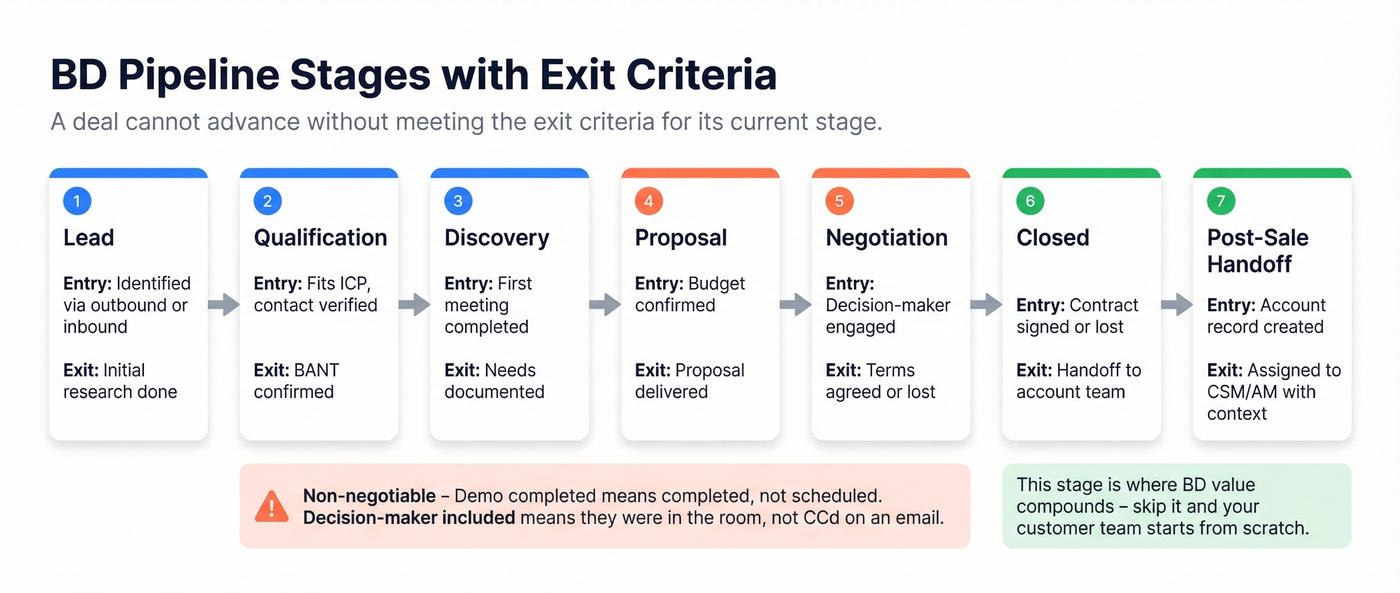
A pipeline without entry and exit criteria isn't a pipeline - it's a wish list.
| Stage | Entry Criteria | Exit Criteria |
|---|---|---|
| Lead | Identified via outbound/inbound | Initial research done |
| Qualification | Fits ICP, contact verified | BANT confirmed |
| Discovery | First meeting completed | Needs documented |
| Proposal | Budget confirmed | Proposal delivered |
| Negotiation | Decision-maker engaged | Terms agreed or lost |
| Closed | Contract signed or lost | Handoff to account team |
| Post-Sale Handoff | Account record created | Assigned to CSM/AM with context |
The non-negotiable rule: a deal can't advance without meeting the exit criteria for its current stage. "Demo completed" means completed, not scheduled. "Decision-maker included" means they were in the room, not CC'd on an email.
That last row matters more than most teams realize. Converting a closed deal into an account record with full context is where BD value compounds - without it, your customer team starts from scratch and the relationship equity you built evaporates.
Run weekly pipeline reviews: top deals, stalled deal diagnosis, forecast updates. Flag anything with no movement in 14 days. 80% of sales require five follow-up calls, but 41% of salespeople give up after just one. Your pipeline review is where you catch that gap.

Your pipeline stage says "Qualification" - but is that contact still at the company? Prospeo refreshes 300M+ profiles every 7 days, so your BD tracker never runs on stale data. 98% email accuracy means deals stall because of strategy, not bad contact info.
Stop flagging stalled deals that were just bounced emails.
Your Minimum Viable BD Tracker
Not every team needs a CRM on day one. A well-structured spreadsheet beats a poorly adopted $50/seat tool every time. On r/smallbusiness, the most common ask is dead simple: total revenue, transaction count, average sale, and performance by rep - all in Google Sheets.
The 3-Tab Schema
Tab 1 - Contact Data: Name, email, phone, company, title, lead source, status (dropdown: New / Contacted / Qualified / Proposal / Closed), deal value, deal stage, last contact date. Keep it to 10-12 columns max. If you’re standardizing fields, it helps to define your lead status rules up front.
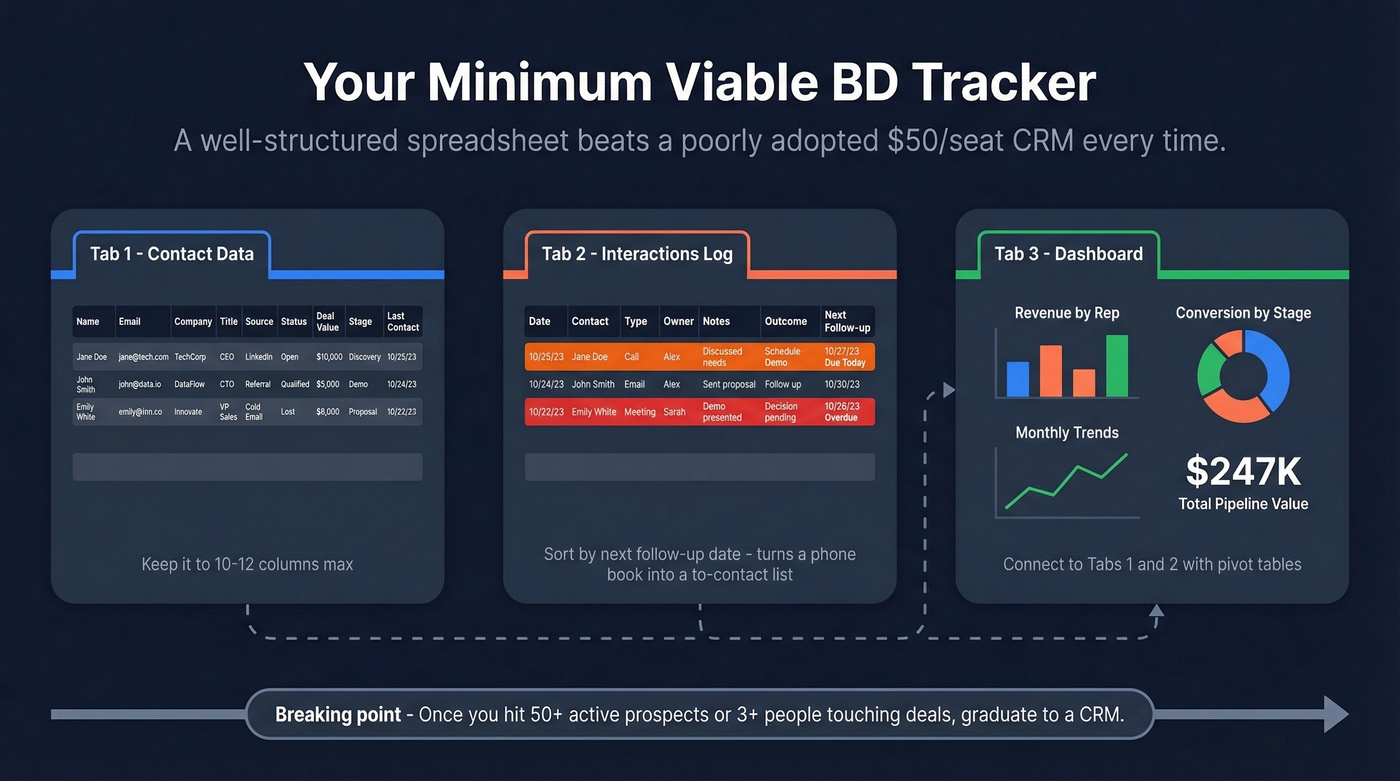
Tab 2 - Interactions Log: Date, contact name, interaction type (dropdown), owner, notes, outcome, next follow-up date. Sort by next follow-up date. Overdue items get highlighted red, due today gets orange - this turns your sheet from a phone book into a to-contact list, a distinction that OnePageCRM's template philosophy gets exactly right. If you need copy you can paste into those follow-ups, keep a set of sales follow-up templates handy.
Tab 3 - Dashboard: Total revenue, transaction count, average sale, performance by rep, conversion rates by stage, total pipeline value, monthly trends. Connect to Tabs 1 and 2 with pivot tables. For a cleaner view of what’s actually predictive, map your dashboard to core pipeline health metrics.
In our experience, the breaking point comes faster than teams expect. Once you hit 50+ active prospects or 3+ people touching deals, version control alone will cost you more time than a CRM subscription. That's when you graduate.
Best Tools for BD Tracking
You don't need 15 tools. You need a CRM, a data source you trust, and discipline. At minimum, your BD CRM needs bulk prospect management, automatic activity logging, multiple pipelines, and post-sale handoff capability. We've tested most of these. If you’re comparing options, it helps to skim a few examples of a CRM first.
| Tool | Best For | Starting Price | Key BD Feature |
|---|---|---|---|
| Prospeo | Data quality layer | Free; ~$0.01/email | 98% email accuracy, 7-day refresh |
| HubSpot Sales Hub | Mid-market teams | $20/user/mo | Automatic activity logging + reporting |
| Pipedrive | Small teams (<10) | $14/user/mo | Visual drag-drop pipeline |
| Salesforce | Enterprise (50+ users) | $25/user/mo | Deep multi-pipeline reporting |
| Close | Inside sales BD | $35/user/mo | Built-in calling + email |
| Copper | Google Workspace teams | $12/user/mo | Native Gmail integration |
| Airtable | Custom tracking | $20/user/mo | Flexible views + automations |
| Google Sheets | Solo/early-stage | Free | Zero learning curve |

Prospeo sits underneath your CRM as the data quality layer that makes everything else work. With 300M+ professional profiles, 98% email accuracy, and a 7-day data refresh cycle (the industry average is six weeks), it catches job changes and email updates that other platforms miss for over a month. The enrichment API returns 50+ data points per contact at a 92% match rate, so your pipeline stages, conversion rates, and outreach sequences are built on verified information rather than stale records. The free tier - 75 emails/month plus 100 Chrome extension credits - is enough to audit your existing pipeline and see how much of your data is actually current. If you’re evaluating vendors, compare a few data enrichment services side by side.
HubSpot Sales Hub is the obvious pick for mid-market teams. The ecosystem is massive, the free tier is generous, and the jump to paid is gentle. It gets expensive once you move to Professional ($100/user/mo) or Enterprise ($150/user/mo), so plan your growth path carefully.
Pipedrive is the best pure pipeline tool for small teams. The visual interface is genuinely intuitive - drag a deal between stages and the data updates. It lacks HubSpot's marketing depth, but at $14/user/mo for clean BD deal tracking, it's hard to beat.
Salesforce is enterprise-grade. The reporting depth is unmatched, but implementation takes months and you'll need a dedicated admin. Skip this unless you're at 50+ users or have complex multi-pipeline requirements.
Google Sheets is where most teams start, and that's fine. Reference the 3-tab schema above.
Automate the Right Things
Automate these: Activity logging, follow-up reminders at defined intervals, stage progression alerts when deals stall past 14 days, and weekly pipeline summary reports. These are high-frequency, low-judgment tasks where humans add zero value doing them manually. If you’re building outbound motion alongside tracking, borrow a few modern sales prospecting techniques.
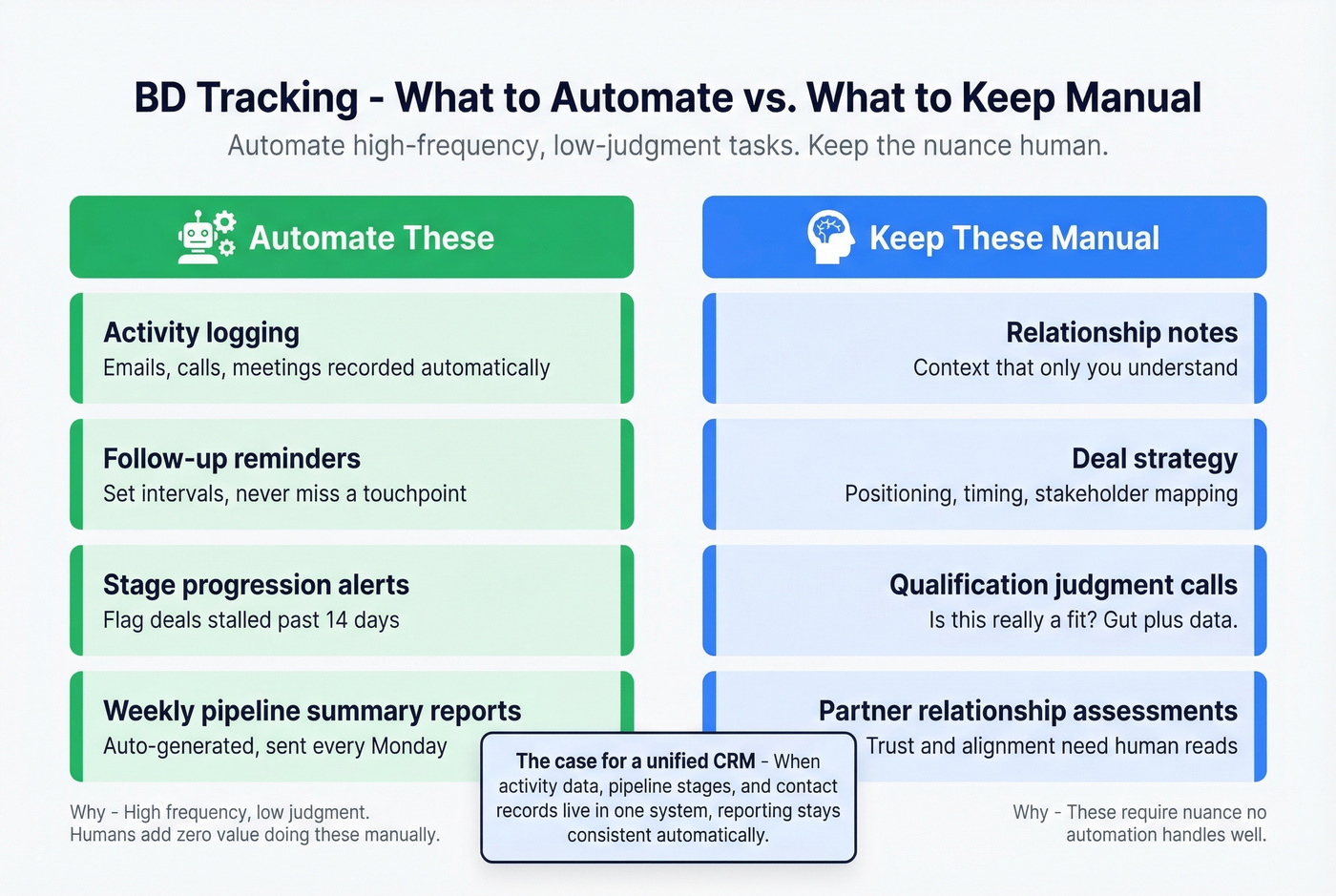
Keep these manual: Relationship notes, deal strategy, qualification judgment calls, and partner relationship assessments. These require nuance no automation handles well.
The argument for a unified CRM over stitched-together tools is strongest here. When activity data, pipeline stages, and contact records live in one system, reporting stays consistent automatically. When they're spread across four tools connected by Zapier, you're one broken zap away from a week of missing data.
Five Mistakes That Kill Your Pipeline
These aren't theoretical. They're the patterns we see repeatedly, and that 70% spreadsheet-reliance stat explains why they're so common. If you want a broader diagnostic list, start with common sales pipeline challenges.
1. Tracking volume without quality. Logging 200 calls a week means nothing at a 0.5% conversion rate. Pair every activity metric with a quality metric: calls made to meetings booked ratio.
2. No exit criteria on pipeline stages. This is the single most common pipeline management failure we see. Deals sit in "Qualification" for months because nobody defined what qualifies. Write one sentence per stage describing the minimum bar to advance.
3. Inconsistent data entry. One rep writes "CEO," another writes "Chief Executive Officer," a third writes "C-suite." Use dropdowns and required fields for every categorical value. No exceptions.
4. Ignoring stalled deals. Run monthly hygiene sessions: deals stagnant over 90 days get a concrete plan or get removed. Letting dead deals linger inflates your pipeline value and makes forecasting useless.
5. Dirty contact data undermining every metric. Your conversion rates, response rates, and pipeline velocity are all wrong if a meaningful chunk of your emails bounce. Clean data makes your dashboards honest again. If you’re monitoring deliverability, track your email bounce rate as a first-line signal.
Keeping Your Data Clean
The most expensive tracking mistake isn't the wrong tool - it's dirty data. Build this monthly hygiene routine:
- Review deals stagnant over 90 days - advance or remove
- Verify contact data for all active prospects
- Enforce dropdowns and required fields - eliminate free-text chaos
- Replace manual entry with enrichment wherever possible
- Audit email bounce rates and phone connection rates
- Flag contacts with stale job titles for re-verification
Let's be honest: most teams skip this until their bounce rate hits 15% and their domain reputation tanks. By then, the damage is done. A 7-day data refresh cycle - like what Prospeo runs - catches job changes before they turn into bounced emails. The free tier is enough to audit your existing pipeline and see how much of your data is actually current.

That 3-tab spreadsheet only works if Tab 1 has verified emails and direct dials. Prospeo returns 50+ data points per contact at $0.01/email - plug clean data into your tracker from day one instead of discovering bad records at pipeline review.
Build your BD tracker on data that's actually current.
FAQ
What's the difference between BD tracking and sales tracking?
BD tracking covers strategic, longer-cycle activities - partnerships, market expansion, relationship building - with metrics that blend qualitative and quantitative signals. Sales tracking focuses on transactional deal progression with shorter cycles and almost entirely quantitative KPIs like calls made, demos booked, and deals closed.
Do I need a CRM to track business development?
Not immediately. A well-structured Google Sheets tracker works for teams with fewer than 50 active prospects and one or two people managing deals. Beyond that threshold, a CRM with automatic activity logging and multiple pipeline support becomes essential to avoid version control nightmares and missed follow-ups.
How often should I review my BD pipeline?
Weekly for deal flow and stalled-deal diagnosis - flag anything with no movement in 14 days. Monthly for pipeline hygiene and KPI trends. Quarterly for strategic metrics like partner yield and Ecosystem Growth Score. Match the review cadence to the metric's time horizon.
What's the best free tool for BD tracking?
Google Sheets is the best zero-cost starting point - use the 3-tab schema above. For contact data quality, Prospeo's free tier (75 verified emails/month plus 100 Chrome extension credits) lets you validate prospect emails at 98% accuracy without spending a dollar, which keeps your pipeline metrics honest from day one.