

Business Email Phrases That Actually Work (and the Ones Everyone Hates)
The average professional receives 270 messages a day - emails, Teams pings, Slack threads. Your email isn't competing with three other messages in someone's inbox. It's competing with 269. With over 361 billion emails sent daily and ineffective communication costing up to $12,506 per employee per year, the business email phrases you choose aren't a style preference. They're a business decision.
Most people default to the same tired openers, the same passive-aggressive follow-ups, the same sign-offs they copied from their first manager in 2014. We've tested hundreds of email variations across outbound campaigns, and the phrases below are the ones that actually move the needle.
The Quick Version
Three rules fix 80% of business email problems:
- Kill the filler opening. "I hope this email finds you well" tells the reader your email will be full of fluff. Start with the point.
- Drop "just" from every sentence. "Just following up" and "just checking in" devalue what you're communicating. You're not bothering anyone - you're doing your job.
- Match formality to the relationship, not the company. A Series B founder doesn't want "Dear Sir." A general counsel doesn't want "Hey!"
Here's what the typical phrase-list article won't tell you: phrases are tools, not scripts. The same sentence can land as confident or condescending depending on context. Every phrase below comes with guidance on when to use it, because a phrase without judgment is noise.
Choosing Tone for Polite Sales Messaging
A conversational, personalized tone can boost response rates by up to 30% compared to generic formal templates. But most people don't think about tone - they default to whatever feels safe.
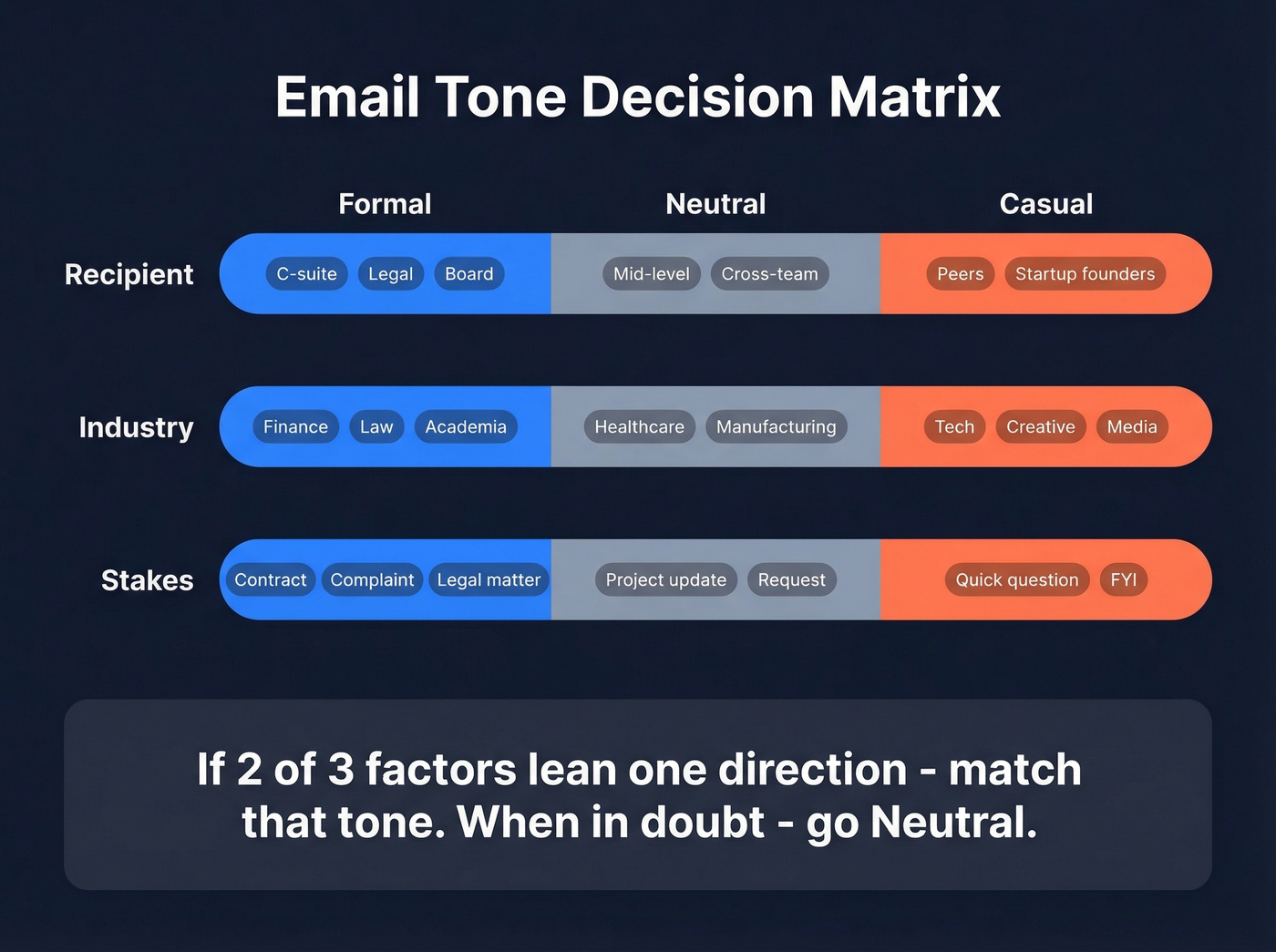
| Factor | Formal | Neutral | Casual |
|---|---|---|---|
| Recipient | C-suite, legal, board | Mid-level, cross-team | Peers, startup founders |
| Industry | Finance, law, academia | Healthcare, manufacturing | Tech, creative, media |
| Stakes | Contract, complaint, legal | Project update, request | Quick question, FYI |
The decision matrix is simple: relationship + industry + stakes. If two of the three lean formal, go formal. If two lean casual, go casual. When in doubt, neutral is always safe - nobody's ever been offended by "Hi [Name], quick question about the Q3 timeline."
20 Professional Email Phrases to Steal
Opening Lines (1-5)
Let's retire "I hope this email finds you well." The consensus on r/work is blunt: it's "utterly meaningless" and signals the email will be full of fluff. A polite email introduction doesn't need filler - it needs relevance.
- "Thank you for your time on Thursday's call - I wanted to follow up on the pricing discussion." Specific, respectful, immediately contextual.
- "Quick question about the rollout timeline." No preamble, no filler. The recipient knows exactly what they're opening.
- "Loved your talk at SaaStr - especially the bit about outbound sequencing." A specific compliment beats a generic greeting every time. If you've just connected with someone, a natural "nice to meet you" goes further than a paragraph of flattery.
- "Attached is the revised proposal with the changes we discussed." No opener at all. For internal emails and established relationships, this is often the best move.
- "Congrats on the Series B - wanted to share something relevant while you're scaling the team." Timely, personal, and immediately useful. A congratulations-on-the-new-job email in sales works the same way: tie the milestone to something genuinely helpful rather than jumping straight to a pitch.
In our experience, the opening line does 80% of the work. Get it right and the rest practically writes itself.
Making Requests (6-9)
Polite doesn't mean vague. "At your earliest convenience" means "whenever you feel like it, which might be never." Be direct about what you need and when.
- "Could you send the updated deck by end of day Friday?"
- "I'd appreciate your feedback on sections 2 and 3 before our Monday sync."
- "Would you be able to loop in your legal team this week? We're targeting a signed contract by the 15th."
- "Can you confirm the budget number by Wednesday so I can finalize the SOW?"
The pattern: specific action + specific deadline. It's polite because it respects the recipient's time by being clear. If alignment requires a live conversation, try "We can schedule a meeting to discuss further" - but only after you've stated the core ask in writing so the meeting has a clear agenda. If you're building a repeatable process, keep a swipe file of sales follow-up templates so you don't reinvent the wheel.
Following Up (10-12)
"Just checking in" was rated the most annoying email cliche by 19% of respondents in a Perkbox study. Here's how to follow up without triggering that reaction.
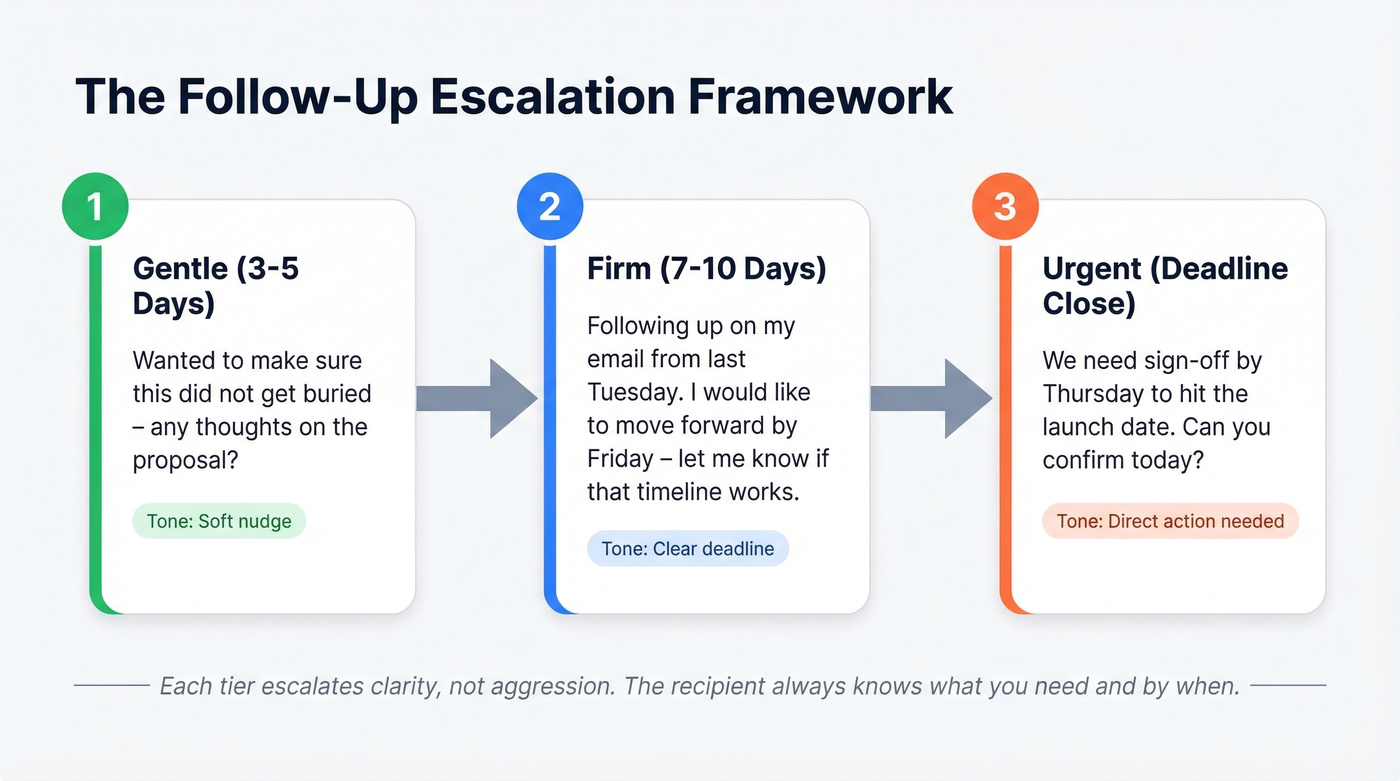
- "Wanted to make sure this didn't get buried - any thoughts on the proposal?" Gentle. Use at 3-5 days.
- "Following up on my email from last Tuesday. I'd like to move forward by Friday - let me know if that timeline works." Firm. Use at 7-10 days.
- "We need sign-off by Thursday to hit the launch date. Can you confirm today?" Urgent. Deadline approaching.
Each tier escalates clarity, not aggression. The recipient always knows what you need and by when. If you're unsure about timing, use this guide on when should you follow up on an email.
Delivering Bad News (13-15)
"Sorry to bother you" undermines your credibility before you've said anything. Lead with the information, not an apology for existing.
- "We won't be able to meet the original March deadline. Here's the revised timeline and what changed."
- "I made an error in the Q2 projections - corrected numbers are attached, and I've flagged the discrepancy for the finance team."
- "Unfortunately, we can't accommodate that pricing at this volume. Here's what we can offer instead."
Acknowledge the situation directly. Skip the groveling. People respect honesty more than elaborate apologies.
Closing Lines (16-20)
Sign-offs are surprisingly polarizing. "Warm regards" can irritate people - especially from someone you've never met. And "Best regards" can feel outdated and overly formal for short replies.
- "Thanks" or just your name - for internal emails. Don't overthink it.
- "Best" or "Best regards" - for client emails. Safe, professional, inoffensive.
- "Talk soon" - for cold outreach. Assumes the relationship, which is the point.
- "Let me know if you need anything else" - for customer support. Functional and warm without being performative.
- "Looking forward to your thoughts" - for proposals and pitches. Invites a response without demanding one. If you're tired of the default "I look forward to hearing from you," try "Eager to hear your take" or "Would love your perspective on this."
10 Email Phrases to Burn
Some phrases aren't just cliched - they're actively working against you. Executive coach Melody Wilding identified five that read as passive-aggressive because email strips out tone and body language.
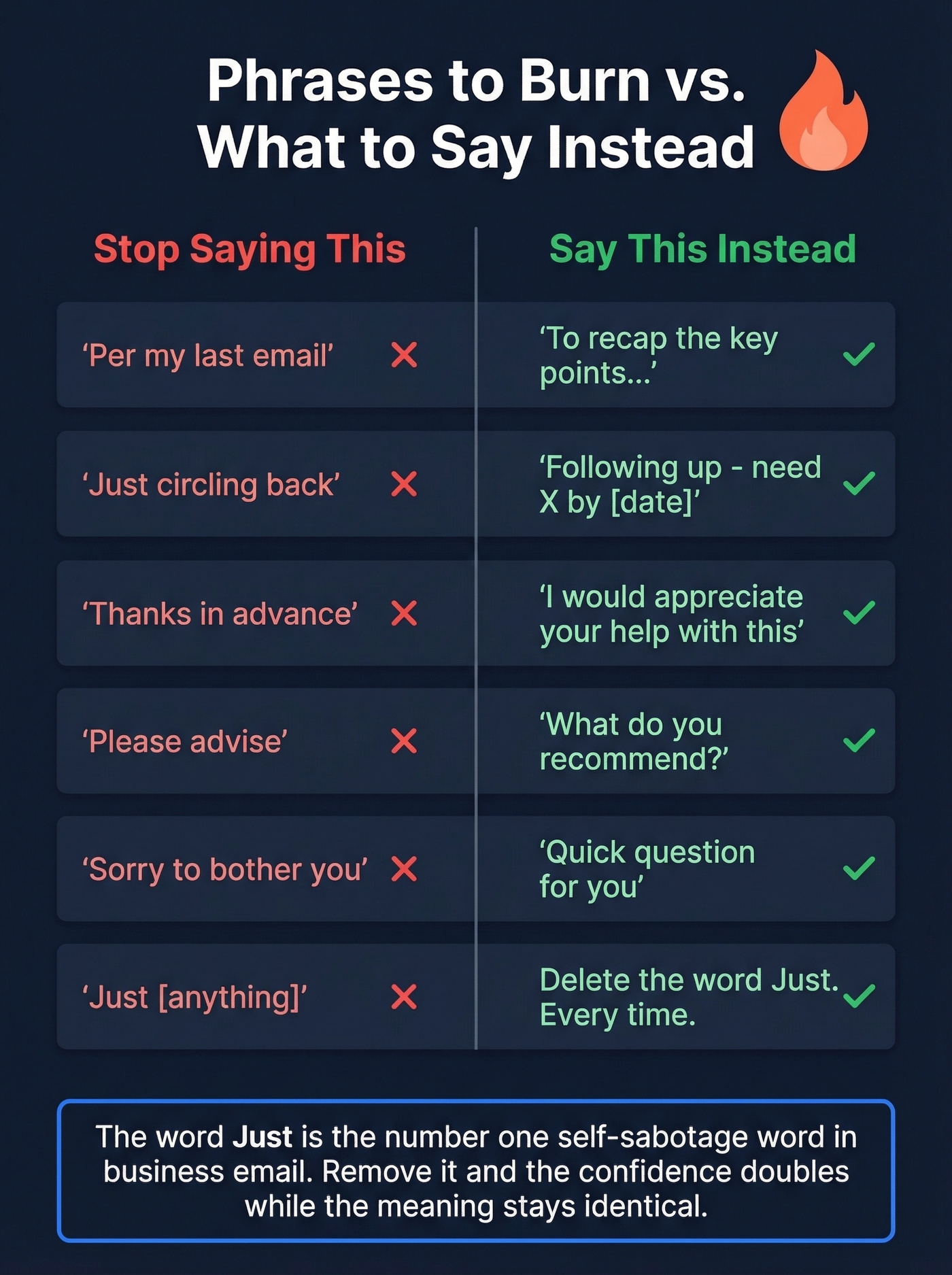
| # | Bad Phrase | Why It Fails | Say This Instead |
|---|---|---|---|
| 1 | Per my last email | Reads as "can you not read?" | To recap the key points... |
| 2 | Just circling back | Passive, self-minimizing | Following up - need X by [date] |
| 3 | Copying [name] here | Feels like escalation/tattling | Adding [name] - they own [area] |
| 4 | Thanks in advance | Presumes compliance | I'd appreciate your help with this |
| 5 | Please advise | Cold, legalistic | What do you recommend? |
| 6 | Per my last message | Voted most hated by 33% | As I mentioned on Tuesday... |
| 7 | Forwarding this along | Implies low importance | Sending this your way |
| 8 | Please note | Condescending | For your reference |
| 9 | Sorry to bother you | Undermines your credibility | Quick question for you |
| 10 | Just | The #1 self-sabotage word | Delete it. Every time. |
"Just" deserves special attention. "Just wanted to check" becomes "Wanted to check." "Just a quick reminder" becomes "Quick reminder." The meaning stays identical. The confidence doubles.

Great email copy deserves a real inbox on the other end. Prospeo's 98% email accuracy and 7-day data refresh mean your carefully crafted phrases actually reach decision-makers - not bounced addresses that tank your domain reputation.
Stop perfecting emails that nobody ever receives.
Cold Email Phrases That Get Replies
Cold email is a different animal. You're writing to someone who didn't ask to hear from you, and 47% of recipients decide whether to open based on the subject line alone.
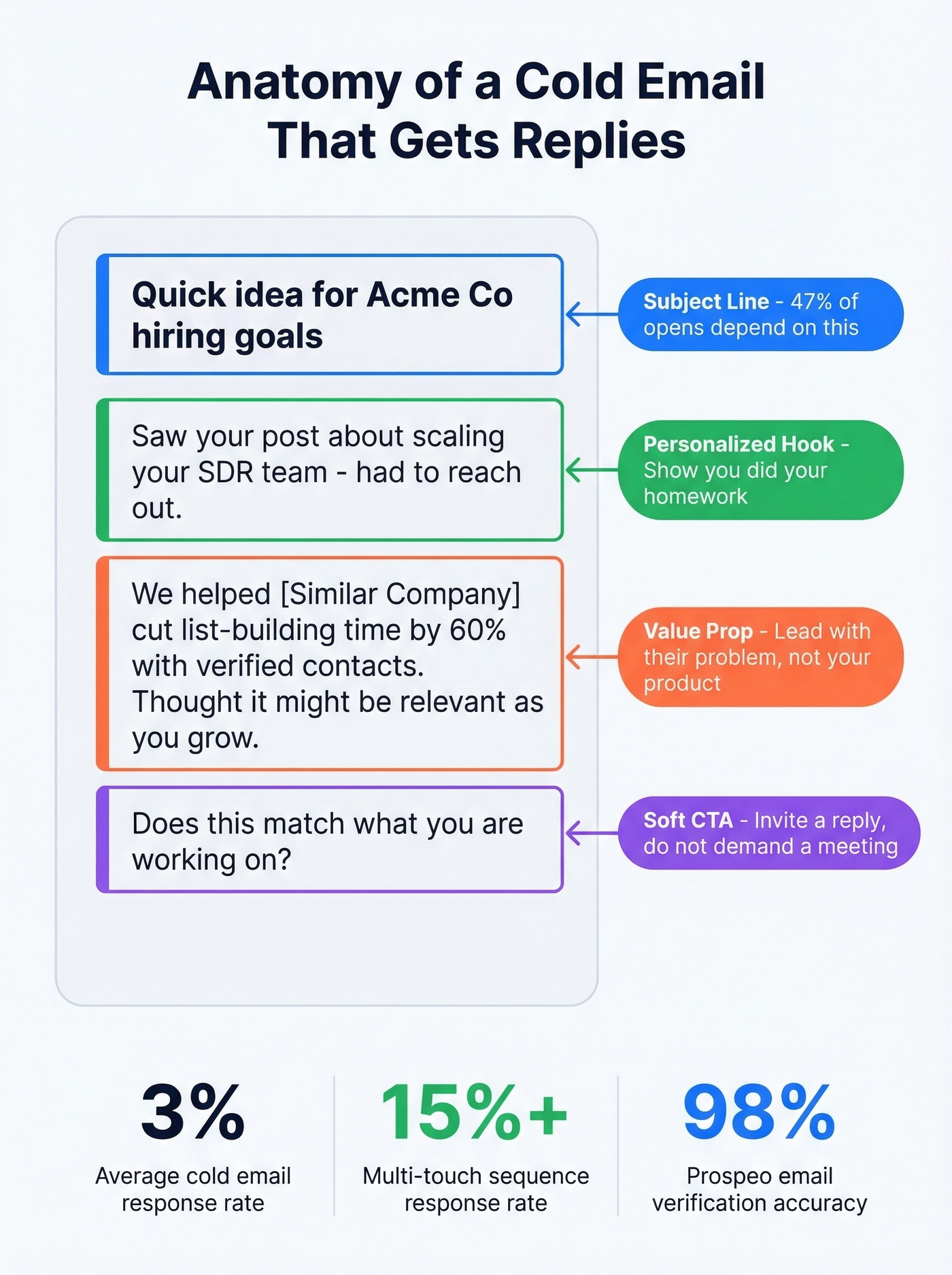
The mindset shift that matters: stop writing from "I want something" and start writing from "I want to help you." Every effective cold email has four components - a clear subject line, a personalized opening, a value proposition, and a low-friction CTA. If you want a full framework, see our guide to AI cold email outreach.
Subject lines that work: "Quick idea for [Company]'s [goal]," "Saw your post on [Topic] - had to reach out," "Is this still on your roadmap?" Vague subject lines like "Regarding potential synergies" give the recipient zero reason to click. For more options, browse these Email Subject Line Examples.
For the body, lead with something specific about the recipient's company, connect it to a problem you solve, and close with a low-commitment ask. The best sales lines in cold outreach are the ones that sound like a real person talking, not a template. "Worth a 15-minute call?" beats "I'd love to schedule a demo at your earliest convenience." Use positive, concrete language - "results," "opportunity," "streamline" - instead of pressure-laden phrases like "act now" or "don't miss out." And email-only outreach averages around a 3% response rate, while multi-touch sequences can push that above 15%.
Close with something that invites a reply without being pushy. "Hope to hear back from you soon" works in warmer sequences, but for true cold outreach, a specific question like "Does this match what you're working on?" pulls better responses.
Look - even a perfectly phrased cold email is worthless if it bounces. We've seen teams burn through entire domain reputations because they were sending to stale lists. Prospeo verifies emails in real time with 98% accuracy across 300M+ professional profiles, and the free tier covers 75 emails a month - enough to test whether your copy converts before you scale. If you're troubleshooting bounces, start with email bounce rate and then work through the full email deliverability guide.
You just leveled up your email phrases. Now level up who you're sending them to. Prospeo gives you 300M+ verified contacts with 30+ filters - buyer intent, job changes, tech stack - so every polished email hits the right person at the right time.
The best cold email is worthless without the right recipient.
Email Phrases by Culture
What reads as efficient in New York reads as rude in Tokyo. I once watched a deal stall for three weeks because an American rep opened a cold email to a Japanese executive with "Hey Takeshi" and jumped straight into pricing. If you're emailing internationally, a 30-second cultural check saves you from accidentally torching a relationship.
| Region | Tone Expectation | What to Know |
|---|---|---|
| US / Canada | Direct, first-name, brief | Get to the point fast. Brevity is respect. |
| UK | Polite + direct | Slightly more formal than US, but still concise. |
| Germany / Switzerland | Formal, precise | Use titles. Be detailed. Vagueness reads as unprepared. |
| Southern Europe | Personable, warm | A brief personal touch before business is expected. |
| Japan / South Korea | High formality, hierarchical | Lengthy greetings are normal. Indirect language preferred. |
| Latin America | Warm, relationship-first | Ask about well-being before diving into business. |
| MENA | Formal, courteous | Family/health inquiries are common and expected. |
The universal rule: when in doubt, err formal and let the other person set the casual tone. You can always relax later. Dialing up formality after a too-casual opener is awkward.
Writing With AI (Without the Robot Voice)
Only ~40% of recipients perceive AI-written emails as sincere. Meanwhile, 87% of marketing teams use AI for email - but only 6% qualify as high performers. The gap between "using AI" and "using AI well" is enormous.
Use AI for first drafts of status updates, grammar checks, simplifying technical content for non-technical audiences, and routine scheduling coordination. Write the negotiations, apologies, networking emails, and anything requiring empathy yourself. Those are the emails where a robotic tone will cost you. If you're using tools to speed this up, pair it with an AI email checker so the final draft still reads human.
The best workflow we've found: let AI generate the first draft, then rewrite the opening and closing in your own voice. Those are the two parts readers actually register emotionally. The middle can be polished by a machine. The bookends need to sound like you.
Skip this advice if your deals close under $10K. A clear, direct email with the right ask beats a beautifully crafted message that takes you 45 minutes to write. Save the wordsmithing for the deals that justify it.
Keep It Short
CIO Jonathan Feldman's rule: most emails should be 80-100 words. If it needs to be longer, lead with an executive summary and the call to action. Don't bury the ask in paragraph four.
With around 85% of professionals checking email on their phones, formatting matters as much as phrasing. Stick to one idea per paragraph - two sentences max. Bold your call to action so it's visible on a quick scroll. Use bullets only when listing more than two items. And make your subject line specific: "Q3 Budget Approval Needed by Friday" beats "Quick Question" every time. If you're sending at scale, make sure you understand email velocity so you don't tank deliverability.
Around 65% of emails go unread. Structure is how you stay in the other 35%.
FAQ
What are common business email phrases?
They fall into five categories: greetings ("Hi [Name]"), requests ("Could you send X by Friday?"), follow-ups ("Following up on my email from Tuesday"), closings ("Best regards"), and acknowledgments ("Thank you for the quick turnaround"). The best ones pair a specific action with a deadline. The worst - "per my last email," "just checking in" - are vague and passive-aggressive.
What's the most professional email greeting?
"Dear [Name]" for legal, finance, or first contact with senior executives. "Hi [Name]" works for everything else and is the default in most industries. Skip "To Whom It May Concern" - find the person's name first. Prospeo's email finder can locate the right contact so you're never stuck with a generic greeting.
How do you say "I look forward to hearing from you" differently?
Try "Looking forward to your thoughts," "Eager to hear how this lands," or "Would love your take on this." Match the alternative to the relationship - casual for peers, slightly more formal for executives. Focus on what you're actually asking for: a decision, feedback, or a next step.
How long should a business email be?
80-100 words for most messages. If it needs to be longer, lead with an executive summary and the call to action in the first two sentences. Your reader gets 270+ messages a day - respect that by front-loading the important parts.
How do I decline a meeting politely over email?
Don't apologize excessively or invent excuses. Try: "Thanks for the invite - I don't think I'm the right person for this one, but [Name] on my team would be a great fit." Or: "My schedule is packed this week. Could you send a summary instead?" Direct, respectful, and it offers an alternative.