

How to Buy Data for Business: A Practical Guide for 2026
Your VP of Sales just told you to "buy a list." Except that phrase means wildly different things depending on who's asking - and getting it wrong costs real money, real domain reputation, and real pipeline.
Quick detour: if you're here to buy data for your phone, US Mobile runs $17.50/mo, Visible is $25/mo, Mint Mobile $20/mo. Done. Now let's talk about the kind of data purchasing that actually moves revenue.
Short on time?
- Want a broad free database to start prospecting: Apollo.io - generous free tier, large dataset, weaker accuracy at scale.
- Need bulk datasets and API access: Coresignal - from $49/mo, 75M+ company records, 839M employee records.
Types of B2B Data You Can Buy
B2B data breaks into four categories. Understanding them saves you from purchasing the wrong thing.
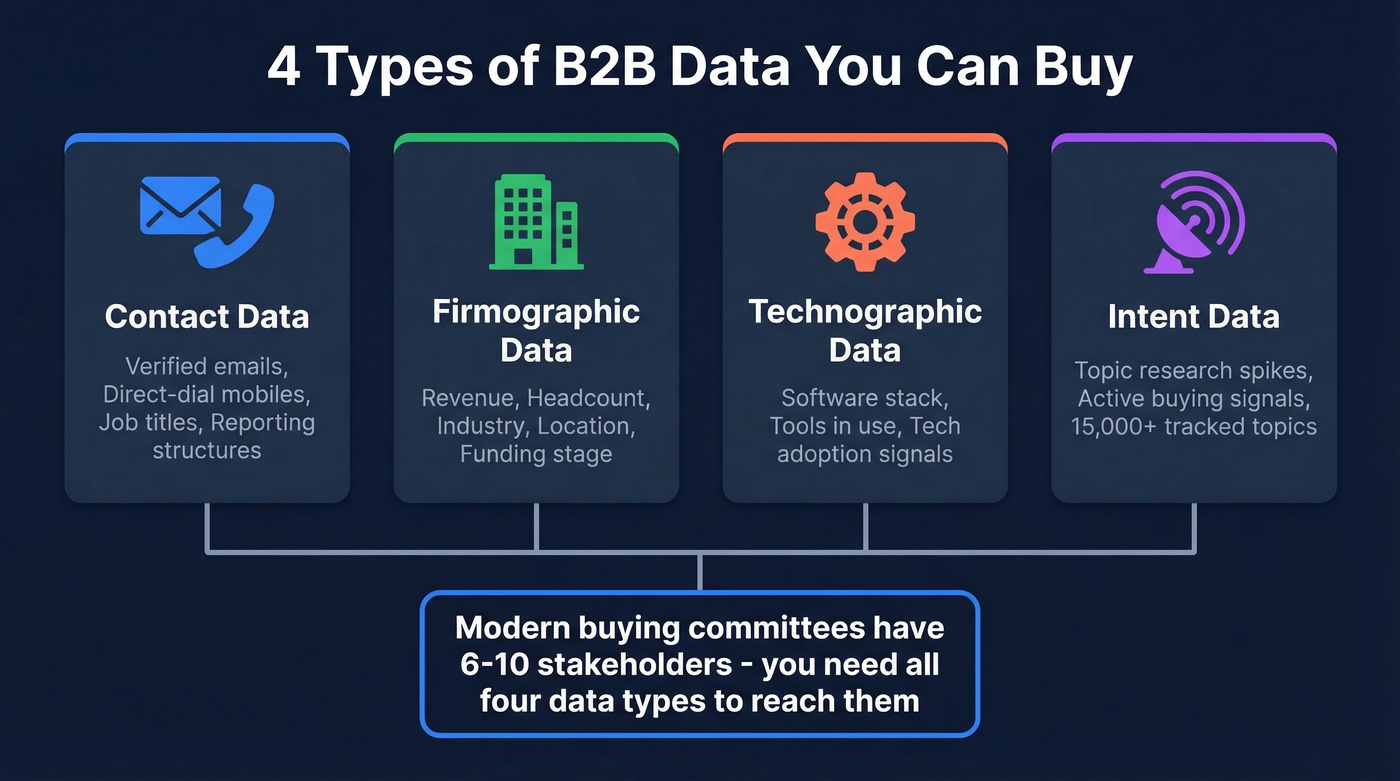
Contact data is the obvious one: verified emails, direct-dial mobile numbers, job titles, reporting structures. This is what most people mean when they say "buy a list." If you’re comparing vendors, start with a ranked view of the B2B database landscape.
Firmographic data covers company-level attributes - revenue, headcount, industry, location, funding stage. It's how you define your ICP and build target account lists.
Technographic data tells you what tools a company runs. If you sell a Salesforce integration, knowing which prospects already use Salesforce is gold. BuiltWith is the classic standalone provider, though most modern platforms bundle technographics into their filters.
Intent data tracks which companies are actively researching topics related to your product. Bombora powers most of the market, tracking 15,000+ topics across a publisher network. When a target account suddenly spikes research on "CRM migration," that's a signal worth acting on - and it's the difference between cold outreach and showing up at exactly the right moment. (If you want to operationalize this, see how to identify buyer intent signals.)
Buying committees now average 6-10 stakeholders. You don't just need one email per account - you need a multi-threaded view of the entire decision-making unit.
Where to Buy Data in 2026
Here's who sells B2B contact data, followed by what actually matters.
| Tool | Best For | Database Size | Email Accuracy | Pricing | Contract? |
|---|---|---|---|---|---|
| Apollo.io | Free prospecting | 275M+ contacts | ~79% | Free; $49-$119/mo | No |
| ZoomInfo | Enterprise GTM | 260M+ profiles | ~87% | ~$15K-$45K+/yr | Yes |
| Lusha | Quick lookups | - | ~81% | Free; $22-$52/mo | No |
| Cognism | EMEA + mobiles | Large (EU-focused) | 87% mobiles | ~$1K-$3K/mo | Yes |
| Coresignal | Datasets + API | 75M+ companies | N/A (raw) | From $49/mo | No |
| Hunter.io | Email only | - | High | Free; $49/mo+ | No |
| Kaspr | Free phone credits | EU-focused | Moderate | Free; $49/user/mo | No |
| RocketReach | Individual lookups | - | Moderate | $75/mo+ | No |
| UpLead | Credit-based | - | 95% (claimed) | $99/mo (170 cr.) | No |
| BookYourData | Pay-as-you-go | Smaller | - | $99/250 contacts | No |
Prospeo
Prospeo's database covers 300M+ professional profiles, 143M+ verified emails, and 125M+ verified mobile numbers - all refreshed on a 7-day cycle. That refresh cadence matters more than most people realize. B2B data decays 25-30% annually, so a database refreshed every 6 weeks (the industry average) is already stale by the time you export.

The 98% email accuracy comes from a proprietary 5-step verification process - catch-all handling, spam-trap removal, honeypot filtering - that doesn't rely on third-party email providers. We've tested this against multiple competitors, and the difference shows up immediately in bounce rates. If you want to pressure-test vendors, use a dedicated email verifier alongside your sample exports.
Real-world proof: Snyk's 50-person AE team went from 35-40% bounce rates to under 5% after switching, generating 200+ new opportunities per month and increasing AE-sourced pipeline by 180%. The 125M+ verified mobiles deliver a 30% pickup rate across all regions. At ~$0.01 per lead with a free tier, there's no contract and no sales call required.
Apollo.io
Apollo is the obvious starting point if budget is zero. The free tier gives you access to 275M+ contacts with basic search filters, and paid plans run $49-$119/user/month billed annually. It doubles as a sequencing tool, so you can find contacts and email them from the same platform. If you’re building lists specifically for outbound, follow a modern cold email lead list building workflow.
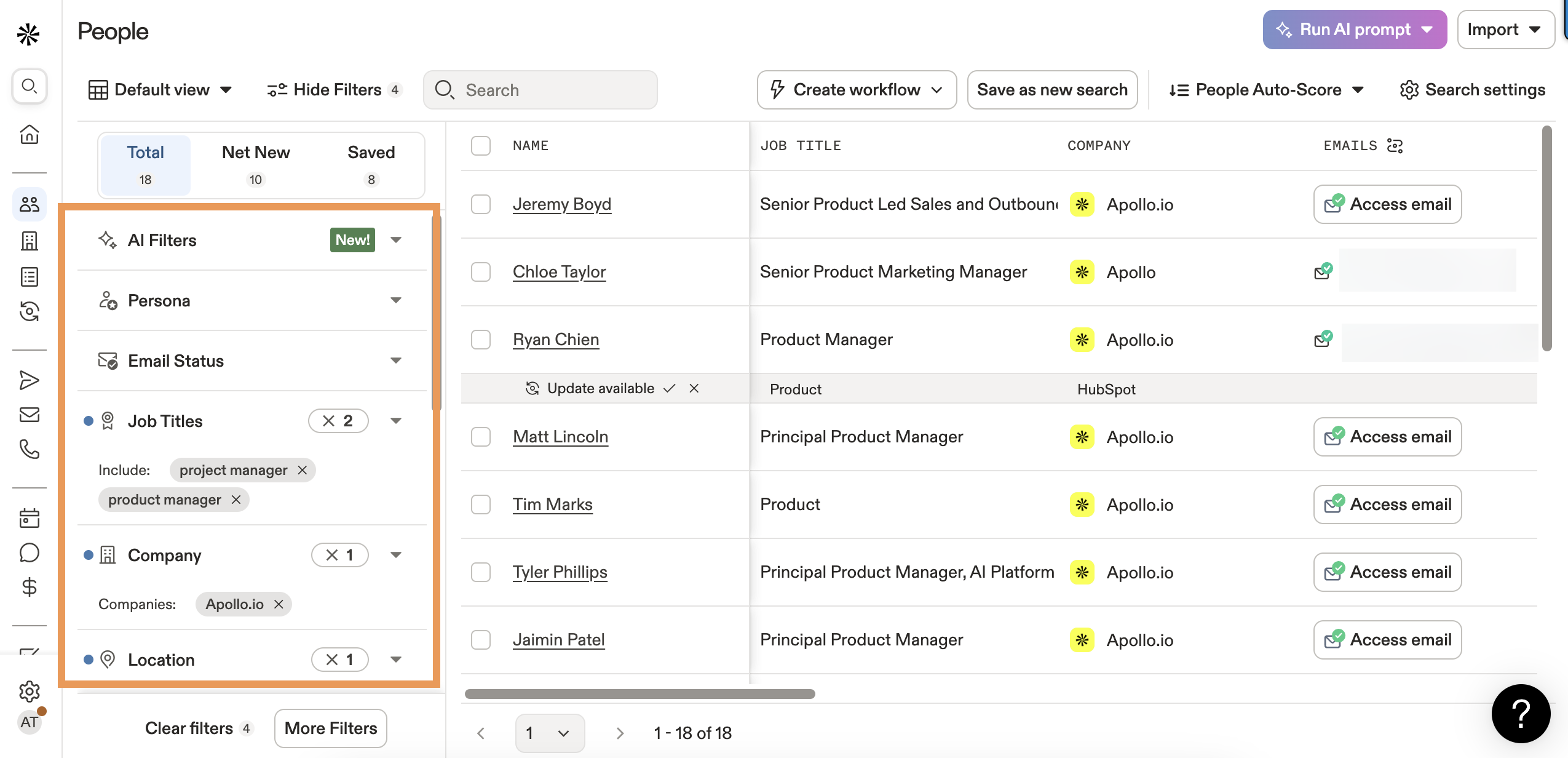
Use this if you're a solo founder or early-stage team that needs volume and a built-in sequencer without paying anything upfront.
Skip this if email accuracy is critical. We've seen Apollo's email accuracy hover around 79% at scale - roughly 1 in 5 emails bounce. That's fine for testing; it's dangerous for high-volume outbound where domain reputation is on the line. Extra credits cost $0.20 each and expire every billing cycle, so costs add up fast once you outgrow the free tier.
ZoomInfo
ZoomInfo is the enterprise incumbent - 260M+ professional profiles, 100M+ company profiles, plus intent data, website visitor tracking, and workflow automation baked in. If you're a 200-person sales org running outbound, ABM, and intent from one platform, ZoomInfo earns its price tag. (If you’re building around ABM, benchmark your program against account based marketing benchmarks.)
The problem is that price tag. Professional tier starts around $15,000/year. Advanced runs $25,000-$28,000/year. Elite hits $40,000-$45,000+. Additional seats add $1,500+ each, and renewals typically increase 10-20% annually.
Here's the thing: the #1 complaint on r/sales and other communities is paying for modules you never activate. Teams purchase ZoomInfo for the database, then realize they're subsidizing chat, workflow, and intent features nobody has time to configure. If all you need is accurate contact data, you're often overpaying by 5-10x. That frustration is what's driving so many mid-market teams to explore alternatives - and honestly, it's justified.
Lusha
Lusha works best as a quick-lookup tool. The Chrome extension is fast, the UI is clean, and published pricing makes budgeting straightforward - $22.45/mo for Pro, $52.45/mo for Premium, both billed annually. Solid for small teams doing targeted outreach, but don't expect it to power a 50-rep org.
Cognism
Cognism is the strongest option for EMEA-focused teams. Their phone-verified mobile numbers (Diamond Data) hit an 87% accuracy rate, and GDPR compliance is baked into the product rather than bolted on. Pricing is custom - typically $1,000-$3,000/mo for small teams, with annual contracts. If your ICP is primarily European decision-makers, Cognism deserves a serious look.
Other Options Worth Knowing
Hunter.io is email-only - great for domain searches and email verification, less useful if you need phone numbers or firmographics. Free tier available, paid from $49/mo. If you’re comparing similar tools, see Hunter alternatives.
Kaspr offers a free tier with 5 phone and 5 email credits monthly, paid from $49/user/month. EU-focused and limited in scope.
RocketReach starts at $75/mo billed annually. Decent for individual lookups but inconsistent at scale.
UpLead runs $99/mo for 170 credits and claims 95% accuracy. BookYourData is pure pay-as-you-go at $99 for 250 contacts - no subscription, useful for one-time campaign lists. If you prefer this buying model, compare pay-as-you-go B2B data providers.
How Much Does It Cost?
| Tool | Monthly Cost | Cost Per Lead | Annual Commitment |
|---|---|---|---|
| Prospeo | Free-$39+/mo | ~$0.01 | None |
| Apollo.io | Free-$119/mo | ~$0.10-$0.20 | Optional |
| ZoomInfo | ~$1,250-$3,750/mo | ~$0.50-$1.00+ | Yes (annual) |
| Lusha | Free-$52/mo | ~$0.15-$0.30 | Optional |
| Cognism | ~$1,000-$3,000/mo | ~$0.30-$0.80 | Yes (annual) |
| Coresignal | From $49/mo | Bulk pricing | No |
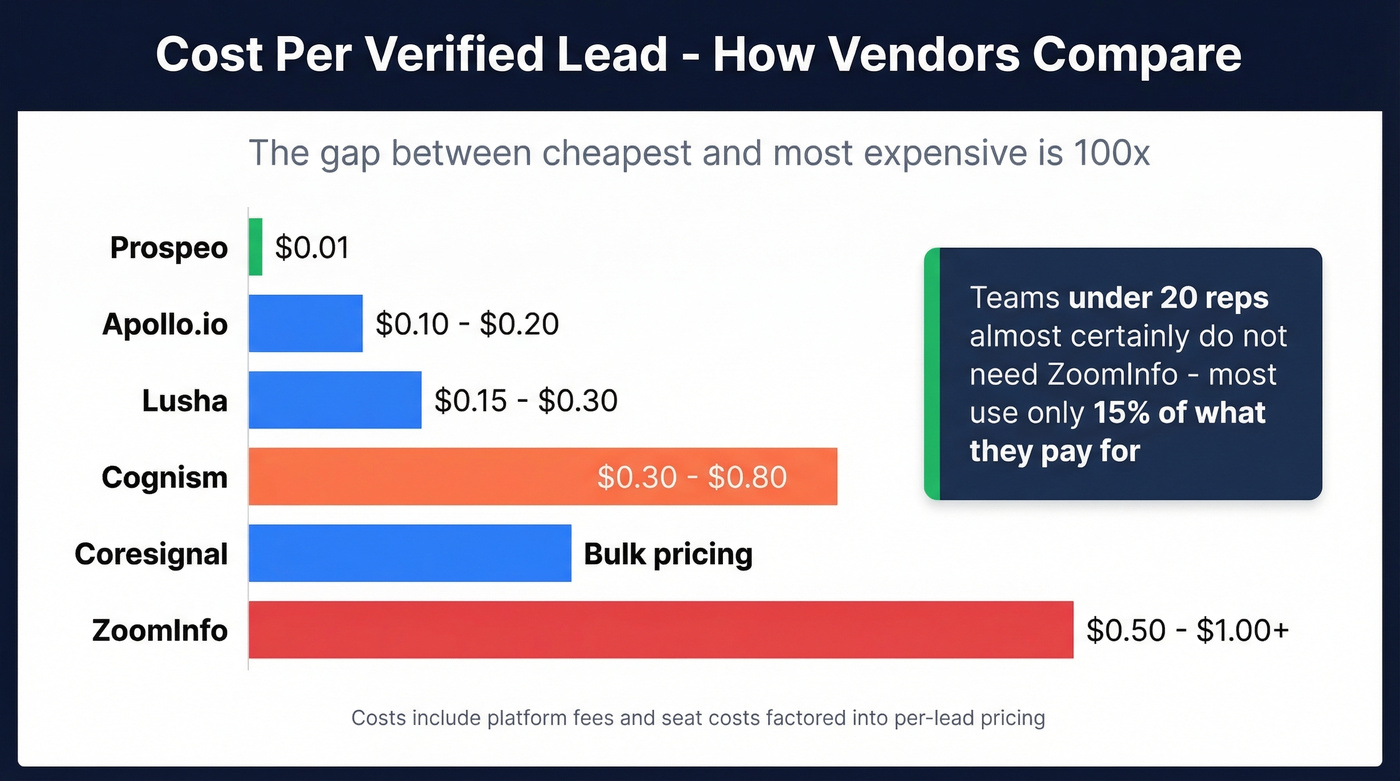
The cost-per-lead gap is staggering. The cheapest verified email runs about $0.01. ZoomInfo runs closer to $1 per lead when you factor in the platform fee and seat costs. That's a 100x difference.
Let's be honest: if your team is under 20 reps, you almost certainly don't need ZoomInfo. The platform features are impressive, but most teams under that size use maybe 15% of what they're paying for. A 5% improvement in data quality can drive a 5% increase in revenue - spend that budget on better data, not more features.
Cost-effective data purchasing means paying for accuracy and coverage you'll actually use, not subsidizing an enterprise feature suite. The sales intelligence market is $4.85B and growing 11.3% annually. Vendors know you need this data, which is why ZoomInfo can push 10-20% renewal increases and get away with it.
Evaluating Quality Before You Sign
Before you sign anything, run this checklist.
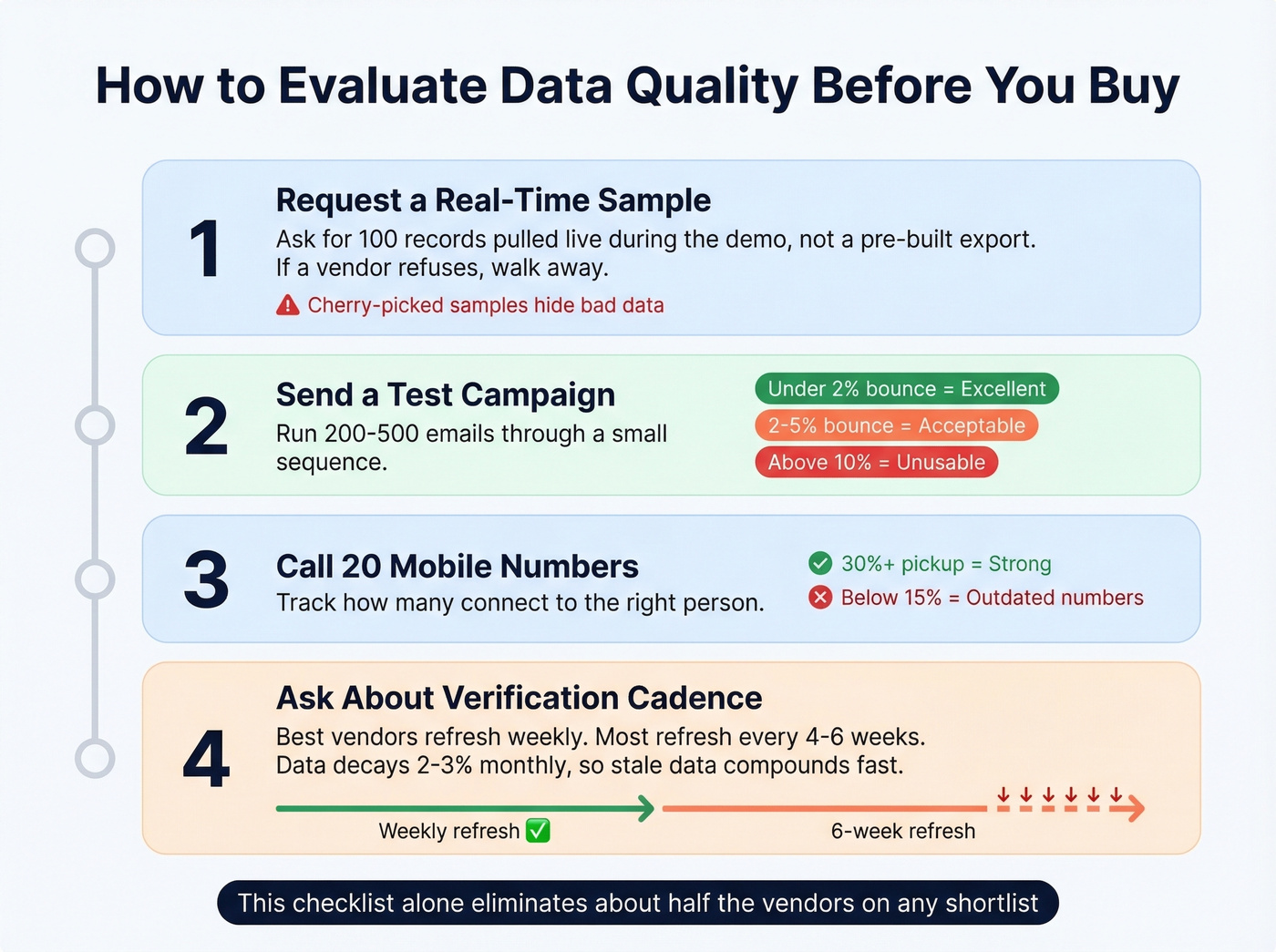
Request a real-time sample. Ask for 100 records pulled live during the demo - not a pre-built export. Cherry-picked samples hide the worst data. If a vendor won't do this, walk away.
Send a test campaign. Take 200-500 emails from the sample and run a small sequence. Under 2% hard bounce rate is excellent. Between 2-5% is acceptable. Above 10% means the data is unusable and your domain reputation is already taking damage. If you need a deeper diagnostic, use this check bounce guide.
Call 20 mobile numbers. Not 5. Twenty. Track how many connect to the right person. A 30% pickup rate is strong; below 15% means the numbers are outdated or unverified. (Your reps will do better with a tighter outbound call script.)
Ask about verification cadence. How often are records re-verified? The best vendors refresh weekly. Most competitors refresh every 4-6 weeks. That gap compounds fast when data decays 2-3% monthly - by quarter's end, you're looking at thousands of bounced emails from records that were "fresh" when you bought them.

In our experience, the sample test alone eliminates about half the vendors on any shortlist. It's the single most valuable 30 minutes you can spend before committing budget.

You just read the comparison table. Here's what the numbers don't show: Prospeo's 98% email accuracy comes from proprietary 5-step verification - not third-party providers. At $0.01/email with a 7-day refresh cycle, you get fresher data than vendors charging 10x more.
Stop buying data that bounces. Start with 75 free emails.
Is It Legal to Purchase Data Online?
Buying data is legal in most jurisdictions. The real question is whether you can use it responsibly.
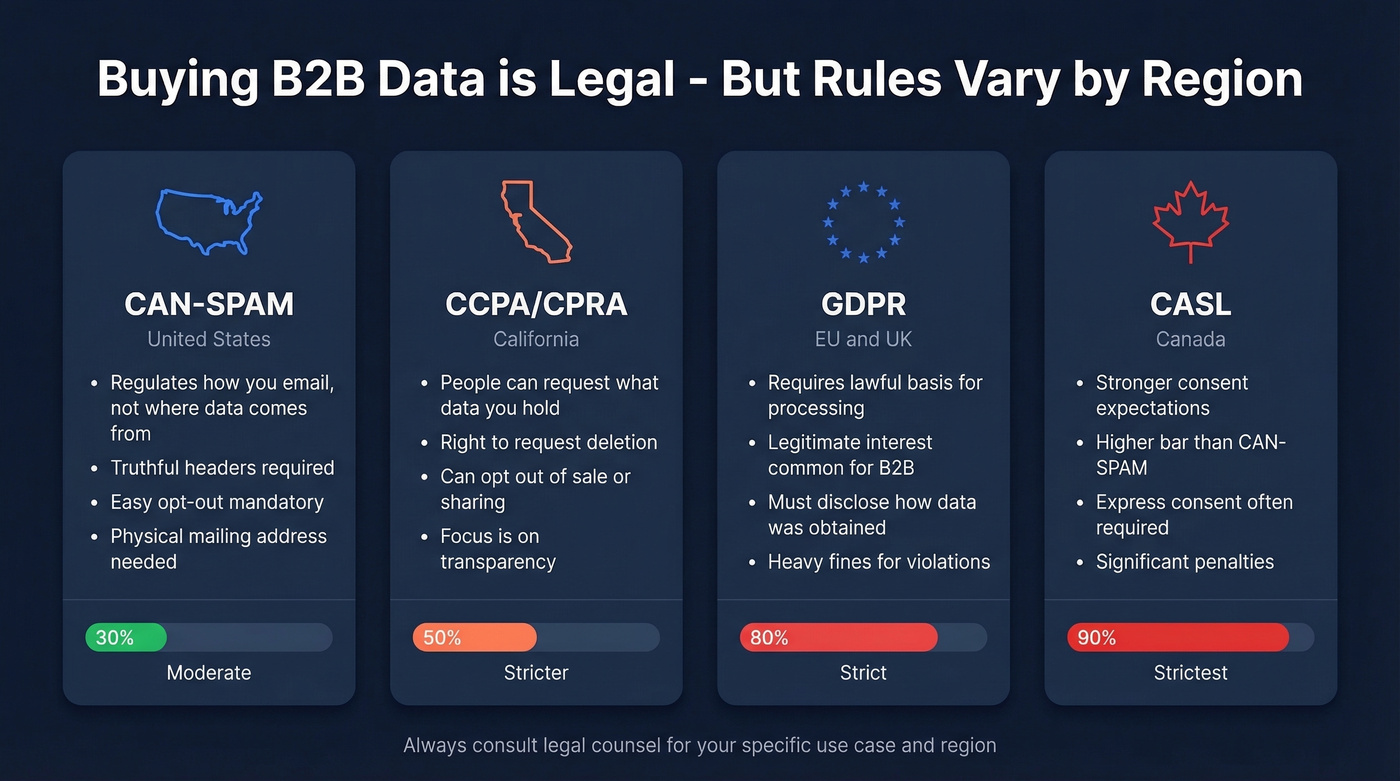
CAN-SPAM (US) regulates how you email, not where addresses come from. You need truthful headers, a real sender address, an easy opt-out, and a physical mailing address.
CCPA/CPRA (California) focuses on transparency - people can request what data you hold, request deletion, and opt out of sale/sharing. GDPR (EU/UK) requires a lawful basis for processing, with legitimate interest being the most common for B2B, plus clear disclosure of how you obtained the data. CASL (Canada) is the strictest, with stronger consent expectations and a higher bar than CAN-SPAM. If you’re building a process around this, use a B2B compliance checklist.
The practical risk isn't a lawsuit - it's deliverability. Purchasing a cheap, unverified list and blasting 50,000 emails will spike your bounce rate, trigger spam traps, and tank your domain reputation. Recovery takes months.
Buy vs. Build
| Factor | Buying Data | Scraping Data |
|---|---|---|
| Effort | Low | High |
| Cost | Predictable | Variable |
| Freshness | Vendor-dependent | You control it |
| Stability | High | Fragile (sites change) |
| Quality | Vendor-verified | You verify it |
For most sales teams, buying verified data is 10x faster and more reliable than building a scraping pipeline. Scraping makes sense for analytics teams building proprietary datasets or companies with specific needs that no vendor covers. The general rule: buy for speed, build for differentiation.
When to Buy Data (and When to Wait)
Not every team needs to purchase external data right away.
Data acquisition makes the most sense when you've validated your ICP, have a repeatable outreach process, and need to scale pipeline faster than manual prospecting allows. If you're still testing messaging or haven't nailed product-market fit, a free tier from Apollo.io or Prospeo is enough to run experiments without committing budget. Once you're ready to scale, prioritize vendors that let you get started without long-term contracts - you want the flexibility to switch if quality drops or your ICP shifts. To expand beyond lists, pull from these pipeline generation ideas.
Datasets for Analytics and AI
Not everyone buying data needs emails and phone numbers. For teams building ML models, running market research, or powering a data product, the options look different.
Coresignal is the standout for bulk B2B datasets - 75M company records, 839M employee records, 425M job records, all accessible via API with a 176ms average response time. Plans start at $49/mo with a free trial.
Major marketplaces include AWS Data Exchange, Snowflake Marketplace, Datarade, and Databricks Marketplace. Expect hundreds to thousands per dataset monthly, with premium alt-data licenses running $10K+. For specific data types: Bombora for intent data, BuiltWith for technographics, Plaid for financial data via API, and Foursquare for location insights.
Buying B2B data in 2026 means choosing between overpaying for enterprise platforms or gambling on accuracy with free tools. Prospeo gives you 300M+ profiles, 125M+ verified mobiles, and intent data across 15,000 topics - no contracts, no sales calls, no annual lock-in.
Snyk's 50 AEs cut bounce rates from 35% to under 5%. Your team can too.
FAQ
Is it legal to buy email lists?
Yes, in most jurisdictions. CAN-SPAM regulates how you email, not where addresses come from. GDPR requires a lawful basis and transparency about data sourcing. The real risk isn't legality - it's deliverability damage from low-quality lists that spike bounce rates and trigger spam traps.
How much does ZoomInfo cost?
ZoomInfo starts around $15,000/year for Professional, $25,000-$28,000/year for Advanced, and $40,000-$45,000+ for Elite. Additional seats add $1,500+ each. Renewals typically increase 10-20% annually, so budget for escalation from day one.
What's a good free alternative to ZoomInfo?
Prospeo offers 75 free email credits per month with 98% accuracy and no contract - best for teams that need verified data without enterprise pricing. Apollo.io has a larger free tier but lower accuracy (~79%). Both are strong starting points before committing budget.
How often should B2B data be refreshed?
At minimum monthly. B2B data decays 2-3% per month, roughly 25-30% per year. The best vendors refresh weekly; most refresh every 4-6 weeks. A database refreshed monthly is already 2-3% stale by the time you use it - that compounds into thousands of bounced emails per quarter.
What's a good bounce rate for purchased data?
Under 2% is excellent. Between 2-5% is acceptable for most outbound campaigns. Above 5% signals data quality issues that need immediate attention. Above 10% means the data is unusable and your sender domain reputation is actively degrading.