

Buyer Behaviour: What It Really Means (and What's Actually Changed)
86% of B2B purchases stall. 81% of buyers end up dissatisfied with the provider they chose. Those aren't edge cases - they're the norm, per Forrester's research compiled by Corporate Visions.
The textbook definition of buyer behaviour hasn't changed much since your marketing professor drew it on a whiteboard. The actual behaviour? Unrecognizable.
Quick Reference
Buyer behaviour is the study of how individuals and organizations decide what to buy, when, from whom, and why - including every psychological, social, and economic factor that shapes those decisions.
The four types at a glance:
- Complex buying behaviour - high involvement, significant brand differences (choosing an ERP system)
- Dissonance-reducing behaviour - high involvement, few brand differences (picking insurance)
- Habitual behaviour - low involvement, few brand differences (reordering office supplies)
- Variety-seeking behaviour - low involvement, significant brand differences (switching streaming services)
The five-stage decision process:
- Problem recognition
- Information search
- Evaluation of alternatives
- Purchase decision
- Post-purchase evaluation
Most guides stop here. The real story is how AI, behavioural economics, and B2B committee dynamics have rewritten the rules underneath these frameworks.
What Is Buyer Behaviour?
It's the full arc of how people and organizations recognize a need, research options, evaluate alternatives, make a purchase, and then decide whether they're happy about it. It covers psychological triggers, social influences, economic constraints, and increasingly, the algorithmic nudges that shape every step.
The reason this matters more now than five years ago is that the customer journey itself has fractured. A B2B buyer in 2026 starts their research in ChatGPT, validates on G2, asks their Slack community for recommendations, and never talks to a salesperson until they've already built a shortlist. A consumer discovers a product in a TikTok livestream, compares prices on their phone while standing in a store, and buys through an in-app checkout - all in under ten minutes.
A single linear funnel doesn't capture that reality anymore.
The classic frameworks still hold. But the channels, timing, and power dynamics have shifted dramatically. During the pandemic, 75% of US consumers tried a new store, brand, or shopping method, and many of those habits became permanent. Food delivery's share of global foodservice spending jumped from 9% to 21% between 2019 and 2024. Understanding how buyers decide in 2026 means understanding both the timeless psychology and the new infrastructure people use to act on it.
The Four Types of Buyer Behaviour
These four types map to a simple 2x2 matrix: how involved the buyer is (high vs. low) and how different the available brands look to them (significant vs. minimal).
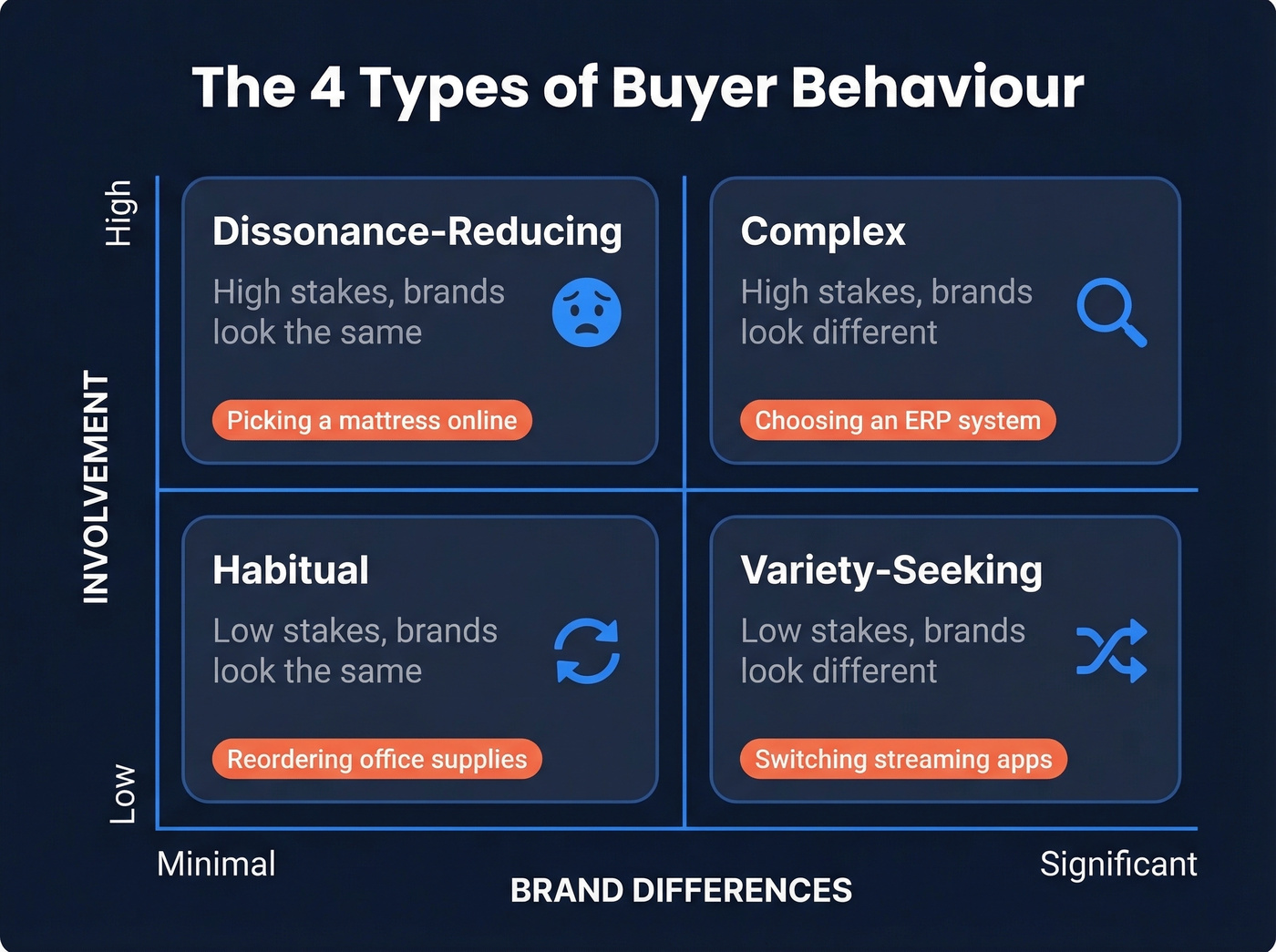
| Type | Involvement | Brand Differences | Example |
|---|---|---|---|
| Complex | High | Significant | Choosing an ERP system |
| Dissonance-reducing | High | Minimal | Picking a mattress online |
| Habitual | Low | Minimal | Reordering office supplies |
| Variety-seeking | Low | Significant | Switching streaming apps |
Complex buying behaviour shows up when the stakes are high and the options look genuinely different. Think enterprise software evaluations, where a buying committee spends months comparing vendors. The buyer builds comparison matrices, runs pilots, and agonizes over the decision because the cost of getting it wrong is enormous - both financially and politically.
Dissonance-reducing behaviour is the anxious cousin. The purchase matters, but the brands all look roughly the same. Someone buying a new mattress reads hours of reviews, then still worries they picked wrong. Post-purchase reassurance - reviews, return policies, follow-up emails - matters enormously here.
Habitual behaviour is autopilot. Nobody deliberates over which brand of paper towels to grab. In SaaS, this looks like auto-renewals on tools nobody's evaluated in two years. Low effort, low engagement, high inertia.
Variety-seeking behaviour is the opposite of habitual. The buyer isn't deeply invested, but they're actively looking for something new. Switching from Netflix to a competitor isn't a high-stakes decision, but the perceived differences between platforms drive experimentation. Brands competing here need to make switching easy and trial friction-free.
Recognizing these purchasing patterns in your own data is the first step toward tailoring messaging that actually resonates at each level of involvement.
The 5-Stage Decision Process
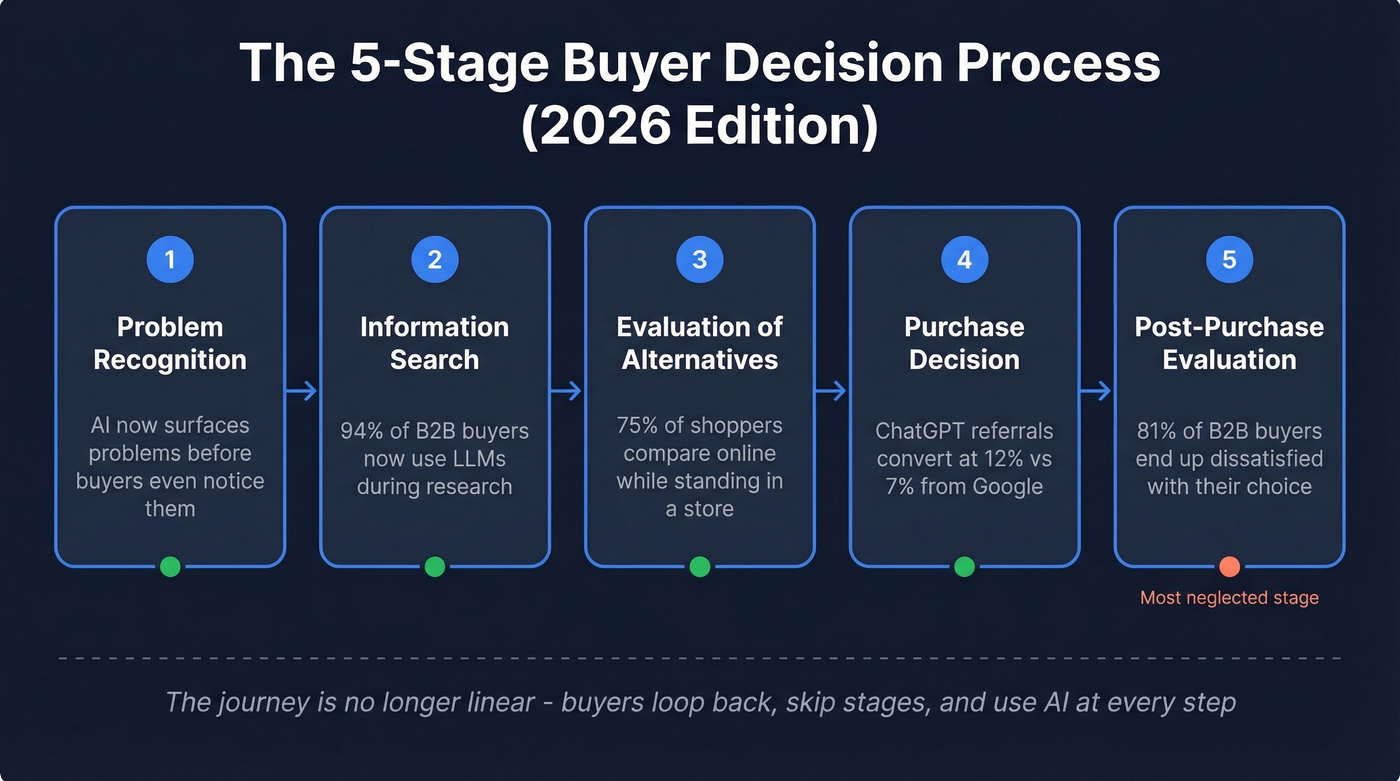
The five-stage model still works as a framework. But the data flowing through each stage looks nothing like it did even two years ago.
Problem Recognition
This hasn't changed structurally. A need emerges - a pain point, a gap, a trigger event. What's changed is that AI tools now surface problems proactively. Recommendation engines and predictive analytics flag issues before buyers consciously register them, which means the "trigger" is increasingly algorithmic rather than experiential.
Information Search
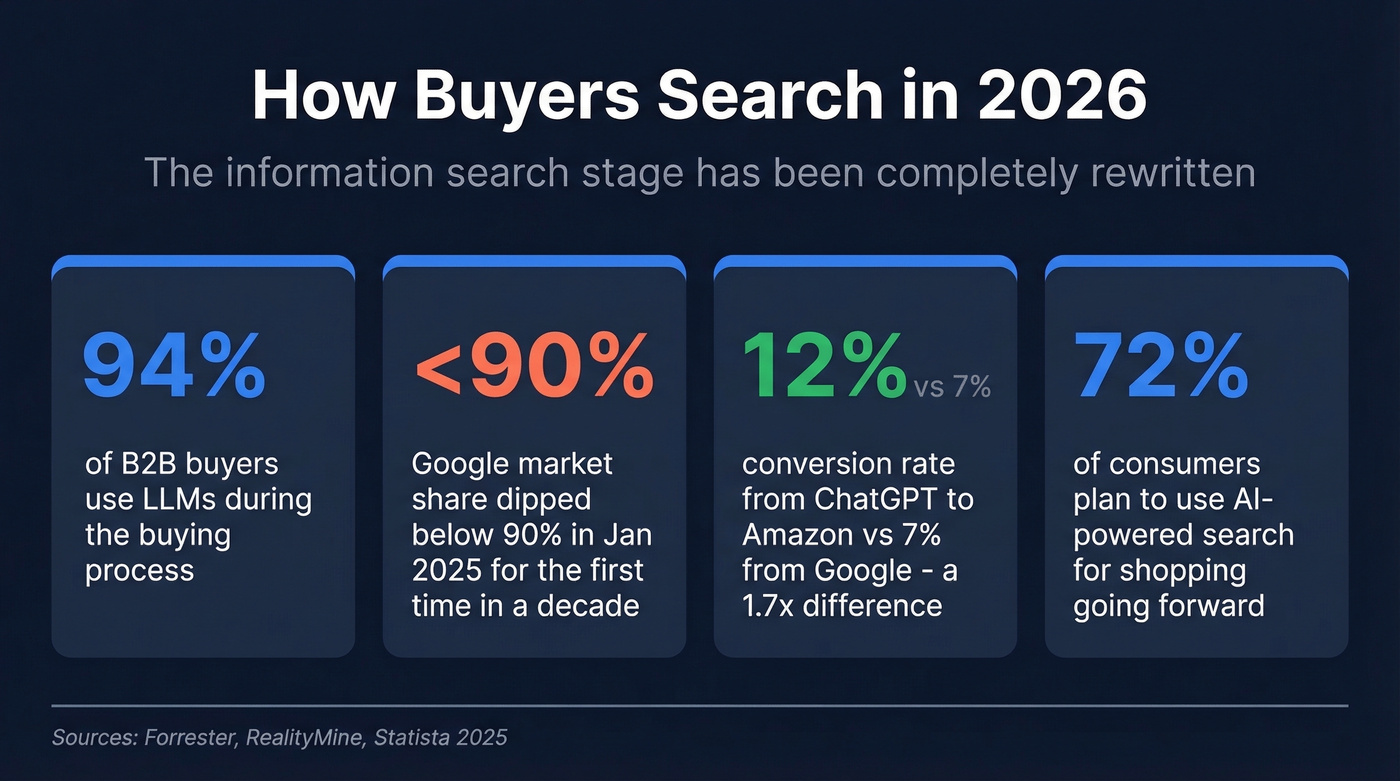
Here's where the biggest disruption sits. 94% of B2B buyers use LLMs during the buying process. Google's market share dipped below 90% in January 2025 for the first time in a decade. Buyers aren't just searching Google anymore - they're asking ChatGPT, Perplexity, and Gemini to synthesize options. And 72% of consumers plan to use genAI-powered search for shopping going forward.
Evaluation of Alternatives
This now happens in parallel across channels. Three out of four shoppers compare products online while physically standing in a store. In B2B, 72% of buyers encountered Google AI Overviews during research, and 90% clicked at least one cited source. Meanwhile, half of all shoppers abandon product pages that lack accurate information or visuals - making the evaluation stage faster but more ruthless than ever.
Purchase Decision
Increasingly shaped by where the buyer started their journey. RealityMine found that shoppers coming to Amazon from ChatGPT converted at 12% versus 7% from Google - a 1.7x difference. The channel of discovery is now a strong predictor of purchase intent and conversion.
Post-Purchase Evaluation
The most neglected stage, and the data proves it. That 81% buyer dissatisfaction stat isn't just a number - it's a signal that sellers optimize for the close, not the experience. In B2B especially, the gap between what was promised and what gets implemented drives churn, negative word-of-mouth, and the kind of Reddit threads that tank your next deal.

94% of B2B buyers use LLMs during their journey - and most never talk to sales. The only way to intercept modern buyer behaviour is with accurate contact data and intent signals. Prospeo tracks 15,000 buyer intent topics and delivers 98% verified emails so you reach decision-makers while they're still evaluating.
Stop studying buyer behaviour. Start reaching buyers who are already in-market.
What Shapes Buyer Behaviour
Psychological and Social Factors
At the foundation, purchasing decisions are emotional. Consumer choices are 70% emotional. Maslow's hierarchy still explains the basics - people satisfy survival needs before aspirational ones - but the social layer on top is where modern marketing lives.
Reference groups shape decisions more than most buyers realize. A VP of Sales doesn't just evaluate a tool on features - they evaluate it on whether their peers use it, whether it'll look smart in a board meeting, whether the brand signals sophistication or risk. Social proof isn't a marketing tactic. It's a fundamental driver of human decision-making.
Stress is an underappreciated factor: 58% of consumers report moderate-to-extreme daily stress, which drives both impulse purchasing and decision avoidance. Stressed buyers default to familiar brands or freeze entirely - bad news for anyone trying to break into a new market.
Behavioural Economics: The Hidden Drivers
Classical economics assumes buyers are rational. They're not. Behavioural economics, formalized by Richard Thaler and Cass Sunstein in Nudge (2008), studies the systematic ways people deviate from rationality - and these deviations are predictable enough to design around.
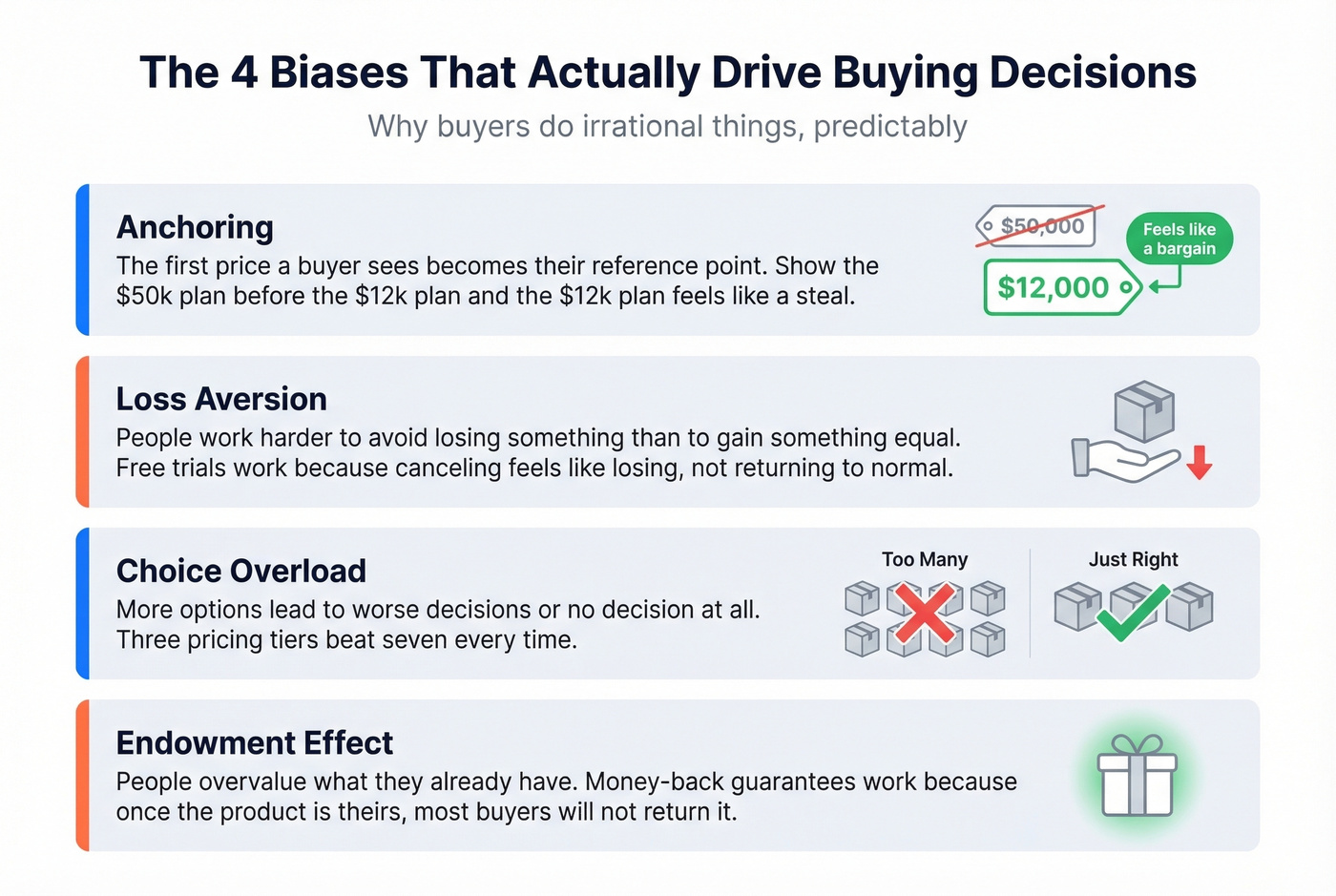
Anchoring is the most exploitable bias in pricing. The first number a buyer sees becomes their reference point. Show a $50,000/year enterprise plan before revealing your $12,000/year mid-market plan, and the mid-market plan feels like a bargain. Two out of three shoppers actively hunt for discounts - and anchoring is why the "original price" strikethrough still works. (If you want to go deeper on anchoring as a tactic, see anchoring.)
Loss aversion explains why "limited time offer" converts even when buyers know it's a tactic. People work harder to avoid losing something than to gain something of equal value. Free trials exploit this beautifully: once someone's used your product for 14 days, taking it away feels like a loss, not a return to baseline.
Choice overload is the paradox that more options lead to worse decisions - or no decision at all. The best SaaS pricing pages show three tiers, not seven. When buyers face too many alternatives, they either freeze or default to the cheapest option.
The endowment effect means people overvalue what they already possess. It's why money-back guarantees work - once the product is "theirs," most buyers won't return it. Dan Ariely's research on customization extends this: letting buyers configure a product increases their perceived ownership and willingness to pay, even before they've bought it.
Let's be honest - skip behavioural economics and you're describing what buyers do without explaining why. These biases are the levers that actually move the needle when you're trying to influence purchasing decisions at scale.
B2B vs B2C Buying Behaviour
B2B and B2C buying look similar on a whiteboard. In practice, the mechanics are fundamentally different.
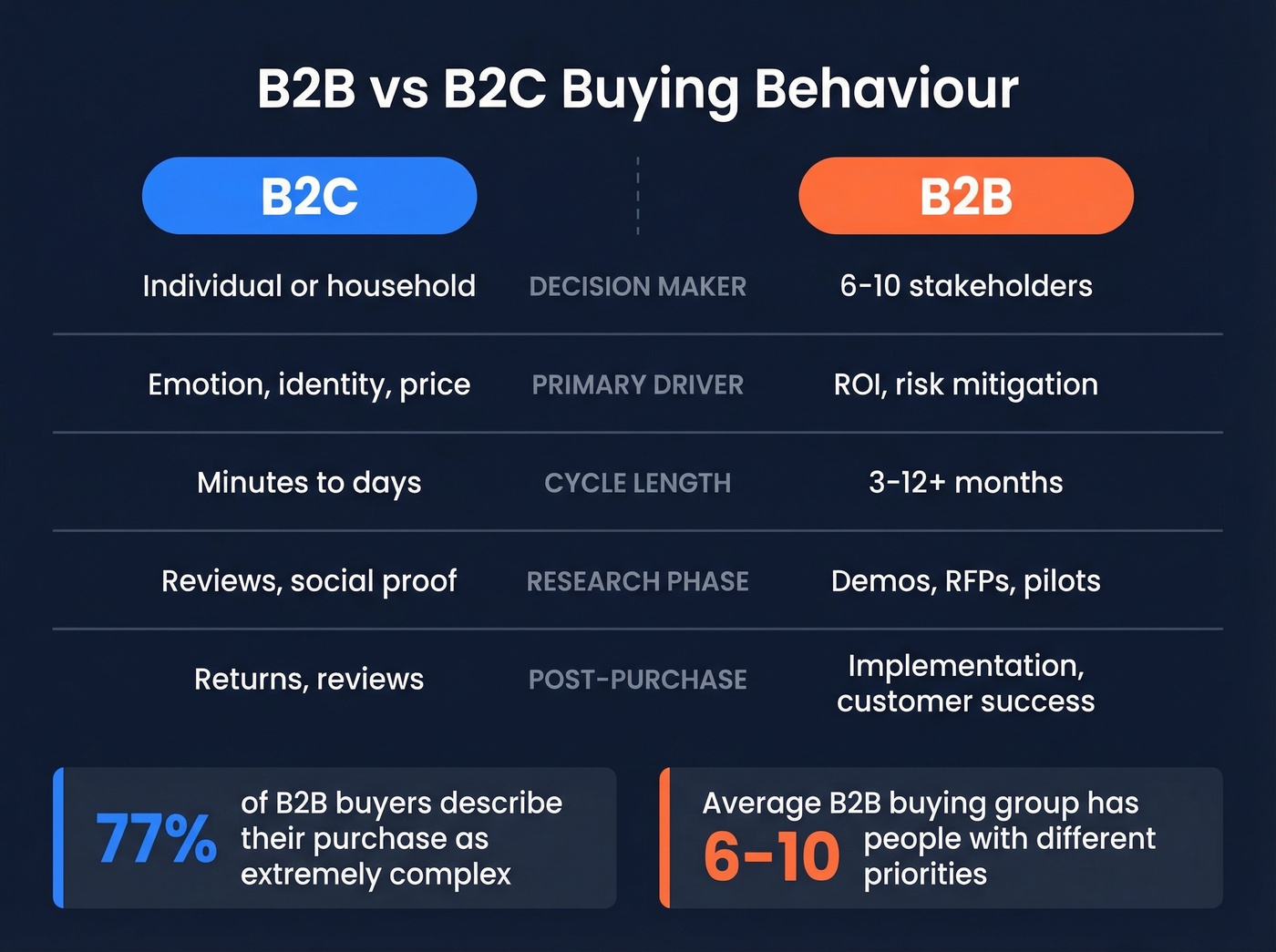
| Dimension | B2C | B2B |
|---|---|---|
| Decision-maker | Individual or household | 6-10 stakeholders |
| Primary driver | Emotion, identity, price | ROI, risk mitigation |
| Cycle length | Minutes to days | 3-12+ months |
| Research phase | Reviews, social proof | Demos, RFPs, pilots |
| Post-purchase | Returns, reviews | Implementation, CS |
77% of B2B buyers describe their purchase process as "extremely complex." That complexity comes from committee dynamics - McKinsey puts the average buying group at 6-10 decision-makers, each with different priorities, risk tolerances, and political agendas.
There's a telling thread on r/procurement where a buyer describes how internal stakeholders routinely tell suppliers they're the "favourite" - undermining the procurement team's negotiating position before formal evaluations even begin. That's not a process problem. It's a human behaviour problem, and it plays out in B2B purchases every day.
The 2026 data shows some compression in B2B timelines. Average sales cycle length dropped from 11.3 months to 10.1 months between 2024 and 2025, with first contact moving from 69% to 61% of the journey - roughly 6-7 weeks earlier. Economic pressure is the driver: 49% of buyers say economic conditions shortened their cycles, and 62% say it pushed them to engage sellers sooner.
But here's the critical stat: 83% of B2B buyers still mostly or fully define their purchase requirements before talking to sales. If your team isn't visible during the research phase, you're not on the shortlist. In our experience, the evaluation stage is where most B2B deals are won or lost - not the demo. The demo is a formality for the vendor who already won during research.
For teams that sell deals under $15K, you probably don't need a 6-month enterprise sales cycle. Compress your buying experience to match the actual stakes. Most B2B companies over-engineer their sales process relative to what the buyer is willing to endure. (If you're mapping this to your pipeline, use a B2B sales funnel with benchmarks.)
How AI and Social Commerce Are Reshaping Buying
AI-Driven Purchasing
The most striking behavioural shift in 2026 isn't a preference change - it's a channel change. Buyers are starting their journeys in AI tools, and the downstream behaviour looks different from traditional search.
RealityMine tracked this during Black Friday 2024: shoppers who came to Amazon from ChatGPT converted at 12% vs 7% from Google. Those ChatGPT-origin shoppers also spent 11% more per order and viewed 5 products versus 3 for Google-origin visitors. ChatGPT usage among Amazon shoppers increased 5x year-over-year, from 1.8% to 9.1%, and those visitors spent 46% longer on the site.
What this tells us is that AI-assisted research produces more intentional, higher-value buyers who've already narrowed their options before arriving at the purchase point. The information search and evaluation stages are collapsing into a single AI-mediated step.
On the B2B side, 72% of buyers encountered Google AI Overviews during research, and 90% clicked at least one cited source. If your content isn't being cited by AI tools, you're invisible during the fastest-growing segment of the decision-making process.
Social Commerce and Livestreams
Social commerce has moved from experiment to infrastructure. One in four social media users bought directly in-app in the past three months. Among Gen Z, that number hits 43%. By 2026, 17% of online sales will occur through social platforms, with US livestream shopping projected to hit roughly $70B.
What makes social commerce behaviourally different is that it compresses the entire five-stage process into a single session - sometimes a single scroll. Discovery, evaluation, social proof, and purchase happen without the buyer ever leaving the platform. They see a product demonstrated by someone they trust, read the comments for social validation, and tap "buy."
The behavioural economics are potent here. Scarcity cues in livestreams trigger loss aversion, influencer endorsements provide anchoring, and frictionless checkout exploits the endowment effect before the buyer even receives the product. McKinsey's data shows consumers now spend 90% of their free time on solo activities, which helps explain why individual, in-app shopping experiences are outpacing group or in-store ones.
One tension worth watching: Escalent's 2026 data shows 40%+ of consumers will pay more for values-aligned products, but 60%+ still prioritize affordability. Social commerce amplifies both sides - values-driven brands thrive on authenticity, while discount-driven livestreams convert on price alone.
How to Analyze Buyer Behaviour
Data Sources and Tools
Understanding buyer behaviour conceptually is one thing. Measuring it in your business is another entirely. The practical toolkit breaks into three layers.
On-site analytics. GA4 handles funnel analysis, page flow, time on page, and conversion paths. It tells you what buyers do on your site, but not why. For the "why," you need session replay tools that capture rage clicks, navigation loops, and form abandonment - what Glassbox calls "struggle scores," quantified friction metrics that flag where buyers get stuck.
CRM and transactional data. HubSpot and Salesforce provide deal velocity, email engagement, content consumption patterns, and lifecycle stage progression. This is where you see purchasing patterns at the individual and segment level. The key is blending quantitative signals like CTR and time-to-close with qualitative inputs from survey responses, usability interviews, and open-text support tickets. (If you're operationalizing this, start with funnel metrics and pipeline health.)
Intent data. This fills the gap the other two layers can't: which accounts are actively researching your category right now. Prospeo tracks 15,000 intent topics via Bombora on a 7-day refresh cycle, and you can combine those signals with 30+ filters covering job role, headcount growth, technographics, funding, and more. That combination lets you identify in-market accounts while they're still evaluating - not after they've already locked in a shortlist. (For a practical framework, see identifying buying signals and intent based segmentation.)
One compliance note: any behavioural data collection needs to respect GDPR and equivalent privacy frameworks. Consent management isn't optional, and the regulatory landscape is tightening. Build your analysis stack with privacy baked in from the start.
Segmentation That Works
Raw behavioural data is noise until you segment it. The three approaches that consistently produce actionable insights are demographic (who they are), behavioural (what they do), and lifecycle stage (where they are in the journey).
McKinsey's ConsumerWise methodology - surveying 25,998 consumers across 18 markets - represents the gold standard for macro segmentation. Most teams won't operate at that scale, but the principle holds: segment by observable behaviour first, then layer in demographics and firmographics.
The payoff is personalization that actually lands. Accenture found that 49% of customers expect to be recognized as loyal customers. That expectation gap between what buyers want and what most companies deliver is where segmentation creates competitive advantage. We've seen teams double their email engagement rates simply by segmenting outreach by lifecycle stage rather than blasting the same message to their entire database. We've also watched companies waste months building elaborate persona models when a simple three-bucket lifecycle segmentation would've moved the needle faster.
Skip the fancy models until you've exhausted the basics. Lifecycle-based segmentation is boring, but it works.
81% of buyers end up dissatisfied because sellers optimize for the close, not the right fit. Prospeo's 30+ filters - intent data, technographics, headcount growth, funding - let you match your outreach to actual buying signals, not guesswork. At $0.01 per email, targeting the right behaviour pattern costs less than one bad lead.
Match your outreach to real buying signals across 300M+ verified profiles.
FAQ
What are the 4 types of buyer behaviour?
Complex (high involvement, significant brand differences), dissonance-reducing (high involvement, minimal differences), habitual (low involvement, minimal differences), and variety-seeking (low involvement, significant differences). They map to a 2x2 matrix of involvement level and perceived brand differentiation.
How does consumer behaviour differ from buyer behaviour?
Consumer behaviour covers everything from need recognition through purchase to usage, disposal, and repurchase. Buyer behaviour focuses specifically on the purchase decision process - how someone identifies a need, evaluates alternatives, and commits. It's a subset of the broader consumer behaviour discipline.
How has AI changed buying decisions in 2026?
94% of B2B buyers now use LLMs during the buying process. ChatGPT-to-Amazon shoppers converted at 1.7x the rate of Google-to-Amazon shoppers, with 11% higher order values. The information search and evaluation stages are collapsing into a single AI-mediated step, producing more intentional buyers with narrower consideration sets.
Why do most B2B purchases stall?
86% stall because 6-10 stakeholders create compounding complexity. Each brings different priorities, risk tolerances, and approval requirements. Misalignment between what buyers need during evaluation and what sellers provide - combined with internal politics - creates friction that delays or kills deals.
What tools help track in-market buyer signals?
GA4 handles on-site analytics. HubSpot and Salesforce provide CRM-level engagement data. For identifying which accounts are actively researching your category, Prospeo combines intent data across 15,000 Bombora topics with 30+ firmographic and technographic filters on a 7-day refresh, letting you reach in-market accounts before they finalize a shortlist.