

Buyer Journey Examples That Actually Look Like Real Life
Every buyer journey example on the internet features the same fictional person shopping for headphones. Meanwhile, 61% of B2B buyers prefer a rep-free buying experience, and real purchase paths look nothing like a tidy three-stage funnel. Here are walkthroughs that reflect how B2B and B2C buying actually works in 2026.
B2B journeys are non-linear, often involve around seven stakeholders, and typically take one to three months. B2C journeys are shorter but extend well past purchase - loyal customers represent just 21% of your audience yet drive 44% of revenue. And most journey maps fail because they're never updated.
What Is the Buyer's Journey?
The textbook answer is three stages: awareness, consideration, decision. B2B reality has six - what Gartner calls "looping buying jobs": problem identification, solution exploration, requirements building, supplier selection, validation, and consensus creation. Buyers revisit these stages repeatedly before a deal closes, often circling back to requirements building after they thought they were done.
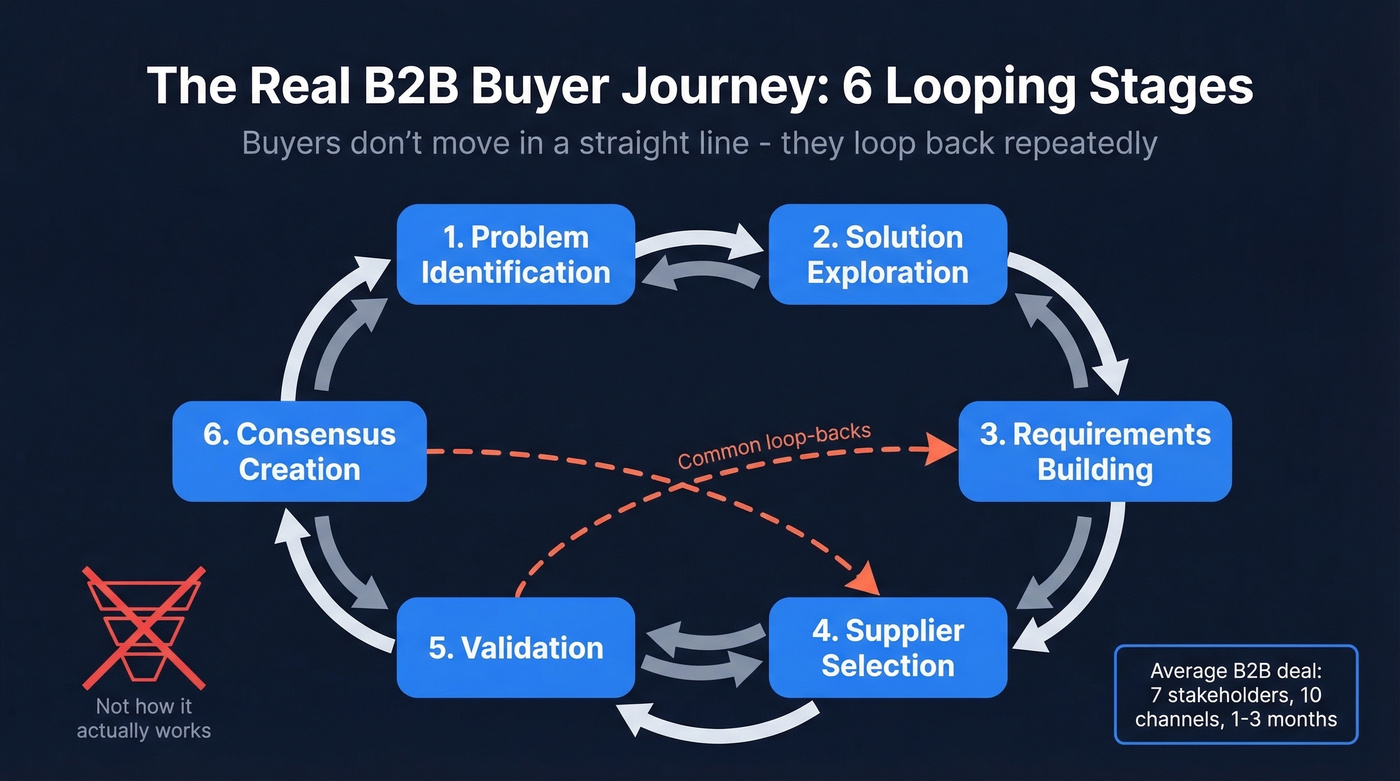
Three terms people use interchangeably but shouldn't:
| Buyer Journey | Customer Journey | Sales Funnel | |
|---|---|---|---|
| Scope | Pre-purchase | Post-purchase | Full pipeline |
| Stages | Awareness → Decision | Onboarding → Advocacy | Lead → Close |
| Owner | Marketing + Sales | CS + Product | Sales + RevOps |
| Key Metrics | MQLs, demo rate | NRR, churn | Win rate, velocity |
B2B SaaS Buyer Journey Example
Meet Jordan, a VP of Sales at a 200-person SaaS company. Pipeline is stalling because reps spend four to six hours a week on manual prospecting with stale contact lists. Bounce rates sit at 35-40%.
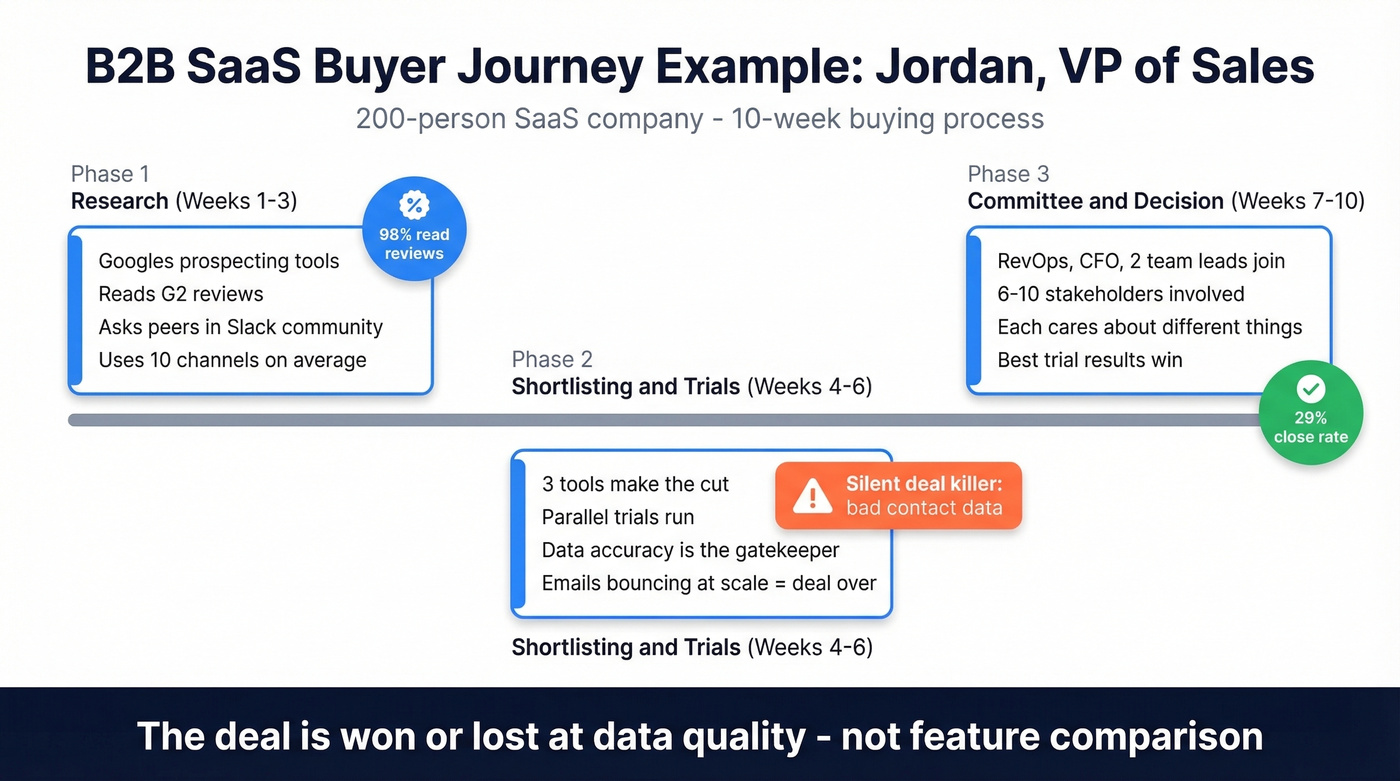
Research. Jordan Googles prospecting tools, reads G2 reviews - 98% of buyers read reviews before deciding - and asks peers in a Slack community. Buyers now use an average of 10 channels during this process and spend only about 17% of total buying time talking to vendors. McKinsey's rule of thirds holds: at any stage, roughly a third of buyers prefer in-person, a third remote, and a third digital self-serve.
Shortlisting and trials. Three tools make the cut based on data accuracy, CRM integrations, and pricing transparency. Jordan runs parallel trials, and this is where data quality becomes the gatekeeper. If a vendor's emails bounce at scale, the journey ends right there. Bad contact data means the buyer never enters the journey for your product - it's the silent killer of B2B deals that never shows up in your CRM's lost-reason field.

Committee and decision. Jordan brings in RevOps, the CFO, and two team leads, and the buying group expands to 6-10 people for a mid-market deal. Each person cares about something different: cost, implementation time, CRM compatibility, data compliance. The committee picks the tool with the best trial results. Total process: about 10 weeks, with around a 29% close rate.
Here's the thing - this walkthrough shows why consensus-building, not feature comparison, determines who wins the deal.
Buyer Journey by the Numbers
- 61% prefer rep-free buying - 73% avoid irrelevant outreach - 69% find inconsistencies between website and seller
- 1.8x higher deal quality with hybrid digital + rep interactions
- 5-12 touchpoints to close - ~7 stakeholders - 10 channels used
That 73% stat isn't a marketing talking point. Nearly three-quarters of buyers actively avoid suppliers who send irrelevant outreach.

Jordan's buyer journey stalled at 35-40% bounce rates. Prospeo customers like Snyk cut that to under 5% across 50 AEs - and grew AE-sourced pipeline 180%. With 98% email accuracy and a 7-day data refresh cycle, your outreach actually reaches the buying committee.
Stop losing deals to stale data before they even start.
B2C DTC Buyer Journey Example
Now a consumer journey - but not running shoes. Meet Alex, who's considering a DTC meal-kit subscription.
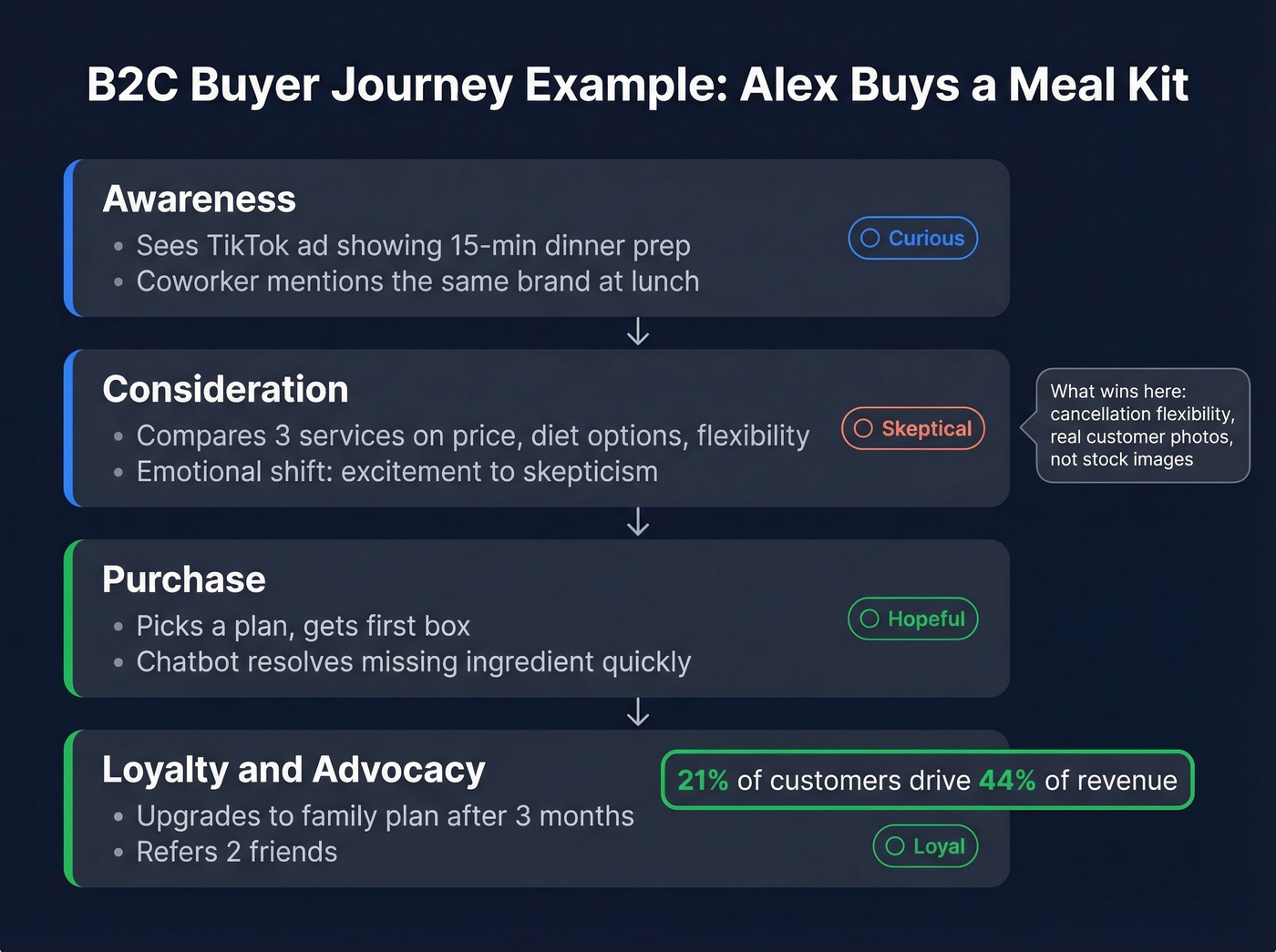
Awareness. Alex sees a TikTok ad showing a 15-minute dinner prep. A coworker mentions the same brand at lunch. Social proof stacks before Alex ever visits the site.
Consideration. Alex compares three services on price, dietary options, and flexibility. Emotional state shifts from excitement ("I'd actually cook more") to skepticism ("will I cancel in two weeks?"). Brands like Airbnb cracked this stage - their "Belong Anywhere" campaign resolves doubt through user-generated testimonials that align with the buyer's identity. The best DTC brands do the same with cancellation flexibility and real customer photos, because nobody trusts a stock image of a smiling family eating quinoa.
Purchase and beyond. Alex picks a plan, gets the first box, and contacts support about a missing ingredient - a chatbot handles it quickly. Three months later, Alex upgrades to the family plan and refers two friends. The loyalty math is striking: just 21% of a brand's audience generates 44% of revenue. That's why the journey doesn't end at checkout.
How to Map Your Own Buyer Journey
Let's be honest: stop perfecting your journey map. We've watched teams spend weeks building beautiful Miro boards that never get opened after the kickoff meeting. Start with one persona, one journey, three data points. A map nobody uses is worse than no map at all.
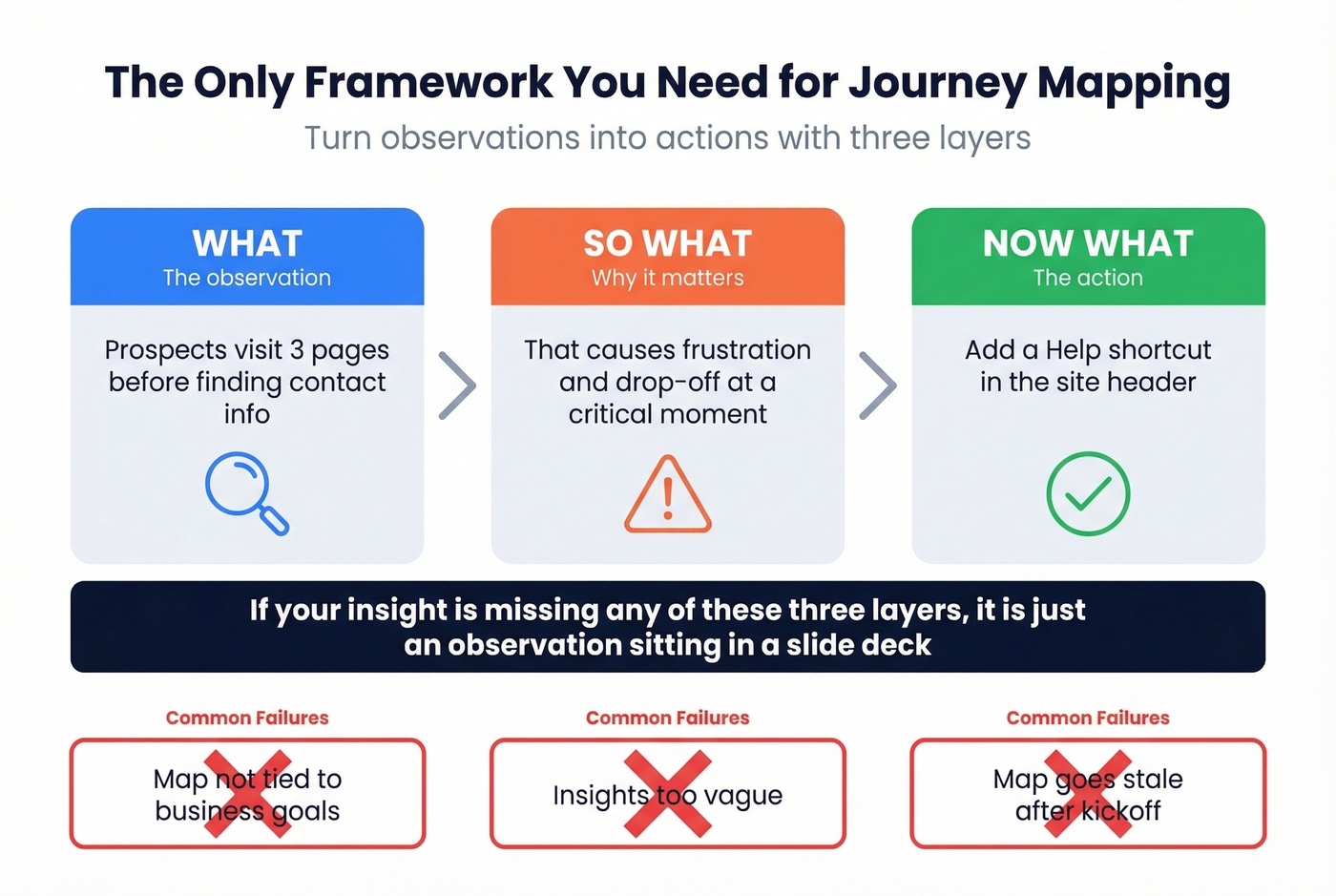
CustomerThink research found three consistent mapping failures:
Maps aren't tied to business goals. Start with a revenue-impacting journey: onboarding, renewal, or a key service touchpoint. If you can't connect a map to churn, CSAT, or pipeline velocity, it's decoration.
Insights are too vague. Use the "What / So what / Now what" framework. "Prospects visit 3 pages before finding contact info" leads to "That causes frustration and drop-off" leads to "Add a Help shortcut in the header." Every insight needs all three layers, or it's just an observation sitting in a slide deck.
Maps go stale. Assign a journey owner and review quarterly. Maps come in several formats - linear stage progressions, non-linear loop models, and emotional maps tracking buyer sentiment - but none of them matter if they reflect a product and market from six months ago. In our experience, the biggest journey-mapping failure is treating it as a one-time project instead of a living document. You don't need expensive software. Google Sheets works for v1. For something purpose-built, UXPressia starts at $24/user/month with a free plan.
Skip the mapping exercise entirely if you don't have someone who'll own updates. Seriously. An outdated map actively misleads your team - it's worse than working from instinct.
Every buyer journey example in this article shares one thing in common: the journey breaks when the data breaks. Fix the data first, then map the experience around it. Tools like Prospeo, with a 7-day data refresh cycle and 98% email accuracy, exist because stale contact data is where most B2B buyer journeys quietly die before they start. If you're diagnosing bounces, start with email bounce rate and then work backward through your email deliverability stack.
FAQ
What is a buyer journey example?
A buyer journey example is a stage-by-stage walkthrough showing how someone moves from first awareness to purchase decision. B2B buying typically involves six stages - problem identification, solution exploration, requirements building, supplier selection, validation, and consensus creation - with buyers looping back through stages rather than moving linearly.
What's the difference between a buyer journey and a customer journey?
The buyer journey covers pre-purchase: everything from first awareness through the decision. The customer journey extends post-purchase into onboarding, adoption, renewal, and advocacy. Marketing and sales drive the buyer journey; customer success and product own the customer journey.
How do I make sure my outreach actually starts the buyer journey?
Verify your contact data before launching campaigns. If emails bounce, the prospect never enters the journey. Pair verified data with relevant messaging - 73% of B2B buyers actively avoid suppliers who send irrelevant outreach, so even perfect deliverability won't save a generic pitch.