

Bytemine vs ZoomInfo: Honest Comparison (2026)
The price gap in Bytemine vs ZoomInfo is wild: ZoomInfo commonly starts around $15,000/year, while Bytemine starts at $50/month. That alone tells you which one belongs in an enterprise budget meeting and which one belongs in a scrappy ops stack.
But price isn't the whole story. Data freshness, workflow fit, and how much "stuff" you actually need (intent, org charts, technographics) decide whether you'll love the tool or resent it six weeks into the contract.
30-Second Verdict
- Pick Bytemine if you're a small team, you want API-first enrichment, and you need to stay under $1K/year.
- Pick ZoomInfo if you're running 50+ reps and you truly need intent data, org charts, and technographics at enterprise scale.
Bytemine vs ZoomInfo: Comparison Table
| Dimension | Bytemine | ZoomInfo | Winner |
|---|---|---|---|
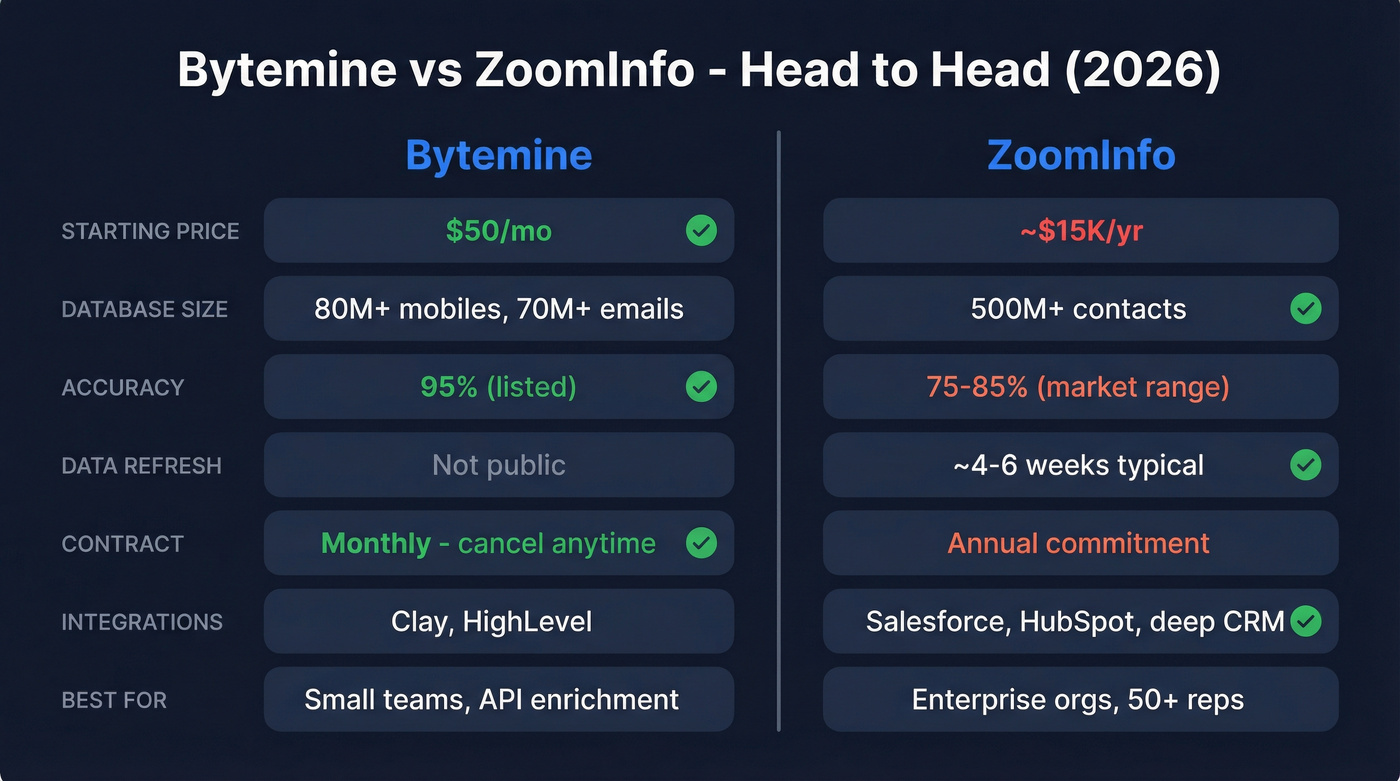
| Starting price | $50/mo | ~$15K/yr | Bytemine |
| Database size | 80M+ mobiles, 70M+ work emails | 500M+ contacts | ZoomInfo |
| Accuracy | 95% (listed on Bytemine's Datarade profile) | 75-85% (commonly cited market range) | Bytemine (on paper) |
| Data refresh | Not public | ~4-6 weeks is typical for large databases | ZoomInfo (clearer expectation) |
| Contract | Monthly | Annual | Bytemine |
| Integrations | Clay, HighLevel | Salesforce, HubSpot | ZoomInfo |
| Best for | Small teams, API enrichment | Enterprise orgs (50+ reps) | Depends |
Pricing breakdown (and the stuff that sneaks in later)
Bytemine starts at $50/month with no annual commitment, unlimited users, and API access. In practice, that means a 3-5 person SDR team can run enrichment all year for roughly what ZoomInfo costs for a week or two. If you're doing light enrichment, you're usually in the $600-$1,200/year range.
If you’re comparing vendors in this category, it helps to benchmark against other data enrichment services too.
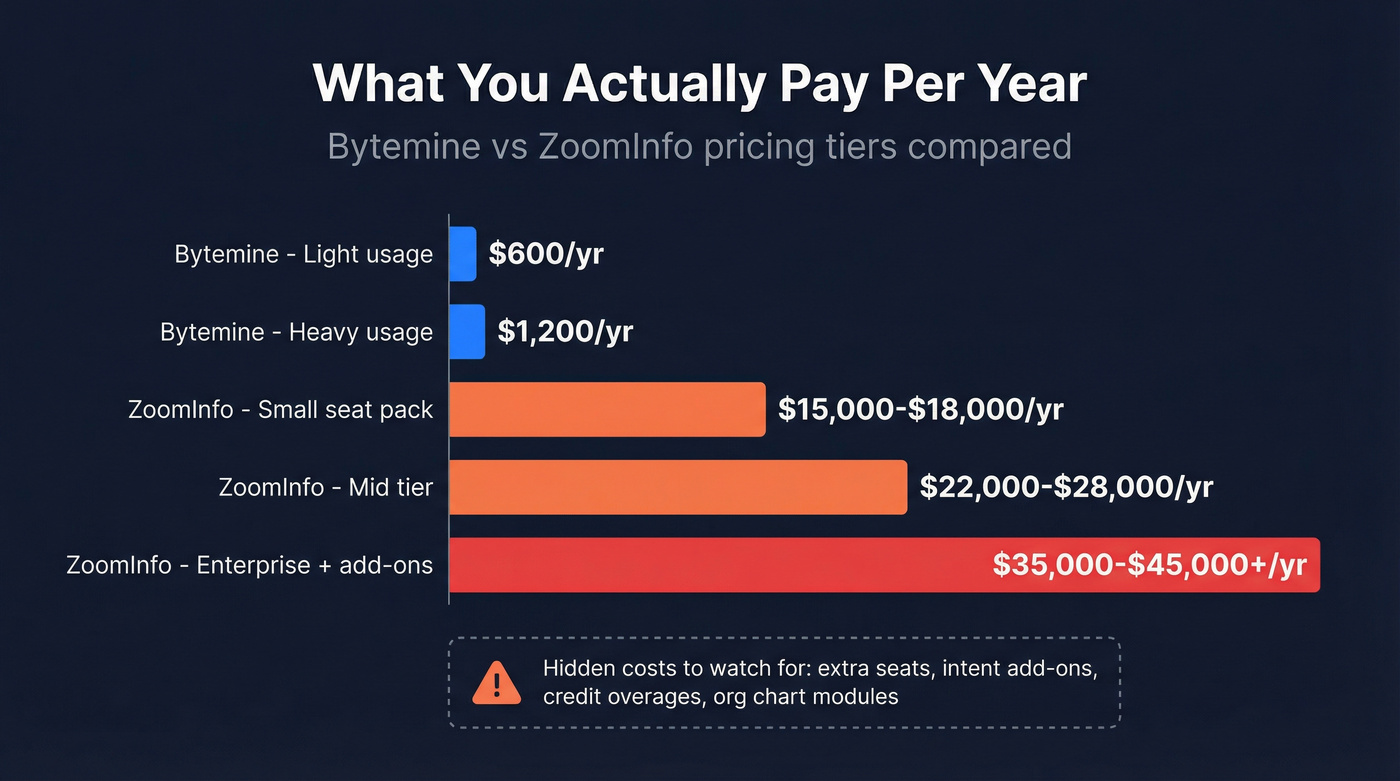
ZoomInfo is a different category. You'll often hear numbers like $15,000-$18,000/year for a small seat pack, then $22,000-$28,000 for higher tiers, and $35,000-$45,000+ once you stack the "enterprise" pieces. And yes, discounts are common. That doesn't make it cheap; it just means list pricing is a negotiation anchor.
Here's the part that frustrates teams: the real bill shows up in the edges. Extra seats, intent add-ons, credit overages, and "one more module" because leadership wants org charts in Q3. We've seen teams go in thinking they're buying a database and come out managing a mini procurement project.
If you're evaluating ZoomInfo, go in with a hard internal rule: decide what you need before the demo, and don't let the rep define your requirements for you. (If you want a framework for that “list price vs reality” dynamic, see anchor in negotiation.)
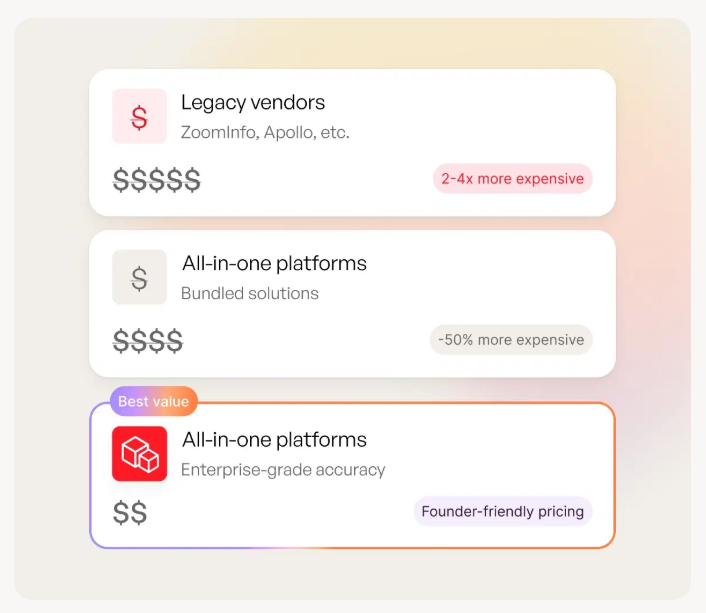

Bytemine's $50/mo pricing is attractive. ZoomInfo's $15K/yr contract is painful. Prospeo gives you 300M+ profiles with 98% email accuracy, a 7-day data refresh cycle, and 125M+ verified mobiles - all at ~$0.01/email with zero contracts.
Stop comparing compromises. Get enterprise data at startup pricing.
Data coverage and accuracy: volume vs freshness
B2B contact data decays fast. People change jobs, companies reorg, domains get locked down, and phone systems route differently. A huge database is great until it isn't refreshed quickly enough, because then you're paying for scale and still eating bounces.
If you’re seeing bounces climb, it’s worth revisiting email bounce rate and the broader email deliverability guide before you blame copy or targeting.
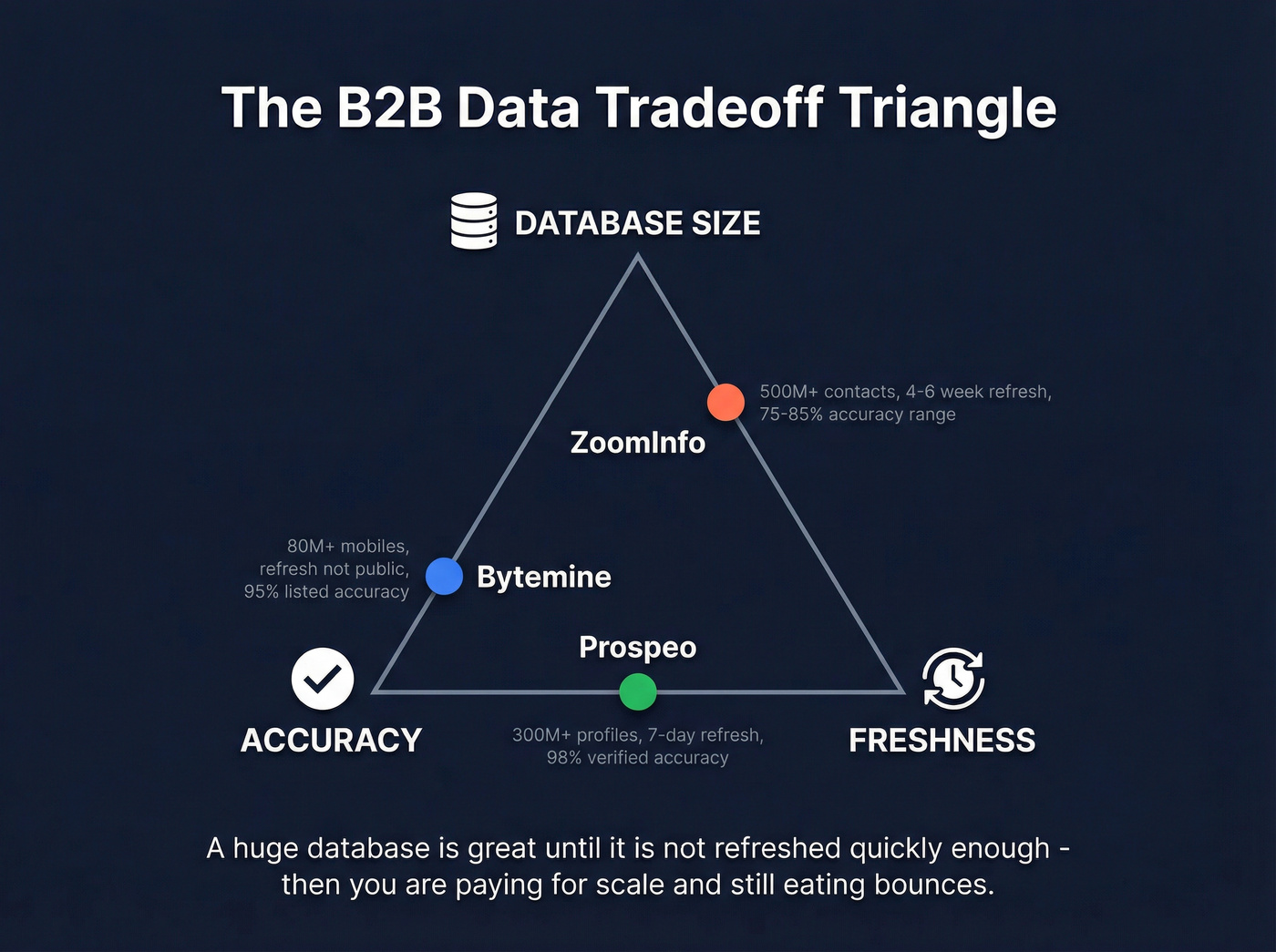
ZoomInfo's big advantage is breadth: lots of contacts, lots of companies, lots of layers (org charts, technographics, intent). The trade-off is that large datasets tend to refresh on slower cycles, and users regularly complain about stale records.
If you want a quick gut-check, skim what operators say in communities like r/sales and r/SalesOperations. The recurring theme isn't "ZoomInfo has no data." It's "ZoomInfo has data, but too much of it is old in my segment."
Bytemine lists 95% accuracy on its Datarade profile. That's encouraging, but it's not the same as years of public reviews across thousands of deployments. Still, the API-first approach tends to attract teams who care about validation and workflow control, which usually correlates with cleaner enrichment habits.
Let's be honest: "battle-tested" doesn't mean "accurate." It means widely used. If your average deal is $8K and you're sending 20K outbound emails a month, you don't need a 500M-contact universe. You need fewer bounces and fewer wasted dials.
Features and integrations
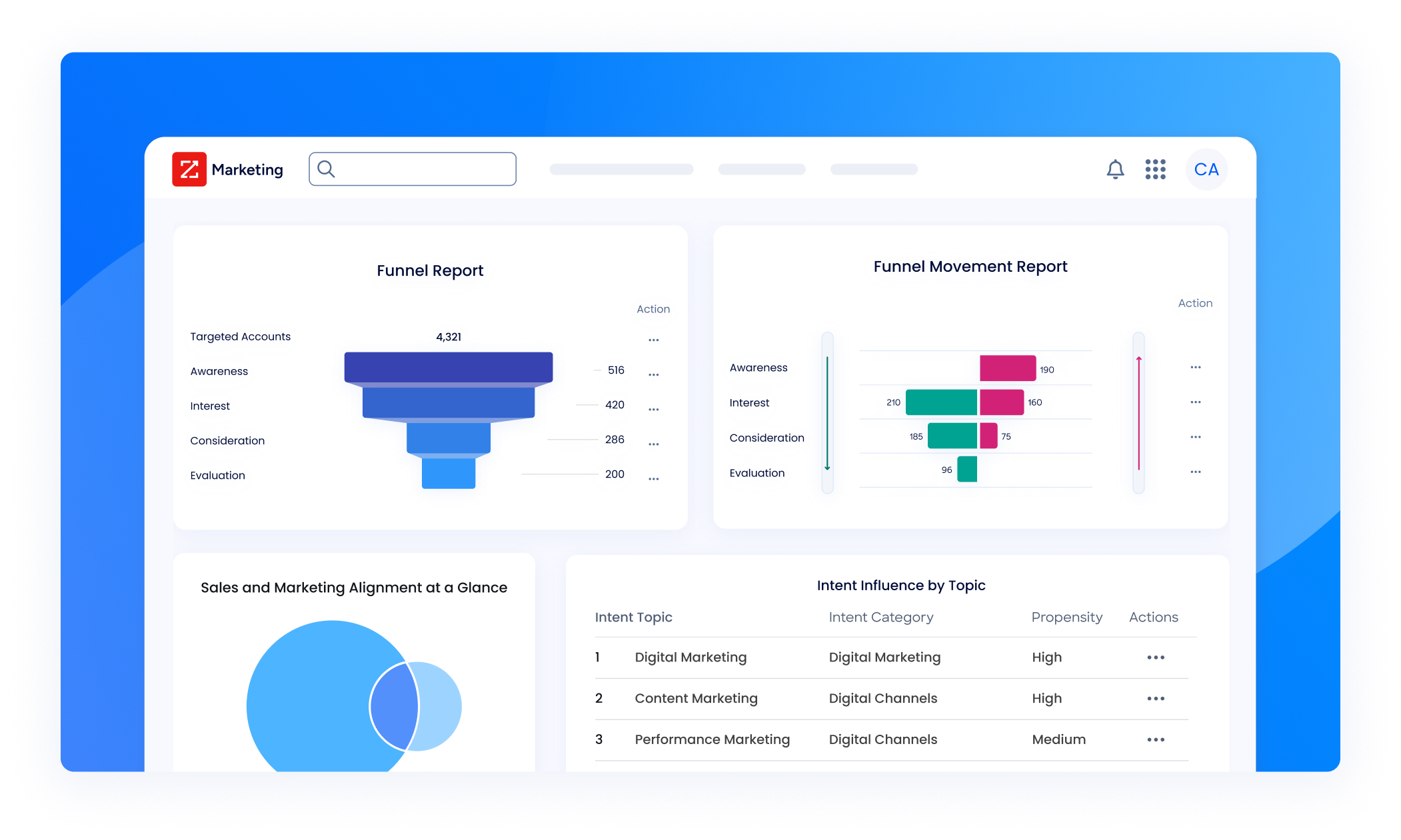
ZoomInfo is the full suite: intent data, technographics, org charts, and deep CRM workflows. If you're running a big team with territories, enablement, and RevOps governance, that matters. It can also be a lot. Annual contracts, cancellation windows, and add-ons that stack quickly are part of the package, and the Chrome extension experience gets mixed reviews.
Bytemine is simpler. It's built like a developer product that happens to sell contact data: API-first, predictable pricing, and lighter "suite" features. That's a plus if you already have your outbound stack and you just need reliable enrichment without buying an enterprise platform.
We've run both through real enrichment workflows. ZoomInfo feels like heavyweight enterprise software: powerful, but you pay in complexity. Bytemine feels like a clean utility: you plug it in, it does the job, and it stays out of the way.
Who should pick which (real-world fit)
Small team, budget under $5K/year: pick Bytemine. ZoomInfo's minimum spend can be 3x your entire annual tooling budget. Skip the demo and put that time into tightening your ideal customer profile and sequences.
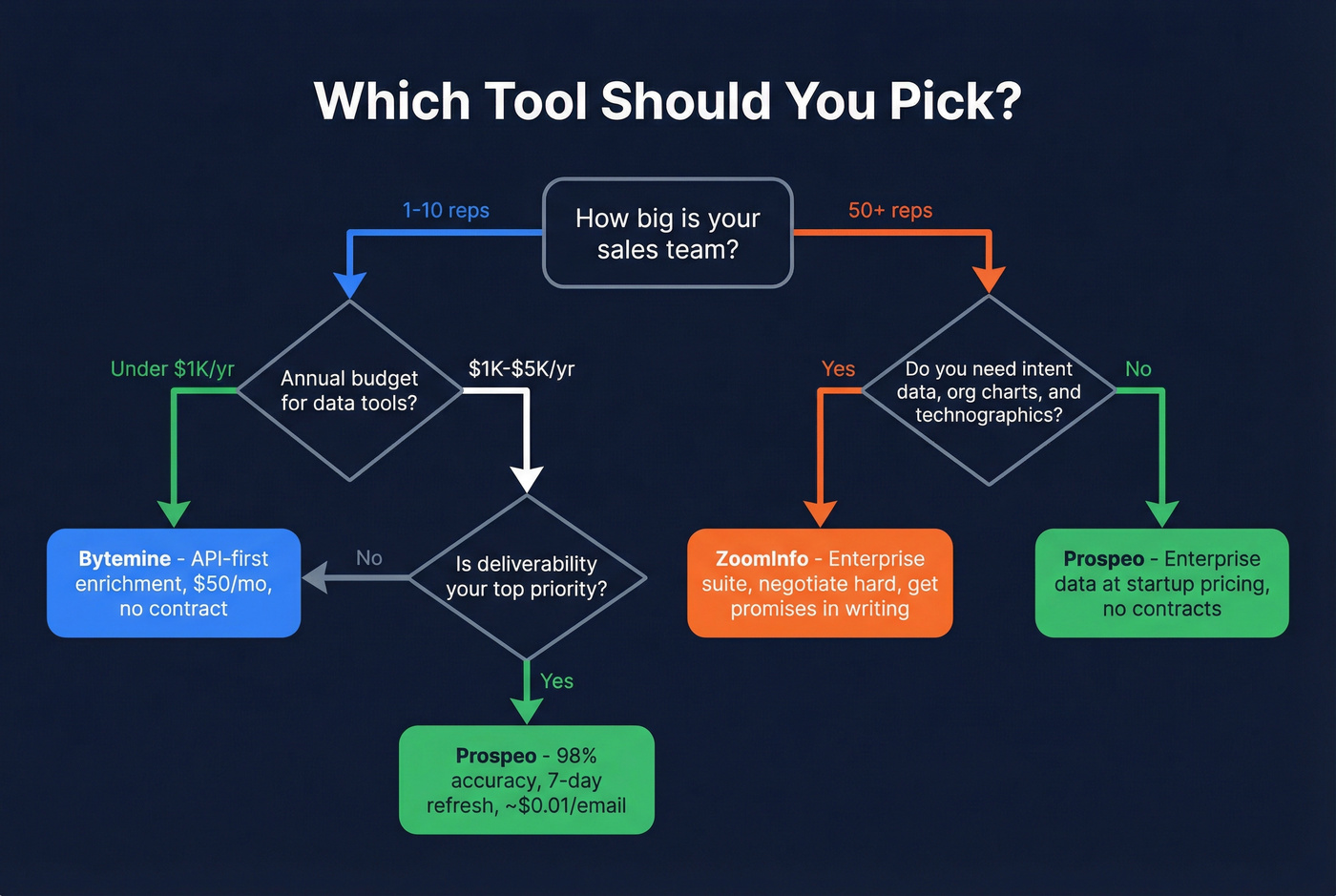
Enterprise org, 50+ reps, you need intent + org charts: pick ZoomInfo. It's expensive, but the feature breadth is hard to match at that scale. Negotiate hard, and get every promise in writing.
Here's a scenario we see a lot: a team buys an enterprise database, blasts it into sequences, and two weeks later they're dealing with rising bounce rates, angry deliverability dashboards, and reps blaming the tool. The tool isn't always the only problem, but bad data makes every other problem worse.
If you want to operationalize this, build a simple lead generation workflow and track the right lead generation metrics.
Where Prospeo fits (and why teams test it early)
If the real issue is "our sequences bounce and reps waste hours chasing dead contacts," Prospeo is often the fastest way to get back to stable outbound:
- Accuracy that protects deliverability: 98% verified email accuracy, with catch-all handling, spam-trap removal, and honeypot filtering.
- Freshness you can plan around: every record refreshes on a 7-day cycle (the industry average is about 6 weeks).
- Coverage that's usable: 300M+ professional profiles, 143M+ verified emails, and 125M+ verified mobile numbers.
- Built for workflows: 92% API match rate, enrichment that returns 50+ data points, and native integrations like Salesforce, HubSpot, Smartlead, Instantly, Lemlist, Clay, Zapier, and Make.
- Self-serve economics: about $0.01/email, no contracts, and a free tier (75 emails/month plus 100 Chrome extension credits).
If you're considering ZoomInfo but you don't want contract gravity, this is usually the first test we recommend running.

Bounce rates kill outbound before your copy even matters. While ZoomInfo refreshes every 4-6 weeks and Bytemine doesn't publish its cycle, Prospeo refreshes every 7 days - with catch-all handling, spam-trap removal, and honeypot filtering built in. Teams using Prospeo see bounce rates drop below 4%.
Test 75 verified emails free - no credit card, no sales call required.
FAQ
Is Bytemine a real ZoomInfo replacement?
For small teams doing API-based enrichment on a tight budget, yes. Bytemine can cover the core "find contact data" workflow for under $1K/year.
For larger orgs that rely on intent signals, org charts, and technographics across territories, it doesn't replace the full ZoomInfo suite.
Can I use Bytemine and ZoomInfo together?
Yes. Running a lightweight enrichment API alongside an enterprise suite is common, especially to patch coverage gaps or reduce credit burn.
If you're paying $15K+ annually and still need a second provider for basics, that's usually a sign your segmentation is off or your team needs a deliverability-first layer.
What's the cheapest ZoomInfo alternative for deliverability?
Bytemine is also inexpensive at $50/month, but it has less independent validation published for accuracy at scale.
Summary
In Bytemine vs ZoomInfo, you're choosing between API-first affordability and enterprise breadth. Bytemine wins on transparent pricing and lightweight enrichment. ZoomInfo wins when you truly need org charts, technographics, and intent at scale.
If your priority is clean data that protects deliverability without a long contract, test Prospeo first and measure bounces before you sign anything.