


Captain Verify vs LeadGenius: An Honest Comparison
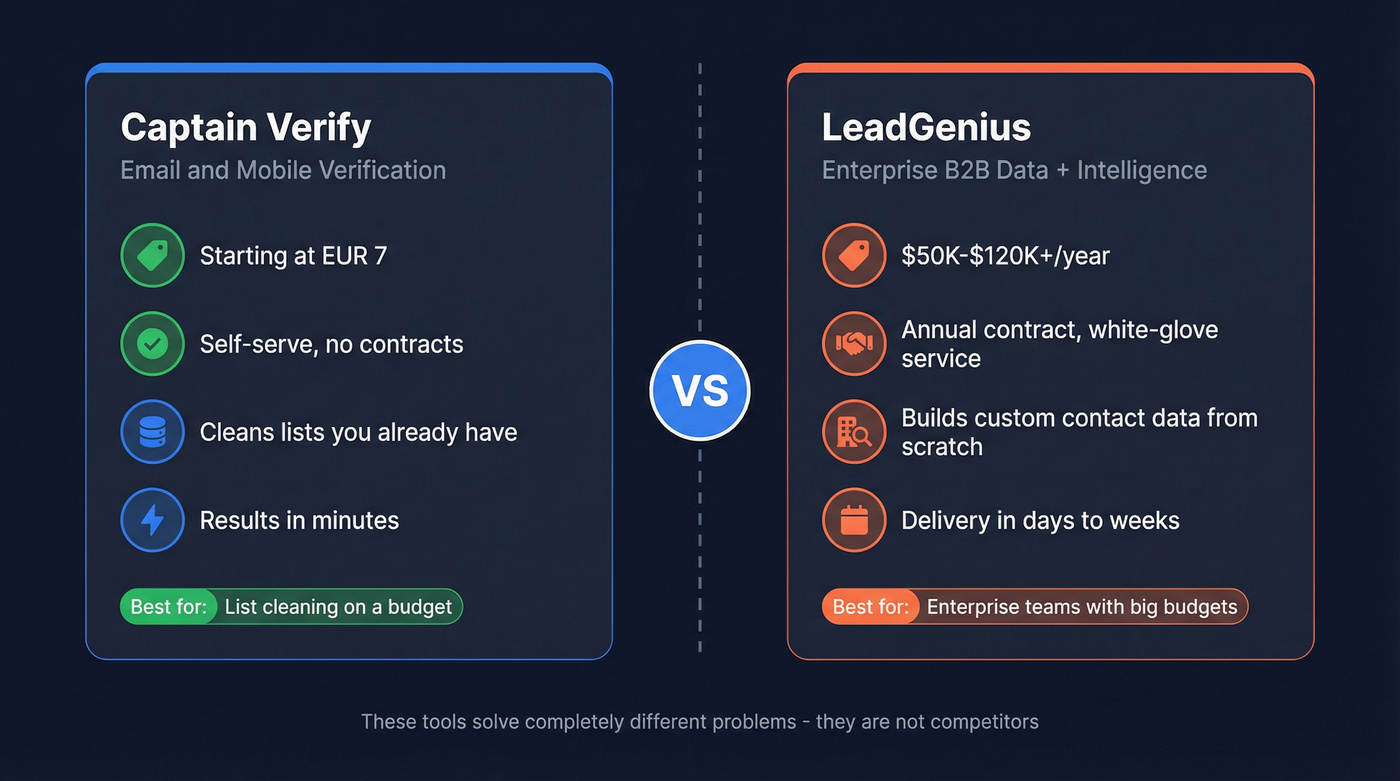
Captain Verify starts at EUR 7. Typical LeadGenius contracts run $50K-$120K+/year. These tools don't compete - they solve completely different problems. With global inbox placement hovering around 83.5%, email verification isn't optional, but how you source and clean contacts depends entirely on your workflow and budget.
Here's what each tool actually does, and why you're comparing apples to aircraft carriers.
30-Second Verdict
- Choose Captain Verify if you already have an email list and need to clean it before sending. It's a verification tool, pure and simple.
- Choose LeadGenius if you need custom, hard-to-find B2B contact data sourced by human researchers at enterprise scale - and you've got the budget to match.
What Each Tool Actually Does
Captain Verify
Captain Verify is a France-based email and mobile verification service. You upload a CSV, it runs deliverability checks - syntax, domain/DNS and MX validation, SMTP-level mailbox checks - and you download a cleaned list. It also offers a real-time API for verifying emails at the point of capture, plus HLR lookup for mobile numbers.
GDPR-aligned with servers in France. You get 100 free credits at signup, and any "unknown" results get recredited. That's a nice touch most verifiers skip.
LeadGenius
LeadGenius isn't a verification tool. Founded in 2011 out of Y Combinator, it's an enterprise B2B contact data and buyer intelligence platform that uses AI combined with human researchers to source custom contact data on demand. Think buying committees, champion tracking across job changes, and in-market buyer activation - delivered in days to weeks, not seconds. It integrates with Salesforce, HubSpot, Marketo, Pardot, and Outreach. You get highly tailored, hard-to-find data, but this isn't a self-serve search database. It's a white-glove, campaign-driven service.

Feature-by-Feature Comparison
| Dimension | Captain Verify | LeadGenius |
|---|---|---|
| Category | Email/mobile verifier | B2B data + intelligence |
| Starting price | EUR 7 (1K checks) | ~$50K/year (typical) |
| Delivery speed | Minutes | Days to weeks |
| Self-serve | Yes | No (campaign-driven) |
| Free tier | 100 credits | None |
| Contract required | No | Annual |
| Integrations | Mailchimp, SendGrid, Mailjet, SendinBlue | Salesforce, HubSpot, Marketo |
| Review rating | 4.5/5 (19 reviews) | 4.3/5 (14 reviews) |
These tools sit at opposite ends of the sales workflow. Captain Verify cleans what you already have. LeadGenius builds what you don't.
If you're trying to map this to your funnel, it helps to think in terms of a full lead generation workflow rather than a single tool choice.

Captain Verify cleans lists. LeadGenius builds them. Prospeo does both - 300M+ profiles with 98% verified email accuracy, built-in catch-all handling, and a 7-day data refresh cycle. No stitching tools together.
Find and verify contacts in one platform for $0.01 per email.
Pricing Breakdown
Captain Verify Pricing
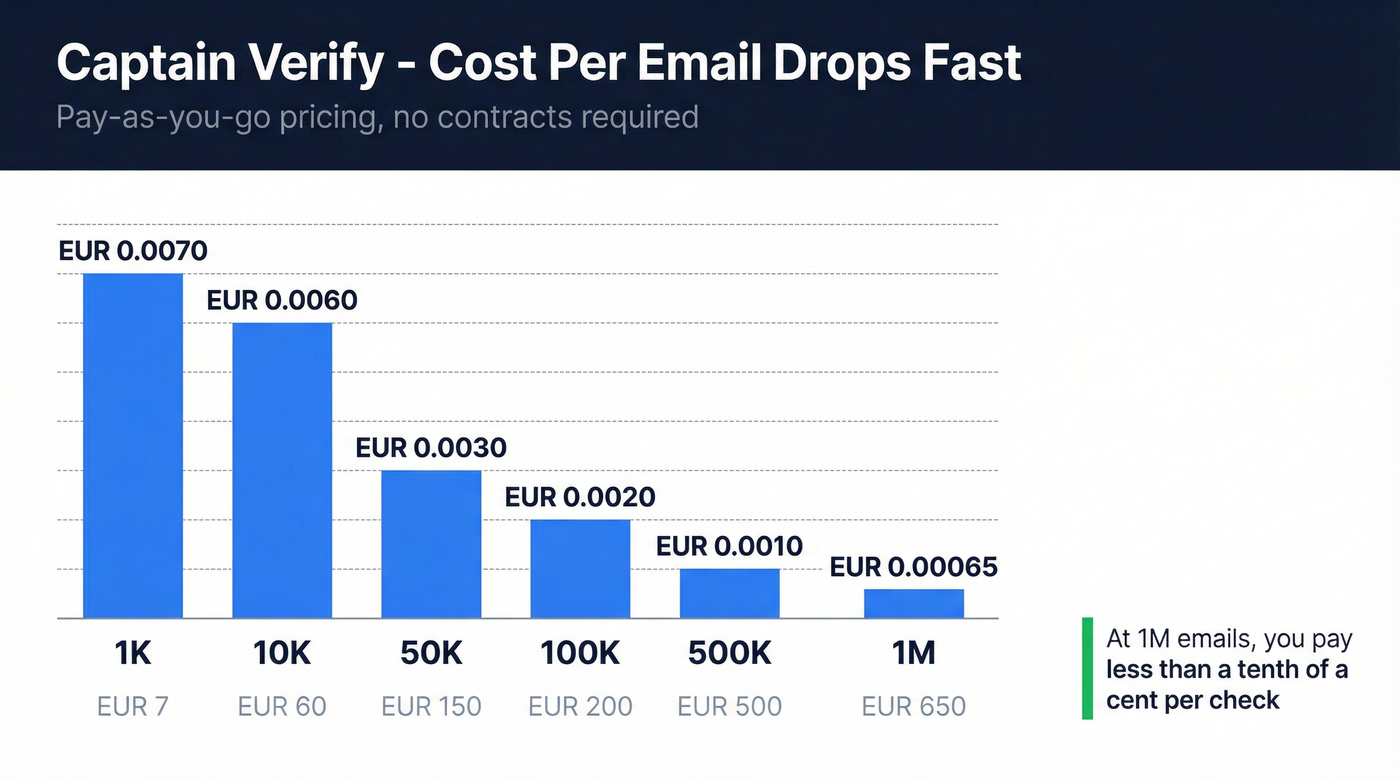
Straightforward credit-based pricing, no contracts. Full tiers from their pricing page:
| Volume | Price |
|---|---|
| 1,000 | EUR 7 |
| 10,000 | EUR 60 |
| 50,000 | EUR 150 |
| 100,000 | EUR 200 |
| 500,000 | EUR 500 |
| 1,000,000 | EUR 650 |
Subscriptions save 10%, annual plans include two months free, and on-demand credits last 365 days. At the high end, you're paying EUR 0.00065 per email. Genuinely cheap.
If you're comparing verifiers on cost vs risk, it’s worth understanding email bounce rate benchmarks and what “clean” actually means.
LeadGenius Pricing
LeadGenius doesn't publish pricing, and numbers vary by scope. Starter contracts run $18K-$30K/year, professional tiers hit $50K-$80K/year, and enterprise engagements exceed $120K/year. Minimum monthly spend sits around $5K, annual contracts only.
In late 2025, LeadGenius shifted to a cents-per-record campaign model, though per-record rates aren't public yet. We've tracked 15-20% price increases from 2024 to 2025, so budget accordingly.
What Users Say
Captain Verify gets praised for simplicity and accuracy. Users on SoftwareAdvice call it "easy to use" with "detailed" results and competitive pricing. On Reddit, it shows up in multi-tool comparison threads alongside EmailListVerify, MillionVerifier, and Proofy - it's a common shortlist item when people compare verifiers. The main gripe from one reviewer was a GDPR concern about an unsubscribe link not working. Captain Verify disputed and apologized, but with only 19 reviews total, individual complaints carry outsized weight.
LeadGenius earns respect for its human element and tailored data accuracy. G2 reviewers highlight strong project support and global coverage. The recurring complaint: some leads come back outdated or irrelevant. With just 14 reviews on G2, the sample is thin - we'd recommend requesting a pilot project before committing to a full annual contract.
Which One Do You Need?
Use Captain Verify if you've already built your prospect list and need to scrub it before launching a campaign. It's fast, cheap, and does one thing well.
If you're doing this at scale, pair list cleaning with a real email deliverability guide so you don’t fix bounces but miss inboxing.
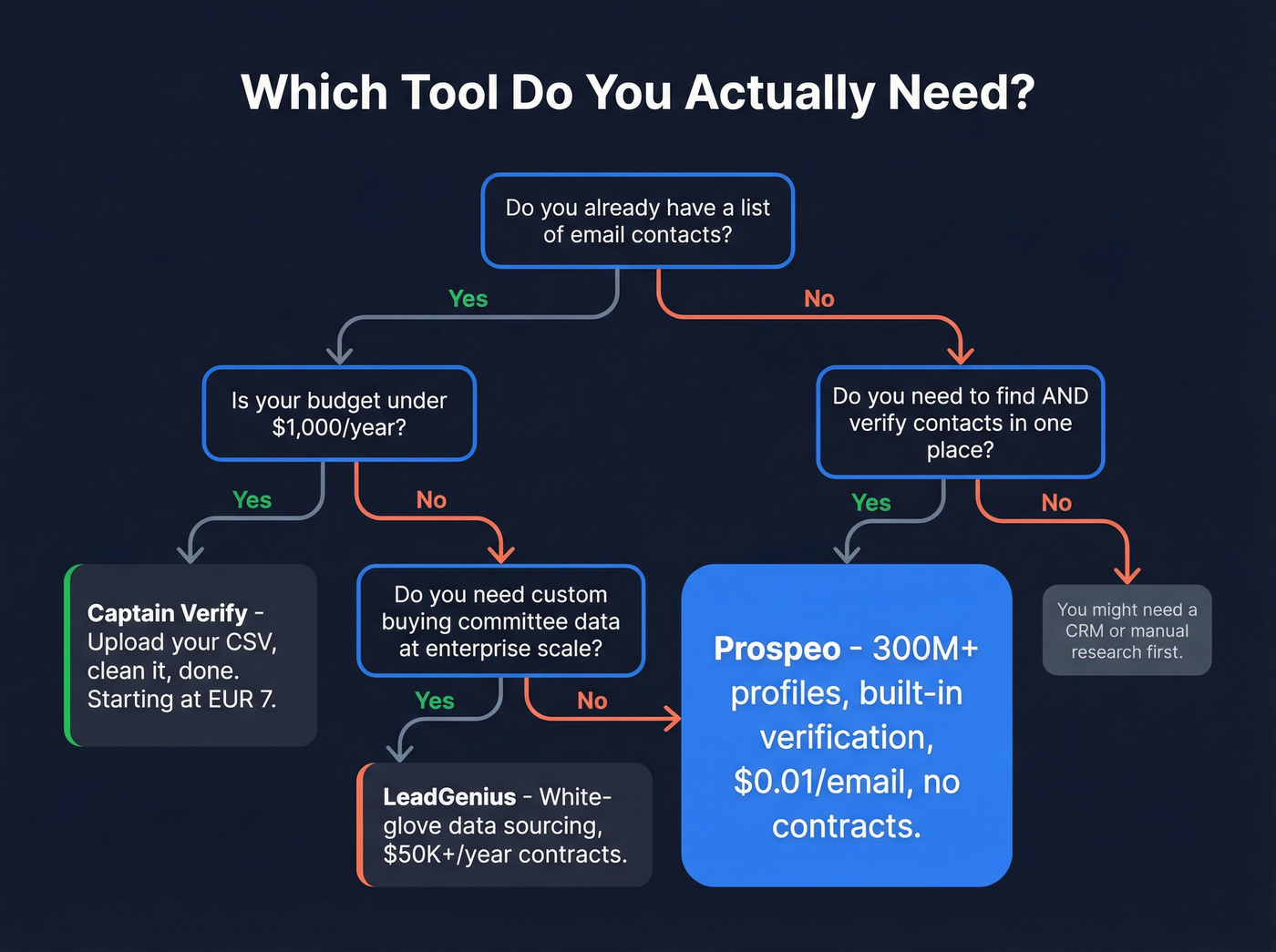
Use LeadGenius if you need bespoke B2B data for complex enterprise deals - buying committees, niche verticals, global coverage - and you've got $50K+ to spend annually. If you're evaluating LeadGenius, your real alternatives are ZoomInfo, Cognism, and Apollo, not email verifiers.
Here's the thing: most teams landing on this comparison don't actually need either tool. They need a single platform that finds verified contacts and lets them start outreach the same day. If your deal sizes don't justify six-figure data contracts, LeadGenius is overkill. If you don't already have a list, Captain Verify is useless. The gap between these two tools is where most B2B teams actually live.
Bridging the Gap
We've tested plenty of workflows that stitch together a verifier and a separate data provider. It works, but it's slow and adds cost at every handoff. Prospeo fills that gap by combining a 300M+ profile database with built-in real-time verification - every email goes through a 5-step process including catch-all handling, spam-trap removal, and honeypot filtering before export. Data refreshes on a 7-day cycle, compared to the 6-week industry average.

The pricing makes the comparison almost unfair: a free tier with 75 verified emails and 100 Chrome extension credits per month, paid plans at roughly $0.01 per email, no annual contracts, no sales calls. For teams that need to find and verify contacts in one place, it's the obvious choice.
If you’re building pipeline from scratch, you’ll get more leverage from modern sales prospecting techniques than from stitching tools together.
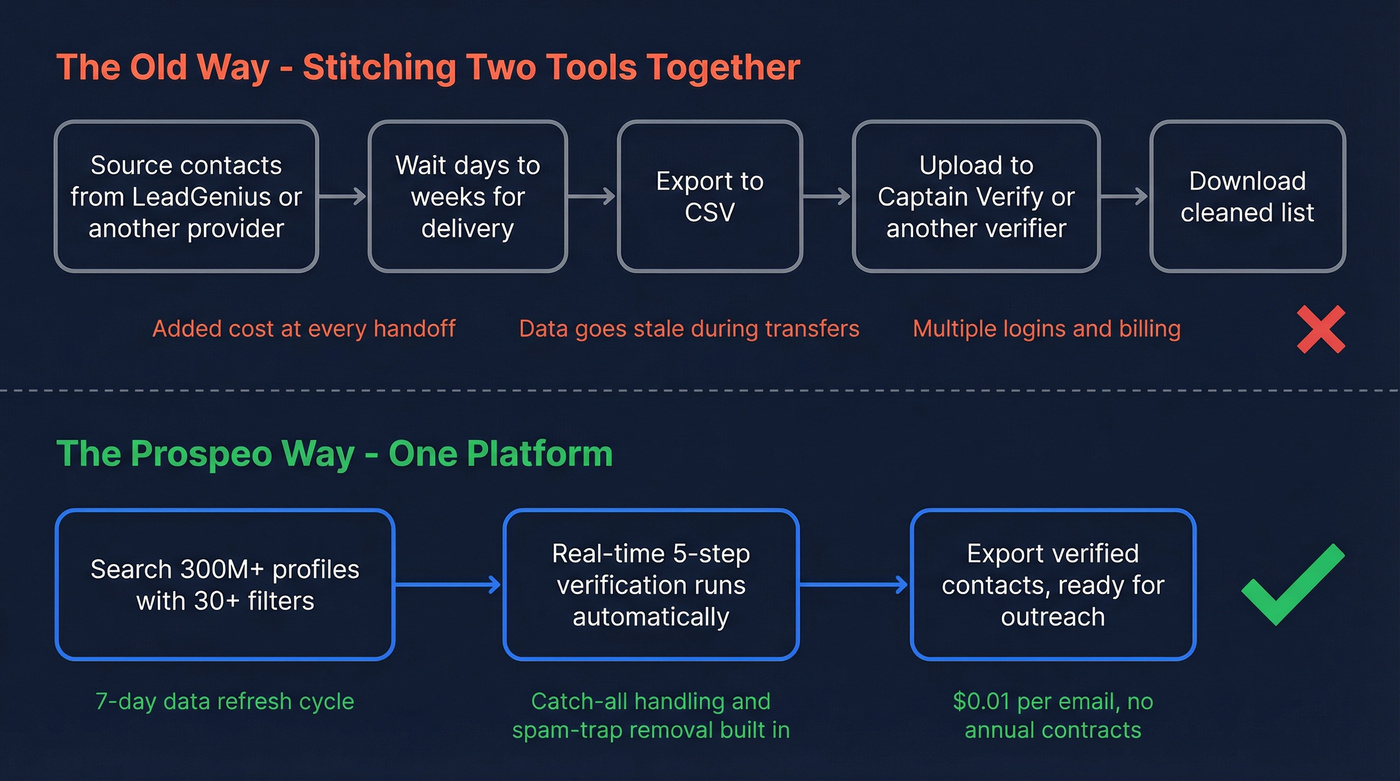
LeadGenius charges $50K+/year for custom data. Captain Verify can't find contacts at all. Prospeo gives you 30+ search filters, real-time verification, and 125M+ verified mobiles - self-serve, no contracts, no sales calls.
Stop paying enterprise prices for what a free tier already covers.
FAQ
Are Captain Verify and LeadGenius competitors?
No. Captain Verify verifies emails you already have. LeadGenius sources custom B2B data on demand using human researchers. They serve completely different stages of the sales workflow - one cleans your list, the other builds it from scratch.
Does LeadGenius include email verification?
LeadGenius focuses on sourcing and enriching contact data, not standalone verification. Some quality checks are baked into their delivery process, but it isn't a dedicated verifier. Pair it with a tool like Captain Verify or Prospeo if deliverability matters to your campaigns.
What's the cheapest way to find and verify B2B emails?
Prospeo offers a free tier with 75 verified emails per month and paid plans starting at ~$0.01 per email. It combines contact discovery and real-time verification in one platform, so you don't need to pay for separate prospecting and cleaning tools.
Can I use Captain Verify with LeadGenius together?
Yes, and some enterprise teams do exactly that - export LeadGenius contacts, then run them through Captain Verify to catch stale addresses. But if you want prospecting and verification in a single step, that two-tool workflow adds friction most teams can skip entirely.