

The Challenger Sale: Taking Control of the Customer Conversation - The Complete Playbook
Your VP just dropped The Challenger Sale into the team Slack with: "This is our new methodology. Read it by Friday."
Now you've got a real problem. You need to understand what "taking control of the customer conversation" actually looks like in a live deal, decide whether Challenger fits your motion, and turn it into something your team can run next week (not next quarter).
Let's break this down like practitioners, not book-club members.
The Challenger Sale, in plain English
The Challenger Sale is a sales methodology built around three behaviors:
- Teach: bring a commercial insight that changes how the buyer sees the problem
- Tailor: adapt that insight to each stakeholder's priorities
- Take control: guide the process, talk about money early, and push back when the buyer tries to skip steps
Matthew Dixon and Brent Adamson introduced the model in The Challenger Sale after research that started at CEB (now part of Gartner). The headline finding was uncomfortable for a lot of teams: in complex B2B deals, being "nice" and responsive isn't enough. Buyers reward reps who create value in the conversation.
One distinction that saves a lot of confusion: a methodology isn't a process. Your process tells reps what happens in Stage 2 vs Stage 3. Challenger tells them how to run the conversation inside those stages, especially when the buyer's default move is to stay comfortable and do nothing.
The 5 sales rep profiles (and why one wins)
The research grouped reps into five profiles. The point isn't to label your team. It's to understand which behaviors show up in high performers and which ones quietly stall deals.
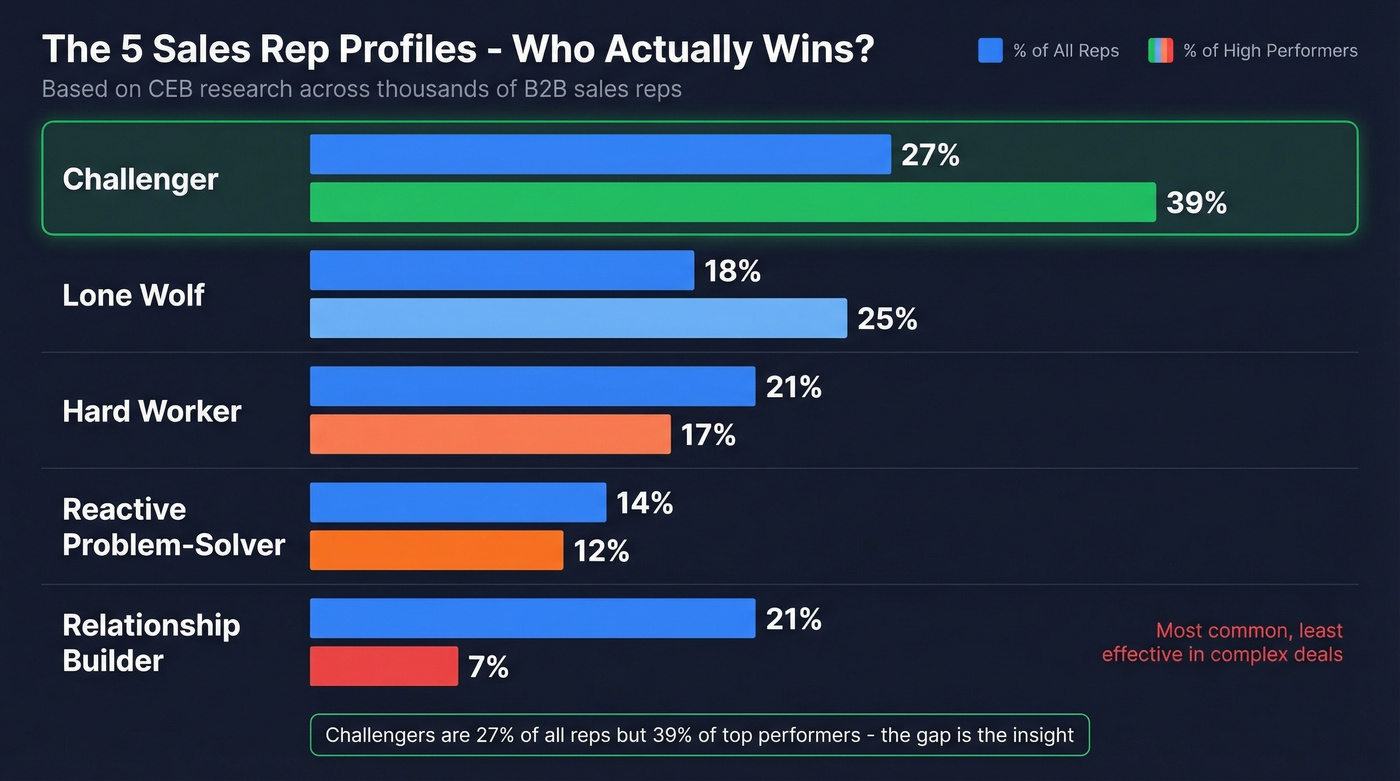
| Profile | Key behavior | % of all reps | % of high performers |
|---|---|---|---|
| Challenger | Teaches, debates, pushes back | 27% | 39% |
| Lone Wolf | Self-directed, ignores process | 18% | 25% |
| Hard Worker | Outworks everyone, high activity | 21% | 17% |
| Reactive Problem-Solver | Fixes issues, detail-oriented | 14% | 12% |
| Relationship Builder | Builds rapport, accommodates | 21% | 7% |
That last row is the one that made the book famous. Relationship Builders are common, and they're usually well-liked. But in complex buying committees, "easy to work with" becomes table stakes fast.
Challengers win because they do two things most teams avoid:
- They create constructive tension (not conflict, not arrogance).
- They keep the deal moving even when the buyer tries to park it in "send me something" limbo.
Teach, Tailor, Take Control (what it looks like in real calls)
Teach: lead with an insight, not a feature
"Teach" doesn't mean you show up with a webinar's worth of stats. It means you bring a perspective the buyer didn't walk into the meeting with.
In our experience, the fastest way to tell if a team understands Challenger is simple: do they lead with a point of view, or do they lead with a demo? If the first five minutes are product clicks, you aren't teaching. You're hoping the buyer connects the dots for you. (If your team needs a tighter structure for demos, use a product demo checklist to standardize the first 10 minutes.)
A good teaching moment has three traits:
- It's about the buyer's business, not your category
- It has a clear economic consequence
- It leads to a new decision, not just new information
One warning: don't confuse "insight" with fear. If your pitch sounds like doomscrolling, buyers freeze. Constructive tension works because it's paired with credibility and a path forward.
Tailor: one insight, five versions
Tailoring is where Challenger stops being a slogan and starts being work.
A CFO hears "risk and margin." A VP RevOps hears "cycle time and forecast." A security leader hears "blast radius and response time." Same underlying problem, different language, different proof, different stakes. (If you want a clean way to document stakeholder priorities, start with an Ideal Customer Profile template and add role-based pains.)
This is also where teams get frustrated because tailoring requires real prep. You can't tailor to a VP of RevOps if you don't know their stack, their team shape, or what initiatives they're being measured on this quarter.
That's why a lot of teams build Challenger messaging in enablement and then pair it with better account research. Prospeo is one practical way to do that research at scale: you can filter by seniority and department, pull verified contact data, and map stakeholders before the first call so reps aren't guessing who actually owns the outcome. (If you're building this into an ABM motion, align it with account-based selling best practices.)
Take control: guide the process without being a jerk
"Take control" is the most misunderstood line in the whole book.
It doesn't mean you dominate the conversation. It means you protect the deal from buyer shortcuts that feel polite but kill momentum.
A scenario we've seen a hundred times:
- Buyer: "This looks great. Just send a proposal."
- Relationship Builder: "Sure thing. I'll send it Friday."
- Challenger: "Happy to. Before I write it, let's align on budget range and who needs to sign off so the proposal doesn't miss the mark. Can we take 10 minutes now?"
That's control. You're not pushing for your sake. You're preventing the classic "proposal black hole" where the buyer goes quiet because nobody agreed on decision criteria.
And yes, sometimes you have to say the quiet part out loud: "If we can't get the economic buyer into the next meeting, we're guessing." Buyers respect that more than you'd think, as long as you say it calmly and back it with a reason. (If you need language for these moments, keep a few talk track examples handy.)
The 6-step commercial teaching pitch (the part most summaries skip)
This is the usable core of Challenger: a structured pitch that creates tension and then resolves it. The sequence matters.
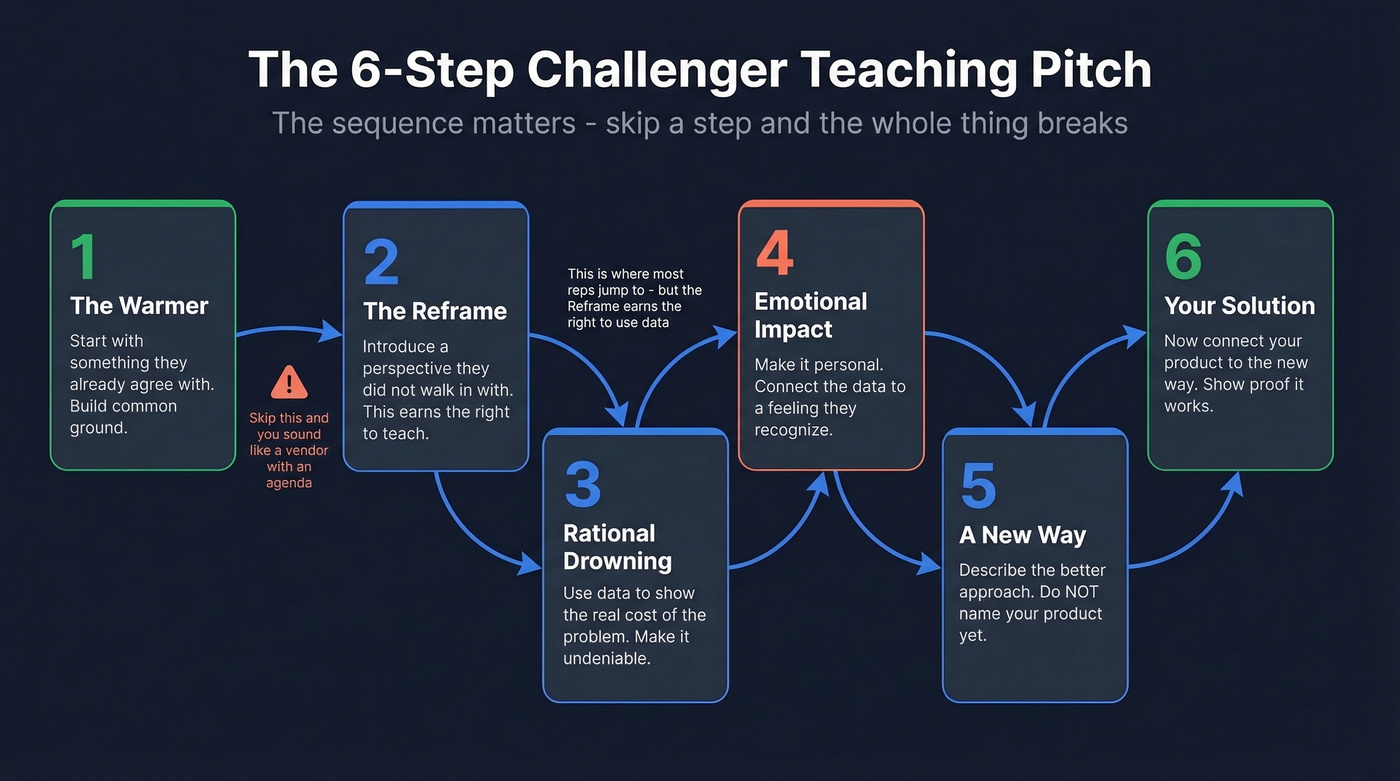
We'll use a marketing automation example aimed at a CMO.
1) The Warmer Start with something the buyer already agrees with. "Most marketing teams we talk to are under pressure to prove ROI on every campaign dollar."
2) The Reframe Introduce a perspective they haven't considered. "The teams that struggle most aren't the ones with bad campaigns. They're the ones that can't connect campaign activity to pipeline fast enough to adjust in-quarter."
3) Rational Drowning Use data to show the problem's size and cost. "Without near-real-time attribution, companies waste 20-30% of spend on channels that stopped converting weeks ago. On a $2M annual budget, that's $400-600K that never had a chance."
4) Emotional Impact Make it personal and real. "That's the number your CFO sees when they ask why marketing can't prove its value."
5) A New Way Describe the better approach without naming your product yet. "The teams that fix this build closed-loop attribution into their stack so they can see the path from first touch to closed revenue while the quarter's still alive."
6) Your Solution Now connect your product to the new way. "That's what our platform supports. Here's how three teams your size moved in under 60 days and what they changed first."
Two notes that save deals:
- If you skip the Warmer, you sound like a vendor with an agenda.
- If you skip the Reframe, you're back to feature pitching with extra steps.
Here's the thing: most reps try to "teach" by jumping straight to Rational Drowning. They throw stats at the buyer and hope the buyer feels urgency. It rarely works. The Reframe is what earns the right to use the data.
Bookmark this sequence: Warmer -> Reframe -> Rational Drowning -> Emotional Impact -> A New Way -> Your Solution.

Tailoring is the hardest part of Challenger. You can't reframe a CFO's thinking if you don't know who's on the buying committee. Prospeo gives you 30+ filters - seniority, department, intent signals - so reps walk into every call knowing exactly who owns the outcome and how to reach them.
Stop guessing stakeholders. Map the full committee before the first call.
How to implement Challenger without making your team hate you
Reading the book isn't implementation. A book club isn't a rollout.
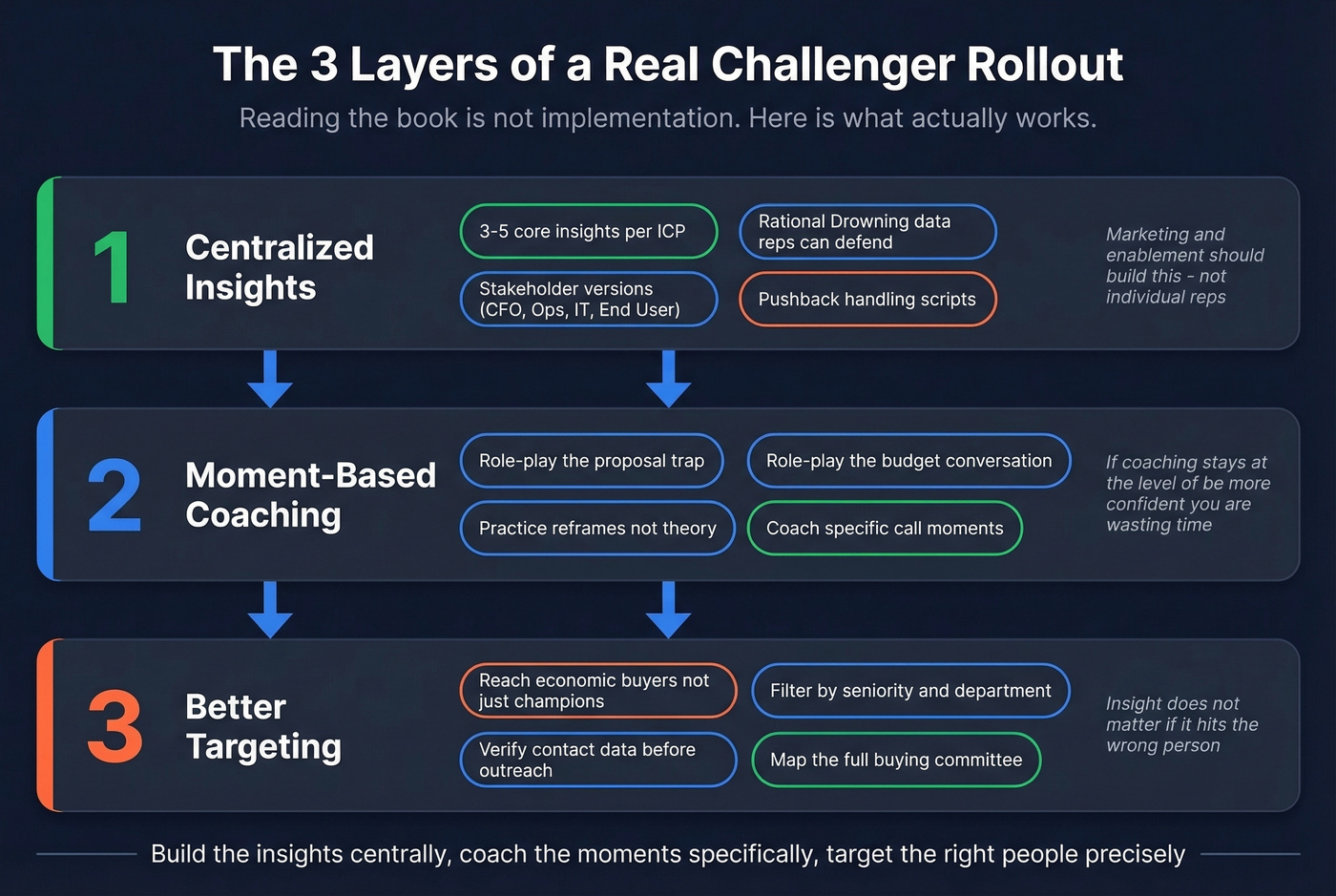
We've watched teams announce "we're going Challenger" and then do nothing except tell reps to "bring insights." That's not leadership. That's outsourcing enablement to individual contributors and then acting surprised when calls sound the same as before.
A real rollout needs three layers.
1) Centralized insights (so reps aren't reinventing the wheel)
Your best reps can create insights. Most reps can deliver them well once they're built.
So build a small library:
- 3-5 core commercial insights per ICP
- proof points and "Rational Drowning" data that sales can defend
- stakeholder versions (CFO, Ops, IT, end user, exec sponsor)
- a "what to say when they push back" section
This is where marketing, product marketing, and enablement should earn their keep. (If you’re formalizing this function, see how marketing enablement teams structure messaging libraries.)
2) Coaching that focuses on moments, not theory
Challenger lives in specific moments: pricing, next steps, pushback, and reframes.
Coach those moments. Role-play the "send me a proposal" trap. Role-play the "we're just looking" brush-off. Role-play the budget conversation without apologizing for it. If your coaching stays at the level of "be more confident," you're wasting everyone's time. (A lightweight way to operationalize this is to track sales activities tied to those moments, not just dials and emails.)
And yes, it's annoying how long this takes. That's the job.
3) Better targeting (because insight doesn't matter if it hits the wrong person)
Challenger pitches work best with economic buyers or people close to the money. If your "champion" can't influence budget, you'll get lots of polite meetings and very few decisions.
This is where tooling matters. Prospeo helps teams build lists by seniority, department, technographics, and intent topics, then verify emails and mobile numbers in real time. That sounds tactical, but it changes the whole motion: reps spend less time chasing ghosts and more time running real Challenger conversations with people who can actually say yes. (If you’re tightening qualification at the same time, pair this with MEDDIC sales qualification.)
Challenger vs SPIN vs MEDDIC (how teams actually use them)
No serious team runs one methodology in a vacuum. The cleanest way to think about it:
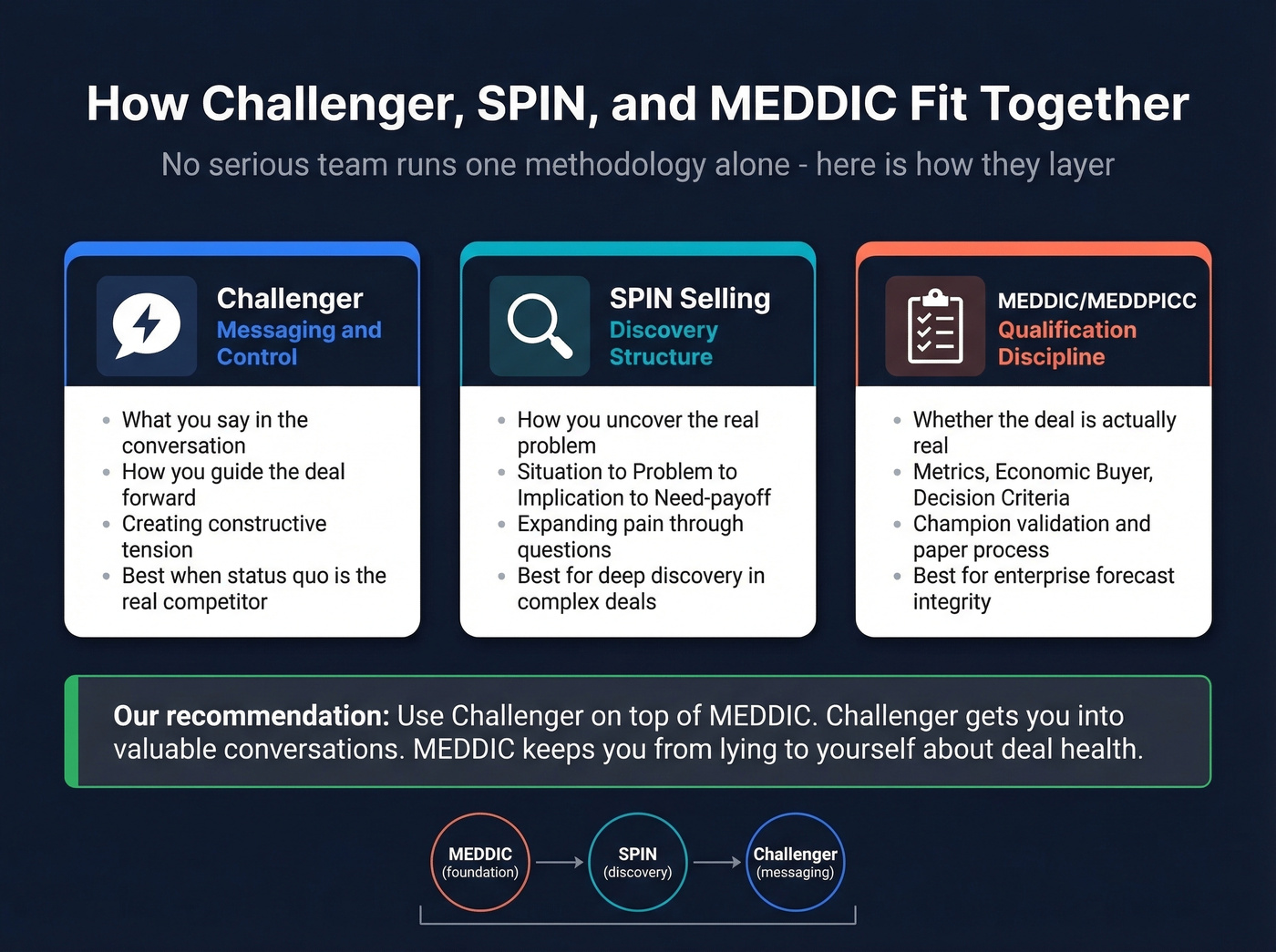
- Challenger = messaging and control (what you say and how you guide)
- SPIN = discovery structure (how you uncover and expand the problem)
- MEDDIC/MEDDPICC = qualification discipline (whether the deal is real)
| Methodology | Core approach | Best for |
|---|---|---|
| Challenger | Teach, tailor, take control | When the status quo is your real competitor |
| SPIN Selling | Situation -> Problem -> Implication -> Need-payoff | Deep discovery in complex deals |
| MEDDIC/MEDDPICC | Metrics, Economic buyer, Decision criteria/process, Identify pain, Champion (+ Paper process/Competition) | Enterprise qualification and forecast integrity |
Our recommendation for most B2B teams selling complex products: use Challenger on top of MEDDIC. Challenger gets you into valuable conversations. MEDDIC keeps you from lying to yourself about deal health. (If you want a tighter discovery layer, add a bank of discovery questions that map to MEDDIC fields.)
If you want a third book that helps with the "take control" moments, Crucial Conversations is a better add than another sales framework. Control is mostly about handling tension without getting weird.
Common misapplications (and how to avoid them)
Misapplication #1: "Take control" turns into aggression
Some reps hear "take control" and start interrupting, steamrolling, or forcing timelines. That's not Challenger. That's insecurity with a methodology sticker on it.
Control is calm. It's clear. It's earned.
If you can't explain why a next step matters to the buyer, you aren't taking control. You're just demanding compliance.
Misapplication #2: "Relationships don't matter"
This one drives us nuts because it's a lazy reading of the book.
Trust matters. Rapport matters. What doesn't work is confusing "being liked" with "being valuable." The Relationship Builder profile isn't "people who build trust." It's people who avoid tension and over-serve, even when the deal needs direction.
RAIN Group has published thoughtful critiques of Challenger that land on this exact nuance. If you want a counterbalance, start here: RAIN Group insights.
Misapplication #3: forcing reps to create insights alone
Real talk: expecting every AE to be a mini-analyst across five verticals is fantasy.
The best teams centralize insight creation, then train reps to deliver it and adapt it. Reps still need to understand the "why," but they shouldn't be building the whole thing from scratch between demos.
Misapplication #4: treating the pitch as a script
The 6-step pitch is a structure, not a monologue. If you deliver it like a TED Talk and never let the buyer in, you'll get the same outcome as any other pitch: polite nods and no decision.
One practical fix: after the Reframe, ask a hard check-in. "Does that match what you're seeing, or is your world different?"
That question turns a pitch into a conversation and gives you permission to push.
A quick note from the trenches (and from Reddit)
If you hang around r/sales long enough, you'll see a recurring theme: methodology doesn't save bad targeting, weak differentiation, or deals where you never reached power. That's accurate. Challenger isn't magic. It's a way to create value once you're in the right room.
And if your org is trying to use Challenger as a substitute for pricing clarity, product maturity, or a real ICP, you're going to have a rough quarter.
Does Challenger still work in 2026?
Yes, and the reason is simple: buyers are confused again.
AI has made a lot of categories noisy. Every vendor claims "AI-powered" everything, and buyers struggle to separate real capability from marketing fog. That's the exact environment where Challenger works best: you win by teaching buyers how to evaluate the category and what risks they're missing, then guiding them through a decision process they don't have time to design. (If you want a practical lens on this, use a competitive intelligence strategy to systematize the “teach” inputs.)
That said, skip Challenger (or keep it light) in a few cases:
- Transactional deals where the buyer already knows what they want and just needs clean execution
- Highly relationship-dependent verticals where trust cycles are measured in years
- Mature categories with clear buying criteria where your bigger problem is qualification and deal control, not insight
One more strong opinion: if your average deal is small and your cycle is short, don't over-engineer this. Challenger is powerful, but it's not free. It costs prep time, enablement time, and coaching time.
FAQ
Is the Challenger Sale still relevant in 2026?
Yes. In markets where buyers face ambiguity and the status quo is the real competitor, reps who teach and guide the process outperform feature-pitching every time.
What are the 5 sales rep profiles in the Challenger Sale?
Hard Worker, Relationship Builder, Lone Wolf, Reactive Problem-Solver, and Challenger.
Can you combine Challenger with MEDDIC or SPIN?
You should. Challenger improves messaging and deal control, SPIN strengthens discovery, and MEDDIC/MEDDPICC keeps qualification honest.
What's the biggest adoption mistake?
Turning "take control" into aggression, or mandating Challenger without building the insight library and coaching reps need to deliver it well.
How do you find the right decision-makers for a Challenger pitch?
You need to reach economic buyers and stakeholders tied to budget and outcomes, not just friendly champions. Tools like Prospeo help teams filter by role and seniority, map accounts, and verify contact data so the pitch lands with people who can actually make a decision.
Taking control means getting the economic buyer into the room, not hoping they forward your email. Prospeo delivers 98% accurate emails and 125M+ verified mobile numbers so your Challenger reps reach decision-makers directly - no gatekeepers, no proposal black holes.
Reach the economic buyer directly. Verified contacts at $0.01 per email.