

The CHAMP Framework: A Practitioner's Guide to Sales Qualification
An SDR spends 45 minutes on a discovery call, asks great questions, builds rapport - then finds out the person they're talking to has zero budget authority and no timeline. That call cost the company real pipeline time, and it happens constantly.
The CHAMP framework exists to kill this exact problem. The average lead-to-MQL conversion sits at 31%, and only about 13% of MQLs become SQLs. Most of the waste happens because reps don't qualify early or consistently enough.
Quick version: CHAMP stands for Challenges, Authority, Money, Prioritization. It's the strongest qualification framework for mid-market B2B teams running 30-90 day cycles and non-trivial deal sizes. If you sell enterprise, use MEDDIC. If you sell transactional, BANT is fine. Below: the origin story, a complete discovery call script, a scoring template, and the CRM fields you need to operationalize it tomorrow.
What Is the CHAMP Sales Methodology?
CHAMP is a sales qualification framework built around four sequential questions: what Challenges does the buyer face, who has Authority to decide, is there Money to fund a solution, and how high is the Prioritization relative to everything else on their plate?
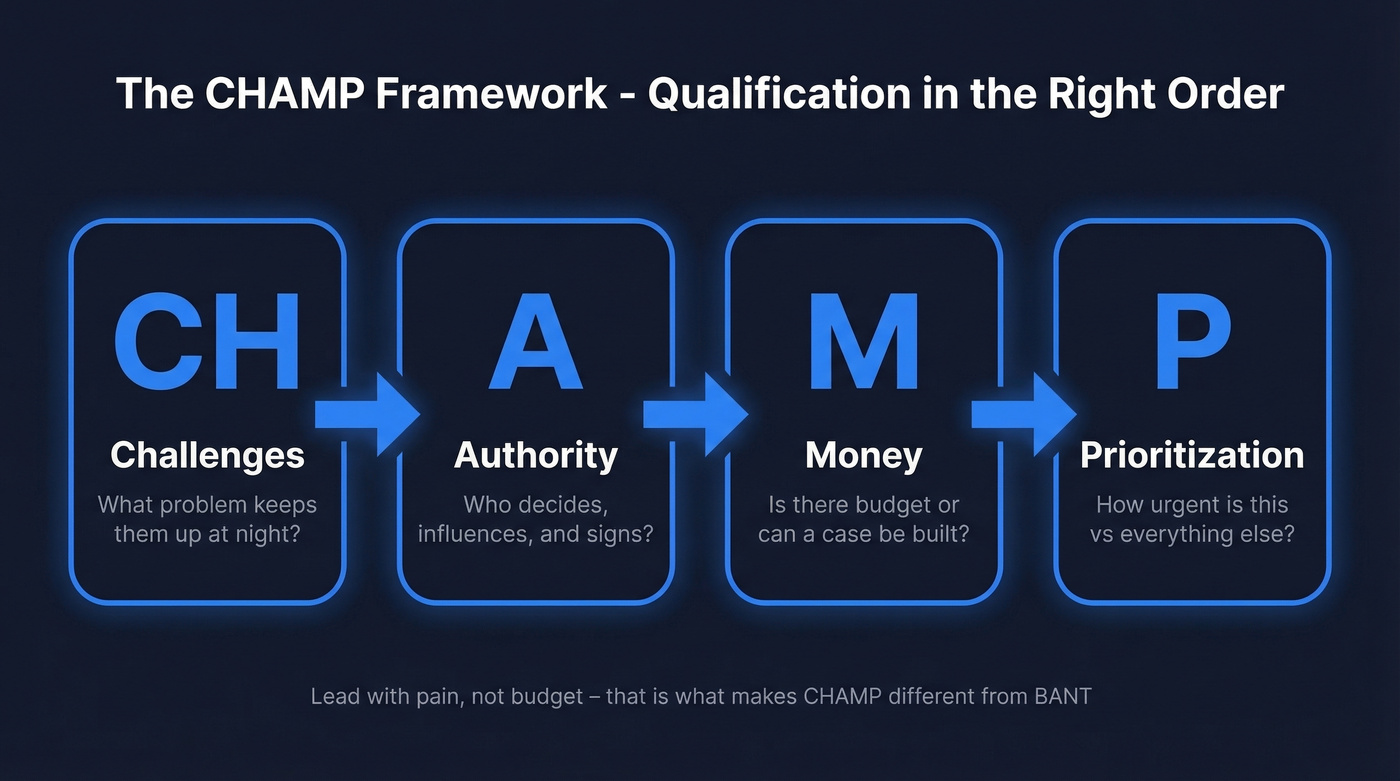
The key word is sequential. CHAMP deliberately leads with the prospect's pain, not the seller's budget checklist. That's the fundamental difference from BANT, which opens with "Do you have budget?" - a question that kills conversations before they start. Modern buyers don't allocate budget until they understand the problem. CHAMP mirrors that reality.
Think of it as buyer-centric qualification. You earn the right to ask about money and authority by first demonstrating you understand what's broken. That sequencing changes how discovery calls feel for the prospect, which changes how much information they share.
Where CHAMP Came From
The framework is widely attributed to Zorian Rotenberg, a sales executive with a strong track record. Rotenberg served on executive leadership teams (VP/CRO/CEO) across multiple software companies, including Acronis and Veeam at $100M+ revenue scale, and AppAssure was acquired by Dell for $211M+. He also holds an MBA from Harvard Business School.
Many sales resources place CHAMP's introduction around 2007, though there isn't a widely cited primary artifact from that year - a post, talk, or paper - that definitively pins down the exact origin date.
Rotenberg didn't just coin an acronym. He developed what he calls the CHAMP Selling System - a broader operating model. The qualification piece is what caught on most widely, probably because it's the easiest to teach and implement without buying into the full system.
Why Qualification Matters
You've probably seen the stat: "67% of lost sales are due to poor qualification." It's everywhere. It's also shaky - the number is often traced back to a LinkedIn article attributed to Steven Tulman and then repeated across hundreds of blog posts without a clear primary study behind it. Let's retire it.
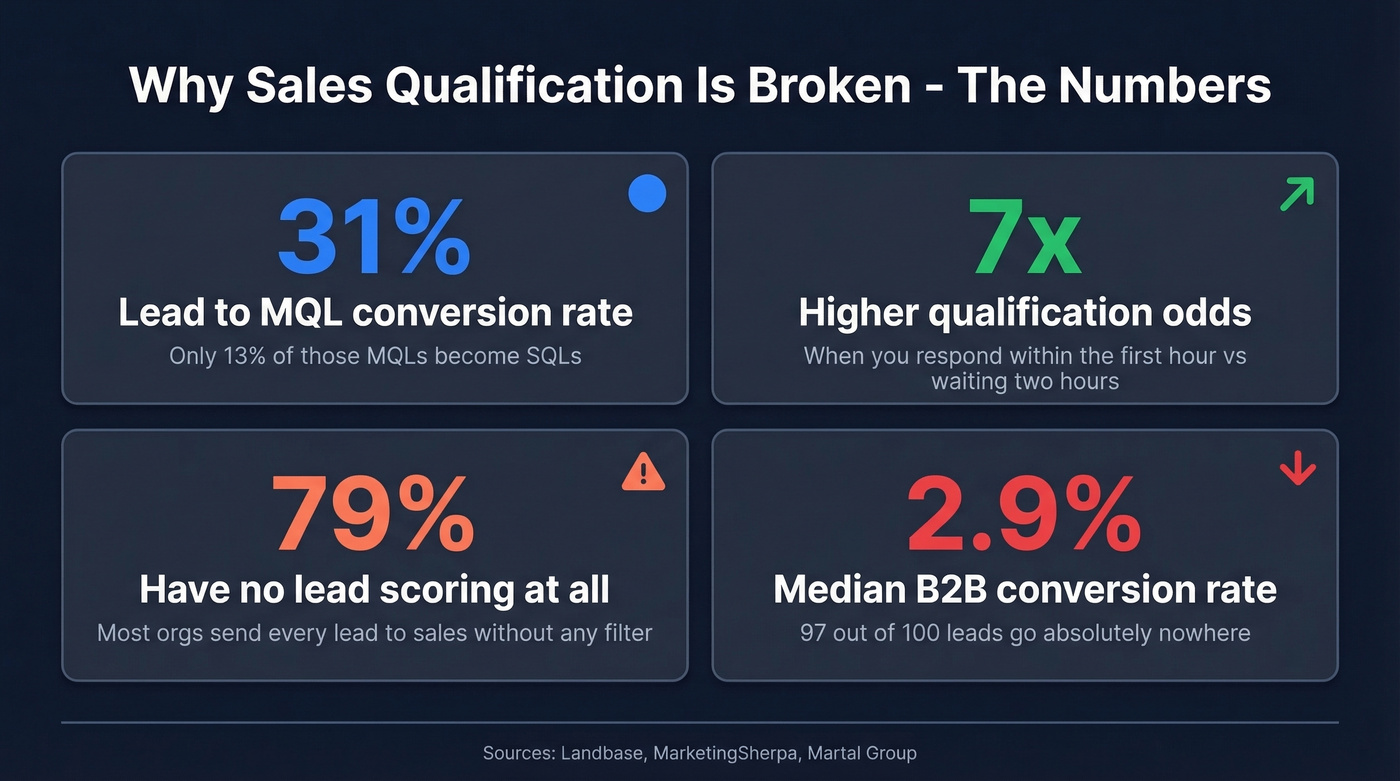
The real numbers are bad enough. 61% of marketing teams send every MQL straight to sales, and only 27% of those leads ever become sales-qualified. 79% of organizations have no lead scoring in place at all. That's from MarketingSherpa's benchmark report, and if anything the problem has gotten worse as buying committees have grown more complex.
Speed matters too. Responding to a lead within the first hour yields 7x higher qualification odds compared to waiting even two hours. Yet only about 40% of firms consistently apply any qualification criteria at all. The median B2B conversion rate sits at 2.9% - meaning 97 out of 100 leads go nowhere. Most of that improvement comes from simply asking the right questions in the right order, consistently. A structured lead qualification process gives teams the repeatable discipline to do exactly that.
The Four Components
Challenges
Nobody wakes up thinking "I need to spend $50K on software." They wake up thinking "we're missing target and I don't know why." CHAMP starts there.
Good discovery questions for this stage:
- "What's the biggest obstacle preventing your team from hitting target this quarter?"
- "If you could fix one thing about your current process tomorrow, what would it be?"
- "How is this problem affecting your team's day-to-day work?"
The common mistake is accepting surface-level answers. "We need better reporting" isn't a challenge - it's a feature request. Push deeper. What decision can't they make without better reporting? What's the cost of that blind spot? The challenge needs to be tied to a business outcome, or it won't survive a budget conversation later.
Authority
The average B2B deal now involves 13 decision-makers, and 80% of buyer interactions happen digitally. The person on your discovery call is almost certainly not the sole decision-maker - and asking "Are you the decision-maker?" is the fastest way to get a polite lie. In our experience, the Authority question is where most reps lose deals they thought they'd won.
Instead of interrogating authority, map the buying committee:
- "Walk me through how your team evaluated the last tool you purchased."
- "Who else would need to weigh in before a decision like this moves forward?"
- "If we got to a proposal stage, what does your internal approval process look like?"
Don't treat authority as binary. It's a map. You need to understand who influences, who approves budget, who signs, and who can kill the deal quietly.
Money
Here's the thing: budget gets created after a strong business case, not before. If you lead with "What's your budget?" you'll hear "We don't have one" - and that's often true. It doesn't mean there's no money. It means nobody's built the case yet.
The reframing that works best in practice: ask "Have you allocated funds to address this challenge this year?" instead of "What's your budget?" The first question opens a conversation about fiscal planning and priority. The second triggers a defensive reflex.
Don't disqualify deals that lack pre-allocated budget. In mid-market sales, budget follows conviction. Your job is to help the champion build the business case.
Prioritization
This is CHAMP's real differentiator versus BANT. BANT asks about timeline - "When are you looking to implement?" Prioritization asks something harder: "How urgent is this relative to everything else competing for your team's attention and budget?"
A prospect can have a genuine challenge, clear authority, and available budget - but if this initiative is #7 on a list of 5 things they can actually execute this quarter, it's not going to close. Prioritization catches that.
- "Where does solving this sit on your priority list for this quarter?"
- "What would need to happen for this to move up in priority?"
- "Are there competing initiatives that might delay this?"
A prospect who says "This is really interesting, let's revisit in Q3" isn't qualified. They're interested. Those are different things.
Do Frameworks Even Matter?
There's a thread on r/sales that captures what a lot of experienced reps feel: all methodologies basically reduce to the same fundamentals - need, budget, stakeholders, timeline. The OP argues that teams "jam a sales methodology down a new rep's throat" before the basics are learned.
They're not wrong. CHAMP, BANT, MEDDIC, Sandler - they're all asking variations of the same four questions. The letters are different. The underlying logic is similar.
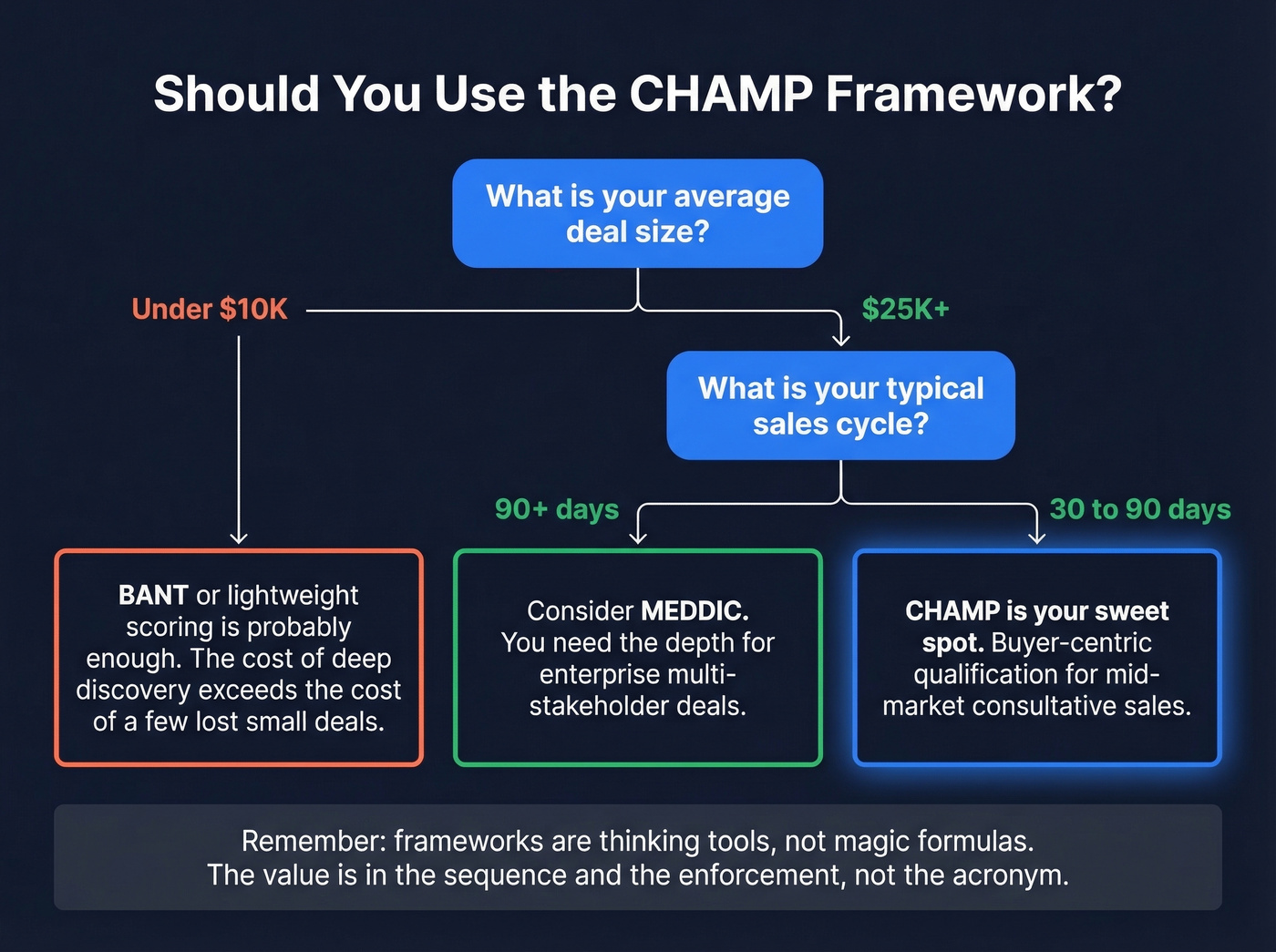
But here's where the skeptics miss the point. The value isn't the letters. It's the sequence and the enforcement. One widely shared anecdote cites forecast accuracy improving from 62% to 89% after standardizing qualification. Companies using structured sales processes report roughly 15% higher win rates. The methodology isn't a magic formula - it's a thinking tool that prevents reps from skipping steps when they get excited about a deal.
Hot take: if your average deal size is under $10K, you probably don't need this level of qualification at all. The cost of a thorough discovery process exceeds the cost of a few lost small deals. CHAMP shines when a bad forecast actually hurts - think $25K+ deals with multi-week cycles.

The CHAMP framework maps buying committees - but you still need verified contact data to reach all 13 decision-makers. Prospeo gives you 300M+ profiles with 30+ filters including authority signals, job changes, and department headcount.
Stop qualifying leads you can't actually reach.
CHAMP vs BANT vs MEDDIC
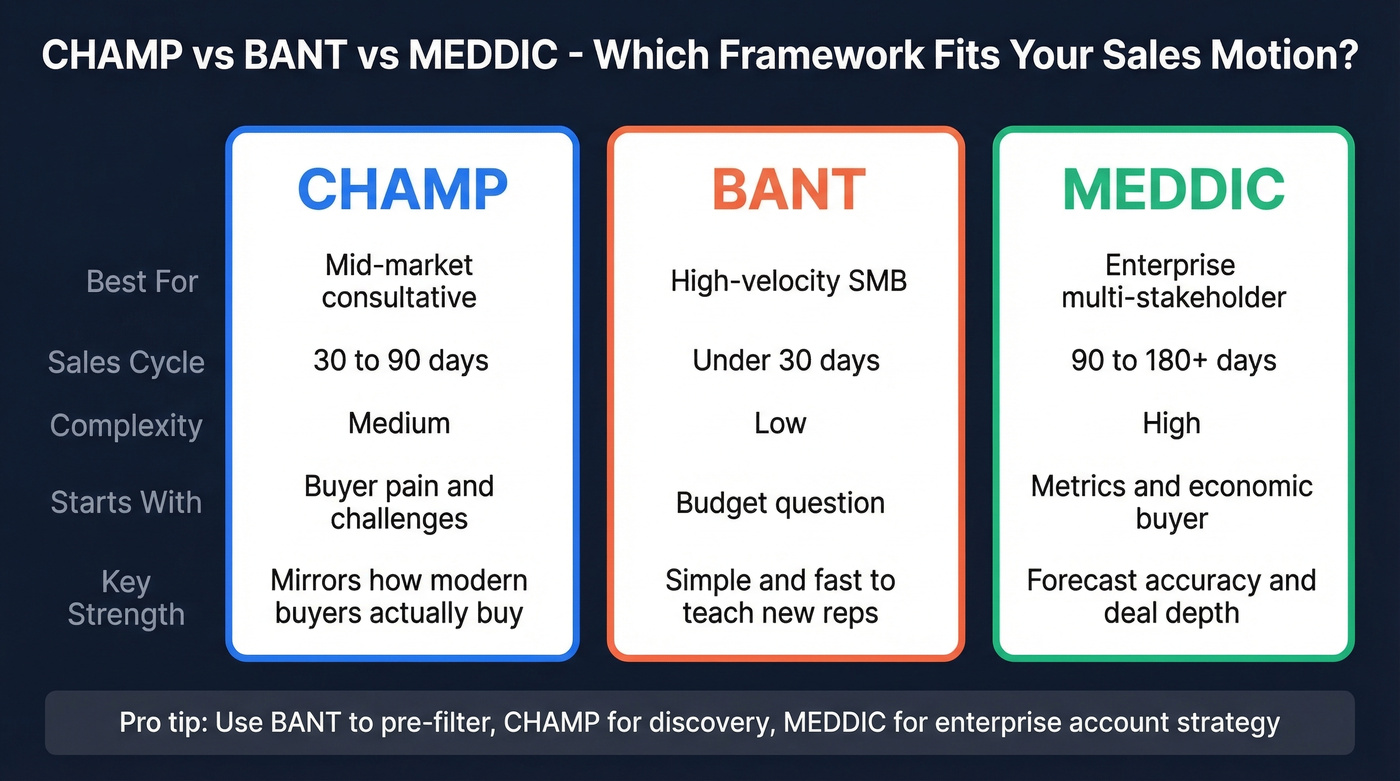
| CHAMP | BANT | MEDDIC | |
|---|---|---|---|
| Best for | Mid-market consultative | High-velocity SMB | Enterprise multi-stakeholder |
| Typical cycle | 30-90 days | 30 days or less | 90-180+ days |
| Strengths | Buyer-centric, flexible | Simple, fast to teach | Forecast accuracy, depth |
| Limitations | Too loose without discipline | Misses stakeholder complexity | Heavy, adds friction |
BANT came out of IBM in the 1950s. MEDDIC was developed at PTC in the 1990s. CHAMP is the newest of the three, and it shows - it's designed for how modern buyers actually behave.
A practical tip from SPOTIO's field-sales guidance: use BANT as a pre-filter to decide if a lead deserves a meeting, CHAMP for the actual discovery conversation, and MEDDIC when you need to decide which accounts deserve repeat high-touch engagement. They're not mutually exclusive.
One important distinction: lead scoring (behavioral and firmographic signals that assign a numeric score) isn't the same as a qualification framework (structured criteria applied through conversation). You need both. Lead scoring tells you who to call. A structured qualification process tells you what to ask when they pick up.
CHAMP Discovery Call Script
Structure this as a 15-20 minute conversation, not an interrogation. The transitions between sections matter as much as the questions themselves.
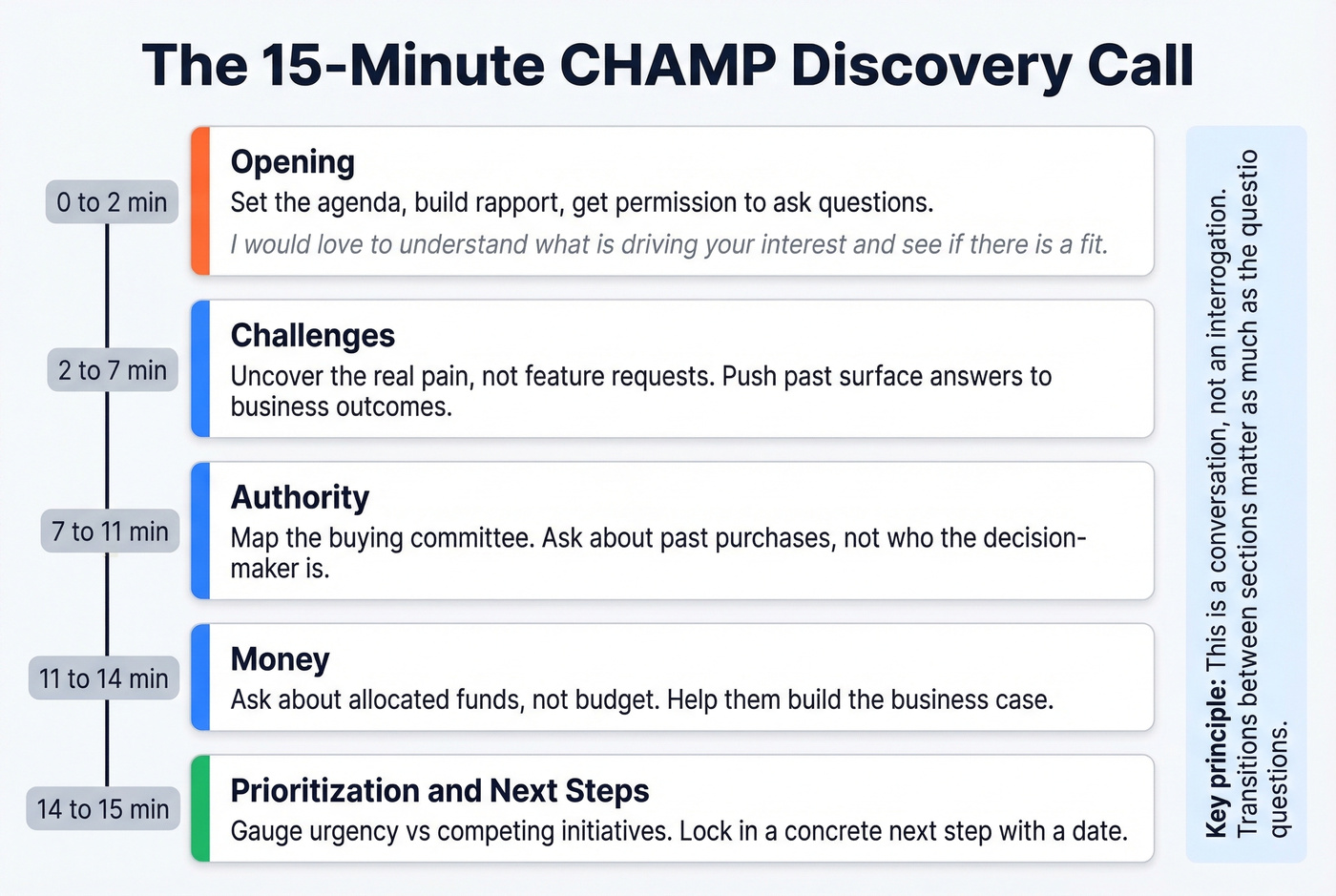
Opening (2 min): "I'd love to understand what's driving your interest and see if there's a fit. I'll ask a few questions about your current situation, and then we can talk about whether it makes sense to go deeper. Sound good?"
Challenges (5 min): "What's the biggest pain point your team is dealing with right now?"
Follow-up: "How long has that been an issue? What have you tried so far?"
Transition: "That makes sense. Let me ask about the people involved in solving this..."
Authority (4 min): "Walk me through how your team evaluated the last tool you brought in."
Follow-up: "Who else would need to be involved if this moved forward?"
Transition: "Got it. Let's talk about the investment side..."
Money (4 min): "Have you allocated funds to address this challenge this year?"
Follow-up: "If we could build a strong business case, is there a path to getting budget approved?"
Transition: "Last question on timing..."
Prioritization (3 min): "Where does solving this sit relative to your other Q-priorities?"
Follow-up: "What would need to happen for this to move up?"
Close (2 min): Summarize what you heard, confirm next steps, identify who else needs to be in the next conversation.
We've used this structure across dozens of onboarding sessions with SDR teams, and the biggest unlock isn't the questions - it's the transitions. Without smooth bridges between sections, the call feels like a checklist. With them, it feels like a conversation.
Scoring Template and CRM Setup
Build a simple weighted scorecard. Each component gets scored 1-3:
| Component | Score 1 (Weak) | Score 2 (Moderate) | Score 3 (Strong) |
|---|---|---|---|
| Challenges | Vague pain, no urgency | Clear problem, some impact | Quantified pain, exec visibility |
| Authority | No access to decision-maker | Champion identified | Buying committee mapped |
| Money | No budget, no path | Budget possible, needs case | Budget allocated |
| Prioritization | Q3+ or "someday" | This quarter, competing priorities | Top 3 priority, active timeline |
Qualification threshold: 3 of 4 components scored 2 or higher = qualified opportunity. Anything below gets nurtured, not forecasted.
CRM custom fields (works in Salesforce or HubSpot):
Challenge_Identified- text field, rep summarizes in 1-2 sentencesAuthority_Mapped- dropdown: Not Started / Champion Only / Committee MappedBudget_Status- dropdown: No Budget / Building Case / AllocatedPriority_Level- dropdown: Low / Medium / High / Top 3CHAMP_Score- formula field that auto-calculates from the four dropdowns
Manager coaching question: "Show me the champion. What's their personal win if this deal closes?" If the rep can't answer that, the Authority score is inflated.
CHAMP handles qualification. For the actual selling conversation, layer in SPIN Selling or the Challenger methodology - they tell you how to win the deals CHAMP tells you to pursue.
When NOT to Use CHAMP
For $100K+ enterprise deals with 6+ stakeholders and 90+ day cycles, use MEDDIC instead. CHAMP doesn't have enough structure for true enterprise political complexity.
For high-velocity transactional sales with sub-30-day cycles and smaller deal sizes, BANT is fine. CHAMP's depth is overkill when the decision is simple and fast.
Skip frameworks entirely if you're running a PLG or self-serve motion with no discovery call. When your buyer signs up, swipes a credit card, and onboards themselves, qualification happens through product usage signals, not rep questions.
And if your team has zero CRM discipline - reps aren't logging calls or updating opportunity stages - fix that first. Layering a qualification methodology on top of broken data hygiene won't help.
The Prerequisite Nobody Talks About
The CHAMP framework requires conversations. Conversations require accurate contact data. This is the part that qualification guides skip, and it's the part that kills pipeline before any methodology gets a chance to work.
We've seen this pattern repeatedly: a team adopts CHAMP, builds the scorecard, trains the reps - and then 35% of their phone numbers are dead and their email bounce rate tanks deliverability. The framework is useless if you can't reach anyone. One sales team at Snyk (50 AEs prospecting 4-6 hours per week) saw their bounce rate drop from 35-40% to under 5% after switching to Prospeo, with AE-sourced pipeline climbing 180% and generating 200+ new opportunities per month. That's what happens when reps actually reach the people they're trying to qualify.
If you're fighting bounces, start with email bounce rate benchmarks and fixes, then tighten your email deliverability fundamentals.
Prioritization kills deals when reps waste time on stale contacts. Prospeo refreshes every 7 days - not 6 weeks - so your outreach hits verified emails at 98% accuracy and direct dials with a 30% pickup rate.
Qualify faster when every email and phone number actually connects.
FAQ
What does CHAMP stand for in sales?
Challenges, Authority, Money, and Prioritization - a lead qualification methodology that leads with buyer pain instead of budget. It's built for mid-market consultative sales with 30-90 day deal cycles and $15K+ ACV.
Who created the CHAMP framework?
Zorian Rotenberg, a sales executive who led teams at Acronis and Veeam at $100M+ revenue scale. Many resources place its introduction around 2007, though no widely cited primary artifact definitively pins the exact date.
Is CHAMP better than BANT?
For mid-market consultative sales with multi-stakeholder deals, yes. The challenges-first approach matches modern buying behavior where budget follows conviction. BANT still works for transactional deals under $15K with single decision-makers.
How many criteria must a lead meet to qualify?
A common threshold is 3 of 4 components scored 2 or higher on a 1-3 scale. Leads below that threshold go into nurture sequences, not the forecast. Customize scoring weights based on your win/loss data.
What tools help with CHAMP qualification?
A CRM with custom fields (Salesforce or HubSpot) to track scores, plus a data platform like Prospeo to verify emails and direct dials before discovery calls - bounce rates above 5% undermine any qualification process.