

ChatGPT Cold Email Prompts: 5 Templates + the 80% Nobody Talks About
The average cold email reply rate is 3.43%. Elite campaigns hit 10.7%+. The gap between those two numbers has less to do with the ChatGPT cold email prompts you copy-paste and more to do with what happens after you hit "generate."
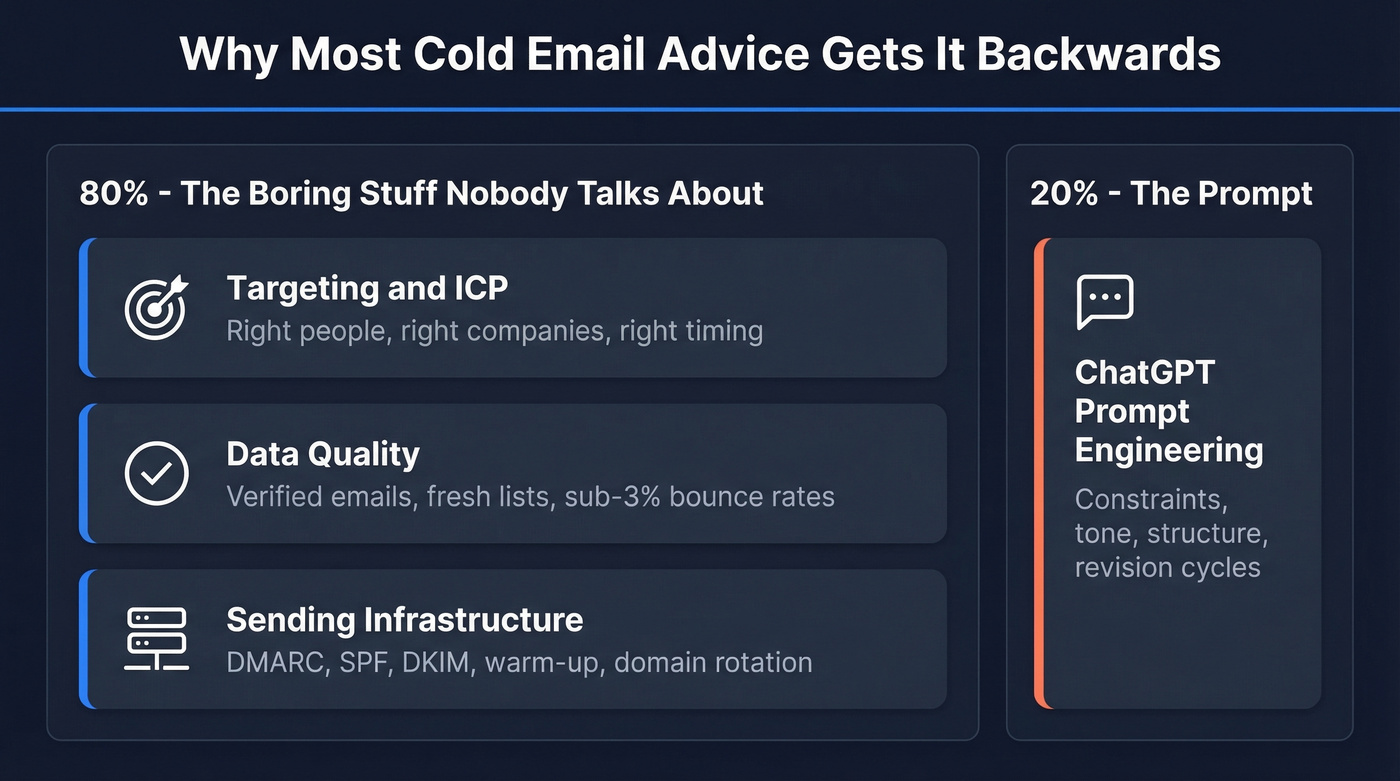
Most people treat prompt engineering like it's the whole game. It isn't. The prompt is maybe 20% of the outcome. The other 80% is targeting, data quality, and sending infrastructure - the boring stuff nobody wants to write a thread about.
What You Need Before You Prompt
High-constraint prompting. Under 100 words, banned cliches, a "3rd email of the day" tone instruction. This single technique eliminates most AI slop.
Draft in Claude, critique in ChatGPT. Both $20/mo. Claude writes more natural first drafts; ChatGPT is better at tearing them apart. We've tested this workflow across dozens of campaigns and the difference in output quality is noticeable.
Verify every email before sending. The best prompt in the world bounces off a dead address - run your list through real-time verification before anything goes out.
5 Cold Email Prompts That Actually Work
Each prompt below is copy-paste ready. Fill in the brackets, then expect 8-10 rounds of revision before you've got something worth sending. That's normal. If your first output is "good enough," your constraints aren't tight enough.
The High-Constraint First Touch
Here's the thing: tell the model to write like it's the 3rd or 4th email someone has sent that day. That kills the desperate, over-eager tone AI defaults to.
You are a [your role] at [your company]. Write a cold email to [recipient role] at [recipient company].

CONSTRAINTS:
- Under 100 words. No exceptions.
- Tone: calm, confident, slightly informal. Write like this is the 3rd email you've sent today   -   not the first.
- BANNED phrases: "I hope this finds you well," "just reaching out," "I'd love to," "exciting opportunity," "synergy," "leverage." No exclamation points.
- First line MUST reference something specific about the recipient: [paste 1-2 sentences of research here].
- Structure: Problem → Agitate → Soft CTA (question, not a calendar link).
- If any required input is missing, ask me before writing.

INPUTS:
- Value prop (1 sentence): [your value prop]
- Company context (2-3 sentences): [what the recipient's company does, recent news, pain signal]
Example output (after editing):
Hi Sarah - saw Acme just opened a second EU warehouse. Scaling fulfillment usually means scaling headcount headaches right alongside it.
We help ops teams at 50-200 person companies cut contractor onboarding from 3 weeks to 4 days. Acme's Glassdoor reviews suggest that might hit close to home.
Worth a 10-minute look?
Notice what's missing: no "I hope this finds you well," no three-paragraph company bio, no calendar link. Practitioners on r/coldemail report 15-20% reply rates with this constraint-based approach across 200+ outreaches. One more thing to watch for - AI loves to sneak in PAS signifiers like "Here's why that matters" or "Picture this." Edit those out. They're dead giveaways.

The Follow-Up Nudge
58% of replies come from the first email. Separately, a 16.5M-email study from Woodpecker found the first follow-up can lift replies up to 49% in high-performing campaigns. After that, spam complaints jump from 0.5% to 1.6% by email four. So your follow-up needs to earn its spot.
Write a 2-sentence follow-up to the cold email below. No guilt-tripping, no "just bumping this up." Add ONE new piece of value   -   a relevant stat, case study result, or industry insight. Under 40 words.

[Paste original email]
The Subject Line Generator
Personalized subject lines hit [46% open rates vs 35% without](https://mailmend.io/blogs/subject-line-effectiveness-statistics). "Quick question" alone pulls 39% opens. Numbers in subject lines actually hurt slightly.
Generate 10 subject lines for a cold email to [recipient role] at [recipient company] about [topic].

RULES: 2-4 words each. At least 5 must be questions. Include the recipient's company name or role in at least 3. No numbers. No hype words. No emojis.
The Re-Engagement Email
For prospects who went silent. No guilt, no "just checking in," and you must offer something new.
Write a re-engagement email to [recipient name], [role] at [company]. They [describe last interaction].

CONSTRAINTS: Under 60 words. No "just checking in" or "circling back." Offer one new, specific piece of value: [paste a relevant insight, stat, or resource]. Soft CTA only.
The Spintax Variation Generator
Templates get flagged quickly. Outbound teams are using AI to spintax nearly every word, including signatures, and the consensus on r/sales is that this is now table stakes for anyone sending more than 50 emails a day.
Take the cold email below and generate 5 spintax variations. Each variation should:
- Change at least 60% of the wording while keeping the meaning identical
- Vary sentence structure (not just synonym swaps)
- Adjust the opening line, CTA phrasing, and sign-off
- Output in {spintax|format} ready for my sequencer

[Paste base email]

The best ChatGPT cold email prompt in the world bounces off a dead address. Prospeo verifies emails in real time with 98% accuracy and refreshes data every 7 days - not the 6-week industry average. Start with 75 free verifications.
Fix your list before you fix your prompts.
Which AI Model to Use
Claude Pro, ChatGPT Plus, and Gemini Advanced all run $20/mo. Budget roughly 500-1,500 tokens per email when you include prospect context, instructions, and one revision cycle.
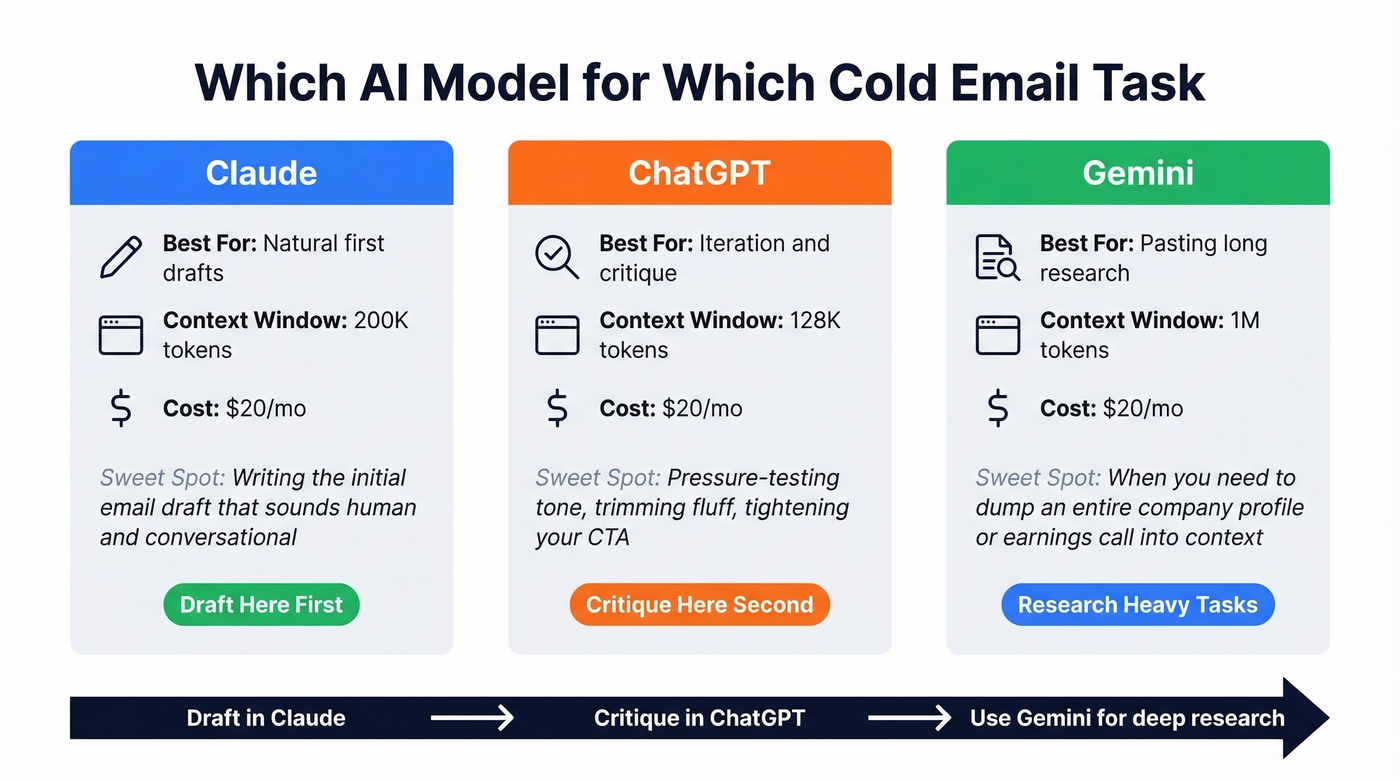
| Model | Best For | Context Window |
|---|---|---|
| Claude | Natural first drafts | 200K tokens |
| ChatGPT | Iteration + critique | 128K tokens |
| Gemini | Pasting long research | 1M tokens |
Let's be honest: most teams agonize over prompt engineering when the real difference-maker is targeting and data quality. If your ICP is wrong or half your list bounces, the world's best AI-written emails won't save you. Fix the inputs first.
Why Prompts Fail Without Clean Data
A team we spoke with rebuilt their cold email infrastructure last year - expanded from 3 domains to 7, each capped at 26 sends/day, ran manual list verification, and tightened copy. Bounce rate dropped from 11% to under 2%. Reply rate doubled from 3% to 6%. The prompts didn't change. The data did.
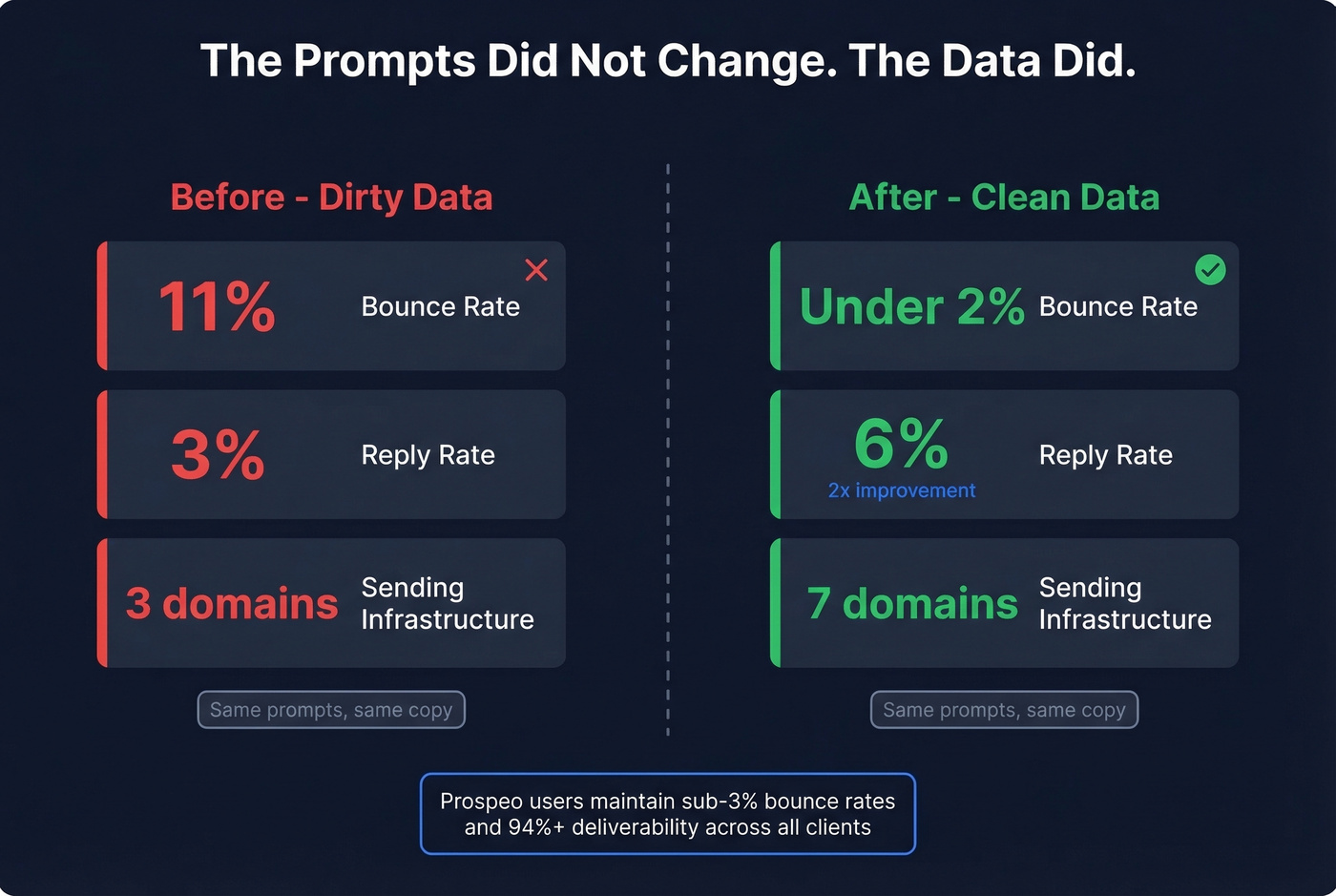
That story isn't unusual. Stack Optimize, an outbound agency using Prospeo for list building, maintains 94%+ deliverability and sub-3% bounce rates across all their clients - with zero domain flags. The difference between a 3% reply rate and a 6% reply rate almost always traces back to list quality, not copywriting.
Before you send anything ChatGPT generates, verify your list. Prospeo checks emails in real time with 98% accuracy and refreshes data every 7 days - not the 6-week industry average. The free tier covers 75 verifications per month, enough to test whether your list is actually sendable.
The Deliverability Checklist
Your prompts are only as good as your sending infrastructure. Skip this section if you've already got DMARC/SPF/DKIM configured and your bounce rate is under 3% - you're fine. For everyone else, here's what matters.
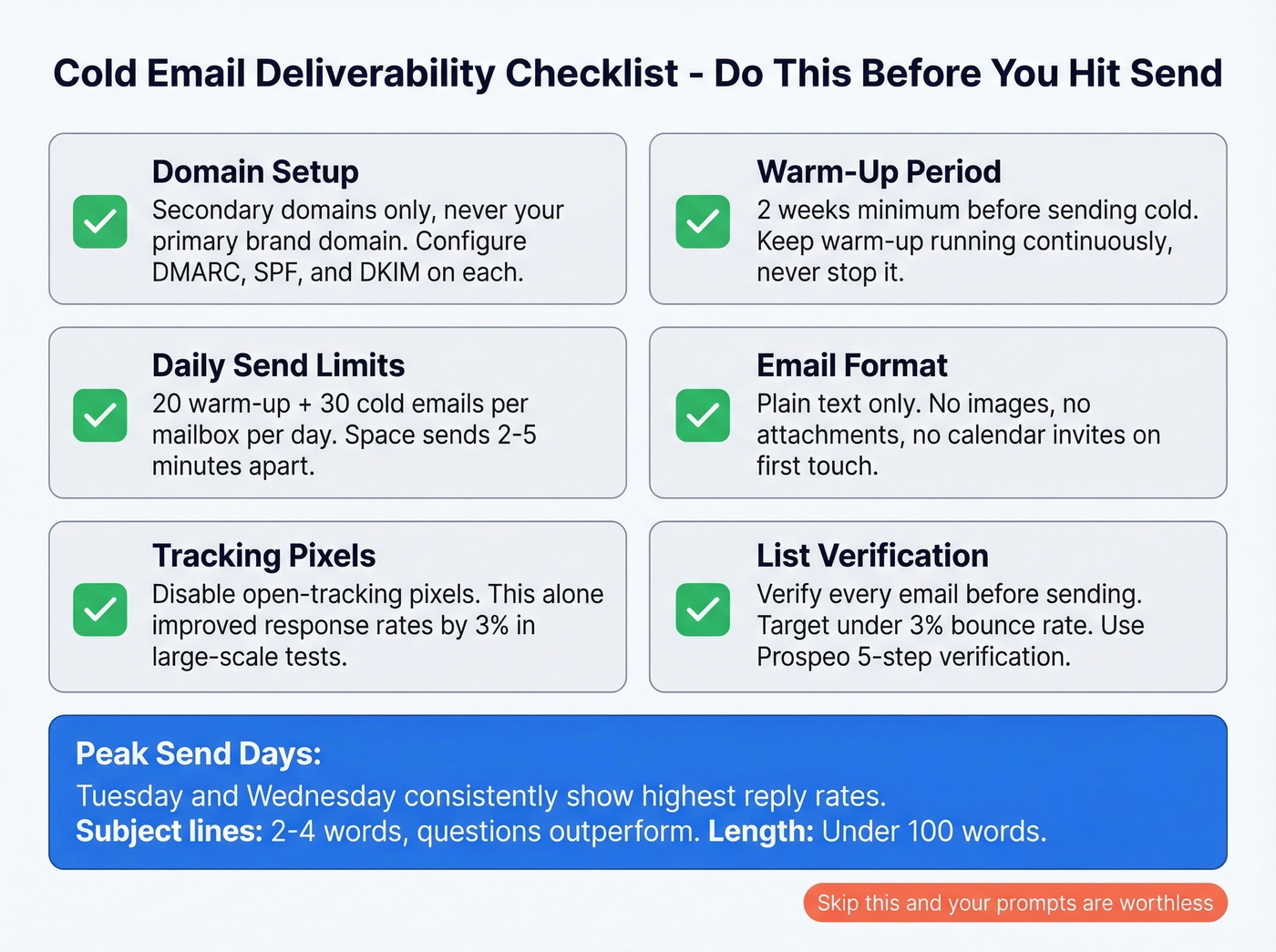
Cap each mailbox at 20 warm-up + 30 cold emails per day, spaced 2-5 minutes apart. Send plain text only - no images, no attachments, no calendar invites on first touch. Disable open-tracking pixels; that alone improved response rates by 3% in large-scale testing from Lemlist.
Subject lines: 2-4 words. Question subject lines outperform most other formats. (If you want more patterns, see subject lines that get responses.)
Length: Under 100 words. Shorter is usually better.
Peak days: Tuesday and Wednesday consistently show the highest reply rates. (More detail: best days to send email marketing.)
Domains: Secondary domains with DMARC, SPF, and DKIM configured. Never cold email from your primary brand domain. This isn't optional - it's the single fastest way to torch your sender reputation, and recovering from that takes months. (Related: sender authentication and how to check domain reputation.)
Warm-up: Two weeks minimum before sending cold. Keep warm-up running continuously. (Guide: Gmail warm up.)
Validation: Verify every email before sending to keep bounce rates under 3%. Prospeo's 5-step verification - with catch-all handling, spam-trap removal, and honeypot filtering - helps teams stay under that threshold. (If you're troubleshooting, start with check bounce.)
Outbound agencies using Prospeo maintain sub-3% bounce rates and 94%+ deliverability - with zero domain flags. At $0.01 per email, clean data costs less than a single wasted send to a bad address.
Stop letting bad data sabotage your AI-written emails.
FAQ
What reply rate should I expect from AI-written cold emails?
Average is 3.43%, top quartile hits 5.5%+, and elite campaigns reach 10.7%+. A separate 16.5M-email study covering Jan-Dec 2024 data showed 5.8% average, down from 6.8% the prior year. Performance depends far more on targeting and deliverability than whether a human or AI wrote the copy.
Are structured prompts better than freeform instructions?
Yes. Structured prompts with explicit constraints - word limits, banned phrases, tone instructions, required inputs - consistently produce tighter, more sendable drafts. Freeform instructions like "write me a cold email" give the model too much room to default to generic, bloated copy. We've seen the difference firsthand: a well-constrained prompt needs 3-4 revision rounds, while a vague one needs 10+.
How do I stop AI cold emails from landing in spam?
Plain text only, no tracking pixels, under 100 words, secondary domains with DMARC/SPF/DKIM, 30 emails per day max per mailbox, and verify your list before sending. Most spam-folder issues trace back to bad data, not bad copy.
Is Claude or ChatGPT better for writing cold emails?
Claude writes more natural first drafts. ChatGPT is better for iteration and critique. Both cost $20/mo. The best workflow: draft in Claude, then paste into ChatGPT to pressure-test tone, length, and CTA strength. Use Gemini when you need to paste long prospect research into context.