

How to Write a Check-Up Email That Actually Gets a Reply
Why "Just Checking In" Doesn't Work
You've typed "just checking in" and stared at it. Something feels off - it reads like you're apologizing for existing in someone's inbox. That instinct is right. The average professional gets 170 business emails per week, and a vague check-up email is the easiest one to skip.
Here's the problem: "just" minimizes your message before the recipient even processes it, and "checking in" doesn't say what you're asking for. Grammarly's guidance puts it plainly - the phrase is overused and can come off as impatient, entitled, or passive-aggressive. It's the email equivalent of knocking on someone's door and shrugging when they answer. A thoughtful follow-up boosts the chance of a reply by 49%, but only if it gives the recipient a reason to respond right now.
What the Data Says About Follow-Up Emails
The average cold email reply rate is 3.43%. That's brutal. But follow-ups drive 20.6% to 42% of all replies depending on the dataset, which means skipping them leaves a massive chunk of responses on the table.
We've dug through several large-scale studies on this, and the patterns are consistent. Sales.co's 2M+ email dataset found that only 14.1% of classified replies were positive - the rest were auto-replies, objections, or unsubscribes. Boomerang's research shows emails between 50 and 125 words tend to get the best response rates. Keep it tight. Make every sentence pull its weight.
The 4-Line Structure That Works
The best check-up emails follow a tight four-part framework:
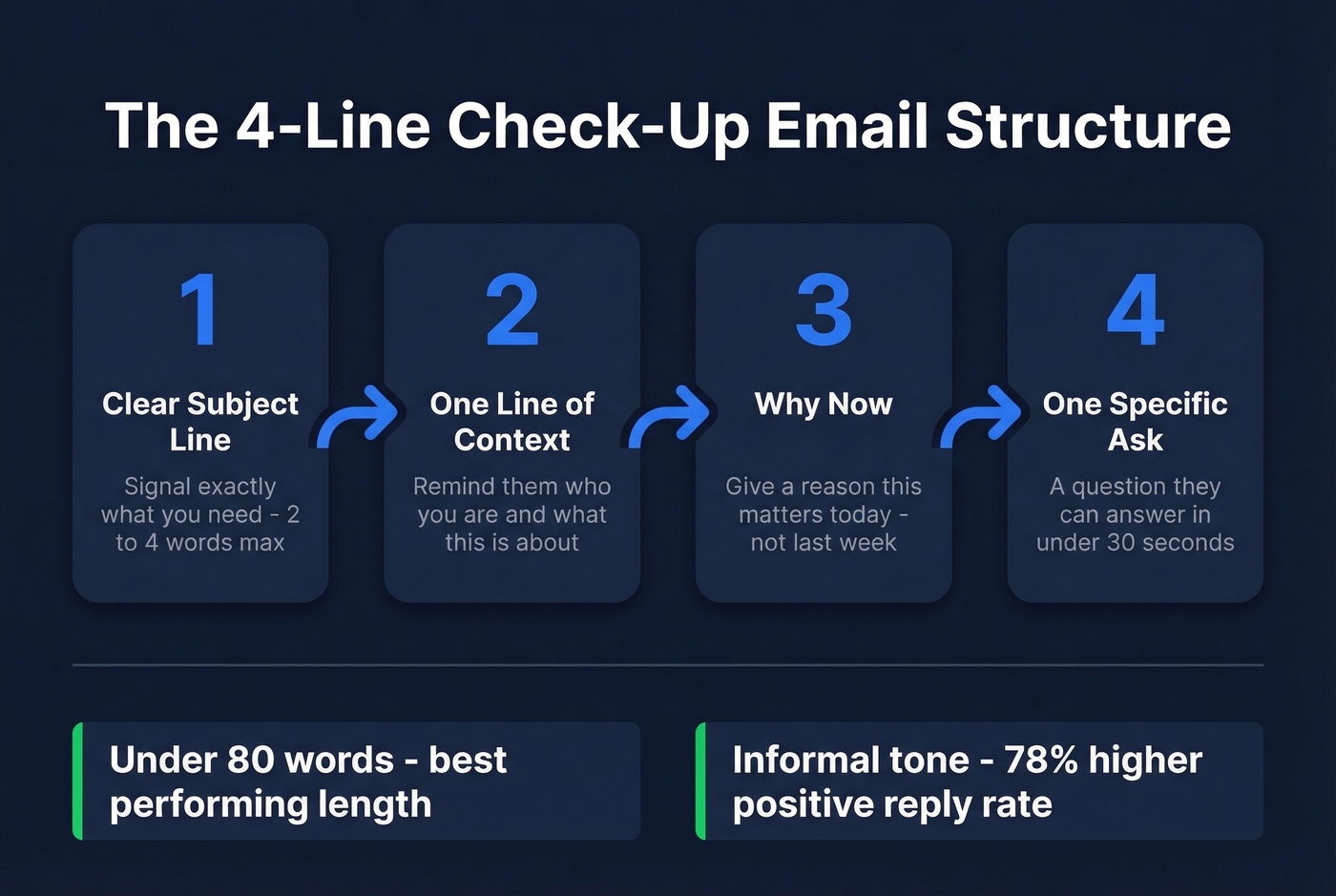
- Clear subject line - signal exactly what you need.
- One sentence of context - remind them who you are and what this is about.
- One sentence on why now - a reason this matters today.
- One specific ask - a question they can answer in under 30 seconds.
This structure works across sales, recruiting, and networking because it creates clarity fast. For outbound follow-ups, aim for under 80 words - that's the benchmark for best-performing campaigns in Instantly's data. You can adapt this framework into a reusable template for each scenario so you're never starting from scratch (or pull from proven sales follow-up templates when you need speed).
An informal tone also wins. Sales.co found "informal" emails produced a 78% higher positive reply rate than formal language. Write like you'd talk to a colleague, not a judge.

You just built the perfect 4-line follow-up. Don't waste it on a dead inbox. Prospeo verifies emails across 300M+ profiles with 98% accuracy - so every check-up email you send actually lands. The free tier gives you 75 verifications per month.
Stop following up with ghosts. Verify before you send.
Subject Lines That Get Opened
Personalized subject lines hit 46% open rates versus 35% without. The sweet spot is 2-4 words, and questions outperform statements. Your subject line's job isn't cleverness - it's signaling purpose. Skip urgency words like "ASAP," which drag opens below 36%. If you want more options, keep a swipe file of email subject line examples you can adapt quickly.
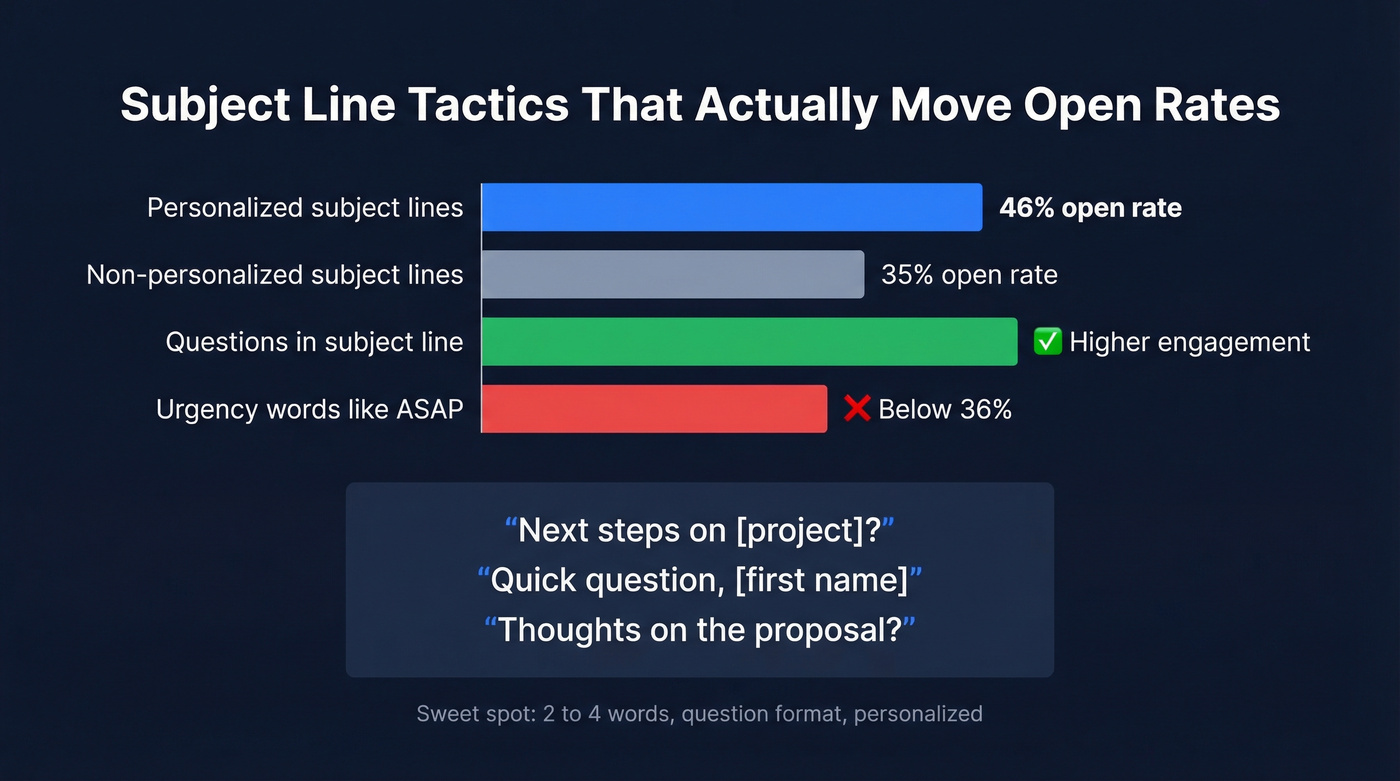
Examples that work:
- "Next steps on [project]?"
- "Quick question, [first name]"
- "Thoughts on the proposal?"
5 Check-Up Email Templates That Earn Replies
Each template ends with a specific ask. Data shows "Want to see it in action?" drives a 30.05% positive reply rate, so steal that pattern.
1. No response to a proposal Subject: Thoughts on the proposal? Hi [Name], I sent over the proposal on [date] and wanted to see if you had questions. Happy to jump on a 10-minute call. Does Thursday work?
2. Post-meeting action items Subject: Action items from Tuesday Hey [Name], wanted to make sure we're aligned from our call. You mentioned [specific item] - still targeting [date]? Let me know if anything shifted.
3. Networking reconnect Subject: Great meeting you at [event] Hi [Name], enjoyed our conversation about [topic]. I came across [relevant resource] and thought of you. Coffee next week?
4. Job application follow-up Subject: Following up on [role] Hi [Name], I applied for the [position] on [date] and remain very interested. Is there anything else I can provide? Happy to send references.
5. Client status check Subject: Quick update on [project]? Hey [Name], where do things stand with [deliverable]? Are we still on track for [deadline]? Want to see it in action before then?
Let's be honest - most of the "checking in" templates floating around online are painfully generic. The single best follow-up framing I've seen came from an r/sales thread: "I'm trying to finalize my schedule for next week - wanted to know if [date] still works for you?" It works because it implies a deadline without manufacturing urgency. Borrow it freely. (If you're building a full sequence, these cold email follow-up templates can help you map touchpoints.)
When to Send and When to Stop
| Scenario | Wait time | Max follow-ups |
|---|---|---|
| Sales outreach | 3-5 days | 4-7 touches |
| Job application | 7-10 days | 1-2 |
| Networking | 5-7 days | 2-3 |
| Client check-in | 3-5 days | 2-3 |
| Post-meeting | within 24 hours | 1-2 |
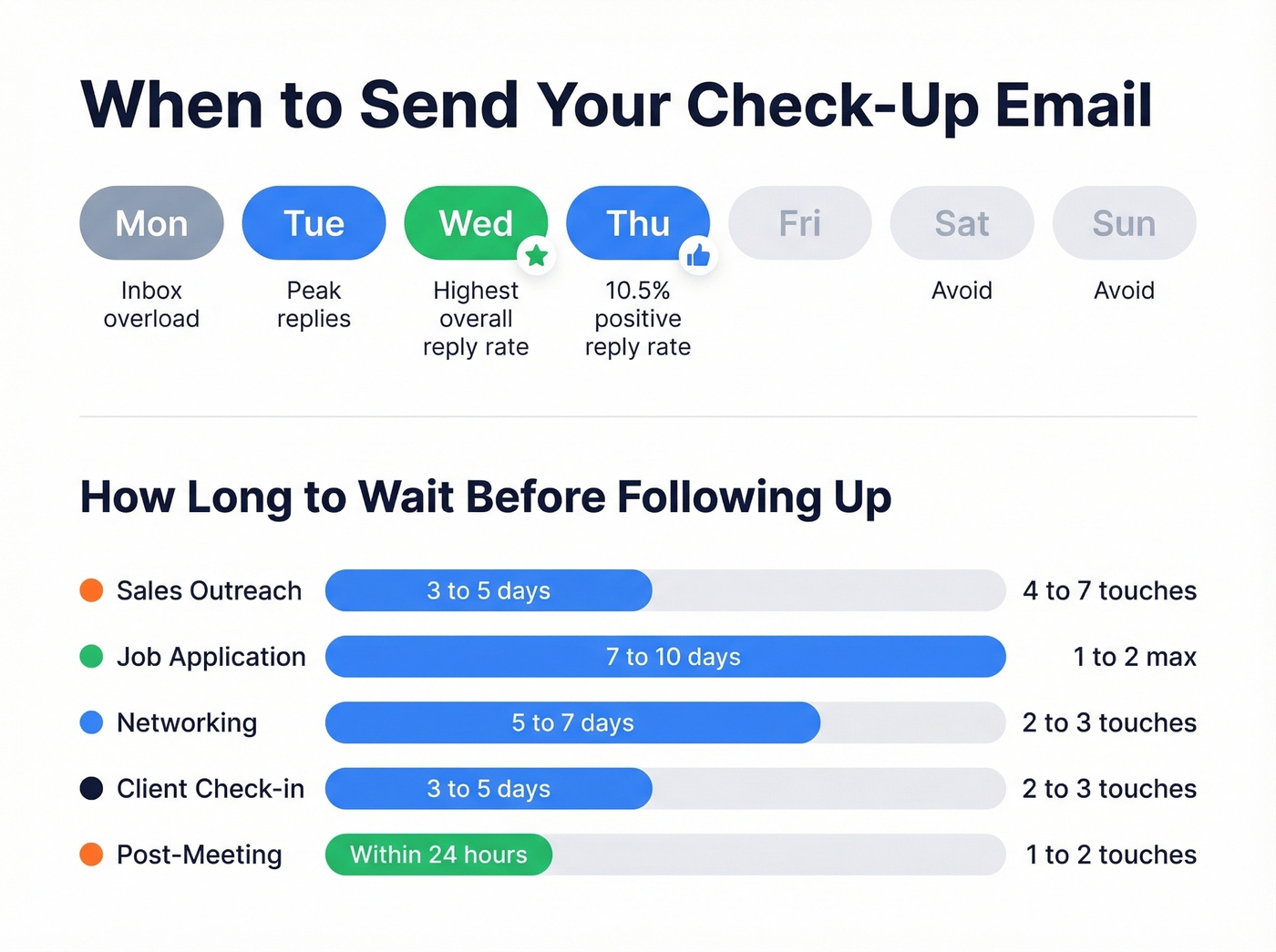
Tuesday and Wednesday see peak reply rates, with Wednesday highest overall. Thursday pulls the highest positive reply rate at 10.5%. Send your most important follow-ups mid-week. (For a deeper breakdown, see best time to send cold emails.)
One thing we've learned from running outbound campaigns: people don't respond on your timeline. Your follow-up should respect that, not punish it. Save the templates above as drafts so you can fire them off on the right day without scrambling for words.
3 Mistakes That Kill Your Reply Rate
Mistake 1: Bumping with no new info.
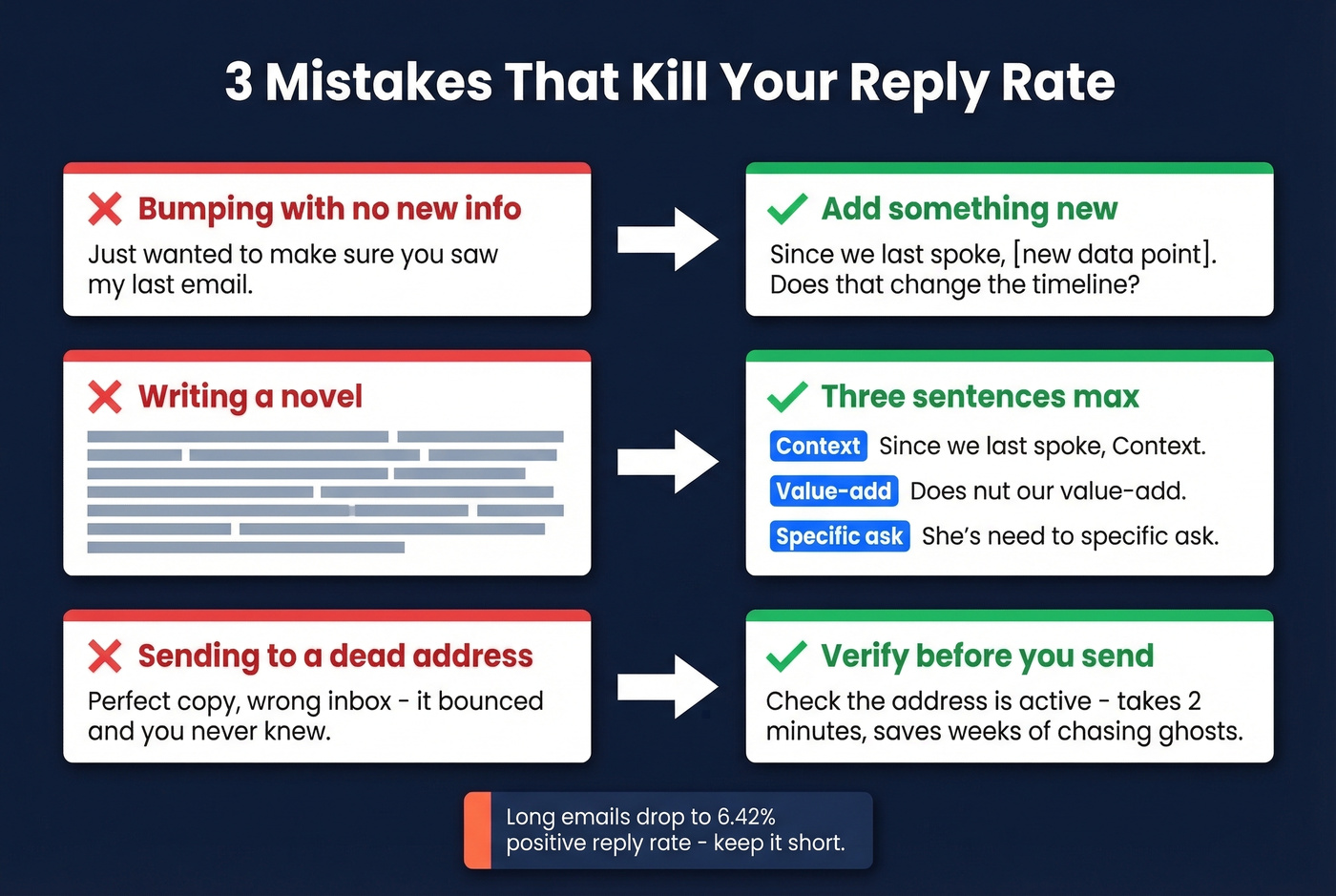
Before: "Just wanted to make sure you saw my last email." After: "Since we last spoke, [new data point]. Does that change the timeline?"
Each follow-up should be a new touchpoint with new information, and it should tackle a different objection - cost, urgency, trust, need, or desire. If you're re-sending the same pitch, you're re-annoying the same person. This is also where better sales communication makes a measurable difference.
Mistake 2: Writing a novel.
Three sentences. One context, one value-add, one ask. Done. Sales.co found long emails dropped to a 6.42% positive reply rate, while shorter formats performed significantly better. Build a template for each use case - proposal follow-up, post-meeting recap, networking - so brevity is baked in from the start. If you want a tighter system, start with a simple B2B cold email sequence and adapt the check-up lines.
Mistake 3: Sending to a dead address.
Your copy might be perfect, but if the email bounced or the contact changed roles three months ago, it never arrived. This is the most overlooked follow-up problem, and it's the one that frustrates us the most because it's so fixable. Verify emails before sending - Prospeo checks against 300M+ professional profiles with 98% accuracy, and the free tier includes 75 email verifications per month. A two-minute verification step saves you from chasing ghosts. If you're troubleshooting bounces, use this email bounce rate guide and the broader email deliverability guide to fix the root cause.
FAQ
How many follow-ups should I send before giving up?
For sales outreach, send 4-7 follow-ups spaced 3-5 days apart - data shows most positive replies come after the second or third touch. For job applications, cap it at two. More than that risks annoying the hiring manager.
What's the best day to send a check-up email?
Wednesday consistently earns the highest overall reply rates, while Thursday pulls the highest positive reply rate at 10.5%. Avoid weekends and Monday mornings when inboxes are most cluttered.
How long should a follow-up email be?
Aim for 50-125 words. Boomerang's research shows this range gets the best response rates. Three sentences - context, value-add, specific ask - is the sweet spot for most scenarios.
How do I verify emails before sending follow-ups?
Use a verification tool to check addresses against a live database before hitting send. Prospeo's free tier lets you verify 75 emails per month at 98% accuracy, catching bounces, role changes, and dead addresses before they tank your deliverability.
Great follow-up copy means nothing if you're emailing the wrong person. Contacts change roles, companies, and addresses constantly. Prospeo refreshes data every 7 days - not every 6 weeks - so the email you're checking in on is still active.
Send your check-up email to someone who actually works there.