

"Checking In" Email Subject Lines: When They Work, When They Don't, and 40+ Better Alternatives
It's 4 PM on a Thursday. Your prospect went dark after a solid demo, and your cursor is blinking on an empty subject line field. Your brain defaults to the classic "checking in" email subject line - and every sales blog says that's lazy. But one A/B test with 4,000+ emails says it actually works, in the right context. With 376 billion emails sent daily, the gap between a good and bad subject line is the gap between pipeline and silence.
The Short Version
"Checking in" works in threaded follow-ups to warm contacts. An Outreach A/B test showed 86% more replies when "just checking in" was added to bumper emails in active deal threads. It fails in cold outreach where there's no prior relationship.
For cold emails, replace it with specificity. Reference a challenge, a shared connection, or a concrete next step. 40+ examples sorted by situation are below.
Open rates are broken in 2026. Apple Mail Privacy Protection inflates opens, so track click-to-open rate (CTOR) and reply rate instead - those numbers actually mean something.
Why "Just Checking In" Subject Lines Usually Fail
The phrase isn't inherently toxic. It fails because of what usually surrounds it - or rather, what doesn't.
It delivers zero value. A "just checking in" subject line tells the recipient nothing about why they should care. No insight, no resource, no reason to reply. It's the email equivalent of knocking on someone's door and shrugging when they answer.
It has no clear CTA. As Dialpad's analysis points out, most "checking in" emails end with vague asks like "let me know your thoughts." That's not a call to action - it's a call to ignore. (If you want stronger asks, see our call to action guide.)
It reads as insincere. Everyone knows you're not "just" checking in. You want something. The phrase tries to disguise intent, and recipients see through it instantly. 47% of recipients decide whether to open based on the subject line alone, and a cliche doesn't earn that click.
When "Checking In" Actually Works
Here's the thing: the data isn't as one-sided as the advice suggests.
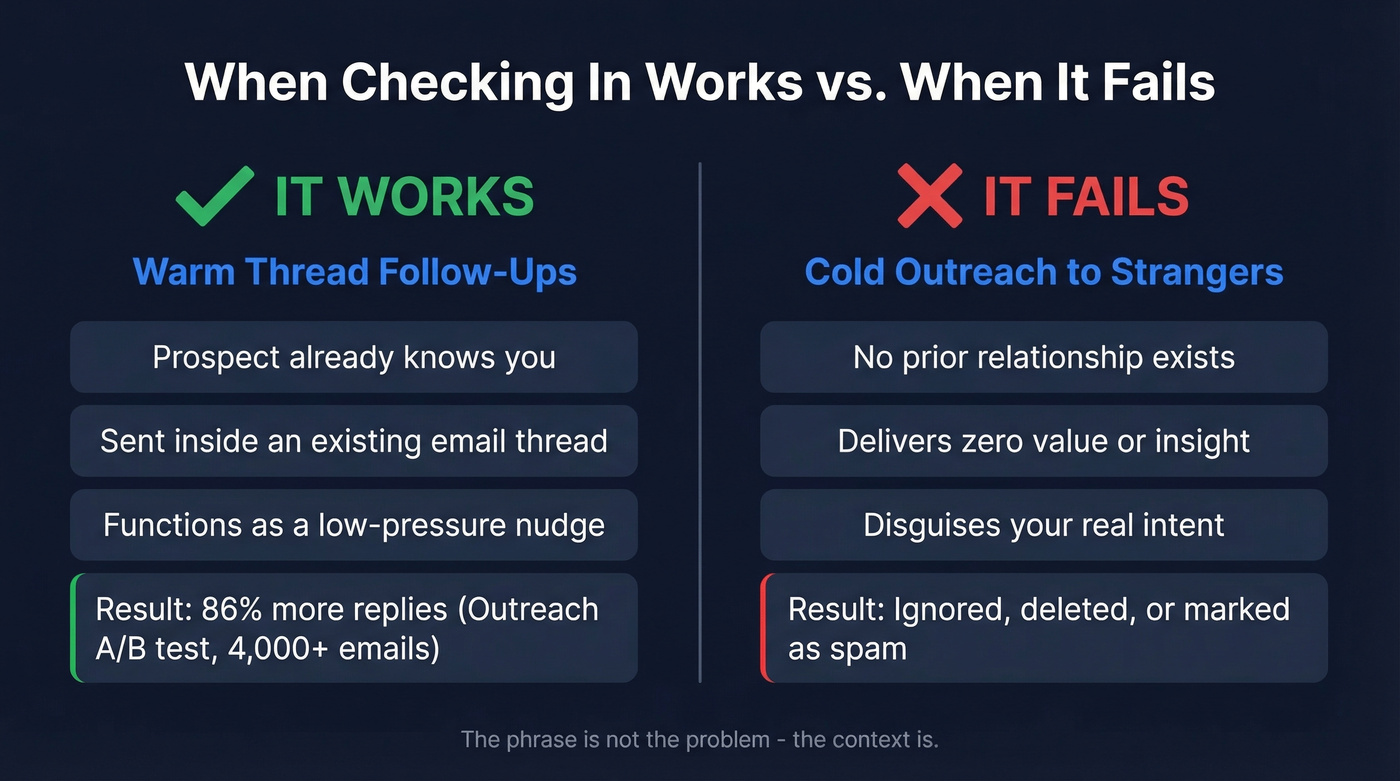
Outreach ran a formal four-week A/B test on what they call "bumper emails" - follow-ups sent within the same thread as a previous message, keeping the original subject line. They split 2,000+ emails into each group. The version that added "just checking in" to the body produced an 86% higher reply rate, and the result was statistically significant.
Why did it work? Context. These weren't cold emails to strangers. They were nudges inside an existing conversation where the prospect already had history with the rep. The phrase functioned as a low-pressure bump - "hey, still here" - rather than a hollow opener. (If you're building a full sequence, start with a proven B2B cold email sequence.)
A Reddit thread on r/sales captures the practitioner debate well: the OP argues the "never say checking in" rule is folklore, not science, and encourages testing over dogma. That's the right instinct. In our experience, teams that actually A/B test their follow-up subject line language - instead of blindly following blog advice - find their own version of this result within a few weeks. (More ideas: prospecting email subject lines.)
The takeaway: bumper emails in warm threads are the one context where the phrase earns its keep. Everywhere else, you need something better.
40+ Better Follow-Up Email Subject Lines
Every subject line below follows two rules: it's under 33 characters when possible (more on why shortly), and it gives the recipient a reason to open. Replace bracketed variables with your specifics. For more swipeable options, use these email subject line examples.
Sales Follow-Up (Cold Outreach)
- [First name], quick [topic] idea - signals value, not a request
- Saw [company]'s [specific news] - proves you did homework
- [Mutual connection] suggested I reach out - borrowed credibility
- [X%] improvement for [their role] - leads with outcome
- Thought of [company] when I saw this - curiosity without clickbait
- [Their competitor] is doing [X] - competitive pressure works
- Resource on [their challenge] - positions you as helpful, not needy
- 3 min read on [pain point] - sets time expectation
Sales Follow-Up (Active Deal / Post-Demo)
This is where specificity pays off the most, because your prospect already knows who you are - they just need a reason to re-engage right now.
- Next steps on [project name] - clear and direct
- The [feature] question you asked - references their words
- ROI numbers from our call - delivers promised value
- [Name], one thing I forgot to mention - creates curiosity
- Updated proposal attached - no ambiguity
- Quick answer on [their objection] - addresses what's blocking the deal
Job Interview Follow-Up
- [Role name] follow-up - [Your name] - clean, scannable format
- Thanks for the [day] conversation - warm, specific
- [Role] next steps? - direct without being pushy
- Excited about [specific project discussed] - shows you listened
- Additional [skill/portfolio] context - adds value to your candidacy
Client / Account Management
- Your Q[X] results are in - leads with their outcome
- [Metric] update + recommendation - positions you as proactive
- New feature for [their use case] - relevant, not generic
- Flagging something before it's urgent - shows you're watching
- [Client name] monthly check-in: [date] - structured, expected
- Saved you [X hours/dollars] this month - quantified value
- Quick win I spotted in your account - proactive, specific
- [Integration/tool] update that affects you - relevance-driven
Internal Team Follow-Up
- [Project] deadline: [date] update - specificity kills ambiguity
- Need your input by [day] - clear ask, clear timeline
- Blocker on [task] - quick sync? - explains why you're writing
- [Meeting name] action items - useful reference
- [Name], your section is due [day] - direct accountability
- [Project] risk I want to flag - urgency without drama
- Recap + next owners for [initiative] - actionable, not just FYI
The Breakup Email (Last Attempt)
These work surprisingly well. Giving someone an easy out often reopens the conversation - it removes the pressure that was keeping them silent.
- Should I close your file? - permission-based, surprisingly effective
- Not a fit right now? - gives them an easy out
- Last note from me on [topic] - sets finality
- Closing the loop on [project] - professional, no guilt
- Going to assume [X] unless I hear back - gentle deadline

A perfect subject line is wasted on a bad email address. Prospeo's 98% verified emails and 7-day data refresh mean your carefully crafted follow-ups actually land in inboxes - not bounce back and torch your domain reputation.
Stop perfecting subject lines for emails that never arrive.
Follow-Up Cadence Cheat Sheet
Great subject lines mean nothing if your timing is off.
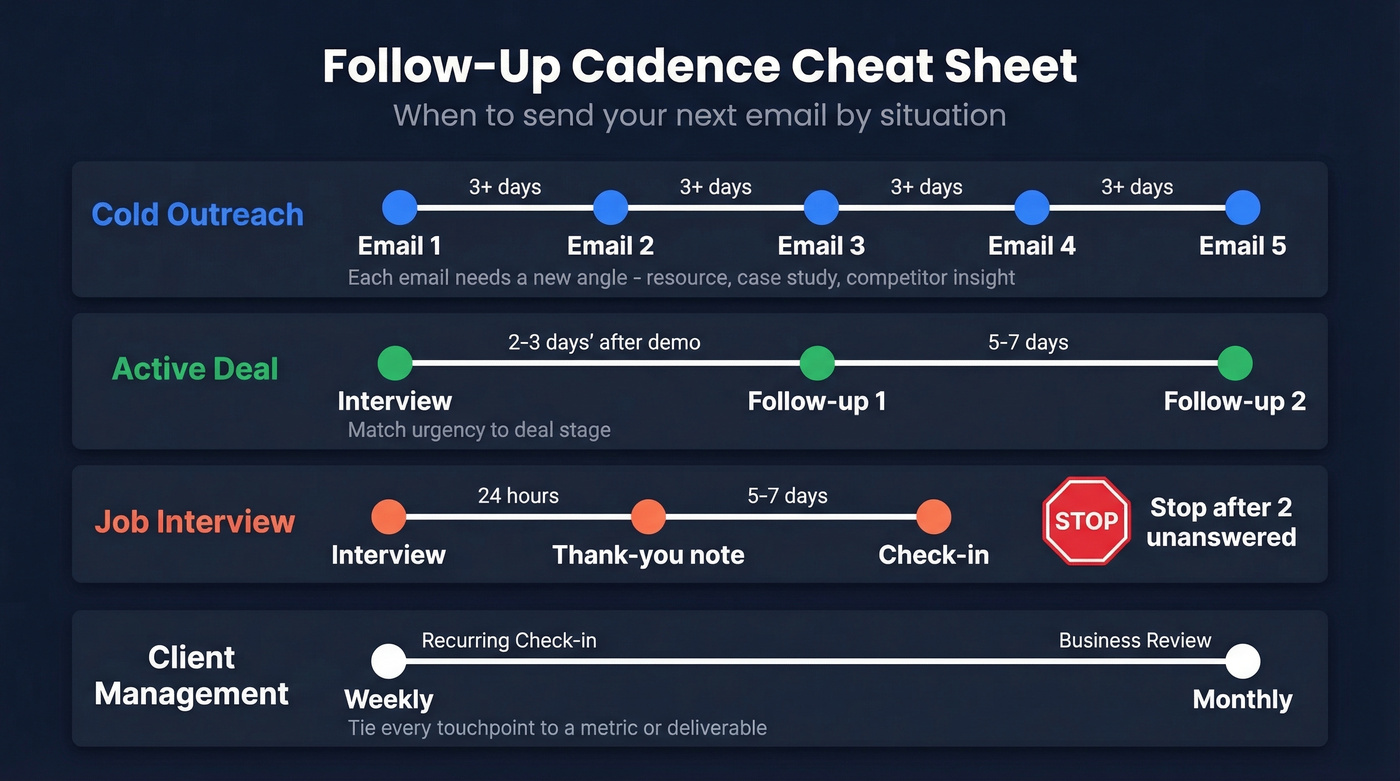
Sales (cold outreach): Wait at least 3 days between touches, and plan on a sequence of at least 5 emails. Each one needs a new angle - a resource, a competitor insight, a case study. Repetition without new information trains your prospect to ignore you. (If you need copy you can send today, use these sales follow-up templates.)
Sales (active deal): Follow up 2-3 days after a demo or proposal, then stretch to 5-7 days. Match urgency to deal stage.
Job interview: Wait 24 hours for a thank-you note, then 5-7 days for a check-in. After two unanswered follow-ups, stop.
Client/account management: Weekly or monthly depending on the relationship. Tie every touchpoint to a metric or deliverable, not just "wanted to touch base."
The 33-Character Rule
Most subject line advice says "keep it under 50 characters." That's desktop advice. On mobile - where most email gets read - you've got less room.
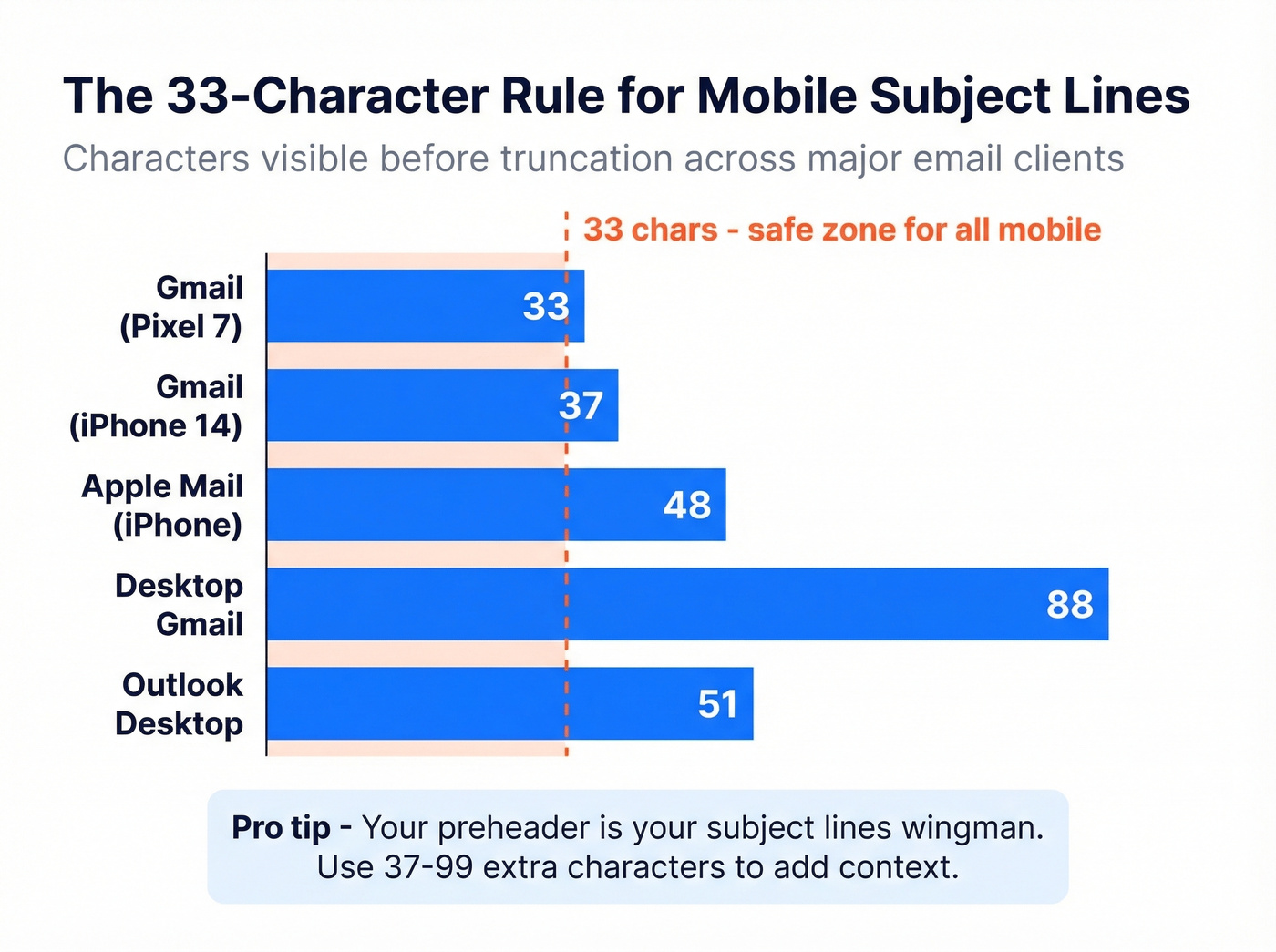
EmailToolTester's device testing found that 33 characters is the threshold for full visibility across major mobile clients:
| Device / Client | Subject Limit | Preheader Limit |
|---|---|---|
| Gmail (Pixel 7) | 33 chars | 37 chars |
| Gmail (iPhone 14) | 37 chars | 39 chars |
| Apple Mail (iPhone) | 48 chars | 99 chars |
| Desktop Gmail | ~88 chars | Varies |
| Outlook Desktop | ~51 chars | Varies |
Klaviyo's data backs this up from a different angle: the average subject line across their platform runs about 7 words, and that length correlates with roughly 30% open rates. Seven words and 33 characters aren't the same thing, but they point in the same direction. Brevity wins on mobile. (To test preview text too, run an email preview text A/B test.)
Don't ignore the preheader. That second line of preview text is your subject line's wingman. If your subject is short and punchy ("ROI numbers from our call"), the preheader can carry the context ("You asked about payback period - here's the breakdown"). Major email clients display about 37-99 characters of preheader text, and leaving it blank means the client pulls from your email body - usually something ugly like "View this email in your browser."
Subject Lines That Land in Spam
Your subject line doesn't just affect opens - it affects whether you reach the inbox at all. An estimated 45% of all emails end up in spam folders.
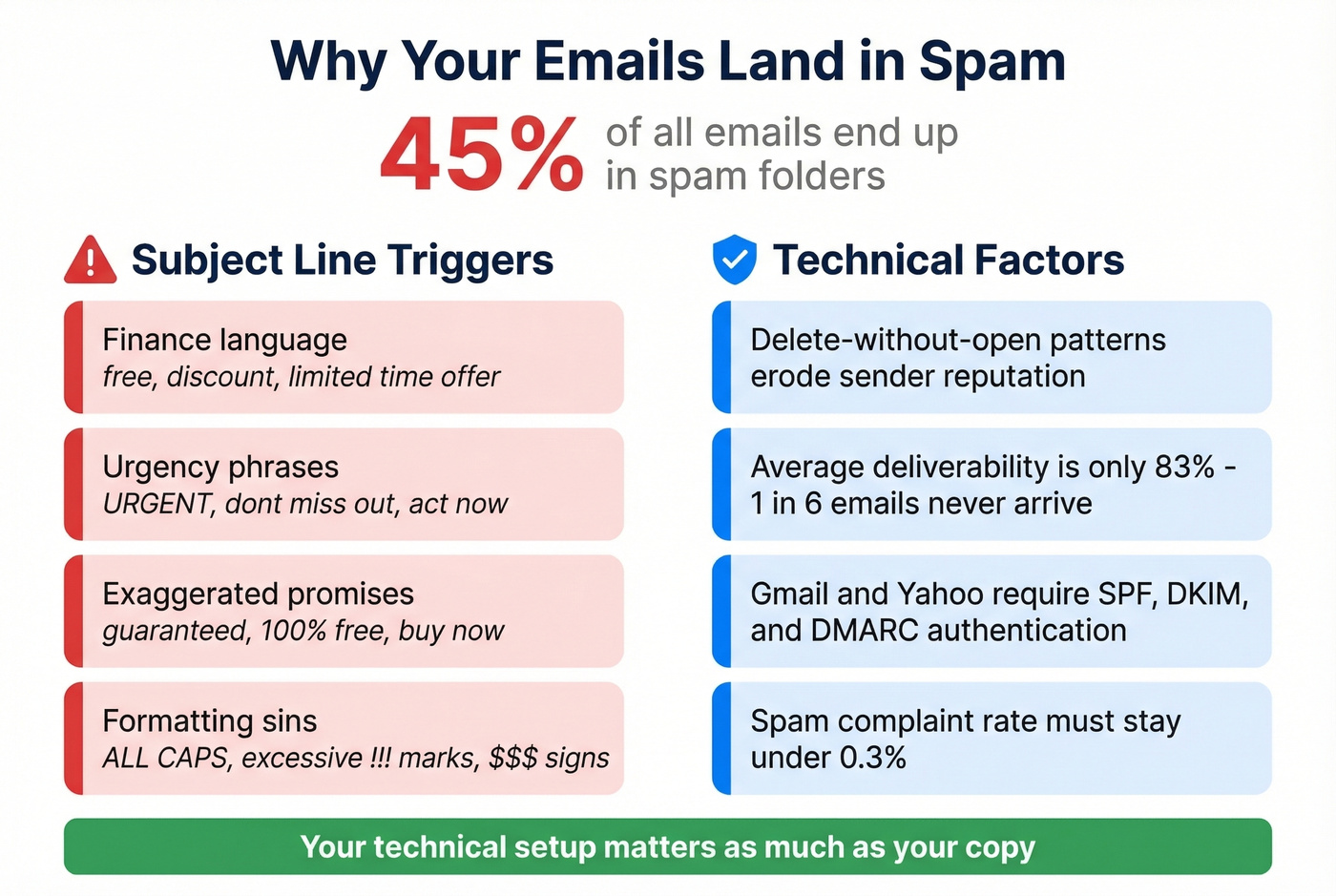
Modern filters evaluate patterns and context, not just individual words, but certain categories consistently trigger problems. Finance language like "free," "discount," and "limited time offer" reliably trips filters. Urgency phrases like "URGENT" and "don't miss out" do the same. Exaggerated promises - "guaranteed," "buy now," "100% free" - are equally risky. ALL CAPS, excessive punctuation (!!!), and dollar signs ($$$) compound the damage.
Beyond content, engagement signals matter. When recipients consistently delete your emails without opening them, inbox providers notice. That delete-without-open pattern erodes your sender reputation over time, making even good subject lines land in spam. The average deliverability benchmark sits around 83% - meaning roughly 1 in 6 emails never reaches the inbox regardless of what the subject line says. Gmail and Yahoo now require SPF, DKIM, and DMARC authentication for bulk senders, and flag accounts exceeding 0.3% spam complaint rates. Your technical setup matters as much as your copy. (If you need the full checklist, start with our email deliverability guide.)
Why Open Rates Lie in 2026
If you're optimizing subject lines based on open rates alone, you're optimizing against broken data.
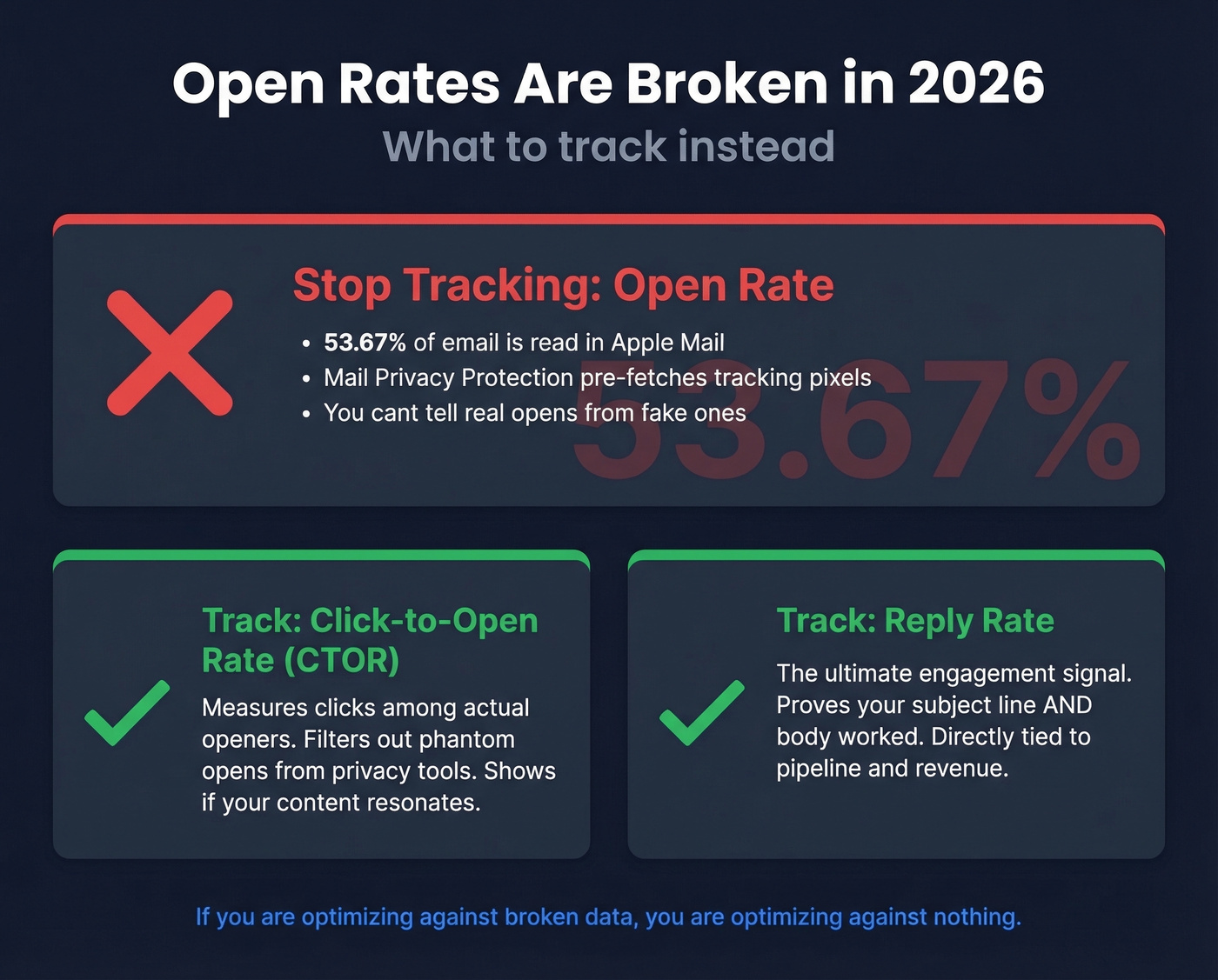
Klaviyo's benchmarked email-client data puts Apple Mail at 53.67% market share. Since iOS 15, Mail Privacy Protection pre-fetches email tracking pixels - whether the recipient reads the email or not. You can't tell the difference between a real open and an Apple privacy open without filtering at the platform level.
CTOR (click-to-open rate) is the metric that actually reflects subject line and content quality, with a benchmark around 6.8%. For cold email specifically, use these diagnostic thresholds: below 30% opens likely means a subject line or deliverability problem, 40-50% puts you in the top quartile, and average cold reply rates run 5-9% with top performers hitting 15%+. Cold email open rates have already dropped from 36% to 27.7% - and that decline is accelerating as MPP adoption grows.
Look, most teams obsess over subject line wording when their real problem is deliverability. If your bounce rate is above 5%, no amount of A/B testing will save you. Fix the pipes before you polish the faucet. (Benchmarks and fixes: email bounce rate.)
Fix Your Data Before Your Subject Lines
Every subject line guide assumes you have the right email address. That's a big assumption when 83% deliverability means 1 in 6 emails never reaches the inbox.
We've seen this pattern repeatedly: teams spend weeks A/B testing subject lines while 15-20% of their list is hitting invalid addresses, spam traps, or abandoned inboxes. The optimization is pointless if the foundation is broken. Snyk ran into exactly this - their bounce rate sat at 35-40% before they fixed their data pipeline. After switching to Prospeo for verification, bounces dropped under 5% and AE-sourced pipeline jumped 180%.
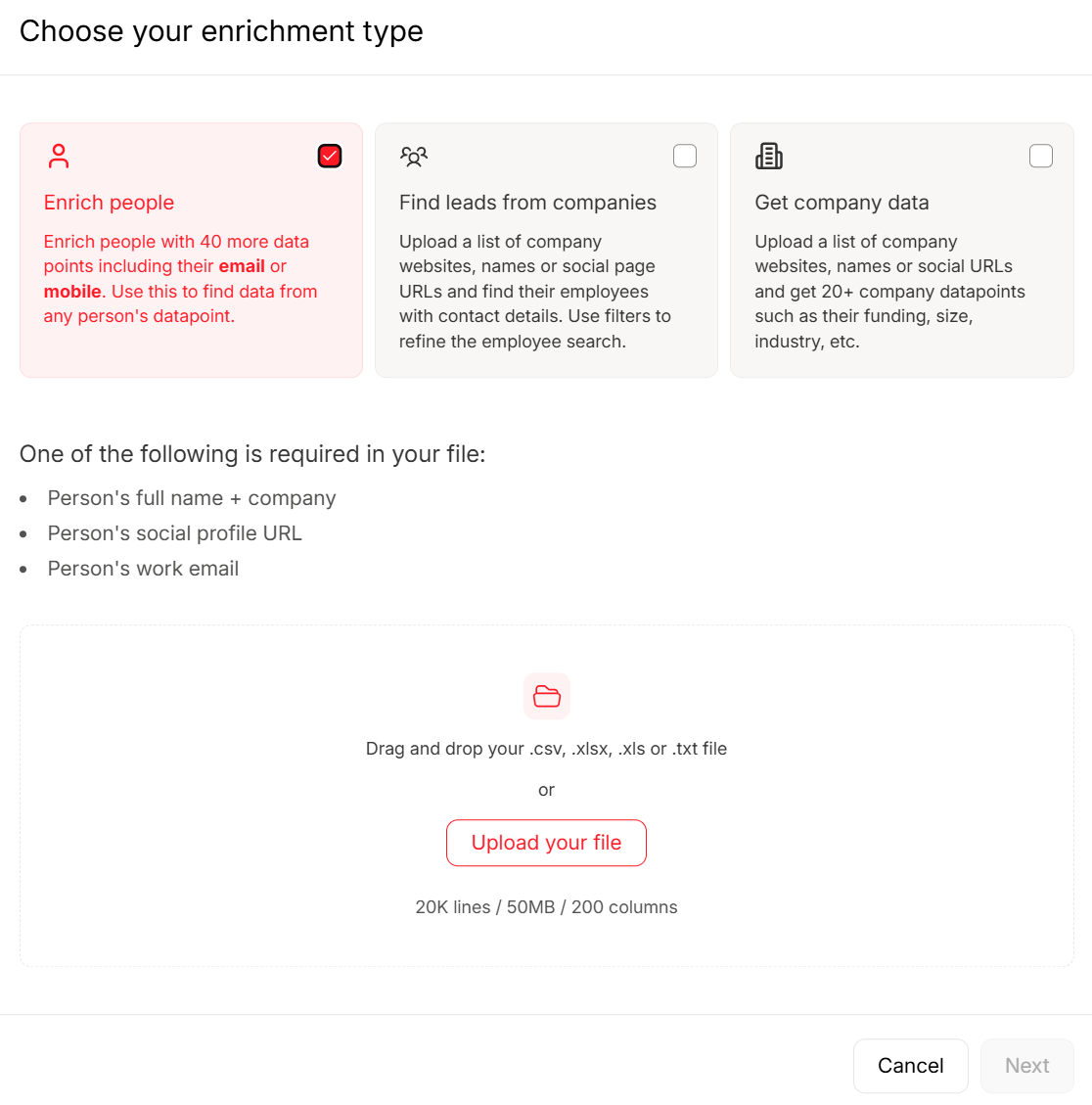
Before you agonize over another follow-up subject line, verify your list. Prospeo's 5-step verification process - including catch-all handling, spam-trap removal, and honeypot filtering - delivers 98% email accuracy across 143M+ verified addresses. It's the highest-ROI fix most teams skip. (If you're comparing vendors, start with data enrichment services.)
You just picked the right follow-up subject line. Now make sure you're sending it to the right person. Prospeo gives you 300M+ verified contacts with 30+ filters - so your breakup email actually reaches the decision-maker, not a dead inbox.
Great copy deserves real contacts. Start free with 75 verified emails.
FAQ
How many follow-up emails should I send?
80% of sales require five or more follow-ups, but nearly half of reps quit after one. Send 3-5 follow-ups spaced 3-7 days apart, each adding new value - a resource, a data point, or a relevant case study. Persistence with fresh angles outperforms repetition every time.
Should I reuse the same subject line for every follow-up?
For threaded replies (bumper emails), yes - that's the exact context where "checking in" tested well with 86% more replies. For new email threads, change the subject each time. Pattern fatigue is real, and a fresh angle gives you another shot at the open.
What's the best subject line after a job interview?
Reference the specific role and your name - something like "[Role name] follow-up - [Your name]." Generic phrases get buried in a hiring manager's inbox. Specificity signals professionalism and makes your message easy to find later.
What day and time works best for follow-ups?
Tuesday through Thursday mornings, 8-10 AM in the recipient's time zone, consistently benchmark highest. Avoid Monday mornings (inbox triage mode) and Friday afternoons (mentally checked out). Test your own audience - B2B SaaS buyers and healthcare executives don't check email on the same schedule.
Does email verification actually improve results?
Verification doesn't change whether someone clicks, but if 17% of your emails never reach the inbox due to bad addresses, your metrics are diluted by sends nobody could open. Cleaning your list before sending gives every subject line a fair shot at performing.