

Chief Revenue Officer Priorities: The 7 That Actually Matter in 2026
The average CRO lasts 25 months. Pave data across 14,000 executives puts it worse: a 1.8-year median with 32% annual turnover, the shortest in the C-suite alongside CMOs. With 7.9% revenue growth expected in 2026 and over a third of companies having reforecasted mid-year last year, the margin for strategic error is razor-thin.
Here's the thing: most CROs don't fail because they picked the wrong strategy. They fail because they spent their first two quarters on the wrong type of work. The priorities below are ordered deliberately - get them wrong and you'll join the 32% who don't see year two.
What a CRO Actually Owns
Most CRO failures start with a title that doesn't match the authority. A VP of Sales owns deal execution. A CRO owns the revenue system across sales, marketing, CS, and RevOps. A CCO sets commercial direction: markets, pricing, positioning, partnerships.
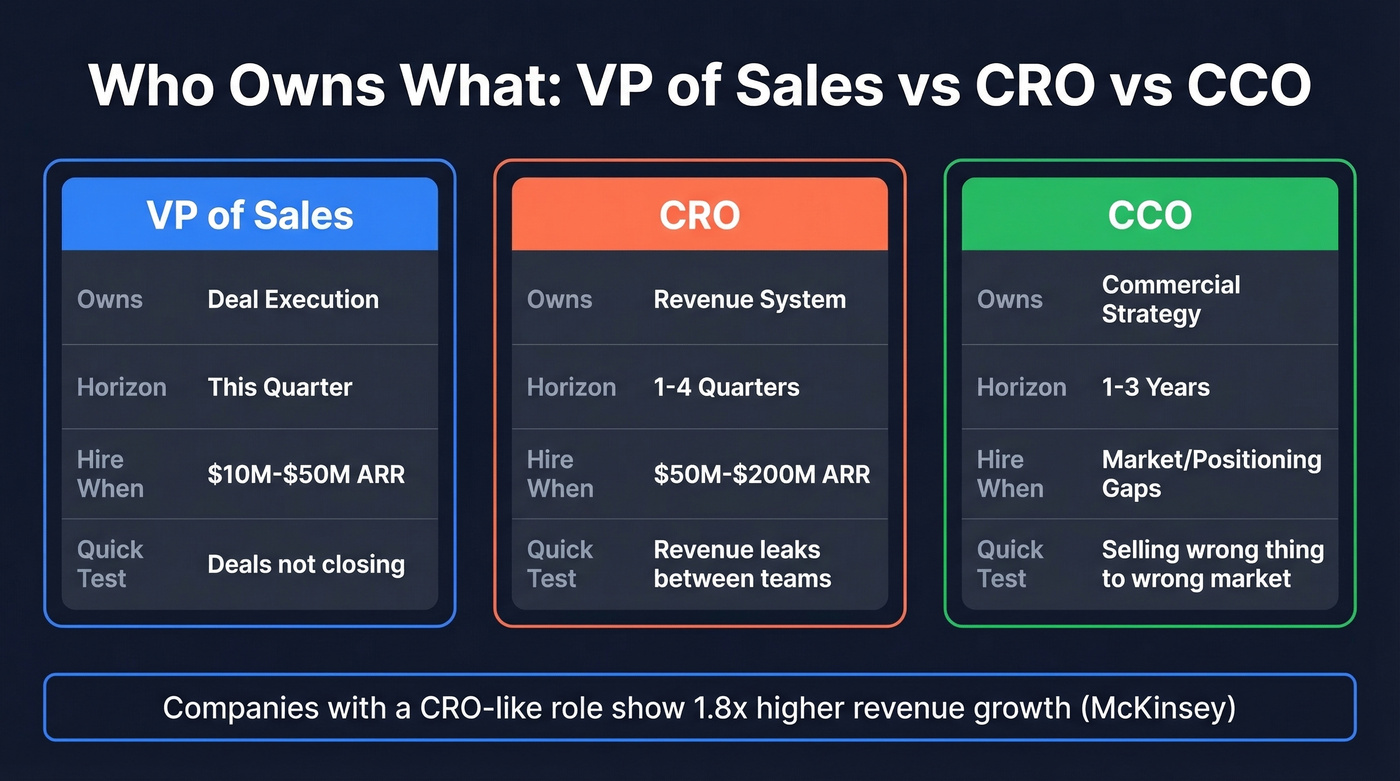
| VP of Sales | CRO | CCO | |
|---|---|---|---|
| Owns | Deal execution | Revenue system | Commercial strategy |
| Horizon | This quarter | 1-4 quarters | 1-3 years |
| Hire when | $10M-$50M ARR | $50M-$200M ARR | Market/positioning gaps |
The quick diagnostic: if deals aren't closing, you need a VP of Sales. If deals close but revenue leaks across handoffs between teams, you need a CRO. Selling the wrong thing to the wrong market? That's a CCO problem.
Companies with a CRO-like role show 1.8x higher revenue growth than peers, per McKinsey's analysis of Fortune 100 firms. That same research found companies founded between 2016 and 2022 hired CROs roughly 2x faster than those founded 2009-2015, and US scale-ups bring on a CRO about two years earlier than European counterparts. The role is accelerating. But a CRO without authority over marketing and customer success isn't a CRO - it's a VP of Sales with a bigger title and a shorter leash.
The 7 CRO Priorities That Matter
1. Role Clarity and CEO Alignment
50% of CROs cite role ambiguity as their top challenge. As one CRO put it, it's "all the accountability, none of the control."
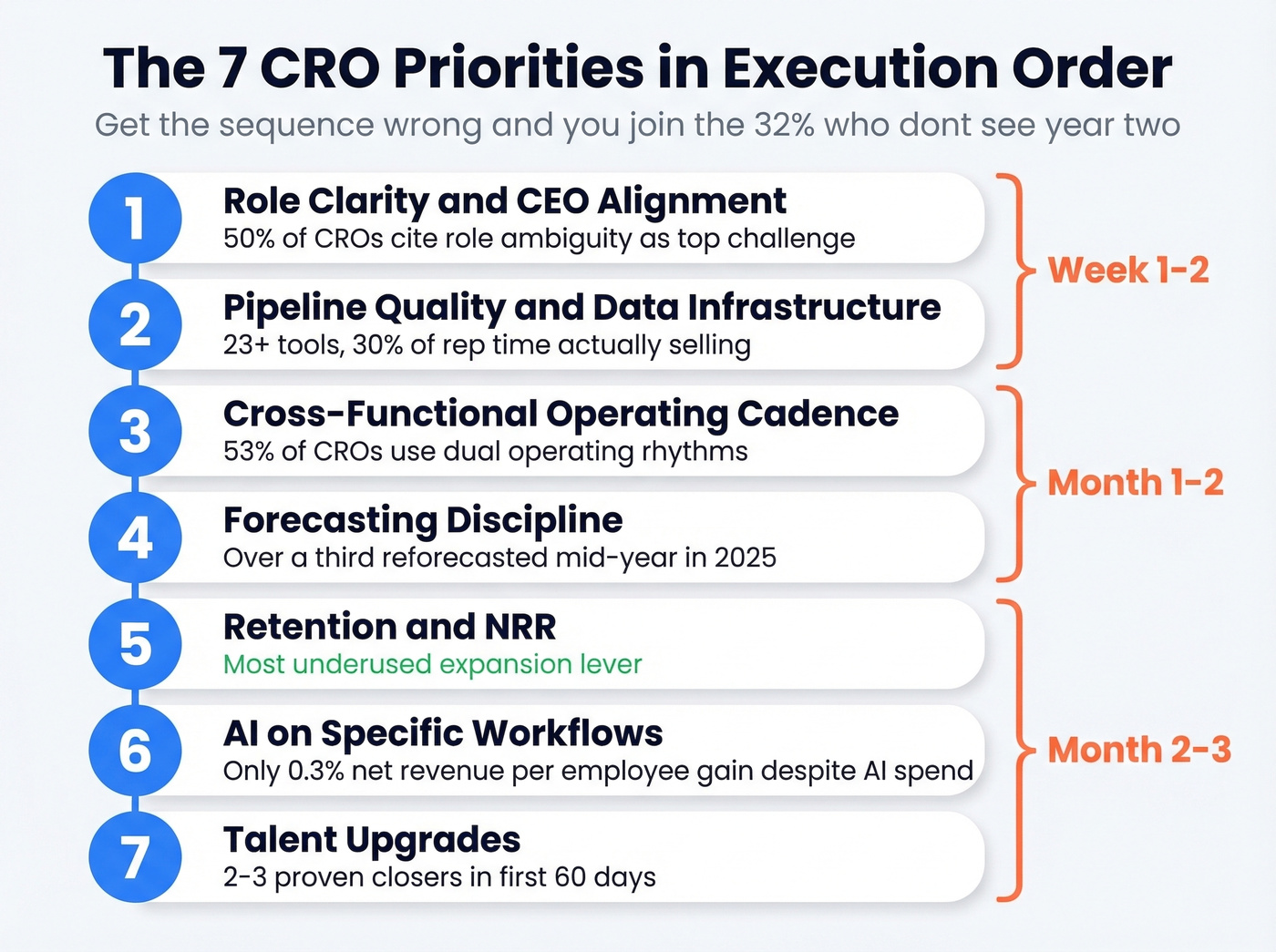
The fix isn't a job description - it's a conversation. Align with your CEO on five priorities in the first two weeks. Get it in writing. If you can't get agreement on what you own, you'll spend your tenure fighting org chart battles instead of building a revenue engine.
2. Pipeline Quality and Data Infrastructure
The average GTM team juggles 23+ tools, and reps still spend roughly 30% of their time actually selling. Revenue leak is estimated at $2 trillion globally. Most of it starts with bad data - stale contacts, wrong titles, bounced emails that corrupt your forecast before a rep makes a single call.
This is a week-one fix, not a quarter-three initiative. We've seen teams identify 20-40% dead records in their first CRM audit when they run contacts through an enrichment tool with a short refresh cycle. Prospeo's 7-day data refresh and 98% email accuracy make that audit fast - kill the dead records and your pipeline coverage numbers actually mean something.
If you’re evaluating vendors, start with a shortlist of data enrichment services and map them to your CRM fields.

3. Cross-Functional Operating Cadence
53% of CROs surveyed use dual operating rhythms - near-term execution cadences layered with longer-horizon strategic bets. Without this structure, you're just a firefighter with a C-suite title.
Weekly deal reviews for this quarter. Monthly strategic reviews for next quarter. Quarterly planning for the year. The rhythm matters more than the meetings themselves, and every meeting should have a decision owner, a data source, and a next action. In our experience, the CROs who struggle most are the ones running six recurring meetings a week with no clear output from any of them.
4. Forecasting Discipline
Over a third of companies reforecasted mid-year in 2025. That's not a market problem - it's a process problem.
Pipeline coverage should run 3-5x your target, but coverage means nothing if stage definitions are sloppy. Install rigorous stage exit criteria and inspect the math weekly, not monthly. If a rep says a deal is in "verbal commit" but there's no signed mutual action plan, that deal isn't in verbal commit. It's in wishful thinking.
If you need a stack to support this, compare sales forecasting solutions that match your deal cycle and data maturity.
5. Retention and NRR
Expansion revenue is the CRO's most underused lever. If CS incentives aren't tied to revenue outcomes, you're leaving money on the table while spending more to acquire net-new logos. Align CS comp to NRR, build expansion playbooks, and treat renewals as a revenue motion - not an afterthought that lives in a different Slack channel.
To pressure-test the motion, run a simple churn analysis before you rewrite comp plans.
6. AI on Specific Workflows
"Adopt AI" isn't a priority. Fixing three specific workflows with AI is.
Median net revenue per employee rose only 0.3% last year despite massive AI spending - proof that broad adoption without focus is just cost. The highest-ROI applications right now: automated CRM updates, call summaries, and follow-up drafting. Pick the workflows where reps lose the most hours and automate those first. Skip the "AI strategy" deck and start with one painful bottleneck.
If follow-ups are the bottleneck, use proven sales follow-up templates before you automate anything.
7. Talent Upgrades
Bring in 2-3 proven closers in your first 60 days. Stop feeding leads to underperformers while you "give them time."
We've watched new CROs burn through their first two quarters coaching reps who were never going to make it, and the math is brutal: every month a weak rep sits on good pipeline is a month of revenue you don't get back. The pipeline you're building deserves reps who can convert it.
If you’re rebuilding the top of funnel at the same time, lean on modern sales prospecting techniques so new talent isn’t starved of at-bats.

Bad data is why CROs reforecast. Prospeo's 7-day refresh cycle and 98% email accuracy mean your pipeline coverage numbers reflect reality, not stale records. Run your CRM through enrichment that returns 50+ data points per contact at a 92% match rate - and know what's real by end of day.
Kill the dead records before they kill your forecast.
The First 90 Days
Days 1-30: Diagnose
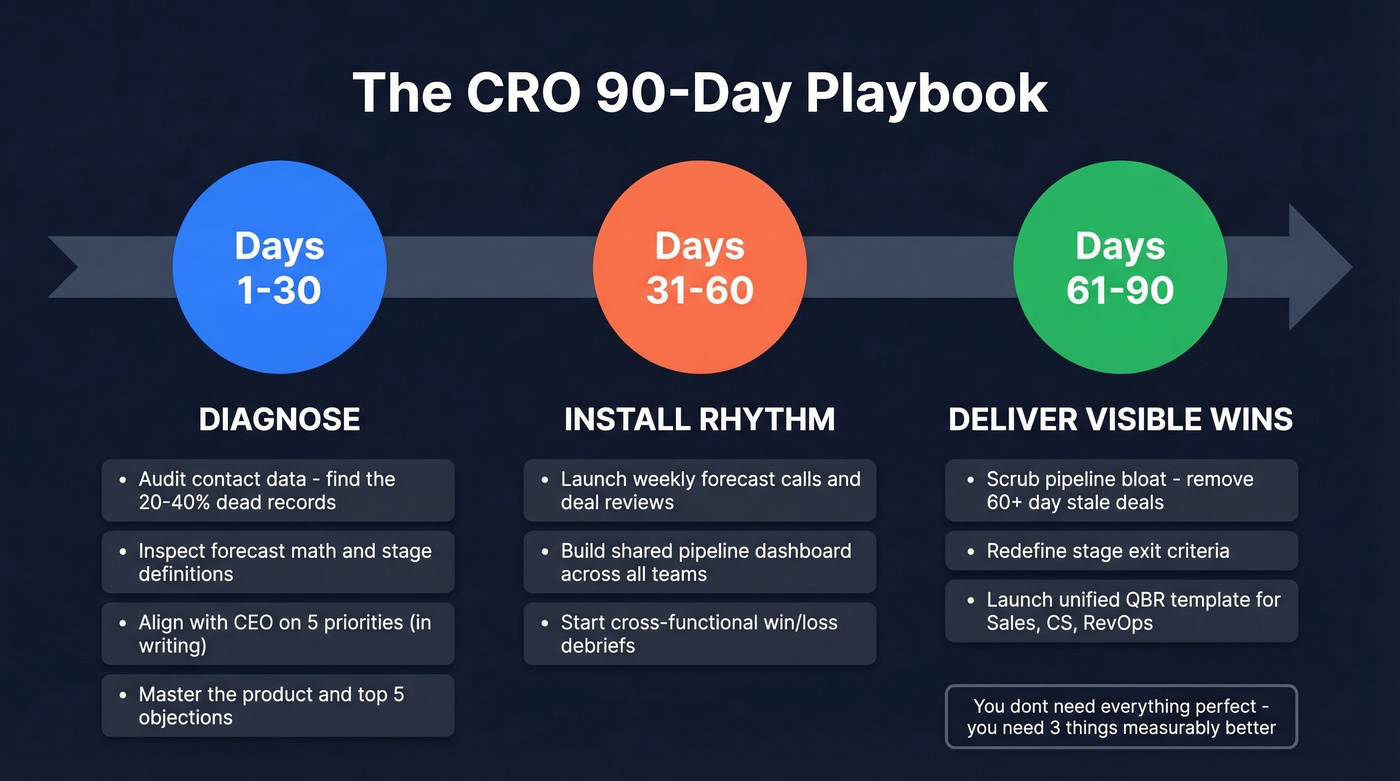
- Audit your contact data. Run your database through a CRM enrichment tool and you'll know how much of your pipeline is real within a day, not a quarter.
- Inspect forecast math and stage definitions. Where are deals stalling? Where are they inflated?
- Align with the CEO on five priorities. Written, not verbal.
- Master the product and ICP. You should be able to demo and handle the top five objections by day 30.
If you want a template for the ramp, adapt a 30-60-90 day plan and apply it at the leadership level.
Days 31-60: Install Rhythm
- Launch weekly forecast calls and deal reviews.
- Build a shared pipeline dashboard showing sourced pipeline by channel, conversion rates by stage, and velocity by segment - visible to sales, marketing, and CS.
- Start cross-functional win/loss debriefs. Marketing needs to hear why deals die.
Days 61-90: Deliver Visible Wins
- Scrub pipeline bloat. Remove deals that haven't progressed in 60+ days.
- Redefine stage exit criteria so your forecast actually means something.
- Launch a QBR template aligned across Sales, CS, and RevOps. One format, one source of truth.
Let's be honest about the 90-day timeline: it's aggressive. But the CROs who survive past 25 months are the ones who create visible momentum before the board starts asking questions. You don't need everything perfect - you need three things measurably better.
Why CROs Fail
Three failure modes show up again and again.
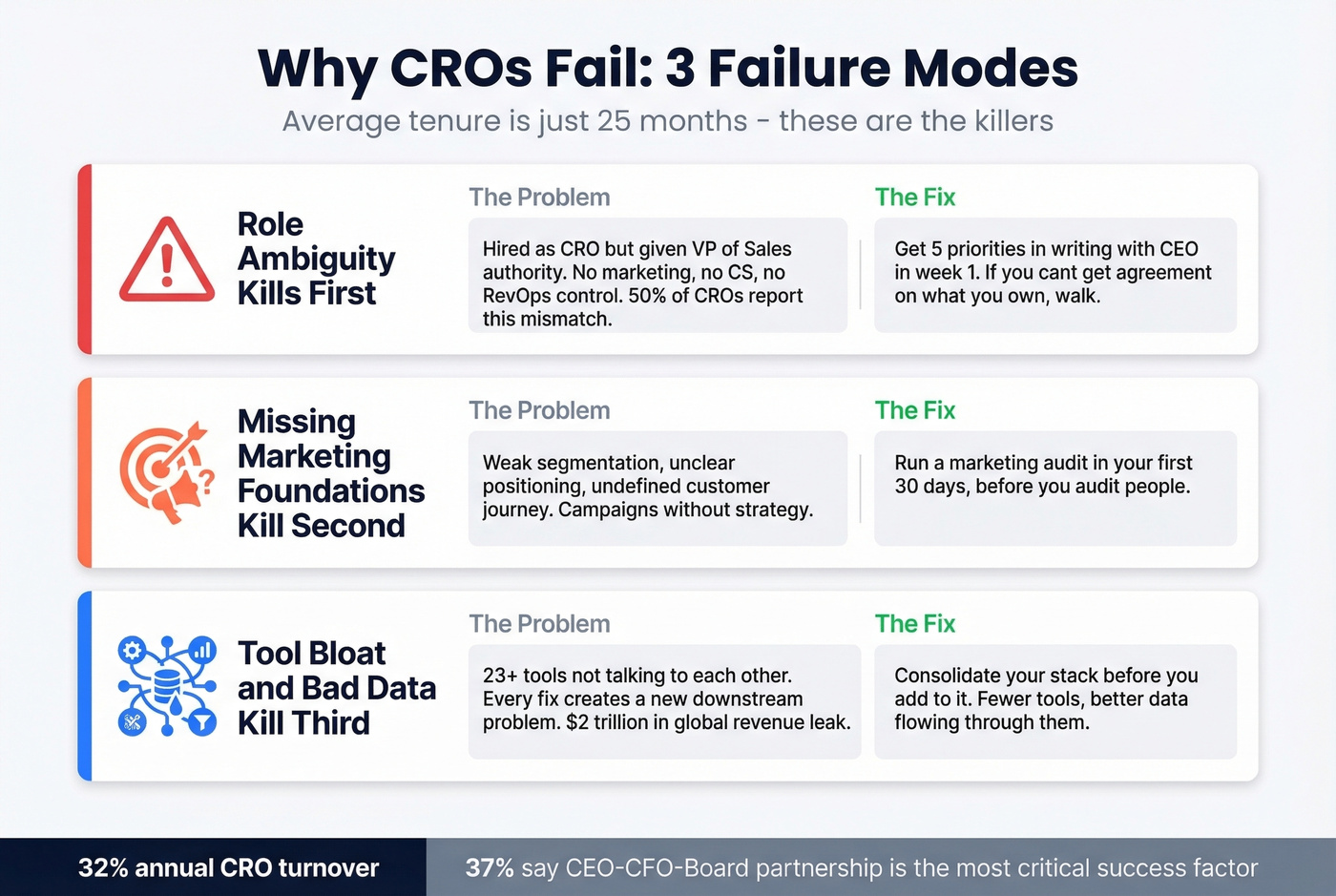
Role ambiguity kills first. You're hired as a CRO but given VP of Sales authority - no marketing oversight, no CS alignment, no RevOps control. Half of CROs report this exact mismatch. 37% say the CEO, CFO, and board partnership is the single most critical factor in their success. If the org isn't ready to give you the full revenue system, the title is just a retention tool for a VP of Sales who wanted a promotion.
Missing marketing foundations kill second. Many CROs walk into organizations with weak segmentation, unclear positioning, and an under-defined customer journey. You can't build a revenue engine on a marketing function running campaigns without strategy. The CROs who move fastest are the ones who run a marketing audit in their first 30 days - before they audit people.
If positioning is fuzzy, tighten your B2B brand positioning before you scale spend.
Tool bloat and bad data kill third. Twenty-three tools, none of them talking to each other, all feeding slightly different numbers into slightly different dashboards. Every fix creates a new problem downstream. The answer isn't more tools - it's fewer tools with better data flowing through them. The consensus on r/salesoperations is pretty clear on this: consolidate your stack before you add to it.
Your first 30 days demand a CRM audit. Prospeo enriches contacts at $0.01/email with 83% match rates and a 7-day data refresh - so the pipeline you hand to those 2-3 proven closers is built on verified contacts, not wishful thinking. 15,000+ companies already made the switch.
Give your best reps data that actually connects them to real buyers.
FAQ
What's the average CRO tenure?
About 25 months, with a 1.8-year median across 14,000 executives and 32% annual turnover. CEOs last 4.3 years by comparison - CROs get roughly half the runway to prove impact.
What's the difference between a CRO and a VP of Sales?
A VP of Sales owns deal execution - pipeline, quotas, rep performance. A CRO owns the revenue system across sales, marketing, CS, and RevOps. If revenue leaks happen between teams rather than within them, you need a CRO, not another sales leader.
What KPIs should a CRO track?
Pipeline coverage at 3-5x target, net revenue retention, forecast accuracy by quarter, and revenue per employee. These four metrics tell you whether your revenue system is healthy or just busy. Layer in win rate by segment and sales cycle length for a complete picture.
How do CROs fix bad pipeline data fast?
Run your CRM through an enrichment tool with a short refresh cycle - stale data older than 30 days degrades forecasts. Most teams identify 20-40% dead records in their first audit, and cleaning those out immediately improves forecast accuracy and rep confidence in the numbers they're working.