

Chorus by ZoomInfo: Pricing, Reviews, Pros and Cons (2026)
You just got the Chorus renewal quote: $16,400 for 10 seats. The product's solid - 4.5 out of 5 on G2 from 2,988 reviews - but the buying experience feels like it was designed to extract maximum revenue, not earn your trust. This breakdown covers Chorus pricing, reviews, pros and cons so you can decide whether the tool is worth the spend.
The 30-second verdict: Chorus is a genuinely good conversation intelligence tool trapped inside a hostile pricing model. If you're already deep in ZoomInfo's ecosystem with 50+ reps, it makes sense. For teams under 20, you're overpaying - Fathom covers call recording and AI summaries for free, and Fireflies handles most needs at $10-19/seat/month billed annually.
What Chorus Costs in 2026
Chorus doesn't publish pricing. You'll talk to ZoomInfo's sales team, and they'll push a bundle. But the benchmark numbers are well-known: $8,000/year base package including 3 seats, plus $1,200/year for each additional seat, on a standard two-year contract.
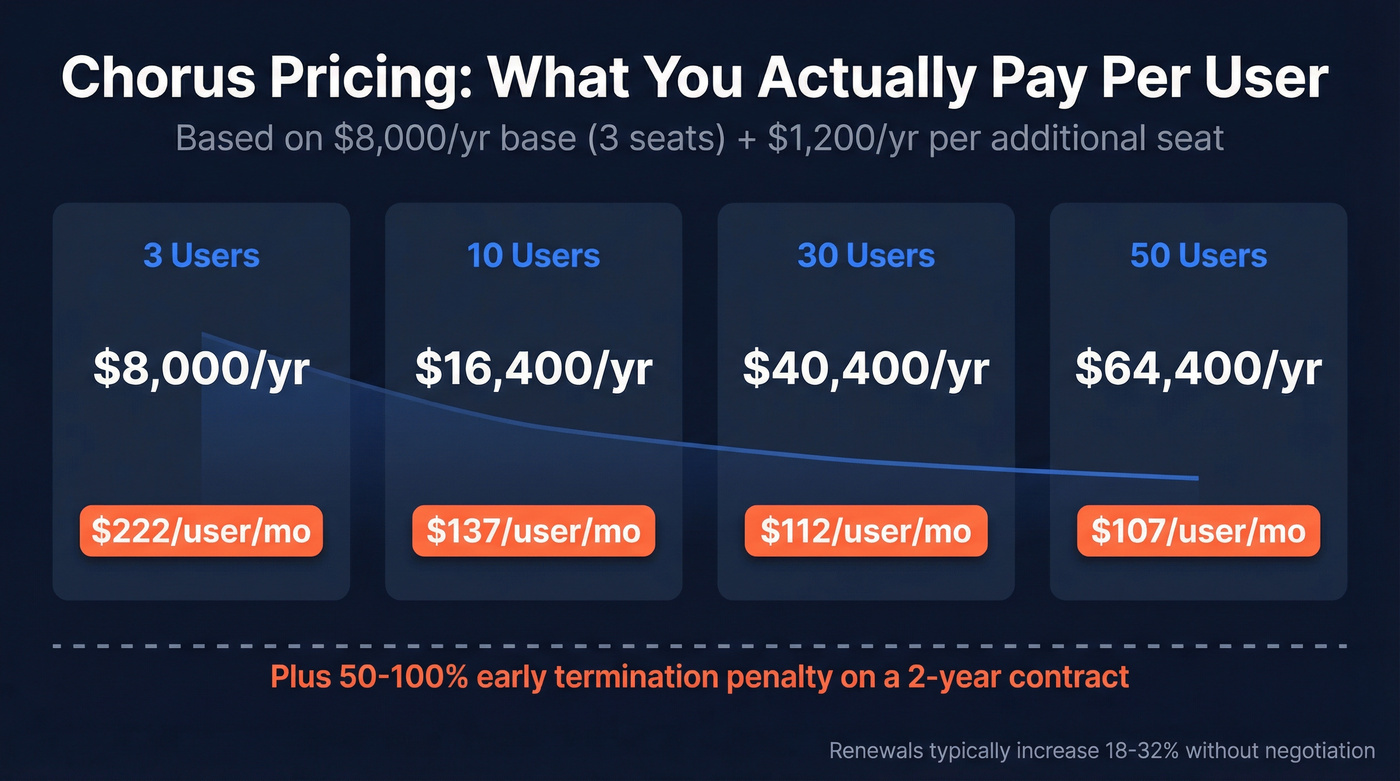
| Team Size | Annual Cost | Effective $/User/Mo |
|---|---|---|
| 3 users | $8,000 | $222 |
| 10 users | $16,400 | $137 |
| 30 users | $40,400 | $112 |
| 50 users | $64,400 | $107 |
Early termination penalties run 50-100% of remaining contract value. If you're buying through ZoomInfo's bundled sales motion - which they'll push hard - expect $35K-$50K/year for Professional or $60K-$80K/year for Advanced (10 users, Chorus included). Teams of 20+ can typically negotiate 10-20% off list price, so don't accept the first number.
Renewals are where it really stings. Gartner's SaaS contract research found 18-32% average contract inflation at renewal for data intelligence platforms when governance isn't applied. We've seen this firsthand - that $16K contract quietly becomes $20K+ by year three if you don't fight it.
If you want a framework for pushing back on renewal increases, use an anchor in negotiation and set a clear walk away point before procurement gets involved.
Chorus Pros: What Users Like
Review distribution skews heavily positive: 71% five-star, 26% four-star, with virtually no ratings below three. Across nearly 3,000 G2 reviews, the standout themes are:
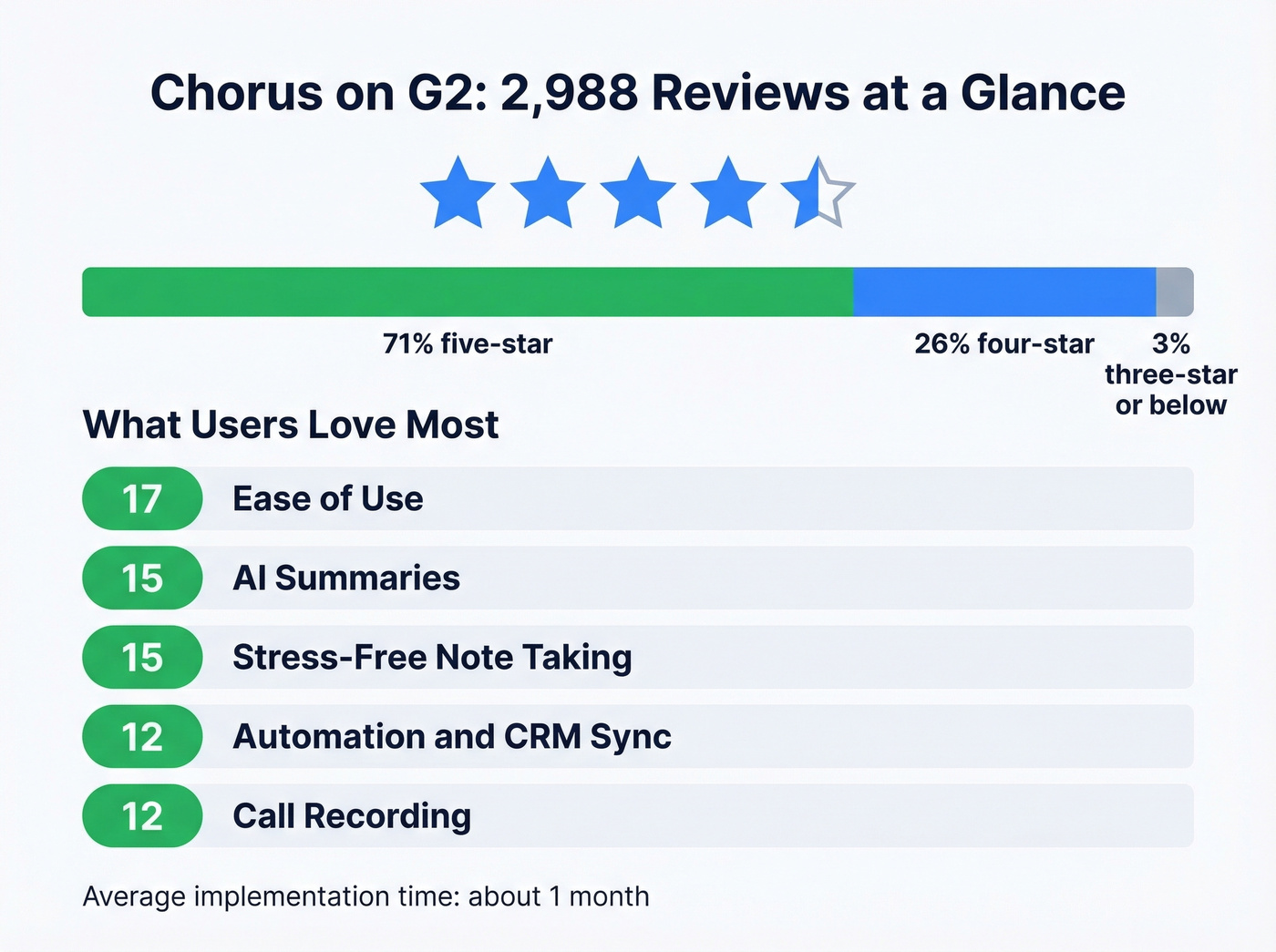
- Ease of use (17 mentions) - reps don't need training to start using it
- AI summaries (15 mentions) - post-call summaries that actually save time
- Stress-free note-taking (15 mentions) - reps stop scribbling and start listening
- Automation (12 mentions) - call logging, CRM syncing, and follow-up triggers work without babysitting
- Call recording (12 mentions) - reliable capture and playback is a core reason teams buy it
Implementation averages about one month per G2's aggregate data - fast for an enterprise CI tool. If you're evaluating the broader stack around call workflows, it helps to map this against your sales pipeline benchmarks and overall pipeline health.

Chorus records calls. But 98% email accuracy ensures reps are calling the right people in the first place. Before spending $8K+ on conversation intelligence, fix the data feeding your pipeline - 300M+ profiles, 125M+ verified mobiles, no two-year contracts.
Stop recording calls to wrong numbers. Fix your data upstream.
Chorus Cons: What Breaks
The cons are fewer in volume but sharper in impact.
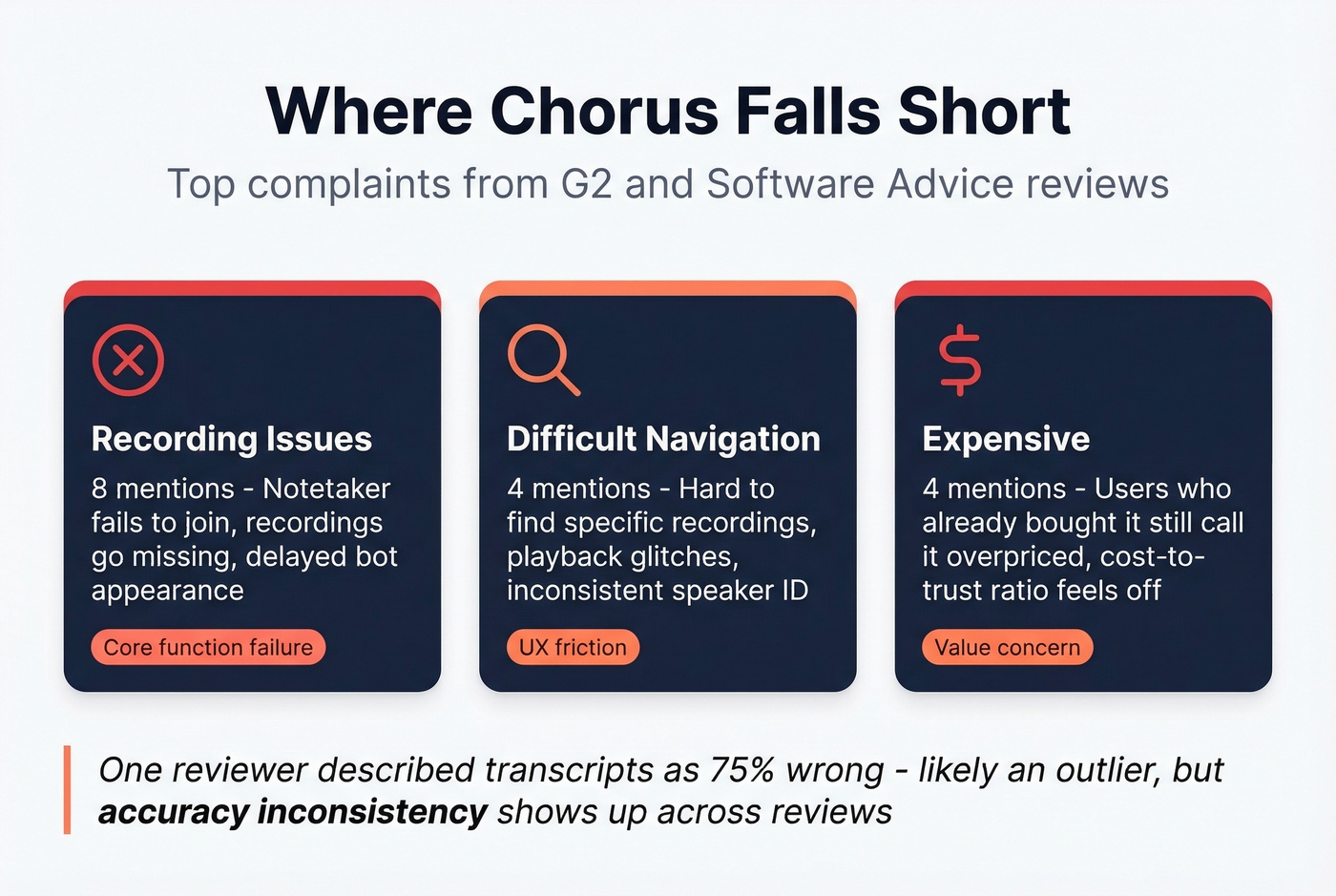
Call and recording issues (8 mentions each) top the list. The notetaker sometimes doesn't join, recordings go missing, or there's a delay before the bot appears. For a tool whose entire job is recording calls, that's a problem. Finding specific recordings after the fact isn't intuitive either - playback glitches and inconsistent speaker identification come up repeatedly.
Difficult navigation (4 mentions) and expensive (4 mentions) round out the pattern. That last one hits different when you realize it's coming from people who already bought it.
Transcription accuracy is another sore spot. One Software Advice reviewer described transcripts as "75% wrong" - likely an outlier, but AI accuracy inconsistency shows up across G2's sentiment data too. Between the pricing complaints and the recording reliability issues, the cost-to-trust ratio feels off for smaller teams.
If you're trying to quantify whether tooling is actually improving outcomes, track it like a sales conversion rate problem, not a feature checklist.
Chorus vs. Gong vs. Alternatives
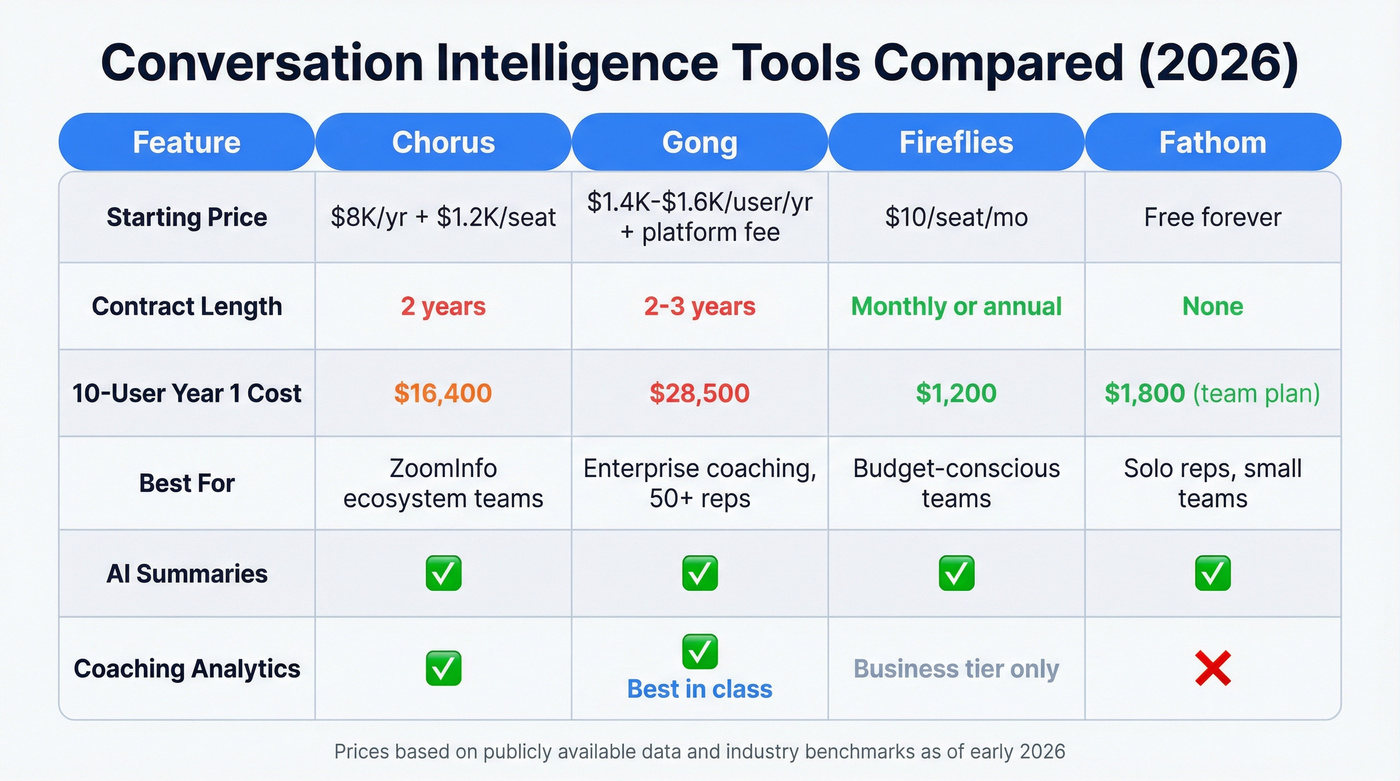
| Tool | Starting Price | Contract | Best For |
|---|---|---|---|
| Chorus | $8K/yr + $1.2K/seat/yr | 2-year | ZoomInfo ecosystem teams |
| Gong | $1.4K-$1.6K/user/yr + platform fee | 2-3 year | Enterprise coaching, 50+ reps |
| Fireflies | $10/seat/mo (annual) | Monthly or annual | Budget teams |
| Fathom | $0 (free forever) | None | Solo reps, small teams |
| Prospeo | Free tier, ~$0.01/email | None | Verified contact data upstream |
Here's the thing: most teams spending $16K+ on Chorus don't have a call recording problem - they have a pipeline quality problem. We've watched teams pour money into conversation intelligence while half their recorded calls are to gatekeepers and wrong numbers. Fixing that upstream with verified contact data at roughly $0.01 per email, no contracts, changes the math entirely.
If you're rebuilding your outbound motion, start with sales prospecting techniques and a clean lead generation workflow before you add more analytics layers.
Gong goes deeper on coaching analytics but costs more. A 10-user Year 1 deployment runs roughly $28,500 ($16K in licenses, $5K platform fee, $7.5K onboarding), and contracts lock you in for 2-3 years with 5-15% automatic renewal increases. Worth it if you'll actually use the coaching features. Most teams don't.
Skip Fireflies if you need enterprise-grade coaching workflows. But for transcription, AI summaries, and broad integrations, Pro tier at $10/seat/month annual handles it. Business tier at $19/seat/month adds conversation intelligence. No multi-year contracts.
Start with Fathom if you just need call recording and summaries without enterprise overhead. Unlimited recordings and AI summaries at $0 for individuals. Team plans run $15/user/month annual with a 2-user minimum. I've seen teams run on Fathom for a full year before deciding they need anything more.
Do You Actually Need Chorus?
Let's be honest: if your average deal size is under $10K and your team is under 20 reps, you probably don't need Chorus-level tooling. Record calls with Fathom or Fireflies, redirect the $16K toward filling your pipeline with verified contacts through a tool like Prospeo, and revisit conversation intelligence once you've outgrown the free options. The consensus on r/sales tends to agree - conversation intelligence ROI only kicks in when you have enough reps and enough deal volume to justify the analytics layer.
If you're prioritizing pipeline over tooling, compare options like free lead generation tools and outbound lead generation tools before signing another multi-year agreement.
When you weigh the full picture - Chorus pricing, reviews, pros and cons included - the math only works for larger orgs already committed to ZoomInfo.
Teams redirecting even half their Chorus budget to verified contact data see results fast. Meritt tripled pipeline from $100K to $300K/week. Snyk's 50 AEs drove 200+ new opportunities per month. All at ~$0.01 per email with no annual lock-in.
Spend $16K on pipeline, not on recording gatekeepers.
FAQ
Is Chorus free to use?
No. Chorus requires a minimum $8,000/year commitment for 3 seats on a 2-year contract with no free tier. Trials are sales-assisted and vary by deal. For free conversation intelligence, Fathom offers unlimited recordings and AI summaries at $0 for individuals.
Why doesn't Chorus publish pricing?
Chorus is sold through ZoomInfo's enterprise sales motion, which uses quote-based pricing to maximize deal size. Expect bundling pressure - ZoomInfo packages Chorus with its data platform at $35K-$80K/year for 10 users depending on tier.
What's a cheaper alternative to Chorus?
For call recording, Fathom (free) or Fireflies ($10/seat/month billed annually) cover most teams. For upstream contact data - the problem that actually kills pipeline - Prospeo provides 98% verified emails and 125M+ mobiles starting free with no contracts.