

Cirrus Insight vs SalesLoft: Which One Do You Actually Need?
The Cirrus Insight vs Salesloft comparison trips people up because these tools don't really compete. One's a screwdriver, the other's a power drill. They both touch email and connect to Salesforce, but they solve fundamentally different problems - and picking the wrong one wastes months and budget.
30-Second Verdict
Pick Cirrus Insight if you're a Salesforce shop where reps live in Gmail or Outlook and need email-to-CRM sync, meeting scheduling, and engagement tracking without cadence workflows. You'll pay $14-$72/user/month.
Pick Salesloft if you need multi-step cadences, a dialer, conversation intelligence, and AI-powered deal management. Budget $125-$180/user/month after negotiation.
Skip both if your real problem is bad contact data. Neither tool finds or verifies emails. Running cadences on unverified lists burns your domain reputation faster than anything else.
Quick Feature Comparison
| Cirrus Insight | Salesloft | |
|---|---|---|
| G2 Rating | 4.2/5 (1,512 reviews) | 4.5/5 (4,269 reviews) |
| Ease of Use (G2) | 8.4/10 | 8.8/10 |
| Ease of Setup (G2) | 8.4/10 | 8.6/10 |
| Quality of Support (G2) | 8.0/10 | 8.6/10 |
| Product Direction (G2) | 8.0/10 | 8.8/10 |
| Pricing | $14-$72/user/mo | ~$125-$180/user/mo |
| Free Trial | Yes | No |
| Best For | Salesforce inbox sync | Full sales engagement |
| Key Limit | No cadences or dialer | Expensive + add-on creep |
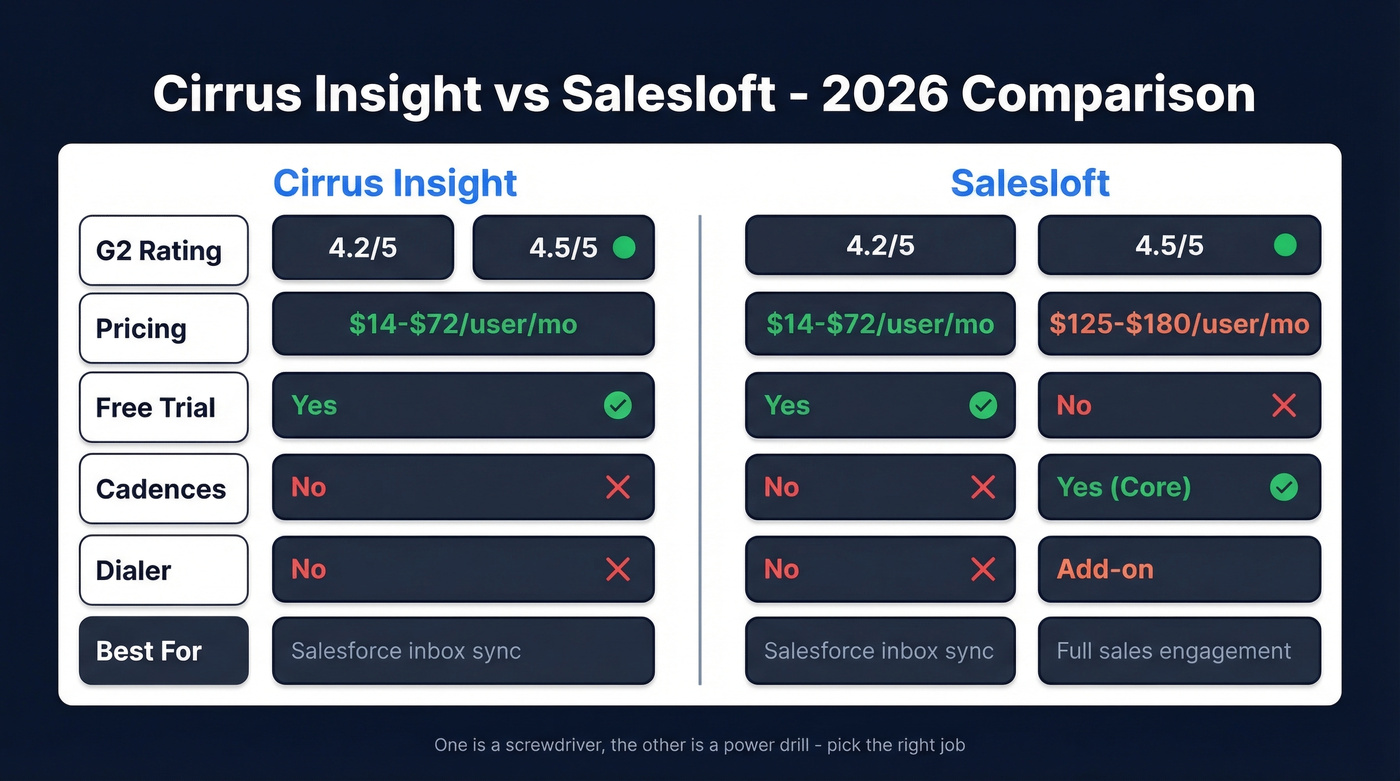
Salesloft wins every G2 sub-score here. That shouldn't surprise anyone - it's a platform with 3x the investment behind it. The real question is whether you need what that investment bought.
What Each Tool Actually Does
Cirrus Insight is a Salesforce inbox connector. It puts a Salesforce sidebar inside Gmail or Outlook so reps can log emails, sync calendar events, update pipeline fields, and track opens - all without leaving their inbox. Data syncs directly to your Salesforce org. It also supports modular seat purchasing, which means you can mix seat counts by feature: 10 users on Email Sync and 5 on Calendar Scheduling, for example, without paying top-tier pricing across the board.
Salesloft is a full sales engagement platform - cadences, a dialer (often packaged as an add-on), conversation intelligence, AI deal management, and a growing suite of AI agents that handle everything from account research to MEDDPICC extraction. With 5,000+ customers and a ~$2.3B valuation, Salesloft competes head-to-head with Outreach, not Cirrus. If you need to orchestrate multi-step sequences across email, phone, and social touches, this is the category you're shopping in. If you're evaluating the broader category, see our guide to Implementing a Sales Engagement Platform.
Pricing Breakdown
Cirrus Insight
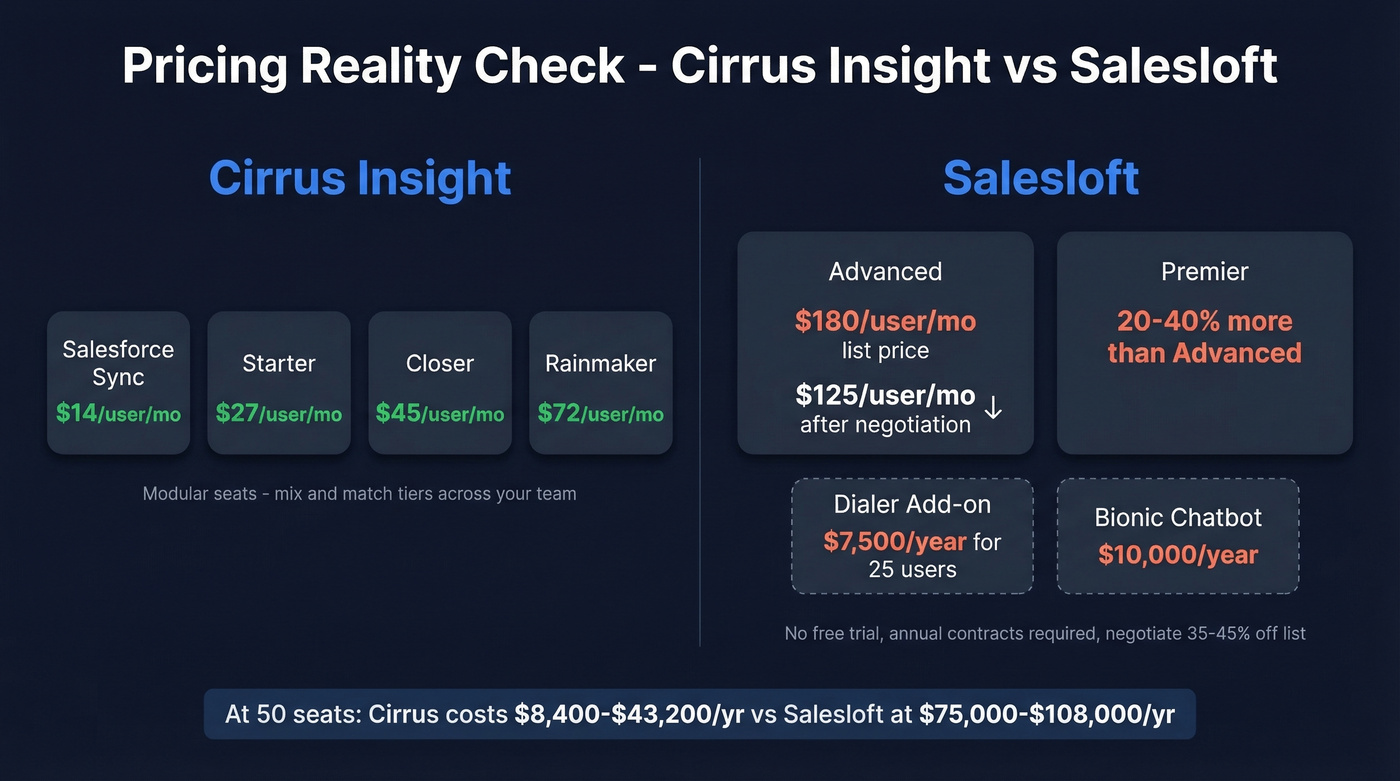
Cirrus pricing shows four tiers on annual billing: Salesforce Sync ($14/user/month), Starter ($27), Closer ($45), and Rainmaker ($72). The modular seat model is genuinely useful - put 10 reps on Email Sync and 5 managers on Rainmaker without paying top-tier pricing across the board. A free trial is available, which already puts Cirrus ahead of Salesloft on the "try before you commit" front.
SalesLoft
Salesloft doesn't publish pricing. Here's what you'll actually pay.
The Advanced plan benchmarks around $180/user/month at 50 seats ($108k/year). Nobody pays list. Negotiate 35-45% off - Vendr's benchmarks are a good reference point - and you'll land around $125-$127/user/month, roughly $75k-$76k for 50 seats. Premier runs 20-40% higher than Advanced. Then come the add-ons: the dialer add-on is commonly benchmarked at $7,500/year for 25 users, and the Bionic Chatbot runs $10,000/year. Annual contracts are standard, and multi-year commitments shave 5-12% off - but you're locking in for a tool you haven't fully evaluated.
Let's be honest: if your average deal size is under $15k, Salesloft's all-in cost is hard to justify. Cirrus plus a solid data tool will get you 80% of the value at a third of the price.

Neither Cirrus Insight nor Salesloft finds or verifies emails. Running cadences on bad data burns your domain. Prospeo gives you 98% accurate emails from 300M+ profiles - refreshed every 7 days, not 6 weeks - at $0.01 per lead.
Fix the data before you pick the engagement tool.
Feature Head-to-Head
| Feature | Cirrus Insight | Salesloft |
|---|---|---|
| Cadences | No | Yes (core) |
| Dialer | No | Add-on |
| CRM Sync | Salesforce-native | Yes |
| Email Tracking | Yes | Yes |
| AI Features | Meeting AI, Convo Intel | Extensive (mostly add-ons) |
Salesloft's AI roadmap is aggressive. The Account Research Agent summarizes engagement history, the Buyer Identification Agent recommends contacts using ZoomInfo Buying Committee data, there's MEDDPICC extraction, AI Email Steps for cadences, and no-code Plays triggered by Salesforce object changes. Here's the thing - a lot of that "agent" functionality is packaged as add-ons, and no-code Plays are tied to the Elite package. What looks like one platform often ends up being three invoices. If you're building sequences, it helps to have solid sequence management fundamentals.
Cirrus keeps it simpler with Conversation Intelligence and Meeting AI for automated pre-meeting research. No frills, no surprise line items.
What Users Actually Say
Cirrus Insight: The Ceiling Problem
The TrustRadius switching quotes are blunt. One user wrote: "Cirrus was so bad. It was slow and never properly added information from Salesforce into the merge fields." Others cite Outlook for Mac issues, random shutdowns requiring reinstalls, and the absence of cadence or local dial support. We've talked to teams who started on Cirrus and hit a wall within six months - once reps need multi-step sequencing, there's nowhere to go inside the product.
SalesLoft: Love the Core, Resent the Upsell
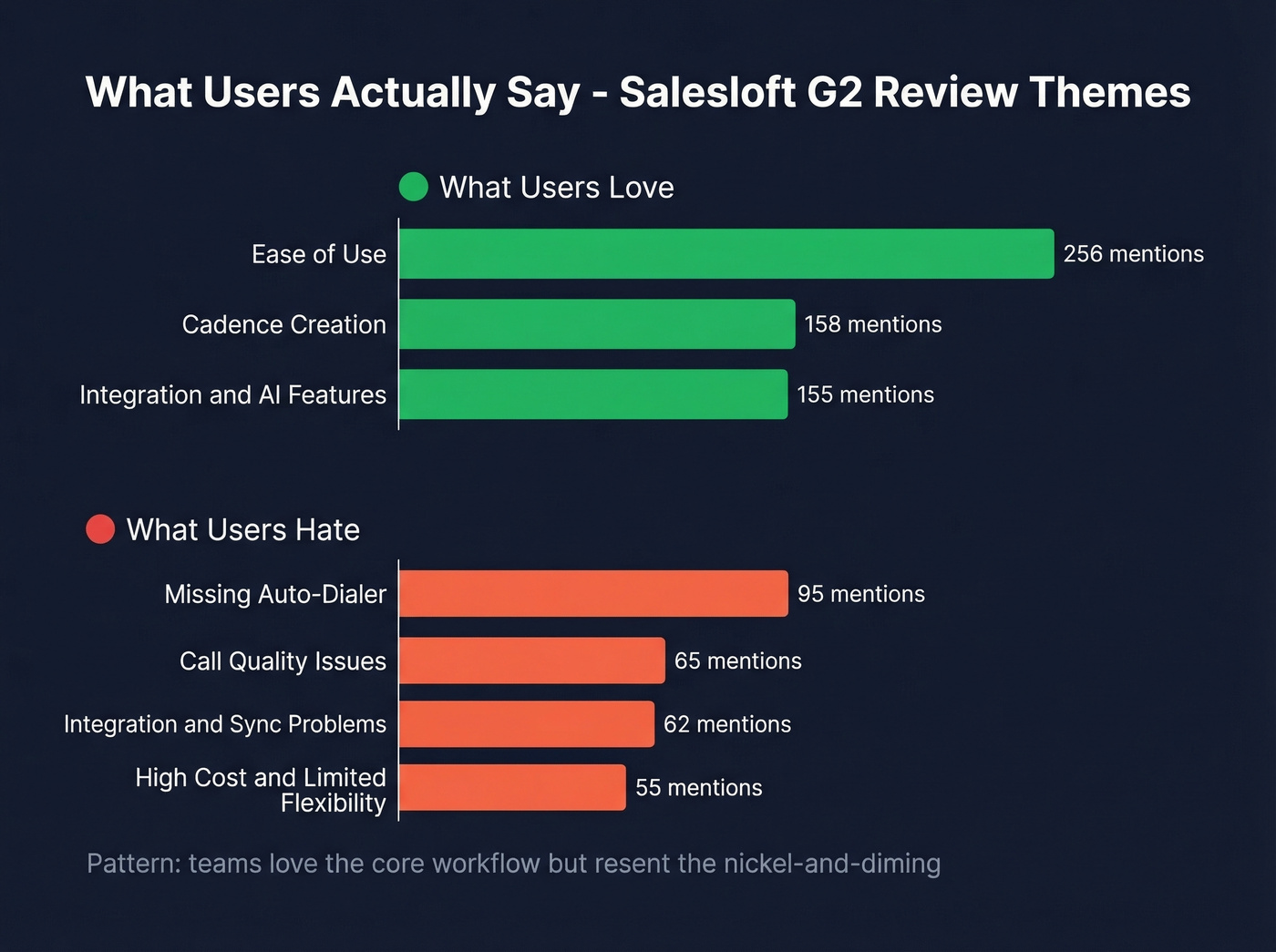
On G2, the loudest complaint - missing auto-dialer - surfaces in 95 reviews. Call quality issues follow at 65, then integration and sync problems at 62, and high cost plus limited flexibility at 55. The praise side is strong: ease of use leads with 256 mentions, cadence creation gets 158, and integration plus AI features earn 155. The pattern is consistent: teams love the core workflow but resent the nickel-and-diming.
The Salesforce Integration Risk
In August 2025, Salesforce disabled all integrations with Salesloft technologies after compromised OAuth tokens tied to Drift (which Salesloft owns) were discovered. Salesloft's platform integrations were eventually re-enabled, but Drift remained disabled.
If you're a Salesforce-first shop, this incident matters. Rotate tokens, audit connected apps, and have a contingency plan for integration downtime. One day without CRM sync during a quarter close is a bad day. If deliverability is part of your risk model, prioritize email reputation tools and an email deliverability guide before scaling volume.
Also Consider
Outreach (~$100-$130/user/month) is Salesloft's closest competitor. Nearly identical feature set - cadences, dialer, conversation intelligence - with a slightly larger enterprise install base. If you're getting Salesloft quotes, get an Outreach quote too. The negotiation leverage alone is worth it. (If you need help with pricing strategy, use an anchor in negotiation approach.)
Apollo.io (free tier available, paid from $49/user/month) bundles prospecting data with basic engagement features. The all-in-one pitch is appealing for smaller teams, though email accuracy lags behind dedicated verification tools. Solid option when budget is tight and you need data plus sequencing in one seat. For more options, compare free lead generation tools and outbound lead generation tools.
Fix Your Data First
Here's what neither tool does: find or verify contact data. Salesloft orchestrates cadences. Cirrus tracks emails. But if the emails you're sending to are wrong, none of that matters. If you're evaluating vendors, start with data enrichment services and a dedicated email bounce rate playbook.
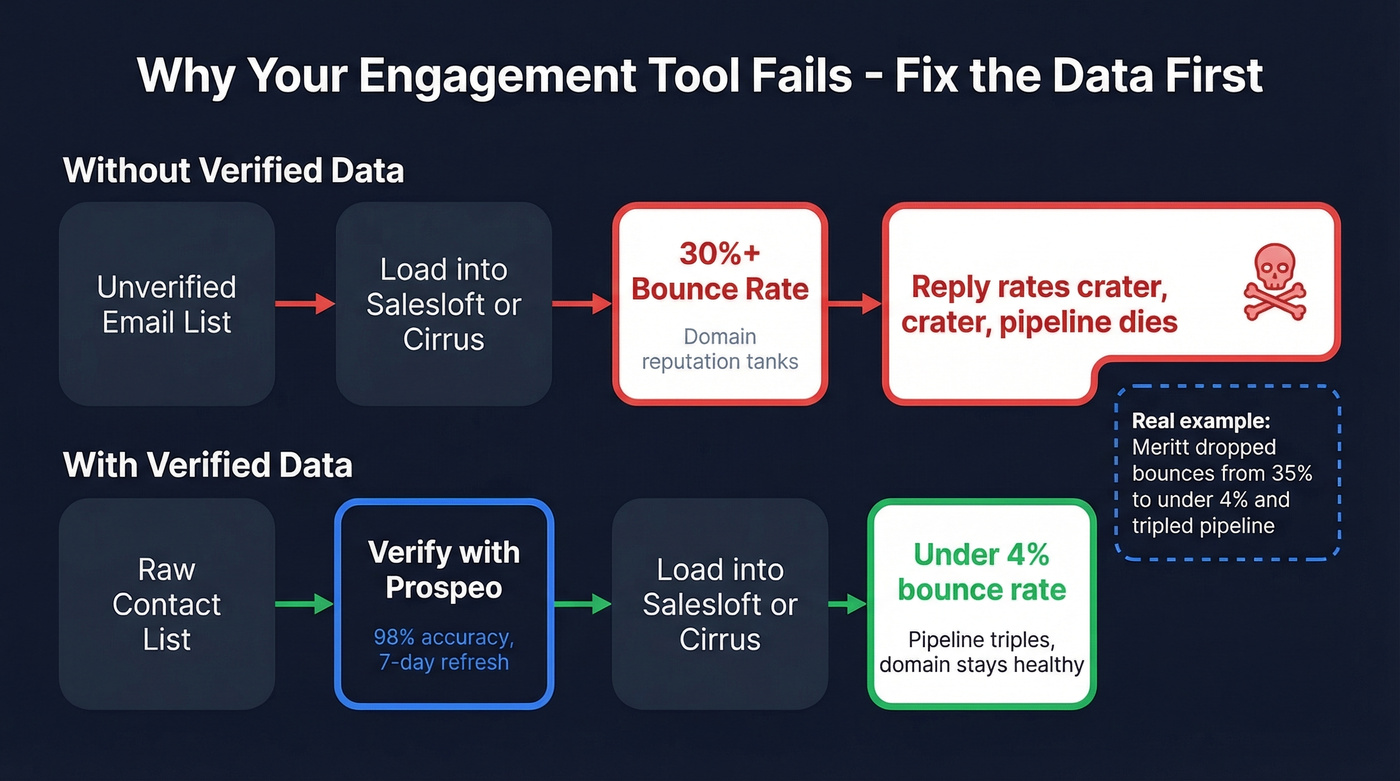
We've seen this play out dozens of times. A team spends $100k+ on Salesloft, loads unverified lists, and watches bounce rates climb past 30%. Their domain reputation tanks. Reply rates crater. And they blame the engagement tool when the real problem was upstream. If you're trying to protect sending, learn how to improve sender reputation.
Prospeo fills this gap with 98% email accuracy and a 7-day data refresh cycle versus the 6-week industry average. It integrates natively with Salesloft and syncs with Salesforce, and at roughly $0.01 per email with no contracts, it's a fraction of what you're spending on the engagement layer. One customer, Meritt, saw bounce rates drop from 35% to under 4% after switching their data source - which directly protected their sender reputation and tripled their pipeline.

Salesloft's dialer add-on costs $7,500/year - but bad phone numbers make it worthless. Prospeo delivers 125M+ verified mobile numbers with a 30% pickup rate. Pair accurate contact data with whichever engagement platform you choose.
Stop paying for cadences that reach nobody.
FAQ
Is Cirrus Insight a direct SalesLoft competitor?
Not directly. Cirrus is a Salesforce inbox connector for email sync and tracking. Salesloft is a full engagement platform with cadences, a dialer, and AI deal management. They overlap on email tracking but serve different jobs. Teams typically outgrow Cirrus into Salesloft when they need multi-step sequencing.
Does SalesLoft offer a free trial?
No. Salesloft requires a sales conversation and annual contract to get started. Cirrus Insight offers a free trial, making it far easier to evaluate. For Salesloft, push for a paid pilot period during negotiation - most reps have flexibility here even if they don't volunteer it.
What's the best way to improve SalesLoft cadence performance?
Verify every email before it enters a cadence. Unverified lists cause 15-35% bounce rates that tank domain reputation. Prospeo's native Salesloft integration lets you clean lists automatically - teams typically see bounce rates drop below 4% and reply rates climb 20-30%.
Can I use both tools with Salesforce?
Yes. Cirrus Insight is Salesforce-native by design. Salesloft integrates with Salesforce as well, though the August 2025 OAuth incident is a reminder to audit connected apps regularly and rotate tokens. Both tools keep your CRM as the system of record.