

Client Acquisition Emails: The Complete 2026 System
You just cut your email copy to 56 words, rewrote the subject line three times, and hit send on 200 prospects. Bounce rate: 11%. Reply rate: 1.8%. The problem wasn't your writing - it was everything underneath it.
Most guides on client acquisition emails start with templates. They skip the two things that actually determine results: infrastructure and data quality. We've watched teams burn through domains for months before realizing their copy was never the bottleneck.
This is about cold outbound email for client acquisition - not email list building or marketing automation. Different game, different rules.
Do Cold Outreach Emails Still Work in 2026?
Yes, but the bar is higher than it was two years ago. The 2026 benchmark report from Instantly analyzed billions of cold email interactions and found an average reply rate of 3.43%. Top-quartile campaigns hit 5.5%+, and elite campaigns exceed 10%.
The gap between average and elite isn't copy - it's systems. One practitioner on r/coldemail rebuilt their cold email infrastructure from scratch and now books 40-50 qualified demos per month for B2B SaaS clients. Another on r/Entrepreneur doubled their reply rate from 3% to 6% in 62 days - not by rewriting emails, but by fixing domains, verification, and send timing.
Here's the thing: 70% of senders stop after one email, and 42% of all replies come from follow-ups. The people who "can't make cold email work" usually quit before the system compounds.
What You Need (Quick Version)
The order matters:
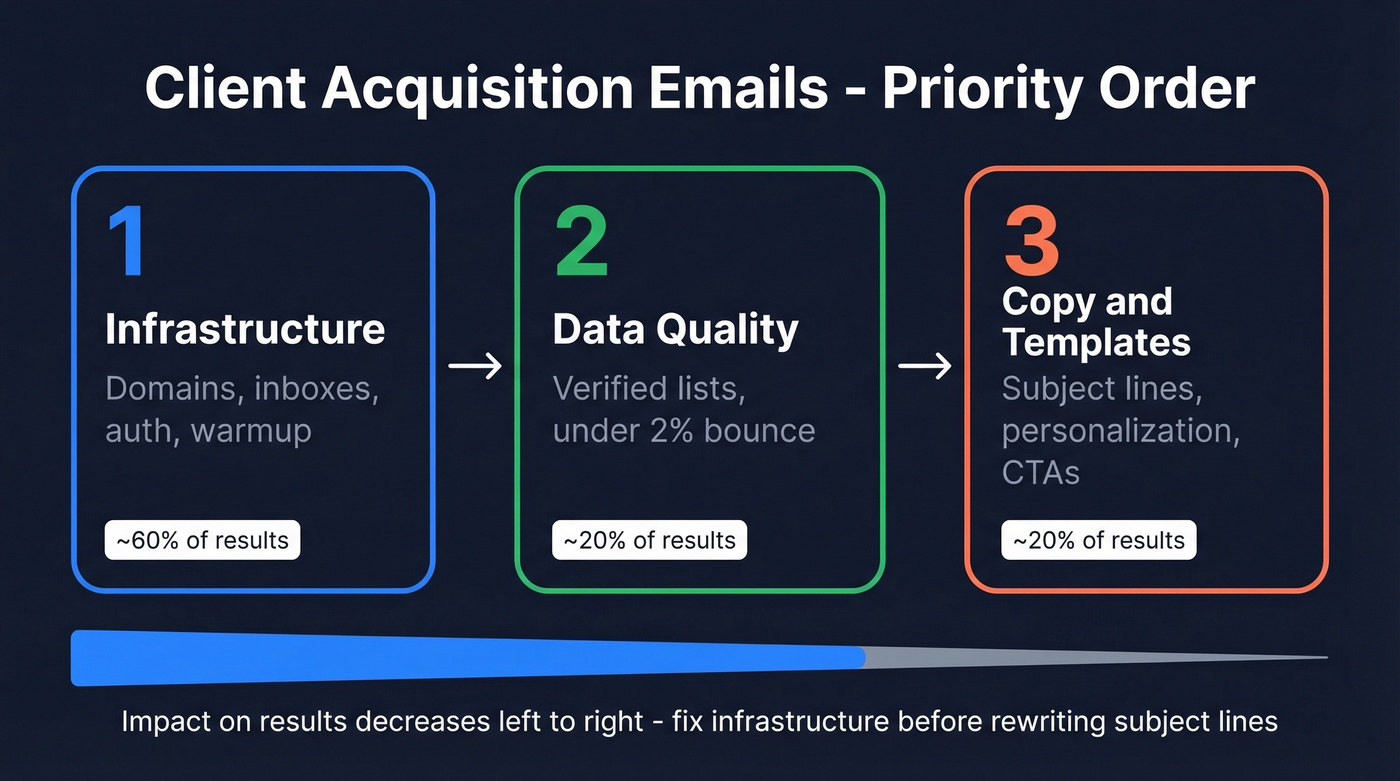
- Infrastructure first. Domains, inboxes, authentication, warmup. Without this, your emails hit spam regardless of quality.
- Data quality second. A verified prospect list with bounce rates under 2%. Bad data is the silent killer of campaigns.
- Copy last. Subject lines, templates, personalization - the final 20% of the equation.
That benchmark spread - 3.43% average vs. 10%+ for elite campaigns - lives almost entirely in steps one and two.
2026 Benchmarks
Before building anything, know what "good" looks like.
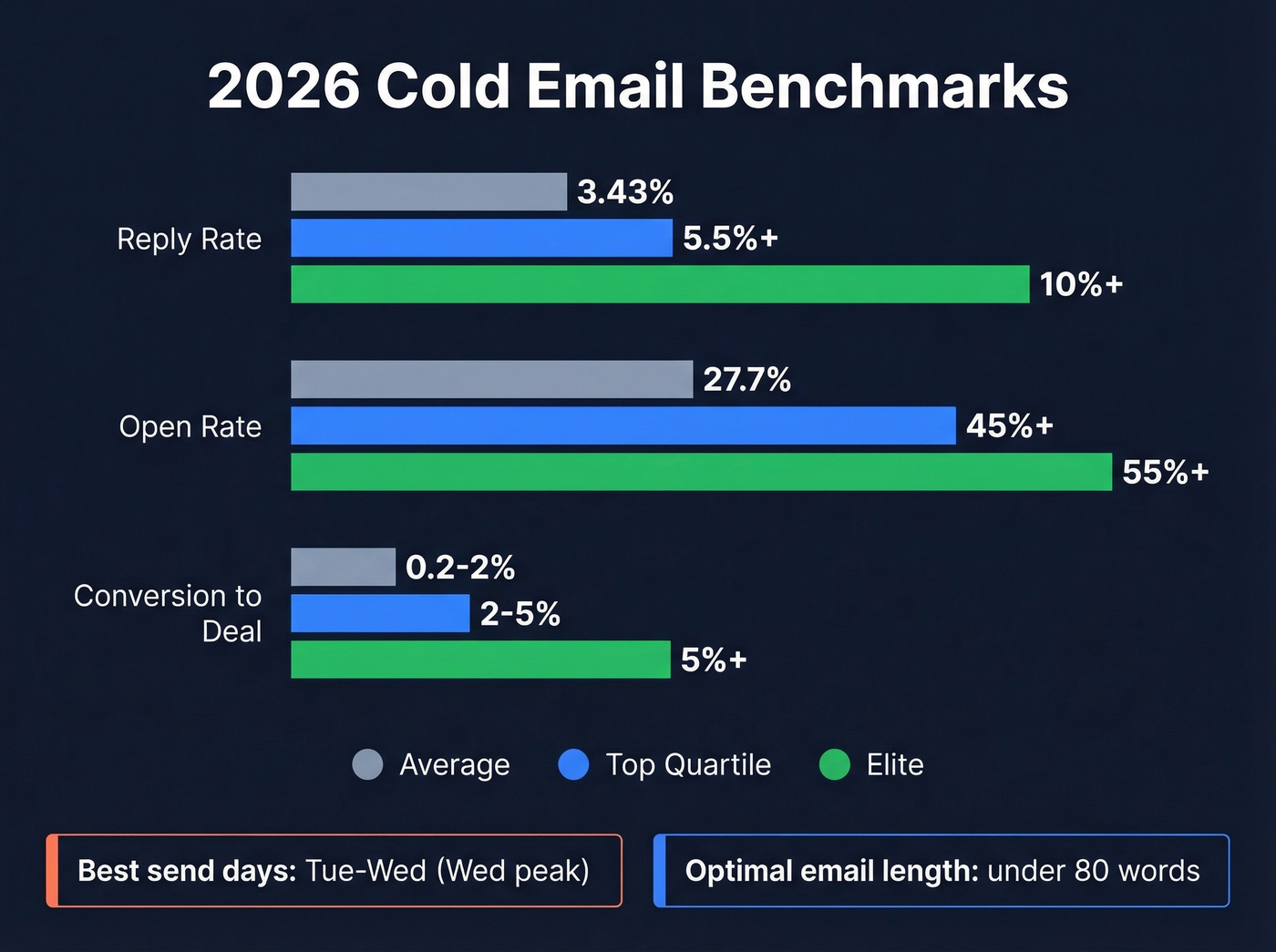
| Metric | Average | Top Quartile | Elite |
|---|---|---|---|
| Reply rate | 3.43% | 5.5%+ | 10%+ |
| Open rate | 27.7% | 45%+ | 55%+ |
| Conversion to deal | 0.2-2% | 2-5% | 5%+ |
| Best send days | Tue-Wed | Wed peak | - |
| Optimal length | <80 words | 50-125 words | - |
Open rates above 45% are achievable with the right subject lines and sender reputation. The conversion-to-deal range of 0.2-2% means you need volume, which means infrastructure that can sustain it without burning domains.
Best-performing campaigns keep emails under 80 words and A/B test weekly. Shorter copy isn't laziness. It's discipline.
Infrastructure and Deliverability
This is the part most guides skip, and it matters most. If your emails land in spam, nothing else you do matters.
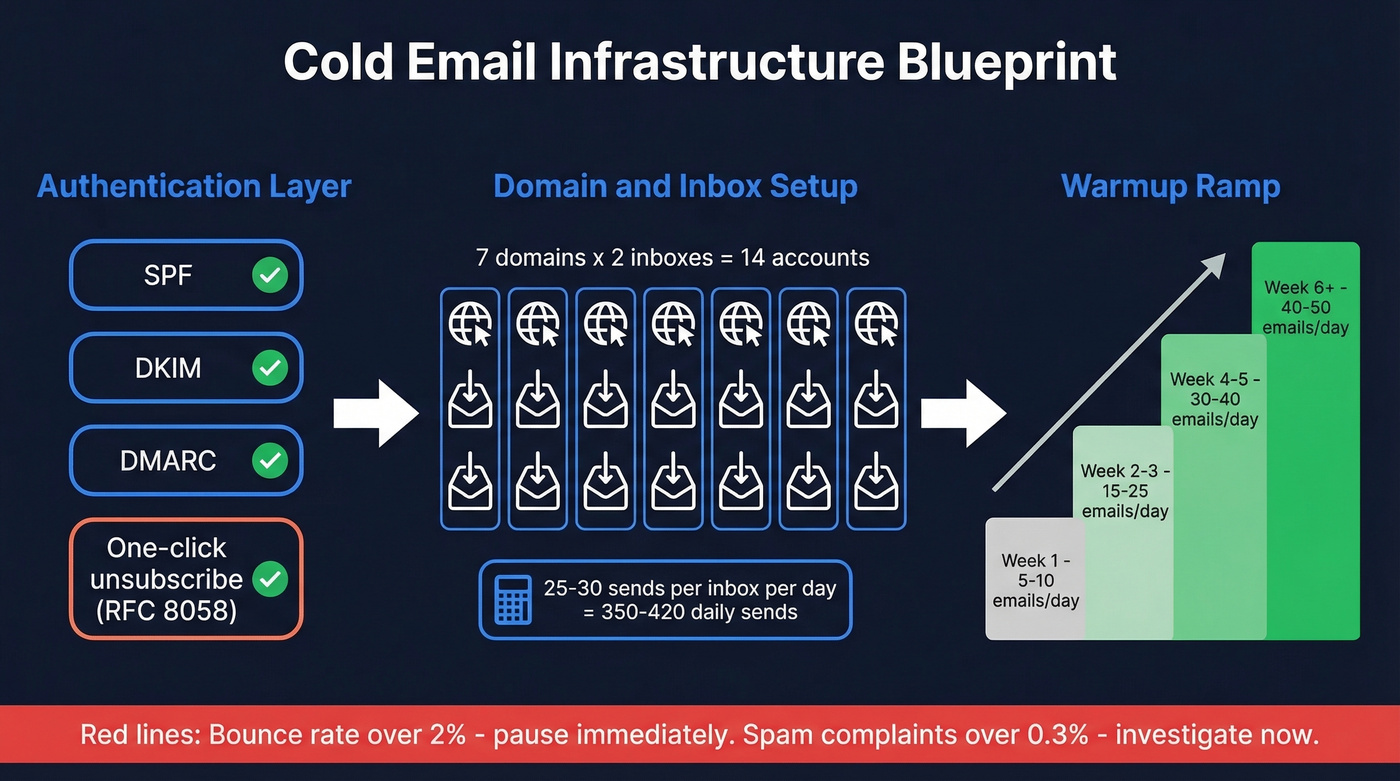
Authentication is non-negotiable. Every sending domain needs SPF, DKIM, and DMARC. Google and Yahoo enforce these for bulk senders, and RFC 8058 one-click unsubscribe is required. Skip any of these and you're fighting deliverability with one hand tied behind your back.
The warmup ramp. New inboxes start at 5-10 emails per day. Over 4-6 weeks, you scale to 40-50 per day per inbox. The practitioner running 40-50 demos/month uses 25 domains with 50 inboxes and warms each for 14 days minimum. That's not overkill - that's what sustainable volume looks like.
Thresholds to monitor:
- Bounce rate: under 2%. Cross this and pause the mailbox immediately. (More on bounce rate benchmarks and fixes.)
- Spam complaints: under 0.3%. Even a small spike tanks sender reputation.
- Custom tracking domain: set up via CNAME before you start warmup, since DNS propagation takes up to 72 hours.
A 7-domain setup with 2 inboxes each gives you 14 sending accounts. At 25-30 emails per inbox per day, that's 350-420 daily sends while staying under spam thresholds - enough volume for meaningful pipeline without torching your reputation.
Sending Platforms
You need a dedicated cold email tool - don't use your marketing ESP. The main options: Instantly (~$30/mo) is the most popular for solo operators and small teams. Smartlead (from ~$33/mo) handles complex multi-inbox rotation well. Saleshandy (from ~$25/mo) is the budget pick with solid deliverability features. All three support warmup, inbox rotation, and integrate natively with Prospeo for verified contact imports.
Building a Clean Prospect List
Here's where campaigns live or die. We've seen teams obsess over subject lines while sending to lists with 15%+ bounce rates. One recruiter on r/recruiting reported sending 400 emails per week for two months with barely any positive replies - classic symptoms of a data quality problem, not a copy problem.
The bounce rate death spiral works like this: you send to unverified emails, 11-38% bounce, mailbox providers flag your domain, your sender reputation drops, and suddenly even your good emails land in spam. One bad list poisons every future campaign from that domain. (If you're building lists at scale, see lead generation workflow and data enrichment services.)
Prospeo's 5-step verification - catch-all handling, spam-trap removal, honeypot filtering - delivers 98% email accuracy across 143M+ verified emails. The database covers 300M+ professional profiles refreshed every 7 days, so you aren't sending to people who changed jobs last quarter. A free tier with 75 emails and 100 Chrome extension credits per month lets you test before committing.
Real results from teams running this at scale: Meritt was bouncing at 35% before switching. They dropped to under 4%, and pipeline tripled from $100K to $300K per week. Stack Optimize built from $0 to $1M ARR running client campaigns with bounce rates under 3%, zero domain flags, and deliverability consistently above 94%.
If your bounce rate is above 4%, stop tweaking your copy and fix your data. Everything downstream depends on it.
For prospecting data beyond verification, Apollo (from ~$59/mo) offers a large database but lower email accuracy around 79%. Lemlist (~$55-79/mo) bundles sequencing and outreach features. Neither matches 98% verified accuracy, so always run a verification pass regardless of source. (If you're comparing sources, start with sales prospecting databases and email list providers.)

Your infrastructure is dialed in. Your copy is tight. But none of it matters if 11% of your emails bounce. Prospeo's 5-step verification delivers 98% email accuracy across 143M+ verified contacts - refreshed every 7 days so you're never emailing someone who left the company last quarter.
Stop burning domains on bad data. Verify your first 75 emails free.
Meritt dropped their bounce rate from 35% to under 4% and tripled pipeline to $300K/week. Stack Optimize hit $1M ARR with zero domain flags. The difference wasn't copy - it was sending to 98% verified emails from a database refreshed weekly, not monthly.
Build your client acquisition list on data that actually connects.
Subject Lines That Get Opened
A Belkins study of 5.5 million emails found personalized subject lines hit 46% open rates vs. 35% without - a 31% lift. Reply rates jumped from 3% to 7%. (For more ideas, see cold email subject line examples.)
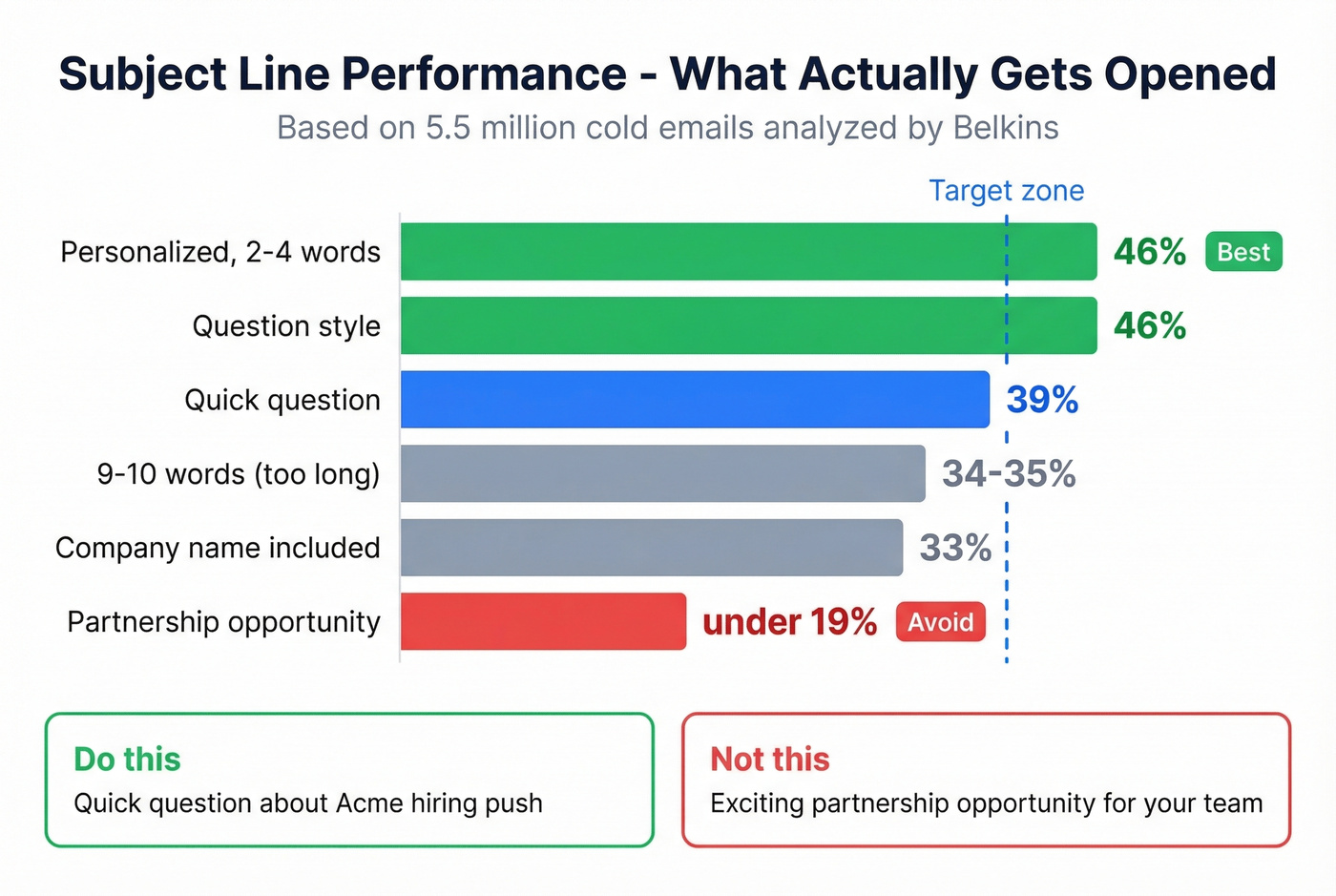
| Subject Line Style | Open Rate | Verdict |
|---|---|---|
| Personalized, 2-4 words | 46% | Top performer |
| Question-style | 46% | Ties for first |
| "Quick question" | 39% | Practitioner-tested staple |
| Company name included | 33% | Decent, not great |
| 9-10 words | 34-35% | Too long - cut it |
| "Partnership opportunity" | <19% | Avoid entirely |
The sweet spot is 2-4 words. Performance drops after 7 words. Numbers in subject lines don't help, and urgency terms like "ASAP" push opens below 36%.
What works: "Quick question about [company]'s hiring push" or "Congrats on the Series B." What doesn't: anything that sounds like a mass blast.
Templates That Book Meetings
Below are four proven frameworks. Each one doubles as an email template for potential clients - adapt the structure to your offer and audience. (If you want more structure options, use these emails that get responses frameworks.)
Cold Introduction (Signal-Led)
Subject: Congrats on [signal] - one idea
Hi [First Name],
Saw [specific signal - funding round, new hire, product launch]. [One sentence connecting signal to a problem you solve.]
We helped [similar company] [specific result] in [timeframe].
Worth a 15-minute call this week?
Keep this under 80 words. The signal proves you did research. The result proves you're not guessing. If you're figuring out how to write an email to a potential customer, this is the gold standard - lead with relevance, not your product.
Pain Point (Observation-Led)
Instead of leading with your product, lead with something you noticed about their business - a job posting that reveals a gap, a tech stack choice that creates friction, a public metric that suggests a problem.
Subject: [Company]'s [specific challenge]
The structure: observation, pain consequence, one-line solution, soft CTA. Stay in the 50-80 word range. The observation opener shows you understand their world before pitching anything.
Service Offering Template
This one works when you're reaching out to a prospect who hasn't expressed a need yet. The key is framing your service around a result, not a feature list.
Subject: [Result you deliver] for [their industry]
Hi [First Name],
We help [type of company] [achieve specific outcome] - most recently, [client name] saw [metric] in [timeframe].
I looked at [their company] and think there's a fit because [one specific observation].
Open to a quick call to see if this applies?
That observation line does the heavy lifting. It separates you from every other sample sales email sitting in their inbox.
Case Study (Before/After)
Social proof carries this one. Here's the structure:
Before: "[Similar company] was spending 6 hours per week on manual list building and bouncing at 15%." After: "After switching to [your solution], they cut list building to 90 minutes and dropped bounces to under 3%. Pipeline grew 140%." Bridge: "I think the same approach applies to [their company] because [one specific reason]. Want to see if this fits?"
The "want to see if this fits?" CTA is softer than "book a call" and consistently outperforms it in our experience.
Follow-Up Sequence (3 Touches)
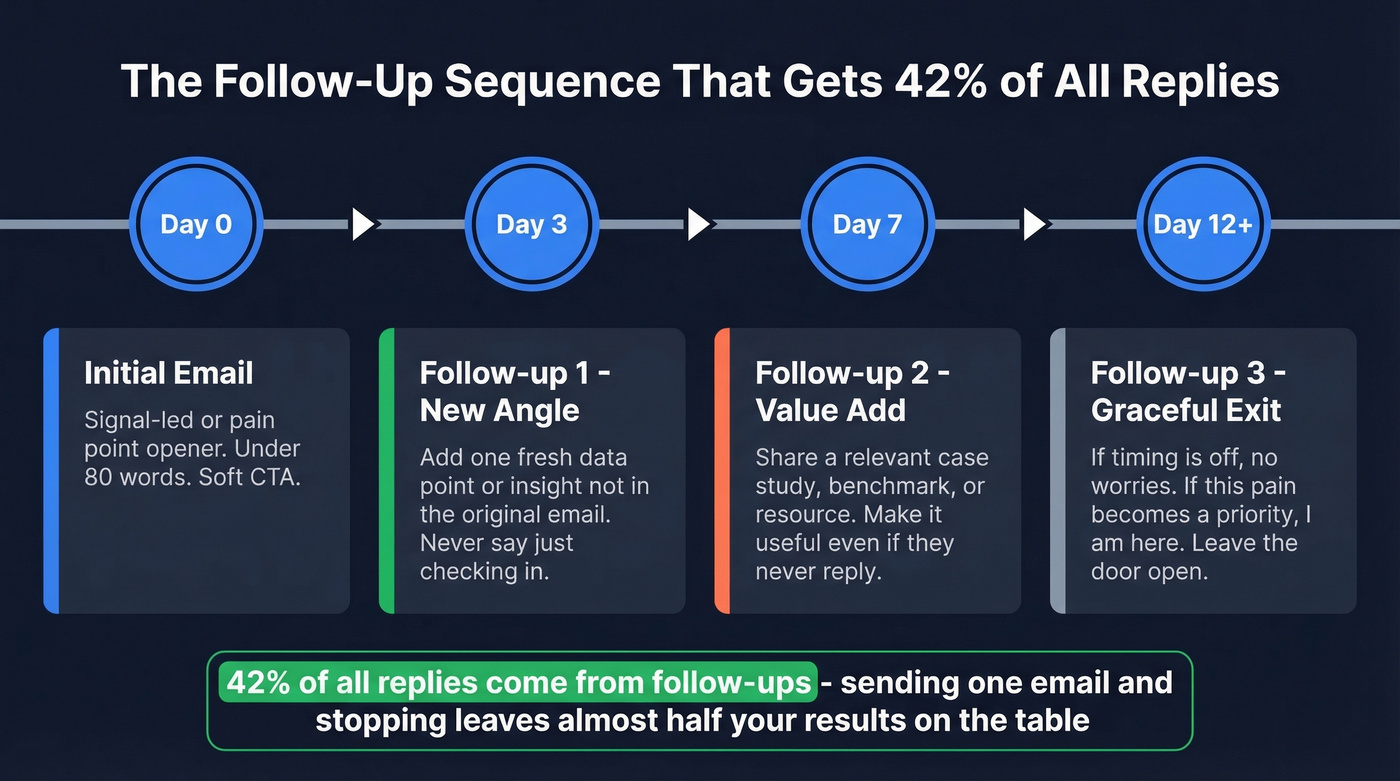
Never just "check in." Each touch adds new value:
| Touch | Timing | Content |
|---|---|---|
| Follow-up 1 | Day 3 | Add one new data point or angle not in the original |
| Follow-up 2 | Day 7 | Share a relevant resource - case study, benchmark, insight |
| Follow-up 3 | Day 12+ | Breakup email: "If timing's off, no worries. If [pain] becomes a priority, I'm here." |
42% of all replies come from follow-ups. Sending one email and stopping leaves almost half your results on the table.
Personalization at Scale
Signal-based personalization averages 18% response rates vs. 3.4% for generic outreach - a 5x difference. The challenge is doing it without spending 20 minutes per prospect. (For a deeper system, see personalized outreach.)
Tier 1 - top 50 accounts: Fully custom. Research their recent activity, reference specific posts or company moves, write each email individually. This is where deals close.
Tier 2 - next 200-500: AI-assisted. Use tools like Clay or custom scripts to scrape recent professional activity, generate a personalized first line via LLM, export as a CSV column, and inject via merge tag. One practitioner on r/SaaS reported roughly 3x response rate improvement with this workflow.
Tier 3 - everyone else: Smart merge tags with company name, industry, and role-specific pain points. Not truly personalized, but better than nothing. Even a basic prospecting email performs better when the first line references the prospect's industry or a recent company event.
Follow-Up Sequences
Let's be honest - most people send one email and give up. The data on follow-ups is unambiguous. Lemlist's analysis of millions of campaigns found cumulative reply rates rise to roughly 22% with 10 touches vs. 4.5% with a single email. Instantly recommends a 4-7 touchpoint sweet spot. Either way, most senders quit far too early. (If you need ready-to-send copy, use these cold email follow-up templates.)
Total sequence duration should run 10-25 days. Space follow-ups 2 days apart early, then stretch to 4-5+ days later. Every touch must add something new. "Just checking in" is the fastest way to get marked as spam. (If you're struggling with that line, see how to say just checking in professionally.)
Skip the 10-touch marathon if your list is under 500 prospects - you'll run out of people before the sequence compounds. For smaller lists, 4-5 touches with higher personalization per touch is the better play.
Two Practitioner Case Studies
40-50 Demos per Month
A cold email operator on r/coldemail rebuilt everything from scratch. Infrastructure: 25 domains, 50 inboxes, all with SPF/DKIM/DMARC and custom tracking domains. Warmup ran 14 days minimum. Triple-verified every email, kept bounces below 2%. Prospecting started from company websites using Crunchbase for firmographics and BuiltWith for technographics. Positive replies got a response within 5 minutes. No calendar link in the first message - just a human reply.
3% to 6% Reply Rate in 62 Days
Another practitioner expanded from 3 domains to 7, capped each at 26 emails/day. Stopped buying lists and manually verified everything - bounce rate dropped from 11% to under 2%. Cut email length from 141 words to under 56. Shifted sends to Tuesday-Thursday, 8-11am in the recipient's timezone, lifting opens 16%. "Quick question" subject lines hit 39% opens. Total stack cost: $420/month. Output: 16 qualified leads per month from email alone.
Look - if your average deal size is under $8K, you probably don't need a $500+/month tech stack. A 7-domain setup, a verification tool, and one sending platform will outperform a bloated enterprise stack every time because you'll actually maintain it.
Compliance Checklist
Cold email is legal. Illegal cold email is not. The distinction matters, and the fines are real.
CAN-SPAM (US): Up to $50,120 per email in penalties. You need accurate From/Reply-To headers, non-deceptive subjects, a valid physical address, and a working unsubscribe honored within 10 business days.
GDPR (EU/UK): Fines up to EUR 20M or 4% of global revenue. B2B cold email is permitted under "legitimate interest," but you must identify yourself, explain how you got their info, and include an opt-out.
CCPA (California): $2,500-$7,500 per violation. Focused on data rights - honor opt-out requests promptly.
RFC 8058: One-click unsubscribe is required by major mailbox providers. If your sending tool doesn't support this header, switch tools.
FAQ
How many cold emails should I send per day?
Start at 5-10 per inbox during warmup, then scale to 40-50 once the inbox is healthy. A 7-domain setup with 2 inboxes each sends roughly 350 emails daily while staying under spam thresholds. The constraint isn't volume - it's maintaining bounce rates under 2% and complaints under 0.3%.
What's a good reply rate for client acquisition emails?
The 2026 average is 3.43%. Top-quartile campaigns hit 5.5%+, and elite campaigns exceed 10%. If you're consistently below 3%, fix your data quality and infrastructure before rewriting copy - those two factors account for roughly 80% of performance.
How do I keep prospecting emails out of spam?
Authenticate every domain with SPF, DKIM, and DMARC. Warm up new inboxes 2-4 weeks before production sends. Keep bounce rates under 2% by verifying every address. Use a custom tracking domain and make sure your tool supports one-click unsubscribe headers.
What's the best free tool for building verified prospect lists?
Prospeo offers 75 free email credits plus 100 Chrome extension credits monthly - enough to test a small campaign with 98% verified accuracy. Apollo has a free tier with more records but lower accuracy around 79%, so you'll need a separate verification pass. For serious outbound, verified data from the start saves domains and time.