

Best Client Profiling Software in 2026 (12 Tools)
You spent six months building "ideal customer profiles" in a spreadsheet. Then your first outbound campaign bounced 30% of its emails, and the profiles turned out to be fiction built on stale CRM data. That's not a profiling problem - it's a data problem. And most client profiling software lists make it worse by lumping CRMs, CDPs, survey platforms, and data enrichment tools into one flat ranking as if they're interchangeable.
They're not. Companies that get personalization right generate 40% more revenue than slower-growing competitors. But the tool you need depends entirely on what's broken in your profiling workflow.
Our Picks (TL;DR)
- Best for B2B data accuracy: Prospeo - enriches and verifies contact data so profiles start with facts, not guesses.
- Best all-in-one CRM: HubSpot - CRM + marketing + service with a generous free plan.
- Best value for SMBs: Zoho CRM - flexible CRM profiling from $20/user/month.
- Best for automated personas: Delve AI - generates ICPs from your analytics data.
- Best for e-commerce/B2C: Klaviyo - behavioral profiling with built-in email/SMS activation.
Which Type of Profiling Tool Do You Need?
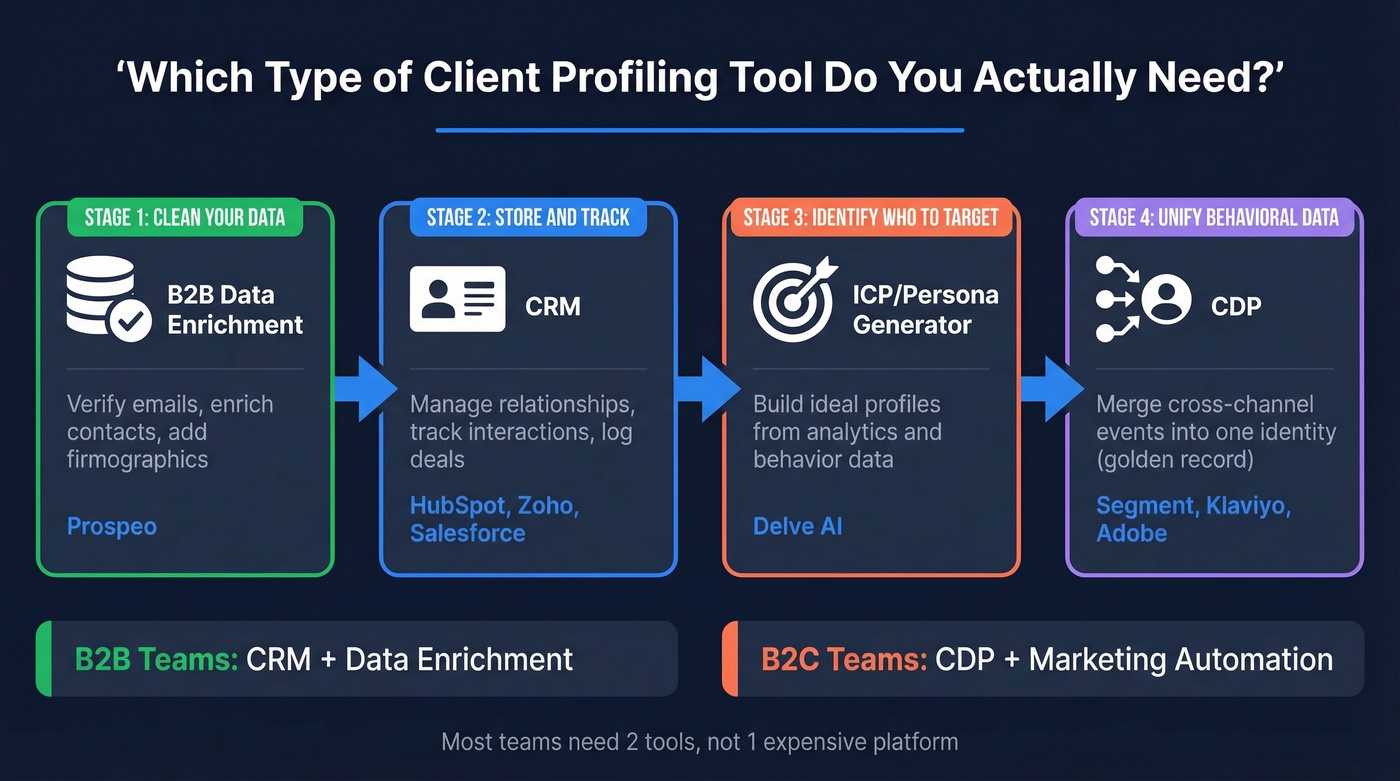
Most lists are useless because they mix four fundamentally different tool categories. A CDP and a CRM solve different problems. An ICP generator and a data enrichment platform serve different stages of the profiling workflow. Here's how they break down:
| Category | What It Does | Best For | Example Tools | Starting Price |
|---|---|---|---|---|
| CRM | Stores client records, tracks interactions | Managing relationships | HubSpot, Zoho, Salesforce | Free-$25/user/mo |
| CDP | Unifies first-party data into persistent profiles | Behavioral segmentation, identity resolution | Segment, Klaviyo, Adobe | $20-$2,000+/mo |
| ICP/Persona Generator | Builds ideal profiles from analytics | Customer segmentation & messaging | Delve AI | Free-$317/mo |
| B2B Data Enrichment | Verifies and enriches contact records | Clean, actionable data | Prospeo | Free-~$0.01/email |
A CRM stores what you already know about clients. A CDP unifies behavioral data across channels into a single identity - what the industry calls a "golden record." An ICP generator tells you who to target. And a data enrichment tool makes sure the contact data underneath all of it is actually accurate. The CDP market alone is projected to hit $37.11B by 2030, which tells you how much demand there is for unified customer data.
Most B2B teams need a CRM plus a data enrichment layer. Most B2C teams need a CDP. And almost everyone benefits from cleaning their data before they try to profile anything.
Here's the thing: if your average deal size sits below $10K, you almost certainly don't need an enterprise CDP or a $300/seat CRM. A solid CRM on a free tier plus accurate contact data will outperform a $50K/year platform filled with garbage records.
The 12 Best Client Profiling Tools
B2B Data Enrichment & Verification
Prospeo
Every profiling tool downstream is only as good as the data feeding it. If your CRM is full of outdated job titles, dead email addresses, and missing phone numbers, your "client profiles" are fiction. We've seen this pattern dozens of times with teams who come to us after burning through months of outbound on bad data.
If you're evaluating providers, start with data enrichment tools and compare coverage, refresh rates, and match rates.
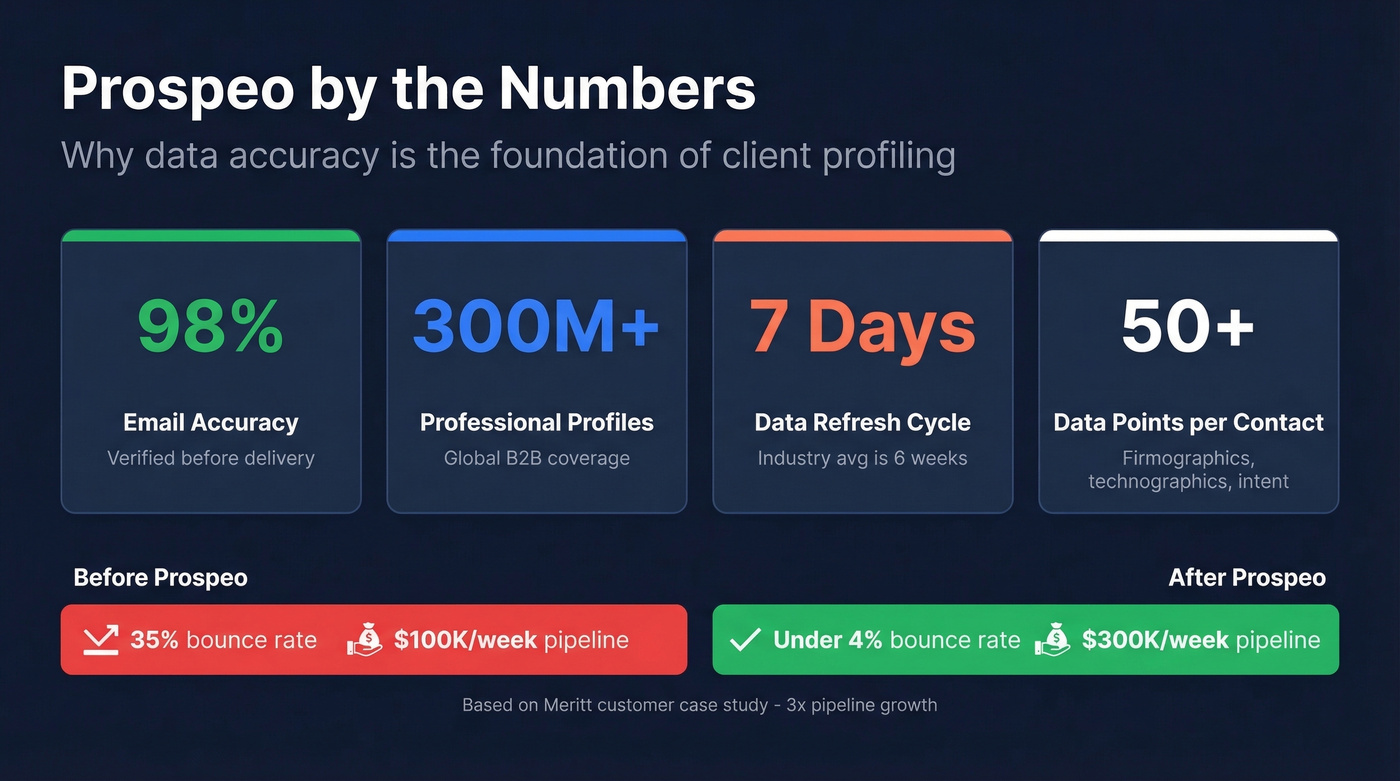
Prospeo solves this at the foundation. The platform covers 300M+ professional profiles with 98% email accuracy and a 7-day data refresh cycle - the industry average is six weeks. Upload a CSV or connect your CRM, and Prospeo returns 50+ data points per contact with an 83% enrichment match rate. That includes firmographics, technographics, and intent data across 15,000 Bombora topics, so you're not just cleaning records - you're adding dimensions that most CRMs can't generate on their own. One customer, Meritt, saw their pipeline triple from $100K to $300K/week after switching, with bounce rates dropping from 35% to under 4%.

Pricing is transparent and self-serve: the free tier gives you 75 emails/month, and paid plans run about $0.01/email with no contracts. If deliverability is the bottleneck, pair enrichment with an email verifier and a quick check bounce audit.
Use this if: your CRM data is stale, your outbound is bouncing, or you need enriched contact records to feed your profiling workflow.
Skip this if: you're a pure B2C brand with no outbound motion and no need for contact-level data.
CRMs with Profiling Features
HubSpot CRM
HubSpot is the default recommendation for a reason - the free CRM is genuinely useful, and the ecosystem around it means you can build client profiles that span the entire customer lifecycle without stitching together five different platforms.
The profiling angle: HubSpot's contact records pull in website activity, email engagement, form submissions, and deal history into a unified timeline. The AI-powered "Breeze" features add predictive scoring and company insights. In our testing, HubSpot's profiling works best for teams that want everything in one place and are willing to grow into paid tiers. Free plan to start, paid from $20/seat/month.
If you're deciding between platforms, use a simple how to choose a CRM checklist before you migrate data.
Use this if: you want one platform for CRM, marketing, and client profiling.
Skip this if: you need deep behavioral analytics across multiple digital touchpoints - HubSpot's profiling is contact-centric, not event-stream-centric, and that's CDP territory.
Zoho CRM
Zoho is the best value play in CRM-based profiling. Free for up to 3 users, $20/user/month for Standard, and $50/user/month unlocks Zia - their AI assistant that scores leads, predicts deal outcomes, and surfaces anomalies in your pipeline data.
The profiling features punch above the price point. Custom fields are nearly unlimited, the Canvas design tool lets you build visual client profile layouts, and the analytics module can segment clients by any combination of firmographic and behavioral criteria. We've seen SMB teams run multi-segment scoring workflows in Zoho that would cost 5x more in Salesforce.
Use this if: you're a small team that needs AI-powered profiling without HubSpot's ecosystem lock-in.
Skip this if: you need enterprise-grade integrations or a massive app marketplace.
Freshsales
Free plan available, paid from $11/user/month. Freshsales keeps things simple - contact scoring, activity timelines, and basic customer segmentation. A solid pick for startups that need a CRM with lightweight profiling and don't want to pay HubSpot or Zoho prices yet.
Capsule
Free plan, paid from $21/user/month. Capsule is built for freelancers and small agencies who need clean client records with custom fields, tags, mobile logging, and basic reporting. Not a profiling powerhouse, but it beats a spreadsheet by a wide margin.
monday CRM
From $15/user/month with a 3-seat minimum. monday CRM works well for project-oriented teams. The profiling features are basic - custom fields, automations, dashboards - but the interface is intuitive enough that non-technical teams actually use it, which counts for a lot.
Salesforce Customer 360
$25-$300/user/month depending on edition. Salesforce is the enterprise standard, but "enterprise standard" also means enterprise complexity and enterprise pricing. If you have a dedicated admin and implementation budget, the profiling capabilities are unmatched. If you don't, you'll spend more time configuring than profiling.
ICP & Persona Generators
Delve AI
Delve AI generates client personas automatically from your analytics data. Connect Google Analytics, your CRM, or competitor domains, and it builds segment-specific profiles with demographic, psychographic, and behavioral dimensions.
If you're building from scratch, start with an ideal customer profile framework so the personas map to pipeline.
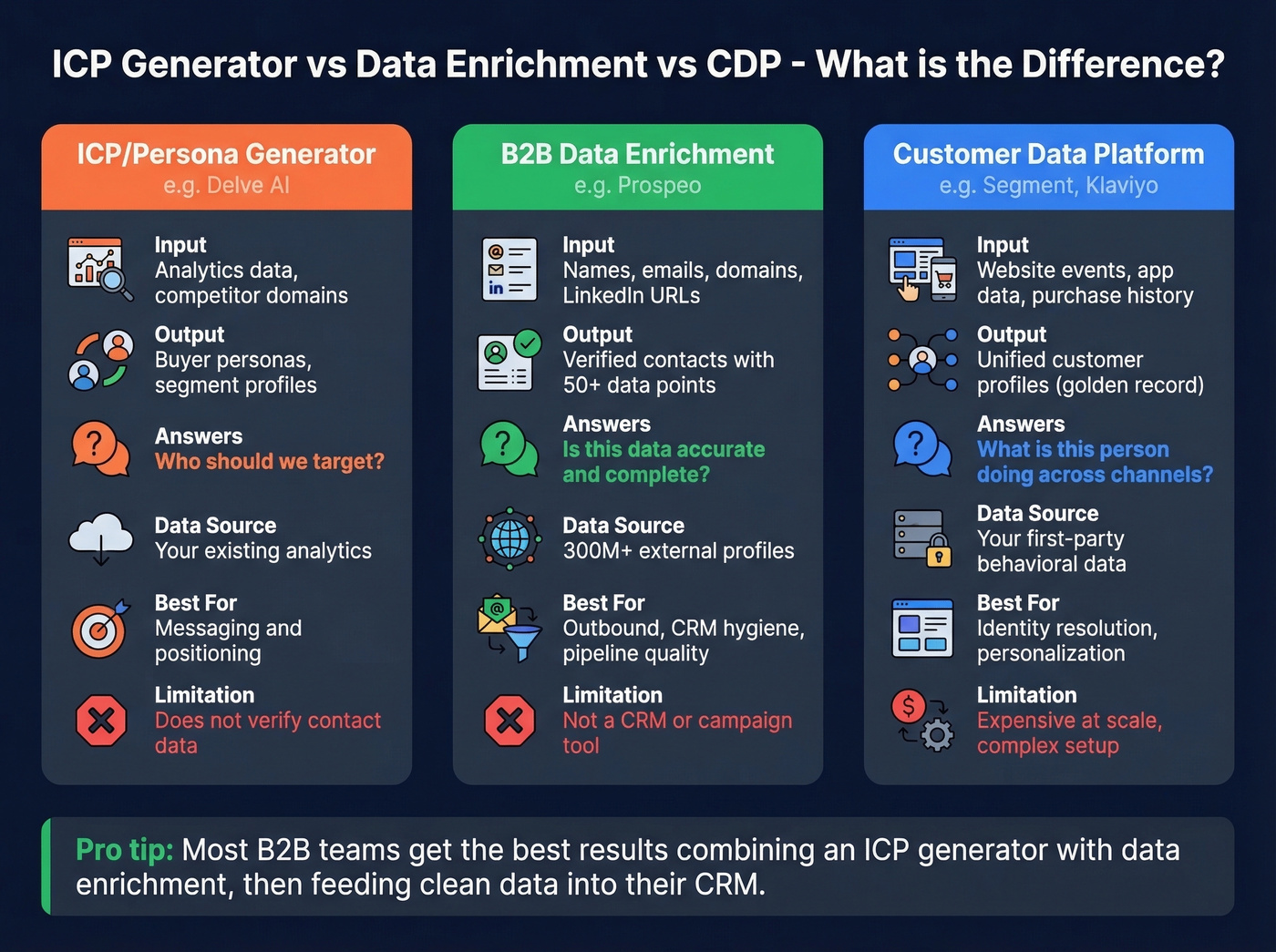
Pricing starts free with 1 Audience Persona, 1 Website Persona, and 50 chat credits, then jumps to $317/month for Research Essential and $2,499/month for the Complete bundle. The gap between free and paid is steep, but paid tiers include competitor persona analysis and suggested contacts - useful for ABM target lists.
Customer Data Platforms
Segment (Twilio)
Segment is the mid-market CDP standard. It collects event data from your website, app, and backend systems, resolves identities across touchpoints, and pushes unified profiles to 550+ downstream tools. Over 25,000 companies use it.
Free plan available for low-volume use. Paid plans start around ~$120/month but scale quickly with event volume - high-traffic sites easily hit four figures monthly. The modular packaging works well: you can buy just Connections for data piping without committing to the full CDP with Unify + Engage.
Klaviyo
Klaviyo is the profiling tool for e-commerce teams who want to turn behavioral data into revenue. It tracks browsing, purchase history, email engagement, and SMS interactions, then builds dynamic segments you can activate immediately through built-in campaigns.
Free plan available, paid from $20/month scaling with list size. If you're running a DTC brand, Klaviyo's profiling-to-activation loop is tighter than any general-purpose CDP. For B2B, look elsewhere.
Adobe Real-Time CDP
Adobe Real-Time CDP takes ~3 months to implement and averages 7 months to ROI. Starts at roughly $2,000+/month. Powerful identity resolution and predictive segmentation, but the cost and complexity make it overkill for any team without dedicated data engineers. If you're a 20-person company, skip it.
ActiveCampaign
From $29/month. ActiveCampaign blends email marketing automation with contact scoring and behavioral profiling. Not a true CDP, but for teams that want profiling layered into their email workflows without buying a separate platform, it's a pragmatic choice.
If you're automating follow-ups, compare it against other outbound email automation options before you commit.

Your client profiles are only as good as the data underneath them. Prospeo enriches every contact with 50+ data points at 98% email accuracy - including firmographics, technographics, and intent signals across 15,000 topics. All refreshed every 7 days, not 6 weeks.
Stop profiling clients with data that expired last quarter.
Pricing Comparison
| Tool | Category | Free Tier? | Starting Price | Best For |
|---|---|---|---|---|
| Prospeo | Data Enrichment | Yes (75 emails/mo) | ~$0.01/email | Contact accuracy |
| HubSpot | CRM | Yes | $20/seat/mo | All-in-one CRM |
| Zoho CRM | CRM | Yes (3 users) | $20/user/mo | SMB value |
| Freshsales | CRM | Yes | $11/user/mo | Startups |
| Capsule | CRM | Yes | $21/user/mo | Freelancers/agencies |
| monday CRM | CRM | No | $15/user/mo | Project-based teams |
| Salesforce Customer 360 | CRM | No | $25/user/mo | Enterprise |
| Delve AI | ICP Generator | Yes | $317/mo | Auto personas |
| Segment | CDP | Yes | ~$120/mo | Data unification |
| Klaviyo | CDP / Marketing | Yes | $20/mo | E-commerce |
| Adobe Real-Time CDP | CDP | No | ~$2,000/mo | Enterprise CDP |
| ActiveCampaign | Marketing Auto | No | $29/mo | Email-first profiling |
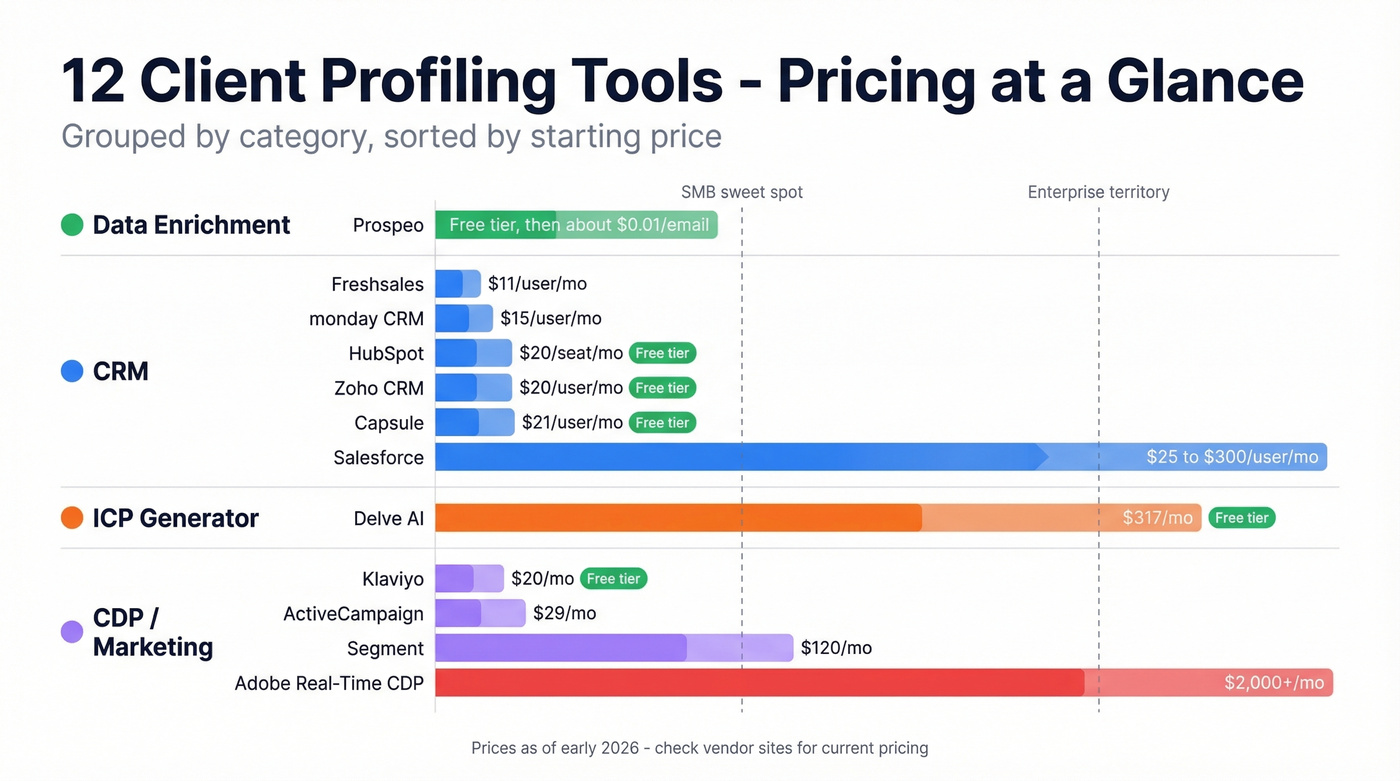
Adobe and Salesforce hide pricing behind "contact sales" - that tells you exactly who these tools are built for.
How to Build a Client Profile
1. Start with your 10 best customers. Don't export your entire CRM. Pick one segment, identify the 10 accounts that represent your ideal outcome, and work from there. One practitioner on r/sales documented generating $200K in pipeline using exactly this approach - start narrow, then expand.
2. Enrich and verify contact data. Before you analyze anything, make sure the underlying records are accurate. Run your list through a data enrichment tool to fill in job titles, company size, tech stack, and intent signals so your profiles are built on current facts, not last year's CRM imports.
If you're doing this for B2B outbound, a best B2B database can help you backfill missing records faster.
3. Identify shared firmographic and behavioral patterns. Look for commonalities across your best accounts: industry, headcount range, tech stack, buying triggers, deal cycle length. The patterns that emerge from 10 real customers are worth more than any hypothetical persona exercise.
4. Build segment-specific profiles. Not one universal avatar. Different segments have different pain points, buying processes, and decision-makers. A "one-size-fits-all" ICP leads to spray-and-pray outbound.
5. Activate and refresh quarterly. Push profiles into your CRM or outreach tools and revisit them every quarter. B2B data decays roughly 30% per year - profiles that aren't refreshed become fiction fast. If you're formalizing the process, use a broader customer profiling workflow to keep segments consistent across teams.
Profiling Mistakes That Waste Your Budget
The universal avatar. Building one ICP for your entire business feels efficient. It's not. It produces generic messaging that resonates with nobody. Build segment-specific profiles or don't bother.
Confirmation bias. You already "know" who your ideal customer is, so you cherry-pick data that confirms it and ignore signals that don't fit. This is the most common profiling trap, and it's invisible until your campaigns underperform. Let's be honest - we've all done it.
The data swamp. Collecting every possible data point without a plan to activate it. You end up with 200 fields per contact and no idea which ones actually predict conversion. Collect what you'll use. Ignore the rest.
If your profiling is meant to drive outbound, tie it directly to pipeline generation ideas so the data actually turns into meetings.
Meritt tripled their pipeline from $100K to $300K/week and cut bounce rates from 35% to under 4% by fixing the data layer first. Prospeo returns 83% enrichment match rates at ~$0.01/email - no contracts, no sales calls.
Clean data turns client profiles from guesswork into revenue.
FAQ
What is client profiling software?
Client profiling software collects, organizes, and analyzes customer data to build detailed profiles of your ideal buyers. These profiles combine firmographic data like company size, industry, and revenue with behavioral data like website visits, email engagement, and purchase history to help sales and marketing teams target the right accounts with relevant messaging.
Do I need a CDP or a CRM for profiling?
A CRM handles profiling well if you're tracking known contacts and managing relationships. You need a CDP when you must unify anonymous behavioral data across multiple digital touchpoints into a single identity. Most B2B teams under 200 employees are fine with a CRM plus a data enrichment layer to keep records accurate.
How often should client profiles be updated?
B2B data decays at roughly 30% per year - people change jobs, companies get acquired, phone numbers go stale. Quarterly profile reviews are the minimum. For contact-level data, a 7-day refresh cycle is the gold standard: the fresher your underlying data, the more accurate your profiles stay between reviews.
What's the difference between a client profile and a buyer persona?
A client profile is data-driven and dynamic - built from actual customer records, enrichment data, and behavioral signals. A buyer persona is semi-fictional and static - a narrative description of an ideal buyer based on assumptions and interviews. Profiles tell you who your customers are; personas describe who you think they are.
Is there free client profiling software?
Several tools offer useful free tiers: HubSpot CRM (unlimited users), Zoho CRM (3 users), Freshsales, Capsule, Prospeo (75 emails/month), and Delve AI (1 audience persona + 1 website persona). You can build a functional profiling stack without spending anything, though paid tiers unlock AI features, higher volumes, and deeper analytics.