

Clodura.AI vs QuickEnrich: Which Enrichment Tool Deserves Your Budget?
Your last outbound campaign spiked hard bounces past 9%, and now your sending domain's reputation is circling the drain. You're weighing Clodura.AI against QuickEnrich, but here's the contrarian take: database size is the wrong metric. Deliverability is the game.
30-Second Verdict
Pick Clodura.AI if you want an all-in-one GTM suite - data, sequences, dialer - and you're okay managing list quality tightly. Clodura users do flag outdated data and bounce issues in reviews.
Pick QuickEnrich if you need API-first enrichment with double-verified emails and don't need built-in outreach tools.
Skip both if deliverability and data freshness are non-negotiable. Prospeo delivers 98% email accuracy on a 7-day refresh cycle, with 300M+ professional profiles and an 83% enrichment match rate. That's a different tier of data hygiene.
Feature Comparison at a Glance
| Category | Clodura.AI | QuickEnrich |
|---|---|---|
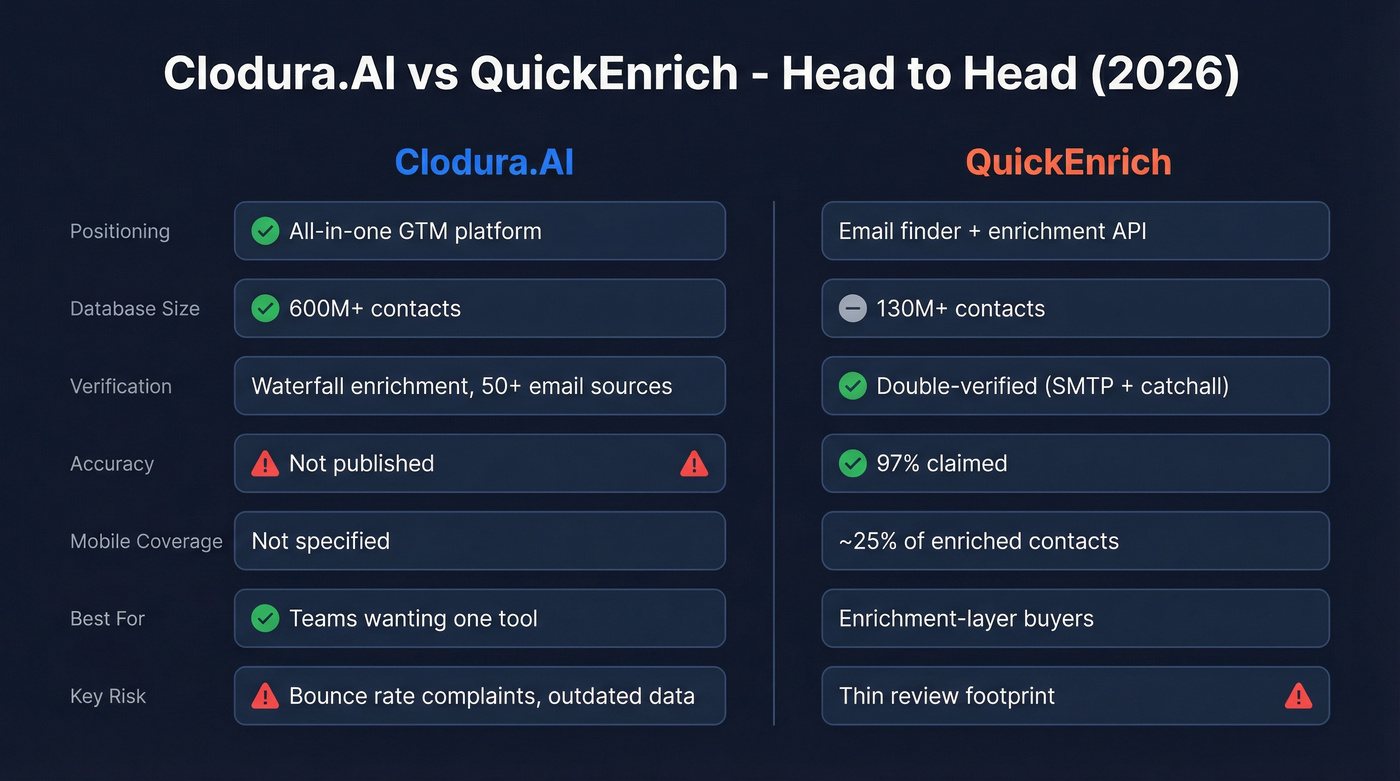
| Positioning | All-in-one GTM platform | B2B email finder + enrichment API |
| Best for | Teams wanting one tool | Enrichment-layer buyers |
| Database size | 600M+ contacts | 130M+ contacts |
| Verification | Waterfall enrichment (50+ email sources, 20+ phone sources) + real-time verification | Double-verified (SMTP + catchall) |
| Accuracy claim | Not published | 97% |
| Mobile coverage | Not specified | ~25% of enriched contacts |
| Key integrations | CRM enrichment/APIs + CallPilot dialer | API + Clay |
| Pricing | Free Forever (100 credits); Max starts at $99/mo | $29/mo-$99/mo |
| G2 rating | 4.5/5 (301 reviews) | Limited third-party reviews |
| Key risk | Bounce-rate complaints + "outdated info" theme | Thin review footprint |
Data Quality and Verification
QuickEnrich claims 97% email accuracy through double verification - emails run through multiple verification tools, catchall checks, and SMTP validation . Each email comes with a verification date so you can gauge freshness. They also claim 250% more email domains than competitors by finding true business email domains, not just company website domains. That transparency matters when your domain reputation is on the line.
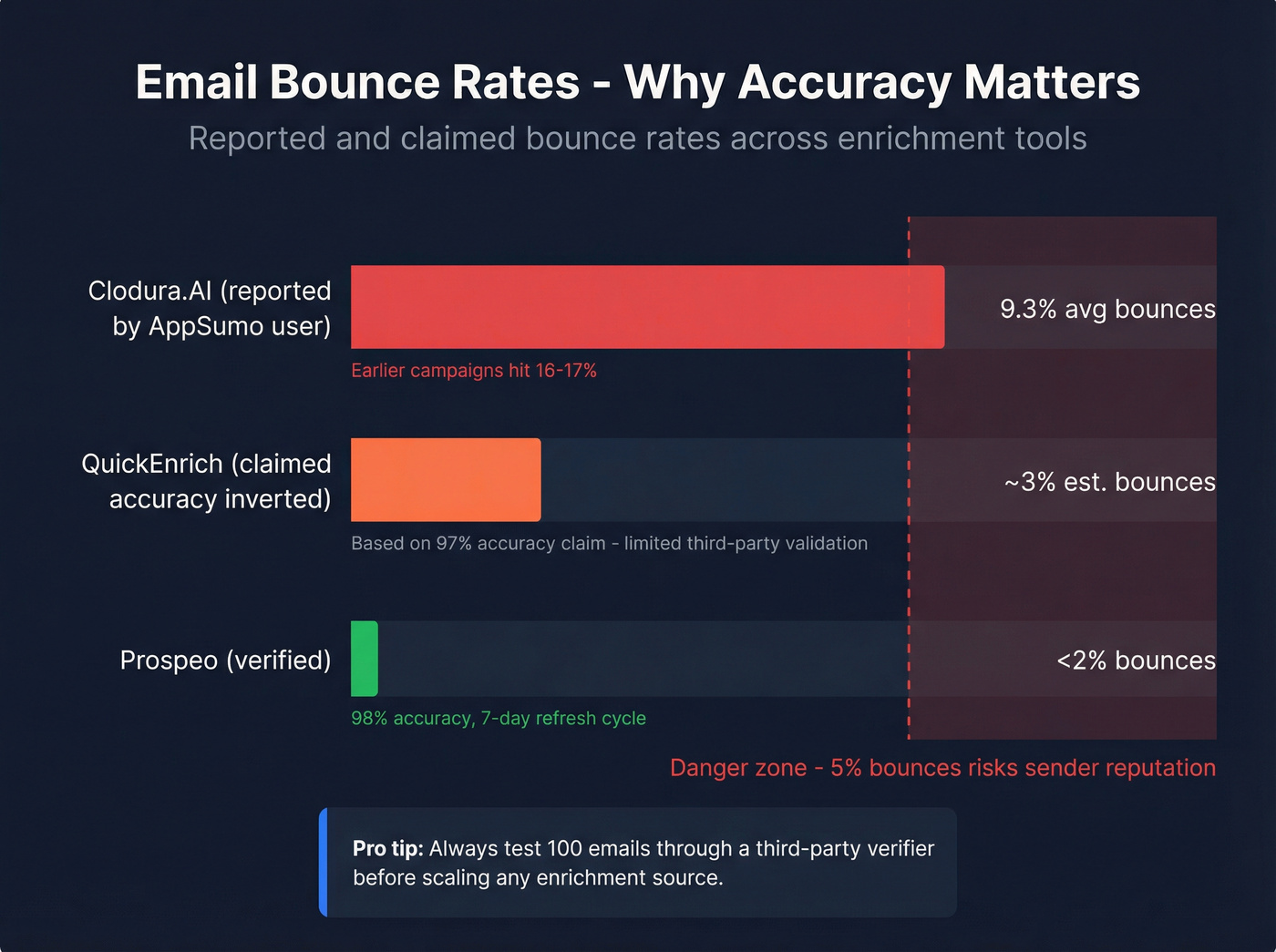
Clodura.AI takes a waterfall approach across 50+ email providers and 20+ phone sources. More sources should mean better coverage. In practice, one AppSumo reviewer reported roughly 9.3% average hard bounces on 484 emails, with earlier campaigns hitting 16-17%. That's domain-killing territory.
The consensus on Reddit threads about enrichment tools keeps surfacing the same concern: accuracy over database size. We always run a 100-email sample through a third-party verifier before scaling any enrichment source (see email bounce rate benchmarks). Relying on a single provider typically leaves 40-60% of prospects unreachable, so layering verification is smart regardless of which tool you pick (more in our email deliverability guide).

Clodura users report 9-17% hard bounces. QuickEnrich has almost no third-party reviews to validate its 97% claim. Prospeo's proprietary 5-step verification delivers 98% email accuracy - no third-party email providers, 7-day data refresh, and an 83% enrichment match rate. Test it on 75 free emails before you commit a dollar.
Stop reverse-engineering which enrichment tool won't kill your domain.
Workflow Fit
RevOps wants API enrichment that slots into Clay or a custom pipeline (see our Clay list building workflow). Sales wants sequences, a dialer, and a CRM sync in one tab. These are fundamentally different buying criteria.
Clodura.AI is the all-in-one play: sequences, CallPilot dialer, buyer intent signals, org charts, CRM sync - it's trying to be your entire GTM stack. QuickEnrich doesn't pretend to be that. It's an enrichment layer with a clean API and Clay integration, designed to sit first in a waterfall. We've seen teams waste months trying to force an all-in-one tool into a modular workflow. Pick the architecture that matches how your team actually operates (especially if you're standardizing lead enrichment across tools).
Here's the thing: if your average deal size sits below $15k, you probably don't need Clodura's all-in-one stack. A focused enrichment tool plus a separate sequencer will outperform a bloated platform every time (compare options in our roundup of data enrichment services).
Pricing Breakdown
| Plan | Clodura.AI | QuickEnrich |
|---|---|---|
| Entry | Free Forever (100 credits) | $29/mo (6,000 credits) |
| Mid-tier | $99/mo (5,000 credits) | $99/mo (25,000 credits) |
| Annual (shown monthly) | $90/mo billed annually | $24/mo and $83/mo |
| Per-seat fees | None (unlimited users) | None |
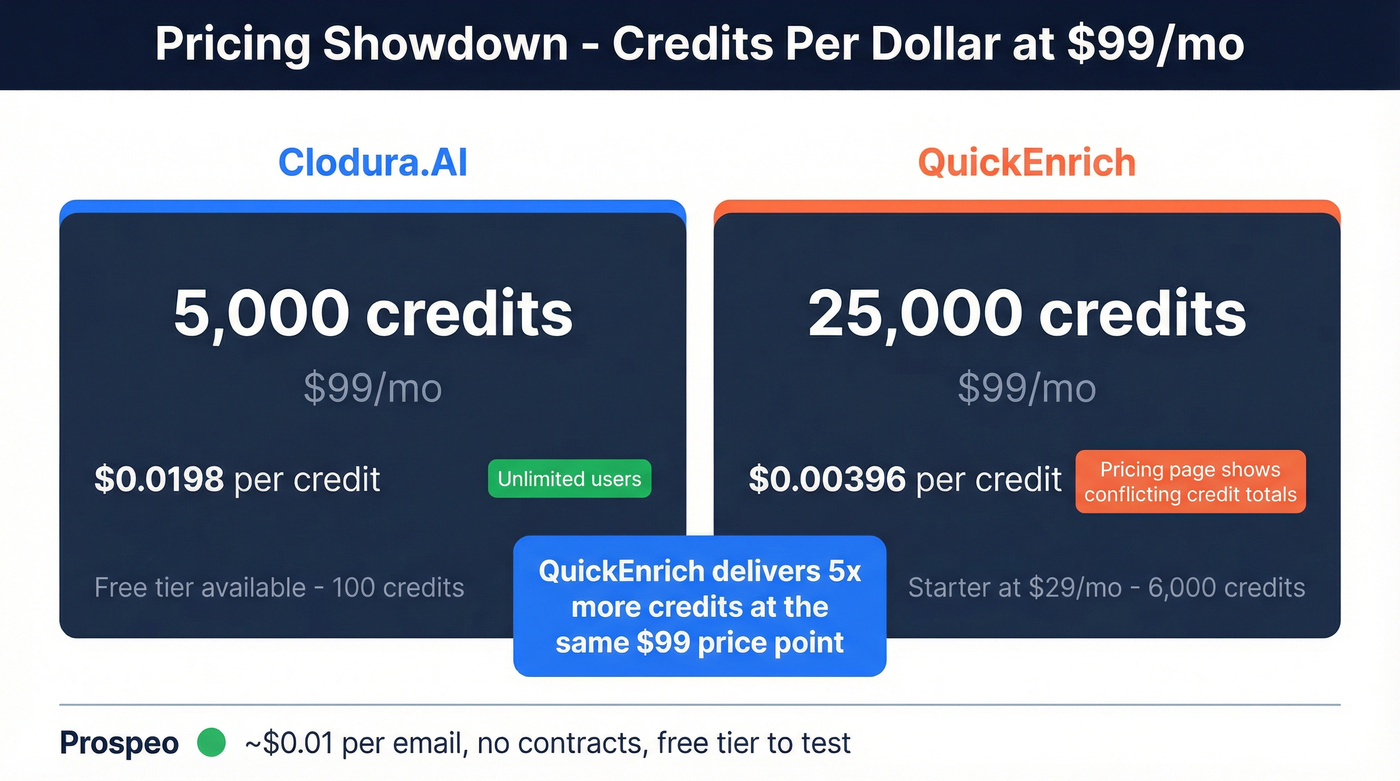
Clodura.AI's unlimited-users model is genuinely appealing for larger teams. But credit-for-credit, QuickEnrich gives you about 5x the volume at the same $99 price point - 25,000 vs 5,000. That math is hard to ignore.
One frustration with QuickEnrich: their pricing page shows conflicting credit totals per plan (6,000 vs 3,000 on Starter, 25,000 vs 11,000 on Growth). You shouldn't have to reverse-engineer credit math before buying.
Trust and Real-World Risk
Clodura.AI has the review volume advantage. G2 shows 4.5/5 across 301 reviews, and AppSumo rates it 4.7/5 across 146 ratings, with users praising ease of use and lead generation. Dig deeper, though, and "outdated information" surfaces as a recurring theme.
If you're building a repeatable outbound motion, it helps to map this back to your sales prospecting techniques and what your team can operationally verify every week.
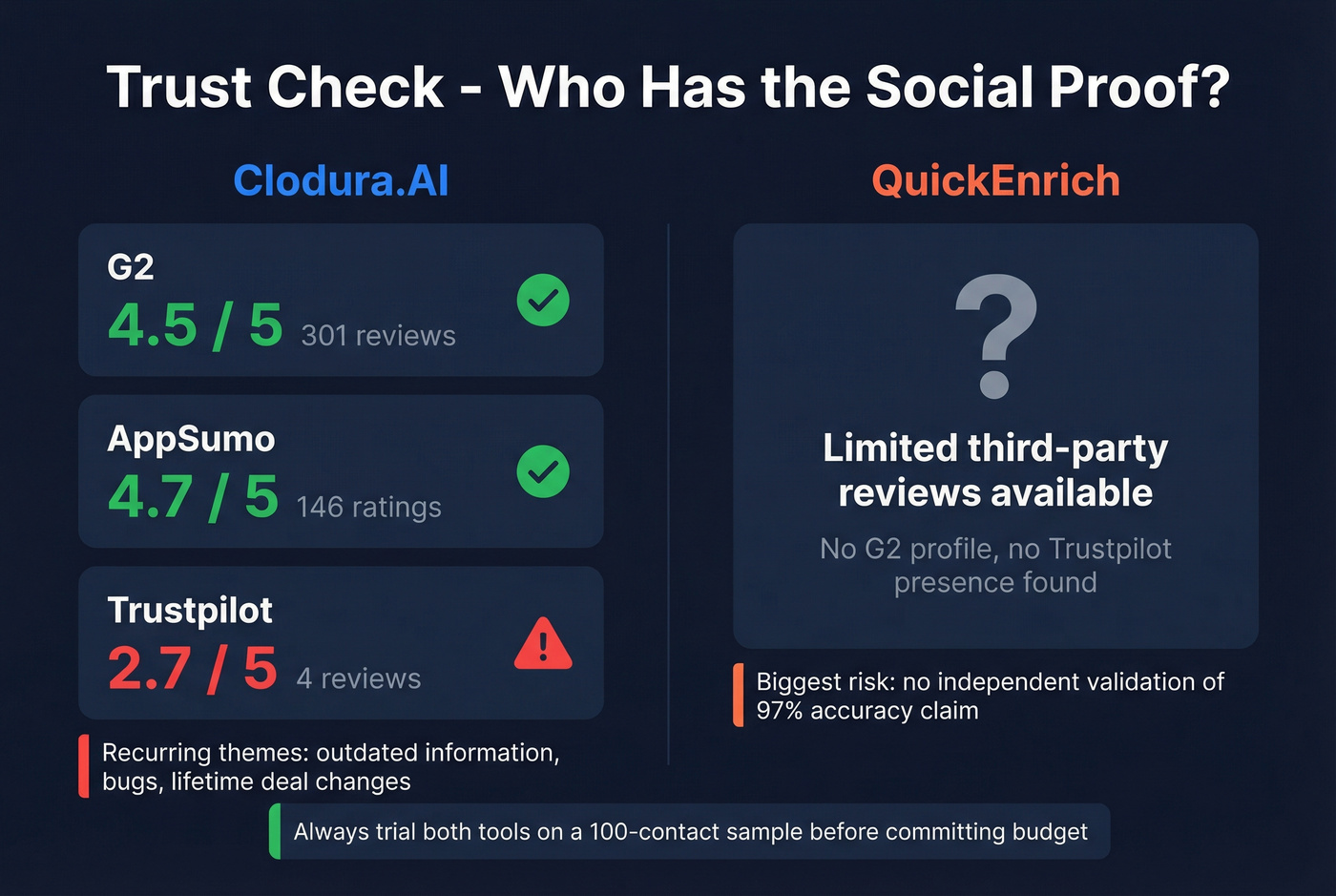
Trustpilot tells a rougher story: 2.7/5 across 4 reviews, with complaints about bugs, lifetime deal changes, and difficulty getting data removed. Small sample, but the severity is notable.
QuickEnrich's biggest risk is the opposite: almost no third-party reviews exist. That's a real buying risk for teams that need social proof before committing budget. Trial both and test deliverability on a small batch before you scale - in our experience, a 100-contact sample tells you more than any marketing page will (and if you're trying to protect your domain, pair it with a plan to improve sender reputation).
If Neither Wins

Let's be honest - if your core problem is email accuracy and data freshness, neither tool fully solves it without compromise. Prospeo's proprietary email-finding infrastructure doesn't rely on third-party providers, which is why teams switching over typically see bounce rates drop from 30%+ to under 4%. With 98% email accuracy, a 7-day refresh cycle (the industry average is six weeks), and 125M+ verified mobiles with a 30% pickup rate, that direct-dial coverage is something most enrichment tools don't come close to matching. Starting at roughly $0.01 per email, self-serve, no contracts, free tier to test.
If you're evaluating alternatives broadly, start with a shortlist of best sales prospecting databases and compare refresh cadence + verification methodology, not just contact counts.
Neither Clodura nor QuickEnrich comes close on mobile coverage. Prospeo gives you 125M+ verified mobile numbers with a 30% pickup rate - plus 300M+ profiles, 30+ search filters, and native integrations with Clay, HubSpot, Salesforce, and every major sequencer. All at ~$0.01 per email, no contracts.
Replace your enrichment stack with one platform that actually verifies its data weekly.
FAQ
Does QuickEnrich include mobile numbers?
Yes, but expect roughly 25% of enriched contacts to include mobiles. If direct dials are critical for your outbound motion, you'll want a platform with deeper mobile databases.
Is Clodura.AI accurate enough for cold outreach?
G2 users praise ease of use but flag outdated data as a recurring issue. One AppSumo user reported roughly 9.3% hard bounces on a 484-email campaign. Always run your list through a dedicated verifier before sending - anything above 5% bounces risks your sender reputation.
Can I use both tools together in a waterfall?
Yes. QuickEnrich positions itself as a first-pass enrichment layer, and Clodura.AI can supplement with its broader database. Run the combined results through a real-time verification tool to catch remaining invalids before they hit your sequences.