

Clodura.AI vs Sales Automation Systems: What You're Actually Comparing in 2026
A RevOps lead at a 50-person SaaS company spent three weeks evaluating Clodura.AI against "sales automation systems" - Salesforce and Outreach, specifically - before realizing she was comparing a prospecting database to a CRM and a sequencing platform. Three different tools solving three different problems, all hiding under one misleading umbrella. That confusion costs teams real time and real budget.
30-Second Verdict
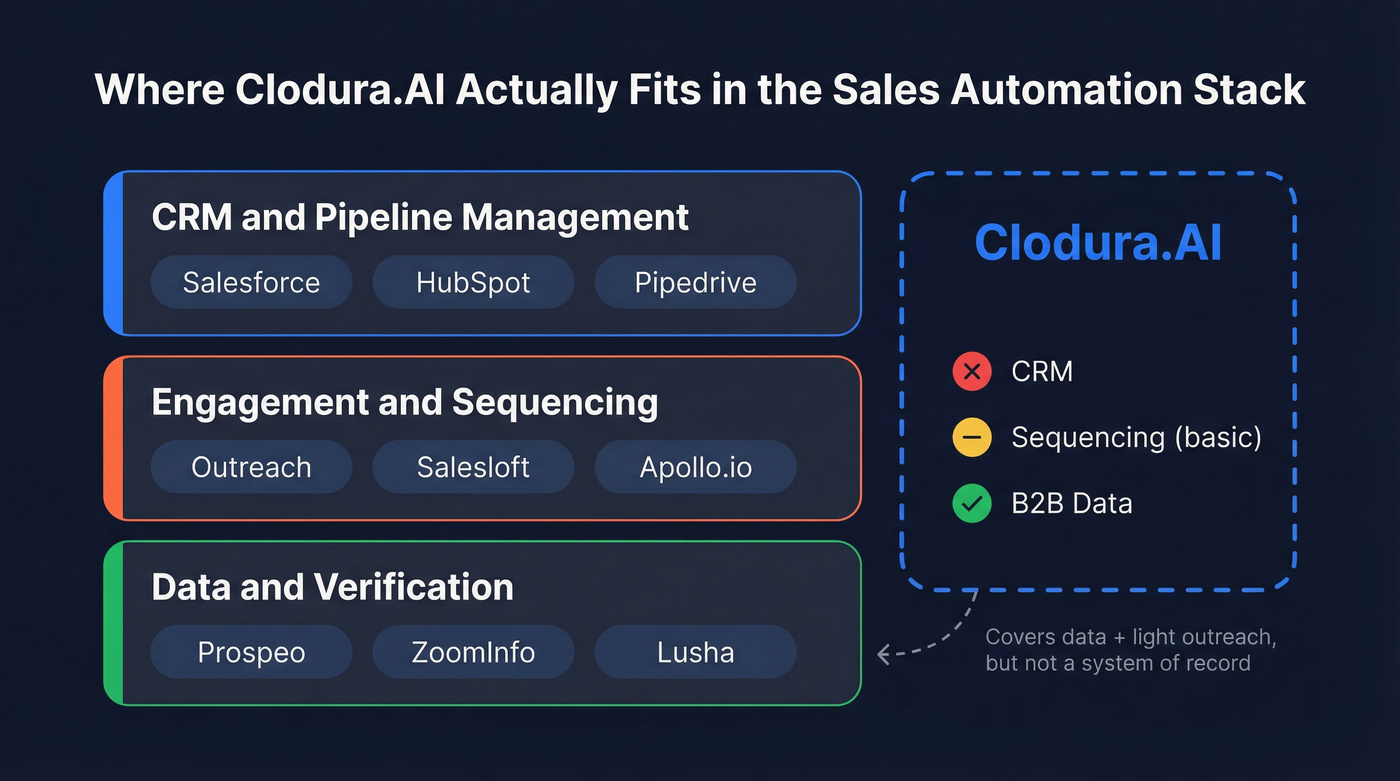
- Clodura.AI is a GTM data platform with outreach bolted on. It's not a system of record.
- Need CRM and pipeline management? Start with Salesforce or HubSpot.
- Need engagement automation at scale? Look at Outreach or Salesloft.
- Real bottleneck is stale data tanking deliverability? Prospeo delivers 98% verified emails on a 7-day refresh cycle, self-serve, no contracts.
What "Sales Automation" Actually Means in 2026
The phrase covers everything from auto-logging CRM activity and lead routing to follow-up sequences and proposal generation. Per Highspot's taxonomy, that spans data entry through deal management - not one product, but a stack.
The payoff is real. Salesforce research shows 61% of overperforming sales teams use automation versus 46% of underperformers. Companies see an average $5.44 return per $1 spent on sales automation, a 14.5% productivity increase, and roughly 6 hours per week saved per rep. The sales force automation market is projected to hit $19.5B by 2030, up from $8.6B in 2023. But Clodura only covers one slice of that stack.
Where Clodura.AI Actually Fits
Use this if you want a single platform combining B2B data with built-in email sequences and a dialer. Clodura lists 600M+ verified B2B contacts and 50M+ company profiles with org charts on G2, while TrustRadius puts the numbers at 220M+ contacts and 18M+ companies. The platform holds a 4.5/5 on G2 across 301 reviews, and an independent deliverability test by Sparkle found 28 bounces out of 1,529 verified-only exports - about 98.2% deliverability.
Skip this if you need a CRM, pipeline forecasting, or enterprise-grade sequencing. Clodura isn't a system of record. G2 reviewers flag outdated data and inaccuracy as recurring issues. It can be too much tool if you don't need a dialer, and not enough if you need real pipeline management.
The Actual Sales Automation Systems
CRM and Pipeline Management
Salesforce Sales Cloud is the common system of record for mid-market and enterprise teams. Five tiers run from $25/user/mo on Starter to $550/user/mo on Agentforce 1 Sales, covering pipeline management, forecasting, lead routing, and AI-powered deal insights. Implementation takes months, but nothing matches its workflow depth. Where Clodura gives you contacts, Salesforce manages what happens after first contact.
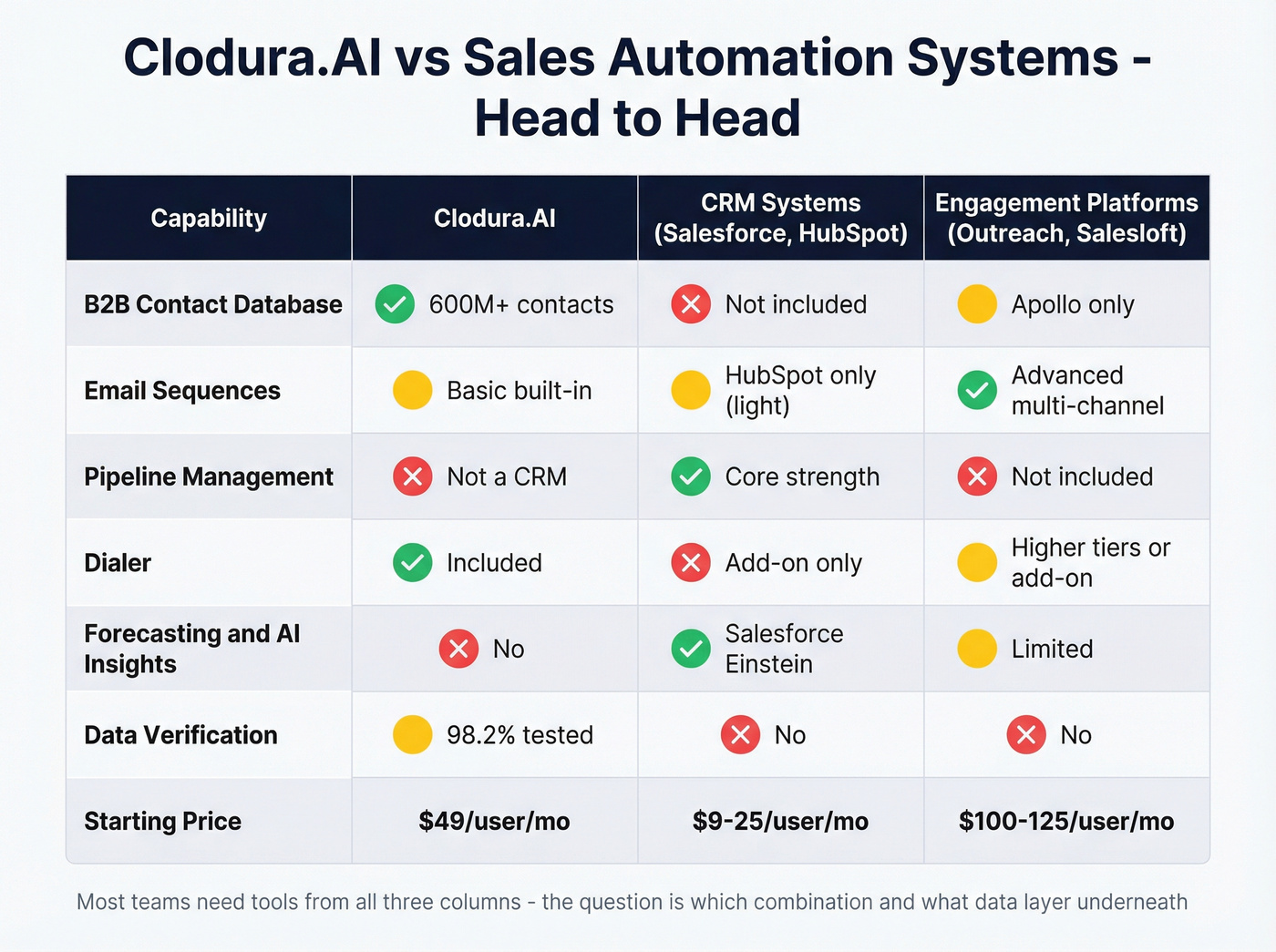
HubSpot Sales Hub starts free, with paid plans from $9/user/mo - the obvious pick for SMBs who want CRM plus light automation without a six-figure implementation. Pipedrive starts at $14/user/mo for teams who just need deal tracking without the complexity.
Engagement and Sequencing
Outreach runs roughly $100-150/user/mo with a 5-seat minimum on annual contracts. It's the go-to for high-volume multi-channel sequences, with a dialer included on higher tiers.
Salesloft typically runs $125-180/user/mo, but 35-60% negotiation discounts are common with upfront annual payment - a 50-seat Advanced deal at $108K list often closes around $75-76K. Three-seat minimum. Dialer is an add-on at $300-400/user/year.
Here's the thing: skip Salesloft if you can't commit to 10+ seats. The per-seat economics only make sense at scale, and a 3-seat deal won't get you meaningful discounts.
Apollo.io takes the data-plus-sequencing approach too, with 210M+ contacts and 35M+ companies in its database. Free tier available, paid from roughly $59/mo.
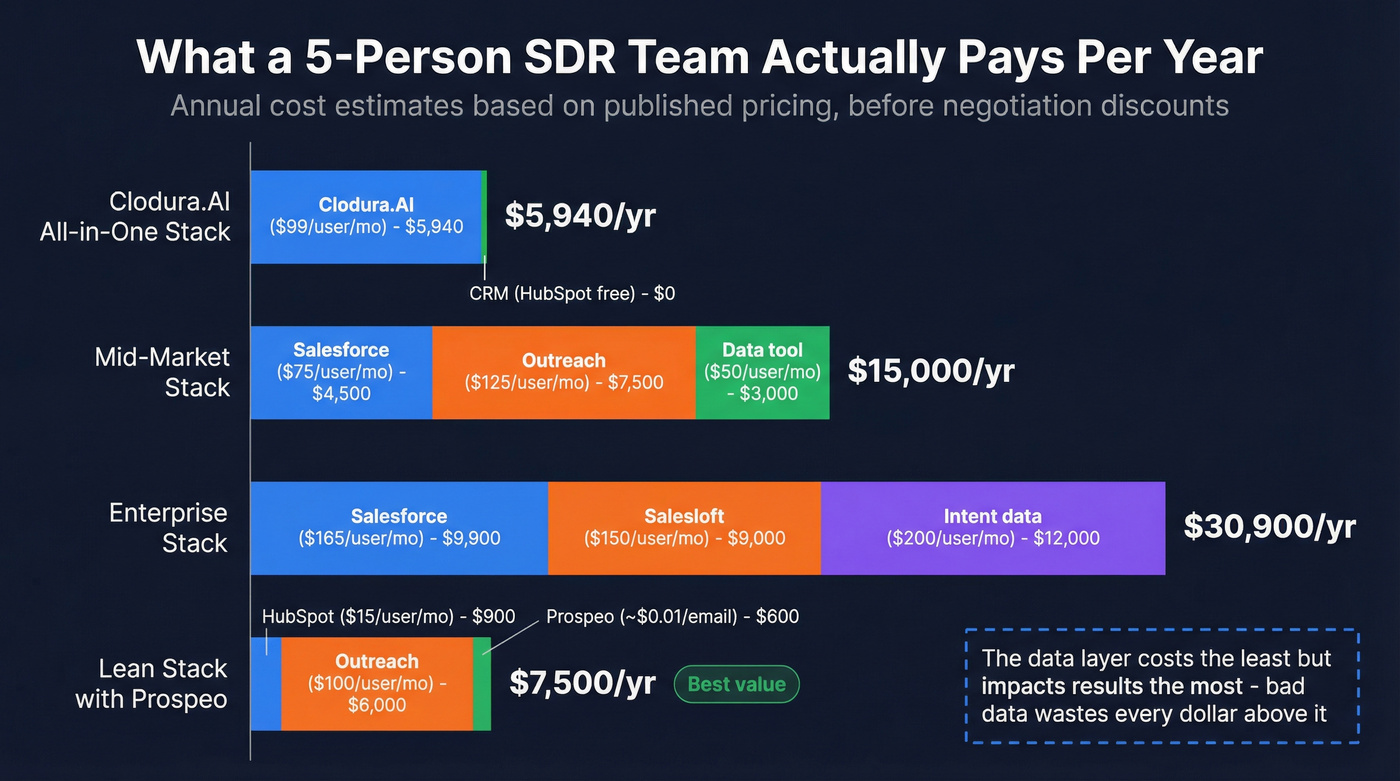
Data quality - not sequencing features - is the number-one reason automation stacks fail. We've watched teams agonize over Outreach vs. Salesloft for weeks while their contact data quietly rots underneath. A 5-person team combining engagement, data, and intent easily hits $30-50K/year before CRM costs.

Teams spend weeks comparing Clodura, Outreach, and Salesloft - then watch their stack underperform because the data underneath is stale. Prospeo refreshes every 7 days (not 6 weeks), delivers 98% email accuracy, and costs ~$0.01 per verified email. No contracts, no sales calls.
Stop optimizing sequences on top of rotting data.
Pricing Comparison
| Tool | Category | Starting Price | Best For |
|---|---|---|---|
| Clodura.AI | Data + outreach | Free / $49-$99/user/mo | All-in-one prospecting with dialer |
| Salesforce | CRM / SFA | $25/user/mo | Pipeline management at scale |
| HubSpot | CRM / SFA | Free / $9/user/mo | SMB teams needing fast CRM setup |
| Pipedrive | CRM | $14/user/mo | Simple deal tracking |
| Outreach | Engagement | ~$100/user/mo | High-volume multi-channel sequences |
| Salesloft | Engagement | ~$125/user/mo | Enterprise engagement with coaching |
| Prospeo | Data / verification | Free / ~$0.01/email | Data accuracy and verification |
The Missing Layer: Data Quality
Automation scales whatever you feed it - including bad data. In our experience, the data quality layer is the most underinvested part of most stacks, and it's the one that silently kills deliverability. If you're evaluating vendors, start with data enrichment and a clear email deliverability baseline.
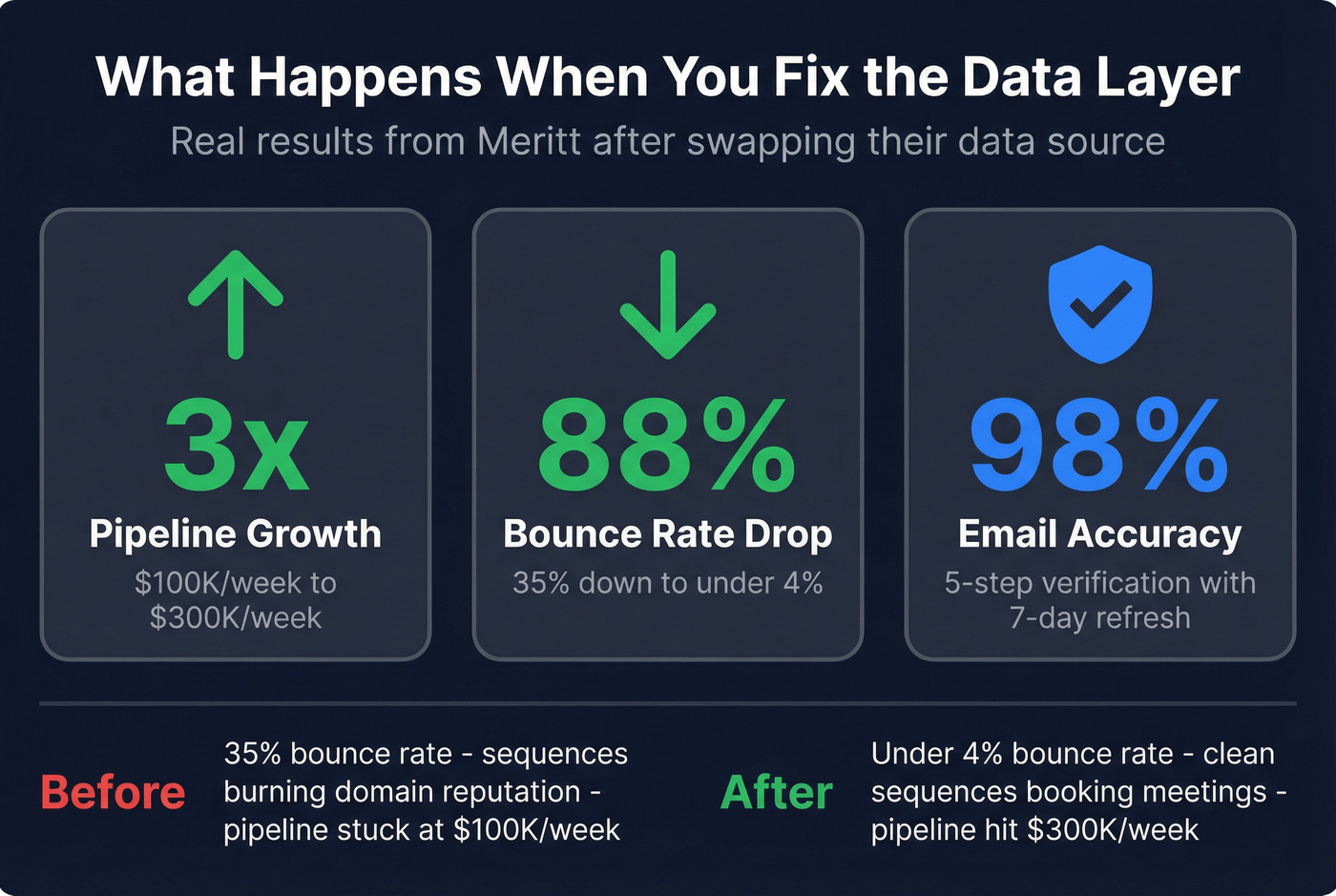
One of our customers, Meritt, saw their pipeline triple from $100K to $300K/week after swapping their data source. Bounce rate dropped from 35% to under 4%. That's the difference between sequences that book meetings and sequences that burn your domain.

Which Stack to Pick
No CRM yet? Start with HubSpot or Salesforce. Everything else is premature without a system of record. If you need a quick refresher on what counts as a CRM, see examples of a CRM.
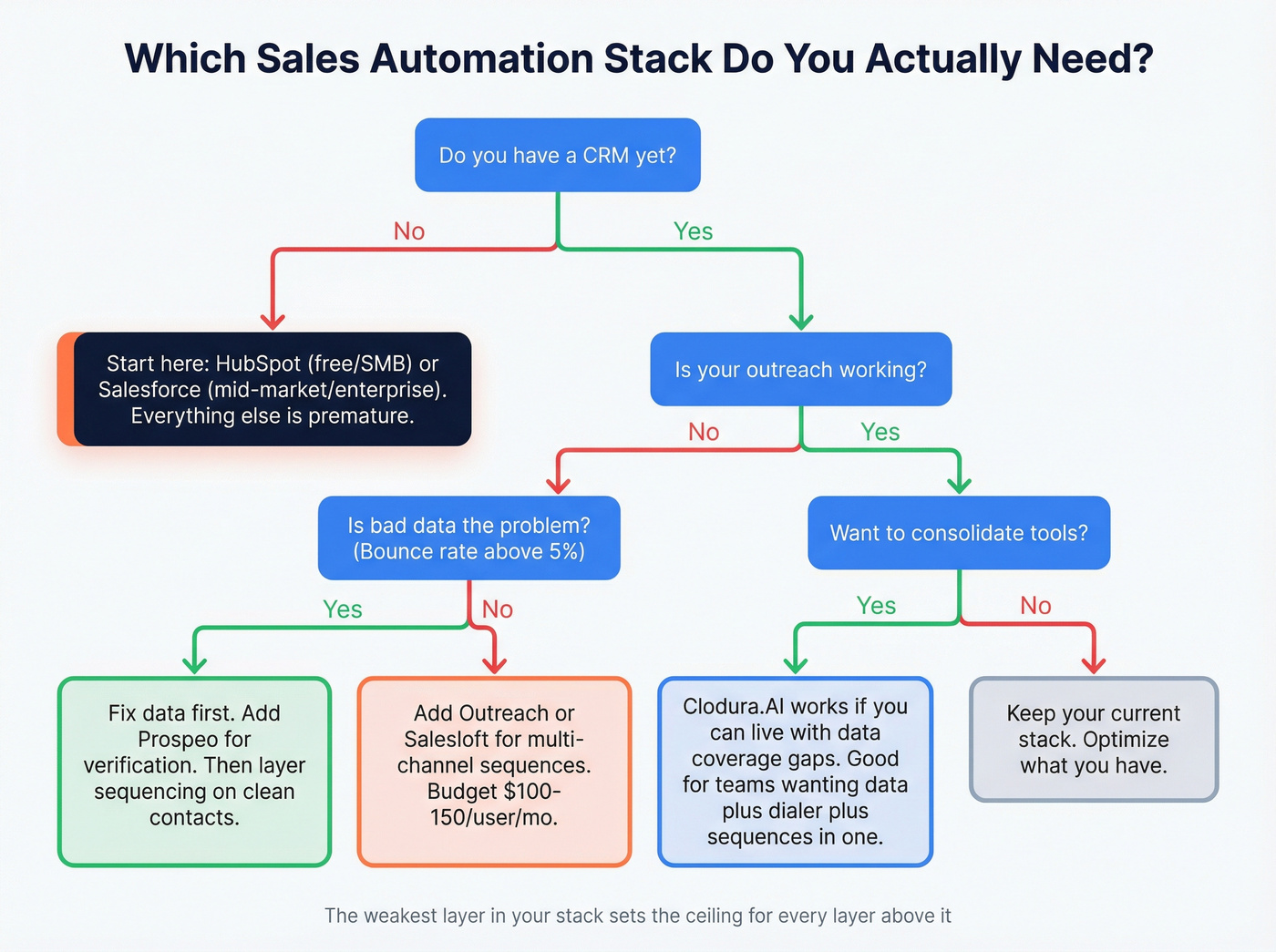
CRM works, outreach doesn't? Add Outreach or Salesloft for sequencing, and pair with a verification layer for clean contacts. Bad data will tank your sequences regardless of which engagement tool you pick. This is also where sequence management and email bounce rate basics matter more than feature checklists.
Want all-in-one? Clodura works if your process is mature and you can live with its data coverage gaps. But if data freshness is the bottleneck - and it usually is - layer verification underneath. For more options, compare sales prospecting databases and broader outbound lead generation tools.
Let's be honest about what this comparison really is. When you're weighing Clodura.AI against sales automation systems, you're rarely choosing one over the other. You're assembling a stack. The weakest layer determines the ceiling.
Meritt tripled pipeline from $100K to $300K/week and crushed bounce rates from 35% to under 4% - just by swapping their data source. Your CRM and sequencer don't matter if contacts are wrong. Prospeo's 5-step verification and 7-day refresh cycle fix the layer most teams ignore.
The weakest layer sets your ceiling. Make it your strongest.
FAQ
Is Clodura.AI a CRM?
No. It's a GTM data platform combining B2B contact data with built-in outreach features like email sequences and a dialer. You still need Salesforce or HubSpot as your system of record for pipeline management, forecasting, and deal tracking.
How much does a full sales automation stack cost?
For a 5-person SDR team, expect $30-50K/year combining CRM, engagement platform, and data tools. A Salesloft-based stack runs $41.8-70.2K/year for 10 users. Adding a verification layer like Prospeo costs roughly $0.01 per email - negligible compared to the domain damage from bounced sequences.
What's the best way to prevent bounces when automating outreach?
Use a verification layer with frequent data refresh before contacts enter your sequences. The industry consensus on r/sales is that bounce rates above 5% signal a data problem, not a platform problem. Tools that refresh records weekly instead of every 4-6 weeks prevent your automation from scaling stale contacts into deliverability disasters. Teams using this approach typically see bounce rates drop below 4%.