

What Does "Close a Deal" Really Mean?
A huge share of qualified B2B opportunities go nowhere. Not because buyers say no - because buying committees can't agree to say yes. That gap between "interested" and "signed" is where the real meaning of closing a deal lives, and understanding what it takes to finalize an agreement separates a healthy pipeline from a graveyard of stalled opportunities.
The Short Answer
Closing a deal means finalizing a business agreement - getting the signature, the purchase order, the commitment. The average B2B close rate sits at 29%, and nearly 80% of B2B buying decisions stall, not rejection. If you want tactics now, jump to the closing techniques section.
Close a Deal by Industry
The phrase means the same thing everywhere - make it official - but the mechanics differ wildly depending on context.
Sales
In B2B and B2C, closing means the prospect signs a contract or purchase order. Money gets committed. The deal moves from "pipeline" to "closed-won" in your CRM, and everything before that is conversation. In CRM terminology, a closed deal is the moment revenue is officially recognized and the opportunity record is locked.
Real Estate
"Closing" here is a regulated legal process. Residential closings follow RESPA (the Real Estate Settlement Procedures Act), requiring standardized cost disclosures. Commercial closings typically don't follow RESPA but involve more parties - attorneys, board members, zoning reviews. One nuance worth knowing: a real estate attorney represents your interests and can negotiate, while a closing company just processes the transaction.
Franchising
Closing a franchise deal means signing the franchise agreement, paying the fee, and beginning onboarding. You're committing to ownership.
Everyday Usage
People use "close the deal" for any outcome they've been working toward - landing a job offer, getting a date, convincing your landlord about the dog. The metaphor works because the structure is universal: negotiate, agree, finalize.
One grammar note: "close the deal" refers to a specific agreement in progress. "Close a deal" is more general.
Related Phrases and Synonyms
English gives us half a dozen ways to say the same thing:
- Seal the deal - informal, works in conversation
- Clinch the deal - implies difficulty overcome
- Secure the deal - formal, common in press releases
- Finalize the deal - neutral, procedural
- Lock in the deal - implies urgency or exclusivity
A quick note: "cinch the deal" is wrong. "Clinch" has meant "make final" since the early 1700s, from the act of securing a nail by bending its end. "Cinch" means something easy. Only "clinch" is correct here.
Why Most Deals Never Close
You've spent six weeks nurturing a prospect. Twelve emails, three demos, a custom proposal. Then the thread goes silent.
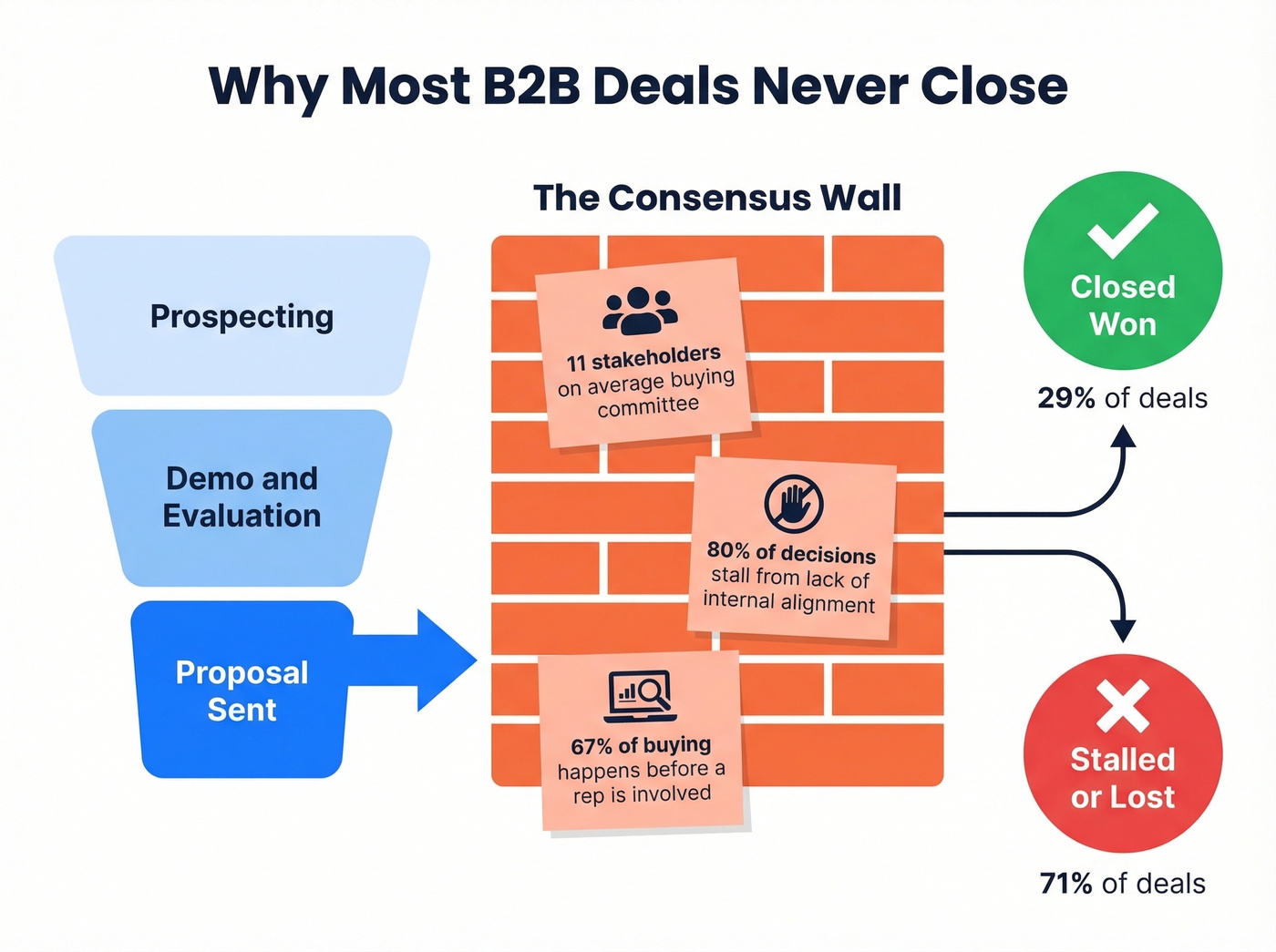
This isn't a closing technique problem. It's a consensus problem. Nearly 80% of B2B buying decisions stall because the internal committee can't align. The average buying committee now includes 11 stakeholders, and 67% of the buying process happens through digital channels before a rep is even involved.
Most deals require 5-12 touchpoints before they close. Ask any experienced rep and they'll tell you the same thing: the close isn't where deals are won or lost. It's qualification. If your cycle is longer than your industry average, the problem is almost always upstream.

80% of deals stall because reps can't reach every stakeholder. Prospeo gives you verified emails and direct dials for all 11 members of the buying committee - not just the one who took the demo. 300M+ profiles, 98% email accuracy, 125M+ verified mobiles.
Stop losing deals to stakeholders you never contacted.
Close Rate Benchmarks
The average B2B close rate is 29%. The average win rate from qualified opportunities runs around 21%. Once a deal reaches the proposal stage, the win rate jumps to 47% - getting to proposal is the hard part.
If you're trying to diagnose where deals get stuck, start with pipeline health and funnel metrics before you change your scripts.
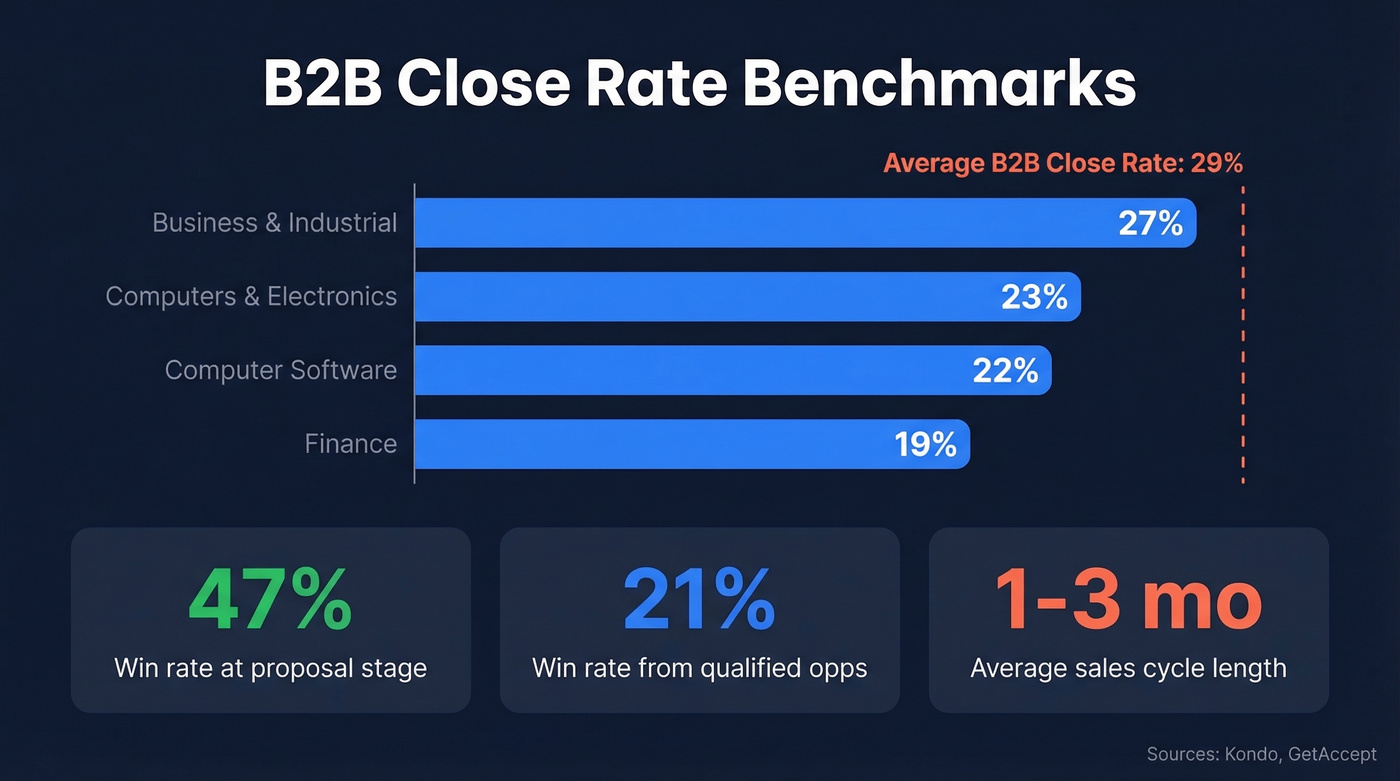
| Industry | Avg Close Rate |
|---|---|
| Business & Industrial | 27% |
| Computers & Electronics | 23% |
| Computer Software | 22% |
| Finance | 19% |
The formula: (Closed deals / Total leads) x 100. Average sales cycles run 1-3 months, with about 8% of high-value deals stretching past five months.
When to Ask for the Close
Tuesday is the best day to push for a close - success rates run almost 20% higher than average. The best window is 9-10 AM, where conversion rates are 45% higher than other hours.
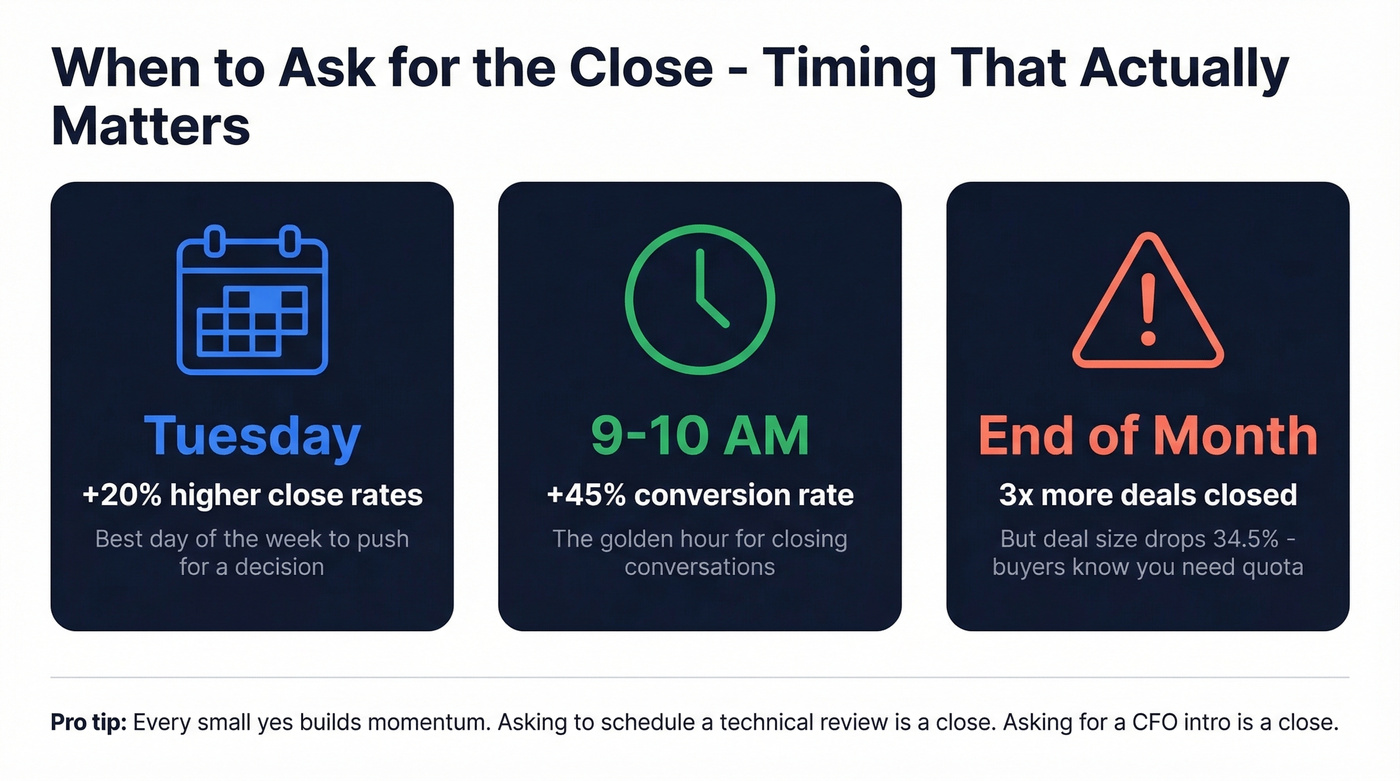
End-of-month is a double-edged sword. Reps close 3x more deals in the final days, but average deal size drops 34.5%. Buyers know you're pushing to hit quota, and they use it against you.
Here's the thing: the best closers don't treat closing as a single dramatic moment. "Does it make sense to schedule a technical review?" is a close. "Can you introduce me to your CFO?" is a close. Each small yes builds momentum toward the final signature.
10 Closing Techniques That Work
As Brian Will put it: "The close isn't about pressure or manipulation... it's confirming the decision they've already made." The right technique depends on your buyer, the deal complexity, and where you are in the process.
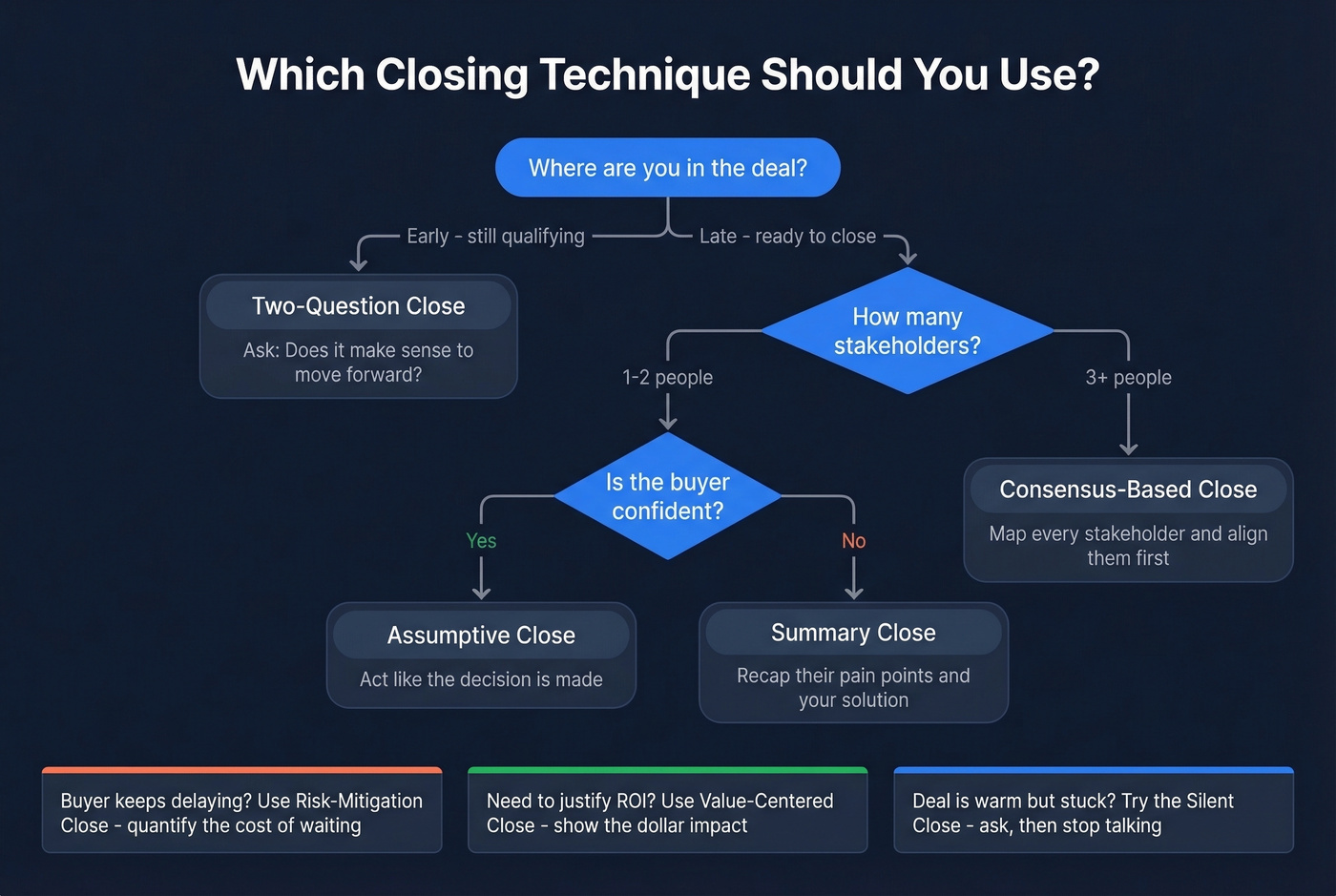
Assumptive Close
Act as if the decision is made. "Should we start onboarding on the 1st or the 15th?" Works when rapport is strong and buying signals are clear. Use it prematurely and the prospect feels railroaded.
Summary Close
Recap the prospect's priorities and pain points, then tie them to your solution. This reduces cognitive load and makes the decision feel obvious. In our experience, it's the hardest technique to mess up - start here if you're newer to sales.
Two-Question Close
From a simple two-step framework: Ask "Does it make sense to move forward?" If yes, done. If no, ask "What needs to happen to move things forward?" That second question surfaces real blockers without confrontation.
Quick-Fire Techniques
These three work best when the deal is already warm and you need to nudge it across the line:
| Technique | Core Move | Best For |
|---|---|---|
| Empathy Close | Validate hesitation, reframe tension as partnership | Risk-averse buyers |
| Collaborative Close | Build next steps together so the buyer co-owns the plan | Complex implementations |
| Silent Close | Ask for the business, then stop talking | Any deal - most reps talk too much |
Consensus-Based Close
For enterprise deals with large buying committees, this is non-negotiable. Map every stakeholder, understand each person's priorities, and align them before you ask for the signature. We've watched six-figure deals die because one VP who wasn't in the demo loop raised an objection at the eleventh hour. Don't let that be your deal.
If you need a more structured process, use a step-by-step sales qualification framework and a clear set of discovery questions to surface blockers early.
Value-Centered Close
Quantify the outcome. Don't say "our tool saves time" - say "this saves your team 14 hours per week, roughly $87,000 annually." ROI math makes the decision defensible when your champion has to justify the spend to their CFO.
Risk-Mitigation Close
Highlight the cost of inaction. "You're losing roughly $12,000/month in manual work. Every month you delay is another $12,000." This addresses status quo bias directly, and it works especially well when the prospect agrees with the numbers but keeps deferring the decision.
Now-or-Never Close
Create urgency with a time-bound incentive - but only if the urgency is real. Fake scarcity repeated every week creates skepticism fast. Skip this entirely if it isn't genuine.
Let's be honest: most teams obsess over closing techniques when the real problem is they're pitching to the wrong person. If your average deal size is under five figures, you probably don't need a ten-step closing playbook - you need faster qualification and better data.
Fix Your Data First
You send 200 emails to a carefully built prospect list. Forty-seven bounce. That's a 23.5% bounce rate - enough to tank your sender reputation and push more of your future sends into spam.
Look, no closing technique on earth helps if your emails aren't reaching anyone. Prospeo runs a 7-day data refresh cycle with 98% email accuracy, compared to the six-week industry average most providers operate on. You're not calling numbers that went stale last quarter or emailing addresses that bounced three months ago. One of our customers, Snyk, saw their bounce rate drop from 35-40% to under 5% after switching, and AE-sourced pipeline jumped 180%.
If you're troubleshooting deliverability, start with email bounce rate and sender reputation before you scale volume. For list quality, data enrichment services can help fill gaps without guessing.
Your close rate tanks when half your outreach bounces. Teams using Prospeo cut bounce rates from 35% to under 4% and book 26% more meetings than ZoomInfo users. Data refreshed every 7 days, not 6 weeks - so the contacts you're closing on are still at the company.
Fix the data gap that's killing your pipeline for $0.01 per email.
FAQ
What does "close the deal" mean in sales?
Closing a deal in sales means the prospect signs the contract and the transaction becomes official - revenue is committed and the opportunity moves to "closed-won" in your CRM. Everything before the signature is negotiation; everything after is fulfillment and onboarding.
What is a closed deal in a CRM?
In most CRMs, a closed deal is an opportunity marked "closed-won" (revenue recognized) or "closed-lost" (deal didn't happen). Tracking this status accurately is how teams measure pipeline health, forecast revenue, and calculate close rates.
What's the difference between "close a deal" and "seal the deal"?
They're interchangeable. "Seal the deal" is slightly more informal and common in everyday conversation, while "close a deal" is standard in business contexts. Both mean finalizing an agreement so it becomes binding.
What is a good close rate?
The average B2B close rate is 29%. Software companies average about 22%, business and industrial hits 27%, and finance sits around 19%. Consistently beating your industry average signals strong qualification and sales execution.
What tools help improve close rates?
Data quality is the foundation - bounced emails mean zero conversations. Pair a verified data source with a CRM and sequencing tool for full pipeline visibility, and you'll spend less time chasing dead leads and more time in actual conversations with decision-makers.