

Cold Call Email Subject Lines: What 31M+ Emails Actually Tell Us
You've copied the "best cold email subject lines" from three different blog posts, swapped in your prospect's first name, and still landed a 2% reply rate. The problem isn't your creativity - it's that most cold call email subject advice ignores what the data says.
Reply rates dropped from 6.8% to 5.8% year-over-year across 16.5M cold emails. The teams still winning aren't template-swapping. They're doing something structurally different.
The Short Version
Three rules backed by large-scale datasets:
- Keep subject lines to 2-4 words. Anything longer and open rates slide.
- Use two custom personalization attributes - not just first name.
- Lead with timeline hooks. They drive 2.3x higher reply rates than problem hooks.
If your open rate sits below 15%, the issue isn't your subject line. It's deliverability. Fix your data first.
Five Rules From 31M+ Emails
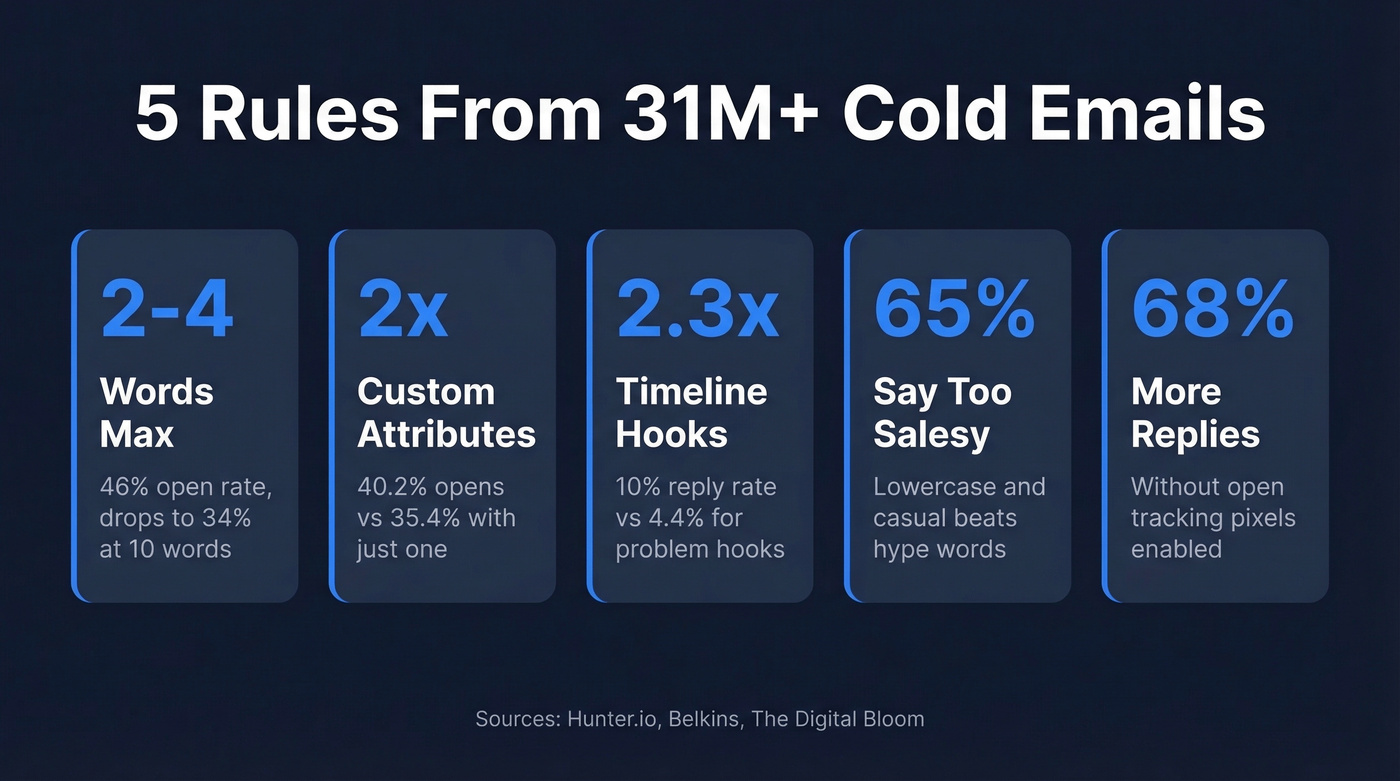
Keep It to 2-4 Words
A 5.5M-email study found that 2-4 word subject lines hit a 46% open rate. Opens decline steadily after seven words - by ten, you're down to 34%. Most phones display 33-50 characters before truncating, so every extra word gambles your hook surviving the preview pane.
Personalize the Persona, Not the Person
Adding {{firstname}} alone barely moves the needle. What works: two custom attributes. Hunter's 31M-email analysis showed two custom attributes drove a 40.2% open rate versus 35.4% for one - a 14% lift from a single extra variable. "Post-Series B hiring plans" beats "Hi Sarah" every time.
If you need more swipeable options, start with these email subject line examples and then adapt them to your ICP.
Use Timeline Hooks
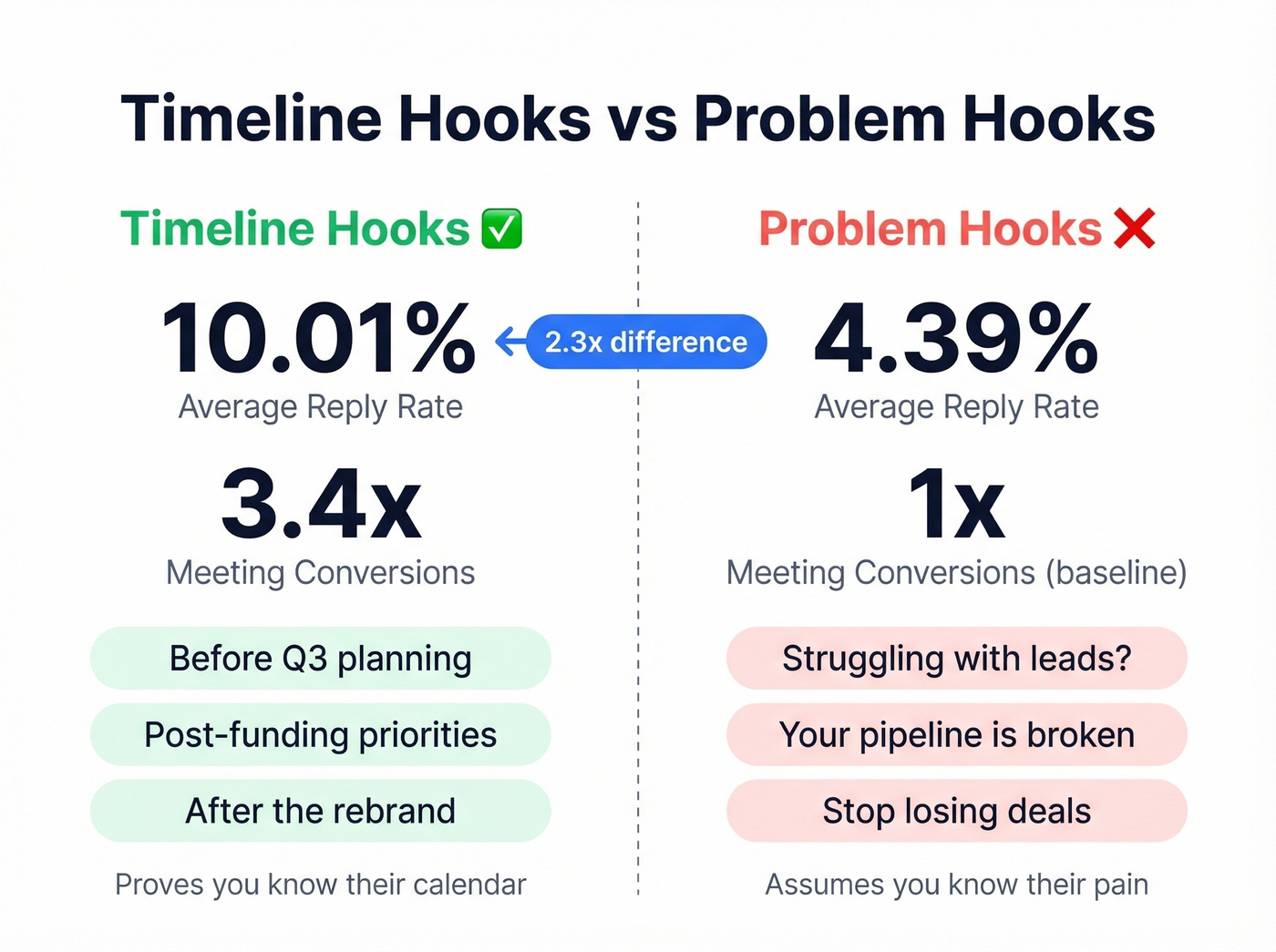
Timeline-based hooks average a 10.01% reply rate versus 4.39% for problem hooks. That's 2.3x the replies and 3.4x the meeting conversions. Problem hooks assume you know their pain. Timeline hooks prove you know their calendar. A funding round, a hiring surge, a quarterly planning cycle - tie your outreach to something happening right now.
This works best when your sales prospecting techniques include reliable trigger tracking, not just list pulls.
Sound Human, Not Salesy
The consensus on r/b2bmarketing is blunt: lowercase, casual, a little curious. Data backs it up - hype words like "ASAP" push open rates below 36%. A Hunter survey puts a finer point on it: 65% of recipients say cold emails fail because they're too sales-focused. Write subject lines the way you'd text a colleague about a meeting, not the way you'd title a webinar.
If you're rebuilding your messaging, a tighter email copywriting framework will usually move replies more than another subject-line tweak.
Measure Replies, Not Opens
Hunter found that campaigns without open tracking get a 68% higher reply rate - 7.4% versus 4.4%. Tracking pixels hurt deliverability, and Apple Mail Privacy Protection has made open data unreliable by pre-loading pixels regardless of whether anyone actually reads your email. We've seen teams optimize for what's essentially noise. Track positive reply rate instead. Above 5% means your subject lines are working.
If you still want to understand the mechanics, this deep dive on email tracking pixels explains what’s happening under the hood.
Subject Lines That Actually Work
| Hook Type | Example | Why It Works |
|---|---|---|
| Timeline | "Before Q3 planning" | Ties to a real deadline |
| Timeline | "Post-funding priorities" | References a trigger event |
| Timeline | "After the rebrand" | Shows you've done research |
| Question | "Wrong approach?" | Curiosity in two words |
| Question | "Still manual?" | Implies a known pain |
| Curiosity | "Quick thought" | Casual, non-threatening |
| Curiosity | "Noticed something" | Implies specific insight |
| Mutual | "From [name]'s talk" | Shared context builds trust |
| Value | "Saved Acme 40%" | Specific proof in the hook |
| Value | "3x pipeline idea" | Outcome-first framing |
Questions hit a 46% open rate. Numbers in subject lines performed slightly worse - 27% versus 28% without.
If you’re building a full sequence (not just a first touch), pair these with proven cold email follow-up templates.

Timeline hooks only work when they reach real inboxes. Prospeo's 5-step verification catches spam traps, honeypots, and invalid addresses before they tank your sender reputation - so your carefully crafted subject lines actually get seen. 98% email accuracy, refreshed every 7 days.
Fix the data problem hiding behind your subject line tests.
Character Limits by Device
| Platform | Characters Shown |
|---|---|
| iPhone | 33-41 |
| Android | 35-50 |
| Gmail (desktop) | ~70 |
| Outlook (desktop) | 50-70 |
| Yahoo (desktop) | ~46 |
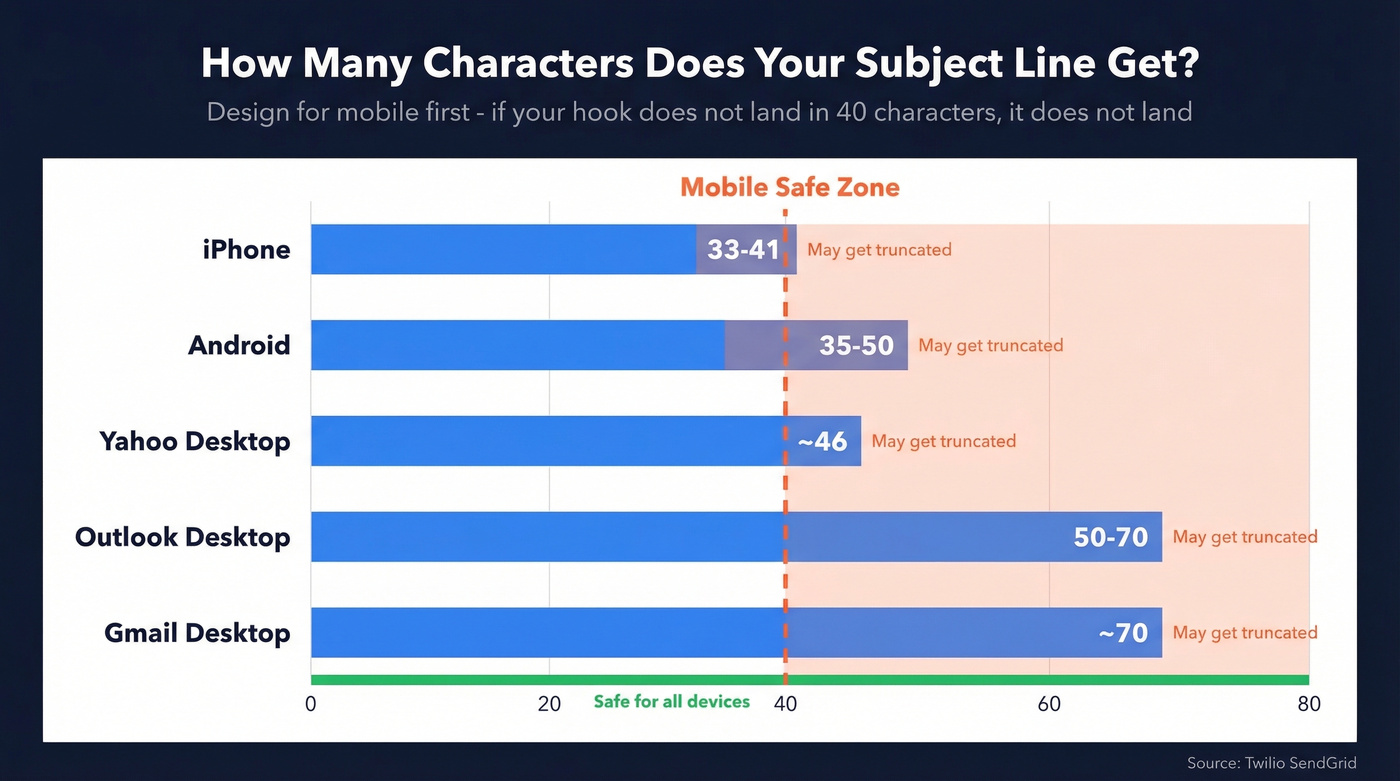
Per Twilio SendGrid. Design for mobile first - if your hook doesn't land in 40 characters, it doesn't land.
Mistakes That Kill Deliverability
"Re:" and "Fwd:" prefixes. They violate CAN-SPAM's prohibition on deceptive subject lines, trigger spam filters, and destroy trust the moment a prospect realizes the thread is fake. Just don't.
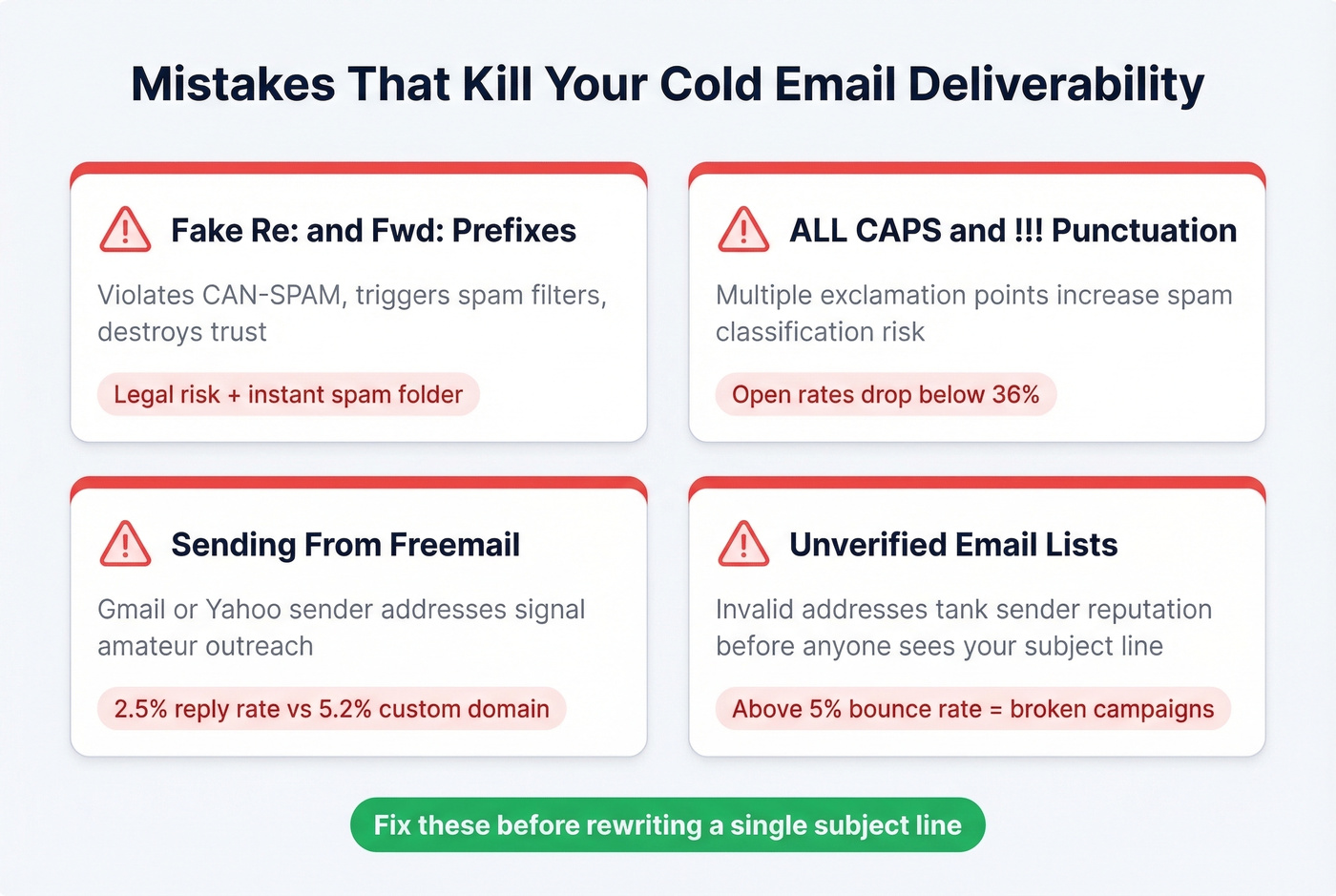
ALL CAPS and excessive punctuation. Multiple exclamation points increase spam risk and push you toward the junk folder. One is fine. Three is a red flag.
Sending from freemail addresses. Custom domains earn a 5.2% reply rate versus 2.5% from freemail. Verify your SPF, DKIM, and DMARC records are properly configured - without authentication, even clean lists won't reach inboxes. (If you want a deeper technical checklist, use this email deliverability guide.)
Emailing unverified addresses. Here's the thing: this is the root cause most teams ignore entirely. If 20% of your list is invalid, your bounce rate tanks sender reputation and your subject line becomes irrelevant because it never reaches an inbox. We ran into this ourselves when testing campaigns for this piece - a list that looked clean had a 12% invalid rate hiding underneath. Running contacts through Prospeo's 5-step verification caught invalid addresses, spam traps, and honeypots before a single email went out.
If you’re diagnosing list quality, start with bounce benchmarks and fixes in this email bounce rate guide.

How to A/B Test Subject Lines
Most teams test subject lines on dirty data and wonder why results are inconclusive. Here's what actually produces signal:
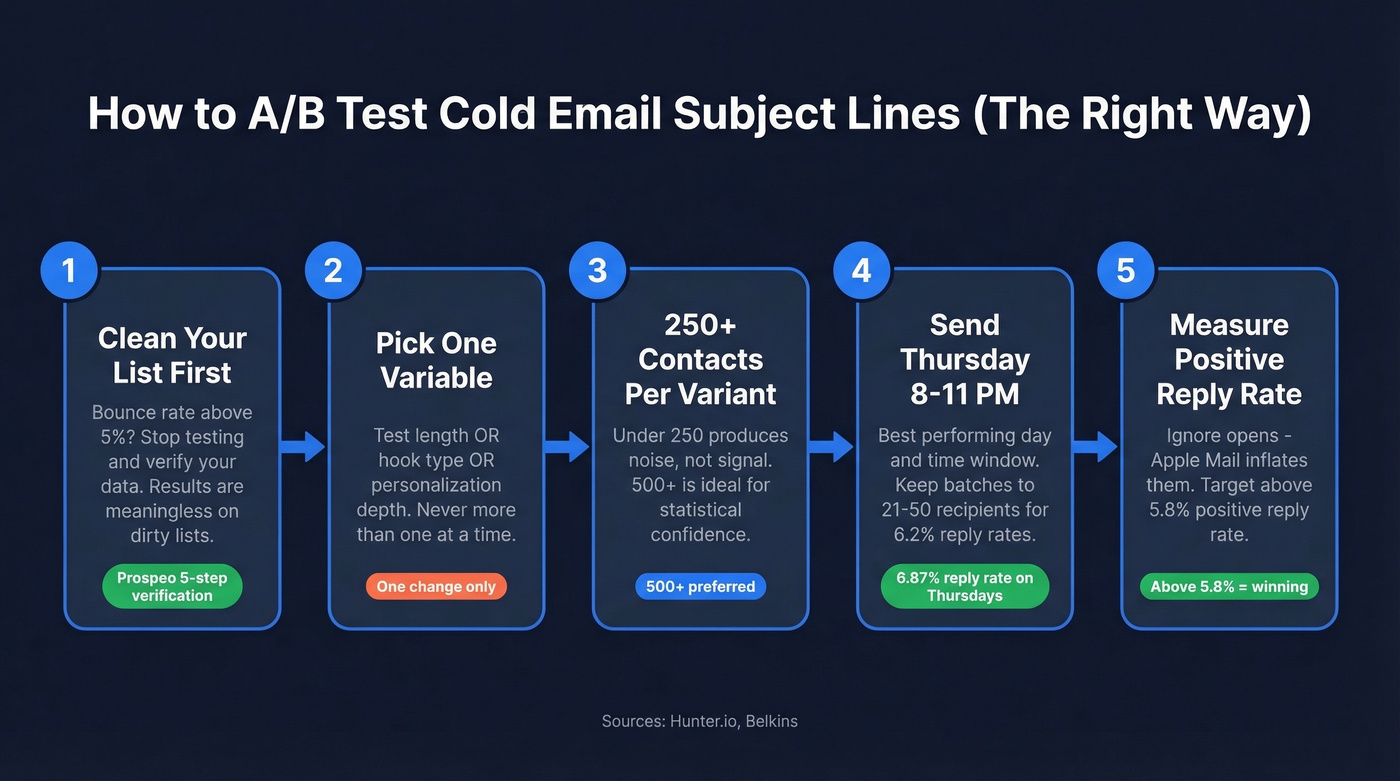
- Minimum 250 contacts per variant (500+ preferred)
- One variable at a time - length, hook type, or personalization depth
- Measure positive reply rate, not opens. Target 5%+.
- Keep sequences to 21-50 recipients for a 6.2% reply rate versus 2.4% for batches of 500+
- Best day to send: Thursday (6.87% reply rate), ideally 8-11 PM
For send-time testing, this best time to send cold emails breakdown helps you avoid false positives.
We've found that testing on lists under 250 contacts produces noise, not signal. And if a chunk of your list is invalid, your test results are meaningless regardless of sample size.
Let's be honest about something: most teams don't have a subject line problem. They have a data problem wearing a subject line disguise. If your bounce rate is above 5%, stop A/B testing copy and start cleaning your list. The best cold call email subject line in the world can't outrun a 30%+ bounce rate.
You just read that two custom personalization attributes lift open rates by 14%. Prospeo returns 50+ data points per contact - funding stage, headcount growth, tech stack - so you can write subject lines like 'Post-Series B hiring plans' instead of 'Hi Sarah.' All at ~$0.01 per verified email.
Turn generic subject lines into timeline hooks with real prospect data.
FAQ
What's a good reply rate for cold emails in 2026?
The current benchmark is 5.8% across 16.5M emails. Open rates are unreliable because Apple Mail Privacy Protection inflates them by pre-loading pixels. Track positive reply rate instead - anything above 5.8% means you're outperforming most outbound teams.
Does adding the recipient's first name improve open rates?
Not much on its own. Two deeper custom attributes - like a pain point plus a trigger event - lift opens by 14% compared to a single personalization token. Persona-level context always beats surface-level name insertion.
How do I know if my subject line or my data is the problem?
Check your bounce rate first. If it's above 5%, bad data is undermining deliverability before anyone sees your subject line. Verify SPF/DKIM/DMARC authentication and run your list through a verification tool before rewriting copy.
Does the follow-up subject line matter as much as the first?
Yes - the same rules apply. Keep it short, reference the original context, and never use deceptive "Re:" prefixes. A follow-up that adds new information - a relevant result or a shifted timeline - outperforms a generic "Just checking in" every time.