

Cold Call Follow-Up Emails: 12 Templates That Actually Get Replies
It's 4:47 PM on a Thursday. You just had a genuinely good cold call - the prospect asked questions, mentioned a pain point, even laughed at your joke about their competitor's rebrand. Now you're staring at Gmail, cursor blinking, trying to write a follow-up email that doesn't undo the momentum. You've got about two hours before that conversation fades from memory.
Across 16.5 million follow-up emails and a separate 5.5 million subject-line study, the difference between a follow-up that converts and one that gets archived comes down to timing, structure, and knowing when to stop. Here's what we've learned after years of testing this stuff.
The Short Version
- 3-7-7 cadence: Follow up on Day 3, Day 10, Day 17. Then stop.
- The 2-hour rule: If you spoke live, send your follow-up within 2 hours. Not tomorrow. Today.
- 2-3 follow-ups max, not 5+. That "80% of sales require 5 follow-ups" stat every sales blog quotes? Nobody ever links to the original study. What 16.5 million emails actually show is that 4+ follow-ups triple your unsubscribe rate and more than triple spam complaints.
- Every template below is organized by what happened on the call - not by arbitrary scenarios.
Jump straight to the 12 templates if you want copy-paste emails now.
When to Send After a Cold Call
Ask five SDR managers when to send a post-call follow-up and you'll get five different answers. There's genuinely no consensus. So here's ours.
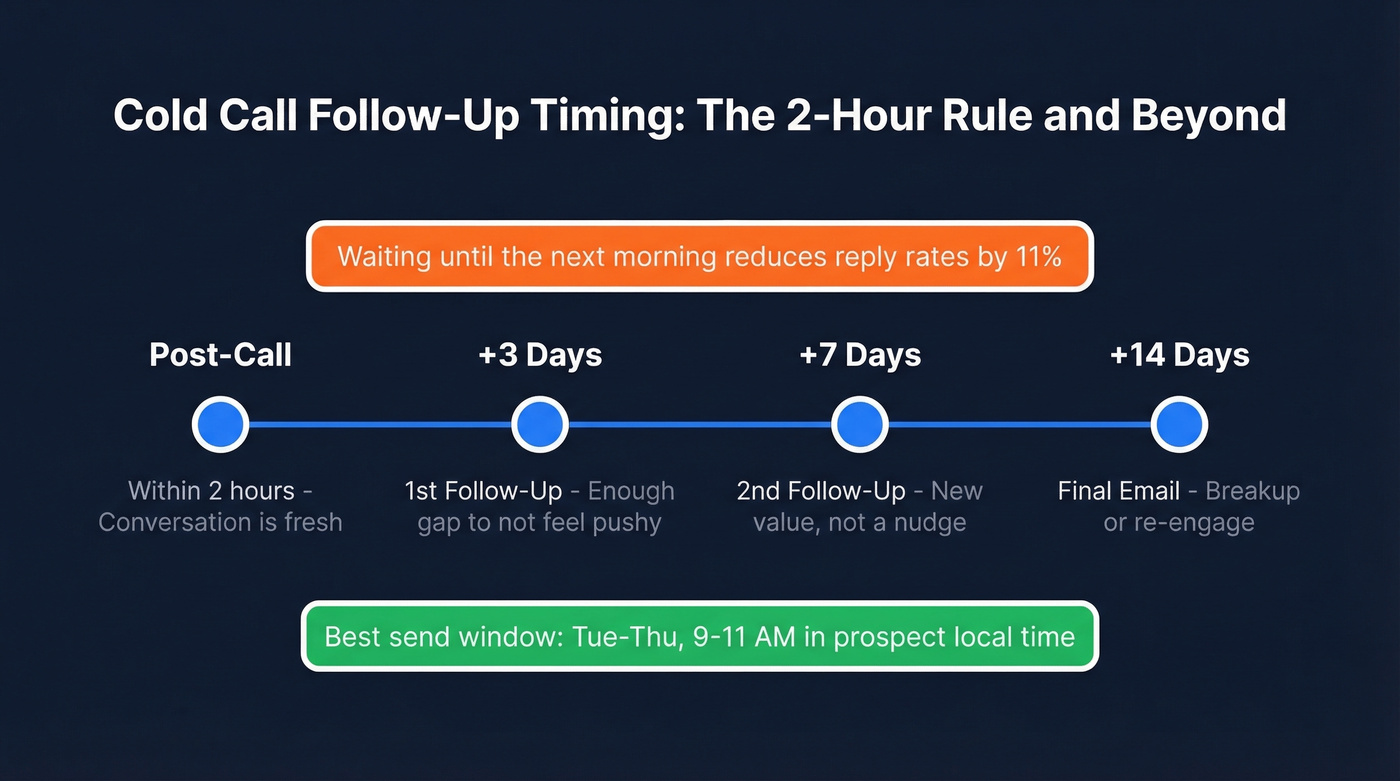
If you had a live conversation, send within 2 hours. The prospect still remembers your voice, your name, the thing they said about their Q3 pipeline problem. We've seen reps lose deals simply because they waited until the next morning. For cold outbound follow-ups, next-day follow-ups reduce reply rates by 11%.
If you're sending a cold follow-up with no prior call, the math is different. Waiting about three days before the first follow-up increases replies by 31%. Don't confuse the two situations.
For subsequent follow-ups after the initial email, use graduated spacing:
| Follow-Up | Spacing | Why |
|---|---|---|
| 1st (post-call) | Within 2 hrs | Conversation is fresh |
| 2nd | +3 days | Enough gap to not feel pushy |
| 3rd | +7 days | New value, not a nudge |
| Final | +14 days | Breakup or re-engage |
Best send window: Tuesday through Thursday, 9-11 AM in the prospect's local time zone. Mondays are inbox triage. Fridays are mental checkout.
Subject Lines That Get Opened
A study of 5.5 million B2B emails found three things that matter more than anything else:
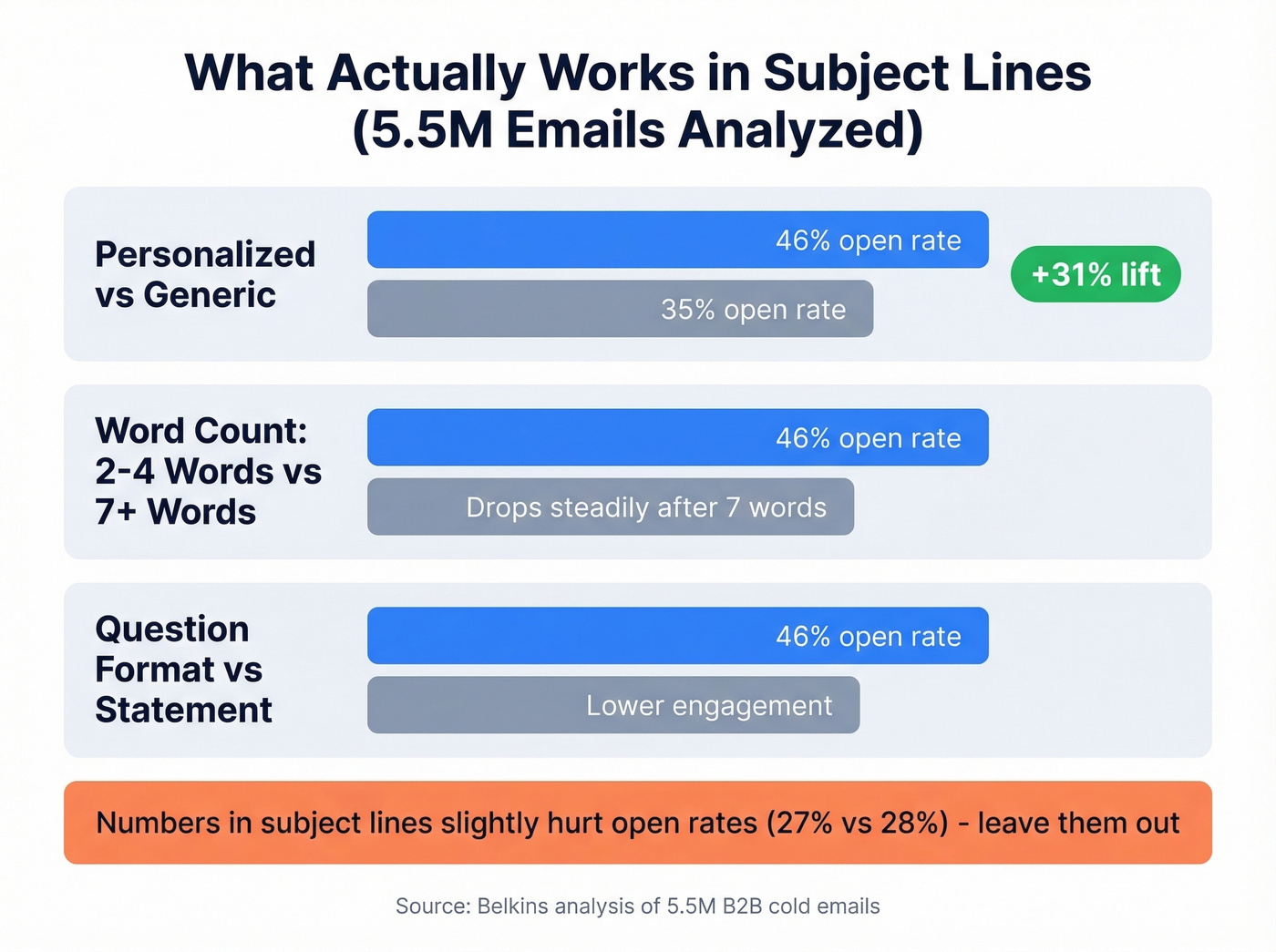
Personalized subject lines hit a 46% open rate vs. 35% without - a 31% lift. Reply rates doubled from 3% to 7%. Two to four words also hit 46%, with performance dropping steadily after seven words. Question format matched that 46% open rate, making it the top-performing structure.
Numbers in subject lines slightly hurt open rates (27% vs. 28% without). Leave them out.
For post-call follow-ups, reference the conversation. That's your personalization:
- "Quick question from our call"
- "The [resource] I mentioned"
- "[First name], next steps"
- "Following up - [specific topic]"
- "One thing I forgot to mention"
- "Re: our conversation today"
- "Worth revisiting?"
Short, personal, conversational. If you want more options, pull from these subject line examples.
Segment Before You Write
Here's the thing - not every cold call deserves the same follow-up. Your template choice should match what actually happened:
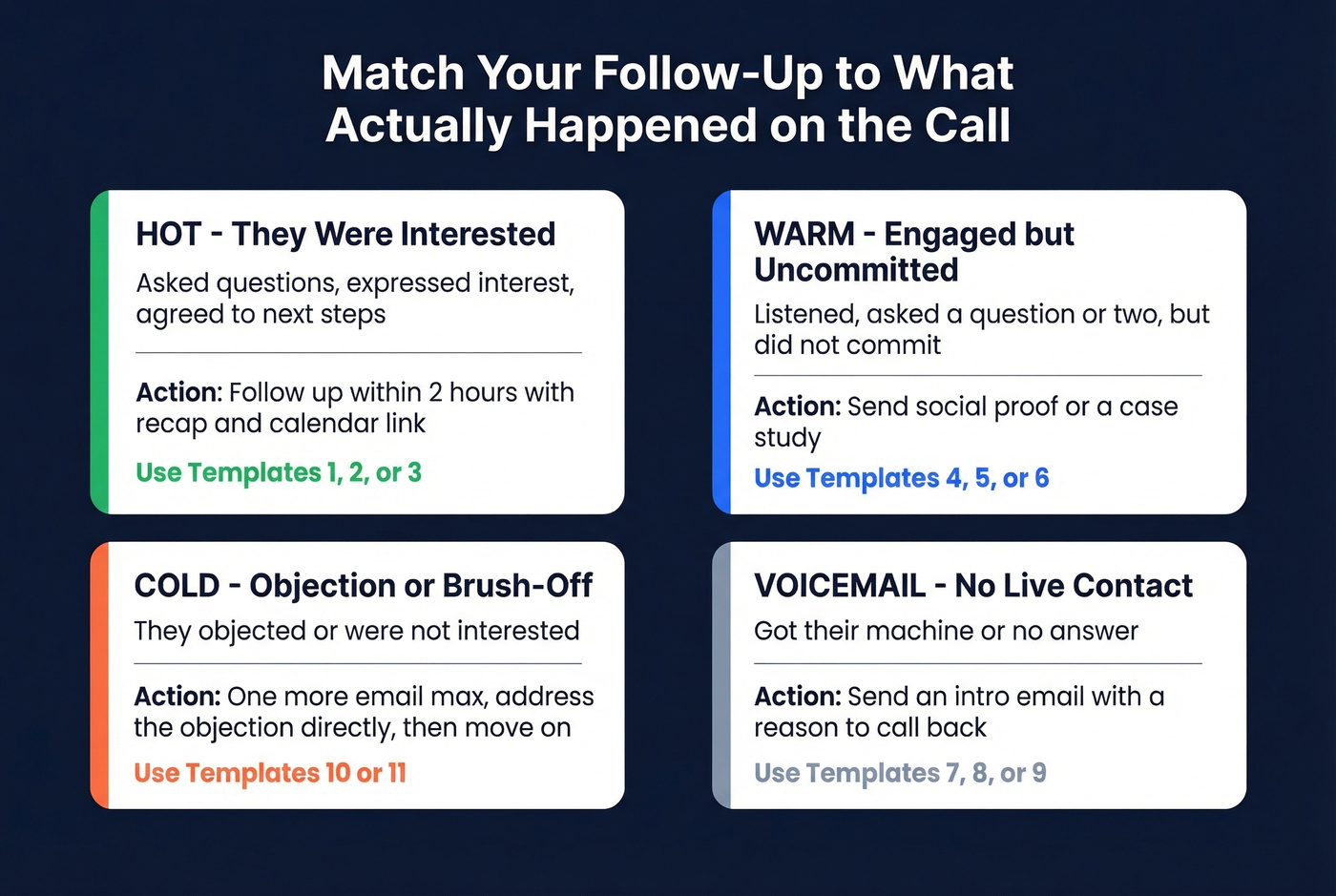
Hot - They asked questions, expressed interest, agreed to next steps. Follow up within 2 hours with a recap and calendar link.
Warm - Engaged but uncommitted. They listened, asked a question or two, but didn't commit. Follow up with social proof or a case study.
Cold - They objected or brushed you off. One more email max - address the objection directly, then move on.
Voicemail - You got their machine. Follow up with an intro email that gives them a reason to call back.
Before you send anything, verify the email. A bounced follow-up after a good call is worse than no follow-up at all - it wastes the conversation and damages your sender domain for every future email you send. Prospeo's real-time verification with catch-all handling ensures your follow-up actually lands. (If you need the deliverability mechanics, start with this email deliverability guide.)

A bounced follow-up after a great cold call kills your momentum and your sender reputation. Prospeo's 5-step email verification with catch-all handling delivers 98% accuracy - so every follow-up you craft actually reaches the inbox.
Don't let bad data waste a good conversation.
12 Cold Call Follow-Up Email Templates
Every template below is plain text, under 75 words, with one clear CTA. Personalization placeholders are in [brackets]. (For more variations, see these sales follow-up templates.)
Positive Conversation (Hot)
Template 1: Recap + Next Steps
Subject: [First name], next steps
Hey [First name],
Great speaking with you today. To recap: you mentioned [specific pain point] is costing your team [specific impact]. I think [your solution] can fix that - here's how [one-sentence value prop].
I've got a 30-minute slot on [date/time]. Does that work to dig deeper?
[Your name]
Template 2: Value-Add Resource
Subject: The [resource] I mentioned
Hey [First name],
Promised you that [case study/guide/report] - here it is: [link].
The section on [specific topic] is most relevant to what you described about [their situation]. Happy to walk through it live if that's easier. [Calendar link]
[Your name]
Template 3: Meeting Confirmation
Subject: Confirmed - [day] at [time]
Hey [First name],
Locked in for [day] at [time]. I'll send a calendar invite shortly.
To make the most of our time, I'll prep a quick analysis of [their specific challenge]. If there's anyone else who should join, loop them in.
[Your name]
Engaged but Uncommitted (Warm)
Template 4: Social Proof Angle
Subject: Quick question from our call
Hey [First name],
You mentioned [specific concern] yesterday. Totally fair.
[Similar company] had the same hesitation - they ended up [specific result] within [timeframe]. Short case study here: [link].
Worth a 15-minute follow-up to see if the same approach fits [their company]?
[Your name]
Template 5: Pain-Point Deepener
Subject: One thing I forgot to mention
Hey [First name],
After our call, I kept thinking about [specific pain point you discussed]. Most teams in [their industry] lose [estimated impact] per quarter on this.
We built [specific feature] to fix exactly that. Can I show you in 10 minutes?
[Your name]
Template 6: Case Study Share
Subject: How [similar company] solved [problem]
Hey [First name],
You asked about [topic from call]. Here's a 2-minute read on how [similar company] went from [before state] to [after state]: [link].
The parallels to your situation at [their company] are pretty clear. Happy to compare notes on a quick call.
[Your name]
Voicemail or No Answer
Template 7: Intro + Reason for Call
Subject: Tried calling - here's why
Hey [First name],
Left you a voicemail today. Quick context: I work with [type of companies] to [one-sentence outcome].
[Their company] caught my attention because [specific reason - hiring signal, tech stack, funding round]. Worth a 5-minute call?
[Your name]
Template 8: Value Hook
Subject: [First name], thought this was relevant
Hey [First name],
Tried reaching you by phone. Instead of another voicemail, here's something useful: [link to relevant content].
It covers [specific topic relevant to their role/industry]. If it resonates, I'd love 10 minutes to discuss how it applies to [their company].
[Your name]
Template 9: "Worth 5 Minutes?"
Subject: Worth 5 minutes?
Hey [First name],
I know cold voicemails rarely get returned - no hard feelings. But [specific value prop] is saving teams like [their company] [specific metric].
If that sounds interesting, here's my calendar: [link]. If not, no worries at all.
[Your name]
Objection or Brush-Off (Cold)
Template 10: Address the Objection
Subject: Re: our conversation
Hey [First name],
You mentioned [specific objection - timing, budget, existing vendor]. Totally understand.
One thing I didn't get to share: [specific data point or case study that directly addresses the objection]. That might change the math.
If the timing's better in [timeframe], happy to reconnect then.
[Your name]
Template 11: Breakup Email
Subject: Should I close your file?
Hey [First name],
I've reached out a couple of times and it sounds like the timing isn't right. Totally respect that.
I'll stop following up, but if [trigger event - new quarter, budget cycle, vendor review] changes things, I'm here. Just reply to this thread.
[Your name]
Gatekeeper Only
Template 12: Request for Correct Contact
Subject: Quick ask - right person for [topic]?
Hey [First name of gatekeeper],
I called today about [one-sentence value prop] and you mentioned [decision maker's name/role] might be the right person. Could you point me to their email or loop them in?
Appreciate the help.
[Your name]
The 3-7-7 Follow-Up Cadence
Email alone won't close the deal. McKinsey research shows buyers engage across an average of 10 channels. A LinkedIn message plus profile visit combo produces an 11.87% reply rate - higher than most cold email sequences. (If you're rebuilding your outbound motion, start with these sales prospecting techniques.)
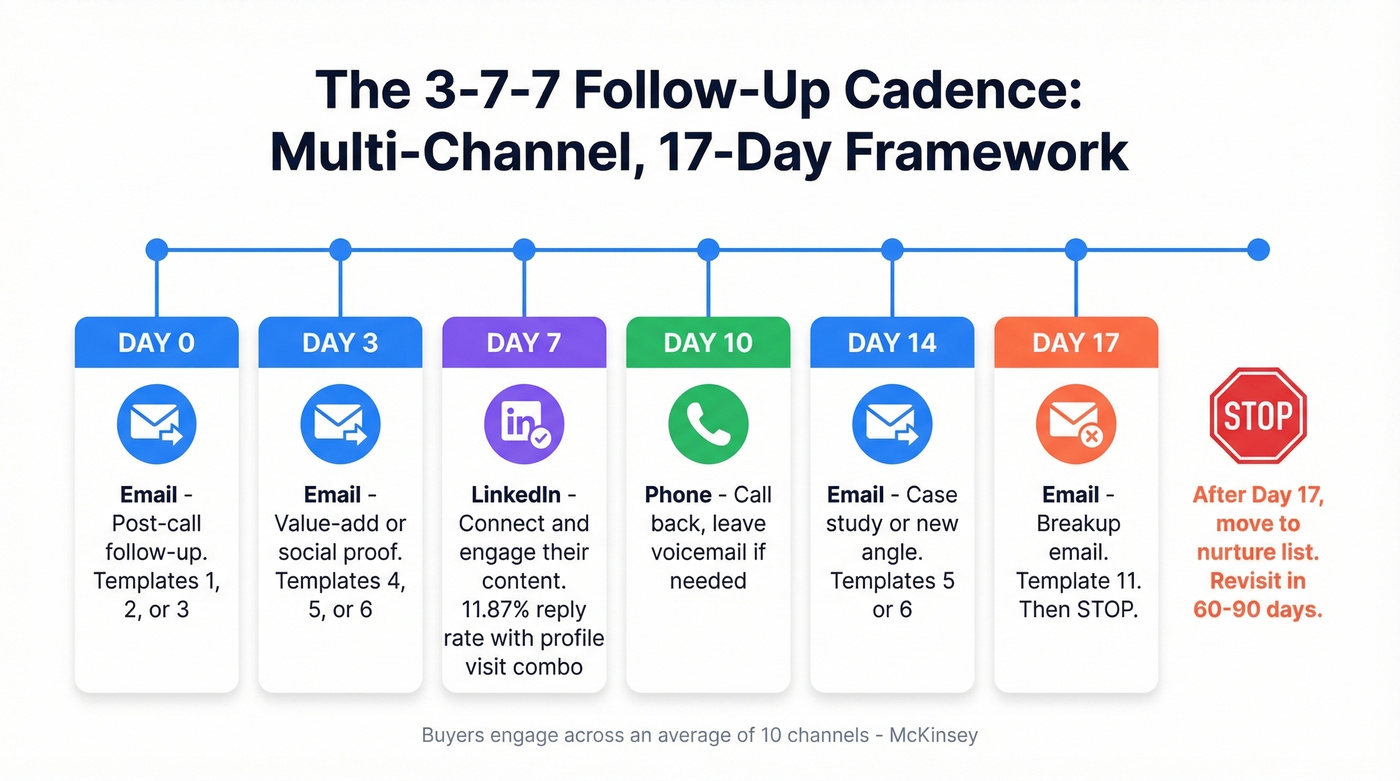
The 3-7-7 cadence spreads your touches across channels so you don't burn out the inbox:
| Day | Channel | Action | Template |
|---|---|---|---|
| Day 0 | Post-call follow-up | Template 1, 2, or 3 | |
| Day 3 | Value-add or social proof | Template 4, 5, or 6 | |
| Day 7 | Social | Connect + engage their content | - |
| Day 10 | Phone | Call back, leave voicemail | - |
| Day 14 | Case study or new angle | Template 6 or 5 | |
| Day 17 | Breakup email | Template 11 |
Cold outreach typically runs 6-8 touchpoints over 2-3 weeks. The 3-7-7 framework fits that window while mixing channels. After Day 17, stop. Move the prospect to a nurture list and revisit in 60-90 days if a trigger event surfaces. (If you want a deeper timing breakdown, see: when should you follow up on an email.)
How Many Follow-Ups Is Too Many?
Let's be honest about the "80% of sales require 5+ follow-ups" stat. It's on every sales blog. Nobody links to the original study because it doesn't hold up against real data. Here's what 16.5 million emails show:
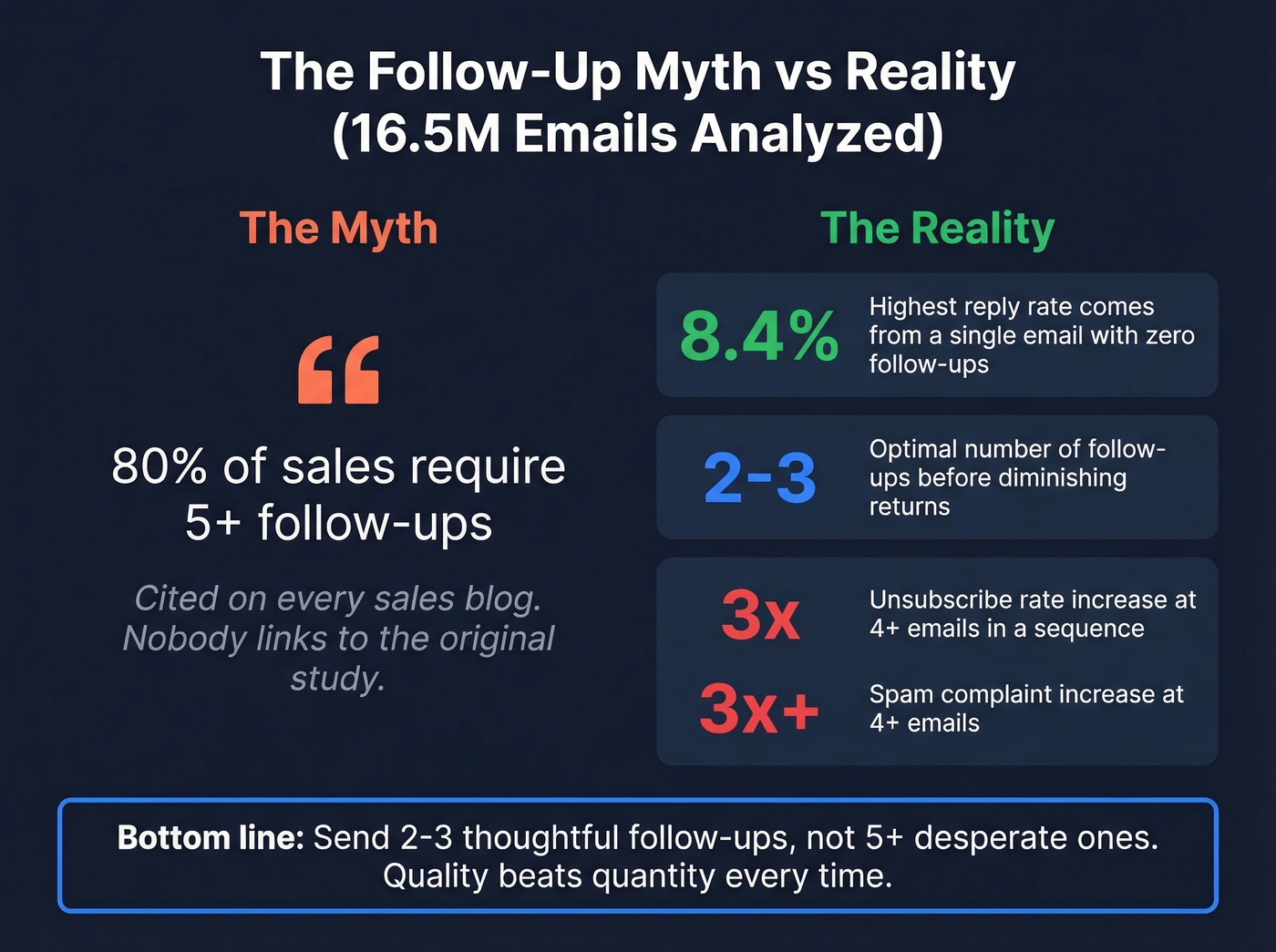
The highest reply rate - 8.4% - comes from a single email with no follow-ups at all. Four or more emails in a sequence triple your unsubscribe rate and more than triple spam complaints.
Founder-targeted outreach tells the same story:
| Follow-Up # | Reply Rate |
|---|---|
| Initial email | 6.64% |
| 1st follow-up | 6.66% |
| 2nd follow-up | 6.94% |
| 3rd follow-up | 5.75% |
| 4th follow-up | 3.01% |
Two follow-ups is the sweet spot. After that, you're actively hurting yourself. Enterprise prospects at companies with 1,000+ employees are especially allergic to persistence - the data shows strong negative reactions to multiple follow-ups.
Most SDR playbooks are still built around the "more touches = more revenue" assumption. In 2026, with every inbox drowning in AI-generated outreach, fewer and better emails beat more and mediocre ones every time. We've watched teams cut their sequence length in half and see reply rates climb. Two great follow-ups will outperform five lazy ones. (If you're building sequences end-to-end, use this B2B cold email sequence framework.)
5 Mistakes That Kill Your Reply Rate
1. Bumping with no new information. "Just checking in" and "wanted to circle back" are the two phrases most likely to get your email archived unread. Every follow-up should add something - a case study, a relevant data point, a new angle on their problem. (More options here: how to say just checking in professionally.)
2. Ignoring the objection from the call. If they said "we're locked into a contract until Q3," your follow-up better acknowledge that. Pretending the objection didn't happen signals you weren't listening. Address it head-on and offer a reason to keep the door open.
3. Follow-ups that look like mass email. HTML templates, image headers, and "Dear [First_Name]" formatting scream automation. Send plain text, reply in-thread, and write like a human. Follow-ups that feel 1:1 dramatically outperform polished marketing emails. In our experience, the reps who get the best reply rates write emails that look like they were typed in 90 seconds - because they were.
4. Static spacing that looks automated. Sending every 48 hours like clockwork is a dead giveaway. Use graduated spacing - 2 days, then 4, then 7, then 14 - and vary your send times by 30-60 minutes.
5. Sending to an unverified email address. A bounced follow-up doesn't just waste a good conversation - it damages your sender domain reputation for every future email you send. Verify first, always. Skip this step and you're sabotaging your own deliverability. (Benchmarks and fixes: email bounce rate.)
Writing the perfect follow-up template is half the battle. The other half is having verified contact data for every prospect you call. Prospeo gives you 143M+ verified emails refreshed every 7 days - not the stale data that bounces and burns your domain.
Start every follow-up sequence with emails you can trust.
FAQ
How long should a follow-up email be after a cold call?
Between 50 and 125 words. That's short enough to read on a phone screen, long enough to reference the specific conversation and include one clear CTA. Anything over 150 words reads like a proposal, not a follow-up.
Should I follow up if the prospect said "not interested"?
One more email, max. Address the specific objection they raised, add one piece of new value like a case study or data point, then stop. The data shows 4+ emails triple spam complaints - a prospect who said no won't reward persistence.
What's the best day and time to send a cold calling follow up email?
Tuesday through Thursday, 9-11 AM in the prospect's local time zone. This window consistently outperforms other slots in B2B engagement studies. Avoid Monday mornings and Friday afternoons.